LIN200 IPA Vowels
 Call Kai
 Learn
Learn Practice Test
 Spaced Repetition
 Match
Match Flashcards
 Knowt Play
1/36

There's no tags or description
Looks like no tags are added yet.
Name | Mastery | Learn | Test | Matching | Spaced | Call with Kai |
|---|
No analytics yet
Send a link to your students to track their progress
37 Terms
Why are vowels trickier than consonants?
- Exist on a continuum (vs. discrete qualities for consonants -- a slight change in articulation makes little noticeable effect in what a vowel sounds like)
- Vary a lot between dialects
- English has a large inventory of vowels compared to most spoken languages
What is true of all vowels?
Voiced by default -- made w/ minimal obstruction of oral cavity (articulated w/ larger opening than consonants like approximants)
What are the 4 ways to characterize vowels?
1. Height
2. Backness
3. Rounding
4. Tenseness
What is vowel height?
Refers to the vertical position of the tongue
High (Vowel Height)
Tongue is high; opening is slightly larger than for approximants
Mid (Vowel Height)
Intermediate tongue height position
Low (Vowel Height)
Tongue is in a low position; has the largest opening (jaw lowering is quite prominent)
What is vowel backness?
Refers to the horizontal position of the tongue
Front (Vowel Backness)
Tongue is in the front of the oral cavity; highest point of tongue is under the front of the palate
Back (Vowel Backness)
Tongue is farther back in the oral cavity; highest point of tongue is under the back end of the palate
Central (Vowel Backness)
Tongue is in the center of the oral cavity; highest point of the tongue is under the centre of palate
What are examples of front, central, and back vowel backness?
[i] (beat) = front
[ʌ] (but) = central
[u] (boot) = back
What is vowel rounding?
Refers to the shape of the lips
Rounded Vowels
Corners of the mouth are pulled together; lips form a circular shape (ex. [u, ʊ, o, ɔ]
Unrounded Vowels
Corners of the mouth are pulled apart and spread like a smile; lips do not form a circular shape (neutral)
What is vowel tenseness?
Refers to how advanced the tongue root is, influencing the rigidity of the tongue overall
Tense Vowels
Tongue root is advanced forward resulting in denser, firmer tongue
Lax Vowels
Tongue root is retracted resulting in more relaxed tongue
What are examples of tense and lax vowels?
[bit] (beat) = tense
[bɪt] (bit) = lax
What is nasality?
Refers to the position of the velum as either lowered or raised (similar to oral stops vs. nasals)
What is an oral vowel?
The velum is raised; airflow into nasal cavity is blocked
What is a nasal vowel?
The velum is lowered; airflow into nasal cavity is allowed
Does English contrast oral and nasal vowels?
No, but nasal vowels in most dialects of English are produced when they are immediately before a nasal stop: bent [bɛ̃nt] (a diacritic is used)
How do you describe a vowel?
Combine the four articulatory dimensions: [height] [backness] [rounding] [tenseness] [nasality]
ex. [ʌ]: mid central unrounded lax vowel
What is a monophthong?
Vowels with a single, stable vowel quality (i.e., they don't change in quality over time)
What is a diphthong and what are the three major kinds?
Dynamic sounds, start in one area of the vowel space and end up somewhere else (similar to affricates) at the end of articulation
Three kinds:
1. aɪ (hi, life)
2. aʊ (how, cow)
3. ɔɪ (boy, oil)
How are diphthongs treated in Canadian English?
As one segment (but don't have a tie-bar like affricates do)
What is special about [e] and [o]?
Called minor diphthongs
Canadian English speakers have a tendency to turn mid-tense monophthongs [e] and [o] into diphthongs
ex. [e] in gate vs. [ɛ] in get -- becomes [geɪt]
ex. [o] in show and toe -- becomes [oʊ]
Why is the vowel chart shaped like a mouth?
Our jaws are hinged: as they jaw moves down (for a low vowel), the jaw also swings backwards, carrying the tongue along with it -- consequently, the tongue moves backwards (its centre position also moves backwards)
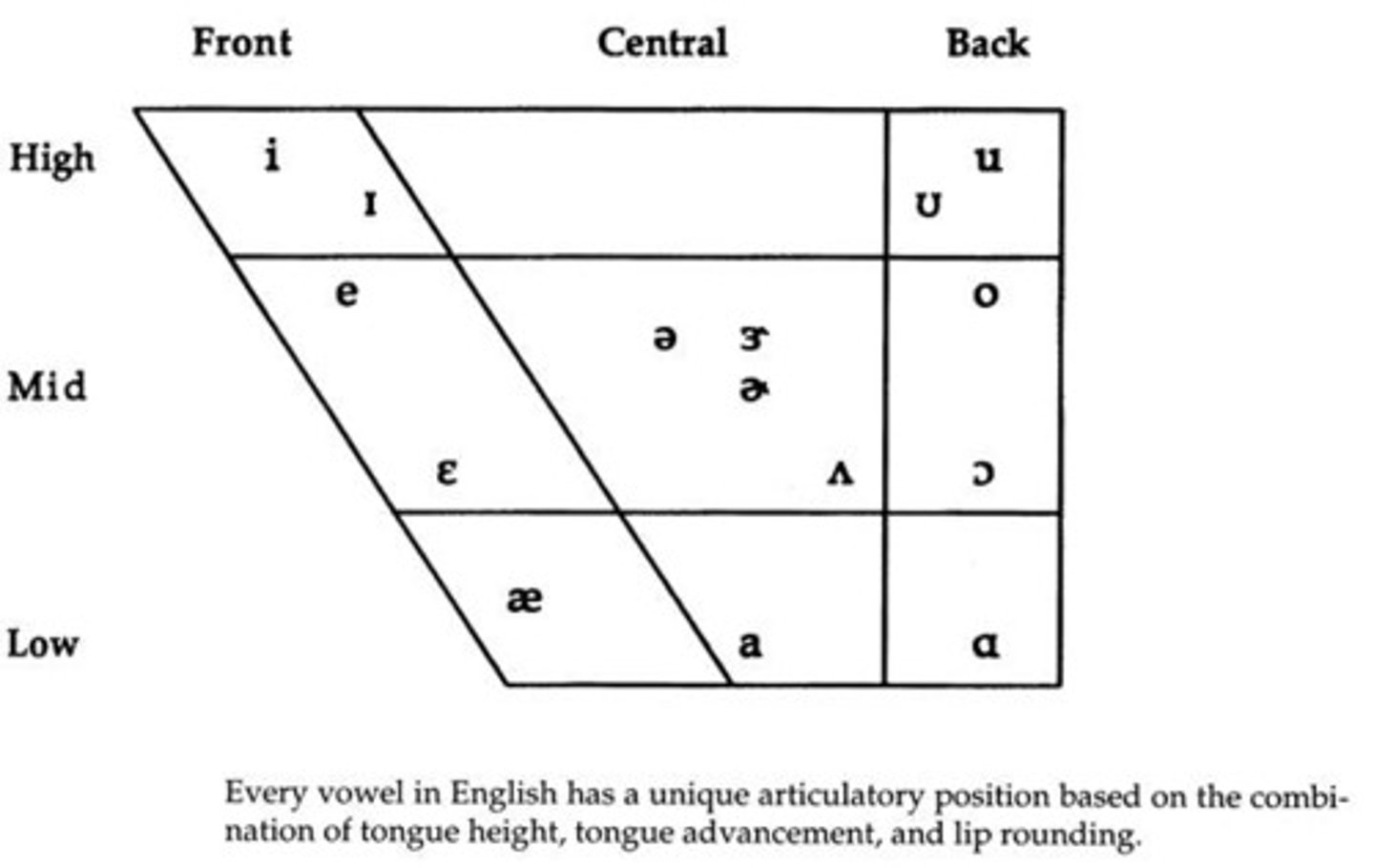
What is vowel space?
The physical extent of vowel production -- the space in the oral cavity within which vowels are produced
What is vowel length?
Refers to the duration of segments -- represented by symbol [ː] following the vowel symbol
*can sometimes entail semantic differences
What are germinates?
Long consonants
What are singletons?
Short consonants
What is true of tenseness and vowel length?
Tense vowels tend to be inherently longer than lax vowels (for some reason)
ex. seat [sit] versus sit [sɪt]
What is the difference between [ə] and [ʌ]?
- [ʌ] is for stressed syllables (e.g., but [bʌt], cutter [kʌtəɹ])
- [ə] is for unstressed syllables (e.g., upon [əpɑn], adjust [ədʒʌst], collect [kəlɛkt])
What is true of lax vowels?
Almost never appear at the ends of words -- ex. [bɛ] cannot be a string of sounds of a (possible) word in English
Still learning (35)
You've started learning these terms. Keep it up!