36. Design and Management of Research Facility
 Call Kai
 Learn
Learn Practice Test
 Spaced Repetition
 Match
Match Flashcards
 Knowt Play
1/247

There's no tags or description
Looks like no tags are added yet.
Name | Mastery | Learn | Test | Matching | Spaced | Call with Kai | Chat |
|---|
No analytics yet
Send a link to your students to track their progress
248 Terms
When building a facility what texts should you reference?
Guide, Ag Guide, BMBL, AWA, GLP Act, State and local codes
Laboratory Animal Housing (ILAR, 1978)
Handbook of Facilities Planning, Vol 2 Laboratory Animal Facilities
Laboratory Animal Management Rodents (ILAR, 1996)
NIH Design Requirements Manual for Biomedical Laboratories and Animal Research Facilities (2008) – must follow if receive federal construction or renovation support
American Society for Heating, Refrigerating, and Air Conditioning Engineers (ASHRAE) publications
When building a facility - the rodent procedure space should be in what location to the animal housing areas
in or adjacent to the animal housing room
What is the most efficient design of an animal facility?
Single story centralized facility w/ direct access to ground level transportation is most efficient
Multistory facilities should be provided with at least ______ dedicated elevators allowing separate transportation of clean and soiled materials and provide redundancy
2
HVAC air intake and exhaust should be _____ to ensures exhaust isn’t carried into the system
Exhaust should be _____ of prevailing winds if close to intake
physically separated
downstream
The animal facility should be located in close proximity to?
a loading dock
A crude estimate of animal facility space is ____% of total research space
15
single-corridor bidirectional pattern
Most cost-effective, but hardest to manage, especially in a disease outbreak
Control level at animal room door and may be divided into AM and PM operations
Both clean and soiled materials and personnel utilize same corridor
Potential for cross-contamination
although effective for all facilities including biocontainment and barrier, there is increased potential for cross contamination
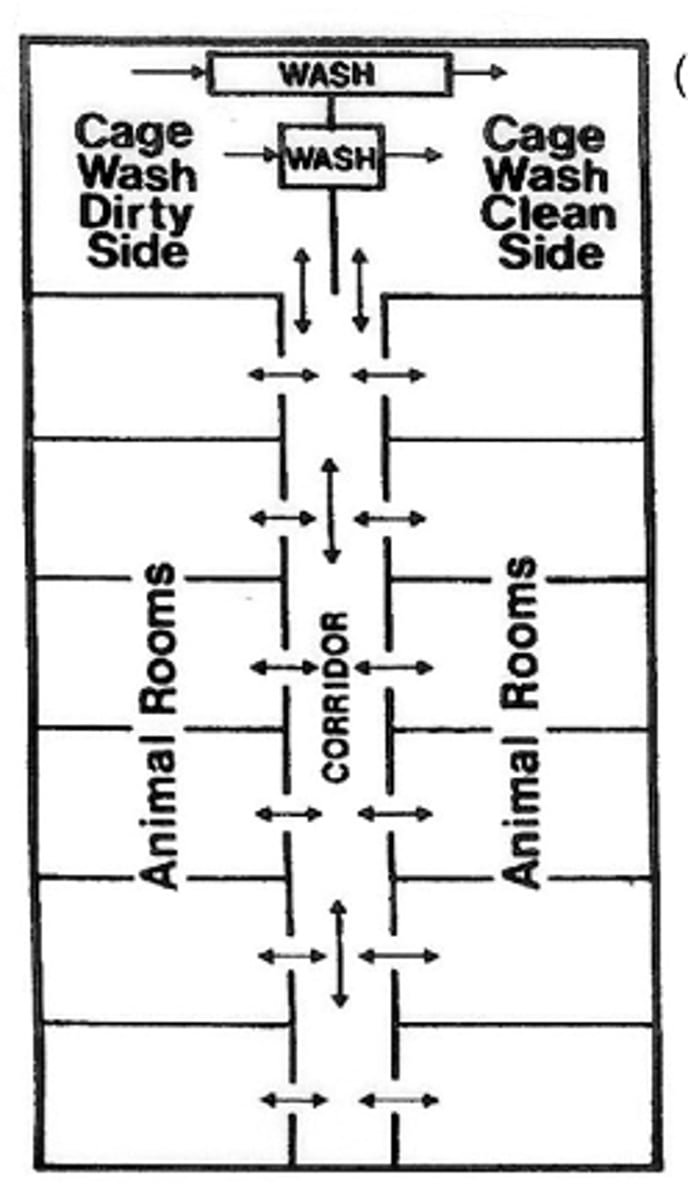
single-corridor unidirectional pattern
Requires strict management control to prevent cross- contamination
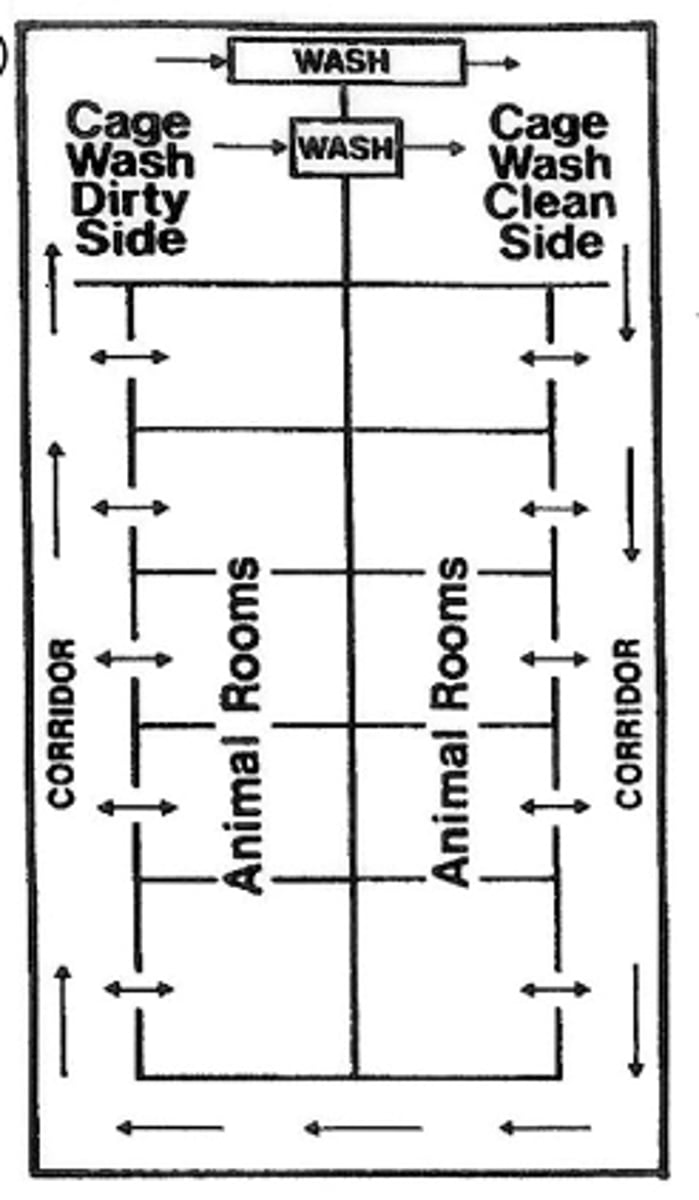
dual-corridor pattern with relatively large animal holding rooms
Clean/Dirty corridor design
Effective for managing disease control and preventing cross contamination
Expensive to build
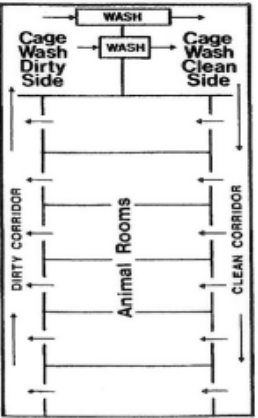
dual-corridor pattern with relatively small animal holding rooms
Increased ability to separate animals by species/protocol/health status due to increased number of holding rooms
Most costly to build and operate
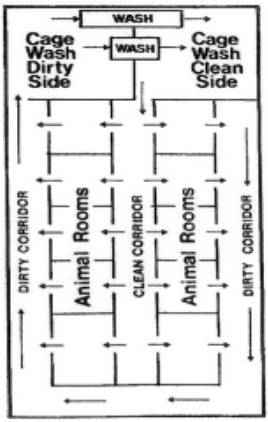
Percentage of floor space dedicated to corridors in each facility design. In order from least to most space taken by corridors.
17% - Single corridor birectional
26% - dual corridor pattern with large animal holding rooms
32% - Single corridor unidirectional
44% - dual corridor pattern with small animal holding rooms
What is the most challenging and important phase of the facility development process?
Programming - decision making phase
4 main categories of housing areas
conventional, barrier, quarantine, biocontainment
What type of barrier housing is least restrictive with respect to the floor plan?
cage level barrier
Facility planner separate animal rooms into 2 types. What are those types?
species that require alot of water (dogs ,swine, NHPs, aquatics) vs species that done (rodents, rabbits)
How are barriers created in the highest level facilities?
one or more double doors
pass through autoclaves
vestibules with interlocking doors
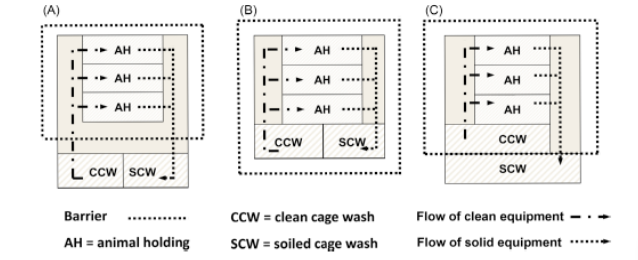
To create barrier in conventional room - add
micro-isolator caging, mass air displacement racks with HEPA filters, flexible-film isolators
Type of caging set up - more efficient cage capacity, but limits personnel access during cage change and is less productive bc racks must be moved for cage changing or cages must be moved on a cart between the rack and the changing station
Library Style
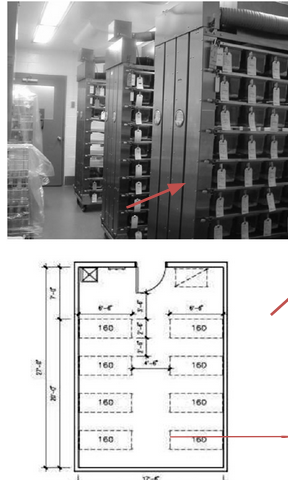
For library rack setup How much space should be between racks?
~ 2.5-4.0 ft.
More efficient with respect to cage capacity
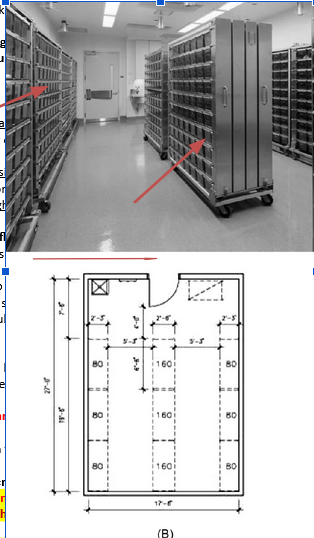
Type of caging set up - less efficient cage capacity but easier to service bc cage change equipment and materials are moved w/in the internal corridors
internal room corridor style
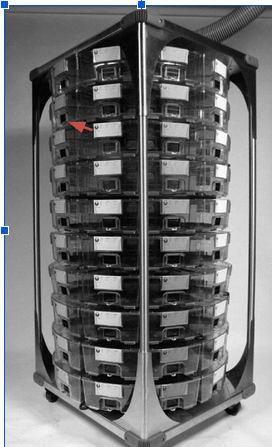
Type of caging set up - high cage density and can rotate for access
carousel style
Type of caging set up - Provide maximum flexibility for animal isolation within minimal space by dividing rooms into multiple small spaces that are usually large enough to hold 1-2 racks, smaller animals normally housed in cages on mobile racks
animal cubicles
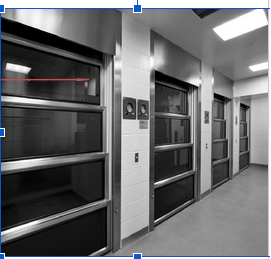
Animal cubicles
Maximum flexibility for animal isolation
Separation of species, source, microbiological status, etc.
Illinois cubicles
Modified Horsfall cubicles
Most common cubicle sizes are approximately 4 ft deep x 6 ft wide
What is a very big con in using animal cubicles for barrier housing
not effective at keeping airborne pathogens out
What is the recommended width of corridor per Guide?
6-8 ft wide
Wide enough to facilitate movement of people and equipment
Double door entry is needed for what areas
Noisy areas (dog, swine, cage-wash, etc)
NHP areas to prevent escape
Where directional airflow is critical
Modular room sizes of ____x_____ ft. common
11 x 22
Animal housing rooms should not contain any fixed casework other than a _______
sink
A holding room with 500-800 cage capacity 🡪 _____________ ft² (each cage ~ ______ ft²)
250-400; 0.5
Minimum ABSL level for NHPs?
ABSL2 - isolated area
Sheep should always be housed at at least ____ housing due to concern for ____.
ABSL2
Q fever
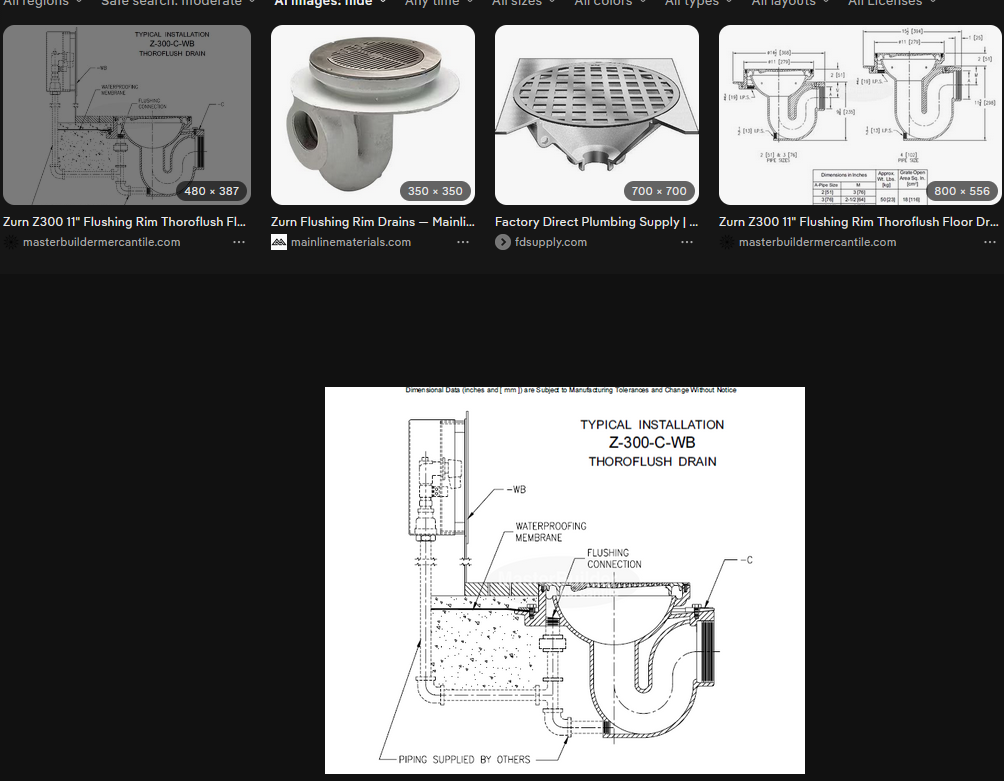
Where should the floor drain be located in an animal housing room for LA?
ideally open floor plan with trough located against sidewalls so cages/pen drain to trough
What type of drains are recommended to aid in solid excrement evacuation
trap or rim flushing drains
What is the minimum width of aisle between the pen and the wall? (for large animal species)
18 inches
Room floor should slope __________ inch per foot from acrown in the center of the room towards drain or trough on side of room
3/16 inch
In large animal room, trough bottom should slope _______ inch per foot toward a ___________ diameter drain with trap flush
¼ inch per foot; 6"
Which direction should the door of animal room open? Should doors be sealed or not sealed? What material should be used to make them? How should they close? If a window is provided, what color should it be? The door handle should be?
Open into animal room
sealed
corrosive resistant material
self closing, lock or electronic device if restricted access
open from inside without key
red tinted
shielded or recessed handle
Size of door for animal room
42 x 84 in.
What is the preferred location for the administrative/training suite?
located adjacent to animal housing areas but outside the security perimeter
The downdraft table in a necropsy suite should capture ___ above the work surface
12”
Major survival surgical procedures on non-rodent mammals must be conducted in _____
a suite specialized for that purpose
What is the recommended ratio for procedure room to animal holding room?
One procedure room for every 4-8 holding rooms
Typical rodent procedure room
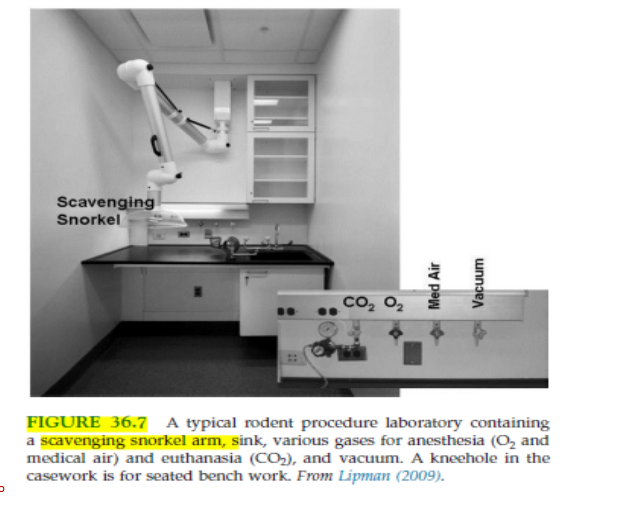
For animal receiving what is the typical “pass through” procedure? What about shipping animals out?
filtered shipping create – decontaminated 🡪 placed on “soiled” pass through Class II Type A2 BSC – decontaminate 🡪 crate is opened 🡪 animals removed and placed in “clean” area using disinfectant treated forceps and placed into a clean cage which is then taken to holding room.
Use it in reverse
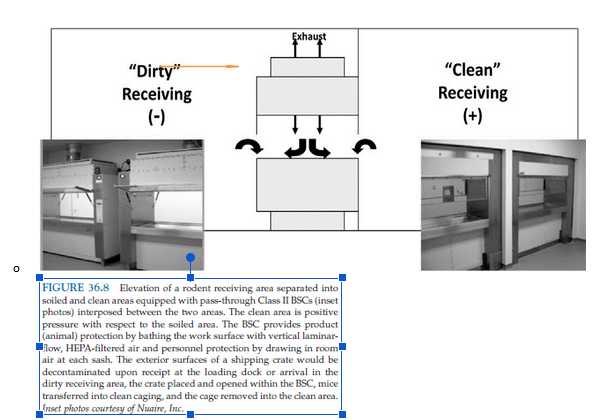
What type of BSC should be used in receiving room?
Class II Type A2 BSC
How should animals be received if you only have 1 room?
shipping crate brought in room 🡪 surface decontaminated 🡪 unpacked in cage change station, mass air displacement unit, or BSC, or taken to holding room for unpacking
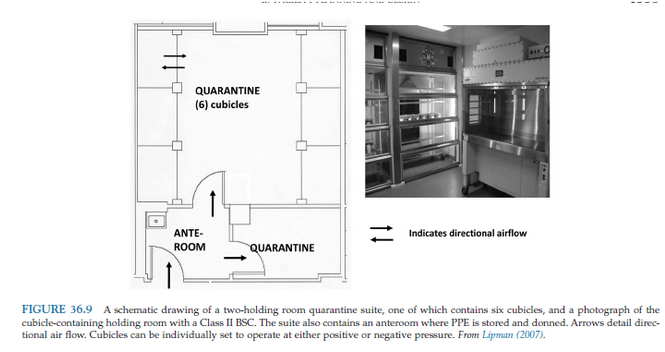
What air pressure should quarantine rooms be kept at?
Maintained at negative air pressure to rest of facility
Common engineering standards for hazards?
physical isolation of hazardous animals, waste
monolithic, sealed and easily sanitized room surfaces and don’t promote dust accumulation
use of BSC or chemical hood
increased room air exchange rate to dilute environmental contaminants
direction airflow to draw hazards away from human occupants
room air pressure differentials to ensure hazardous areas have a negative pressure to surrounding spaces
Volatile compounds are not captured by what filters?
HEPA filters and other media (activated carbon)
What type of engineering control is necessary for volatile compounds
Chemical hood (personnel protection only) OR
100% Exhaust BSC (Class II B2)
-both connect to building’s exhaust
What air exchange rate is necessary for animal cages exposed to volatile compounds
>50 complete air changes/hr
Common engineering practices for hazardous waste
autoclave bedding before dumping, decontaminate cage before handling
sterilize before processing if hazards are heat labile (most bio hazards)
most chemical require chemical deactivation (some heat labile)
What caging is useful for highly hazardous cages
disposable polysterene or polyethylene
Administration of radionuclides to animals mandates adherence to ________________ standards requiring institutions to be licensed and use ALARA
Nuclear Regulatory Commission; As low as reasonably achievable (ALARA)
What does Nuclear Regulatory Commission standard proposed when dumping radionuclides contaminants?
Allowing carcasses and waste to decay for 10 half-lives permits the disposal into nonradioactive waste streams
Prior to release of carcasses, caging, or bedding, radioisotope activity levels are confirmed with Geiger counter or surface wipes
Once radioactivity is no longer detectable mechanical washers can be used to sanitize (because some mechanical washers recirculate wash water - can contaminate other equipment in wash)
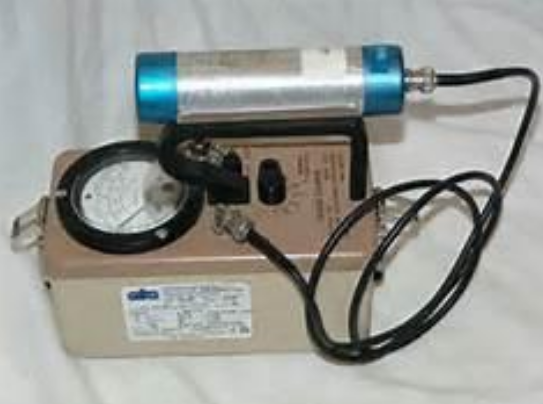
What is this?
Geiger counter
How long is the half life for the isotope positron emitting radioisotope F18 commonly used in used in PET (positron emitting tomography)?
Half-life = 110 min
How long is the half life for Ultrashort lived radioisotopes O15, C11?
Half-life less than 30 min
What radioisotopes are short lived vs long lived?
short - O15, C11
Long - I90, C11
What caution should be taken when using MR scanners?
Ventilation requirements and redundancy
To avoid potential for asphyxiation associated w/ cryogen boil-off
Heat load generated
Location must support floor loads
Ideal location for aquatic rooms
lowest level
What is important to have to prevent electrical shock in aquatic rooms?
Outlets at risk for water exposure should be ground fault interrupted (GFI) or connected to a GFI circuit. All essential
What water should be avoided in aquatic rooms, why?
distilled and deionized water
must run over a column or filter that replaces lost ionic constituents if used
removal of organic and nonorganic debris adhering to surfaces
cleaning
reduces but may not eliminate microorganisms from surfaces
disinfection
combo of cleaning and disinfection
sanitation
eliminates all life forms
sterilization
Air gradient for cage wash
clean side is positive, dirty side is negative
How should servicable sections of the cage wash be set up?
service on dirty side OR
mechanical space between sections
What is the minimal diameter size for drains in cage wash?
4” in diameter (6” preferred)
What BSC is recommended for cage dumping?
Class I BSC
Water temp for sanitation of cage wash?
180F
Who decides the temperature standard?
National Sanitation Foundation (NSF)
Sanitation Can be achieved at temperatures lower than 180°F by using longer exposure times
____ at 82.2°C (180°F)
____ at 71.6°C (161°F)
____ at 61.7°C (143°F)
1s at 82.2°C (180°F)
15 s at 71.6°C (161°F)
30 min at 61.7°C (143°F)
Floors in cagewash should be ___ and made of ___
slip and impact resistant AND monolithic
made of seamless troweled or broadcast chemical and heat-resistant polymer composites
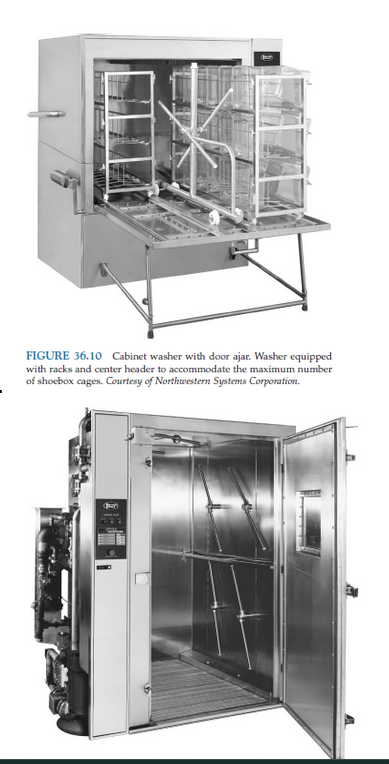
Soiled equipment is placed in chamber and sprayed w/ high pressure on all sides w/ hot water through a series of detergent/rinse cycles, then it’s removed, cleaned, and sanitized
cage or rack washer (cabinet washer is smallest)
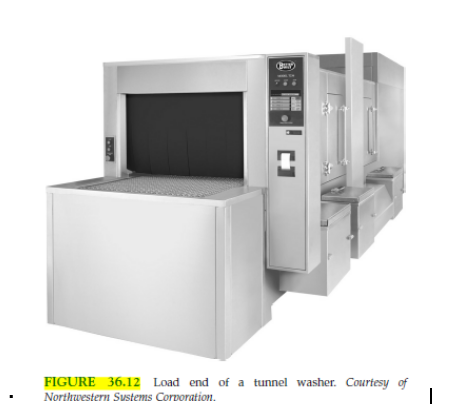
Items placed on a conveyor that moves through a tunnel divided into sections (pre-rinse, detergent wash, rinse, and final rinse)
tunnel washer / belt washer / conveyor washer
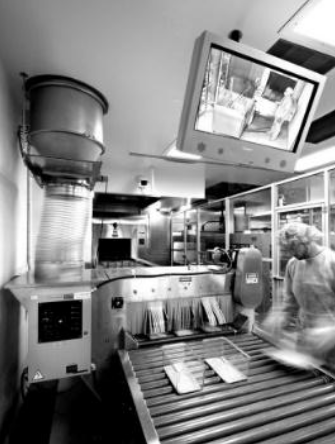
Uniform amount of bedding in each cage, Decrease employee repetitive stress injuries
Bedding dispenser attached to tunnel washer
Facilities with large number of bedded rodents
bedding dispenser
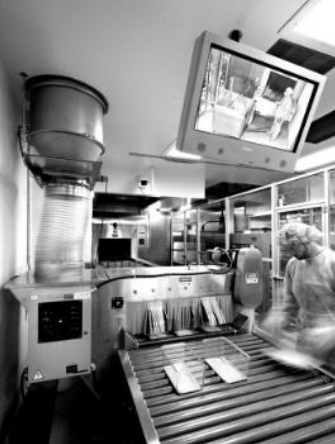
High vacuum autoclaves (steam) are recommended, the temperature ranges from __________to ______
temperatures ranging from 121°C to 132°C (250-270°F)
Why is clean steam preferred when sterilizing animal equipment?
clean steam does not have chemical rust inhibitors - don’t expose the animal to it
Type of sterilizer that is carcinogenic and highly explosive when mixed w/ air
ethylene oxide (ETO) sterilization
Other sterilizers used to now used for sterilization of cages and other hard surfaces
hydrogen peroxide and gaseous chlorine dioxide
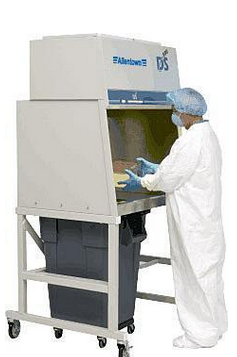
what is this?
cage dump station
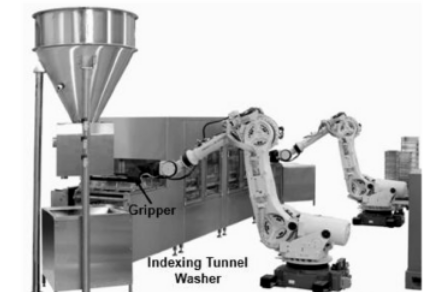
What is this?
Foundary or articulating robot
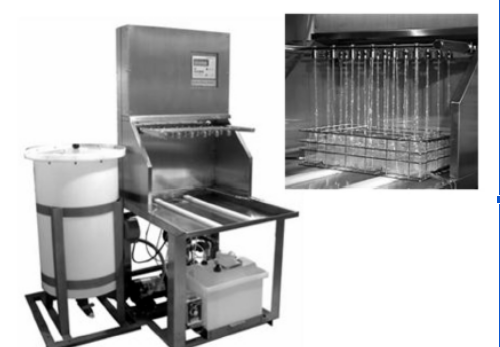
What is this?
water bottle filler
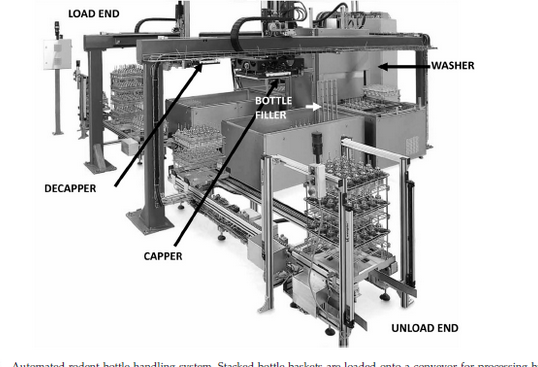
What is this?
automatic water bottle filler
involves challenging, verifying, and documenting the building structure, utilities, systems, and equipment before routine operation is authorized
commissioning
establishing documented evidence that provides a high degree of assurance that a specific test process consistently produces results at predetermined specifications and quality attributes
validation
Walls should be constructed of ________________ or moisture and impact-resistant cement wallboard
sealed and epoxy-coated cement masonry units (CMUs)
What is the risk of using ethylene oxide?
Ethylene oxide (ETO) – carcinogenic and highly explosive when mixed with air (rare use nowadays)
Hydrogen peroxide or gaseous chlorine dioxide now used for sterilization of cages and other hard surfaces
What is the single most expensive component of vivarium for both initial and life cycle costs (capital e.g., acquisition and installation and operating costs)?
HVAC system
Draw in 100% fresh air, then filter, heat or cool, and humidify before to facility
Conditioned air delivered to individual rooms at a constant temp and humidity is then reheated to desired temp at the room level based on room’s thermostat
single duct, constant volume reheat (CVR) type
systems w/ reheat provide some energy savings as ventilation rates can be tailored, however, vivarium systems designed and operated to maintain a minimum of at least 10 air changes/hr (ACH)
Variable air volume (VAV)
What is the most common HVAC system?
Single duct, constant volume reheat (CVR) type
Where is intake air generally filtered in HVAC system? What is the final dust spot efficiency that the filters should achieve per ASHARAE?
air handler
85-95%
Air exiting the air handling unit (discharge temp) is usually ____ and reheated by the terminal reheat device independent of outside air temp
55-60F
HEPA filters are at least ____% efficient at filtering 0.3um diameter particles; more effective capturing particles <0.3um or >0.3um
99.97% (99.99% per BMBL)
HEPA filters rely on what 3 mechanisms?
Interception, impaction, diffusion
N+1 redundancy refers to?
critical components have at least one independent backup