EEB Exam 4
 Call Kai
 Learn
Learn Practice Test
 Spaced Repetition
 Match
Match Flashcards
 Knowt Play
1/263

There's no tags or description
Looks like no tags are added yet.
Name | Mastery | Learn | Test | Matching | Spaced | Call with Kai |
|---|
No analytics yet
Send a link to your students to track their progress
264 Terms
Why was early Earth a difficult place for life to survive?
Because of intense volcanism and frequent meteor impacts, some severe enough to vaporize oceans.
What is the significance of 3.7 billion years ago on this slide?
It marks the earliest geological evidence of life mentioned here.
What does the carbon isotope evidence suggest?
It suggests the rock may preserve a signature or fossil of early living organisms.
What is the main takeway?
Early Earth was harsh, but life seems to have appeared and persisted by at least 3.7 billion years ago.
What major event happened before life could become abundant on Earth?
The heavy bombardment had to end, around 4.0 billion years ago.
About when does this figure place abundant cellular life?
Around 3.5 billion years ago.
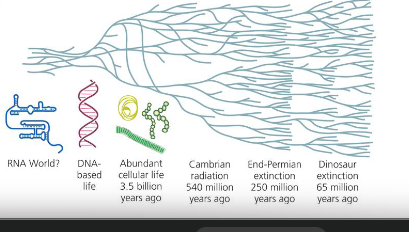
What does the branching diagram on the right represent?
The increasing diversification of life through time.
What is the significance of the 3.4-billion-year-old microfossils?
They suggest that microbial life existed by about 3.4 billion years ago.
What evidence was used to identify these structures as fossils of microbes?
Their carbon content, size, location in rock, and resemblance to modern dividing bacteria.
What uncertainty does the slide raise about these fossils?
They may come from an extinct lineage that did not directly lead to LUCA.
What do old fossils help with?
These fossils help with timing, but they do not automatically tell us whether that organism is part of the direct ancestry of modern life.
What are two ways to study early life?
Studying fossils or comparing genes shared by all organisms.
What gene did Carl Woeses use for studying early life?
He used ribosomes RNA (rRNA
Why was rRNA a good gene to test one to serve the purpose?
Because all organisms have ribosome and since all life has this you can compare rRNA sequences across species.
What major groups of life are shown in this phylogeny?
Bacteria, Archaea, and Eukarya.
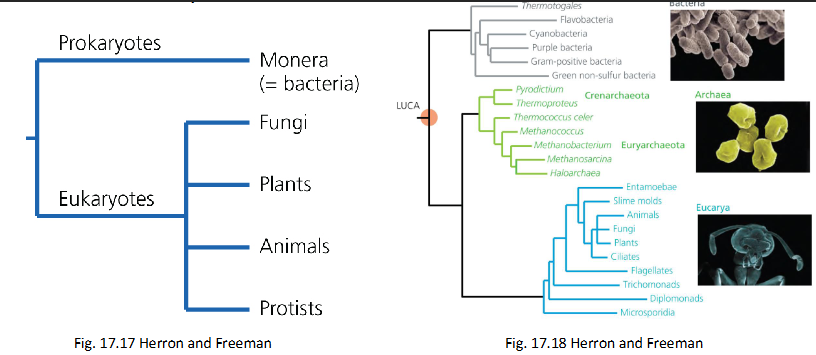
What does the Old (left) tree show in terms of the new (right) tree
The old tree classified that life was split as prokaryotes= all simple cells without a nucleus and Eukaryotes= plants, animals, fungi, etc. But thats too simple.
The new tree shows that Bacteria is one major branch, archea is a different major branch and eukarya is another major branch. Even though Bacteria (prokayotes) and archea but lack a nuclues, they are not the same deep lineage. So you need three classifications not just simply prokaytoes and eukayotes. In fact, archea are more closely related to eukaryotes than procaryotes.
What does LUCA mean in bacteria, Archaea, and Eukarya ?
Last Universal Common Ancestor, the ancestor of Bacteria, Archaea, and Eukarya.
If a trait is found in all 3 groups what does that mean?
It means that it was probably in LUCA
If a trait is only found in 2 groups what does that mean?
It means that it may have evolved later in those groups or been lost in a third.
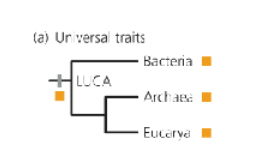
What does the universal traits graph show?
If Bacteria, Archaea, and Eukarya all have the trait, then the best guess is that LUCA had it too.
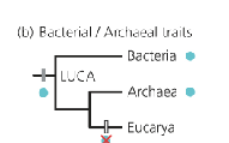
What does the Bacterial/Archeal Traits show?
If only Bacteria and Archaea have it, but Eukarya does not, then you cannot automatically say LUCA had it. It could have evolved after Eukarya split off, or Eukarya could have lost it.
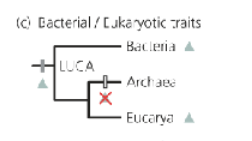
What does the Bacterial/Eukaryotic traits mean?
If only Bacteria and Eukarya have it, you cannot be sure LUCA had it. It might be a later evolution or a loss in Archaea.
How do scientists infer traits of LUCA?
By comparing traits across Bacteria, Archaea, and Eukarya on a phylogenetic tree.
What kind of trait is strongest evidence that LUCA had it?
A trait shared by all three domains of life.
What are examples of universal traits that LUCA likely had?
DNA, rRNA, tRNA, and proteins.
Why do DNA, rRNA, tRNA, and proteins provide strong evidence about LUCA?
Because they are shared by Bacteria, Archaea, and Eukarya.
What does this suggest about LUCA?
LUCA already had the core molecular machinery of modern life.
What is a gene tree approach?
It is building an evolutionary tree using the sequence of one gene at a time.
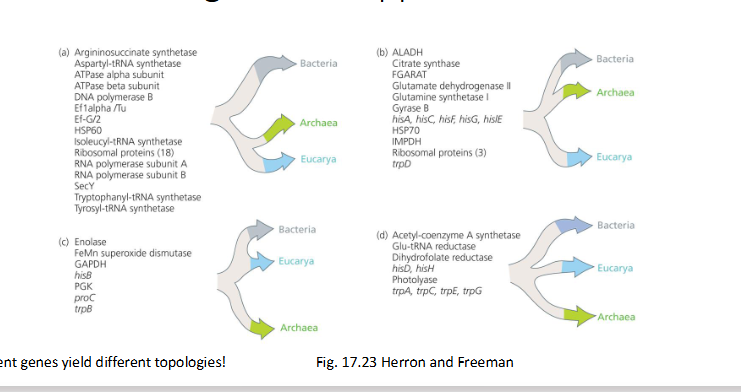
Why are there several different tree patterns on this slide?
Because different genes can support different evolutionary relationships among Bacteria, Archaea, and Eukarya.
What is the main lesson of this slide?
Early evolutionary history is complicated because individual genes do not always tell the same story.
What does horizontal gene transfer (HGT) mean?
means an organism gets a gene from a different lineage, not just from its ancestor. one species transfers a gene to another unrelated species
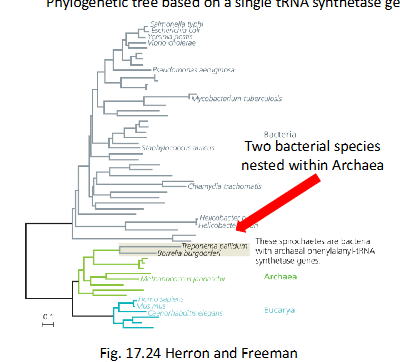
Why is there two bacteria species nested within archaea?
Because the tree was build from one single gene and it means that the bacteria picked up that gene from archaea.
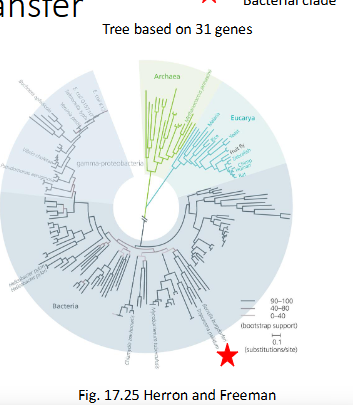
What does this tree dipict?
This three uses 31 genes not just one and it gives a more reliable picture of the organisms overall ancestry.
Single-gene tree vs. Multi-gene tree
Single-gene tree can be distorted by HGT and multi-gene tree is usually better for true evolutionary relationships
Is horizontal gene transfer equally common in all organisms?
No. It depends on where you look.
How extensive can HGT be in some species?
Some estimates are as high as 18 to 24%.
What is the main point of this slide?
HGT can be significant, but estimates vary widely, with some studies finding much lower averages like 2%.
What is the main point of this sweet potato slide?
Sweet potatoes contain bacterial DNA acquired through horizontal gene transfer.
Why is sweet potato an important example of HGT?
Why is sweet potato an important example of HGT?
What is an important concept
The bacterial DNA in sweet potato is still expressed, which means the horizontally transferred genes are biologically active, not just fossil DNA.
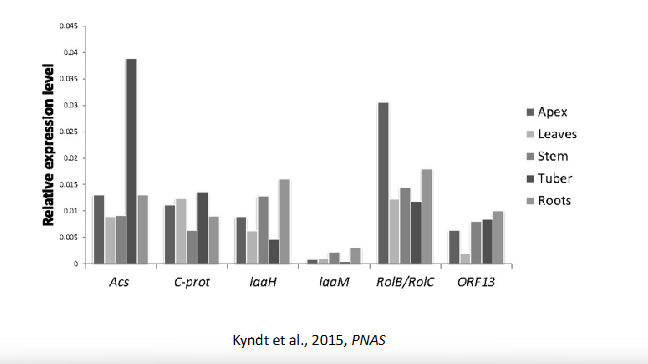
What is the main point of this graph?
Some bacterial-derived genes are still expressed in sweet potato.
Why is this important evidence for HGT?
It shows the transferred bacterial DNA is active, not just passively present in the genome.
What does it mean that expression differs across tissues?
The bacterial-origin genes are expressed at different levels in different parts of the plant.
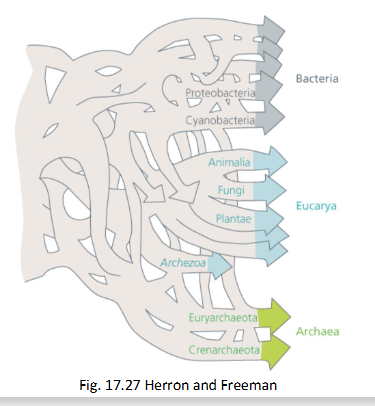
What does this image show?
many lineages exchanging genes
not just simple branching
Why might early life be represented as a web instead of a tree?
Because horizontal gene transfer allowed genes to move between lineages, not just from ancestor to descendant.
What question does this raise about LUCA?
Whether LUCA was a single species or a group of early organisms exchanging genes readily.
What is the main point of this slide?
Extensive HGT makes the earliest history of life look network-like, not perfectly tree-like.
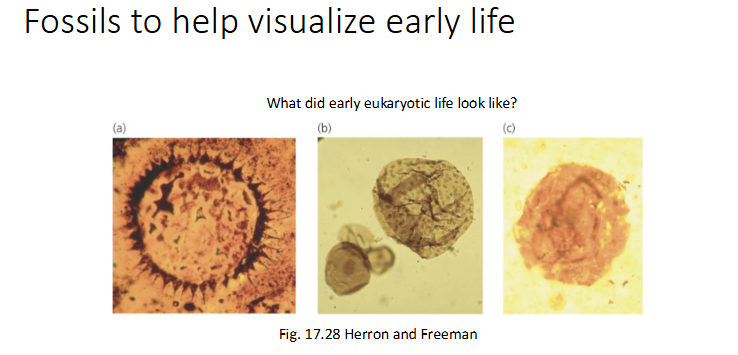
What is the main purpose of these fossils in the slide?
To help scientists visualize what early eukaryotic life may have looked like.
Why are these fossils important but still uncertain?
Because they suggest complex eukaryotic structures, but their exact identity is not fully certain.
What is the main takeaway of this slide?
Early eukaryotic life may already have been diverse and structurally complex, and fossils help us infer that.
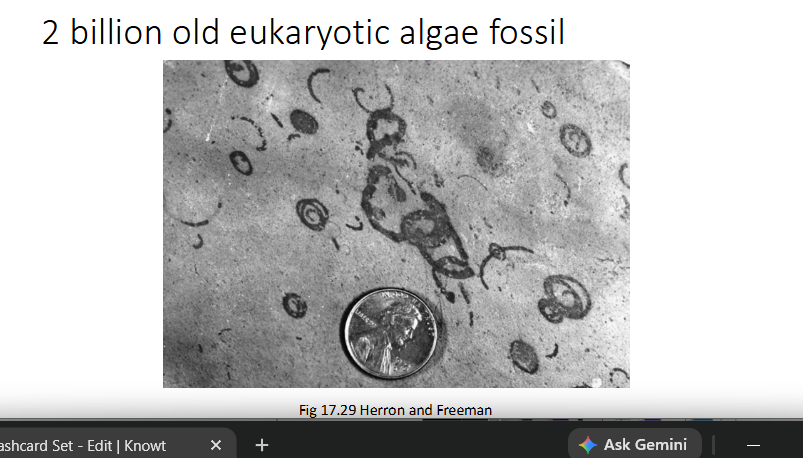
What is the significance of this fossil?
It suggests eukaryotic algae existed about 2 billion years ago.
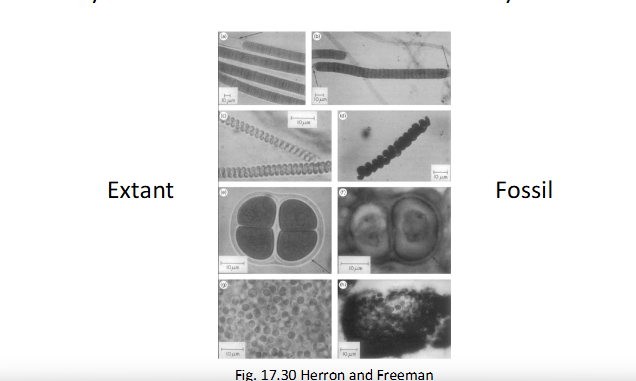
What is the main point of this slide?
Fossil cyanobacteria look very similar to modern cyanobacteria.
Why is that important?
It suggests cyanobacteria are an ancient lineage whose basic forms have remained similar for a long time.
What does “extant” mean on this slide?
It means living today.
Why has LUCA sometimes been described as a “community”?
Because early organisms may have exchanged genes extensively through horizontal gene transfer.
Why are ribosomal genes often treated differently from many other genes?
Because they may better preserve the deep evolutionary branching pattern, while many other genes were more affected by HGT.
What is the main point of this slide?
Early evolution may have involved so much gene exchange that LUCA is best thought of as a community of gene-sharing lineages.
Why is this called the “ring of life” instead of a simple tree?
Because eukaryotes may have arisen from the fusion of two lineages, one archaeal and one bacterial.
What kinds of eukaryotic genes tend to look bacterial vs archaeal?
Metabolic genes tend to look more bacterial, while genes for genetic information processing tend to look more archaeal.
What is the main takeaway of this slide?
Eukaryotes likely have mixed ancestry, with major contributions from both bacteria and archaea.
Why is the ring of life model controversial?
Because it does not fully explain eukaryote-specific genes, the timing of gene origins, or a clear mechanism for the proposed fusion.
What is one major weakness of the ring of life model?
It assumes a simple fusion, but the origin of eukaryotes was likely more complex.
What is the main point of this slide?
The ring of life idea is useful, but it is not a complete explanation for eukaryote origins.
An important thing to know understand is once the three domains became isolated from each other, how did they diversify into todays biodiversity?
How did Georges Cuvier prove extinction?
Cuvier used comparative anatomy, especially fossil morphology, to show that some organisms from the past no longer exist.
How did Georges Cuvier show that extinction was real?
By comparing fossils to living animals and showing some fossils matched no living species.
Why were mammoth and mastodon teeth important to Cuvier’s argument?
Because they were different from elephant teeth, showing they belonged to extinct animals rather than living elephants.
What is the main point of this slide?
Cuvier established extinction as a fact using comparative morphology of fossils and living species.
True/False : Fossils from a region often resemble the living animals from that same region?
True
What is Law of Succession?
Fossils and living species from the same geographic region tend to resemble each other.
Why is the law of succession important for evolution?
It supports descent with modification, meaning living species are related to earlier fossil species from the same area.
What is the main point of this slide?
Modern regional species often resemble extinct regional species, which supports common ancestry over separate creation.
What is a fossil?
Any preserved remains or trace of an organism that lived in the past.
Do fossils only include body parts like bones?
No. Fossils can also include traces, such as impressions or footprints.
What is the main point of this slide?
Fossils are evidence of past life, and they can form in many different ways.
How does amber preserve organisms?
Sticky plant resin traps an organism and then hardens, preserving it.
Why are amber fossils especially useful?
Because they can preserve very fine-scale traits in exceptional detail.
What is the main point of this slide?
Amber fossils provide rare but extremely detailed preservation of past life.
How does freezing help preserve organisms?
It prevents or greatly slows decomposition.
How can drying preserve remains?
Dry conditions reduce decay and help preserve material.
What is the main takeaway of this slide?
Fossils and preserved remains can form when cold or dry conditions stop decomposition.
What happens during permineralization?
Minerals fill in spaces within the organism’s remains and preserve its structure.
What happens during replacement?
The original biological material is gradually replaced by minerals.
What is the main point of this slide?
Permineralization and replacement are more common fossilization processes that preserve the form of ancient organisms than amber, freezing, and drying
Can permineralization happen in plants?
Yes. Plant tissue can be preserved when minerals fill in and preserve the structure.
What is a common example of plant permineralization?
Petrified wood.
What is the main takeaway of this slide?
Permineralization can preserve plant material, not just animal fossils.
What is a trace fossil?
A fossil of an organism’s activity, such as footprints, feces, or burrows.
What do trace fossils tell us better than body fossils?
They tell us about behavior.
Why is it hard to assign a trace fossil to a species?
Because the trace usually exists without the organism’s body, so the maker or what speceis that made it is uncertain.
What conditions make fossilization more likely?
Hard parts, rapid burial by sediment, and low-oxygen conditions.
Why do hard structures fossilize more often than soft tissues?
Because they are more durable and resist decay longer.
Why is the fossil record biased?
Because only certain organisms and environments are likely to produce fossils.
What type of speceis are more likely to be preserved and discovered?
Common species are more likely than rare speices.
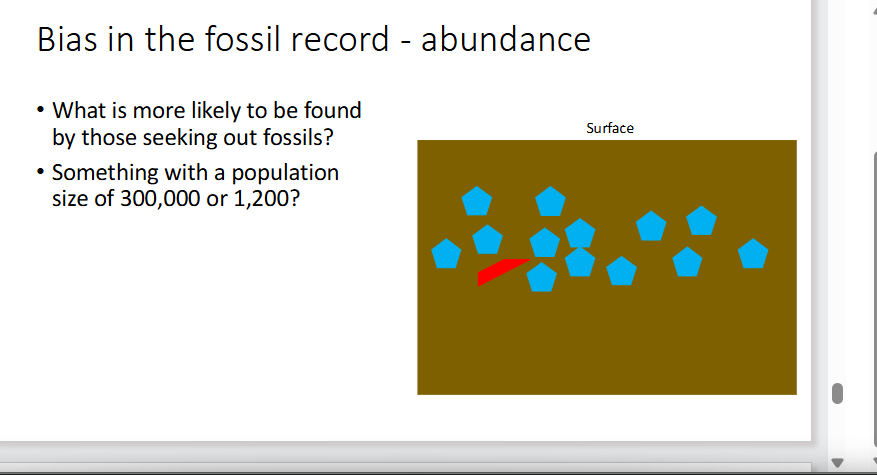
Which species is more likely to be found in the fossil record: one with 300,000 individuals or one with 1,200?
The species with 300,000 individuals.
Why does abundance create bias in the fossil record?
Because more individuals means more chances for fossilization and discovery.
What is the main point of this slide?
The fossil record tends to overrepresent abundant species and underrepresent rare ones.
Fossilization depends on what?
Depends a lot on where an organism lives.
Why are some locations better for fossilization than others?
Because some environments favor burial and preservation, while others favor erosion.
Why might mussels fossilize especially well?
Because they live in sediment and also have hard shells.