Biogeography
 Call Kai
 Learn
Learn Practice Test
 Spaced Repetition
 Match
Match Flashcards
 Knowt Play
1/44

There's no tags or description
Looks like no tags are added yet.
Name | Mastery | Learn | Test | Matching | Spaced | Call with Kai |
|---|
No analytics yet
Send a link to your students to track their progress
45 Terms
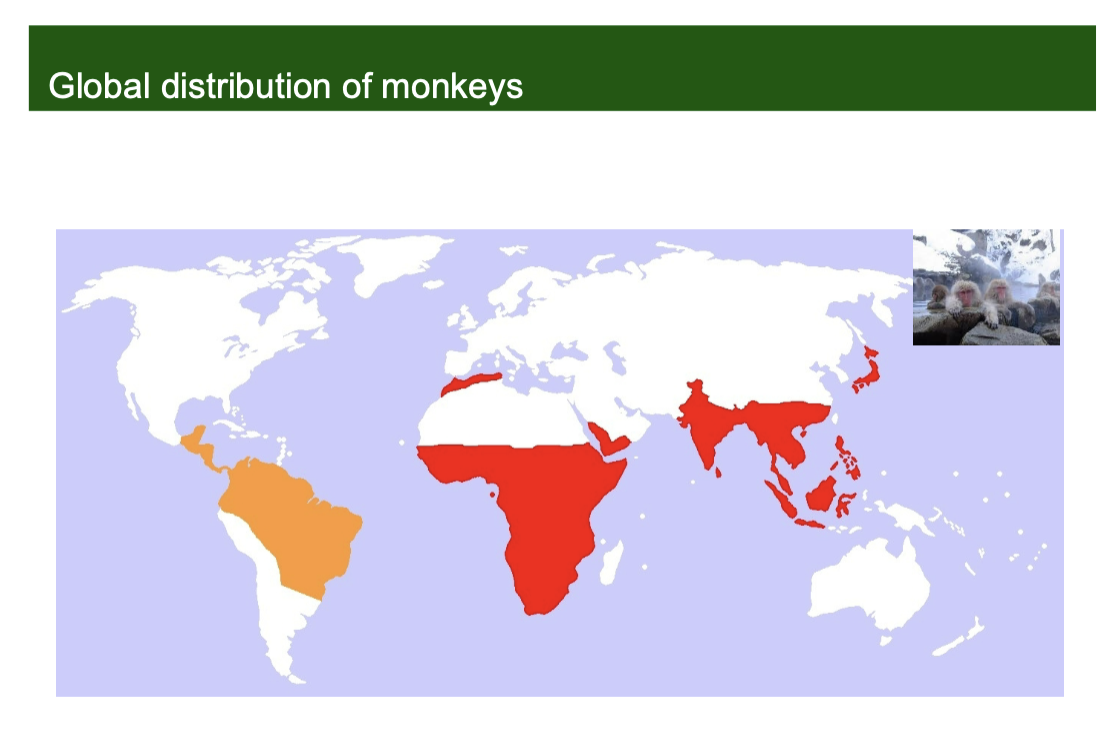
Global distribution of monkeys
Shows a map of monkey distributions, highlighting their presence in Central/South America (orange) and Africa/Asia (red)
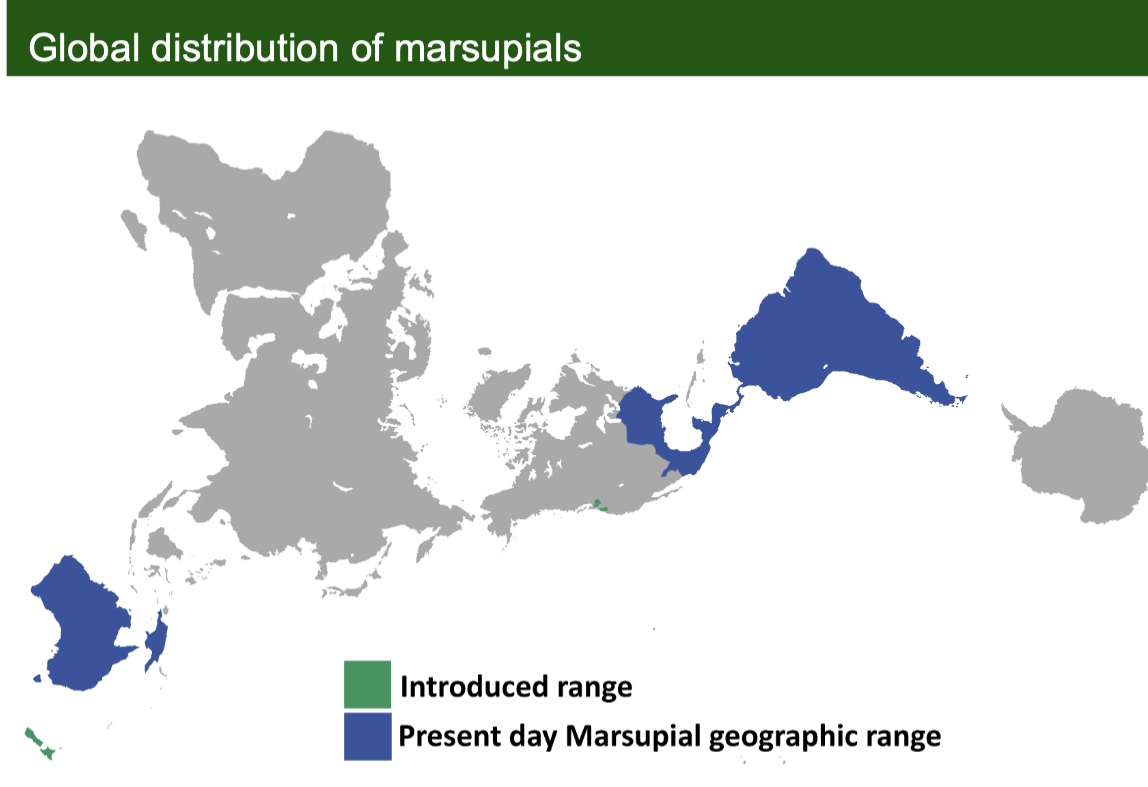
Global distribution of marsupials
Displays the present-day geographic range of marsupials, primarily in Australia and South America, as well as introduced ranges
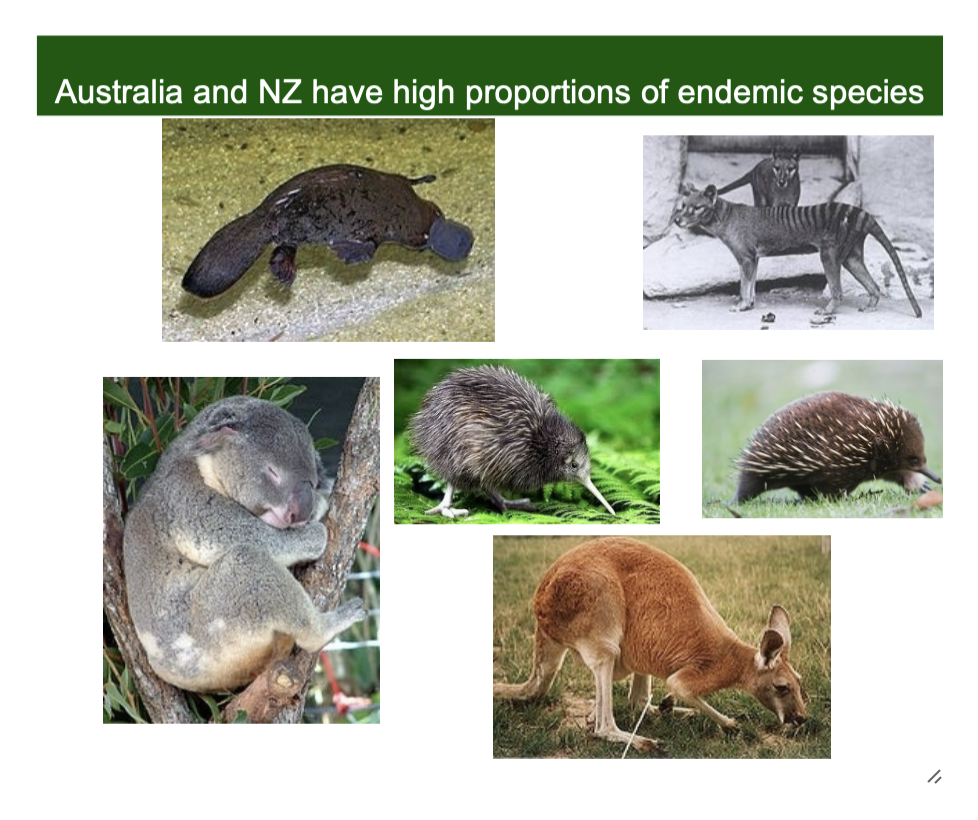
Endemic species in Australia and New Zealand
These regions have high proportions of endemic species (species found nowhere else).
Echidna, koala, kangaroo, platypus, thylacine, and kiwi
“Biodiversity” hotspots
Introduces areas with exceptionally high species richness and endemism.
One hectare of rainforest in the Amazon contains more plant species than all of Europe.
The number of fish species in the Amazon River exceeds the total number found in the entire Atlantic Ocean.
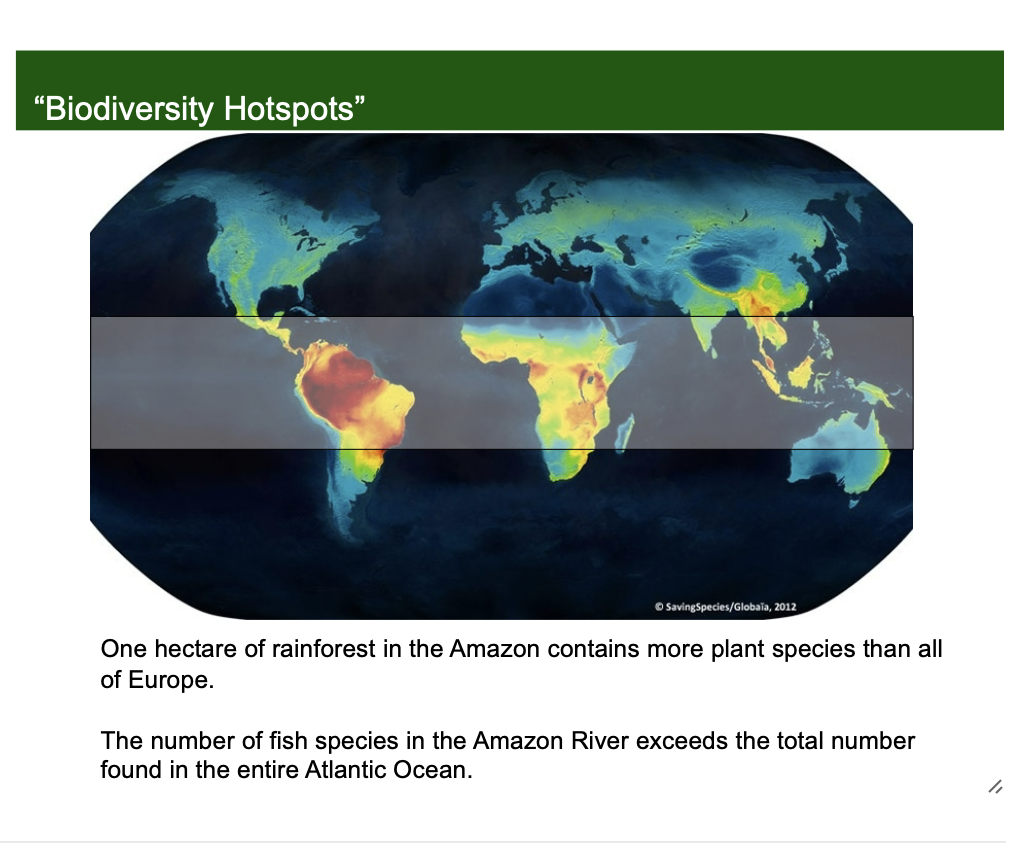
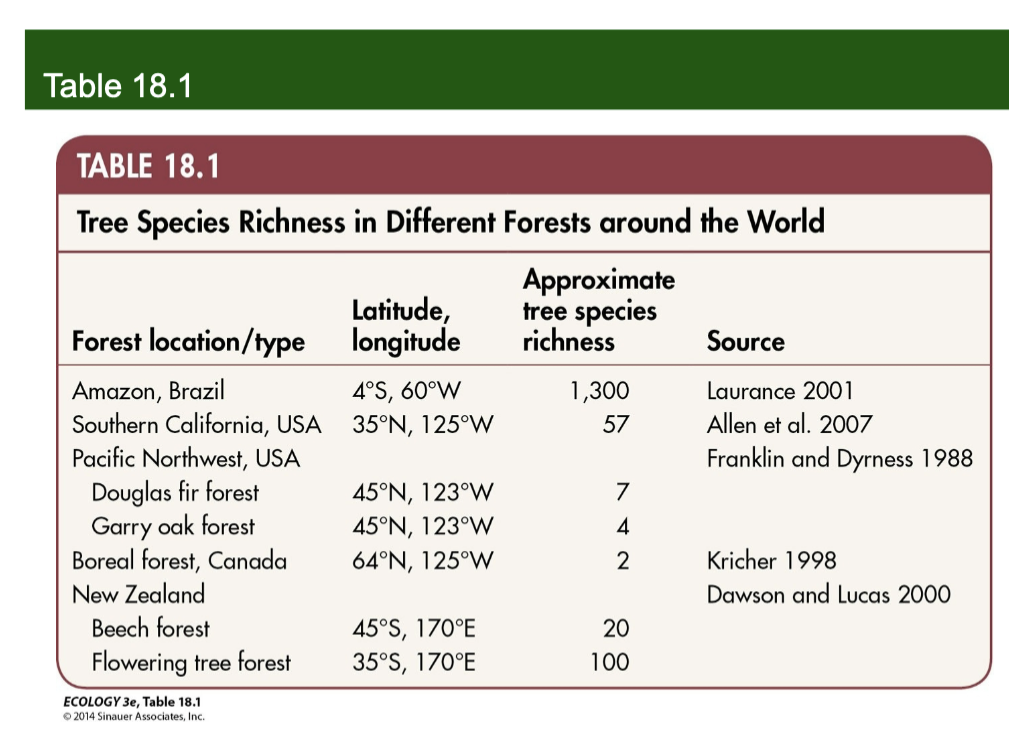
Table 18.1 - Tree Species Richness
Shows tree richness gradients: Amazon (1,300 species) vs. Boreal forest (2 species).
Biogeography
Biogeography is the study of species composition and diversity across geographic locations.
Interconnected Spatial Scales
Shows how diversity patterns are hierarchical; larger scales set the conditions for smaller ones
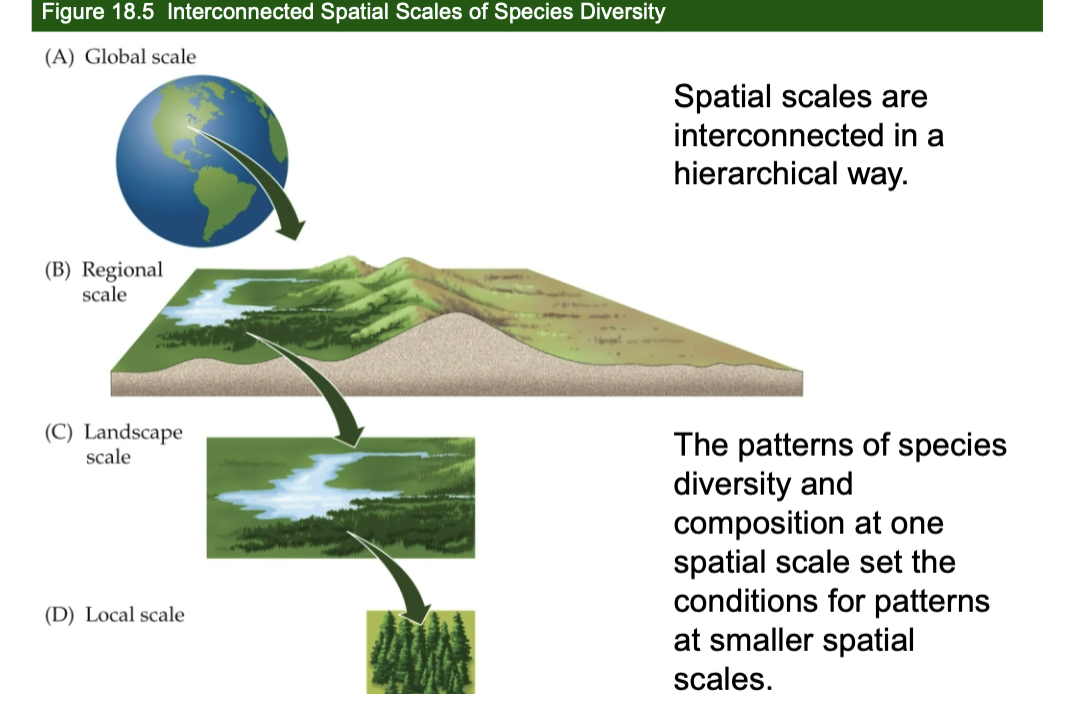
Global Scale
Encompasses the entire world
Isolation over long distances and periods (continents/oceans) influences diversity
Rates of speciation, extinction, and dispersal are the primary drivers
Regional scale
Areas with uniform climate; the species are tied to that region by dispersal limitations
Regional species pool - all the species contained within a region
Landscape Scale
Focuses on the topographic and environmental features of a region
The landscape shapes rates of migration and extinction
Local scale
Equivalent to a community
Species physiology and interactions with other species are important factors in the resulting species diversity
Variability of Scale
The actual area of a "scale" depends on the species; local scale for plants might be 10²–10^4 m², while for bacteria it might be 10² cm²
Alpha, Beta, and Gamma Diversity
Gamma: species diversity within a region (regional)
Alpha: local species diversity
Beta: the change in species composition (turnover) from one community to another, connecting local and regional scales
Determining Local Species Richness
The regional species pool sets the theoretical upper limit on local diversity
If the slope=1, all regional species are found locally. If the curve levels off, local processes (like competition) limit richness.
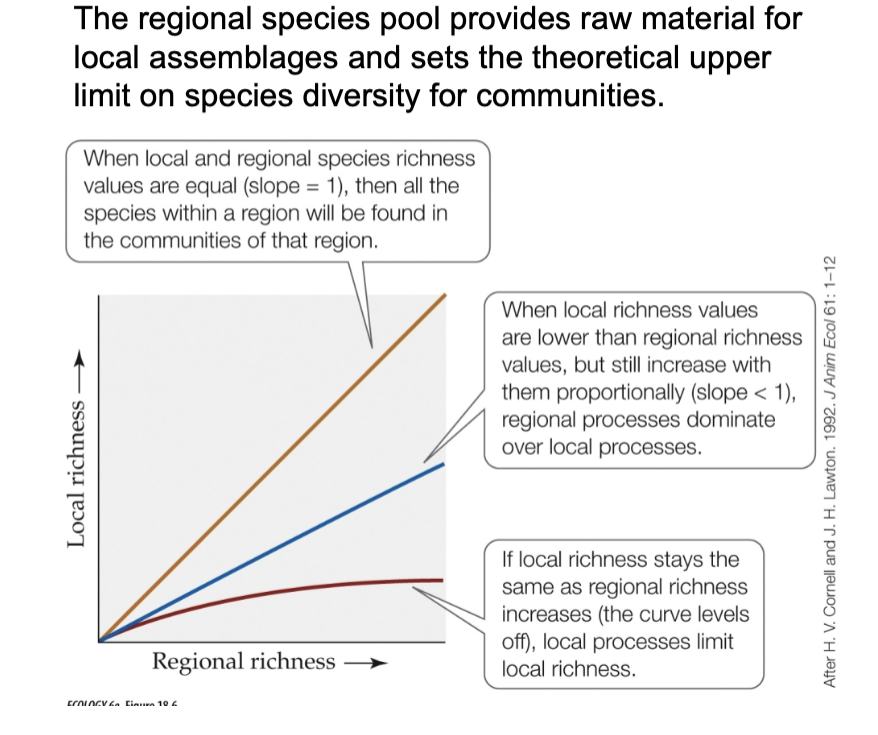
Marine Invertebrate Communities
Suggests that some communities may be limited by regional processes rather than local ones
What influences global diversity
Influenced by geographic area, isolation, evolutionary history, and climate
Alfred Russel Wallace
Known as the father of biogeography; he divided the world into six biogeographic regions
Latitudinal Gradient
Clear gradient where species diversity generally increases towards the equator
Continental Drift
Figures showing how the movement of tectonic plates over geologic time changed the positions of continents and oceans
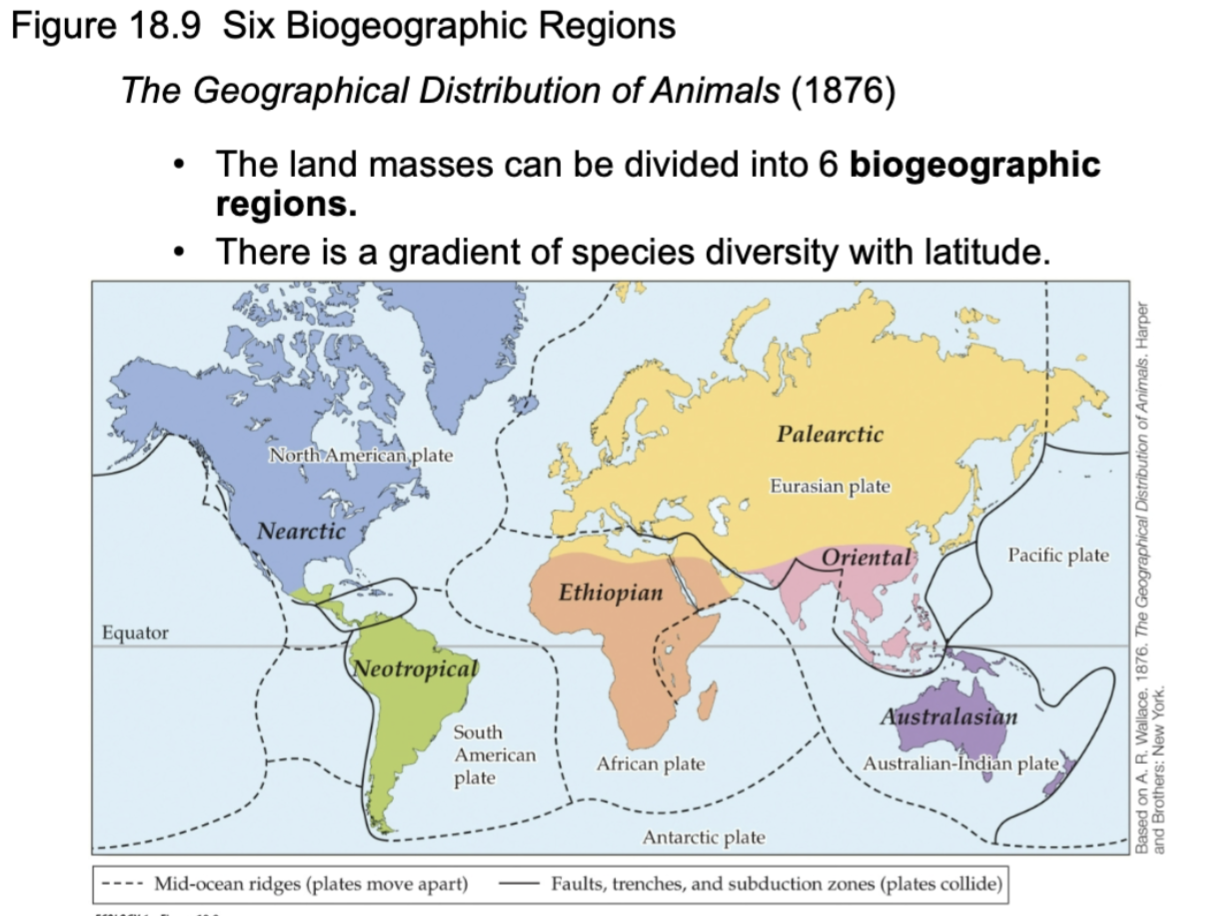
Figure 18.9
Map of the six biogeographic regions.
Regional Isolation
Neotropical, Ethiopian, and Australian regions have been isolated longest, leading to unique life. North and South America were isolated until ~6 million years ago.
Vicariance
The evolutionary separation of species by physical barriers like continental drift
Marine Biogeography
Challenges include water depth and lack of knowledge of deep oceans
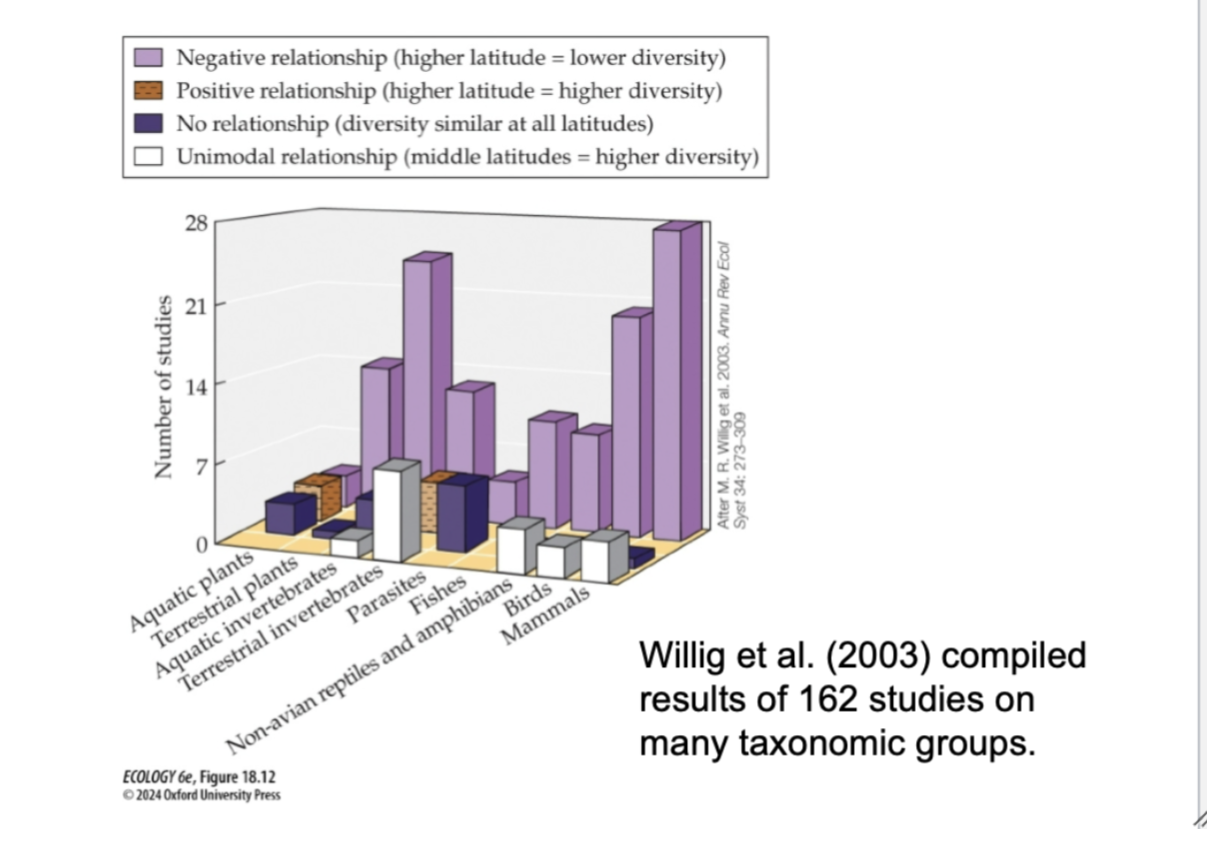
Confirming the gradient
Willig and colleagues (2003) tallied the results of 162 studies on a variety of taxonomic groups extending over broad spatial scales (20° latitude or more)
Considered whether diversity and latitude showed a negative relationship (with diversity decreasing toward the poles), a positive relationship (increasing toward the poles), a unimodal relationship (increasing toward mid-latitudes and then declining toward the poles), or no relationship.
Negative relationships were by far the most common.
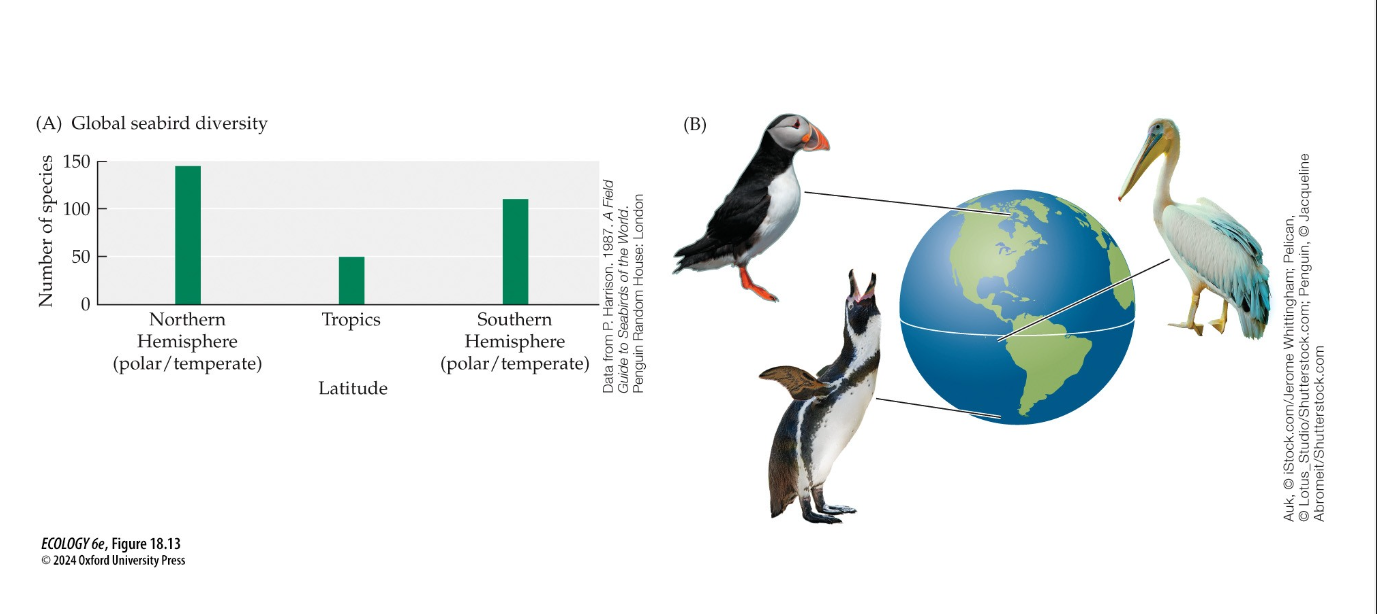
Seabird exceptions
Seabirds defy the latitudinal gradient, often showing higher richness at higher latitude and NOT AT TROPICAL CLIMATES.
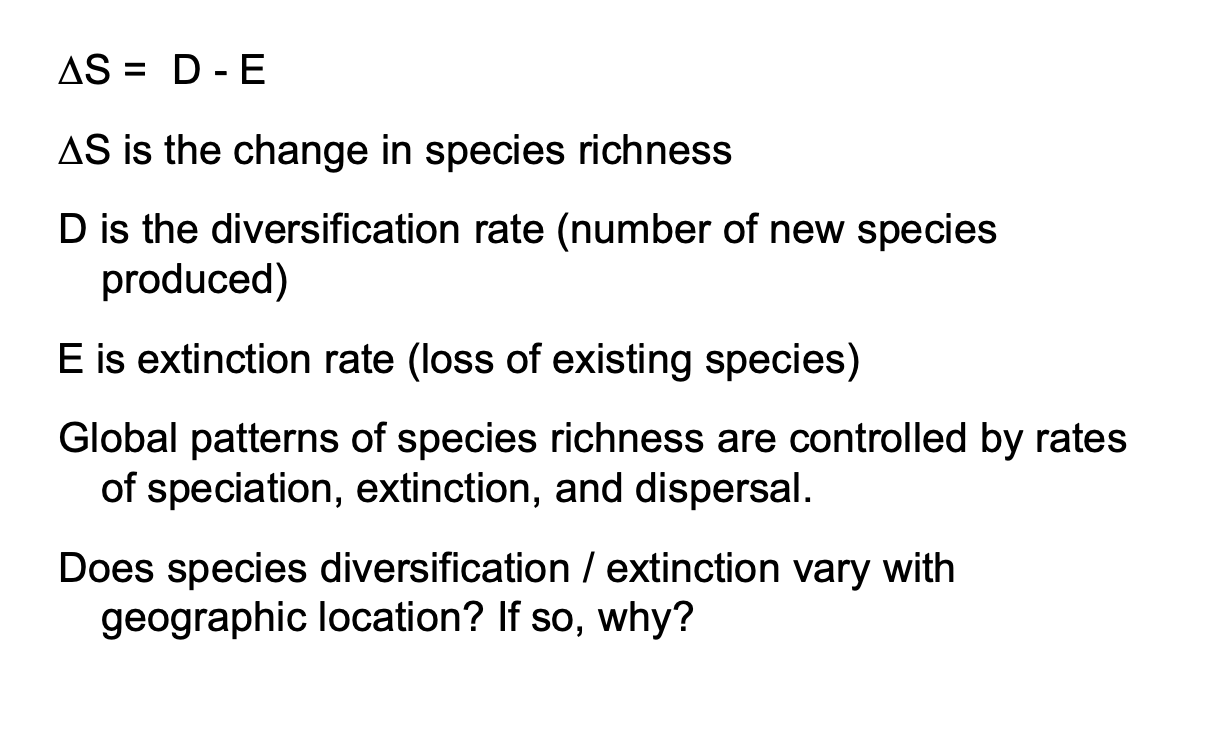
Global Richness Equations
ΔS=D−E (Change in richness = Diversification/Speciation - Extinction
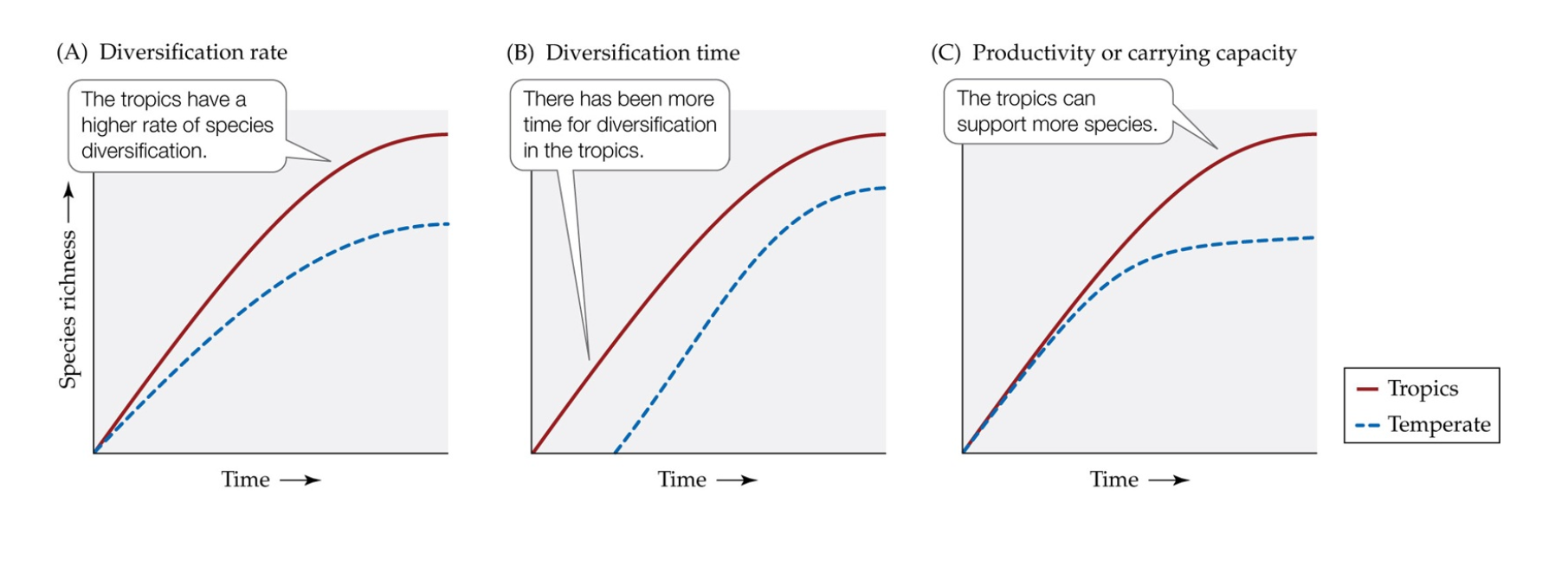
Explain the Latitudinal Gradient in Species Richness
Proposes Speciation Rate, Speciation Time, and Productivity as drivers for the latitudinal gradient
Species Diversification Rate
Tropics have the largest, most thermally stable land area, likely decreasing extinction and increasing speciation by isolation.
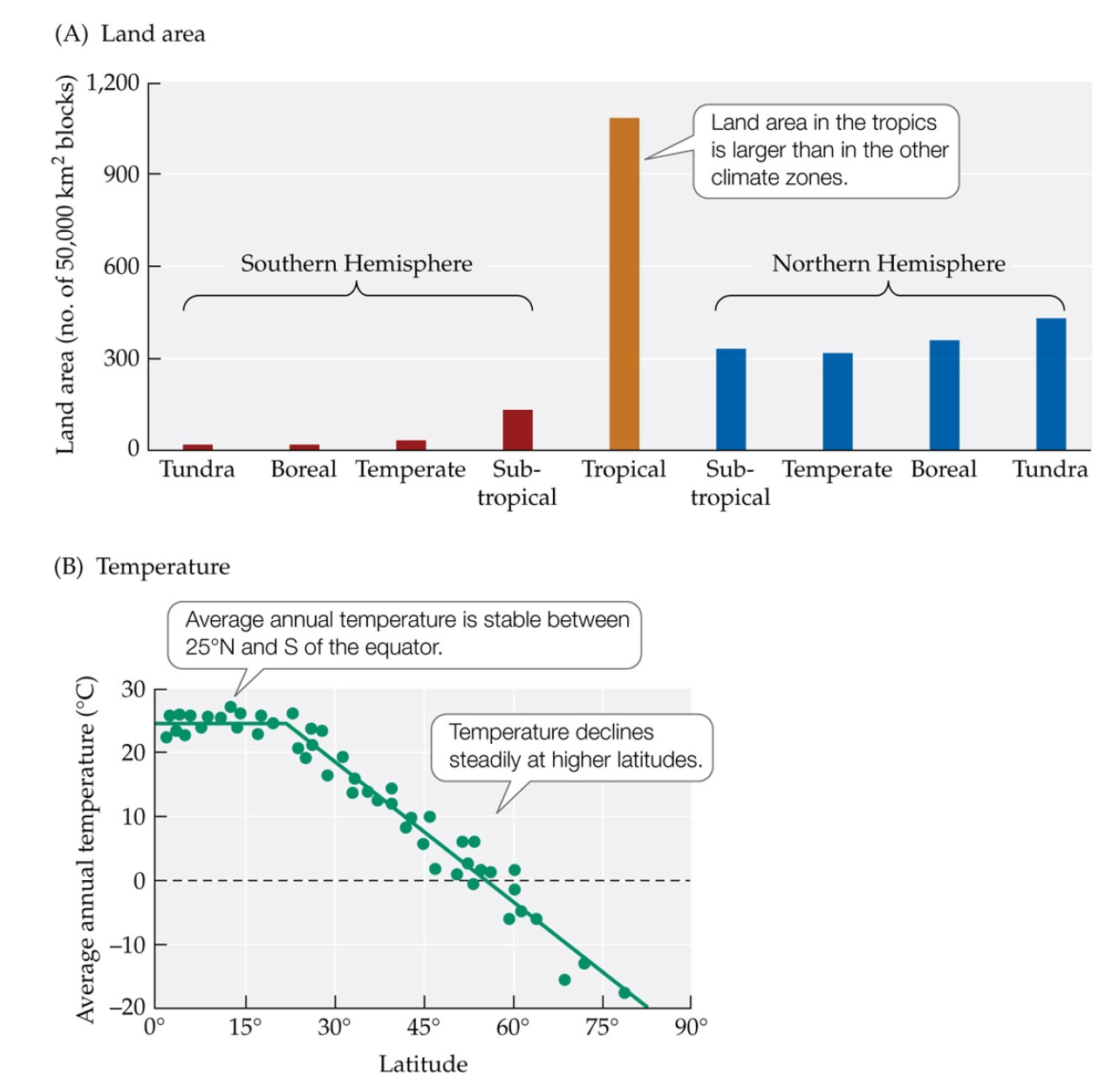
Land and Temperature Influencing Species Diversity?
Michael Rosenzweig hypothesized that two characteristics of the tropics lead to high speciation rates and low extinction rates: (A) their land area and (B) their stable temperature
Species Diversification Time
Tropics were climatically stable longer, allowing more time for evolution
Tropics as Source
Most species originate in the tropics and spread toward the poles; the tropics act as a "cradle" and a "museum"
Cradle - species originate in there and to other regions, primary source of new species
Museum - safe havens where older species persist
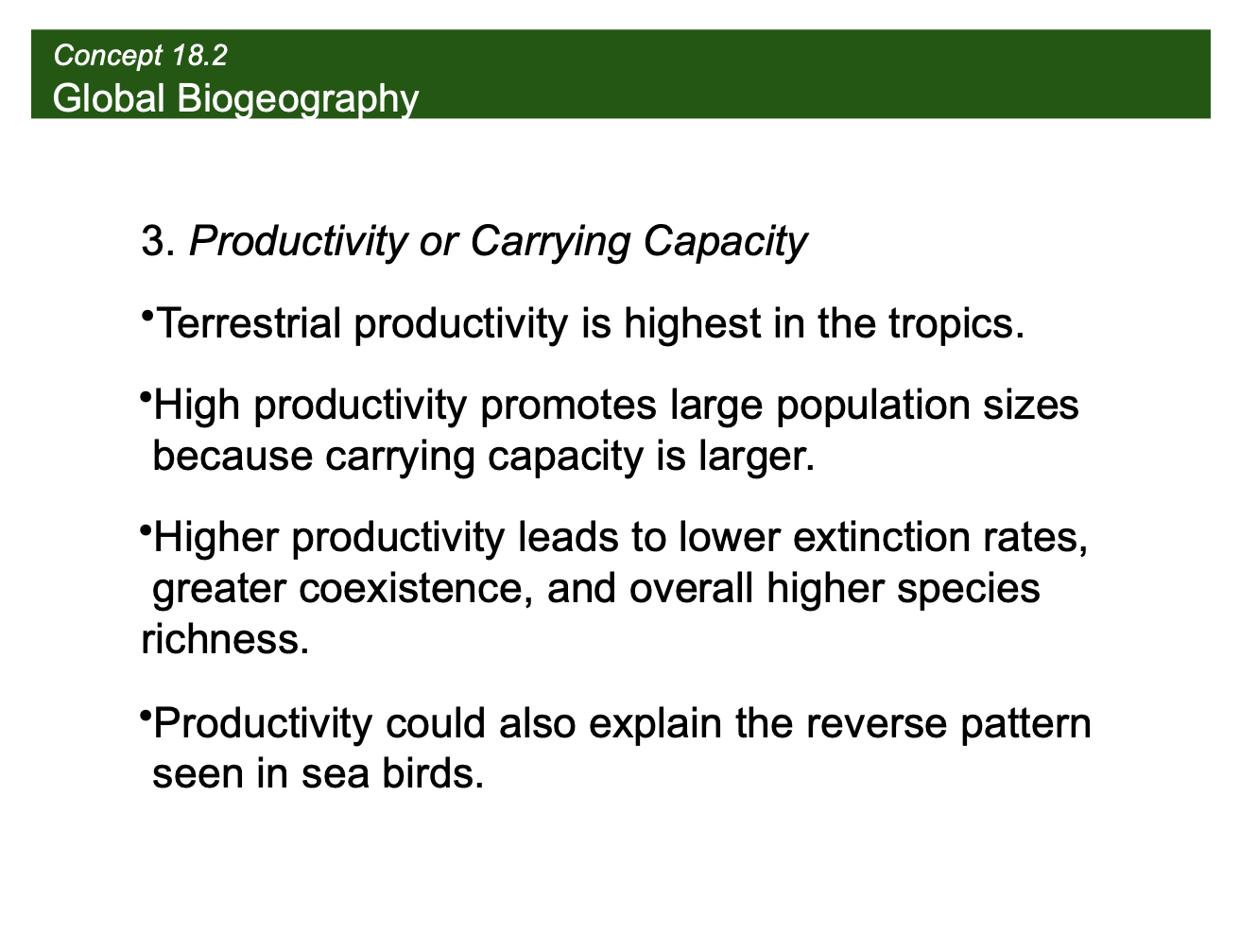
Productivity/Carrying Capacity
High tropical productivity supports larger populations, higher carrying capacity, and lower extinction rates
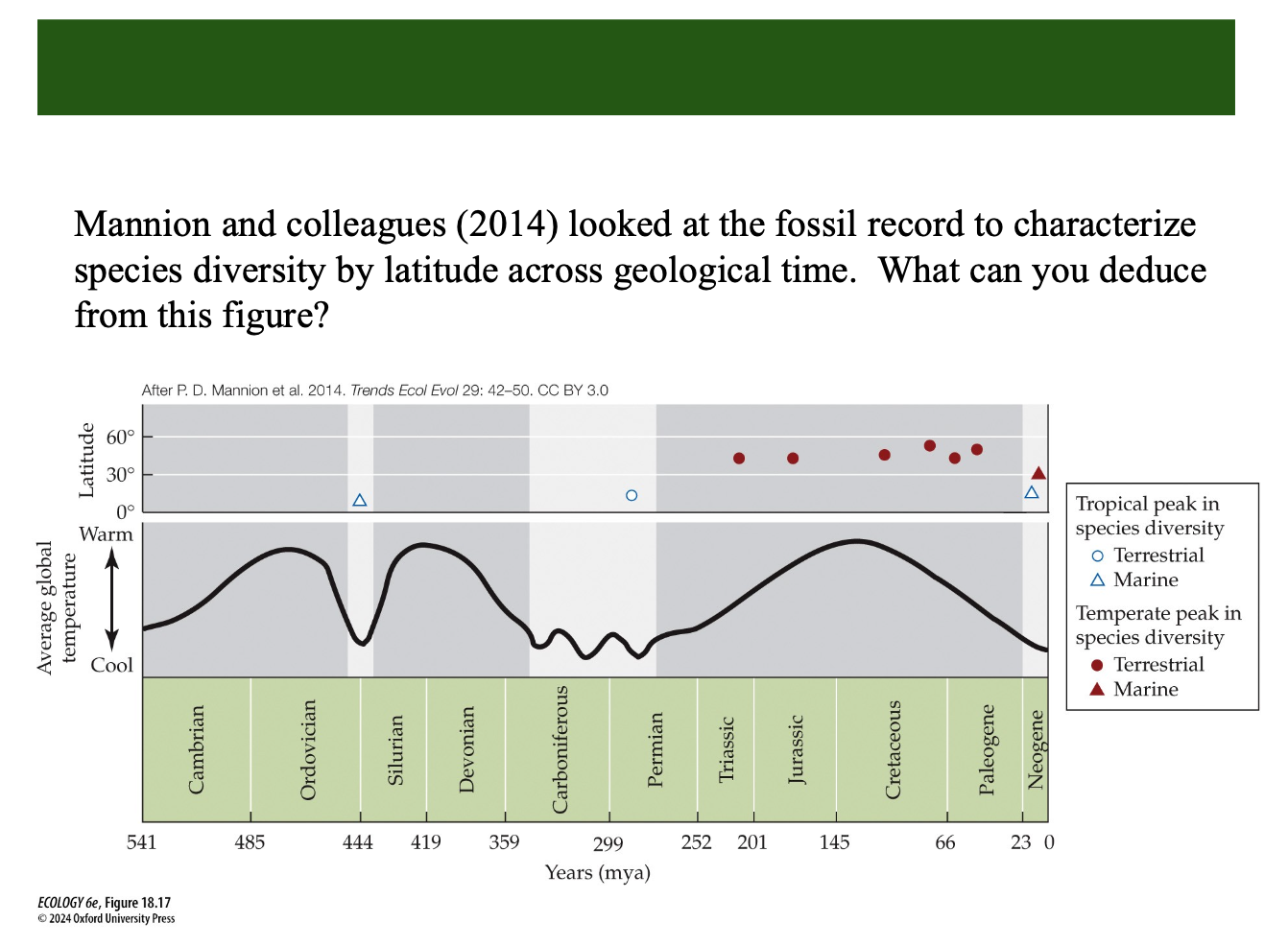
Fossil records
Shows that tropical diversity has been higher for most of Earth's history.
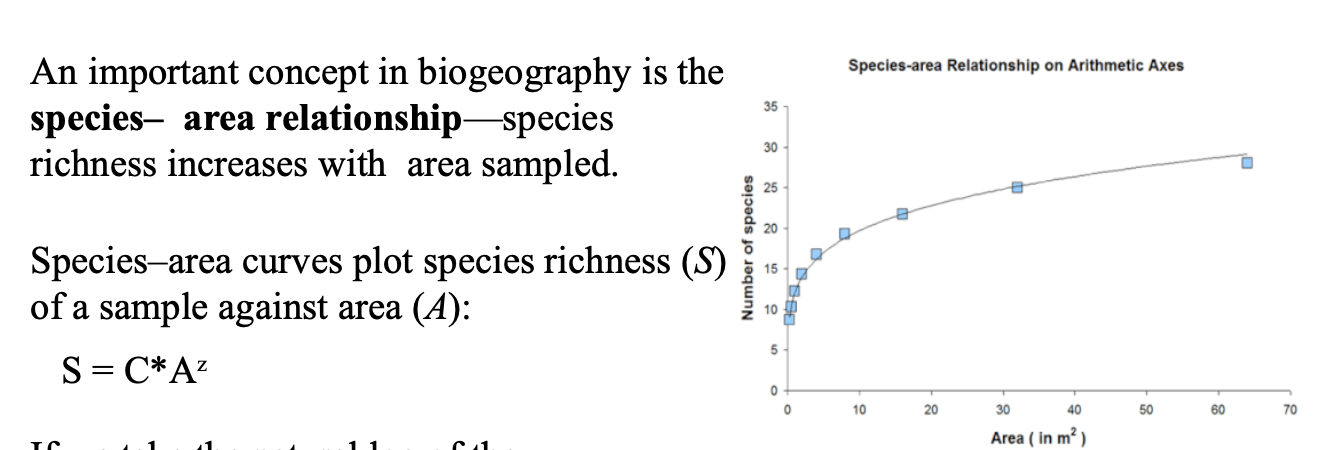
Species-Area Relationship
Formula: S=cA^z. As area (A) increases, species richness (S) increases
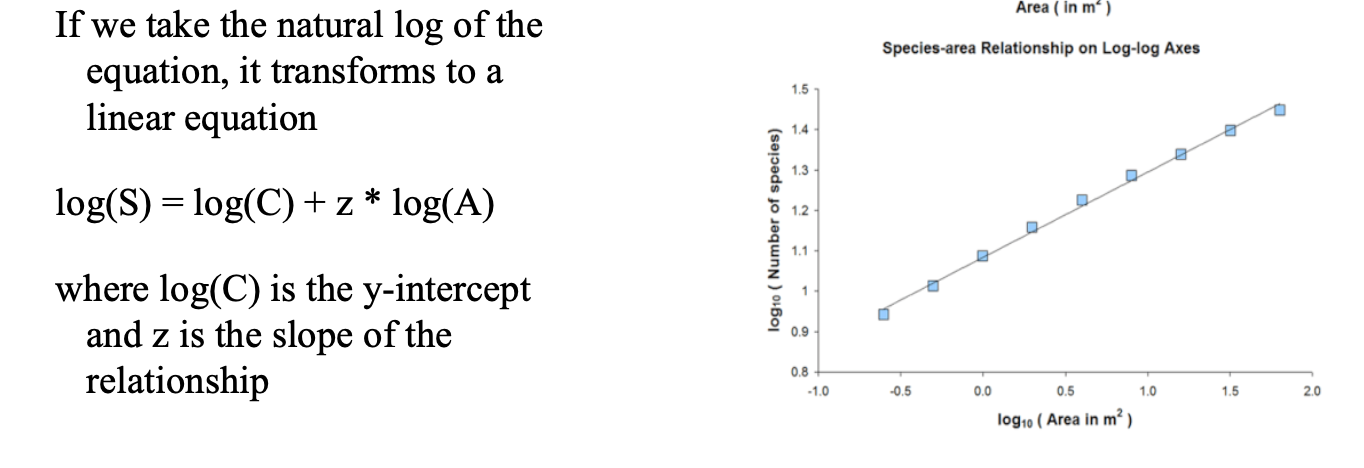
Log Transformation
Shows how scientists turn the curve into a straight line (logS=logc+zlogA) to calculate the slope (z).
HC Watson
Plotted first species-area relationship, using plants in the Great Britain…in 1859
Islands as Models
"Islands" aren't just in the ocean; they can be mountaintops or forest fragments.
Big islands vs small islands
Data showing that big islands have more species than small ones, and near islands have more than far ones
Equilibrium Theory
MacArthur and Wilson’s idea: Species number is a balance between Immigration and Extinction
Proves that as island size increases 10x, species count doubles
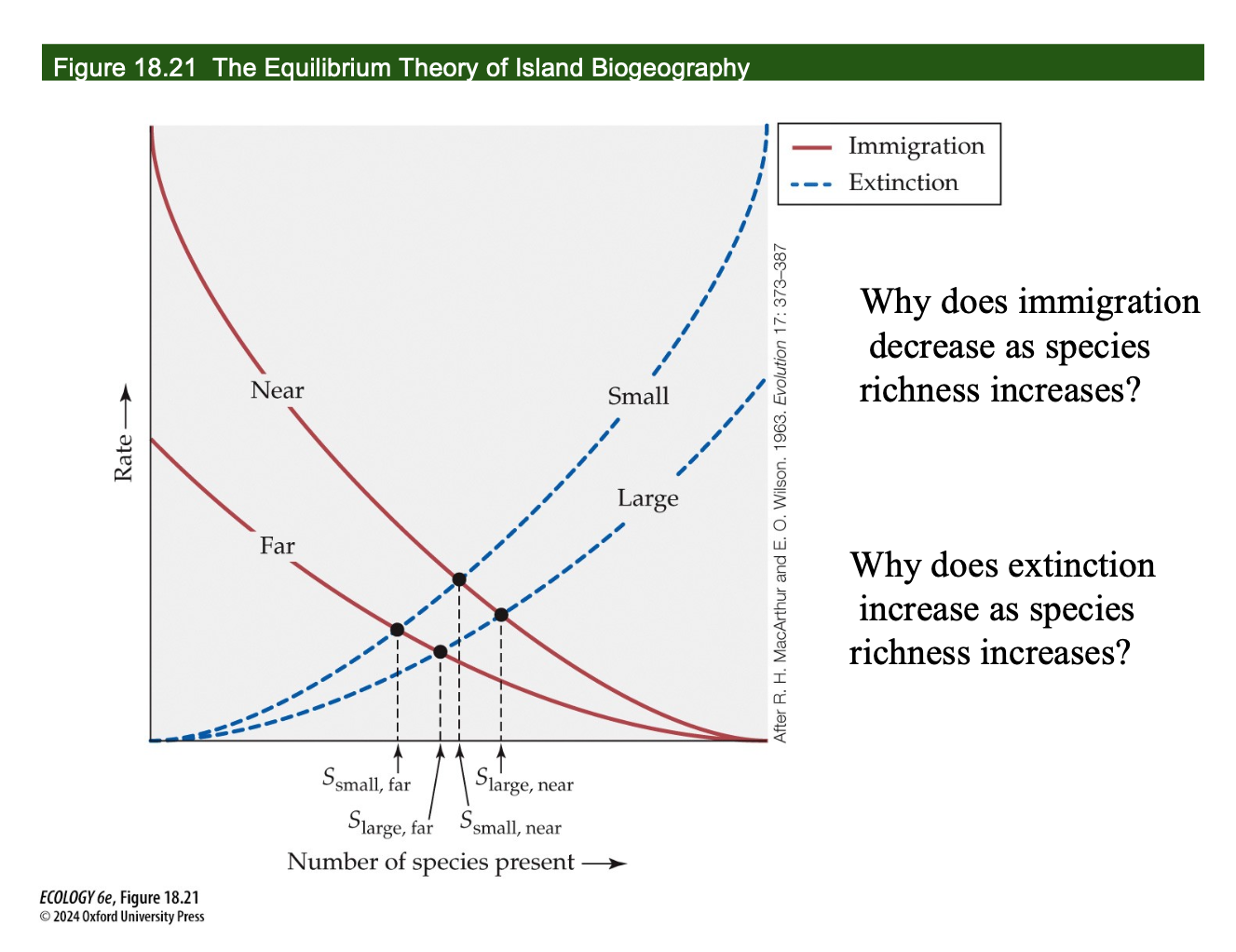
The Equilibrium Graph
dCrucial graph showing where Immigration and Extinction curves cross.
According to the Equilibrium Theory of Island Biogeography, the rate of immigration decreases as the number of species on an island increases for two primary reasons:
Fewer "New" Species: As more species become established on an island, the likelihood that a newly arriving individual belongs to a species that is not already present decreases. Eventually, every individual that arrives will belong to a species that is already a resident, bringing the immigration rate of "new" species to zero.
Reduced Opportunities for Successful Colonization: As species richness increases, competition for limited resources also increases. Incoming individuals find it more difficult to establish themselves in a community that is already crowded and biologically divers
Krakatau
A real-world test: Life returned to a volcanic island and reached a stable equilibrium of ~30 bird species
To test their theory, MacArthur and Wilson used
Krakatau as an example, and island that had a
violent volcanic explosion that killed everything on
the island.
Based on immigration and extinction rates from
multiple surveys, they predicted that the islands
could support ~ 30 bird species, with a predicted
turnover of 1 species per year
Mangrove Experiment
Simberloff & Wilson killed all insects on mangrove islands with insecticide to watch them recolonize.
Mainland vs. Island
Mainlands have higher immigration and lower extinction because there are no water barriers.
The Rescue Effect
Species on mainlands are less likely to go extinct because new individuals from nearby populations "rescue" them.
Habitat Fragmentation
A closing look at how human-caused "islands" in the Amazon impact biodiversity.