TEC -12 theories of emotion
 Call Kai
 Learn
Learn Practice Test
 Spaced Repetition
 Match
Match Flashcards
 Knowt Play
1/32

There's no tags or description
Looks like no tags are added yet.
Name | Mastery | Learn | Test | Matching | Spaced | Call with Kai |
|---|
No analytics yet
Send a link to your students to track their progress
33 Terms
EMOTION def
"Episodic, relatively short-term, biologically-based patterns of perception, experience, physiology, action, and communication that occur in response to specific physical and social challenges and opportunities" - Keltner & Gross, 1999 -obvs theres different ones but this one is decent This one looks at it as smth functional but they don't always have pos resultsConsider may be facial expressions, physiological response
"What emotions aren't
Moods - stronger, shorter lasting, more likely have a couse t affective disorders, or personality temperaments (these more defined by moods)
Components of emotion
Subjective feelings
Physiological response
Expressive behaviour (eg smile)
Appraisal
Action tendencies
(eg avoid)-consider what you can control, what can objectively studied
Why should we care about emotions
-women over 65 more likely than men to die of heart attack as doctors more likely to diagnose anxiety
-we think we are good at understanding others emotions
-being able to do this properly is importat
TSA spent million on training to tell if people risky by detecting small movements say smth about emotion
-understanding what is accurate is important to understand
THEORIES OF EMOTION
1. Evolutionary 2. Appraisal 3. Psychological constructionist
COnsider theories of emotions in terms of what they believe about
• Antecedents of an emotion (what causes them)
• Biological givens (innate emotional capabilities)
• The integration of emotional experience (how components of emotion fit together)
Evolutionary
• Evolutionary approaches are based in the writings of Darwin (1872)
• Observational approach: human and animal emotional expressions (darwin did)
• Argued for universality and functional adaptation (emotions as beneficial - disgust of rotten food = avoid , in us or others ,communication)
EVOLUTIONARY: ANTECEDENTS
• Emotions arise when we detect a threat to survival, or an opportunity for reproduction
• Signal stimuli: indicate an adaptive problem (e.g., a high cliff, a
potential mate)
• Emotions associate with action tendencies - how likely to act to survive - but not necessary, body is prepared to run in fear but can supress and not run
EVOLUTIONARY: ANTECEDENTS theory
• Plutchik (1980): theory of actions taken in response to adaptive problems, their associated emotions, and outcomes.
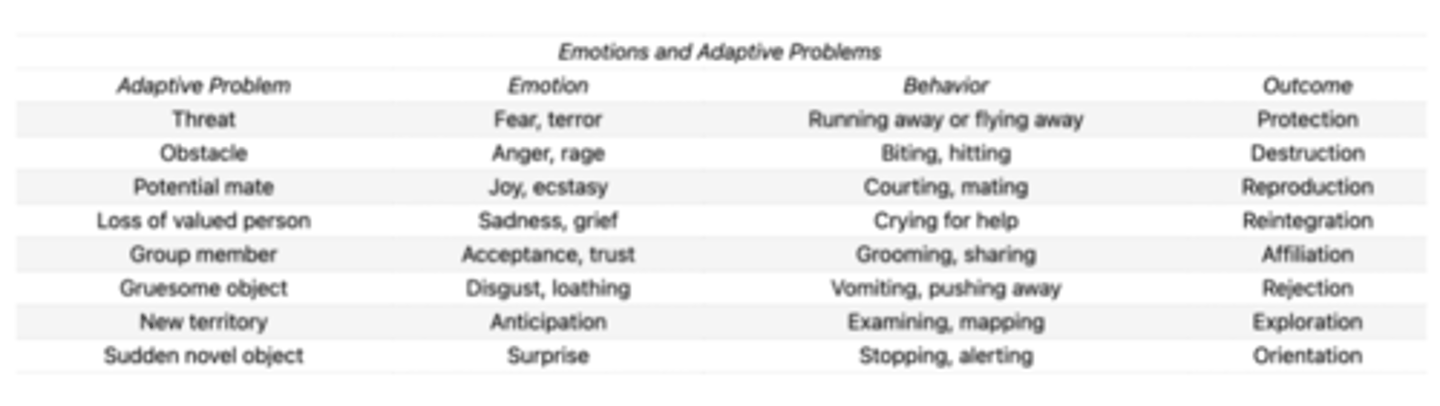
Basic emotions (evol)
Innate, quick, and automatically caused by signal stimuli
• Universal expression (eg cross-culturally)
• Discrete physiology (in the body fear should loook one way hapiness another
• Presence in other primates -evolutiion
• Automatic evaluations of the environment -quick
This theory acknowledges emotions other than these but simply made up of other emotions
-like combining of rods disgust + sadness may lead to regret
Ekman basic emotions research
Showed pictures of basic emotions to tribe in Papa New Guniea
There was some consistency (happiness most consistent disgust and fear harder)
However quite controversial (forced choice, just 2 cultures, similiarity vs universality, posed prototypes, recognition vs production
Basic emotions research overview
• Evidence to suggest that emotions are recognized and produced cross- culturally
• Methodological concerns, however.
-consistent big 5 (not surprise , i think)
Basic emotions physiological evidence
Levenson, Ekman, and Friesen (1990)
• Directed Facial Action Task: participants asked to contract specific muscles in their face
-measured heart rate and skin conductance
• Allows expression of emotion, without specific reference to it
-different emotions showed different physiological responses but some look quite similar - is their a distinct response
• Replicated in Indonesian participants who lived in isolation from Western Culture (Levenson et al., 1992)
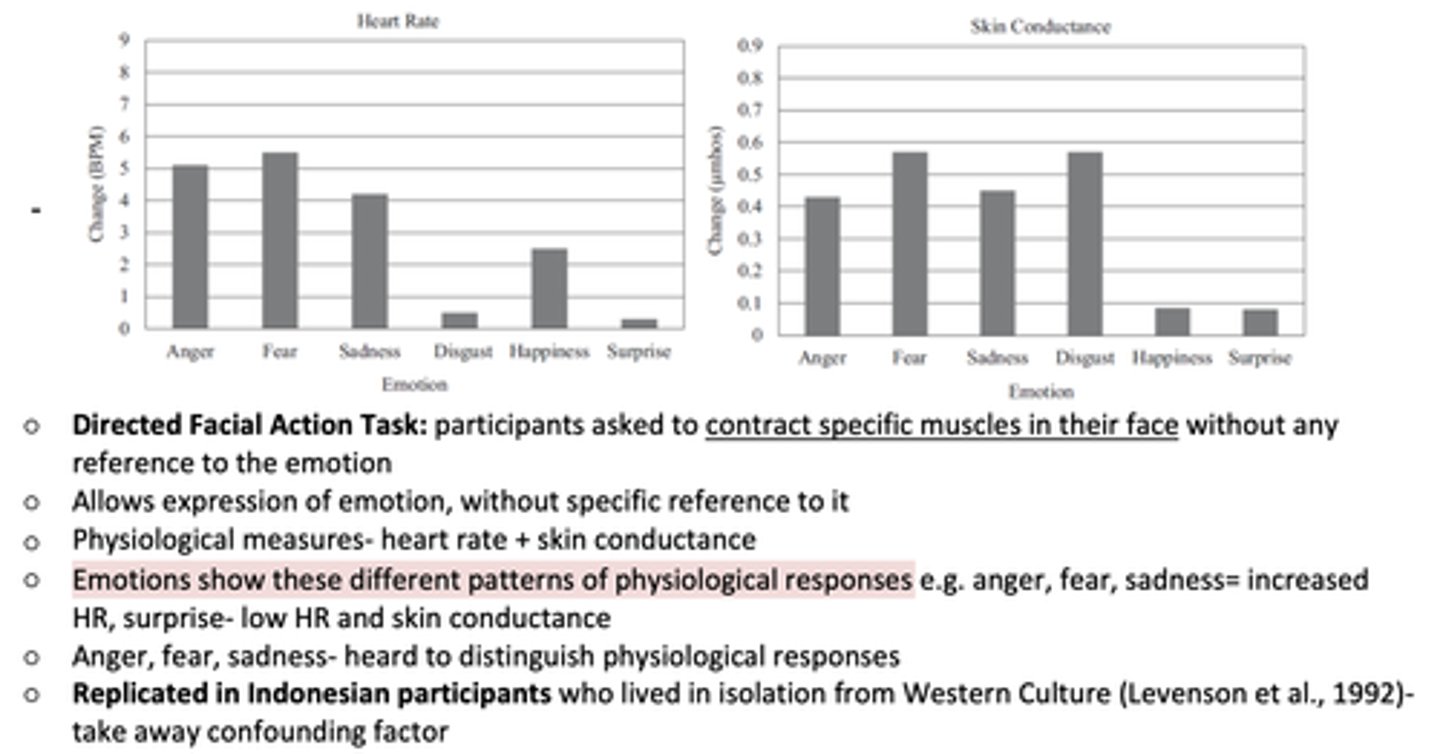
emotions + physiological response
• Anger > blood flow to arms and hands (fight)
• Fear > blood flow to legs and feet (run)
• Happiness > neurotransmitter release, dampening effects of negative emotions
• Disgust > triggers gag reflex, restricts airflow to olfactory receptors
How components of emotion fit together in evolutionary
Affect programmes -distinct program for each of the basic emotions where all the components co-occur (eg emotional expression, phsyiological, appraisal)
The innate and automatic emotional responses triggered by specific
environmental stimuli, which lead to physiological and expressive reactions.
Triggered by a singal stimuli and leads to emotion
• Affect programs are innate, but can change to include knowledge gained through individual experience (Ekman & Cordaro, 2011)
-body is pre sent to know what to do
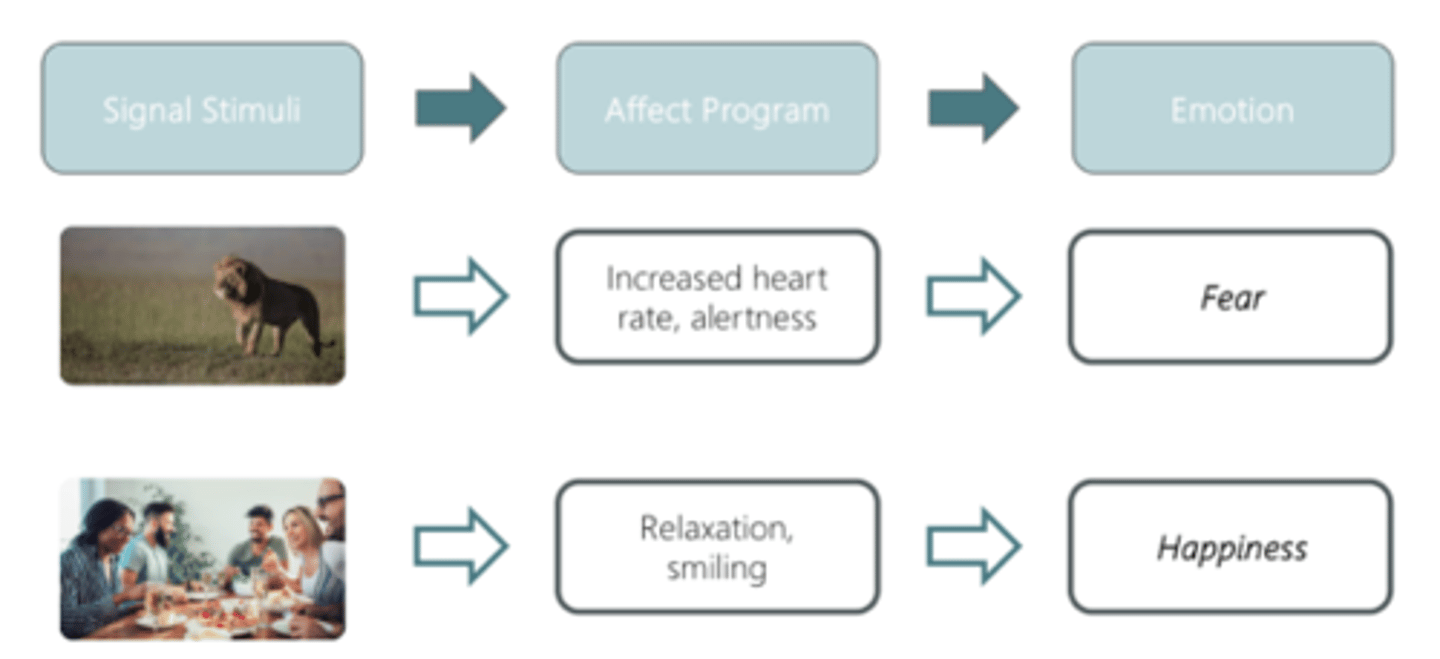
EVOLUTIONARY: SUMMARY
• Antecedants of an emotion (what causes them):
-Signal stimuli (threat to survival, opportunity to reproduce)
• Biological givens (innate emotional capabilities):
-Basic emotions (universal, discrete physiology, automatic)
• The integration of emotional experience (how components of emotion fit together):
-Affect programs (co-occurrence of emotion components)
APPRAISAL THEORIES: ANTECEDENTS
• Emotions are determined by how an individual appraises their circumstances
• Very few stimuli cause the same emotion in everyone
• Appraisal: mental process which allows detection and evaluation of stimuli and how they affect your well-being
-unlike evolutionary theory
appraisals are
unconscious, but part of them can become conscious
not as simple as good vs bad
• Occurs along dimensions, not dichotomous
apriasal theories explain/determine
-Explain the variation in emotional life
-Determine the intensity and quality of components of emotion
example of appraisal theory
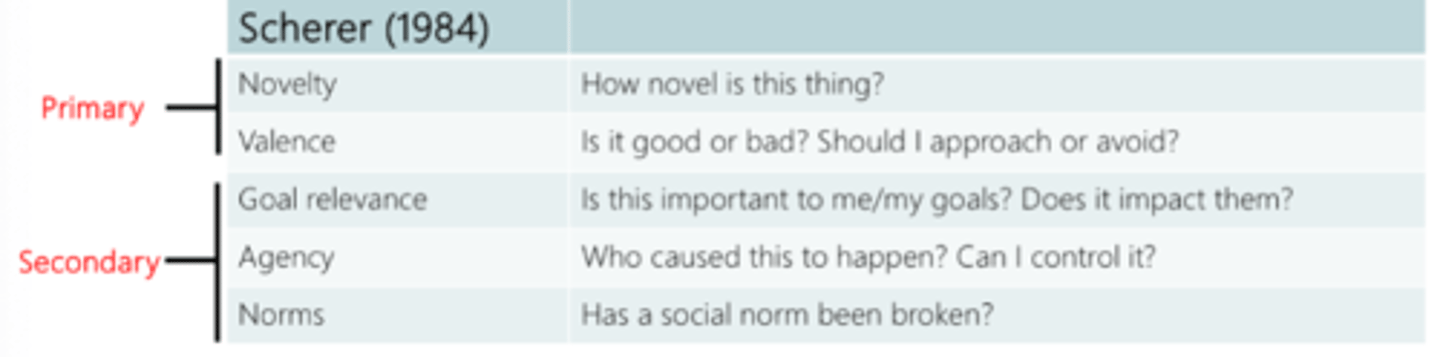
Scherer (1984) - just one appraisal theories there are many
Eg fear
-high novelty, low valence, goal relevance depends, lack of angency, norms broken
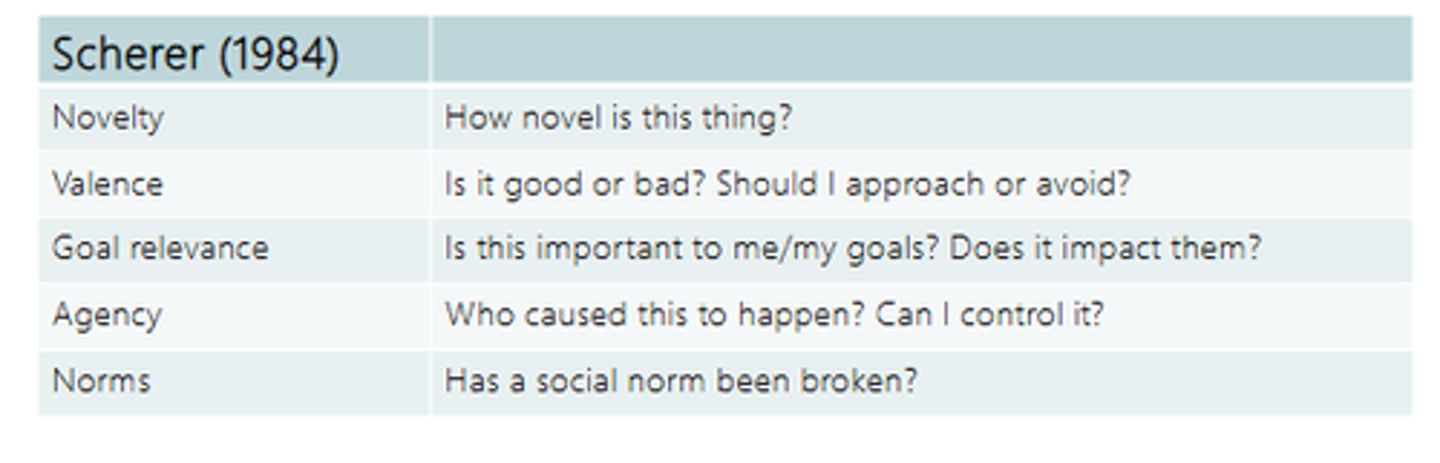
appraisal evidence airport
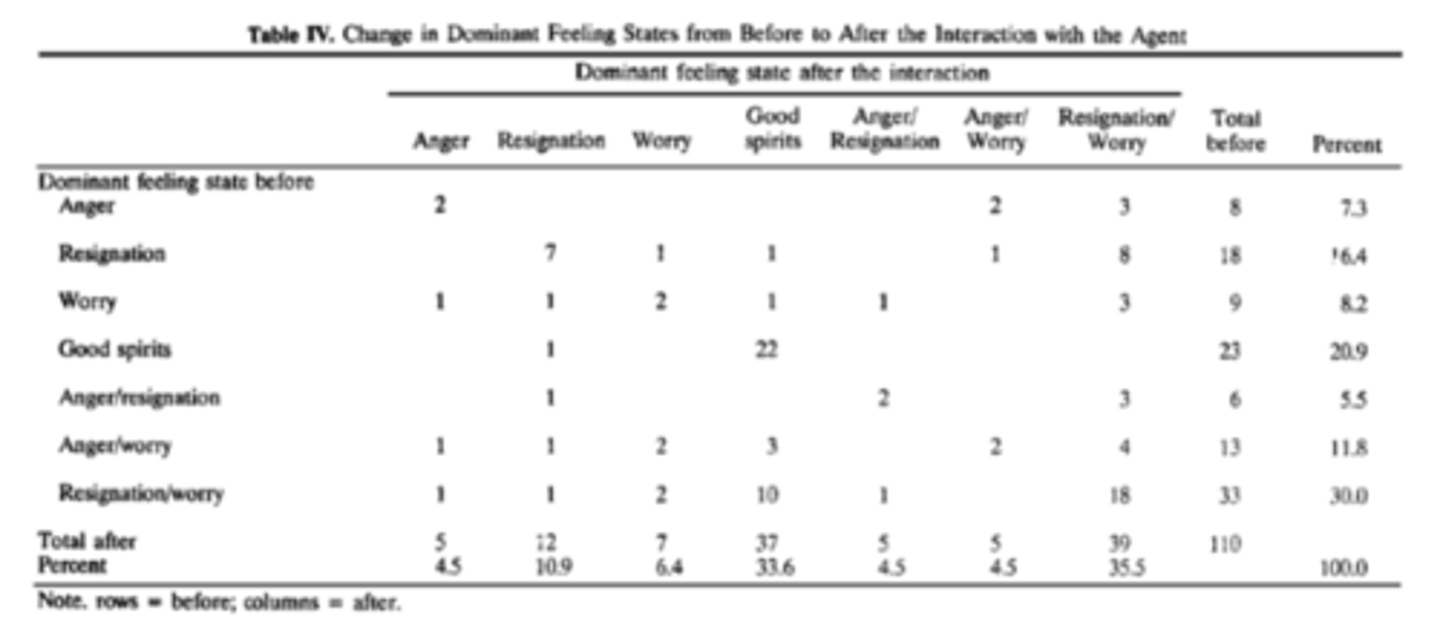
Scherer & Ceschi (1997)
• Researchers conducted interviews with people who had genuinely lost their luggage at the airport (before and after luggage desk)
Asked about appraisals non-directly:
e.g., novelty = did it occur to you that your luggage might have been lost?
-more ecologically vaid thenusing vingettes like lots of appraisal research
Scherer & Ceschi (1997) airport results
• Variation in emotions experienced following the same event
• Goal relevance best predicted emotions (high more likely anger/worrying)
-people who strted in good spirits styed in them
-some people became in better spritis after going desk
-ager predicted by norms + lack or control - not their fault
APPRAISAL THEORIES: BIOLOGICAL GIVENS
Scherer (2001) argues for a distinction between primary and secondary appraisals
• Primary = fast, clear-cut, innate (snake= dangerous)
• Secondary = higher-order, learned (snake = not poisonous)
emotions coming together appraisal theory
Stimulus Appraisal Emotion
All emotion components do not necessarily occur together
-different apraisals can cause different aspects of emotional experience
lab evidence for not co-occur
Reisenzein, Studtmann, & Horstmann, 2013:
• Review of lab-based evidence of the relationship between reported feelings and appearance of specific facial expressions.
• Emotions and expressions did not reliably co-occur
-but consider methodology of being in lab setting
APPRAISAL THEORIES: SUMMARY
• Antecedents of an emotion (what causes them):
Specific appraisal patterns (can differ across people)
• Biological givens (innate emotional capabilities):
Valence and novelty appraisals
• The integration of emotional experience (how components of emotion fit together):
Components are independent
PSYCHOLOGICAL CONSTRUCTIONISM: ANTECEDENTS
"Emotions are not reactions to the world - you are not a passive receiver of sensory input, but an active constructor of your emotions"
Feldman Barrett, 2017
• Specific emotions are caused by applying learned categories to experience
• Categorization: Mental process by which we take experience and give it meaning
-learning what sadness looks and feels like so can cateorise experiences as this
• Can explain (and predicts) cross cultural variations
• Categories are based on the individual's learning history, culture, and current context. They contain varied examples
-your expeirence of fear might not be prototypical
psychological consturcitivism example
Stomach ache can be interpruted as many different things depending on the situation
• Evolutionary theory might argue that attraction and feeling sick should have distinct physiological profiles
-psychological constuctivism allows for their to be ooverlp
PSYCHOLOGICAL CONSTRUCTIONISM: BIOLOGICAL GIVENS
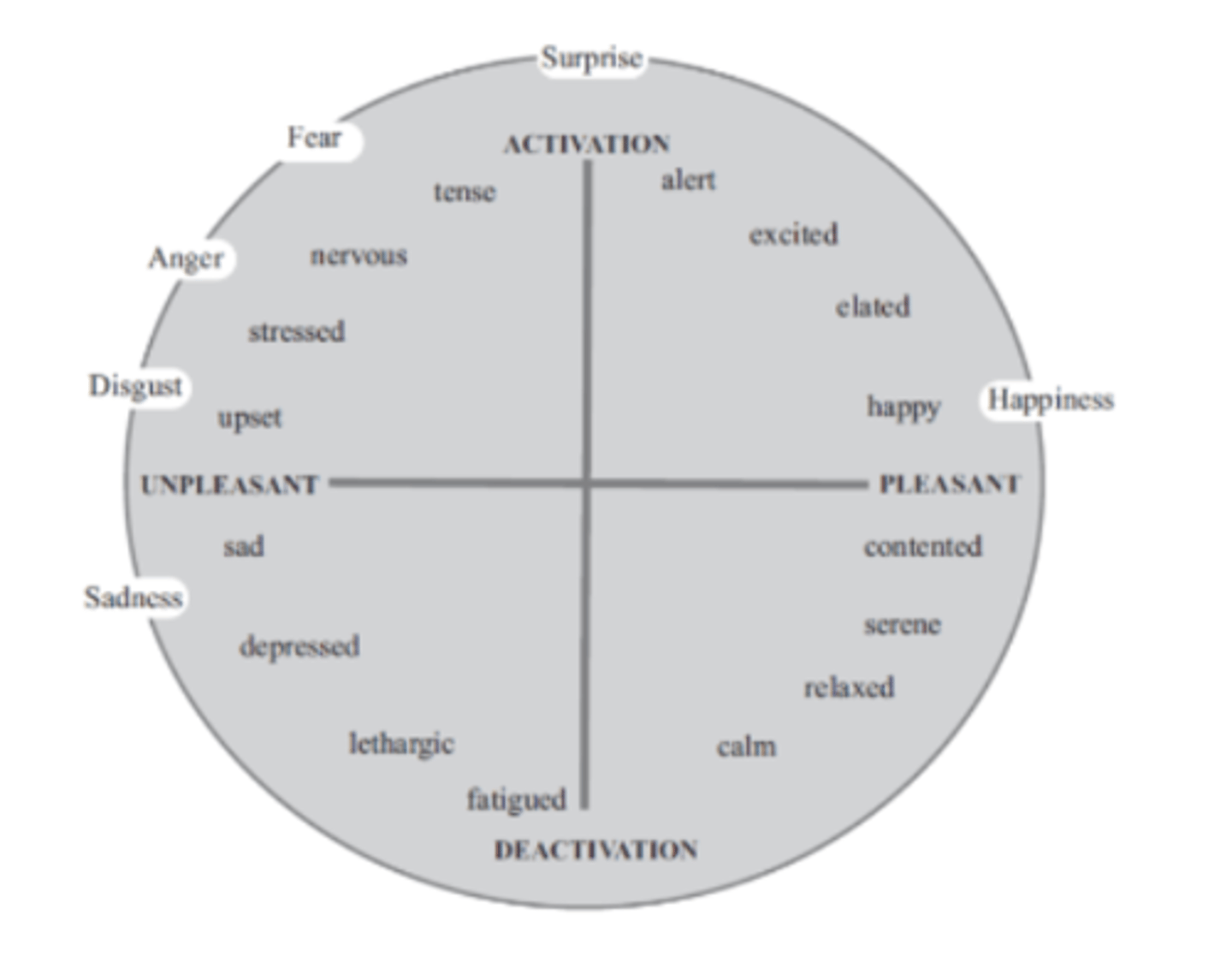
Core Affect (underlying state in body)
Composed of two dimensions:
• Valence: pleasant vs unpleasant
• Activation: activated vs deactivated (arousal ish)
= Current affective state
Can be a mood, an emotion, a symptom, a body state, or an evaluation
Clinicaal implication of psychological constructivism
➢ Alexithymia (difficulty explaining emotion), more likely to describe things somatically than emotionally eg sickness rather than anxiety
➢ Anxiety, depression - tendency to over chatecrise things as moods than body states low rather than fatigued
psych con hunger study
MacCormack & Lindquist (2019)
• Participants rated hunger, shown context image, then asked to rate
pleasantness of pictograph (separate image to the affective content shown afterwards)
• With increasing hunger, increased unpleasantness ratings but only with negative context (image)
• Participants conceptualized their affect as negative feelings when made meaningful in a negative context
psychological constructionism: bringing together
Constructionism as an integrated framework
• Core ideas in constructionist approach to emotion:
1. Emotions don't have fingerprints (based on what weve learnt)
2. The emotions you experience are not inevitable consequences of your genes
Stimulus to core affect to categorisation to emotion
- Whether facial expression, autonomic activity, or specific mental processes occur depends upon the category that is used to construct an emotion in the situation in which it is occurring
e.g., happiness with partner, you might be very likely to smile because your specific experience of happiness in the situation involves communicating the happiness with the other person. Some of your experiences of happiness when alone might not include smiling
PSYCHOLOGICAL CONSTRUCTIONISM: SUMMARY
• Antecedents of an emotion (what causes them):
Categorization of affect responses
• Biological givens (innate emotional capabilities):
Core Affect
• The integration of emotional experience (how components of emotion
fit together):
Components are independent