APES vocab -- exam review assignment
 Call Kai
 Learn
Learn Practice Test
 Spaced Repetition
 Match
Match Flashcards
 Knowt Play
1/55

Earn XP
Description and Tags
1 point for every 5 terms (max 15 pts) yayyy
Name | Mastery | Learn | Test | Matching | Spaced | Call with Kai |
|---|
No analytics yet
Send a link to your students to track their progress
56 Terms
unit 1— climate
the average weather that occurs in a given region over a long period of time
unit 1— weather
short-term conditions of the atmosphere in a local area (temp, clouds, wind, precipitation, etc)
unit 1— symbiosis
two species living in a close and long-term association with each other in an ecosystem
unit 1— biosphere
the region of our planet where life resides (combination of all of earth’s ecosystems)
unit 1— competitive exclusion principle
says that two species competing for the same limiting resource cannot coexist (one must go extinct)
unit 1— parasitoid VS parasitism
a type of predator (that lays eggs inside another organism, the host) / a type of species interaction (where one organism lives on/in another)
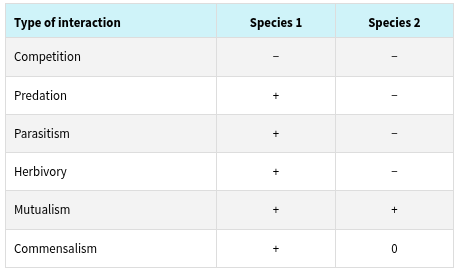
unit 1— commensalism
interaction b/w 2 species where one benefits and the other is not harmed or helped (😊+😐)
unit 1— exotic/alien species VS invasive species
a species living outside its historical range (were introduced to a new area) / a species that spreads rapidly across large areas and causes harm
unit 1— biome VS habitat
the organisms that are found in a particular region of the world / an area where a particular species lives (both: land or water)
unit 1— littoral zone
shallow zone in lakes/ponds; soil, water, most algae and emerging plants (cattails)
unit 1— limnetic zone
open water in lakes/ponds, the deepest zone sunlight can reach; only phytoplankton is found here
unit 1— profundal zone
sunlight cannot reach this zone
unit 1— benthic zone
the muddy bottom of a lake/pond/ocean
unit 1— oligotrophic VS mesotrophic
lakes w little phytoplankton bc of little nutrients (low fertility) / lakes w a moderate level of fertility
unit 1— estuary
area along the coast where fresh water (rivers) mixes with salt water (ocean)
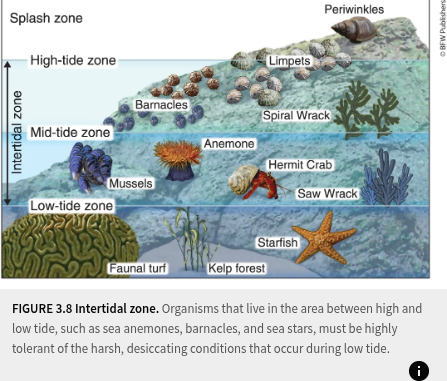
unit 1— intertidal zone
narrow band of coastline; exists b/w high and low tide
unit 1— coral reef
diverse marine biome; warm, shallow waters
unit 1— open ocean
area of deep-ocean water, sunlight cannot reach the bottom
unit 1— photic zone VS aphotic zone
upper layer of ocean water that gets enough sunlight for photosynthesis / deeper layer of ocean that doesn’t get enough sunlight for photosynthesis
unit 1— chemosynthesis
some bacteria use this process to generate energy w methane and hydrogen sulfide (w/o sunlight— in aphotic zones)
unit 1— biogeochemical cycle
movement of matter w/in and b/w ecosystems; involves biological, geological, and chemical processes (reservoirs=components of the cycle that contain the matter (inc. air, water, animals))
unit 1— ecological efficiency
proportion of consumed energy that can be passed from one trophic level to another (10% rule: overall, only around 10% of biomass is converted into energy)
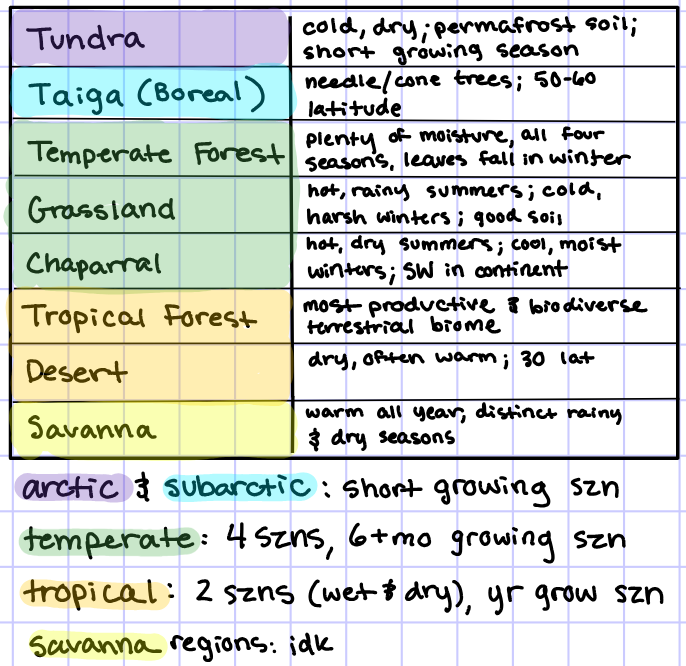
unit 1— different biomes
biomes are big ecosystem types, large regions of similar climate and plant communities, named based on climate and community
unit 1— different interactions b/w species
unit 1— ecotone VS landscape ecology
boundary zone blending two ecosystems (high in diversity; can be dynamic aka unclear… like tidal zones) / how ecosystems interact (study of)
unit 1— photosynthesis VS cellular respiration (equations)
6CO2 + 6H2O + sunlight —> C6H12O6 + 6O2
C6H12O6 + 6O2 —> 6CO2 + H2O + ATP (energy)
unit 1— layers of the atmosphere (closest to farthest)
Troposphere (weather; gets colder), Stratosphere (good ozone; gets warmer), Mesosphere (gets colder), Thermosphere (auroras; gets really warm really fast), Exosphere (very warm)
unit 2— allopatric speciation VS sympatric speciation
a geographic isolation causes a new species to evolve that can’t produce offspring w the original species / a new species evolves from another older species in the name region via reproductive isolation
unit 2— fundamental niche VS realized niche
an organism’s niche (role; attributions) w/o limiting factors (predators, habitat challenges, food supply, etc) / an organism’s realistic niche; competitor species and limited resources included
unit 2— resistance VS resilience
measure of how much a disruption affects the energy/matter flow / rate at which an ecosystem can return to it’s original state after a disruption
unit 2— why Madagascar, a biodiversity hotspot, has a lot of endemic (only found there) species
genetic isolation, (stable) climate, habitat diversity
unit 3— k-selected species VS r-selected species
have few offspring that they take good care of and often live a long time VS have many offspring and do not provide much care, significant mortality rate
unit 3— overshoot and die-off
when a population increases too rapidly and surpasses carrying capacity, then a bunch die bc limited resources and dip below carrying capacity
unit 3— type I VS II VS III survivorship curve
individuals live a long time (k-selected) / population decreases consistently (linear) / many die at a young age but those who survive, survive a long time (r-selected)
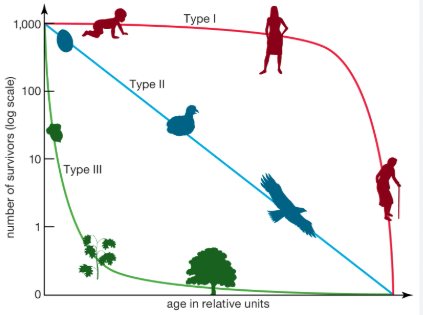
unit 3— example of a density dependent factor
disease
unit 3— J curve VS S curve
exponential growth of a population / logistic growth of a population; initially exponential but slows then reaches carrying capacity (K)
unit 3— equation for population growth rate
((CBR + immigration) - (CDR + emigration)) / 10
unit 3— equation for environmental impact
Impact = Population x Affluence x Technology (pop has biggest effect)
unit 10— pros and cons of geothermal energy
P: renewable and non-depleting, no greenhouse gas emissions, no intermittency
C: very site-specific, minor sulfur emissions
unit 10— pros and cons of wind energy
P: renewable and non-depleting
C: kills birds/bats, intermittency, site-specific
unit 10— pros and cons of solar energy
P: renewable and non-depleting, no emissions, abundant materials and have few parts
C: intermittency, 20% efficient, small radius for storage and transport of electricity, construction can release toxic chemicals
unit 9— pros and cons of nuclear energy
P: fewer emissions (no carbon output) [[[[tehre’s gotta be more man
C: depletable, storage/disposal of radioactive waste, thermal pollution, upfront costs, accidents are very dangerous
unit 12— pros and cons of landfills
P: convenient, toxic waste in contained, better than unregulated dumping
C:
unit 12— pros and cons of incineration
P:
C:
unit 12— pros and cons of recycling
P:
C:
tidal energy VS hydroelectricity
uh hyd offers flood portection
active solar E VS passive solar E
capture energy from sunlight (via pump/photovoltaic cell) to generate electricity / lower electricity usage strategically; mechanical devices (like fans), south-facing windows, tree placement, roof design, certain building materials
unit 9— energy VS power
ability to do work (joules) / rate at which work is done (Watts aka joules per second)
unit 9— equation for energy
E = P x t
unit 9— kilowatt hours
a unit of energy
unit 9— an energy source that does not originate from solar (3 options)
nuclear, geothermal, tidal
unit 8 and 9— EROEI (Energy Return on Energy Investment) VS Energy Subsidy
Eout / Ein / Ein / Eout
unit 9— coal (formation, use, reserve locations, drawbacks)
old forests; electricity generation (heat, steam turbine, scrubbers); US, Russia, China, Australia, India;
unit 9— natural gas (formation, use, reserve locations, drawbacks)
g THEYRE PLAYING MY SONG! RIO RIO O O RIO RIO RIO RIO O!
unit 9— petroleum (formation, use, reserve locations, drawbacks)
p
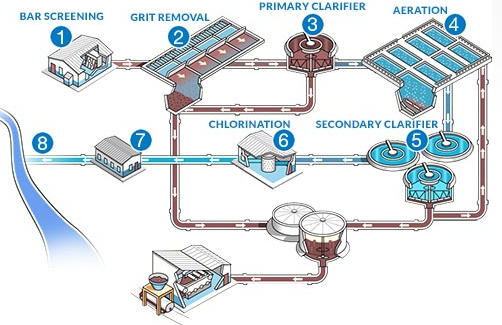
process of wastewater treatment
Bar screening (remove large items), screening/grit removal, primary clarifier (separates organic matter), aeration (air is added to convert NH3 to NO3 and provide oxygen for bacteria), secondary clarifier (remaining organic matter settles and separate), chlorination/disinfection (kills bacteria), analysis/testing (pH, DO, and other chemicals), effluent disposal (clean water is reintroduced to environment)