astronomy unit 3
 Call Kai
 Learn
Learn Practice Test
 Spaced Repetition
 Match
Match Flashcards
 Knowt Play
1/66

There's no tags or description
Looks like no tags are added yet.
Name | Mastery | Learn | Test | Matching | Spaced | Call with Kai |
|---|
No analytics yet
Send a link to your students to track their progress
67 Terms
The brightest planet in Earth’s nighttime sky is
Venus
The process by which small particles stick to one another by way of an electromagnetic force until they gain enough mass to develop their own gravity and form planetesimals is called
accretion
Which of the following was originally one of the main problems with the Nebular Hypothesis?
most of the angular momentum in the solar system is held by the outer planets while they possess very little of the total mass of the solar system.
determine the eccentricity of an ellipse if the major axis is 5 AU and the distance between the foci is .6 AU.
0.12
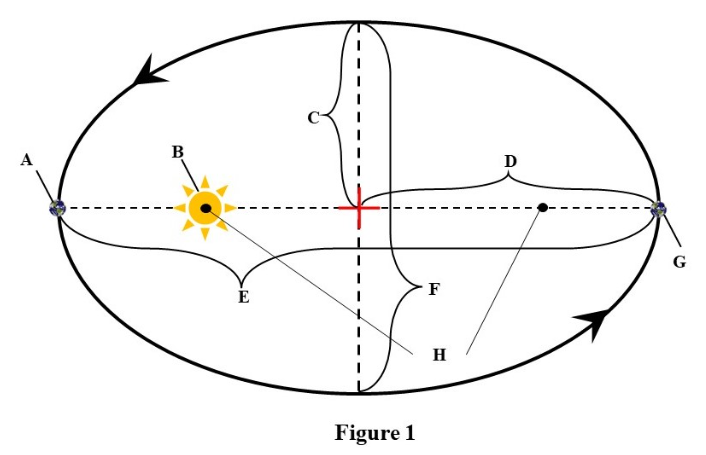
In Figure 1, what letter represents the major axis?
E
Which of the following is not considered a planet?
Pluto
In the eccentricity formula

, the letter "a" represents the
length of the semi-major axis
The orbital eccentricity of an astronomical object that possesses a value greater than 0 but less than 1 is called a(n)
ellipse.
Radiometric dating can only measure the age of a rock
since it solidified.
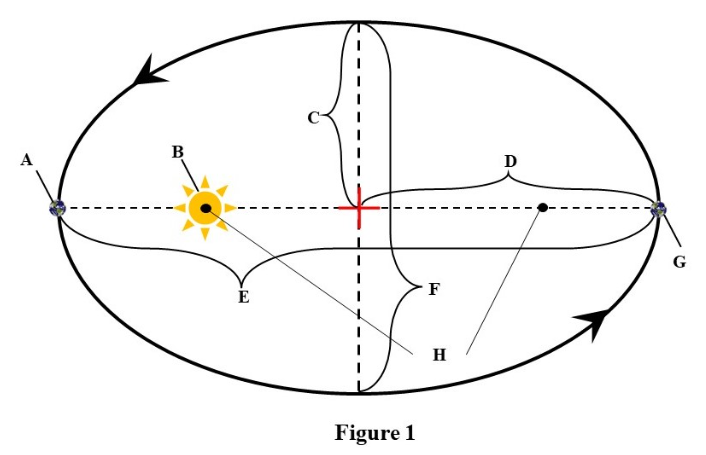
In Figure 1, what letter represents the semi-minor axis?
C
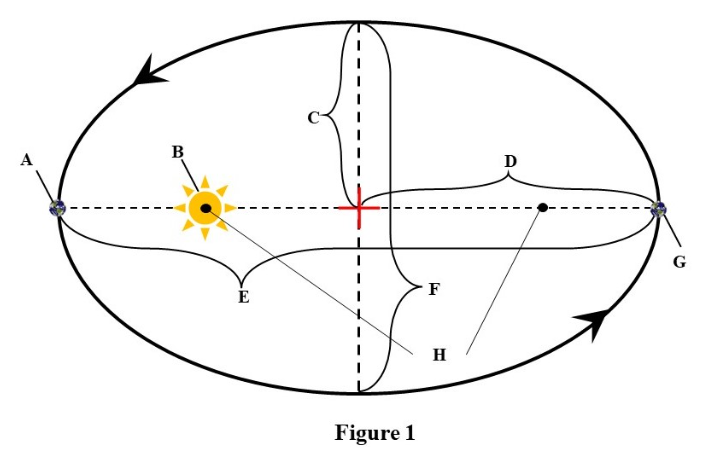
In Figure 1, what letter represents aphelion?
G
The Hale-Bopp comet has a semi-major axis of 186AU. How long does it take to orbit the Sun?
2,536.7 yrs
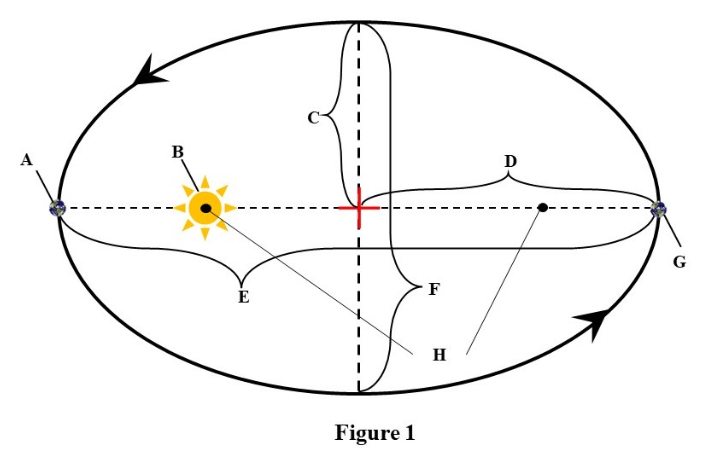
In Figure 1, what letter represents the foci?
H
The Hale-Bopp comet has a semi-major axis of 186AU and its foci were 370.17AU apart, what is its eccentricity?
0.995
When categorizing planets, the planets with the largest size and therfore called giant planets are
Jupiter, Saturn, Uranus, and Neptune.
When categorizing planets, the Classical classification is applied to
Mercury, Venus, Mars, Jupiter, and Saturn.
The area between the termination shock and the heliopause is called the
heliosheath.
The orbital eccentricity of an astronomical object that possesses a value of 0 is called a(n)
circle
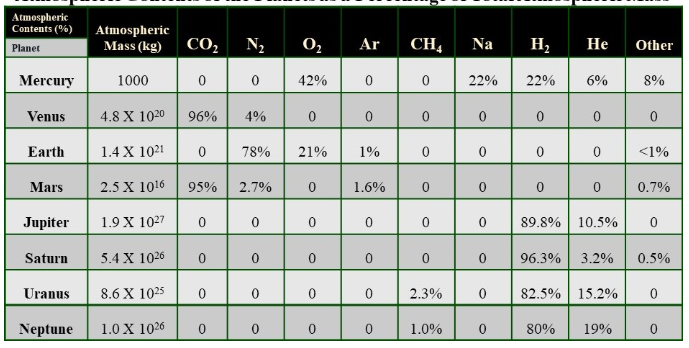
According to the table above, which of the planets has an atmosphere that contains significant amounts of both argon and carbon dioxide?
Mars
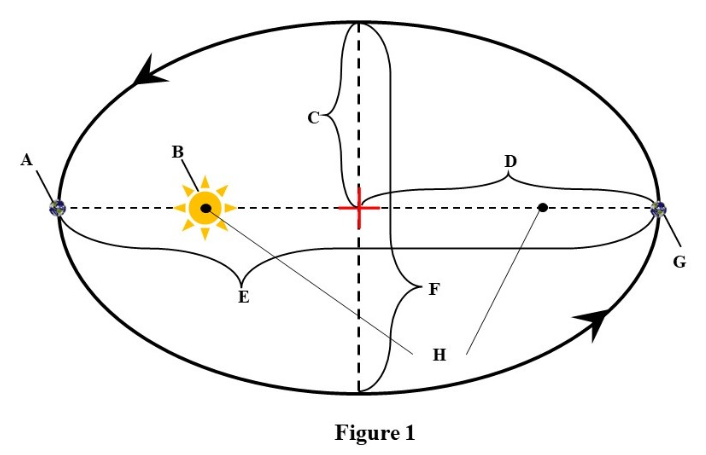
In Figure 1, what letter represents the semi-major axis?
D
What is the eccentricity of Eris it if has a semi-major axis of 67.669AU and its foci are 59.0141349AU apart?
0.43605
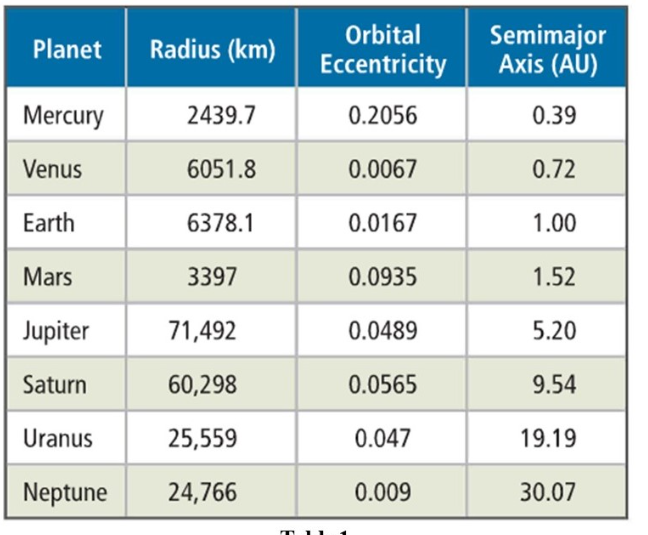
According to Table 1, which of the planets has largest radius?
Jupiter.
When categorizing planets by their chemical composition, the term terrestrial is applied to
Mercury, Venus, Earth, and Mars.
Where is the dwarf-planet Eris located?
Scattered Disc.
The orbital eccentricity of an astronomical object that possesses a value greater than 1 is called a(n)
hyperbola.
What percentage of the mass of the solar system does the Sun possess?
99.8%
How is the age of the solar system determined?
Radiometric dating is used to determine the age of meteorites which are the same age as the solar system.
The orbital eccentricity of an astronomical object that possesses a value of 1 is called a(n
parabola.
Which of the following represent a circular orbit?
e = 0
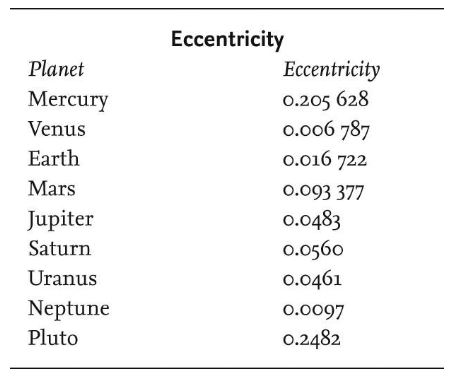
In the above table, which planet has an orbital path closest to a perfect circle?
Venus
The Hale-Bopp comet has a semi-major axis of 186AU and its foci were 370.17AU apart. How many years does it take to orbit the Sun?
2536.7
Which of the following elements do all of the Jovian planets have a high concentration of?
Hydrogen
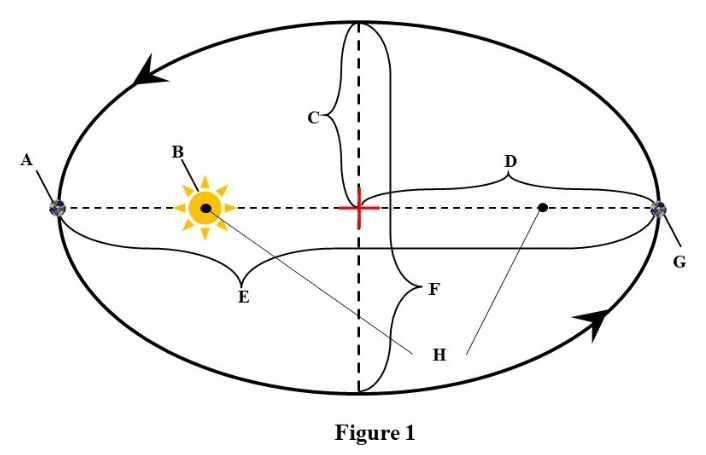
In Figure 1, what letter represents the minor axis?
F
How many times bigger than Mercury is Earth?
3
The asteroids that orbit with Jupiter around the Sun and that ultimately hold the clues to the formation of our solar system are called
trojans.
The surface of Mercury is similar to the surface of
the Moon.
The Interstellar object known as ʻOumuamua, has an eccentricity of 1.2. Which of the following statements best describes ʻOumuamua travel through the solar system?
The eccentricity of ʻOumuamua means that it has a hyperbolic trajectory and will not orbit the Sun.
Using the formula
, determine the length of the semi-major axis if the eccentricity of the ellipse is .05, the distance between the foci is 2.5 AU, and the minor axis 25 AU.
25 AU
What is the eccentricity of the orbit of Makemake if the distance between its foci is 14.0833AU and it is 45.430AU from the Sun?
0.155
Which of the following hypothesis was revised in the late 1970s and is now the most accepted theory of how the galaxy formed?
Nebular Hypothesis.
Where is the dwarf-planet Ceres located?
Asteroid Belt.
The location where solar wind particles slow down as the push against the interstellar medium is called the
termination shock.
The four inner planets of our solar system are
terrestrial planets
The closest planet to the Sun is
Mercury.
The vast majority of astronomers and astrophysicists believe the asteroid belt exists because
Jupiter's gravity prevented a planet from forming.
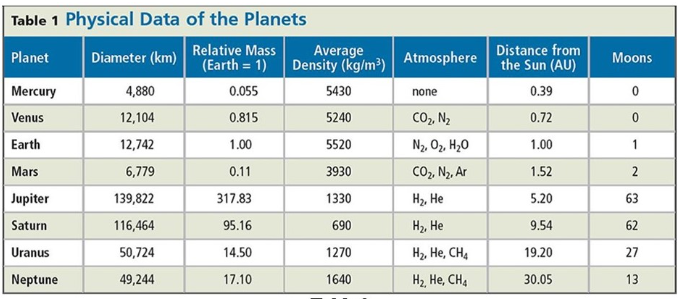
According to Table 2, which of the planets is the least dense?
Saturn.
The process by which elements and compounds began to solidify out of the nebula is called
condensation.
What percentage of the mass of the solar system does Jupiter possess?
0.1%
The long-period comets are believed to originate from the
Oort Cloud.
Using the formula
, determine the length between the foci if the eccentricity of an ellipse is .022, the major axis is 1.5 AU, and the minor axis 1.12 AU.
0.033 AU
Eris has a semi-major axis of 67.669AU. How many years does it take to orbit the Sun?
556.65
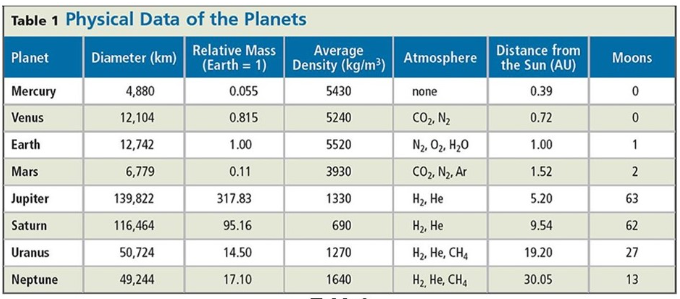
According to Table 2, which planet(s) has an atmosphere that contains a significant amount of hydrogen and helium?
all of the Jovian planets
Observations of Mercury suggest that it was originally much larger, with a mantle and crust similar to that of
Earth.
When categorizing planets, the term inferior planets includes
Mercury and Venus.
Almost all the mass in the solar system is in
the Sun.
Using the formula
, determine the eccentricity of an ellipse if the major axis is 4 AU and the distance between the foci is .2 AU.
0.05
The area where the Sun's solar wind is stopped by the interstellar medium is called the
heliopause.
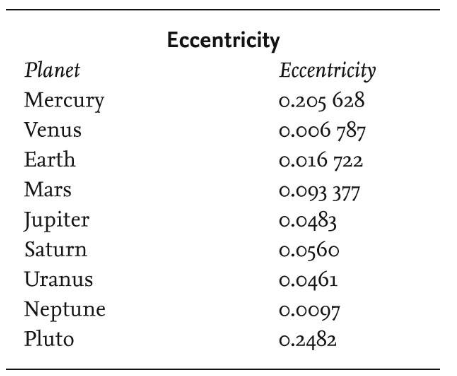
In the above table, which planet has the most eccentric orbit?
Mercury
The short-period comets are believed to originate from the
Kuiper Belt.
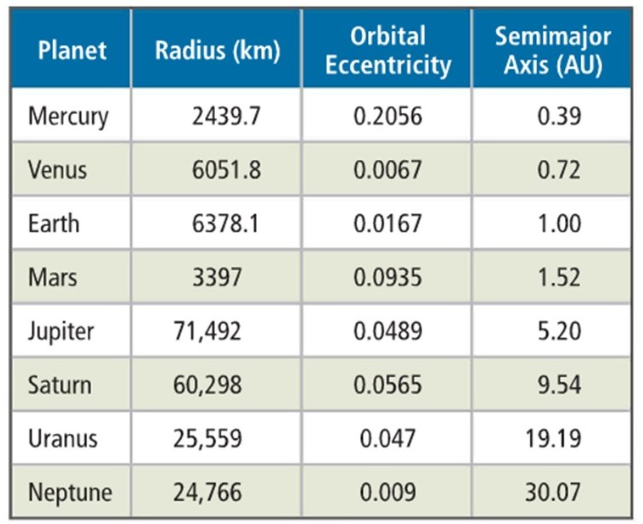
According to Table 1, which of the planets has an orbit that most closely resembles a perfect circle?
Venus.
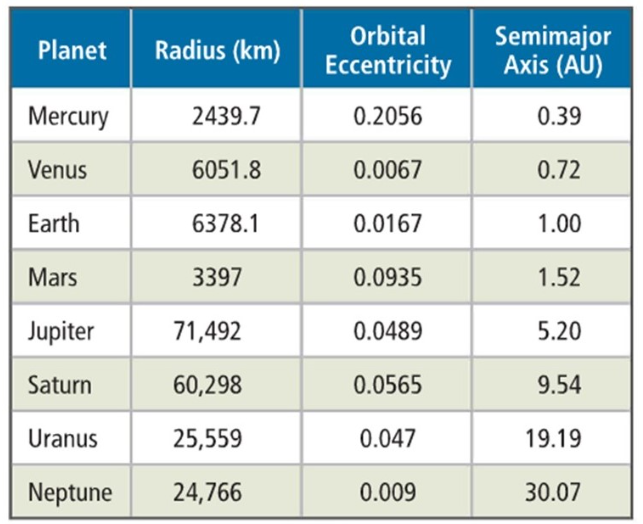
According to Table 1, which of the planets has a major axis closest to 3 AU?
Mars.
The four outer planets of our solar system are
Jovian planets.
Which of the following represent a parabolic trajectory?
e = 1
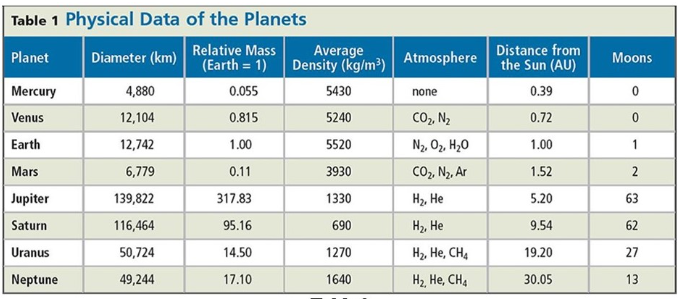
According to Table 2, which of the Jovian planets is the most dense?
Neptune.
The giant cavity formed by the Sun in the surrounding interstellar medium is called the
heliosphere.
In the formation of the solar system, all evidence points to a single formation event that indicates our solar system was formed how many years ago?
4.6 billion
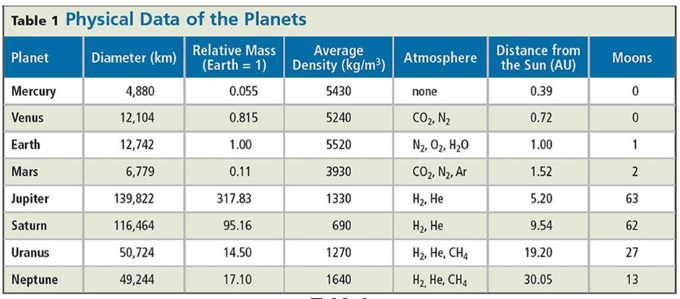
According to Table 2, which of the planets is the only on that has an atmosphere that contains water?
Earth.