9- Altered Cast Impression Procedure
 Call Kai
 Learn
Learn Practice Test
 Spaced Repetition
 Match
Match Flashcards
 Knowt Play
1/27

There's no tags or description
Looks like no tags are added yet.
Name | Mastery | Learn | Test | Matching | Spaced | Call with Kai |
|---|
No analytics yet
Send a link to your students to track their progress
28 Terms
When is an altered cast impression taken?
In mandibular unilateral or bilateral distal-extension partial dentures (Class I & II); it may be used for maxillary distal extension, but the increase in stability is not as dramatic as in the mandible
Steps to taking an altered cast impression
Adapt a resin tray over the framework on the distal extension portion of the master cast
Check fit of frame and extension of tray in the mouth
Take an impression inside the tray of the distal-extension area
Cut off corresponding area of master cast
Seat framework and attached impression on master cast, box, and pour in stone
Remove tray from framework and attach occlusal rim for recording max-mand relations
What is the main purpose of an altered cast?
To gain better support for distal-extension base and obtain correct border extension. You want to increase support to improve the relationship between framework to teeth + soft tissues
What is an altered cast meant to help with in terms of movement towards tissues?
Reduce tissueward movement of distal extension base, which is important in protecting the abutment teeth from harmful stress
T/F: Dentures processed on an altered cast have better tissue adaptation and border extensions than those processed on a cast made from a single impression
True
What did studies show when forces were placed on abutment teeth by RPDs made with and without an altered cast impression?
Lowest forces were shown with the bases processed on the altered cast
Why would you want to take an altered cast impression in class IV cases?
Because the edentulous ridge is likely to be anterior to the fulcrum line so it provides support to the base
What are some materials you can use when evaluating the fit of the framework?
Fit Checker (work fast, allow it to set, mark with pencil, use metal to make adjustments)
Mylar acufilm tape (noramlly used for occlusal adjustment)
Kerr’s Disclosing Wax over a low flame
T/F: PIP works well to evaluate the fit of the framework
False
Can you bend a clasp out of contact with the teeth to make insertion and removal easier?
No, you might break a clasp and readapting them is difficult. Adjust only if the clasp is active or if it is loose and doesn’t touch the tooth
When should you make the impression trays?
After the framework has been fitted intraorally
It is important that the trays cover which two anatomical areas to obtain maximum support?
Buccal shelf and retromolar pad
What should the trays look like after they are cured and you need to adjust them?
Rounded corners that are 2mm thick, slightly underextended borders (1/2mm) relieve internal surface by 1mm to make space for impression material
Do you need to border mold in this case?
Not necessarily, border seal is not a major function of RPD base
When is PIP used when making the final impression?
After you’ve adjusted the borders, you use PIP to identify tissue contact areas and determine whether additional tray relief is needed
What impression material is used for the final altered cast impression?
Polyether impression material made by mixing low-viscosity Permadyne and medium-viscosity Impregum with accelerator (50/50 mix works well)
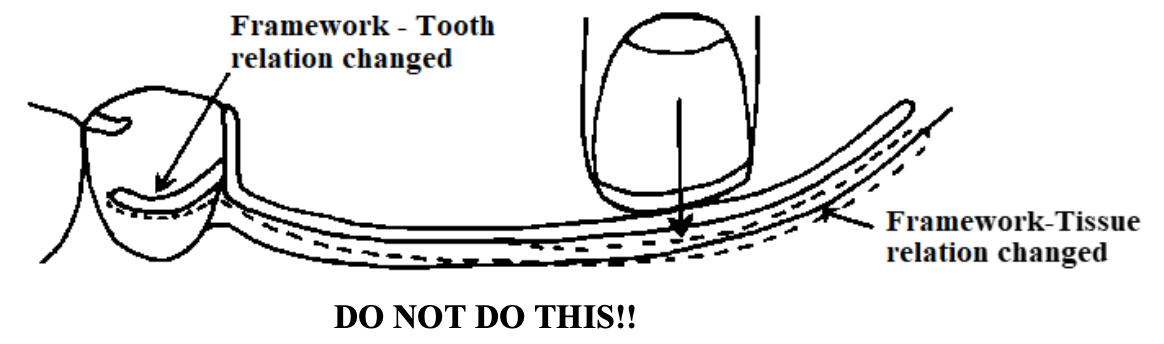
How should you hold/adapt the tray in the mouth?
By pressing only on the rests or other metal parts supported by the teeth and never on the tray because it would alter the relationship of the framework to teeth and soft tissues
Why is gentle pressure placed on the palatal major connector during a maxillary altered cast impression?
To prevent the posterior portion of the framework from hanging away from the palate due to gravity and the weight of the impression material, thereby improving retention, stability, and adaptation
How much time does the impression take from the time it is mixed to the time it is removed?
6 minutes
When inspecting the impression for completeness, how do you check if the casting was seating completely?
If the layer of material covering the tissue rest seems thick (> 0.5 mm). Use an explorer to “sound” through the impression material to determine thickness
In a bilateral distal extension situation, can you take an altered cast impression one at a time?
No, they must be simultaneous. If one side is unacceptable and requires redoing, an impression of both sides must be repeated at the same time.
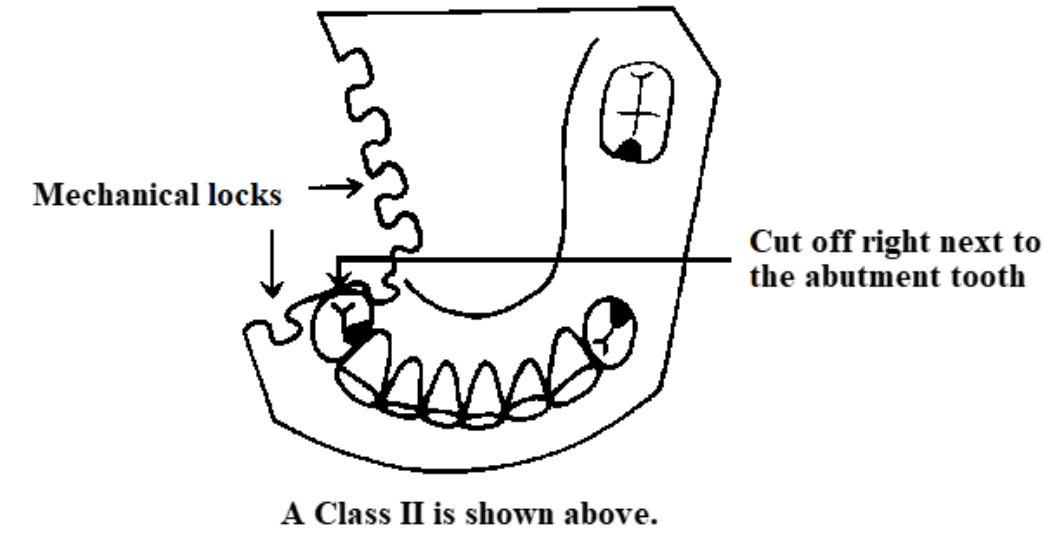
The distal extension portions of the master cast are cut off with a coarse saw blade and key-shaped undercuts are made. Why?
For mechanical retention of the new stone base
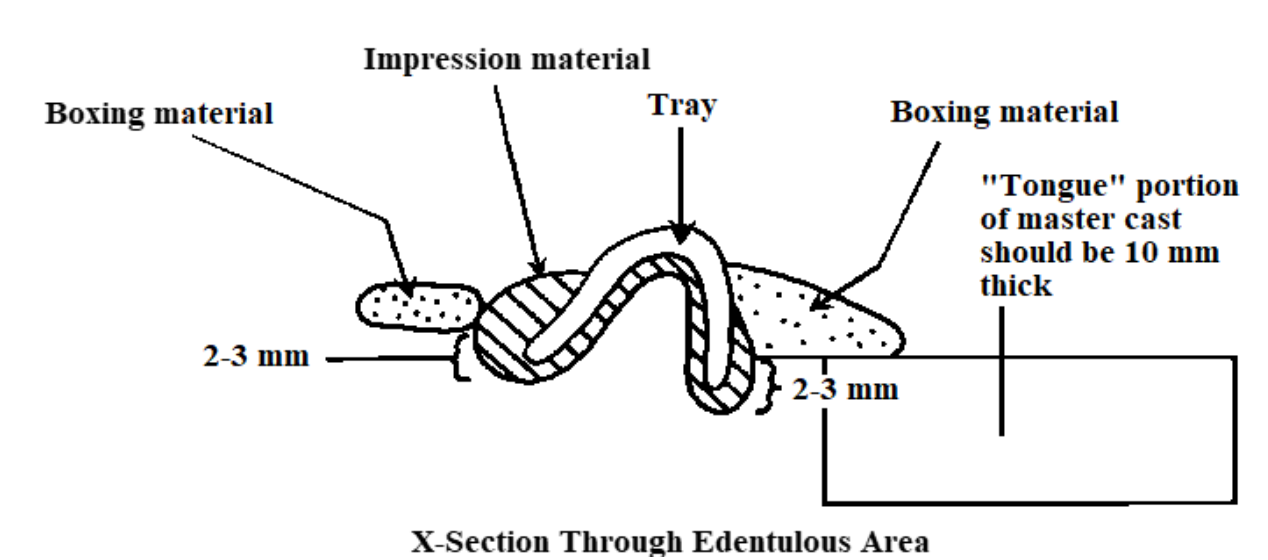
After adding on the new (altered) cast distal extension, attach the framework to the cast and box everything up with caulking and tape. What material do you use to pour up?
Yellow stone, don’t use Die-Keen because it is too difficult to remove after processing
After recovering and smoothing the cast, the land area at the labial should be
4-5mm wide
The land area at the buccal and retromolar pad areas should be
6 mm wide
The lingual vestibular depth should be
2-3 mm
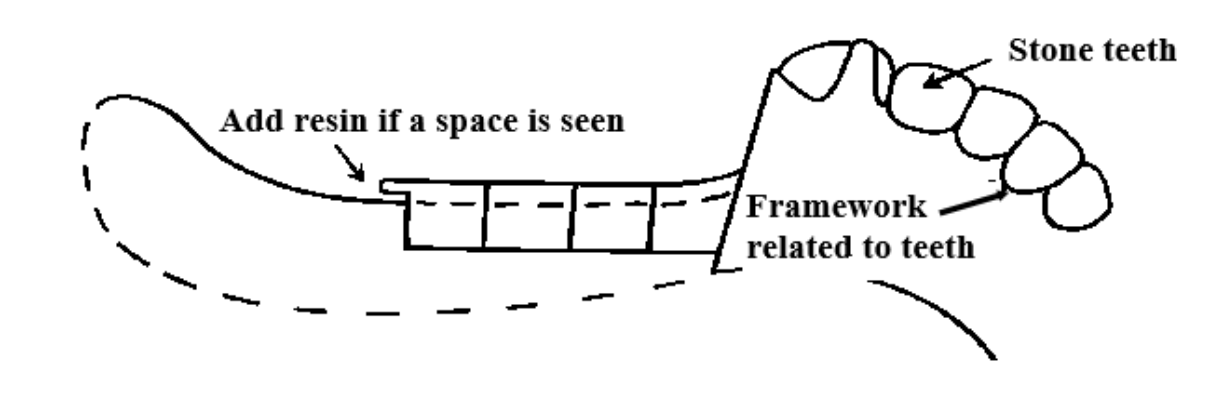
Put the framework back on the altered cast. Sometimes you'll notice the old acrylic tissue rest no longer touches the ridge. Why is that?
Because the ridge position changed when you made the altered cast —> build a new small tissue rest with pink autopolymerizing resin. The new rest should be 2 × 3 mm
TL;DR - Altering the Master Cast steps
Cut off old distal extension ridge.
Box the cast.
Pour new stone from altered cast impression.
Remove tray and trim cast.
Reseat framework.
If tissue rest no longer contacts ridge, add a new resin tissue rest.
Proceed to occlusion rim