Phycology II Identification
 Call Kai
 Learn
Learn Practice Test
 Spaced Repetition
 Match
Match Flashcards
 Knowt Play
1/174

There's no tags or description
Looks like no tags are added yet.
Name | Mastery | Learn | Test | Matching | Spaced | Call with Kai |
|---|
No analytics yet
Send a link to your students to track their progress
175 Terms
Zoochlorella
Any green algae living symbiotically within body of aquatic invertebrate animal
Actinastrum
4-8 celled Spherical 3D coenobia,cells radiate from ceonobium centre, cells long-conical, cylindrical when young, at lower end near coenobium centre they are broadly rounded, at the end near periphery more pointed, tip and base of cells often hyaline, chloroplast parietal with pyrenoid often indistinct
Actinotaenium
individual cells, circular under apical view, frontal view: oval-cylindrical/elliptical/broadly spindle-shaped, only slightly constricted in middle, with indistinct isthmus, apices broadly rounded/bluntly trunicated with rounded edges. In each half-cell, there is one chloroplast, usually axial, star-shaped in cross-section; in larger species, it can be parietal, composed of longitudinally arranged strands. The chloroplast usually contains one centrally located pyrenoid.
Ankistrodesmus
Unicells or colonies of loosely bound unicells. Fiber-shaped cells are either straight, bent, or spiral. Needle like, sometimes curving. Unicellular but can be found in clusters or twining around one another.
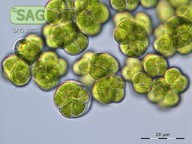
Apatococcus
Spherical/ellipsoidal cells, occasionally flattened, single nucleus, cell wall thickened with age, young cell chloroplasts are mounted to cell wall, later lobed and net-like, without pyrenoid, cells form irregular clusters/ short filaments
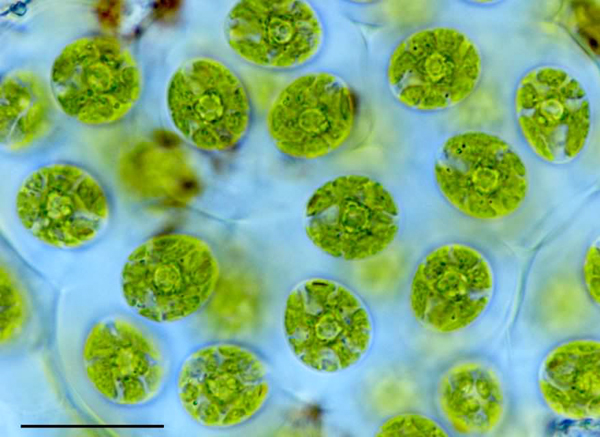
Asterococcus
broadly oval cells occur individually or in groups in diverse mucous colonies, surrounded by a concentrically layered or simple mucous envelope, which may be encrusted. The chloroplast is usually star-shaped, with a central pyrenoid, sometimes with a stigma. Two contractile vacuoles. The mucous envelope is mostly brown encrusted
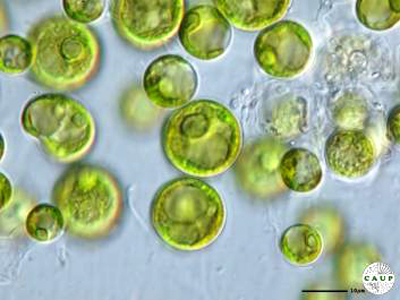
Bracteacoccus
spherical cells with smooth cell wall, always multinucleate in adulthood. Cells contain a larger number of wall-attached sponge-like chloroplasts without pyrenoids.
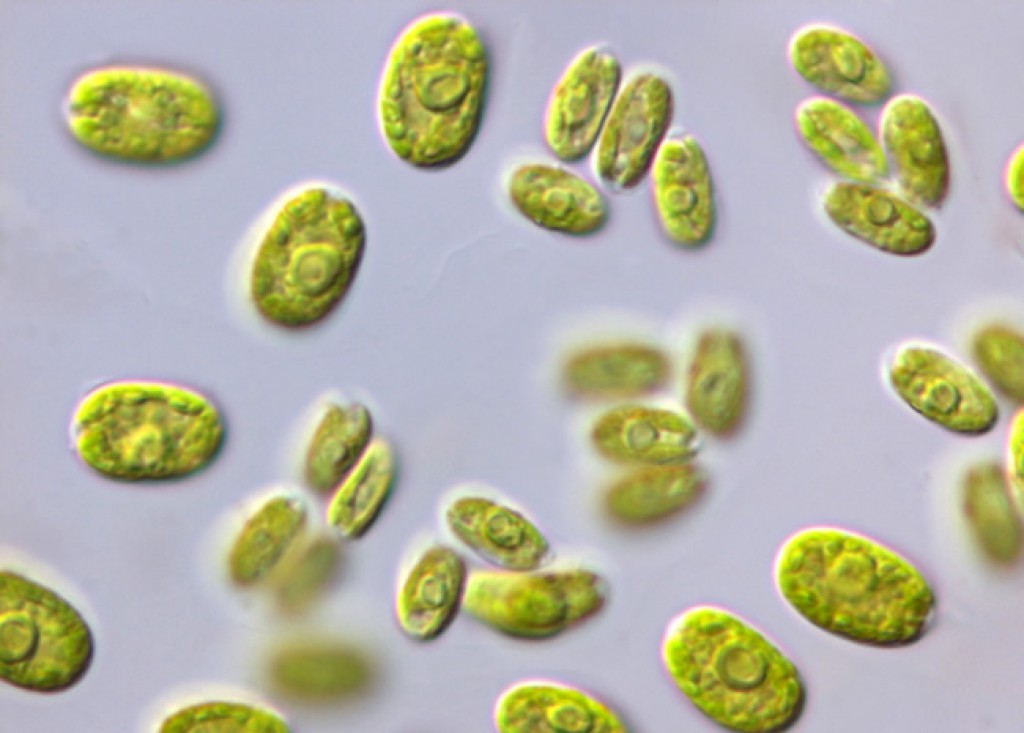
Chlamydomonas
single celled, and has an almost spherical cell wall around the cytoplasm and centralized nucleus. They have two flagella extending out of one side that propel them about. They contain an eyespot leading into ion channels that react to changes in light allowing the cell to always move closer to light (positive phototaxis). Near the flagella are two vacuoles that are used for moving water into and out of the cell. Pyrenoids present
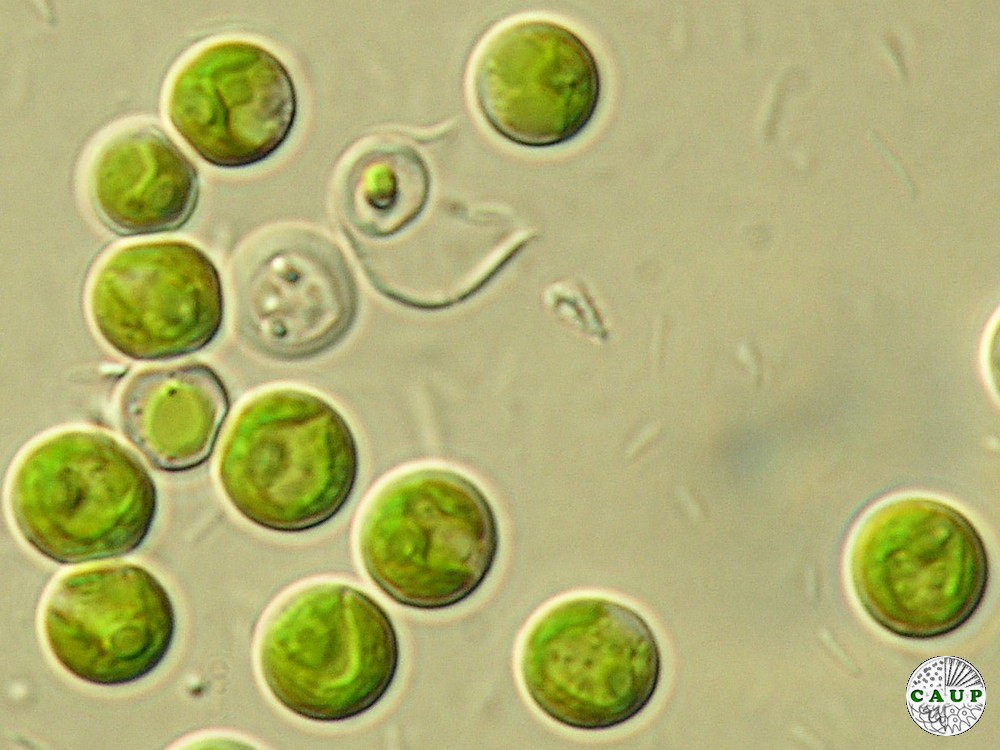
Chlorella
small round or oval cells (2-15 μm diameter) which divide into 2 or 4 non-motile daughter cells, enclosed for a little while within the old wall
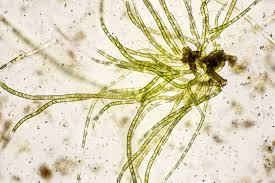
Cladophora
Thalli of the siphonocladial type, usually attached by a rhizoidal cell, secondarily detach from the substrate. Branched filaments form macroscopic tufts. Multinucleate cells, wall chloroplast, net-like, with a larger number of pyrenoids.
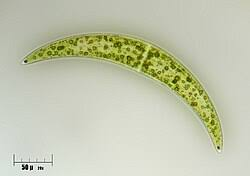
Closterium limenticum
Cells slender, for the most part straight and cylindrical, only tapering gradually at the ends and slightly curved. Apices very narrowly rounded, only about 1 µm wide. Cell wall without true bands, sometimes however with one or more false bands, colorless, smooth.
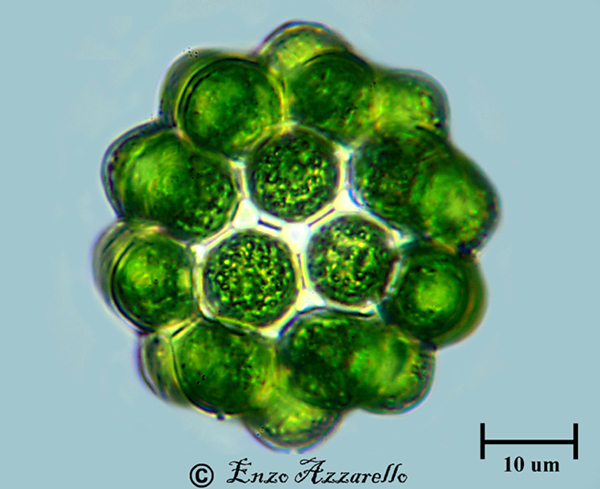
Coelastrum
Cells spherical, ellipsoidal, or spindle-shaped, often with polar thickenings and longitudinally grooved. Chloroplast wall-bound, filling the entire periphery of the cell, on the surface divided into many short lobes. Pyrenoid very prominent, spherical, covered with starch grains.
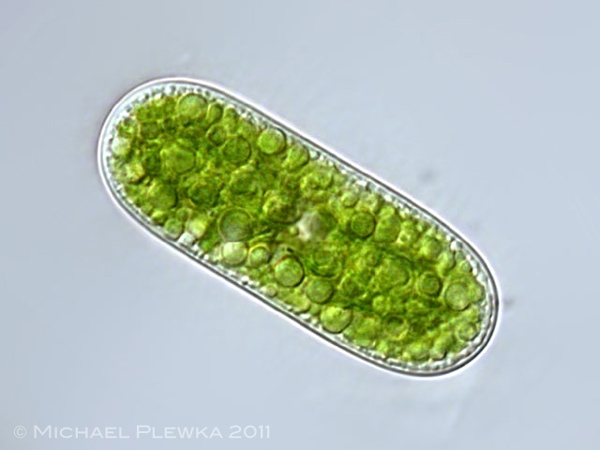
Cylindrocystis
two axial chloroplasts, each with one pyrenoid (sometimes with two). Chloroplasts in cross-section are approximately star-shaped, with projections/ridges running from the central axis to the edge, either longitudinal, plate-like, or radially branched outward. Cells usually solitary (rarely they may also form disintegrating filamentous colonies), cylindrical or broadly elliptical in outline, straight or slightly curved, with broadly rounded ends.
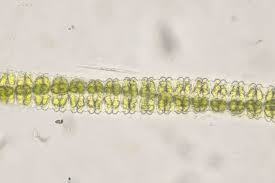
Desmidium
Cells arranged into fragile filaments with a mucous sheath, usually slightly offset from each other (the filaments are therefore spirally coiled). They are connected either by the entire apical part of neighboring cells or by apical protrusions, shallow but clearly visible groove. Cell wall smooth. One axial, star-shaped chloroplast in each half-cell, with a central pyrenoid or a pyrenoid in each lobe.
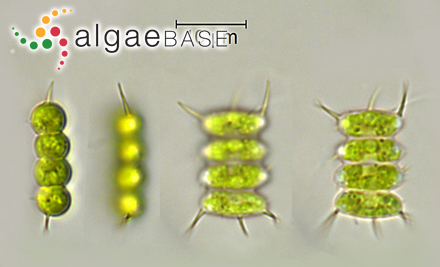
Desmodesmus
cells ellipsoidal to ovoid, joined to each other by their longer sides, terminal cells of colony (sometimes medial cells as well) are usually armed with spines, cell contains one parietal chloroplast, containing one pyrenoid
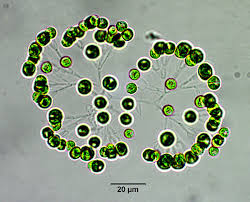
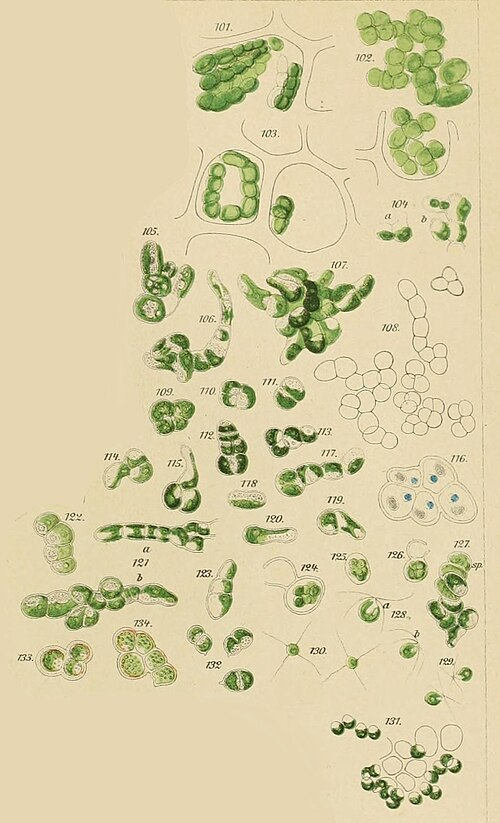
Dictyosphaerium
loose colonies of green cells in clear mucilage, the cells conntected to central point by branched strands (often barely visible)
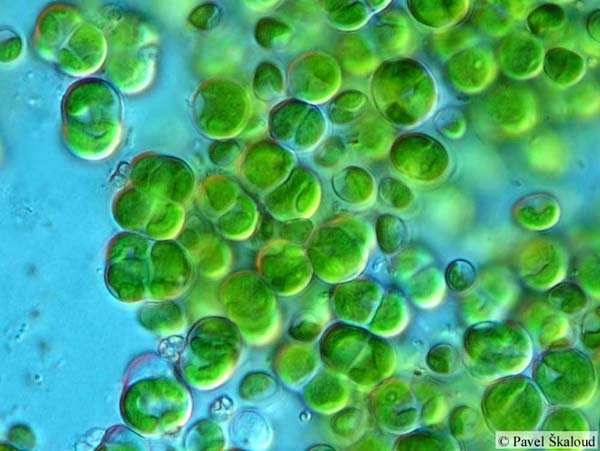
Dilabifilum
Fibrous thallus made of densely branched filaments. Older filaments ccomposed of spherical cells, breaking down into multicellular bundles. Chloroplast wall bound, in central part of cell with one pyrenoid
Diplosphaera
Cells with pyrenoid, may be large & stalked. If they are smaller, they can also attach with the apex. If they are perfectly spherical, they are very small and can resemble tiny coccoid cyanobacteria. The chloroplast is usually marginal and cup-shaped.
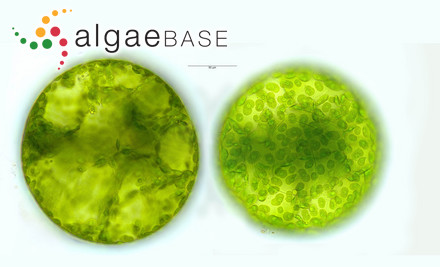
Eremosphaera
Large spherical or broadly oval cells (30–150 μm in diameter), individual, rarely arranged in a few in the parent cell wall. Around the central nucleus and vacuole, many small chloroplasts with one to three pyrenoids. Different chloroplasts in the center and on the periphery of the cell.
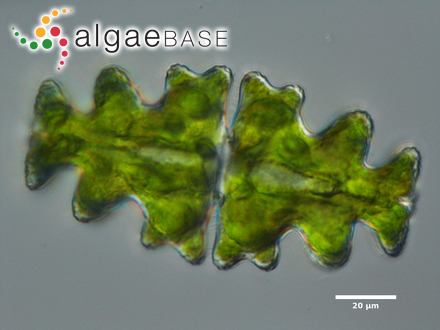
Euastrum
Half-cell in frontal view semi-oval or trapezoidal, with prominent lateral and apical lobes. Apical lobe usually with a clearly visible notch or indentation. Cell wall with scattered pores, smooth or adorned with projections, granules, or short spines. Chloroplasts axial, usually one in each half-cell, with one or more (in larger species) pyrenoids.
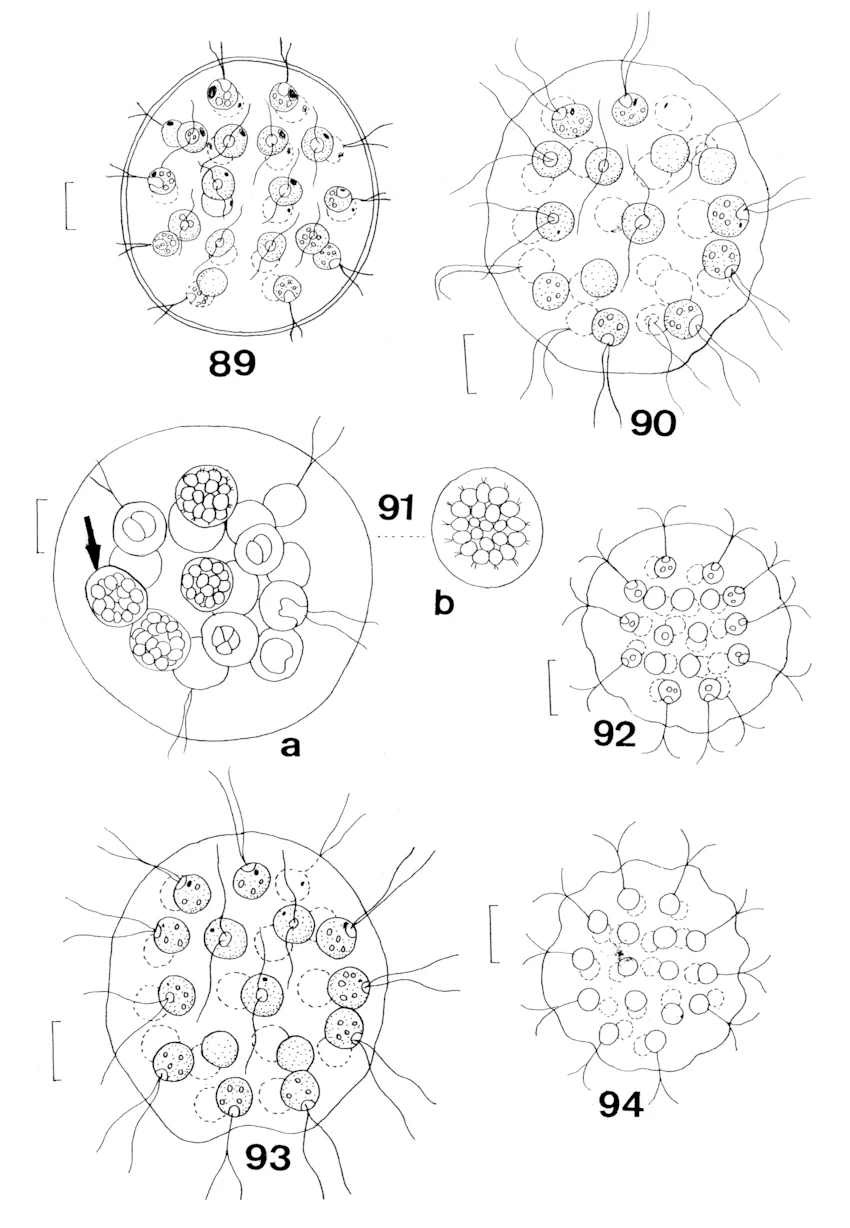
Eudorina
Colonies spherical, ellipsoid, or cylindrical, usually containing 16 or 32 cells, in rarer cases even 64, cells are mostly spherical, in the colony arranged freely with space between the cells filled with mucilage, sometimes the cells may be connected by fine cytoplasmic threads. Chloroplast cup-shaped, usually with several pyrenoids, stigma conspicuous.
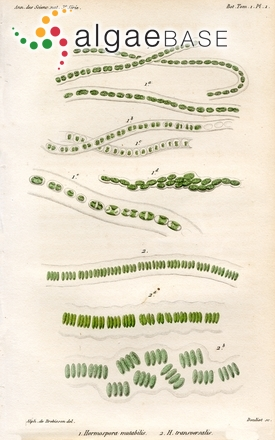
Geminella
filament cells are arranged in pairs separated by distinct gaps, cell width 6.5–7(–15) µm, cells surrounded by mucus 7–18 µm wide. They are 2–3 times longer than wide, cylindrical, with broadly rounded ends. The chloroplast with 1–2 pyrenoids fills at least two-thirds of the cell. Akinetes are thick-walled, with a verrucose surface, brown
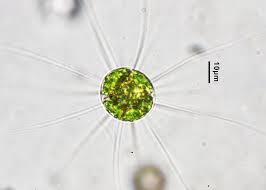
Golenkinia
Individual spherical cells (10–18 μm in diameter) with a narrow mucilage sheath that covers the cell wall in a single layer. The chloroplast is wall-like and bell-shaped, with a pyrenoid and a starch grain, which, however, may not be developed, and then the pyrenoid is indistinct. Spines (25–65 μm) are straight and uniformly thin along their entire length. This is an alga with high morphological variability.
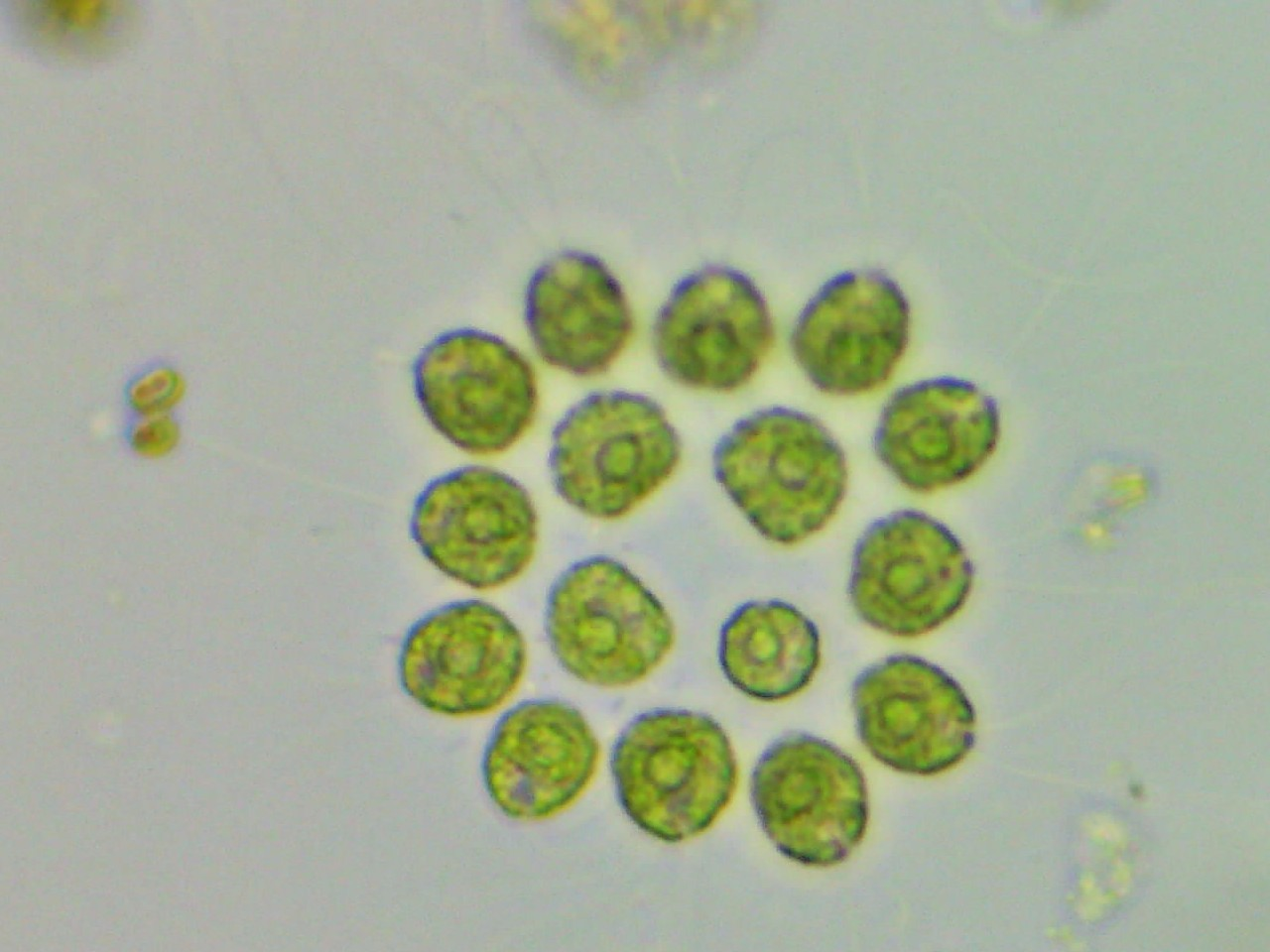
Gonium
Square, slightly convex colonies, mostly containing 16 cells (rarely only 8 or 32), colony size is 70–100 μm, cells ellipsoidal, obovoid, or almost spherical, on average 5–20 μm, spaced apart, connected by short protrusions of the cell wall, cells do not have developed papillae (distinguishing feature from the genus Tetrabaena)
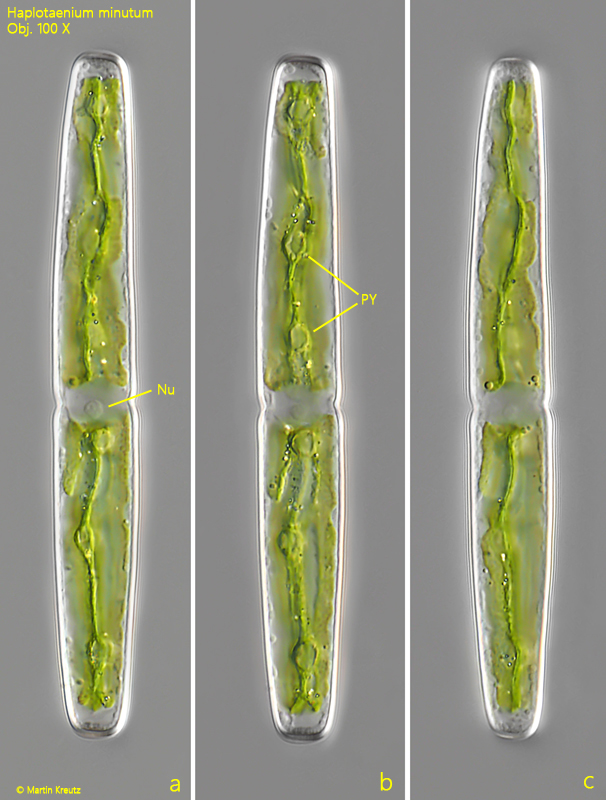
Haplotaenium
Individual cells, circular from an apical view, many times longer than wide, elongated cylindrical, straight, sometimes slightly widened at the base of half-cells, with blunt to broadly rounded ends. Sinus shallow, almost indistinct, widely open. Cell apex without a terminal vacuole. Cell wall smooth or with fine pores. Two axial chloroplasts in each cell with longitudinal lamellae with a central row of pyrenoids. One and a half cells without basal expansion (waves)
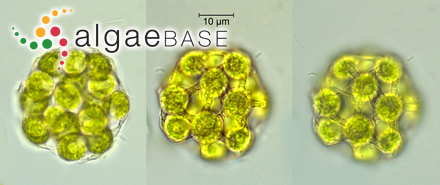
Hariotina
Cenobia 4–64-celled and spherical, cells spherical to slightly ellipsoidal or flattened. From each cell extend 5–15 longer projections, by which the cells are interconnected, and the entire cenobium therefore has a characteristic, net-like appearance.
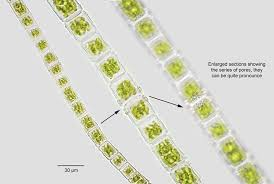
Hyalotheca
Cells connected into long unbranched filaments, cylindrical, about 1.3–2 times wider than long, 10–28 µm long and 15–32 µm wide. Semi-cells roughly transversely rectangular with rounded, slightly convex sides. Sinus shallow, widely open, in the form of a slight depression. From the apical view, cells are circular, sometimes with two or three evenly spaced bumps. Cell wall in the apex region finely porous – slime can be exuded from the pores and form longitudinal rings of false warts. In the cell, two axial, star-shaped chloroplasts, each with a centrally located pyrenoid. Filaments often enclosed in a thick mucilaginous sheath.
Klebsormidium
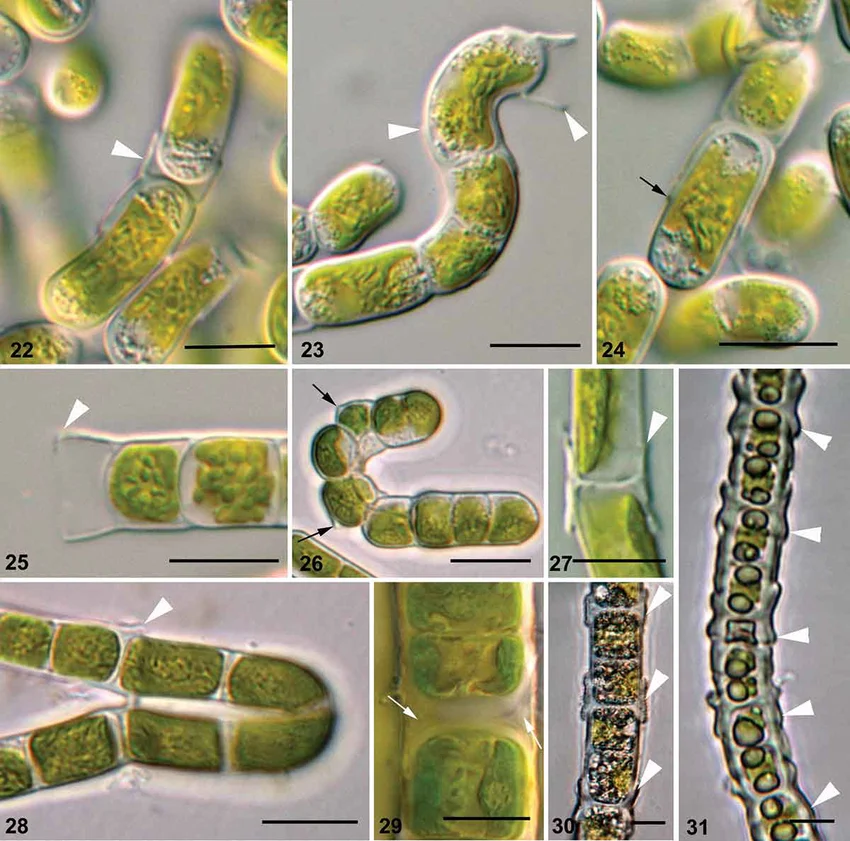
Unbranched filaments, unattached or fixed to the substrate using mucilaginous discs formed at the bends of the filament. Cells are uninucleate, cylindrical or barrel-shaped. The cell wall is thin and smooth, in older filaments it may be thickened and roughened. H–pieces may form at the cell partitions. Chloroplast is parietal, with 1–2 inconspicuous pyrenoids covered with small starch grains.
Lacunastrum
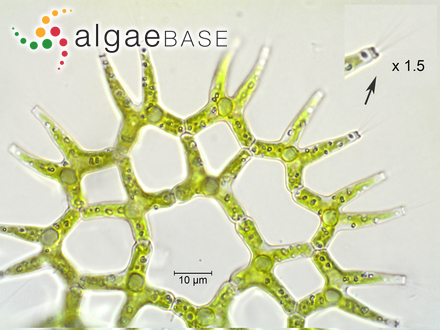
Cenobia (up to 87 μm in diameter) are strongly perforated, with large, 5–6–angled, strictly delimited openings. The cells are reduced to a transverse beam-like structure, from which four long, roughly cylindrical projections extend. The cell wall is smooth.
Micrasterias
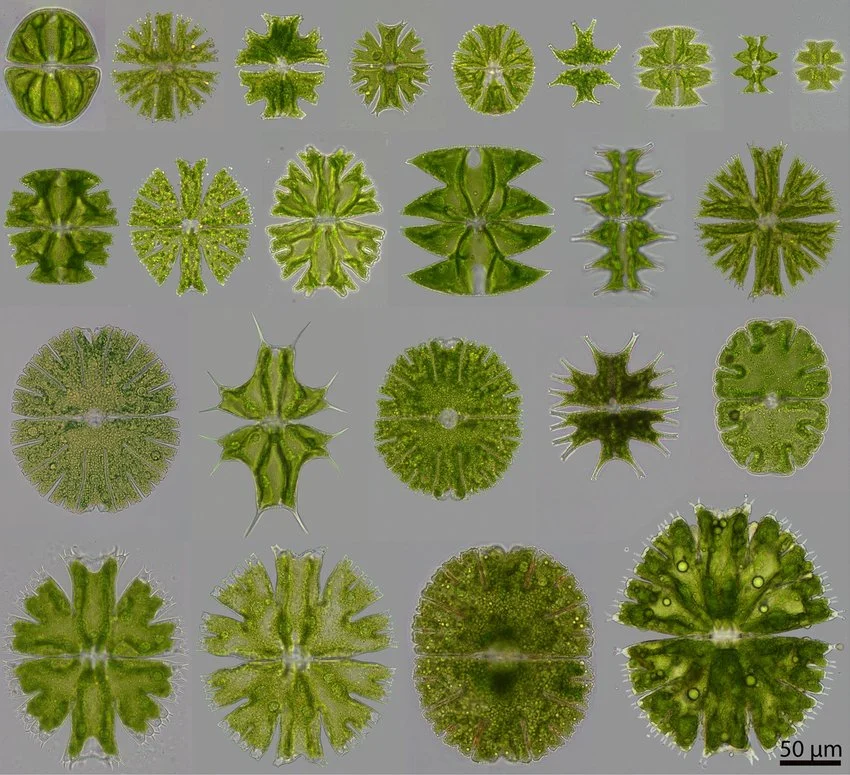
bilateral symmetry, two mirror image semi-cells joined by narrow isthmus containing nucleus of organism
Microactinium
Cells are grouped in four- to multicellular colonies, which are arranged irregularly or tetrahedrally. They are spherical or oval and equipped with a species-specific number of thin or thick and long spines. The chloroplast is parietal, cup-shaped, or groove-shaped with one pyrenoid.
Microspora
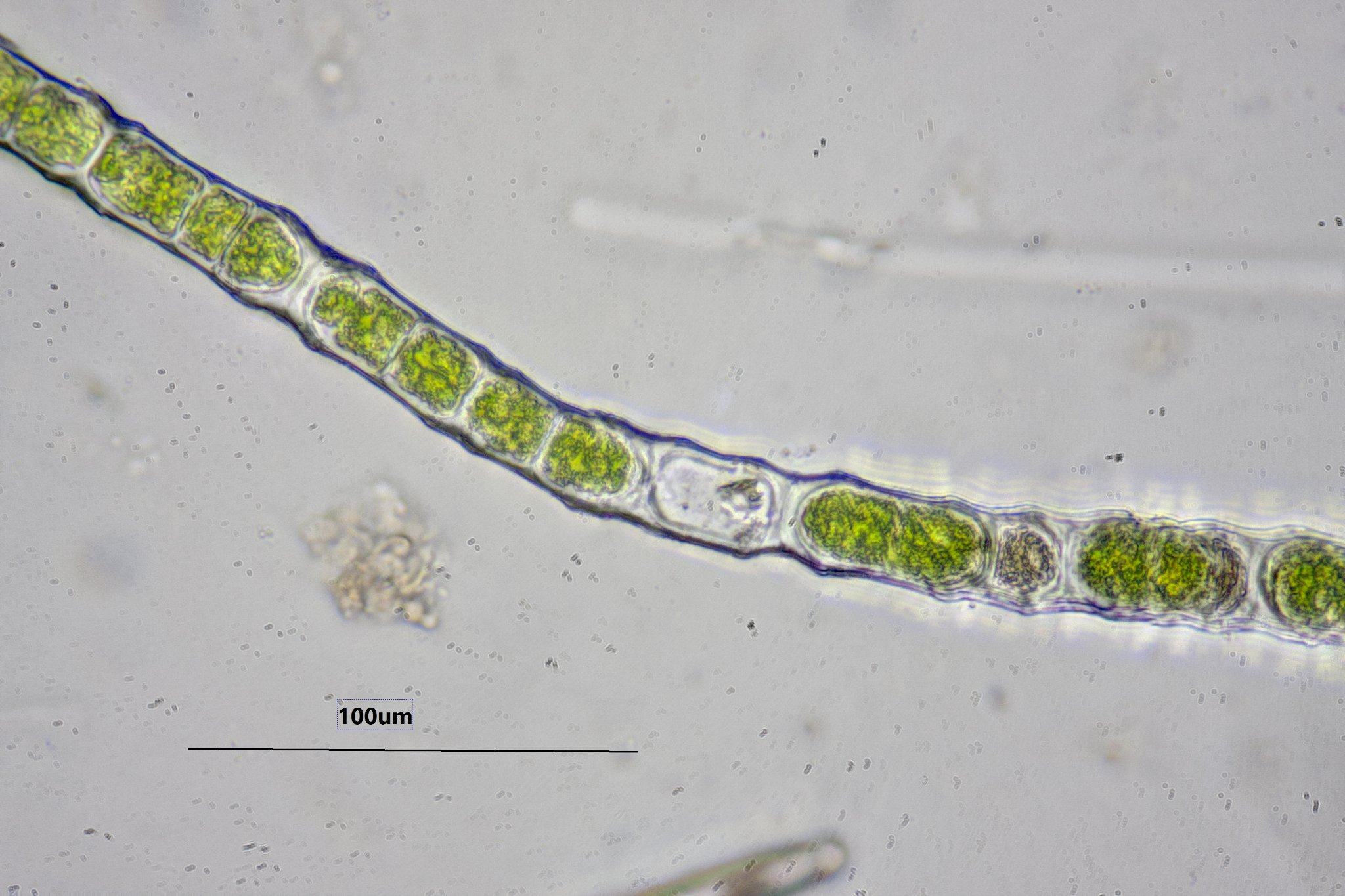
Uniseriate unbranched filaments, free or attached to a substrate from a young age. Cells cylindrical to slightly barrel-shaped, with cell walls thin or, conversely, thick, sometimes layered, with a tendency to break in the middle of the cell and form H-shaped pieces visible mainly at the ends of the filaments. Cells are uninucleate, with a single chloroplast. Chloroplast wall-bound, often perforated, to a net-like appearance, sometimes granular or grooved, without a pyrenoid. Akinetes form by thickening of cell wall layers.
Microthamnion
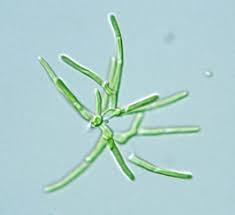
Microscopic thalli, forming light green bushes composed of branched uniseriate filaments. Lateral filaments grow roughly at one-third of the cell's length, with further branching closer to the cell tip. Chloroplasts are wall-associated, grooved, without pyrenoids. Asexual reproduction occurs by biflagellate zoospores (one cell produces up to 32), released through a rupture in the cell wall.
Monactinus
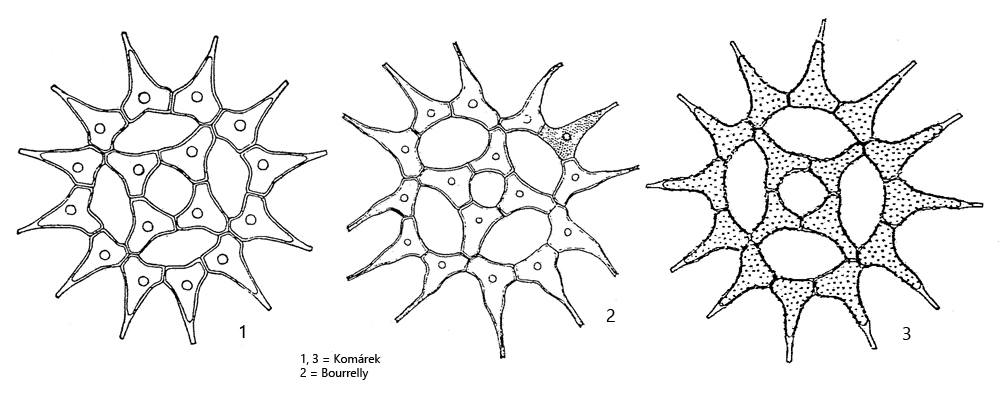
Cenobia with 8–16–32 cells may or may not be perforated. The cells are arranged in a circular pattern, often only a ring of peripheral cells with a large hole in the center occurs. Peripheral cells have one narrow and abruptly narrowed projection.
Monoraphidium
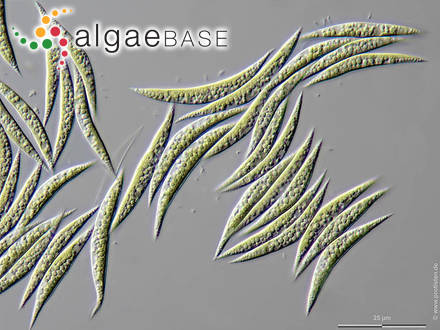
Cells are individual, freely floating. The shape is mostly approximately spindle-shaped, sometimes semi-netlike. Both ends of the cell are the same, pointed or rounded. The cell wall is smooth, thin, without mucus. One wall chloroplast without pyrenoid
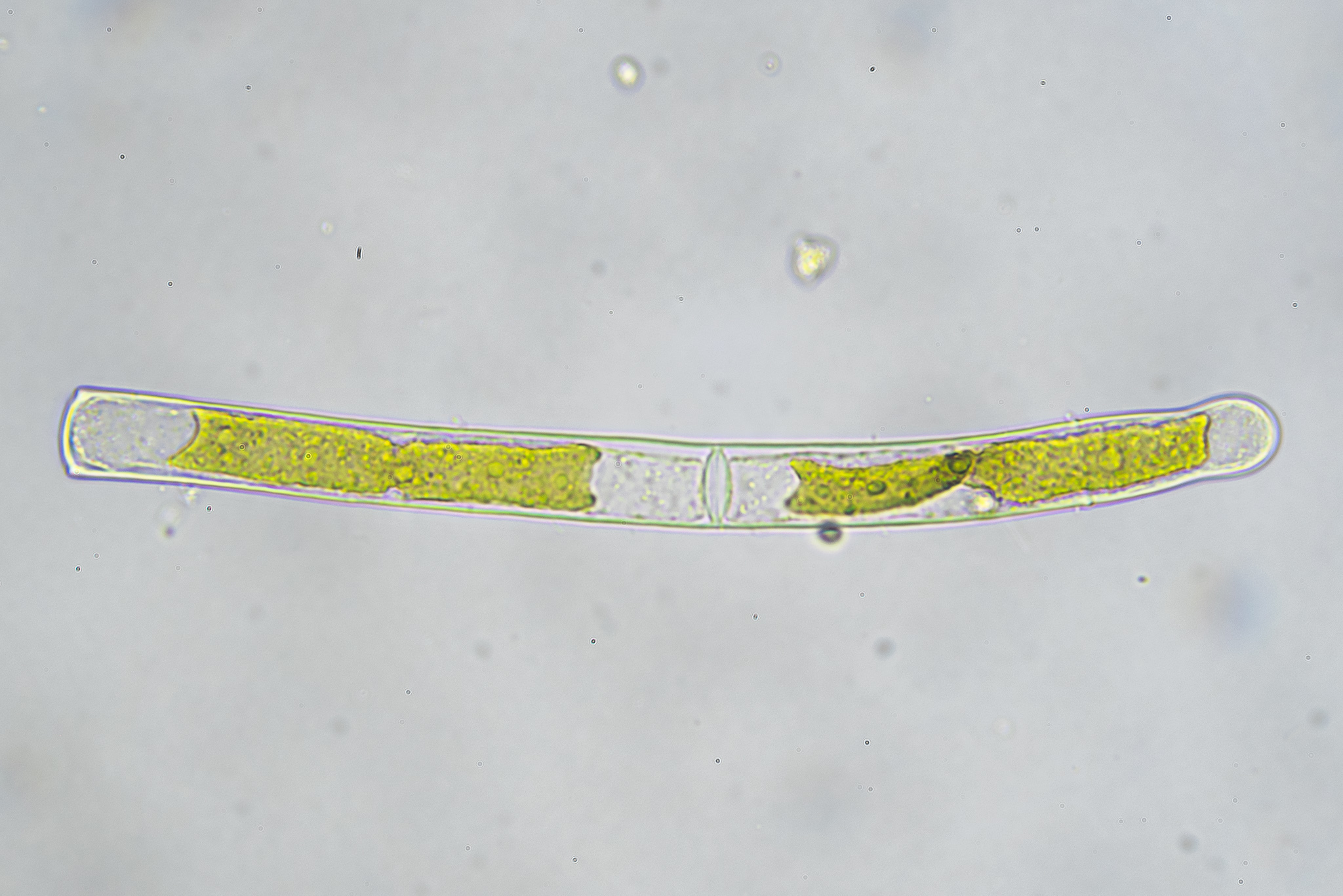
Mougeotia
cells contain single chloroplast, an axile ribbon running the length of cell, with pyrenoids at intervals
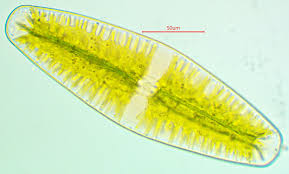
Netrium
Individual cells, spindle-shaped or oblong-cylindrical in outline, straight, with broadly rounded or bluntly cut ends with rounded edges. In the cell, two axial chloroplasts, star-shaped in cross-section, with interrupted longitudinal lamellae with notched or serrated edges.
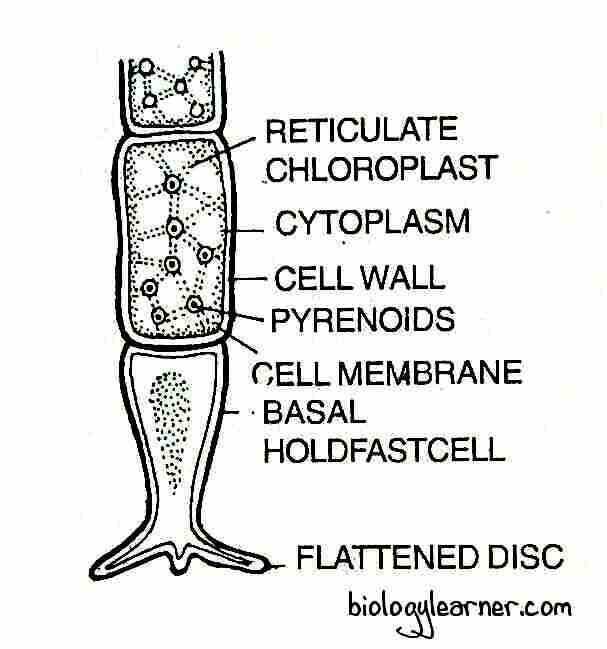
Oedogonium
thicked wall at one end of some cells, ridged like disposabile plastic cups one inside the other, chloroplast a parietal net, with several pyrenoids
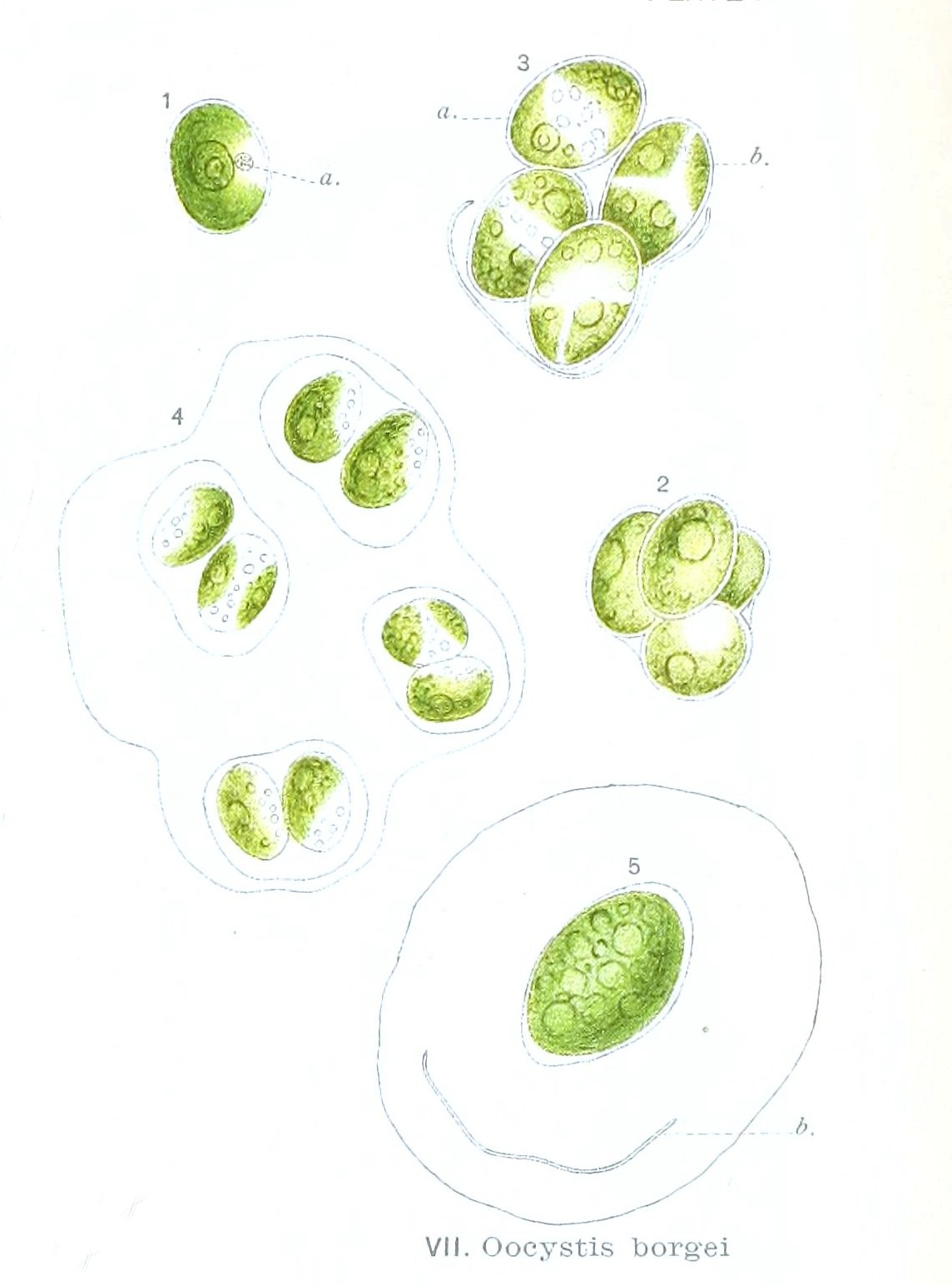
Oocystis
oval or lemon-shaped cells 5-20 μm long, sometimes found 2 or 4 together inside the enlarged clear mother cell wall
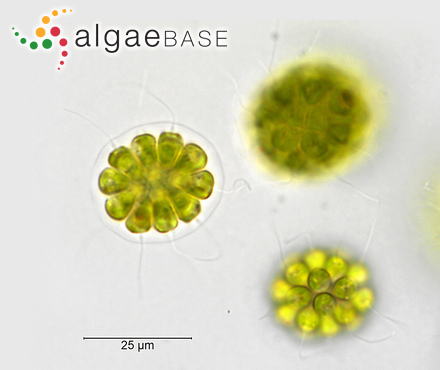
Pandorina
differs from Eudorina in the cells fit closely together without a large central space
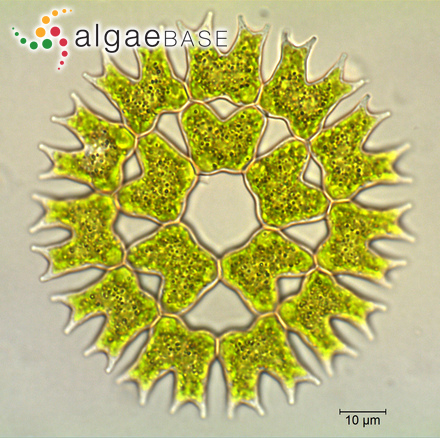
Parapediastrum biradiatum
The inner notch between the protrusions is deep, V-shaped, while the outer notches between the spines are shallow. Inner cells (8–21 x 10–26 μm) are X-shaped and touch only at the corners. The cell wall is finely granulated.
Pectinodesmus
Linear cenobia, but cells can be alternating or spatially arranged. Cells narrowly spindle-shaped, strongly elongated at the ends into thin hyaline projections, whose length may correspond to half the length of the cell itself.
Pediastrum duplex
cenobia circular, 8-64-celled and markedly perforated. Peripheral cells with two long projections, at the ends of which are short, cylindrical appendages. Inner cells opening between them occupy a significantly smaller area than the cells themselves
Planotaenium
Individual cells, elongated cylindrical to spindle-shaped, straight, with a shallow, widely open sinus, circular to biradial from the apical view (towards the apices, transition from circular to elliptical cross-section). Cell apices slightly narrowed, rounded, with a distinct central concavity/incision. Cell wall smooth, thickened at the apices, with scattered pores. Each cell has two axial, star-shaped chloroplasts, with protruding longitudinal strips from the frontal view and one or more axially arranged pyrenoids. The pores in the cell wall are arranged in regular longitudinal rows.
Pleurotaenium
Cells individual, elongated cylindrical, significantly longer than wide, with straight or (partly) wavy edges, with bluntly cut or broadly rounded apices, from an apical view they are circular. Sinus shallow, but clearly discernible, widely open. Semicells at the base ring-shaped expanded. Cell apices with a ring of papillae, less commonly smooth or with a ring of short spines, cell wall otherwise mostly smooth. At the ends of cells usually present a vacuole with crystals moving randomly by Brownian motion. In the cell several parietal, ribbon-shaped chloroplasts with a larger number of disordered pyrenoids. NOTE: Differs from the similar genus Haplotaenium by the presence of an apical vacuole and the type of chloroplast. At the same time, the papillae at the apex, whose presence/absence or number are important identification features, are in some species often reduced or very inconspicuous, visually seemingly below the level of the apex, so this feature requires increased attention.
Pseudopediastrum boryanum
Colonies (up to 180 μm in diameter) have 4–64 cells, the projections on the inner cells are wide and fairly short, gaps between the inner cells occur rarely. Cell wall usually granular. Projections of outer cells are pronounced with a wider base
Spirogyra
unbranched mucilaginous filaments, cell with one or more parietal chloroplasts in form of spirally wound ribbons
Stauridium tetris
Coenobia most commonly circular, 4–16-celled, cells are four- to six-rayed, with a pronounced V-shaped notch and four projections, of which the two inner ones are significantly longer, the outer ones may be reduced to a fine wart or entirely absent. The inner cells have a very narrow notch. The cell wall is only finely granular.
Stichococcus
The cells are mostly solitary, but they can form short chains, though they easily fall apart. They are without mucus, spherical, rod-shaped, or cylindrical. One discoid, plate-like, or grooved chloroplast, which does not have a pyrenoid.
Symbiochloris
Cells spherical, oval, or irregular in shape, with a single central nucleus containing a prominent nucleolus. Chloroplast without pyrenoid, in young cells wall-bound, reticulate and perforated, in adult cells can form a multi-layered network.
Tetmemorus
one chloroplast per semicell, stellate in end view with one or more pyrenoids in axial row, nucleus in isthmus
Tetrabaena socialis
Four-celled cenobium, cells are connected to each other by protrusions of their cell walls, forming a square, cells mostly pear-shaped, with flagella pointing in the same direction. In the cell, a cup-shaped chloroplast with one pyrenoid, stigma present.
Tetradesmus
Coenobia linear, alternating, may be up to two rows, or even spatial.
Trebouxia
Cells mostly spherical, often aggregated into multicellular clusters. Chloroplast central, massive, with short lobes or irregular edge, containing one or several pyrenoids. Nucleus located parietally, between chloroplast lobes.
Trentepohlia
Branched filaments, without rhizoids. Cells are uninucleate, cylindrical, often several times longer than wide, occasionally oval and barrel-shaped. Young cells are green, but gradually turn orange due to carotenoid production. The cell wall is often thick. The chloroplast is peripheral, often lobed or reticulate, without a pyrenoid.
Trochiscia
Spherical cells with a very thick cell wall, covered with numerous short and sharp spines. Around them a mucous envelope is formed, which slightly exceeds the length of the spines. The chloroplast is wall-bound, notched at the edge, and has one pyrenoid.
Ulothrix
Unbranched filaments, mostly attached to the substrate by rhizoids. Cells are uninucleate, cylindrical or barrel-shaped, in adult filaments often wider than long. Apical cells are rounded. The cell wall is thin and smooth, in older filaments often thickened and rough. H–pieces may form at the cell partitions. Chloroplast is peripheral, ribbon-like or ring-shaped, with one or several prominent pyrenoids surrounded by a starch sheath.
Zygnema
Vegetative cells cylindrical, roughly as long as wide to several times longer than wide, with straight transverse septa, joined into unbranched, often easily disintegrating filaments, which rarely have rhizoids. The filaments are often covered with a thin mucilaginous sheath, although to the touch their tufts are not as distinctly mucilaginous as in the genus Spirogyra. Each cell contains two (rarely four) star-shaped chloroplasts with a central pyrenoid. Conjugation is ladder-like, less frequently lateral.
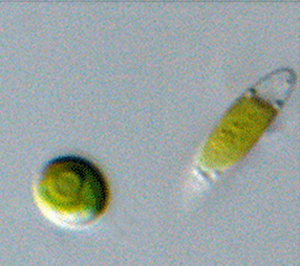
Identify
Zoochlorella
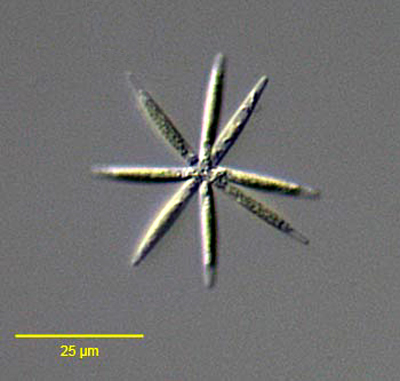
Identify
Actinastrum
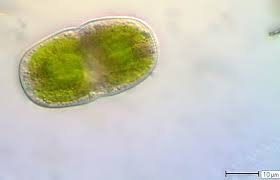
Identify
Actinotaenium
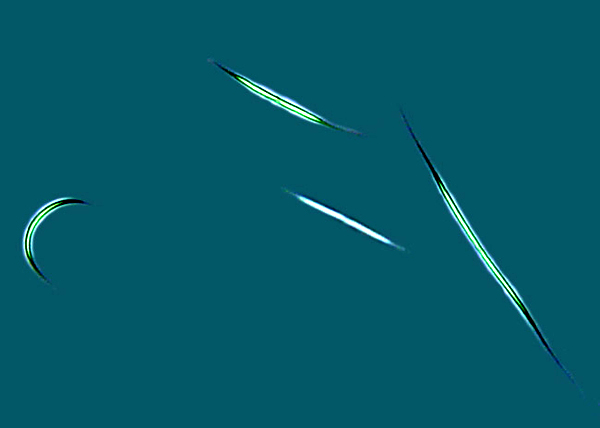
Identify
Ankistrodesmus
Identify
Apatococcus
Identify
Asterococcus
Identify
Bracteacoccus
Identify
Chlamydomonas
Identify
Chlorella
Identify
Cladophora
Identify
Closterium limenticum
Identify
Coelastrum
Identify
Cylindrocystis
Identify
Desmidium
Identify
Desmodesmus
Identify
Dictyosphaerium
Identify
Dilabifilum
Identify
Diplosphaera
Identify
Eremosphaera
Identify
Euastrum
Identify
Eudorina
Identify
Geminella
Identify
Golenkinia
Identify
Gonium
Identify
Haplotaenium
Identify
Hariotina
Identify
Hyalotheca
Identify
Jaagichlorella
Identify
Klebsormidium
Identify
Lacunastrum
Identify
Micrasterias
Identify
Microactinium
Identify
Microspora
Identify
Microthamnion
Identify
Monactinus
Identify
Monoraphidium
Identify
Mougeotia
Identify
Netrium
Identify
Oedogonium
Identify
Oocystis
Identify
Pandorina
Identify
Parapediastrum biradiatum