Bio 315 Lecture 22 Part 1
 Call Kai
 Learn
Learn Practice Test
 Spaced Repetition
 Match
Match Flashcards
 Knowt Play
1/25

There's no tags or description
Looks like no tags are added yet.
Name | Mastery | Learn | Test | Matching | Spaced | Call with Kai |
|---|
No analytics yet
Send a link to your students to track their progress
26 Terms
Alveoli
terminal air pouches at end of bronchioles
Respiratory organs [4]
1) Nose, nasal cavity, and paranasal sinuses
2) Pharynx, larynx, and trachea
3) Bronchi and bronchioles
4) Lungs containing alveoli
Organs of the Respiratory System Divided into [2]
1) Conducting zone
2) Respiratory zone
Conducting zone
passage-way for air
Respiratory zone
allow exchange of gases between
blood and atmosphere
Upper respiratory tract – two types of mucosa [2]
1) Olfactory mucosa
2) Respiratory mucosa – lines remainder of nasal
Olfactory mucosa use and location
houses olfactory receptors
located on superior concha
Respiratory mucosa
lines remainder of nasal
cavity, nasopharynx, trachea, bronchi
Respiratory Mucosa Consists of [3]
1) Ciliated, pseudostratified columnar epithelium
2) Goblet cells
3) mucosal glands
mucosal glands
secrete lysozyme to destroy bacteria and mucus to trap debris
Nasal Conchae
Superior, Middle, and Inferior covered by respiratory mucosa
Groove inferior to each concha
Meatus (there are 3: superior, middle, and inferior)
Conchae and meatuses Function
1) Filter air of particulate matter
2) Warm inhaled air
3) Moisten inhaled air:
Paranasal Sinuses [4]
1) Air-filled spaces
2) within skull bones
3) lined by respiratory mucosa
4)lighten skull and sound resonance
4 Paranasal Sinuses
a) Frontal
b) Sphenoidal
c) Ethmoidal
d) Maxillary
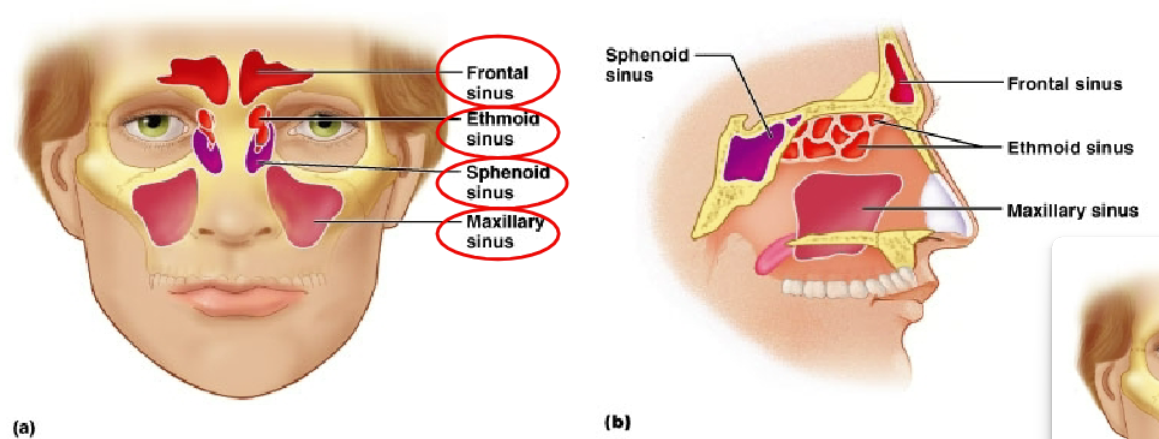
The Nasopharynx [3]
1) Only an air passageway
2) Closed off during swallowing
3) Lined by respiratory mucosa
The Larynx 3 functions
a) Voice production (contains vocal cords)
b) Provides an open airway
c) Routes air and food
The Larynx [3]
1) Lies at entrance to trachea
2) Three functions
3) Mostly cartilage framework
Epiglottis
elastic cartilage
What is the larynx made up of
1) Epiglottis (elastic cartilage)
2) Thyroid cartilage
3) Cricoid cartilage
4)Arytenoid cartilages
Cartilage components
mostly hyaline cartilage,
except epiglottis
Rima Glottidis
Space between vocal cords
Vocal cords move via
movements of arytenoids
Larynx Picture [4]
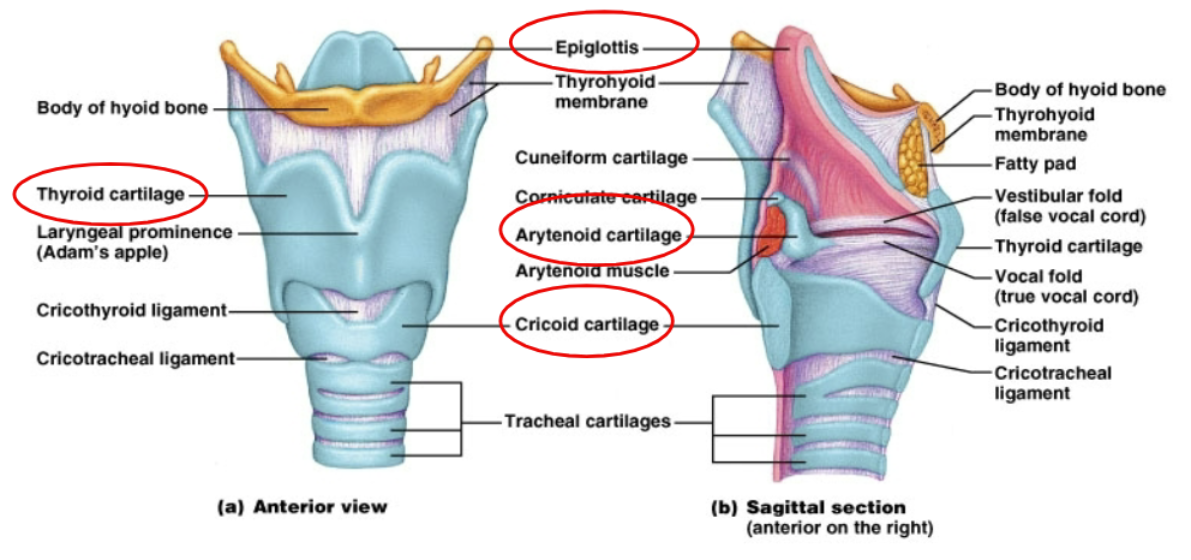
Two types of vocal cord movement
Lateral-medial: increase/decrease size of rima glottidis
Rotation: change length/tension of cords = pitch
Innervation of the larynx
branch from vagus nerve