PartTech Lecture 3 Part B Screening
 Call Kai
 Learn
Learn Practice Test
 Spaced Repetition
 Match
Match Flashcards
 Knowt Play
1/70

There's no tags or description
Looks like no tags are added yet.
Name | Mastery | Learn | Test | Matching | Spaced | Call with Kai | Chat |
|---|
No analytics yet
Send a link to your students to track their progress
71 Terms
Sieving
__________ is a separation technique based on the difference in particle size.
Sieve
In sieving, the __________ is responsible for retaining the larger particles.
Sieve plates
__________ have meshed or perforated bottoms which allow only particles of a specific size to pass through it.
Screening
SCREENING VS SIEVING. Identify if the characteristics below are of screening or sieving.
continuous
Sieving
SCREENING VS SIEVING. Identify if the characteristics below are of screening or sieving.
[usually] small diameter wires
Screening
SCREENING VS SIEVING. Identify if the characteristics below are of screening or sieving.
[relatively] large wire thickness
Screening
SCREENING VS SIEVING. Identify if the characteristics below are of screening or sieving.
for heavy-duty and lasts longer
Sieving
SCREENING VS SIEVING. Identify if the characteristics below are of screening or sieving.
batch
Sieving
SCREENING VS SIEVING. Identify if the characteristics below are of screening or sieving.
for light-duty, fine separations
Tyler Standard Sieve Series
Identify the scales used to classify particle sizes (Tyler Standard Sieve Series or US Standard Sieve Series)
Based on a 200-mesh screen with wires 0.0021 in (0.0053 cm) thick and openings of 0.0029 in (0.0074 cm)
US Standard Sieve Series
Identify the scales used to classify particle sizes (Tyler Standard Sieve Series or US Standard Sieve Series)
Introduced by the National Bureau of Standards
Tyler Standard Sieve Series
Identify the scales used to classify particle sizes (Tyler Standard Sieve Series or US Standard Sieve Series)
Other sizes vary by a fixed ratio of √2
US Standard Sieve Series
Identify the scales used to classify particle sizes (Tyler Standard Sieve Series or US Standard Sieve Series)
Based on a 1-mm opening (no.18 mesh) and varying by ∜2
US Standard Sieve Series
Identify the scales used to classify particle sizes (Tyler Standard Sieve Series or US Standard Sieve Series)
Arbitrary numbers
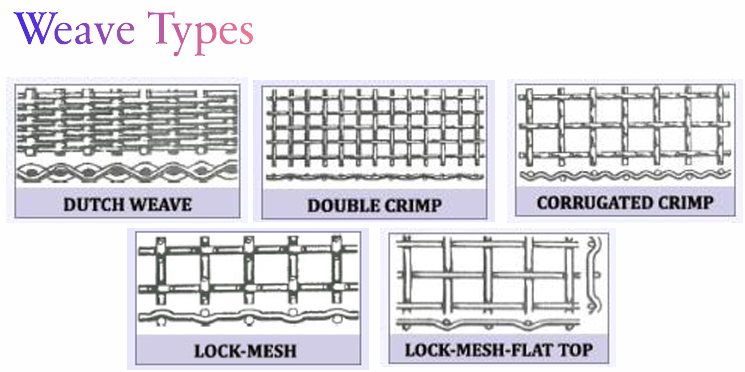
Dutch Weave
Double Crimp
Corrugated Crimp
Lock-Mesh
Lock-Mesh Flat Top
Weave Types (5)
Dutch Weave
Identify the Type of Weave
Weft wires are woven as closely together as possible to obtain a “zero mesh“, i.e., practically without an aperture. [single plain dutch weave (SPW), basket weave, reps, corduroy]
Double Crimp
Identify the Type of Weave
Wires are crimped evenly in both direction and sprung together by the weaving process to provide a rigid mesh used for most normal applications.
Corrugated Crimp
Identify the Type of Weave
Screens have additional crimps in both wrap and weft directions between intersections; used to achieve a rigid mesh where the aperture size is large in relation to the wire diameter. [double intermediate]
Lock-Mesh
Identify the Type of Weave
Similar to double crimp, but with the positive crimps of each intersection, the mesh remain firmly locked throughout its life; traditionally associated with heavy wire diameters.
Lock-Mesh Flat Top
Identify the Type of Weave
Similar to standard lock-mesh but with the crimps on the underside of the mesh only, the top surface remains smooth allowing materials to pass freely across screens.
TRUE
TRUE or FALSE
The smaller the percentage of the open space, the slower the screening.
TRUE
TRUE or FALSE
The larger the percentage of the open space, the shorter its working life.
FALSE
The larger the percentage of the open space, the faster the screening.
TRUE or FALSE
The larger the percentage of the open space, the slower the screening.
TRUE
TRUE or FALSE
The smaller the percentage of the open space, the longer its working life.
[1] particle being too large that it is easily retained
[2] particle being too small that it passes through easily
[3] particle having a critical dimension so that it would be trapped and promote blinding or clogging of the screen surface which occurs when a particle has an approximate size of 1.1D
Situations that a particle may face when it strikes a screen (3)
Aperture (A)
SCREEN CHARACTERISTICS
The clear space between the individual wires of the screen
Square Mesh
SCREEN CHARACTERISTICS
Identify what mesh or screen is being described:
Used in applications in which a cubic shape is required
Slotted Mesh
SCREEN CHARACTERISTICS
Identify what mesh or screen is being described:
Faster screening because of the reduced resistance
Harp Screen
SCREEN CHARACTERISTICS
Identify what mesh or screen is being described:
For screening wet and difficult-to-screen feed material
1 inch/25.4 mm
SCREEN CHARACTERISTICS
Calculations for the Aperture Size
From the formula, what is L and its value (in inches or mm)?

Mesh Number
SCREEN CHARACTERISTICS
Calculations for the Aperture Size
From the formula, what is N?

Wire Diameter
SCREEN CHARACTERISTICS
Calculations for the Aperture Size
From the formula, what is D?

Mesh Number/Mesh Count (N)
SCREEN CHARACTERISTICS
The number of openings (A) per linear inch of a screen. German, American, British
Mesh Number/Mesh Count (N)
SCREEN CHARACTERISTICS
Equal to the aperture (A) expressed to the nearest decamicron (0.01 mm). Indian
Pitch
SCREEN CHARACTERISTICS
The sum of the aperture or opening size (A) and the wire’s diameter or gauge size (D).
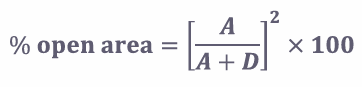
Open Area
SCREEN CHARACTERISTICS
Percentage of the actual opening vs the total screen area.
Open Area
SCREEN CHARACTERISTICS
This can be calculated if the mesh count and wire diameters are the same across the width and length.
Aperture Size
SCREEN CHARACTERISTICS
Calculations for % Open Area:
What is A?
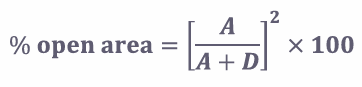
Wire Diameter
SCREEN CHARACTERISTICS
Calculations for % Open Area:
What is D?
+20 mesh
SCREEN ANALYSIS
Methods of Reporting Size Fractions
Give other methods of reporting from the given size fraction:
(Ex. Given: Oversize, ¼ in. Answer: +1/4 in)
Oversize, 20 mesh
![<p>[-1/4 + 1/8] or [-1/4 / 1/8]</p>](https://knowt-user-attachments.s3.amazonaws.com/381e318f-6714-45b2-841f-6b0b04a2187d.png)
[-1/4 + 1/8] or [-1/4 / 1/8]
SCREEN ANALYSIS
Methods of Reporting Size Fractions
Give other methods of reporting from the given size fraction:
(Ex. Given: Oversize, ¼ in. Answer: +1/4 in)
Through ¼ in, on 1/8 in
[-10 + 20] or [10 / 20]
SCREEN ANALYSIS
Methods of Reporting Size Fractions
Give other methods of reporting from the given size fraction:
(Ex. Given: Oversize, ¼ in. Answer: +1/4 in)
Through 10 mesh, on 20 mesh
[-200] or [-200 + pan]
SCREEN ANALYSIS
Methods of Reporting Size Fractions
Give other methods of reporting from the given size fraction:
(Ex. Given: Oversize, ¼ in. Answer: +1/4 in)
Undersize, 200 mesh
Differential or Fractional Analysis
SCREEN ANALYSIS
Methods of Reporting Screen Analysis
Reports the mass fraction of particles passing through the bigger screen and retained on the next smaller screen.
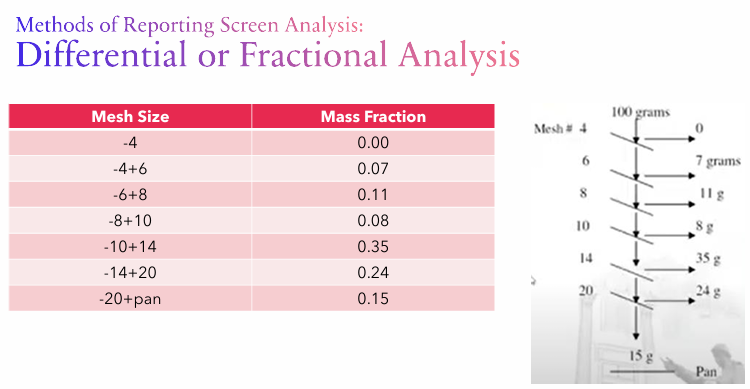
SCREEN ANALYSIS
Methods of Reporting Screen Analysis
Example of Differential or Fractional Analysis (see image)
Cumulative ON Screen
SCREEN ANALYSIS
Methods of Reporting Screen Analysis
Reports the mass fraction of particles whose diameter is larger than the mesh or screen opening (% retained)
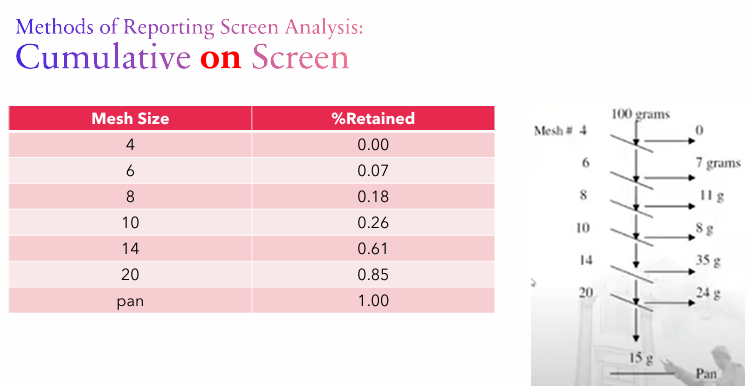
SCREEN ANALYSIS
Methods of Reporting Screen Analysis
Example of Cumulative ON Screen (See image)
Cumulative THROUGH Screen
SCREEN ANALYSIS
Methods of Reporting Screen Analysis
Reports the mass fraction of particles whose diameter is less than the mesh or screen opening (% passing).
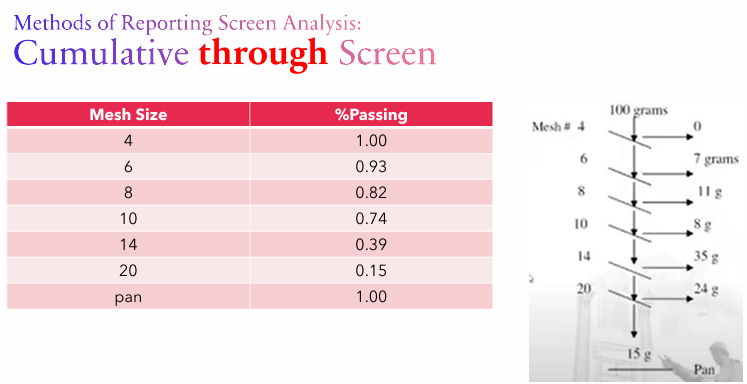
SCREEN ANALYSIS
Methods of Reporting Screen Analysis
Example of Cumulative THROUGH Screen (See image)
Mass flow rate of the feed
MATERIAL BALANCE OVER SCREENS
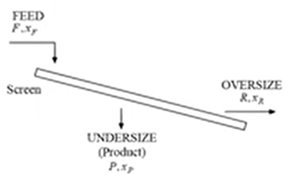
Consider a binary mixture containing particle A and B,
From the given Diagram:
“F“ refers to _____.
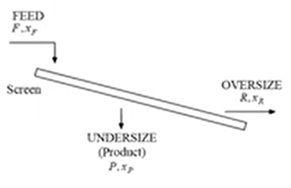
Mass flow rate of the reject (Oversize)
MATERIAL BALANCE OVER SCREENS
Consider a binary mixture containing particle A and B,
From the given Diagram:
“R“ refers to _____.
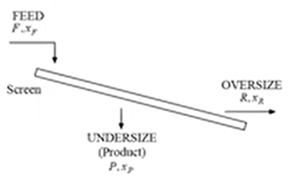
Mass flow rate of the product (Undersize)
MATERIAL BALANCE OVER SCREENS
Consider a binary mixture containing particle A and B,
From the given Diagram:
“P“ refers to _____.
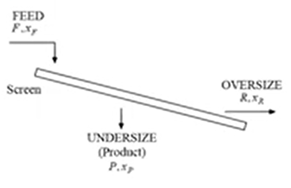
Xf - mass fraction of A in the FEED
Xr - mass fraction of A in the REJECT
Xp - mass fraction of A in the PRODUCT
MATERIAL BALANCE OVER SCREENS
Consider a binary mixture containing particle A and B,
From the given Diagram:
Xf refers to _____.
Xr refers to _____.
Xp refers to _____.
Recovery of desired product
Rejection of undesired material
MATERIAL BALANCE OVER SCREENS
Screen Effectiveness or Efficiency
Screen effectiveness/efficiency mostly depends on two (2) aspects:
Recovery of Desired Product
MATERIAL BALANCE OVER SCREENS
Screen Effectiveness or Efficiency
Identify what aspect of screen effectiveness/efficiency is represented:
Represents the ability of the screen to separate all particles of the desired size.
Rejection of Undesired Material
MATERIAL BALANCE OVER SCREENS
Screen Effectiveness or Efficiency
Identify what aspect of screen effectiveness/efficiency is represented:
Separated product must contain minimal amount of particles having sizes other than the desired size.
Screen effectiveness or Efficiency
MATERIAL BALANCE OVER SCREENS
Measure of success of a screen in separating materials A and B
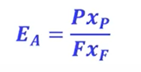
formula for Ea
MATERIAL BALANCE OVER SCREENS
Screen Effectiveness or Efficiency
One measure of the efficiency is the ratio of undersize material A that is actually in the underflow to the amount of A entering the feed (read lungs)
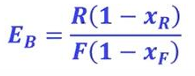
Formula for Eb
MATERIAL BALANCE OVER SCREENS
Screen Effectiveness or Efficiency
Can also be based on the oversize i.e, the ratio of the oversize material B that is actually in the overflow to the amount of B entering the feed (read lungs ulet)

MATERIAL BALANCE OVER SCREENS
Screen Effectiveness or Efficiency
What is the formula for overall efficiency?
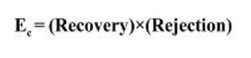
MATERIAL BALANCE OVER SCREENS
Screen Effectiveness or Efficiency
The general method of classifying screen effectiveness (Ec) is _________.

where Yp and Yf are the mass fraction of the desired particle in the product and feed respectively
MATERIAL BALANCE OVER SCREENS
Screen Effectiveness or Efficiency
What is the formula for Recovery?

MATERIAL BALANCE OVER SCREENS
Screen Effectiveness or Efficiency
What is the formula for Rejection?

MATERIAL BALANCE OVER SCREENS
Screen Effectiveness or Efficiency
Substituting the formula for Recovery and Rejection in the general method for classifying screen effectiveness (Ec) (read lungs ulet)

Mesh Size & Wire Diameter
Screen Capacity
Blinding
Moisture
Direction of Particle Approach to Screen Surface
Cohesion
Adhesion
MATERIAL BALANCE OVER SCREENS
Factors Affecting Effectiveness (7)
Screen Capacity
MATERIAL BALANCE OVER SCREENS
Refers to the mass of material that can be fed per unit time to a unit area of the screen.

MATERIAL BALANCE OVER SCREENS
What is the formula for Capacity or Screen Capacity?
TRUE
MATERIAL BALANCE OVER SCREENS
Capacity vs Effectiveness
TRUE or FALSE
The capacity of a screen is measured by the mass of material that can be fed per unit time to a unit area of screen.
TRUE
MATERIAL BALANCE OVER SCREENS
Capacity vs Effectiveness
TRUE or FALSE
Capacity and Effectiveness are opposing factors
FALSE
To obtain maximum effectiveness, the capacity must be small.
MATERIAL BALANCE OVER SCREENS
Capacity vs Effectiveness
TRUE or FALSE
To obtain maximum effectiveness, the capacity must be large.
FALSE
Large capacity is obtainable only at the expense of a reduction in effectiveness.
MATERIAL BALANCE OVER SCREENS
Capacity vs Effectiveness
TRUE or FALSE
Large capacity is obtainable without the expense of a reduction in effectiveness.