MB5400 Life History and Evolution of Coral Reefs
 Call Kai
 Learn
Learn Practice Test
 Spaced Repetition
 Match
Match Flashcards
 Knowt Play
1/84

There's no tags or description
Looks like no tags are added yet.
Name | Mastery | Learn | Test | Matching | Spaced | Call with Kai |
|---|
No analytics yet
Send a link to your students to track their progress
85 Terms
Difference between unitary and modular organisms
Unitary organisms - size is determinate, governed by genetics, determinate lifespan, individuals sexually derived
Modular organisms - growth is indeterminate as colonies can increase in size (through replication) or decrease in size (through fission, partial mortality)
What is a module
A morphological individual
What are polymorphisms in corals?
Polyps can undertake different and specialised forms. For example sea pens have both axial and secondary polyps - the axial polyp provides support and anchors colony, secondary polyps have different functions, some feed and reproduce, others pump water through colony
Modular growth
Module is replicated and remains attached so colony grows larger
Modular reproduction
A new, separate individual is produced, can be sexually or asexually derived
Consequences of modular organisation
connected modules allows for the sharing of resources, communication, collaboration and enhances colony survival
modules have their own birth and death rates: size and age decoupled
placement of modules determines colony form - potential for morphological diversity
Colony vs aggregation
Colony - replicated modules that remain attached
Aggregation - replicated modules that detach
Physiological implications for colony shape
Biomechanical constraints of skeleton govern optimal environments
SA:V affects prey and light capture
Ecological implications of colony shape
Shape determines how the colony interacts with:
competitors
predators
the environment
Key decisions that govern the evolution of an organism’s life history
size
reproductive age
fecundity
longevity
parental responsibilities
number of reproductive events
Ideal life history
Fecundity - high
Size at birth - large
Age at maturity - young
Size at maturity - large
Early mortality - low
Late mortality - low
Longevity - high
Implication of the ideal life history
Ideal life history requires significant effort and energy expenditure - tradeoffs must be made
Reasons for the evolution of so many different life history strategies
Genetic variation
Natural selection
What is life history
The analysis of what causes differences in fitness among life history variants
What is life history evolution
The evolution of major features of the life cycle, mainly age distribution of birth and death rates, growth rates, and size of offspring
Importance of studying life history
increases understanding of how the phenotype is designed for reproduction and survival
key to understanding population dynamics
makes sense of all biology, the diversity of organisms and their life cycles
What key aspects of corals have shaped their life histories?
Corals are sessile - can’t seek refuge from environmental events
Corals are modular - success related to size
Principle life history traits of organisms
size at birth
growth rate
growth form
age at maturity
size at maturity
number, size and sex ratio of offspring
age and size-specific reproductive investment
age and size-specific mortality schedule
lifespan
Define fitness
Relative contribution of a genotype to succeeding generations
What life history traits are commonly involved in tradeoffs?
reproduction vs survival
number vs size of offspring
growth rate vs growth form
growth rate vs competitive ability
Example of a life history tradeoff
Pocillopora - has small polyps which limits the number of eggs per polyp
What determines a species’ schedule of growth, reproduction and mortality?
Energetic tradeoffs - compromises on how best to invest its resources
What is the r-k selection theory?
Theory relating to how populations increase (r) relative to the capacity of their environment (K)
Traits of r-selected species
adapted to unstable, unpredictable environments
invade new habitats quickly
grow and reproduce quickly
rely on high reproduction of use short-lived ephemeral resources
population boom and bust cycles
Traits of K-selected species
adapted to stable, predictable environments
good competitors
ability to acquire and persist within a space
rely on competitive ability to persist at carrying capacity
maintain steady population rate
Inconsistencies and problems with r-K selection theory
Corals persist a mixture of r and K-selected traits.
Porites would be considered a K-strategist as it is a good persister, grows large and is long lived, however has a high reproductive output and is a poor competitor, which are r-selected traits
Major problem: r is a population parameter but K is a function of the environment - doesn’t account for interactions
Key features of Grime’s C-S-R selection?
Competitors - low stress, low disturbance - growth focused
Stress-tolerators - high stress, low disturbance - lifespan focused
Ruderals - low stress, high disturbance - reproduction focused
How does Grime’s model compare with r-K selection?
Grime’s model extends the r-K selection model by addressing two distinct environmental pressures - stress and disturbance - rather than relying solely on population density or stability
What inconsistencies and problems are there with C-S-R selection theory?
Defines life history strategies in terms of the environment and focuses on the adult stage, where in corals, there are lots of energy tradeoffs that occur early in the life stage
Semelparous vs iteroparous
Semelparous breed once and die (annuals)
Iteroparoud breed repeatedly throughout lifetime
Key details of Charnov and Shaffer’s model
Compares survival probabilities - when you die determines when you should reproduce and how much to reproduce:
adults likely to survive spread reproduction over time
adults unlikely to survive put everything into one big reproductive effort
Model incorporates adult vs juvenile mortality and early vs late reproduction
Population growth rate of annuals
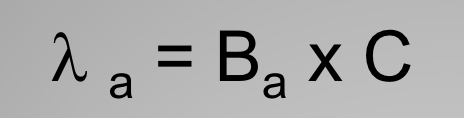
Birth rate x probability of surviving 1st year of life
Population growth rate of perennials

Birth rate x probability of surviving 1st year of life + adult survival rate
How does Charnov and Schaffer’s model improve on previous theories?
Focuses on natural selection driving survival and reproduction tradeoffs
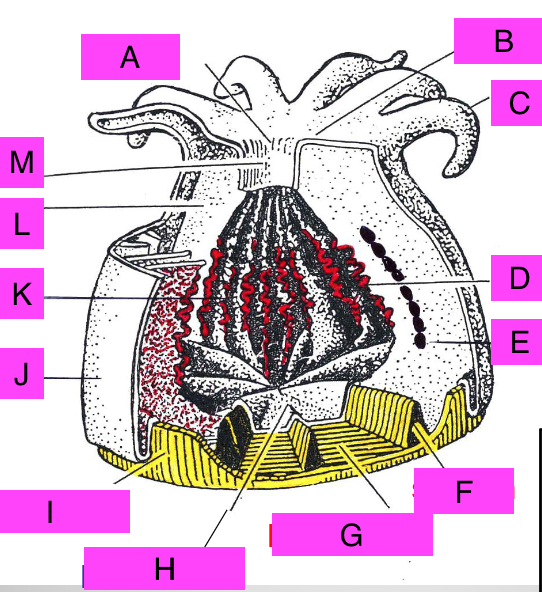
A = mouth
B = oral disc
C = tentacle
D = mesenterial filament
E = eggs/spermaries
F = septum
G = basal plate
H = basal disc
I = wall
J = column
K = coelenteron
L = mesentery
M = stomadeum (oesophagus)
Key characteristics of Cnidarians
specialised cells grouped into tissues which perform functions, but tissues not grouped into organisms
diploblastic tissues - 2 epithelial cell layers separated by a connective acellular layer (mesoglea)
epidermis contained cnidae
widespread algal symbiosis
radial/biradial symmetry
two polyp forms - polyp and medusa
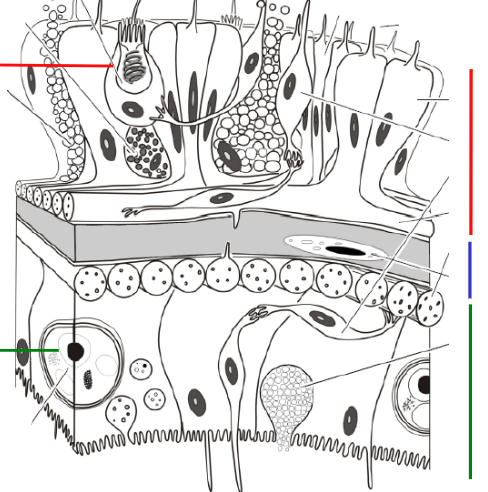
Red = epidermis
Blue = mesoglea
Green = gastrodermis
Roles of mesentaries
digestion
defence
Steps to form coral skeleton
Larva attaches to substratum
Mucoid layer
Basal plate
vertical structures
Complete juvenile skeleton
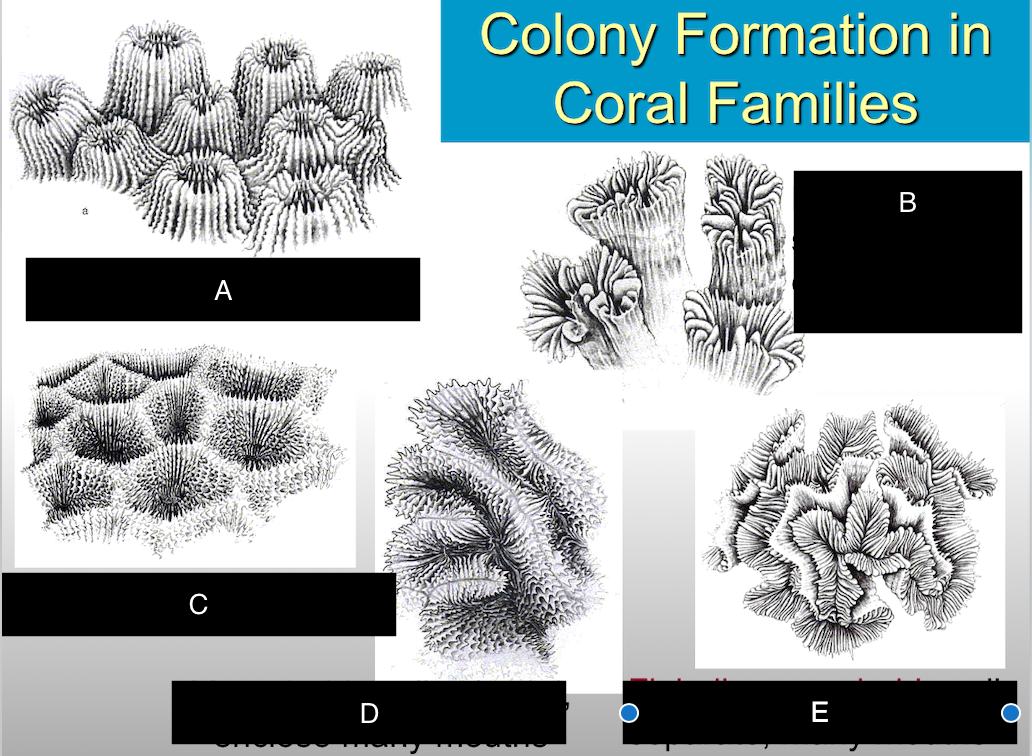
A = plocoid - separate walls
B = phaceloid - separate, extended walls
C = Cerioid - walls shared
D = Meandroid - walls shared, enclose many mouths
E = Flabello-meandroid - walls separate, many mouths
Why does competition come about?
Competition is an interaction between individuals due to a shared requirement for a resource in limited supply, leads to a reduction in survivorship, growth and reproduction of individuals
Define histocompatibility
Ability for a coral to recognise itself
Isografts
The same genotype
Allografts
Different genotypes, but the same species
Xenografts
Different species
Responses to histocompatibility
fusion of tissue along point of contact
rejection
What is a chimera
A mix of tissues from 2 or more genetically different individuals that have fused
Advantages of chimeras
juveniles increase in size more rapidly
acquire a life long mate
greater genetic variability
Disadvantages of chimeras
genotypes may compete for resources
parasitism of one genotype by the other
Competitive mechanisms in corals
Direct interactions: mesentarial filaments, overgrowth, sweeper tentacles
Indirect interactions: overtopping, allelochemicals
Standoffs: expending energy to inhibit growth of neighbour
Most effective competition mechanism for slow growers
Direct injury
Most effective competition mechanism for fast growers
Overtopping
Role of competition in structuring communities
creates dominance hierarchies or competitive networks
retards rate of resource monopolisation
enables coexistence of competing species
3 levels of organisation in modular organisms
module (polyp) - morphological individual
colony - physiological individual
genet (clone) - genetic individual
Ecological/demographic consequences of asexual reproduction
replication of polyps (growth) and colonies (asexual reproduction)
genotype dispersed over a wider area, greater range of habitats/resources
spreads the risk of mortality over 3 levels
3 levels of mortality
Polyp death - partial colony mortality - reduces colony fitness
Colony death - affects abundance/distribution of genotype - reduces genet fitness
Genet death - reduces genetic diversity - reduces population fitness
Evolutionary implications of cloning
Preservation of successful genomes
don’t need a mate to reproduce
cloning may circumvent senescence of a genotype
Growth vs reproduction tradeoff interacting with reproduction
Corals channel resources into growth rather than reproduction until the colony attains an appropriate size
Spawners vs brooders egg size/egg number
Spawners - more eggs, smaller eggs
Brooders - less eggs, larger eggs
Brooder vs spawners reproductive tradeoffs
Brooders require increased energy for parental care
Most brooders pass down zooxanthellae
Spawners are able to disperse more widely
Brooders have greater chance of fertilisation success and lower juvenile mortality
Physiological vs evolutionary tradeoffs
Physiological - responses of individuals to extrinsic factors (e.g. growth rate vs competition)
Evolutionary - responses of populations or species (e.g. egg size vs egg number)
3 levels of synchrony for mass spawning, their proximal and ultimate factors
Hour - P=daily photo-period cycle, U=avoid visual predators
Night, P=lunar cycle, U=neap tides to maximise dispersal and fertilisation
Month, P=temps?, U=optimise juvenile survival and growth
3 hypotheses about ultimate factors that could’ve led to the evolution of synchronous spawning
Predator satiation hypothesis - implies that different species have co-evolved short, synchronous breeding periods and suggests that mass spawning should occur in all regions where planktivorous fish are abundant and that mass spaning should not be tied to any particular season
Genetic legacy hypothesis - assumes that current spawning patterns are a result of a historical, genetic legacy
Environmental constraints hypothesis - assumes that each species has independently responded to environmental, ecological or physiological factors that constrain the optimal time of breeding, and suggests that synchrony occurs because species respond similarly to these factors and that the timing of spawning should vary regionally in response to regional variation in these factors
Links between physiology and life history
physiology controls responses of an organism to the environment
physiological mechanisms link performance of organism and life table of population to environment