Exam 1
 Call Kai
 Learn
Learn Practice Test
 Spaced Repetition
 Match
Match Flashcards
 Knowt Play
1/284

There's no tags or description
Looks like no tags are added yet.
Name | Mastery | Learn | Test | Matching | Spaced | Call with Kai |
|---|
No analytics yet
Send a link to your students to track their progress
285 Terms
Erikson’s Stages of Development: Infancy
whats the crisis
trust vs mistrust
Do I feel secure or insecure in the world?
Goal: To feel comfortable to explore
Erikson’s Stages of Development: 1-3 years whats the crisis and goal?
Autonomy vs. Shame & Doubt
What am I capable of?
Goal: To know my abilities & limits
Freud’s Stages of Development: first year
oral
Goal: To feel comforted
How can I feel content?
Freud’s Stages of Development: second year
anal
Goal: To assert control in the environment
What can I control in my life?
How Does Psychosocial Growth Advance in the 1st 2 Years of Life:birth
Distress; contentment
How Does Psychosocial Growth Advance in the 1st 2 Years of Life: 6 weeks
Social smile
How Does Psychosocial Growth Advance in the 1st 2 Years of Life: 3 months
Laughter; curiosity
How Does Psychosocial Growth Advance in the 1st 2 Years of Life: 4 months
Full, responsive smiles
How Does Psychosocial Growth Advance in the 1st 2 Years of Life: 4-8 months
anger
How Does Psychosocial Growth Advance in the 1st 2 Years of Life: 9-14 months
Fear of social events (strangers, separation from caregiver)
How Does Psychosocial Growth Advance in the 1st 2 Years of Life: 12 months
Fear of unexpected sights and sounds
How Does Psychosocial Growth Advance in the 1st 2 Years of Life: 18 months
Self-awareness; pride; shame; embarrassment
Temperament
how you respond in the world, based on emotions, activity, & self-regulation (due to nature)
• Parent ↔ child interactions
Synchrony
value of eye contact for developing attachment
Temperament: Continuity & Change Over Time: Categories:
Easy
Difficult
Slow-to-Warm
Temperament: Continuity & Change Over Time: Characteristics:
Effortful Control
Negative Mood
Activity Level
Temperament: Continuity & Change Over Time: overtime
Continuity & change
Advancing Self Awareness:
• Realize my body, thoughts, & actions are separate from others
• Self Awareness reflects complex emotions (pride, shame, & embarrassment)
Advancing Social-Awareness to engage in the world:
• Social referencing (watch & imitate others)
• Recognize cultural values & features of the environment
social smile
A smile evoked by a human face, normally first evident in infants about 6 weeks after birth.
separation anxiety
An infant’s distress when a familiar caregiver leaves; most obvious between 9 and 14 months.
stranger wariness
An infant’s expression of concern — a quiet stare while clinging to a familiar person, or a look of fear — when a stranger appears.
self-awareness
A person’s realization that they are a distinct individual whose body, mind, and actions are separate from those of other people.
temperament
Inborn differences between one person and another in emotions, activity, and self-regulation. It is measured by the person’s typical responses to the environment.
synchrony
A coordinated, rapid, and smooth exchange of responses between a caregiver and an infant.
still-face technique
An experimental practice in which an adult keeps their face unmoving and expressionless in face-to-face interaction with an infant.
attachment
According to Ainsworth, “an affectional tie” that an infant forms with a caregiver — a tie that binds them together in space and endures over time.
Strange Situation
\A laboratory procedure for measuring attachment by evoking infants’ reactions to the stress of various adults’ comings and goings in an unfamiliar playroom.
secure attachment (type B)
A relationship in which an infant obtains both comfort and confidence from the presence of their caregiver.
insecure-avoidant attachment (type A)
A pattern of attachment in which an infant avoids connection with the caregiver, as when the infant seems not to care about the caregiver’s presence, departure, or return.
insecure-resistant/ambivalent attachment (type C)
A pattern of attachment in which an infant’s anxiety and uncertainty are evident, as when the infant becomes very upset at separation from the caregiver and both resists and seeks contact on reunion.
disorganized attachment (type D)
A type of attachment that is marked by an infant’s inconsistent reactions to the caregiver’s departure and return
social referencing
Seeking information about how to react to an unfamiliar or ambiguous object or event by observing someone else’s expressions and reactions. That other person becomes a social reference.
trust versus mistrust
Erikson’s first crisis of psychosocial development. Infants learn basic trust if the world is a secure place where their basic needs (for food, comfort, attention, and so on) are met.
autonomy versus shame and doubt
Erikson’s second crisis of psychosocial development. Toddlers either succeed or fail in gaining a sense of self-rule over their actions and their bodies
proximal parenting
Caregiving practices that involve being physically close to the baby, with frequent holding and touching.
distal parenting
Caregiving practices that involve remaining distant from the baby, providing toys, food, and face-to-face communication with minimal holding and touching
working model
In cognitive theory, a set of assumptions that the individual uses to organize perceptions and experiences. For example, a person might assume that other people are trustworthy and be surprised by an incident in which this working model of human behavior is erroneous.
allocare
Literally, “other-care”; the care of children by people other than the biological parents.
The science of human development seeks to…
understand how and why people — all kinds of people, everywhere, of every age — change over time.
replication
Repeating a study
Nature
refers to the influence of the genes that people inherit.
Nurture refers to
environmental influences, beginning with the health, diet, and stress — of the future person’s birth parent at conception and continuing lifelong, within family, school, community, and nation.
adverse childhood experiences (ACEs)
Childhood experiences that have been proven to have harmful effects on development. Physical and emotional problems in adulthood can be traced to ACEs.
The harm is cumulative. Four or more ACEs can be destructive, even when the experience itself is a hazy memory.
5 steps of the scientific method
curiosity
hypothesis
test
analyze data and draw conclusions
report the results
replication (sometimes used)
life-span perspective
An approach to the study of human development that takes into account all phases of life, not just childhood or adulthood.
Development Is Multidirectional
Multiple changes, in every direction, characterize the life span
critical period
a time when something must occur for normal development, or the only time when an abnormality might arise.
Sensitive Periods
A time when a certain type of development is most likely, although it may still happen later with more difficulty. For example, early childhood is important to learn language
Cross-Sectional
Conducted over a few days, plus analysis (what do we know right now)
A research design that compares groups of people who differ in age but are similar in other important characteristics.
Longitudinal:
Conducted over 16 years, plus analysis (change over time)
Continuity
growth in the same direction
Discontinuity
change in direction for growth- often abruptly
Development is Muticontextual
includes everything from the direct physical environment (temperature, air quality, objects, plants) to the surrounding living creatures (people, mammals, birds, insects), as well as everything from social values (attitudes about love, money, cooperation) to cultural norms (the expected way to behave and believe, the proper manners and customs).
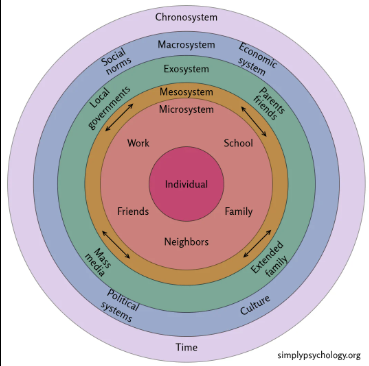
what are the 5 parts of the Ecological Model
Microsystem (most influence/closest): direct relationships
Mesosystem: interacting systems
Exosystem: local resources for microsystems
Macrosystem: broad/societal influences on microsystems
Chronosystem (least influence): influence of moment in time/history
cohort
people born within the same historical period who therefore move through life together, experiencing the same events, new technologies, and cultural shifts at the same ages. For example, the effect of the internet varies depending on what cohort a person belongs to.
Development Is Multicultural
“shared beliefs, language, conventions, norms, behaviors, expectations”
social construct
An idea that is built on shared perceptions, not on objective reality. Many age-related terms (such as childhood, adolescence, yuppie, and senior citizen) are ____ connected to biological traits but strongly influenced by social assumptions.
difference-equals-deficit error
The mistaken belief that a deviation from some norm is necessarily inferior to behaviors or characteristics that meet the standard.
ethnic group
People whose ancestors were born in the same region and who often share a language, culture, and religion
cross-sequential research
A hybrid research design in which researchers first study several groups of people of different ages and then follow those groups over the years.
correlation
A number between +1.0 and -1.0 that indicates the degree of relationship between two variables, expressed in terms of the likelihood that one variable will (or will not) occur when the other variable does (or does not). A ____ indicates only that two variables are somehow related, not that one variable causes the other to occur.
experiment
A research method in which the researcher tries to determine the cause-and-effect relationship between two variables by manipulating one (called the independent variable) and then observing and recording the ensuing changes in the other (called the dependent variable).
hypothesis
A specific prediction that can be tested.
independent variable
In an experiment, the variable that is introduced to see what effect it has. (Also called experimental variable.)
dependent variable
In an experiment, the variable that may change as a result of whatever new condition or situation the experimenter adds.
meta-analysis
A technique of combining results of many studies to come to an overall conclusion.
qualitative research
Research that considers qualities instead of quantities. Descriptions of particular conditions and participants’ expressed ideas are often part of qualitative studies.
quantitative research
Research that provides data that can be expressed with numbers, such as ranks or scales.
ecological-systems approach
A perspective on human development that considers all of the influences from the various contexts of development. (Later renamed bioecological theory.)
differential susceptibility
The idea that people vary in how sensitive they are to particular experiences. Often such differences are genetic, which makes some people affected “for better or for worse” by life events.
intersectionality
The idea that the various identities need to be combined. This is especially important when discrimination occurs.
socioeconomic status (SES)
A person’s position in society as determined by income, occupation, education, and place of residence. (Sometimes called social class.)
dynamic-systems approach
A view of human development as an ongoing, ever-changing interaction between the physical, cognitive, and psychosocial influences. The crucial understanding is that development is never static but is always affected by, and affects, many systems.
race
A group of people who are regarded by themselves or by others as distinct from other groups on the basis of physical appearance, typically skin color.
Development Is Multidisciplinary
Many influences and parts that make up us as individuals (like a puzzle piece)
E.g., nature & nurture: biosocial, cognitive & psychosocial
Biosocial includes biology, neuroscience, and medicine.
Cognitive includes psychology, linguistics, and education.
Psychosocial includes economics, sociology, and history.
Development Is Plastic
The idea that abilities, personality, and other human characteristics can change over time.(we are malleable)
People can change over time.
New behavior is affected by what has already happened.
survey
A research method in which information is collected from a large number of people by interviews, written questionnaires, or some other means.
scientific observation
A method of testing a hypothesis by unobtrusively watching and recording participants’ behavior in a systematic and objective manner — in a natural setting, in a laboratory, or in searches of archival data.
what ethics do researchers follow
Institutional Review Board (IRB), a group that requires research to follows guidelines set by the federal government.
: Development is Multicontextual
Vanessa is getting married this summer, and she’s a bit concerned about
her mother and father getting along during all of the festivities. Her
parents got divorced 10 years ago, but they still argue constantly.
If Vanessa has relationships with both her mother and her father, this
represents her...
If Vanessa’s parents communicate, this represents her....
The community where the ceremony will take place represents her...
The American cultural value of marriage represents her...
If Vanessa has relationships with both her mother and her father, this represents her microsystem – the immediate relationships that directly affect her development.
If Vanessa’s parents communicate, this represents her mesosystem – the interactions between different parts of her microsystem, such as her parents' relationship affecting her experience.
The community where the ceremony will take place represents her exosystem – the broader social setting that influences her indirectly.
The American cultural value of marriage represents her macrosystem – the overarching cultural beliefs and values that shape societal expectations.
You have been asked to participate in a research study about the relationship between memory ability and age (comparing college students & retired faculty). The researchers have asked you to participate in the study this afternoon in order to complete all the surveys at once. The researchers are most likely using which type of research design?
cross sectional
what do theories do (4)
Theories are general ideas about a topic.
theories produce hypotheses
theories generate discoveries
theories offer practical guidance
Psychosexual theory
Unconscious shapes motives for behavior → resolve conflict
Influence of childhood memories
Goal: Conflict resolution → shapes personality
Id, Ego, & Superego
5 Psychosexual Stages: Oral, Anal, Phallic, Latency, Genital
(To resolve conflicts)
Psychosocial theory
Erikson’s theory of the stages of development, emphasizing the interaction between the psychic needs of the individual and the surrounding social network of family and community.
Development through the lifespan
8 Psychosocial Stages for increasing self-understanding over time
Goal: Resolution of crises facilitates self-awareness
Conflicts/crises influence thoughts & behavior → Resolution → Development
(To overcome crises)
Behaviorism (observe & measure) theory
A grand theory of human development that studies observable behavior. _____ is also called learning theory because it describes the laws and processes by which behavior is learned.
conditioning = learning
Behaviorists do not focus on how people ______,
but instead focus on how people behave in the e_____________
think,
environment
Classical conditioning
The learning process in which a meaningful stimulus (such as the smell of food to a hungry animal) is connected with a neutral stimulus (such as the sound of a tone) that had no special meaning before conditioning. (Also called respondent conditioning.)
operant conditioning
The learning process by which a particular action is followed by something desired (which makes the person or animal more likely to repeat the action) or by something unwanted (which makes the action less likely to be repeated). (Also called instrumental conditioning.)
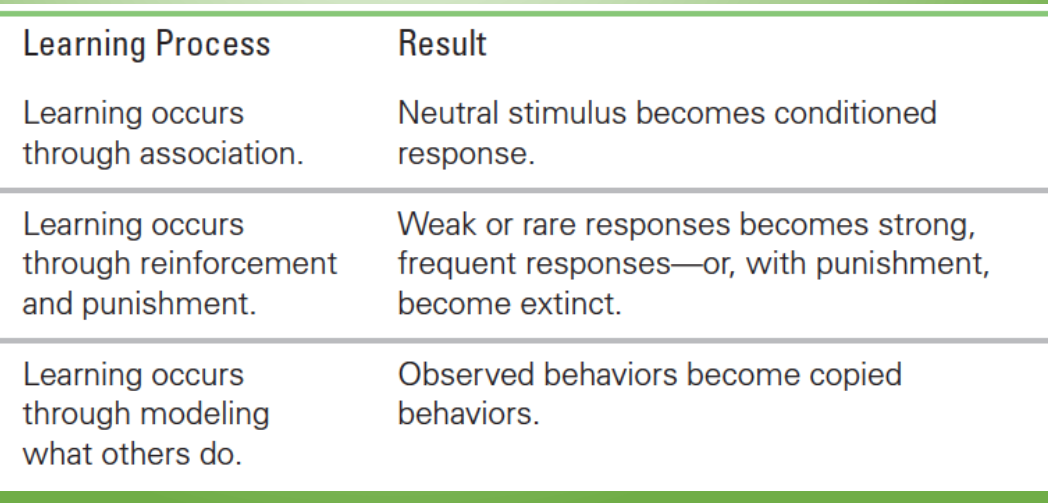
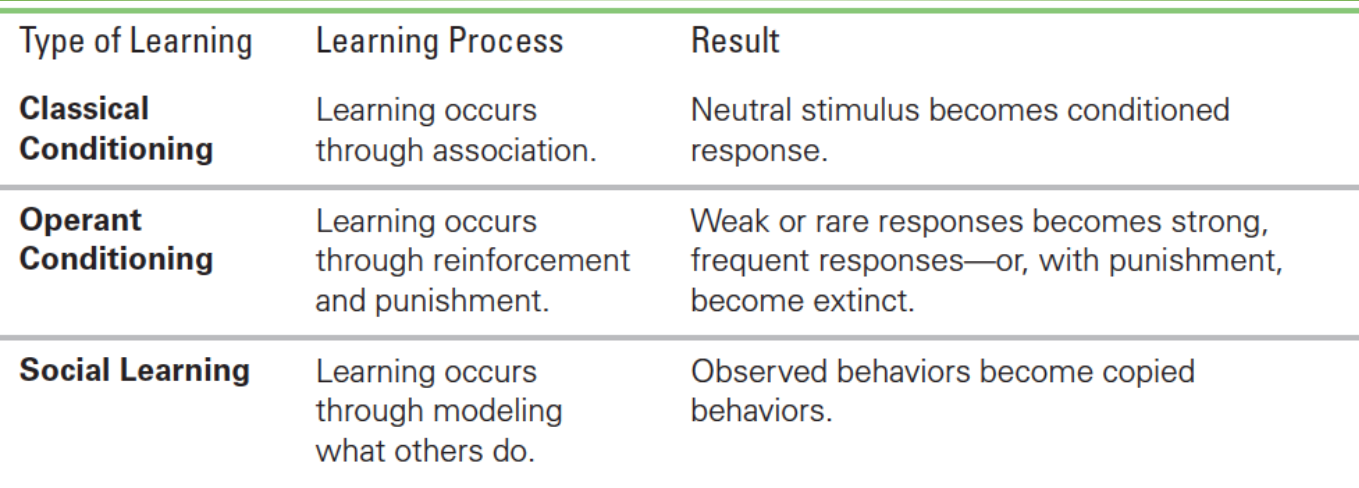
types of learning - social, classical, and operant
answer:
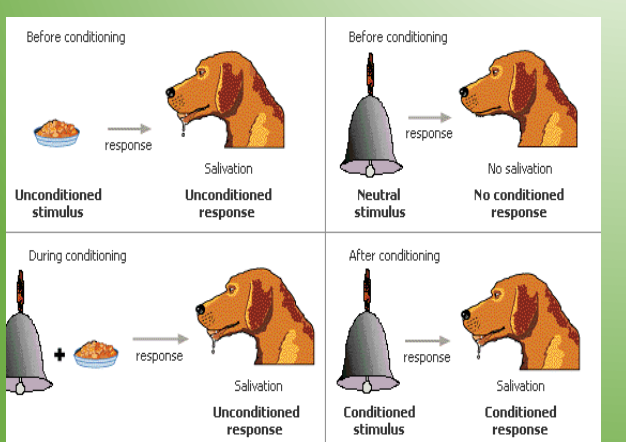
Classical Conditioning & Pavlov...
Pavlov (NS + UCS → UCR)
• Initially, NS is meaningless, but the UCS is important...
• If NS + UCS occurs over time, the NS becomes important alone...
Repeated pairing of stimuli facilitates learning - as assigning new meaning to the previous NS
Operant Conditioning & B.F.
Skinner...
Stimulus → Response → Outcome
• If outcome is reinforcing... ↑ response frequency
• If outcome is punishing... ↓ response frequency
• What behaviors do we repeat?
What behaviors do we avoid?