Neuro Exam of Limbs
 Call Kai
 Learn
Learn Practice Test
 Spaced Repetition
 Match
Match Flashcards
 Knowt Play
1/40

There's no tags or description
Looks like no tags are added yet.
Name | Mastery | Learn | Test | Matching | Spaced | Call with Kai |
|---|
No analytics yet
Send a link to your students to track their progress
41 Terms
How many spinal nerves are there
31
Dorsal/Ventral roots carry sensory/motor fibres
Dorsal roots carry sensory fibres
Ventral /anterior roots carry motor fibres
Dermatome
An area of skin supplied by peripheral nerve fibres originating from a single dorsal root ganglion
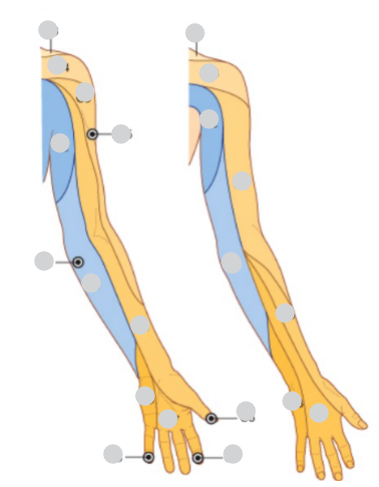
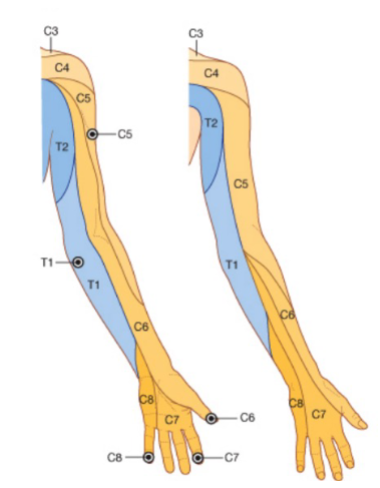
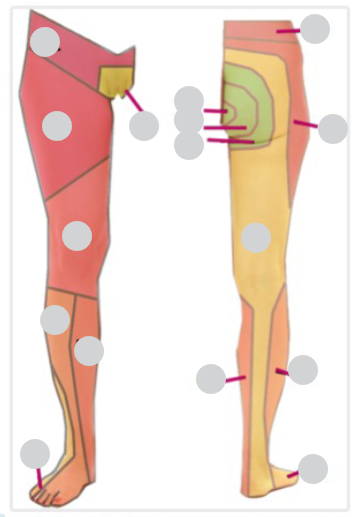
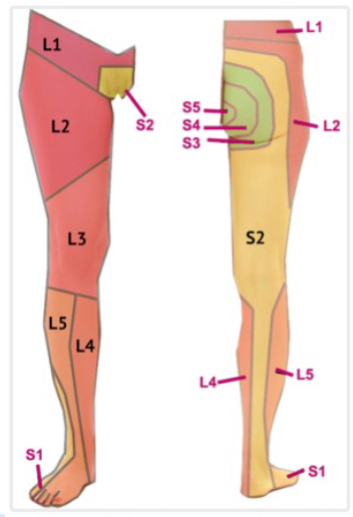
Myotomes
groups of muscles innervated by a single spinal nerve root
What groups of muscles & actions does C5,C6 supply
Shoulder abduction: Deltoid/supraspinatus
Elbow flexion: biceps & brachoradialis
What group of muscles & action does C6, C7 supply
Wrist flexion: flexor carpi ulnaris & radialis
What group of muscles & action does C6,C7, C8 supply
Shoulder adduction: Pertoralis major/latissimis dorsi
What groups of muscles & actions does C7, C8 supply
Elbow extension: triceps
Wrist extension: extensor carpi group
Finger flexion: flexor digitorum profundus & sublimis
Finger extension: extensor digitorum communis, extensor
indicis, extensor digiti minimi
What groups of muscles & actions does C8, T1 supply
Finger abduction: dorsal interossei
Finger adduction: palmar interossei
What group of muscles & action does L2,L3 supply
Hip flexion: iliopsoas (psoas & iliacus)
What group of muscles & action does L2,L3,L4 supply
Hip adduction: adductors longus, brevis & magnus
What group of muscles & action does L3,L4 supply
Knee extension: quadriceps
What group of muscles & action does L4, L5 supply
Ankle dorsiflexion: tibialis anterior, extensor digitorum longus, extensor hallicus longus
What group of muscles & action does L4,L5,S1 supply
Hip abduction: gluteus medius & minimus
What groups of muscles & actions does L5,S1 supply
Knee flexion: hamstrings
Tarsal joint inversion: tibialis posterior, gastronemius, hallucis longus
Tarsal joint eversion: peroneus longus & brevis, extensor digitorum longus
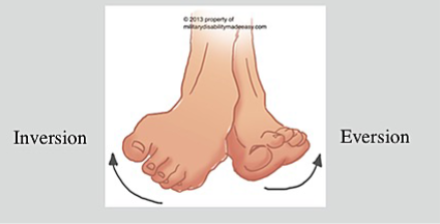
What group of muscles & action does L5, S1,S2 supply
Hip extension: gluteus maximus
What group of muscles & action does S1, S2 supply
Ankle plantar flexion:gastrocnemius, plantaris, soleus
On 1st inspection of a neuro exam of the limbs what would you look out for
Muscle wasting
Abnormal movements (tremor)
Fasiculations
Skin changes e.g. neurofibromatosis
What could cause increased muscle tone
claspknife / leadpipe rigidity
UMN lesion e.g. stroke, MS
Parkinson’s disease
What could cause reduced tone
LMN disease
Cerebellar disease
Explain the power scale from 5/5 to 0/5
5/5 normal
4/5 moderate movement against resistance
3/5 movement against gravity but not against resistance
2/5 movement when gravity excluded
1/5 flicker of contraction possible
0/5 complete paralysis / no movement
How to test someone’s coordination
Finger nose test/ heel shin test
Rapid alternating movements
What is Diadochokinesis
the ability to perform rapid, alternating movements
What is disdiadokinesis
inability to perform rapid, alternating movements smoothly
Patient presents with Intention tremor, Past-pointing, & disdiadokinesis. What is the diagnosis?
These are signs of cerebellar disease
Cerebellum function
cerebellum is concerned with smooth coordination of movement
A disruption to smooth coordination of movement is caused by a lesion to the same/opposite side as the signs
Same side
Sensation uses what neural tract
spinothalamic tract
Route of passage of the spinothalamic tract
Fibres enter & ascend ipsilaterally in spinal cord → decussate in medulla (nucleus gracilis, nucleus cuneatus) → thalamus → somatosensory cortex & limbic system
How does a reinforcement manoeuvre aid in testing reflexes
A reinforcement manoeuvre (e.g. clenching teeth) is used to make it easier to elicit a reflex when the reflex is difficult to see or feels weak
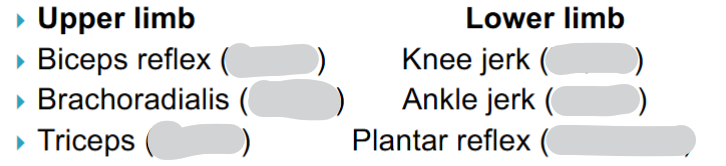
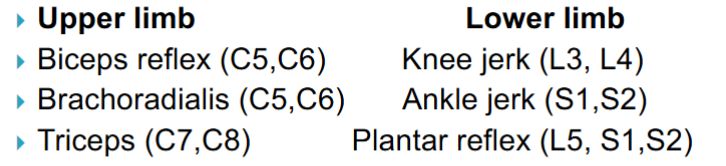
Name the spinal roots involved in each reflex
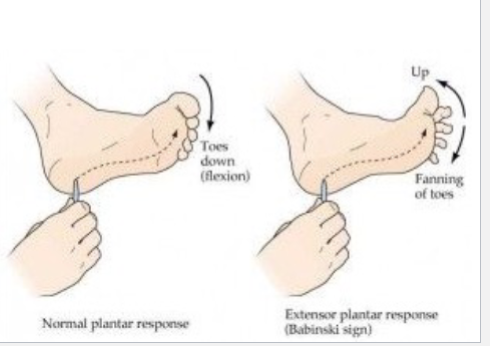
Babinski signs tests what nerve roots
L5, S1, S2
What are the 5 levels that you can report a reflex as
0 = absent
+ = present but reduced
++ = normal
+++ = increased, possibly normal
++++ = greatly increased
Greatly increased reflexes can be associated with what
clonus
Clonus is associated with upper/lower motor neuron damage
UMN - Upper Motor Neuron
Clonus is associated with hyper/hypotonia & hyper/hyporeflexia
hypertonia & hyper-reflexia
What happens when you suddenly stretch a muscle of someone with clonus
There is a sustained rhythmic contraction of muscles when put under sudden stretch
What specifically happens in Ankle clonus
sharply dorsiflex of the ankle
What specifically happens in Knee/patellar clonus
sharply push down on patella and maintain stretch