Immunology Lecture 4 - Major Histocompatibility Complex and Antigen Recognition by T cells
 Call Kai
 Learn
Learn Practice Test
 Spaced Repetition
 Match
Match Flashcards
 Knowt Play
1/19

Earn XP
Description and Tags
Know the 2 lymphocytes, T cell receptor structure, MHCs , functions and antigen processing.
Name | Mastery | Learn | Test | Matching | Spaced | Call with Kai |
|---|
No analytics yet
Send a link to your students to track their progress
20 Terms
B and T cell origin,
B cells. Originate and differentiate in the adult bone marrow. migrate to lymphoid tissue like the spleen, but especially lymph nodes. T cells originate in bone marrow and differentiate to mature T cells in the thymus
CD4 vs CD8 T cells
CD4 are helper T cells. Th. CD8 cells are cytotoxic. Tc/CTL.
The thymus. What happens as we age
The thymus shrinks with age. And the function declines. 30 to 3 grams.
Describe the T and B cell antigen receptors.
BCR have a Y structure made of light and heavy chain. Top of Y is antigen recognition and the complementary determining region. TCR dont have a Y structure. They have CDR at the top. Both B and T have signal transducing molecules adjacent at the membrane.
TCR Structure
Alpha and beta chain next to each other with 2 carbohydrates attached to each. (one in the variable region at the top and one in the constant region). The variable regions are V alpha and V beta. Constant regions are C alpha and C beta. Under these 2 sections is the hinge just above the transmembrane region. V alpha and V beta domains contain hyper variable regions resulting in different CDRs. Specific for diff antigen epitopes.
TCR is associated with…
CD3. This is not involved in antigen recognition. Interacts with TCR to mediate intracellular signalling
How do TCR recognise antigen
The antibody binds to antigen on an antigen presenting cell . They dont recognise antigen directly unlike BCRs. Antigen has to be processed and presented.
How is antigen processed and presented to T cells?
MHC. the major histocompatibility complex. Called HLA in humans. MHCs are antigen presenting molecules.
What do MHC molecules do
Bind antigenic peptides and present them in the surface to T cells. Two types: MHC 1 and MHC 2.
MHC 1 and MHC 2 structure
MHC 2 has an alpha and a beta chain. MHC 1 has a long alpha chain which is non covalently linked to a 2beta chain. MHC 2 is restricted expression. both chains have transmembrane and cytoplasmic domains.
Genetic organisation of MHC
Chromosome 6. Highly polymorphic gene cluster. Class 1-3. Only class 1 and 2 are important.
MHC class 1
Cell surface glycoproteins on all nucleated cells. Involved in T cell recognition. Alpha chain is encoded by a b and c loci. B2 microglobulin encoded by a gene on a diff chromosome.
MHC class 2
Cell surface glycoproteins expressed on antigen presenting cells like macrophages. Involved in T cell recognition. Encoded by DP DQ and DR regions. Encode alpha and beta chains.
Polymorphism in MHC 1 and 2.
MHC 1- Each allele presents a different set of intracellular peptides to CD8 T cells. MHC 2 -wide range of extracellular peptides to CD4 T cells.
How do antigens get to the MHC?
Class 1 MHC are involved in presentation of intracellular antigens eg viral. MHC 2 is presentation of extracellular antigens eg parasites and some bacteria
Processing of endogenous antigen to class 1 MHC
Involved in presentation of intracellular antigens. 1. Antigen is in the cytoplasm. 2. antigen is degraded in the proteosome. 3. antigen peptides are transported by TAP to the RER. 4. p88 dissociates from the MHC 1 in RER when the peptide is bound. 5. goes into membrane and is presented.
Processing of endogenous antigen to class 2 MHC
antigen is taken up by endocytosis. 2. endosome and lysosome fuse. endolysosome. 3. enzymes in endolysosome degrade the antigen. 4. class 2 MHC synthesised in RER with associated peptide invariant chain. 5.class 2 MHC transported fuse with endolysosome. 6. invariant chain is degraded and is displaced by antigen peptides of right size. 7. MHC/peptide complex is transported to the cell surface and peptide is presented.
What happens once the antigen is in the MHC
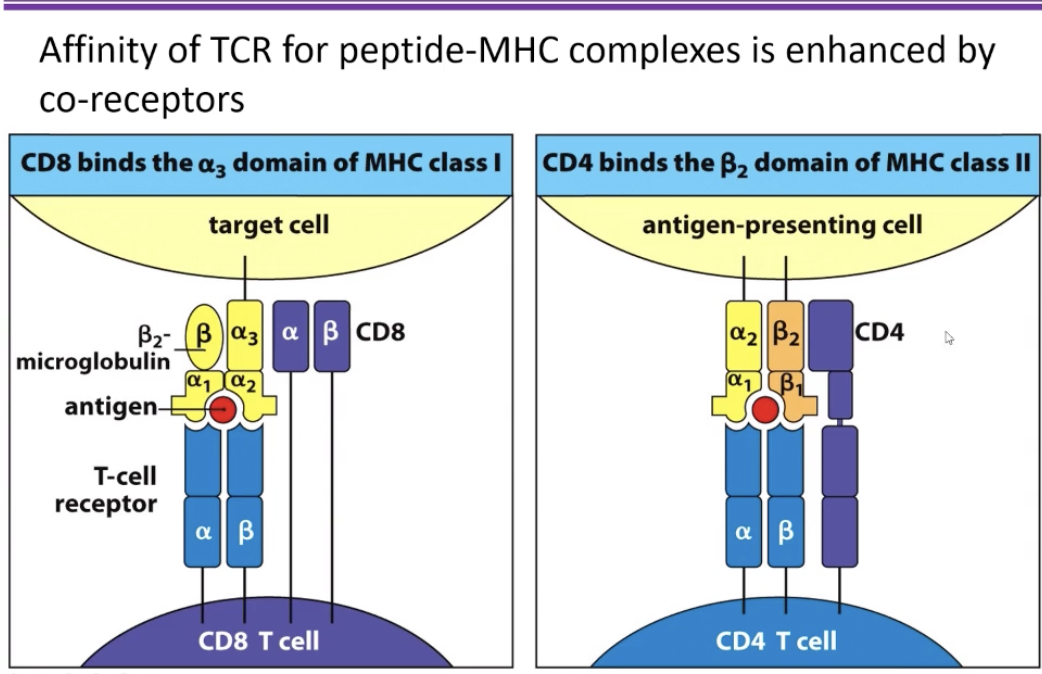
TCR binds to both antigen peptide and MHC. Fit has to be really good. MHC and TCR have to fit both really well. If it fits there will be recognition. TCR will have a CD3 molecule and make a complex (TCR-CD3) remember, CD4 recognises class 2 nd cd8 recognises class 1.
CD4 to MHC 2 and CD8 to MHC 1
What are the advantages of MHC associated recognition
Extra recognition, recognising different parts of pathogen from antibody, can detect antigen inside cells.