Artificial Eyes 2
 Call Kai
 Learn
Learn Practice Test
 Spaced Repetition
 Match
Match Flashcards
 Knowt Play
1/18

There's no tags or description
Looks like no tags are added yet.
Name | Mastery | Learn | Test | Matching | Spaced | Call with Kai |
|---|
No analytics yet
Send a link to your students to track their progress
19 Terms
Vision Loss
Vision loss refers to a broad spectrum of visual impairment, which includes a reduction in the ability to see clearly. It can range from mild to sever and may involve issues like blurred vision decreased peripheral vision, and difficulty in focusing
Blindness
Blindness, on the other hand, is the complete loss or absence of vision. An individual who is blind has little to no light perception and cannot see objects or shapes
Examples of Optical Low Vision Aids
Correctly refracted glasses, magnifying spectacles, magnifiers and telescopes for low vision
Examples of Non-Optical Devices
Watches with audible announcements
Large-print text
Audible books
Large-sized numbers and high-contrast colors
Textured labels
Age-related Macular Degeneration (AMD)
With AMD you lose your central vision. You cannot see fine details, whether you are looking at something close or far
But your peripheral (side) vision will still be normal.
It is a leading cause of vision loss in people 50 years or older
What are two types of inherited retinal degenerations
Juvenile Macular Dystrophy
Retinitis Pigmentosa
Retina Pigmentosa
Trouble seeing at night
Decreasing peripheral vision (tunnel vision)
What is the issue of the retina research
The retina is incredibly sophisticated, and regrowing is not possible
Why does vision prostheses used?
In severe vision loss arising from degenerative retinal disease
What are the two main retinal diseases for vision prostheses
Inherited retinal degenerations such as retinitis pigmentosa, RP
Age-related degenerative disease such as atrophic age-related macular degeneration, AMD
What does RP and AMD do to the eye
In these conditions, the photoreceptors (rods and cones) in the outer layers of the retina are damaged or lost, but the inner retinal neurons (bipolar and ganglion cells) remain relatively intact
What could an implant device do RP and AMD
The implant devices can wake up and excite the remaining parts of the visual pathway to bring back some basic vision for the people who use them
What are the challenges with implant devices
Challenges: Transmitting signals between artificial implants and the bodys natural components
Technology Miniaturization: Electronics have become smaller, but their architecture remains unchanged
Nature’s Blueprint: Our body’s wiring follows a fractal pattern, offering efficient communication. The curvature of eye makes the process more complicated
Research Imperative: Achieving seamless communication requires multidisciplinary and complex research efforts.
What happens if you apply to a large voltage to the eyeball
If you apply a large voltage to the eyeball, that signal will go into the eye, shoot down the optic nerve to the brain, so you can see.
What happens when stimulating the back of the brain
He showed that stimulating the back of the brain produced still, centred flashes of light (phosphenes), while stimulating the other areas produced peripheral phosphenes, validating the retinocortical map.
What happened when examining the minimum number of light points required to enable the reading of printed text by recipients
Visual field map of phosphenes generated by the implant. Numbers refer to the electrode being stimulated. Note that some phosphenes are elongated, and some multiple (with curly braces) phosphenes appear when a single electrode is stimulated.
First retinal prosthesis
He reported on the implantation of an electrode array in back of the eye of a blind volunteer.-
Patient Response: - Blind volunteer's post-operative perception: "uniform white light"
What can be expected when with a retinal implant
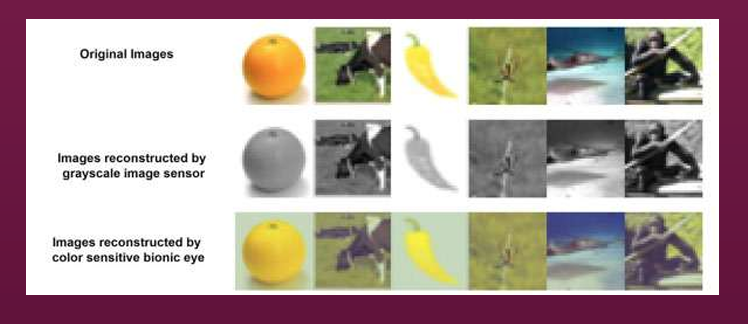
Could be greyscale, could be blurry or need to be reconstructed
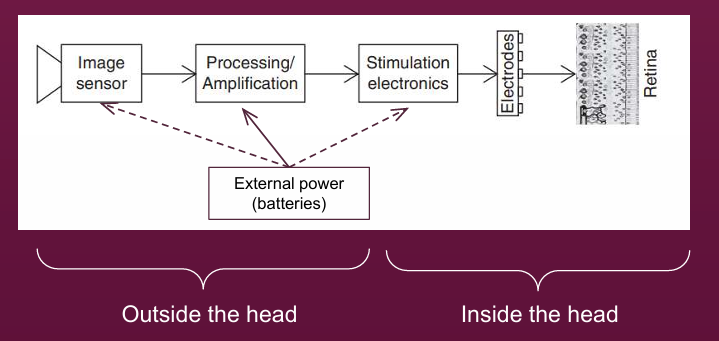
What is the overall system overview of artificial etes
external power, image sensor →Processing → Stimulation electronics → electrodes → retinal