Module 8: Evidence on Diagnostic Tests & Clinical Measures
 Call Kai
 Learn
Learn Practice Test
 Spaced Repetition
 Match
Match Flashcards
 Knowt Play
1/41

There's no tags or description
Looks like no tags are added yet.
Name | Mastery | Learn | Test | Matching | Spaced | Call with Kai |
|---|
No analytics yet
Send a link to your students to track their progress
42 Terms
What are the components of a diagnosis?
Labels a patient
Classifies a problem
Determines a prognosis
Determines an intervention
What is the purpose of diagnostic tests?
Helps to focus the examination on a particular body region or symptom
Assists in identifying problems requiring referral to a physician or other specialists
Helps with the classification process
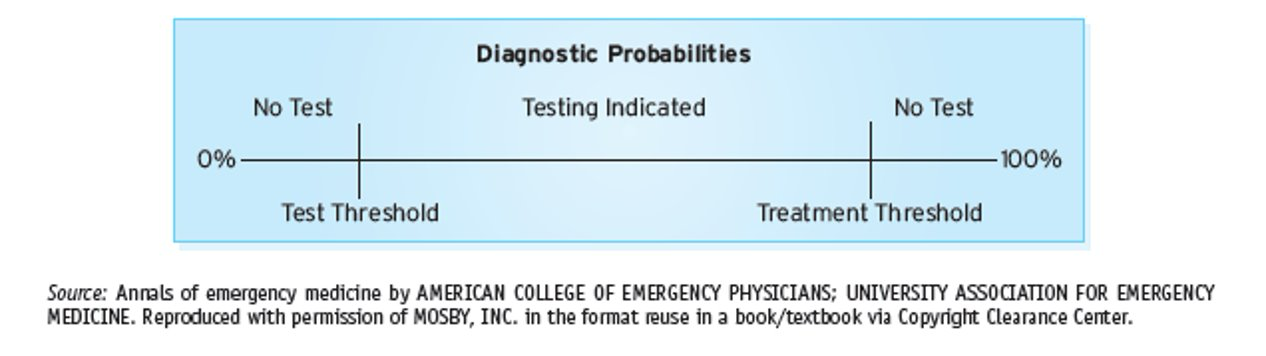
What is the Test Threshold for a Diagnostic Test?
The probability below which a diganostic test will not be ordered or performed because the possibility of the diagnosis is so remote
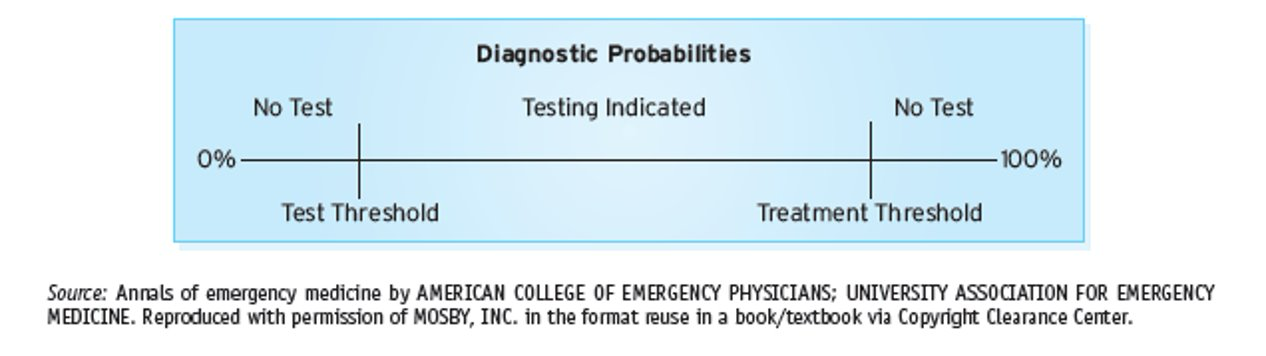
What is the Treatment Threshold for Diagnostic Test?
The probability above which a diagnostic test will not be ordered or performed because the possibility of the diagnosis is so great that immediate treatment is indicated
What are two types of diagnostic tests in physical therapy?
Special Tests (clinical examination techniques; e.g., Lachman's Test for suspected ACL tears)
Tests performed and/or interpreted by others (e.g., radiographs, lab tests)
A measure is a technique that we perform to quantify a patient's ________, ________, & ________
Impairment, Functional limitation, Disability
What are examples of impairment measures in physical therapy?
Range of Motion (goniometry)
Strength (dynamometry)
What is an example of activity measures in physical therapy?
Assistance required with functional task (FIM)
What are examples of participation restriction measure in physical therapy?
Health Status (SF-36)
What are sources of variability?
Observer
Subject
Instrument
Environment
________ is defined as the ""stability"" of the measure
Reliability
________ is defined as ensuring that a measure represents what it is supposed to represent
Validity
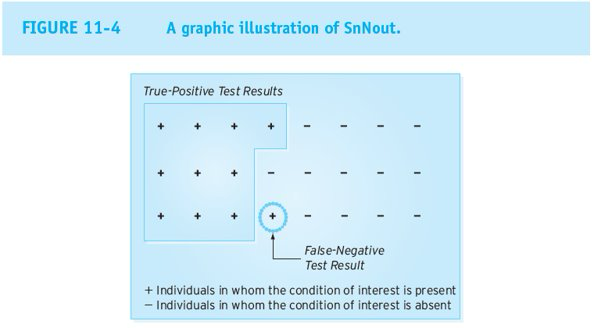
What is Sensitivity (Sn)?
Ability of a test to correctly identify (+ test result) in someone with the disorder
What does SnNout mean?
Sn = Sensitivity
N = Negative Test Result
Out = Rule out the disorder
(If a sensitivity test is negative, we can rule out the disorder)
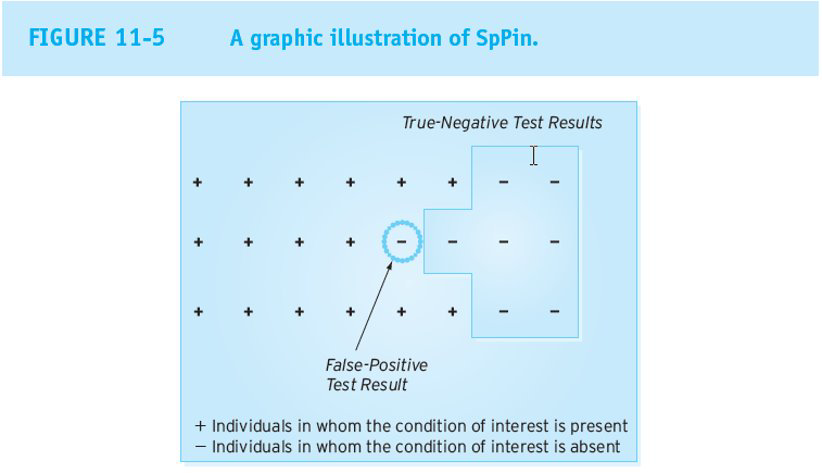
What is Specificity (Sp)?
Ability of the test to correctly identify (- test result) in someone without the disorder
What does SpPin mean?
Sp = Specificity
P = Positive Test Result
In = Rule in the disorder
(If specificity test is positive, then we can rule in the disorder)
What is a Positive Predictive Value (PPV)?
Ability of the test to correctly determine the percentage of people with the disorder from all of the people with positive test results
What is a Negative Predictive Value (NPV)?
Ability of the test to correctly determine the percentage of people without the disorder from all of the people with a negative test result
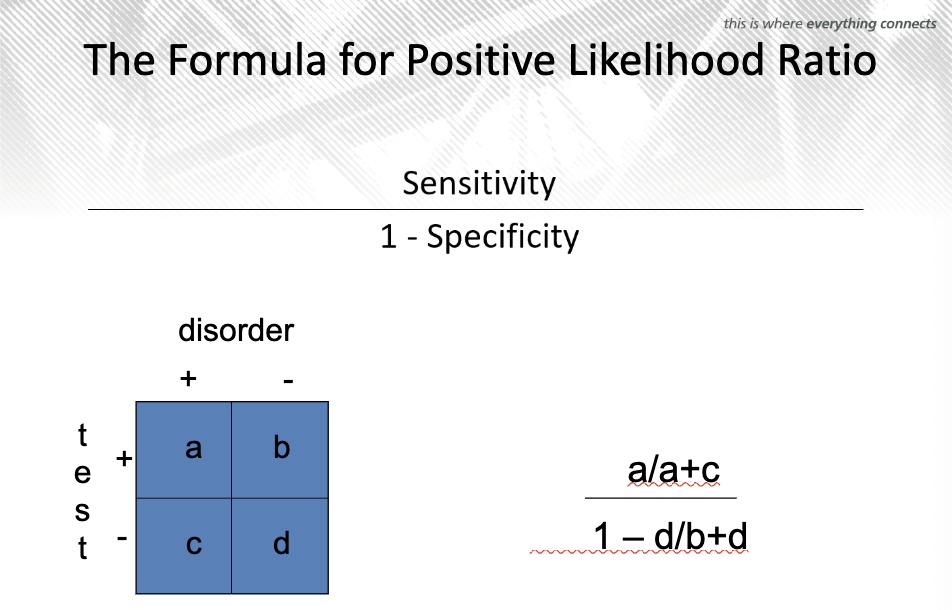
What is the Positive Likelihood Ratio (LR+)?
The likelihood that a positive test result was observed in a person with the disorder vs in a person without the disorder of interest
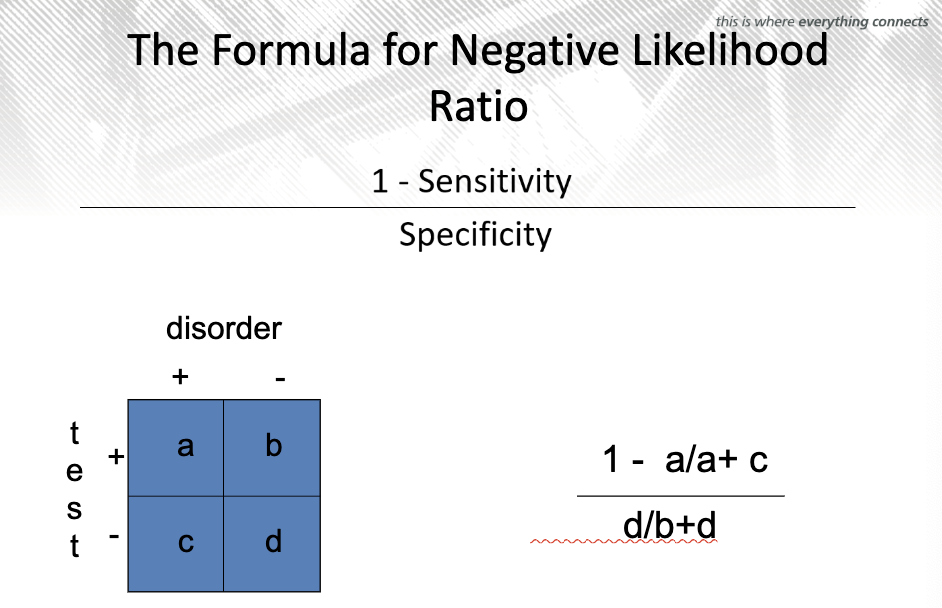
What is the Negative Likelihood Ratio (LR-)?
The likelihood that a negative test result was observed in a person with the disorder vs in a person without the disorder of interest
What is the formula for calculating sensitivity?
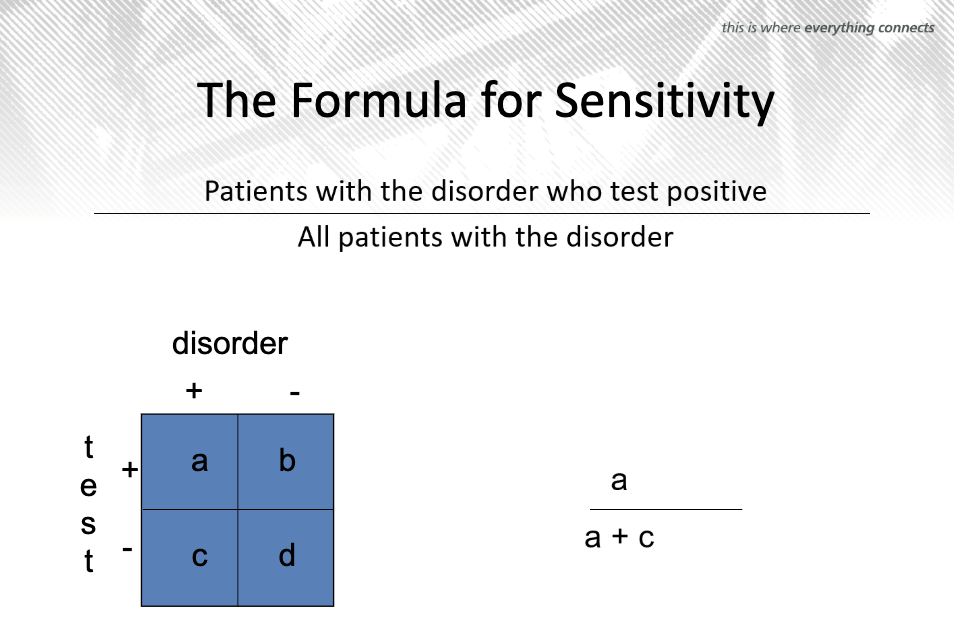
What is the formula for calculating specificity?
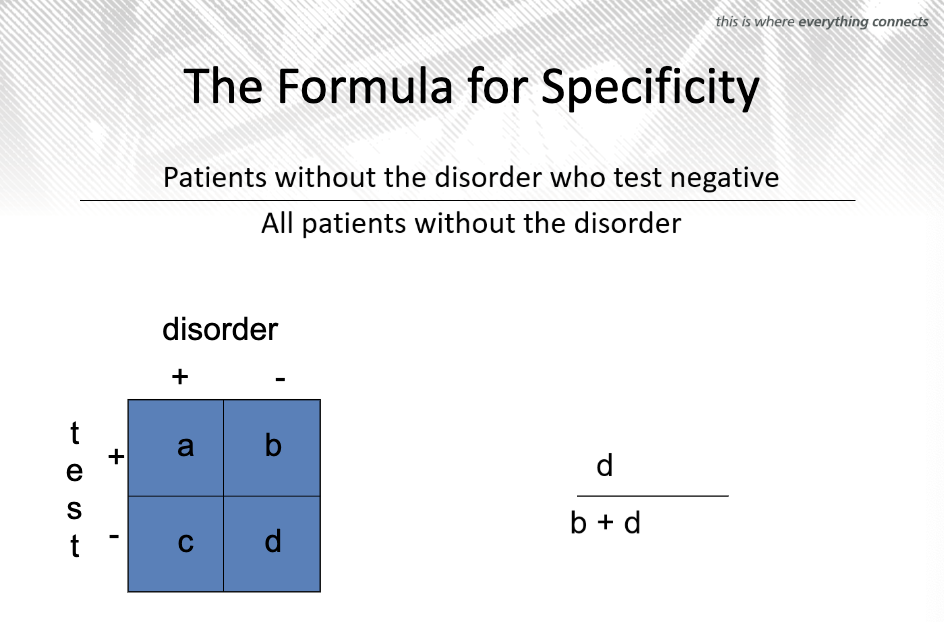
What is the formula for calculating Positive Predictive Value?
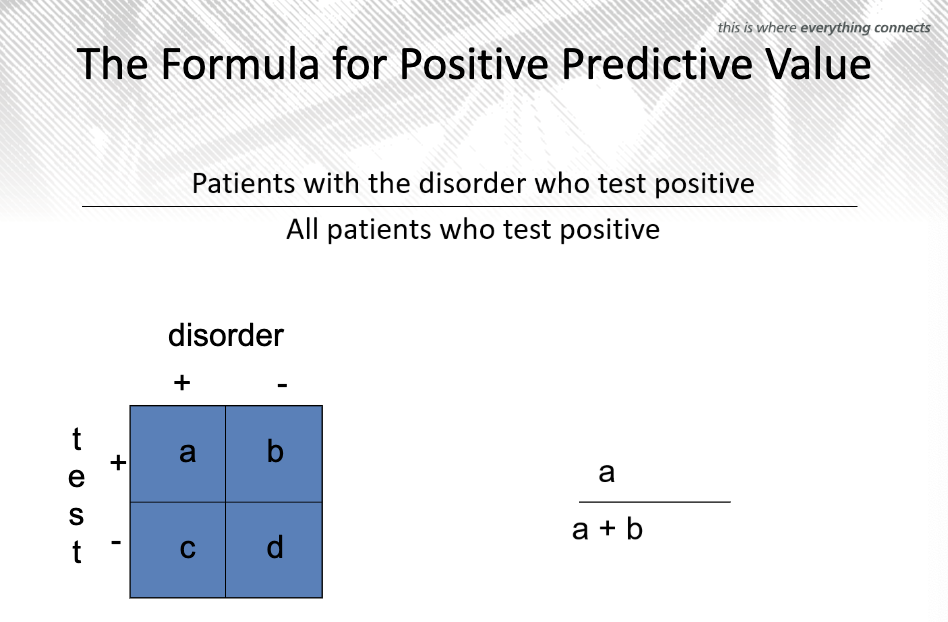
What is the formula for calculating Negative Predictive Value?
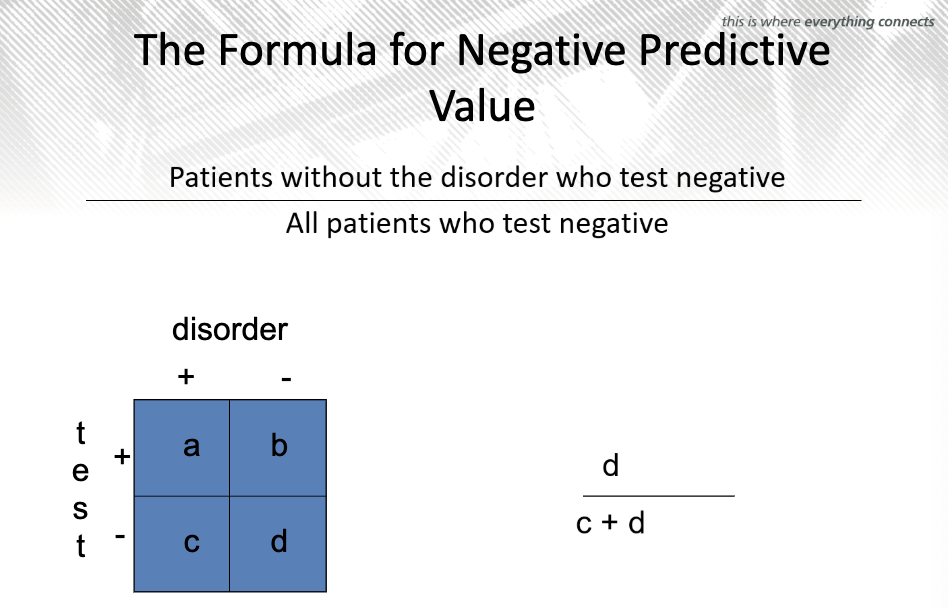
What is the formula for calculating Positive Likelihood Ratio?
What is the formula for the Negative Likelihood Ratio?
How would you interpret the following Likelihood Ratios:
LR+ > 10 or LR- < 0.10
Large and Conclusive Change
How would you interpret the following Likelihood Ratios:
LR+ = 5-10 or LR- = 0.10 - 0.20
Moderate Change
How would you interpret the following Likelihood Ratios:
LR+ = 2 - 5 or LR- = 0.20 - 0.50
Small (but sometimes important) Change
How would you interpret the following Likelihood Ratios:
LR+ = 1 - 2 or LR- = 0.50 - 1.0
Negligible Change in Pre-Test Probability
Pre-Test Probablity is the essentially the same as ________
Prevalence (%)
What are Pre-Test Odds?
What you think the odds are that the patient has the disorder before you conduct the diagnostic test
How do you calculate the pre-test odds?
Pre-Test Odds = Pre-Test Probability / (1 - Pre-Test Probability)
What are Post-Test Odds?
What you think the odds are that the patient has the disorder after you conduct the diagnostic test
How do you calculate the Post-Test Odds?
Post-Test Odds = Pre-Test Odds x Likelihood Ratio (+/-)
What is Post-Test Probability?
How do you calculate the Post-Test Probability?
Post-Test Probability = Post-Test Odds / (Post-Test Odds + 1)
What is a P-Value?
The probability that the result (e.g., correlation coefficient, Sn, Sp, PPV, PNV, LR+, LR-) occurred due to chance
What is the 95% Confidence Interval?
The range of values within which the true value is estimate to lie within a 95% probability
What does it mean if a Likelihood Ratio is 1.0?
Represents a 50:50 chance of increasing or decreasing the probability of a diagnosis
What does it mean if a 95% Confidence Interval includes 1.0 in its range?
"Means that one possibility for the ""true value"" of the Likelihood Ratio is a 50:50 chance"
What are commonly used as gold standards?
Radiographs
Surgical Exploration
A test or measure with previously demonstrated consistency (and usefulness)