Cells & Cellular Transport (Unit 3)
 Call Kai
 Learn
Learn Practice Test
 Spaced Repetition
 Match
Match Flashcards
 Knowt Play
1/23

There's no tags or description
Looks like no tags are added yet.
Name | Mastery | Learn | Test | Matching | Spaced | Call with Kai |
|---|
No analytics yet
Send a link to your students to track their progress
24 Terms
Cell membrane structure
3 main parts: Phospholipids, Proteins, Cholesterol. Main functions: Holds contents of the cell, and controls what comes in and out due to polarity and size.
Glycoprotein/glycolipid, carbohydrate sticks out to the outside of the cell.
Lipid bilayer is a part of the cell membrane.
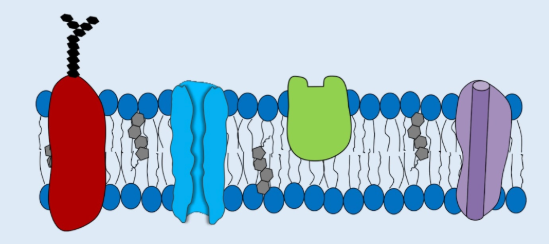
Phospholipids
Contributes to the fluid mosaic, as unsaturated fatty acids tails with kinks keep the fluidity. Polar heads, non polar tails. (Double layer since polar hydrophilic and inside and outside of the cell are mostly water, non polar hydrophobic far away.
Cholesterol
HO end is polar, since the electrons are unevenly shared creating a partial charge, so it faces the outside, and the rest/tail is non polar, so it can wedge itself into the phospholipid bilayer, preventing tightly packing at lower temperatures.
Proteins
Enzymatic activity: Speeds up reactions by lowering activation energy.
Transport (Active/Passive): Passage for particles that can’t easily pass through phospholipids.
Cell-Cell Recognition: ID of the cell (Blood type)
Signal Transduction: Antenna
Cell membrane role in controlling the movement of substances in/out of the cell.
Small, non polar molecules (also gases and hydrophobic molecules) can fit through and do not get ‘distracted‘, the phospholipid bilayer. (O2, CO2, Benzene)
Small, polar molecules can fit through, but they get distracted (interactions with other polar molecules, such as the polar heads) and take much longer. (H2O, Ethanol)
Large, polar molecules cannot fit through, so they require a transport protein. (Glucose)
Large, nonpolar molecules can fit through, just their size makes them very slow. (Carbon, Hydrogen)
Charged molecules are repelled and attracted by the partial charges of polar heads (one positive, one negative), so they require a transport protein [ion channel] (+ or -).
Passive transport
Movement of particles through the cell membrane without the cell expending energy (not using ATP). Particles move H→ L, with/down the concentration gradient.
Simple diffusion: No protein helper between phospholipids.
Facilitated diffusion: Through a protein channel.
Includes Osmosis (the diffusion of water high to low, simple and facilitated, uses an aquaporin), which also tries to equal out the water to solute ratio.
Active transport (of small substances)
Movement of particles through the cell membrane (With the cell expending energy (using ATP). Particles move L→H, against the concentration gradient.
Using Pumps: Membrane proteins pump particles against their gradient.
The active transport of large substances and large amounts of substances is using vesicles through exocytosis and endocytosis (both involve membrane fusing).
Diffusion and NET (Passive mechanisms)
Diffusion is the random movement of molecules from high to low. NET is the direction as a whole (of the movement).
Exocytosis
From the inside of the cell to the outside of the cell, the membrane of the smaller part fuses with the bigger cell membrane.
Endocytosis
From the outside of the cell to the inside of the cell, the cell membrane engulfs the molecule(s), and then fuses and closes.
Cell Theory
All living things are composed of cells
All cells come from other cells
All cells contain hereditary information (DNA) which is passed from cell to cell.
Cell size
Cells are generally small, since a high surface area to volume ratio allows for the best function (able to easily and quickly expel waste and take in nutrients). When cell size increases, volume increases at a much greater rate than surface area (MATH). Also smaller cells means more cells, so in one breaks it is not as detrimental/a big deal.
Eukaryotic cells
Nucleus bound organelle
Came from prokaryotic cells becoming more complex (endosymbiotic theory)
Protists, Plants, Animals, Fungi (Eukarya)
Typically unicellular, typically multicellular, typically multicellular, typically multicellular.
Complex, membrane bound organelles (nucleus, nucleolus, mitochondria, endoplasmic reticulum, Golgi apparatus, and lysosome, permanent central vacuole, vesicles, chloroplasts.)
10-100µm (micrometers)
Prokaryotic cells
No nucleus
First to evolve
Bacteria and Archaea
Always unicellular
Simple, no membrane bound organelles (nucleoid/free floating DNA)
1-10µm (micrometers)
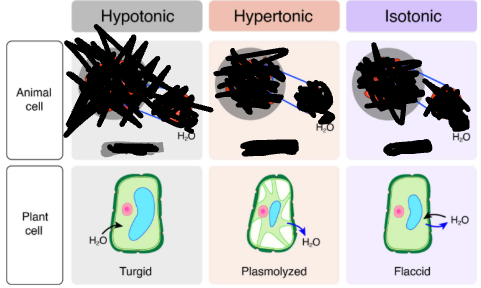
Plant cells in hypotonic, hypertonic, and isotonic environments.
Hypo (Less solute outside the cell)→ Turgid, Hyper (More solute outside the cell)→ plasmolyzed, Isotonic (Same concentration outside and inside the cell) → flaccid. Opposite water concentrations.
Plant cells prefer a hypotonic environment, where they recieve more water.
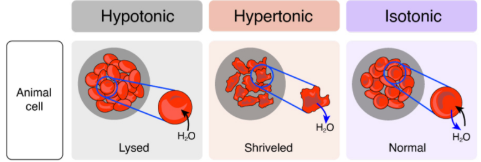
Animal cells in hypotonic, hypertonic, and isotonic environments.
Hypo (Less solute outside the cell)→ Lysed, Hyper (More solute outside the cell)→ shriveled, Isotonic (Same concentration outside and inside the cell) → normal. Opposite water concentrations.
Endosymbiotic theory (→evolution of eukaryotic cells)
Eukaryotic cells originated from symbiotic relationships where a larger host cell engulfed smaller prokaryotic cells, which eventually evolved into essential organelles like mitochondria and chloroplasts.
Evidence: Mitochondria and chloroplasts have their own DNA, their ribosomes resemble those of prokaryotes, they reproduce in a manner similar to prokaryotes. Cells cannot make any of these organelles from scratch, they have double membranes and inner membranes resemble prokaryotic cell members.
Endomembrane system
Nuclear envelope surrounds nucleus and is connected to rough ER.
Proteins enter the rough ER as they are synthesized by the ribosomes on its surface.
Proteins are modified in the rough ER, then flow in Transport vesicles to the Golgi body.
Proteins are tagged in the Google body before being packaged into a lysosome or vesicle.
LYSOSOME: Lysosomes contain digestive enzymes to break down old organelles or foreign particles. VESICLES: contain proteins, they travel to other parts of the cell that need it or can also fuse w/ the cell membrane to be released from the cell.
Genetic control of the cell
Nucleus - Contains and protects DNA
Energy processing
Mitochondria - Site of cellular respiration, transforms chemical energy from food into smaller energy molecules (ATP)
Chloroplasts - Site of photosynthesis, coverts light energy into food (sugar).
Manufacturing, distribution, & breakdown
Rough ER - Modifies protein’s and ships them to the Golgi.
Smooth ER - Contains enzymes to make hormones and lipids; can store calcium ions, helps rebuild cell membrane w/ lipids!
Golgi Apparatus - Further modified proteins and ships them out or around the cell.
Transport Vesicles - Transpots materials around the cell, buds off of ER and Golgi.
Lysosomes - Contains digestive enzymes
Cell Membrane - Regulates what enters and leaves a cell; made of phospholipids.
Ribosome - Site of protein synthesis; can be attached to rough ER.
Structural support, movement, & communication between cells.
Cell wall - Maintains cell shape and protects the cell
Cytoskeleton - Internal structural support of the cell, can help move cell structures by way of motor proteins
Cytoplasm/Cytosol - Jelly-like fluid in which cell structures float in.
Cell Membrane - Regulates what enters and leaves a cell, made of phospholipids.
Plant’s central vacuole - Usually the largest organelle in a plant cell that regulates water amount in the cell.
Vacuoles - Storage organelle that contain food, water. or poisonous compounds.
Cilia - All eukaryotic cells can have these to help them move, cover cell surface, they are short.
Flagella - Helps sperm to move, there are less of them and they are long.
Plant vs Animal Cells vs Fungus vs Protists
Plants have cell wall, chloroplasts, large central vacuole, more rectangular/cube-ish and are generally 10-100u/p m in length.
Animals have none of those, tinier vacuoles, Lysosomes are more common, they have a centriol and are 10 - 30 u/p m in length.
Microscopy sizing
meter = 10^9 nm
Total magnification: Optical lens times objective
ADD MORE/CHECK W/ MS. VARGAS