genetic information
 Call Kai
 Learn
Learn Practice Test
 Spaced Repetition
 Match
Match Flashcards
 Knowt Play
1/79

There's no tags or description
Looks like no tags are added yet.
Name | Mastery | Learn | Test | Matching | Spaced | Call with Kai |
|---|
No analytics yet
Send a link to your students to track their progress
80 Terms
Compare and contrast DNA in eukaryotic cells with DNA in prokaryotic cells similarities
Nucleotide structure is identical - deoxyribose attached to phosphate and a base
Adjacent nucleotides joined by phosphodiester bonds, complementary bases joined by hydrogen bonds
DNA in mitochondria / chloroplasts have similar structure to DNA in prokaryotes
Short,circular,not associated with proteins
Compare and contrast DNA in eukaryotic cells with DNA in prokaryotic cells Differences
●Eukaryotic DNA is longer
●Eukaryotic DNA is linear, prokaryotic DNA is circular
●Eukaryotic DNA is associated with histone proteins, prokaryotic DNA is not
●Eukaryotic DNA contain introns, prokaryotic DNA does no
What is a chromosome
●Long, linear DNA + its associated histone proteins
●In the nucleus of eukaryotic cells
What is a gene?
A sequence of DNA (nucleotide) bases that codes for:
●The amino acid sequence of a polypeptide
●Or a functional RNA (eg. ribosomal RNA or tRNA
What is a locus?
Fixed position agene occupies on a particular DNA molecule
Triplet code
A sequence of 3 DNA bases, called a triplet, codes for a specific amino acid
Universal
The same base triplets code for the same amino acids in all organisms
Non-overlapping
Each base is part of only one triplet so each triplet is read as a discrete unit
Non-overlapping
Each base is part of only one triplet so each triplet is read as a discrete unit
Degenerate
An amino acid can be coded for by more than one base triplet
What are ‘non-coding base sequences’ and where are they found
Non-coding base sequence - DNA that does not code for amino acid sequences / polypeptides:
1. Between genes - eg. non-coding multiple repeats
2. Within genes - introns
In eukaryotes, much of the nuclear DNA does not code for polypeptides
What are introns and exons
Exon
Base sequence of a gene coding for amino acid sequences (in a polypeptide)
Intron
Base sequence of a gene that doesn’t code for amino acids, in eukaryotic cells
genome
The complete set of genes in a cell (including those in mitochondria and /or chloroplasts)
Proteome
The full range of proteins that a cell can produce (coded for by the cell’s DNA / genome
Describe the two stages of protein synthesis
Transcription
Production of messenger RNA (mRNA) from DNA, in the nucleus
Translation
Production of polypeptides from the sequence of codons carried by mRNA, at ribosome
Compare and contrast the structure of tRNA and mRNA
Comparison (similarities)
●Both single polynucleotide strand
Compare and contrast the structure of tRNA and mRNA
●tRNA is folded into a ‘clover leaf shape’, whereas
mRNA is linear / straight
●tRNA has hydrogen bonds between paired bases,
mRNA doesn’t
●tRNA is a shorter, fixed length, whereas mRNA is a
longer, variable length (more nucleotides)
●tRNA has an anticodon, mRNA has codons
●tRNA has an amino acid binding site, mRNA doesn’t
Describe how mRNA is formed by transcription in eukaryotic cells
1. Hydrogen bonds between DNA bases break
2. Only one DNA strand acts as a template
3. Free RNA nucleotides align next to their complementary bases on the template strand
○In RNA, uracil is used in place of thymine (pairing with adenine in DNA)
4. RNA polymerase joins adjacent RNA nucleotides
5. This forms phosphodiester bonds via condensation reactions
6. Pre-mRNA is formed and this is spliced to remove introns, forming (mature) mRNA
Describe how production of messenger RNA (mRNA) in a eukaryotic cell is
different from the production of mRNA in a prokaryotic cell
●Pre-mRNA produced in eukaryotic cells whereas mRNA is produced directly in prokaryotic cells
●Because genes in prokaryotic cells don’t contain introns so no splicing in prokaryotic cells
Describe how translation leads to the production of a polypeptide
1. mRNA attaches to a ribosome and the ribosome
moves to a start codon
2. tRNA brings a specific amino acid
3. tRNA anticodon binds to complementary mRNA
codon
4. Ribosome moves along to next codon and another
tRNA binds so 2 amino acids can be joined by a
condensation reaction forming a peptide bond
○Using energy from hydrolysis of ATP
5. tRNA released after amino acid joined polypeptide
6. Ribosome moves along mRNA to form the
polypeptide, until a stop codon is reached
Describe the role of ATP in translation
●Hydrolysis of ATP to ADP + Pi releases energy
●So amino acids join to tRNAs and peptide bonds form between amino acids
Describe the role of tRNA in translation
●Attaches to / transports a specific amino acid, in relation to its anticodon
●tRNA anticodon complementary base pairs to mRNA codon, forming hydrogen bonds
●2 tRNAs bring amino acids together so peptide bond can form
describe the role of ribosomes in translation
●mRNA binds to ribosome, with space for 2 codons
●Allows tRNA with anticodons to bind
●Catalyses formation of peptide bond between amino acids (held by tRNA molecules)
●Moves along (mRNA to the next codon) / translocation
What is a gene mutation? and some examples
●A change in the base sequence of DNA (on chromosomes)
●Can arise spontaneously during DNA replication (interphase
Examples - base deletion or substitution
What is a mutagenic agent?
A factor that increases rate of gene mutation, eg. ultraviolet (UV) light or alpha particles
Explain how a mutation can lead to the production of
a non-functional protein or enzyme
1. Changes sequence of base triplets in DNA (in a gene) so changes sequence of codons on mRNA
2. So changes sequence of amino acids in the polypeptide
3. So changes position of hydrogen / ionic / disulphide bonds (between amino acids)
4. So changes protein tertiary structure (shape) of protein
5. Enzymes -active site changes shape so substrate can’t bind, enzyme-substrate complex can’t form
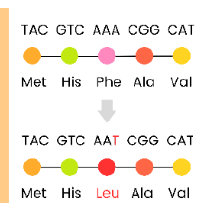
Explain the possible effects of a substitution mutation
1. DNA base / nucleotide (pair) replaced by a different base / nucleotide (pair)
2. This changes one triplet so changes one mRNA codon
3. So one amino acid in polypeptide changes
○Tertiary structure may change if position of hydrogen / ionic /
disulphide bonds change
OR amino acid doesn’t change
○Due to degenerate nature of genetic code (triplet could code for same
amino acid) OR if mutation is in an intron so removed during splicing
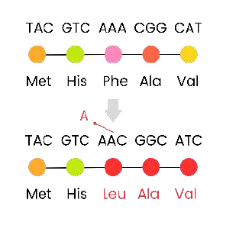
Explain the possible effects of a deletion mutation
1. One nucleotide / base (pair) removed from DNA sequence
2. Changes sequence of DNA triplets from point of mutation (frameshift)
3. Changes sequence of mRNA codons after point of mutation
4. Changes sequence of amino acids in primary structure of polypeptide
5. Changes position of hydrogen / ionic / disulphide bonds in tertiary
structure of protein
6. Changes tertiary structure / shape of protein
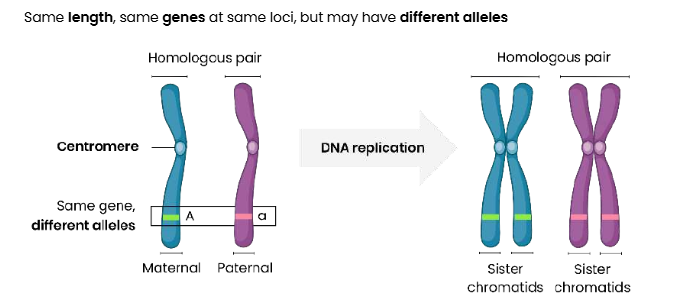
Describe features of homologous chromosomes
Describe the difference between diploid and haploid cells
Diploid - has 2complete sets of chromosomes, represented as 2n
●Haploid - has a single set of unpaired chromosomes, represented as n
Describe how a cell divides by meiosis
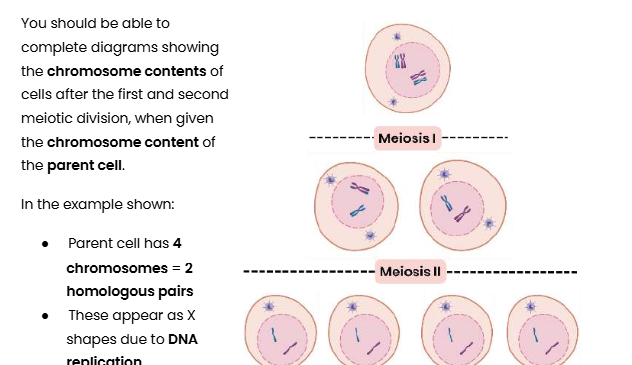
. Meiosis I (first nuclear division) separates homologous chromosomes
○Chromosomes arrange into homologous pairs
○Crossing over between homologous chromosomes
○Independent segregation of homologous chromosomes
2. Meiosis II (second nuclear division) separates chromatids
outcome of meosis
Outcome = 4 genetically
varied daughter cells
●Daughter cells are
normally haploid (if
diploid parent cell)
In interphase…?
DNA replicates →2 copies of each chromosome (sister chromatids), joined by a centromere
Draw a diagram to show the chromosome content of cells during meiosis
Explain why the number of chromosomes is halved during meiosis
Homologous chromosomes are separated during meiosis I (first division
Explain how crossing over creates genetic variation
●Homologous pairs of chromosomes associate / form a bivalent
●Chiasmata form (point of contact between (non-sister) chromatids)
●Alleles / (equal) lengths of (non-sister) chromatids exchanged between chromosomes
●Creating new combinations of (maternal & paternal) alleles on chromosomes
Explain how independent segregation creates genetic variation
●Homologous pairs randomly align at equator →so random which chromosome from each pair
goes into each daughter cell
●Creating different combinations of maternal & paternal chromosomes / alleles in daughter cells
Other than mutation and meiosis, explain how genetic variation within a
species is increased
●Random fertilisation / fusion of gametes
●Creating new allele combinations / new maternal and paternal chromosome combinations
Explain the different outcomes of mitosis and meiosis 1
1. Mitosis produces 2 daughter cells, whereas meiosis produces 4 daughter cells
○As 1 division in mitosis, whereas 2 divisions in meiosis
Explain the different outcomes of mitosis and meiosis 2
Mitosis maintains the chromosome number (eg. diploid →diploid or haploid →haploid)
whereas meiosis halves the chromosome number (eg. diploid →haploid)
○As homologous chromosomes separate in meiosis but not mitosis
Explain the different outcomes of mitosis and meiosis 3
Mitosis produces genetically identical daughter cells, whereas meiosis produces
genetically varied daughter cells
○As crossing over and independent segregation happen in meiosis but not mitosis
Explain the importance of meiosis
●Two divisions creates haploid gametes (halves number of chromosomes)
●So diploid number is restored at fertilisation →chromosome number maintained between generations
●Independent segregation and crossing over creates genetic variation
How can you recognise where meiosis and mitosis occur in a life cycle?
●Mitosis occurs between stages where chromosome number is maintained
○Eg. diploid (2n) →diploid (2n) OR haploid (n) →haploid (n)
●Meiosis occurs between stages where chromosome number halves
○Eg. diploid (2n) →haploid (n
Describe how mutations in the number of chromosomes arise
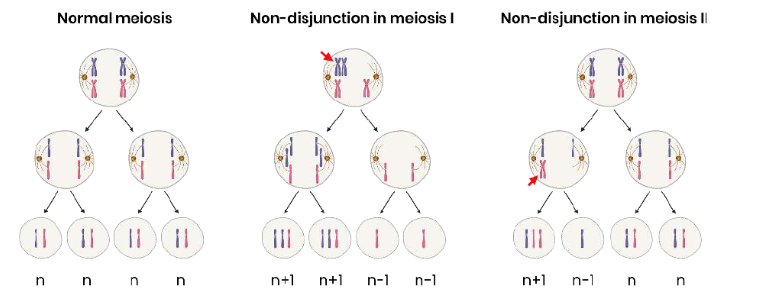
●Spontaneously by chromosome non-disjunction during meiosis
●Homologous chromosomes (meiosis I) or sister chromatids (meiosis II) fail to separate during meiosis
●So some gametes have an extra copy (n+1) of a particular chromosome and others have none (n-1)
Suggest how the number of possible combinations of chromosomes in
daughter cells following meiosis can be calculate
2nwhere n = number of pairs of homologous chromosomes (half the diploid number)
Suggest how the number of possible combinations of chromosomes
following random fertilisation of two gametes can be calculated
(2n)2where n = number of pairs of homologous chromosomes (half the diploid number)
What is genetic diversity?
Number of different alleles of genes in a population
What are alleles and how do they arise?
●Variations of a particular gene (same locus) →different DNA base sequence
●Arise by mutation
What is a population?
●A group of organisms of the same species in a particular space at a particular time
●That can (potentially) interbreed (to produce fertile offspring)
Explain the importance of genetic diversity
●Enables natural selection to occur
●As in certain environments, a new allele of a gene might benefit its possessor
●By resulting in a change in the polypeptide (protein) coded for that positively changes its properties
●Giving possessor a selective advantage (increased chances of survival and reproductive success)
What is evolution?
●Change in allele frequency (how common an allele is) over many generations in a population
●Occurring through the process of natural selection
Adaptation and selection are major factors in evolution and contribute to the diversity of living organism
Explain the principles of natural selection in the evolution of populations
1. Mutation
Random gene mutations can result in [named] new alleles of a gene
2. Advantage
In certain [named] environments, the new allele might benefit its possessor
[explain why] →organism has a selective advantage
3. Reproduction
Possessors are more likely to survive and have increased reproductive success
4. Inheritance
Advantageous allele is inherited by members of the next generation (offspring)
5. Allele frequency
Over many generations, [named] allele increases in frequency in the population
Describe 3 types of adaptations
Natural selection results in species that are better adapted to their environment:
●Anatomical - structural / physical features that increase chance of survival
●Physiological - processes / chemical reactions that increase chance of survival
●Behavioural - ways in which an organism acts that increase chance of surviva
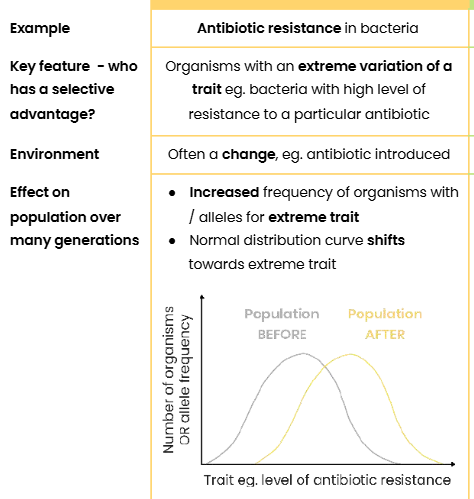
Directional selection + example
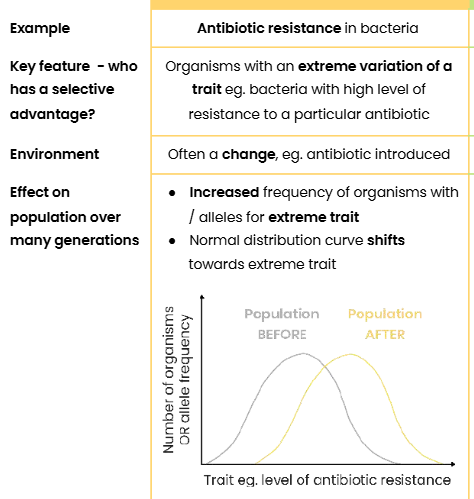
stabilising selection + example
What is a species
A group of organisms that can (interbreed to) produce fertile offspring
Suggest why 2 different species are unable to produce fertile offspring
●Different species have different chromosome numbers →offspring may have odd chromosome number
●So homologous pairs cannot form →meiosis cannot occur to produce gametes
Explain why courtship behaviour is a necessary precursor to successful
mating
●Allows recognition of members of same species →so fertile offspring produced
●Allows recognition / attraction of opposite sex
●Stimulates / synchronises mating / production / release of gametes
●Indicates sexual maturity / fertility
●Establishes a pair bond to raise young
Describe a phylogenetic classification system
●Species (attempted to be) arranged into groups, called taxa, based
on their evolutionary origins (common ancestors) and relationships
●Uses a hierarchy:
○Smaller groups are placed within larger groups
○No overlap between groups
Name the taxa in the hierarchy of classification
1. Domain (largest / broadest)
2. Kingdom
3. Phylum
4. Class
5. Order
6. Family
7. Genus
8. Species (smallest)
How is each species universally identified
Abinomial consisting of the name of its genus and species, eg. Homo sapiens
Suggest an advantage of binomial naming
Universal so no confusion as many organisms have more than one common name
How can phylogenetic trees be interpreted
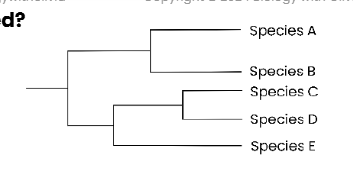
●Branch point = common ancestor
●Branch = evolutionary path
●If two species have a more recent common
ancestor, they are more closely related (eg. C & D)
advances that have helped to clarify evolutionary
relationships between organisms - Advances in genome
sequencing
allows
comparison of DNA
base sequences
●More differences in DNA base sequences →more distantly related /
earlier common ancestor
●As mutations (change in DNA base sequences) build up over time
advances that have helped to clarify evolutionary
relationships between organisms - Advances in
immunology
allowing
comparison of protein
tertiary structure (eg.
albumin
●Higher amount of protein from one species binds to antibody against
the same protein from another species →more closely related /more
recent common ancestor
●As indicates a similar amino acid sequence and tertiary structure
●So less time for mutations to build u
What is biodiversity?
●Variety of living organisms (species, genetic and ecosystem diversity)
●Can relate to a range of habitats, from a small local habitat to the Earth
What is a community?
All populations of different species that live in an area
What is species richness
A measure of the number of different species in a community
What does an index of diversity do?
Describes the relationship between:
1. The number of species in a community (species richness)
2. The number of individuals in each species (population size)
Suggest why index of diversity is more useful than species richness
●Also takes into account number of individuals in each species
●So takes into account that some species may be present in small or high numbers
What is the formula for index of diversity
Calculate the total number of organisms (N), if not given
2. Multiply Nby (N - 1)
3. For each species, multiply the number of organisms (n) by (n - 1)
4. Add up all the values of n(n - 1) to get Σn(n - 1)
5. Divide N(N - 1) by Σn(n - 1

Describe how index of diversity values can be interpreted
●High →many species present (high species richness) and species evenly represented
●Low →habitat dominated by one / a few species
Explain how some farming techniques reduce biodiversity
Use of pesticides to kill pests
Predator population of pest decreases

Explain the balance between conservation and farming
●Conservation required to increase biodiversity
●But when implemented on farms, yields can be reduced, reducing profit /income for farmers
○Eg. by reducing land area for crop growth, increasing competition, increasing pest population
●To offset loss, financial incentives / grants are offered
Give examples of how biodiversity can be increased in areas of agriculture
●Reintroduction of field margins and hedgerows (where farmers only grow one type of crop)
●Reduce use of pesticides
●Growing different crops in the same area (intercropping)
●Using crop rotation of nitrogen fixing crops instead of fertilisers
How can genetic diversity within or between species be measured?
●Comparing frequency of measurable or observable characteristics
●Comparing base sequence of DNA
●Comparing base sequence of mRNA
●Comparing amino acid sequence of a specific protein encoded by DNA and mRNA
Explain how comparing DNA, mRNA and amino acid sequences can indicate
relationships between organisms within a species and between species
●More differences in sequences →more distantly related /earlier common ancestor
●As mutations (change in DNA base sequences) build up over time
●More mutations cause more changes in amino acid sequences
Explain the change in methods of investigating genetic diversity over time
●Early estimates made by inferring DNA differences from measurable or observable characteristics
○Many coded for by more than one gene →difficult to distinguish one from another
○Many influenced by environment →differences due to environment not genes
●Gene technologies allowed this to be replaced by direct investigation of DNA sequences
Explain how data should be collected when investigating variation within a
species quantitatively
●Collect data from random samples →to remove bias
○ divide area into squares
○Use a random number generator to obtain random coordinates
●Use same method of measurement each time
●Use a large sample size →so representative of population
●Calculate a running mean and sample until number becomes (fairly) constant
●(Where applicable) ensure sampling is ethical →must not harm organism / must allow release
unchanged
Explain how data should be processed and analysed when investigating
variation within a species quantitatively
●Calculate amean value of collected data and standard deviation (S.D) of that mean
○Mean =sum of values in data set / number of values in data set
●S.D shows spread of values about the mean →higher S.D = higher variation
●If standard deviations overlap, causing values of two sets of data to be shared, any
difference between the two may be due to chance / not significant
●Use [named] statistical test
○To analyse whether there is a significant difference between populations