genetics lab final
 Call Kai
 Learn
Learn Practice Test
 Spaced Repetition
 Match
Match Flashcards
 Knowt Play
1/157

There's no tags or description
Looks like no tags are added yet.
Name | Mastery | Learn | Test | Matching | Spaced | Call with Kai |
|---|
No analytics yet
Send a link to your students to track their progress
158 Terms
To identify genetically modified ingredients from food, we used ____ region of the T-DNA to amplify using a PCR.
35S promoter
> or carat symbol in front of a DNA sequence suggests that the sequence is in this format:
FASTA format
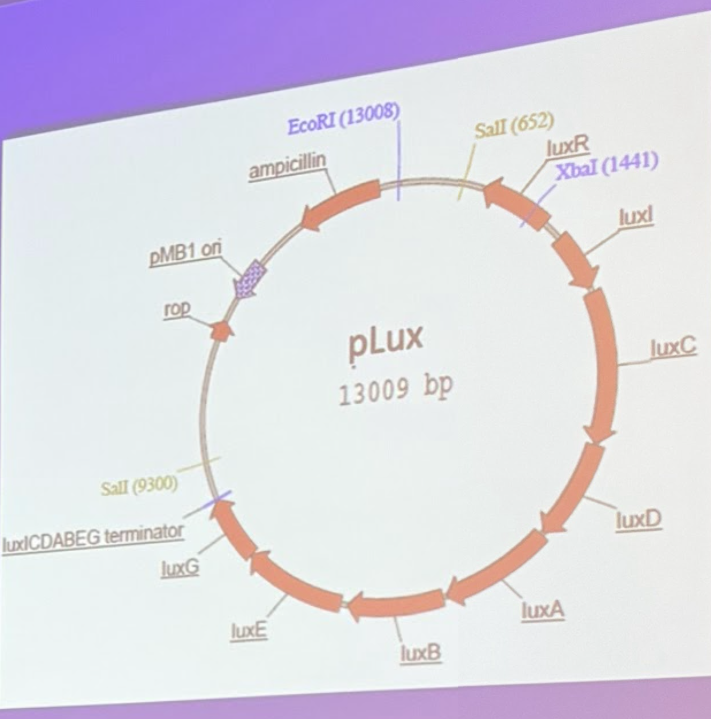
Plasmid pLux is digested with restriction enzymes EcoRI and Xba I and the digest is run on an agarose gel. The sizes of bands you see on the gel would be:
1442 and 11567
The direction of adding nucleotides in a PCR reaction is _____.
5’ to 3’
The mathematical representation of Hardy-Weinberg equation that predicts the genotypic frequencies for a population that is not evolving is:
p^2 + 2pq + q^2 = 1
The genomic DNA extraction from corn chips in the GMO lab uses this chemical as the strong reducing agent:
Beta mercapoethanol
A gene with the location code 6p21.34 is on the ____ arm of chromosome ____.
Short arm, chromosome 6
In bioinformatics, this refers to the value given as a percentage (0-100%), how much of the length of your sequence of interest (query sequence) aligns with the length of a reference sequence.
Query coverage
BRCA1 and BRCA2 genes normally act as ____, by helping in regulation of cell division.
Tumor suppressors
If the DNA concentration from the nanodrop measurement is 300ng/ul. How many uls will be needed to make 1 ug of DNA?
3.3 ul
During plasmid DNA extraction procedure, this chemical was used to lyse the cells.
NaOH
In a gene, a mutation at this location would lead to the most significant effect on the phenotype?
Closer to the 5’ end
The following is not a characteristic of VNTRs?
a. Useful in genetics, biology research, forensics, and DNA fingerprinting
b. Repeats vary in sizes from as low as 6 bp to as much as 100 bp
c. They cut DNA at specific sites
d. These loci contain DNA sequences organized as a tandem repeat
c. They cut DNA at specific sites
This component allows for the identification of organisms or cells which exhibit successful transformation (between transformed and untransformed cells).
Selective marker
In CRISPR gene editing, Cas-9 endonuclease cuts 3 bps upstream of this sequence.
PAM
This type of promoter is always on in every single cell.
Constitutive promoter
With regards to the sleep regulation, which two genes act as transcriptional regulators of per genes?
CLOCK and BMAL
In gel electrophoresis this compound was added as a DNA stain to allow for visualization under UV light.
SYBRsafe
In Ti plasmid mediated genetic transformation which part of the Ti plasmid is inserted into a plant genome.
T DNA
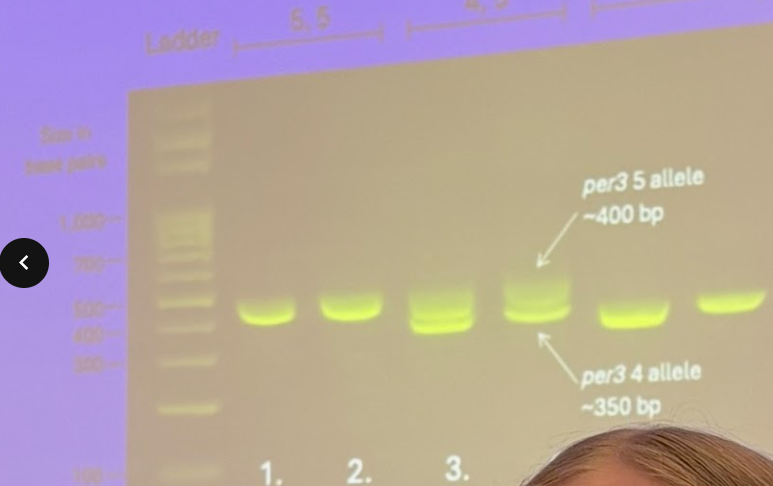
Four people perform a sleep analysis by amplifying the PER3 gene. You observe the samples on the gel below after the PCR reaction. For sample 3: the phenotype of this person would be a:
Intermediate
A mixture of DNA and proteins with a condensed structure that allows the genetic code for an entire organism to fit in the nucleus of the cell.
Chromatin
In CRISPR gene editing, this component helps to identify the gene for cas 9 nuclease to cut.
Guide RNA
Morning preference phenotype is associated with these many VNTR repeats in an individual.
5
The molecular mechanism for onset of Huntington Disease depends on _____?
CAG repeat
If heat shock is needed to open the cells so the plasmids can enter, the reason why we place the cells on ice for a few minutes after heat shock is:
Reseals the membrane
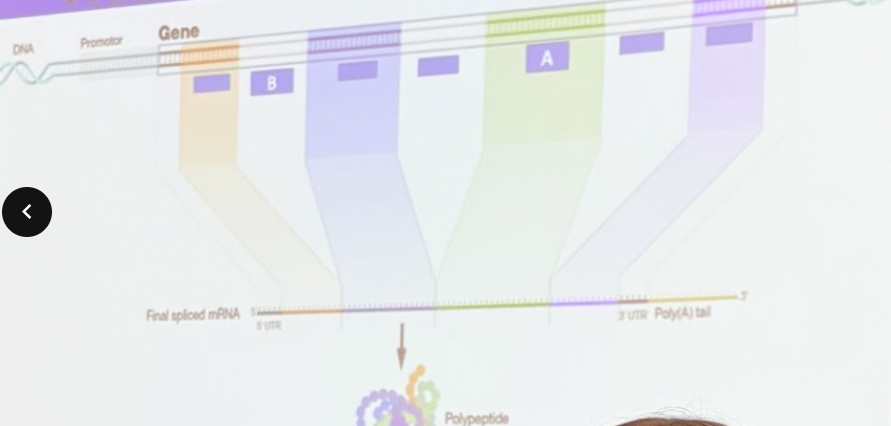
In the figure below A and B represent what parts of a gene?
A is exon, B is intron
What do the mRNA sequences UAA, UAG, and UGA code for?
Stop codons
T/F: An organism with one extra set of chromosomes is considered to have Trisomy.
False
If you transformed bacteria with a plasmid carrying the kanamycin (Kan) resistance gene and a gene for GFP under the control of an arabinose-dependent promoter, what media can you use to observe the bacteria glow?
Arabinose + LB agar
A cross between yellow and white flowers yields all yellow flowers in the F1 generation. When F1 are selfed, they produce 105 yellow flowers and 45 white flowers. Calculate the chi-square value for the F2 generation seeds. If the critical chi square value is 3.84, what will be the outcome for the null hypothesis?
Chi-square = 2, fail to reject the null
What are the two parts of sgRNA
scaffold and guide
What is genetic engineering?
The use of laboratory technologies to intentionally alter DNA by inserting, deleting, or modifying genes
Why are GMOs developed?
For improved traits such as higher nutrition, disease resistance, drought tolerance, and longer shelf life
What organism is commonly used for plant genetic engineering?
Agrobacterium tumefaciens
Why is Agrobacterium useful for genetic engineering?
It naturally transfers DNA into plant cells
What disease does Agrobacterium cause in plants?
Crown gall disease
What plasmid is responsible for DNA transfer in Agrobacterium?
Tumor-inducing (Ti) plasmid
What part of the Ti plasmid integrates into the plant genome?
T-DNA
What genes are found in T-DNA?
Plant hormone genes, opine synthesis genes, and transgenes of interest (when engineered)
What are Vir genes and what do they do?
Virulence genes that help transfer and integrate T-DNA into plant cells
What are left and right borders in the Ti plasmid?
25 bp inverted repeats that define the region of DNA transferred into plants.
What is a constitutive promoter?
A promoter that turns a gene on in all tissues at all times.
What is an inducible promoter?
A promoter that turns a gene on or off in response to a specific signal (e.g., light)
What is a tissue-specific promoter?
A promoter active only in certain tissues
What selectable marker genes are commonly used?
Antibiotic resistance genes (e.g., kanamycin or hygromycin resistance)
What is DNA isolation?
Collecting as much DNA as possible from a sample
What is DNA purification?
Removing contaminants from isolated DNA
What is DNA extraction?
A process that includes both isolation and purification.
What types of materials bind DNA during extraction?
Silica particles, anion-exchange resins, magnetic beads
Why are detergents important in DNA extraction?
They break cell membranes to realease DNA
What is SDS and its function?
Sodium dodecyl sulfate; solubilizes membranes and proteins.
What is CTAB used for?
Removes polysaccharides and polyphenols from plant DNA
What is β-mercaptoethanol used for?
Removes tannins and polyphenols; strong reducing agent.
What is PVP used for?
Binds plant polyphenols
What is chloroform used for?
Separates proteins from DNA
What is isoamyl alcohol used for?
Prevents foaming and stabilizes phase separation
What is the role of isopropanol?
Precipitates DNA
What is ethanol used for?
Washing DNA pellet
What do Tris and EDTA do?
Tris maintains pH; EDTA inhibits DNases by chelating metal ions
Why is grinding the sample important?
Breaks cell walls to allow DNA release.
Why is centrifugation used?
Separates DNA from proteins and debris.
What phase contains DNA after chloroform extraction?
The aqeuous (upper) phase
Why must the DNA pellet be dried before resuspension?
To remove alcohol that could inhibit downstream reactions like PCR
What solution did you use to dissolve DNA?
Nuclease-free water
T/F: BRCA1 and BRCA2 genes normally act as tumor suppressors by helping in regulation of cell division.
True
Which of the following databases is publically available to find variations in a gene that has clinical significance:
a. nucleotide
b. protein
c. ClinVar
d. domains and structures
ClinVar
T/F: The following sequence is considered to be a FASTA format:
>NP_009221. breast cancer type 1 susceptibility protein isoform 1
MDLSALRVEEQNYWLKNDFIQKKWNVV ABLDJFNEBFOQEJKFBNMDVCDJ
True
T/F: In bioinformatics, Query coverage refers to the value given as a percentage (0-100%), how much of the length of your sequence of interest (query sequence) aligns with the length of a reference sequence.
True
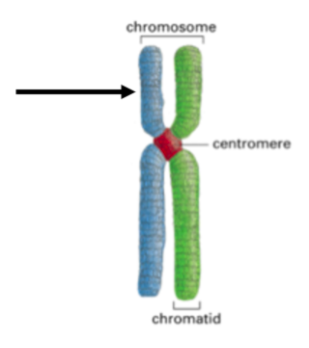
T/F: the picture of the chromosome shows the P arm
True
The purpose of adding bromophenol blue to the DNA loading dye is to:
a. allow monitoring the DNA migration on the gel during electrophoresis.
b. give density to the DNA so it can sink in the wells
c. change negative charge of DNA to a net positive charge
d. resist pH changes for running the gel
a. allow monitoring the DNA migration on the gel during electrophoresis.
T/F: The direction of adding nucleotides in a PCR reaction is from 3' to 5' end of the template DNA
False
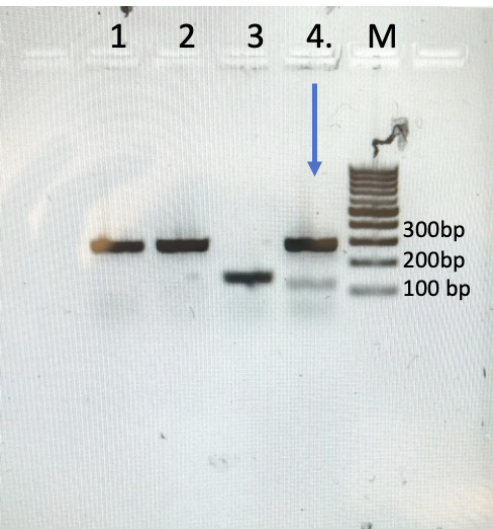
As you learned in the fast plant genotyping lab, the wild type should give a band for 280 bp and if there is mutation, it should give a band for 150bp. Based on the figure below what is the genotype of the seedling in lane # 4 with the arrow that has two bands.
Heterozygous for wild type and DFR
T/F: The insertion in the DFR gene leads to green colored seedling
True
While screening plants for segregation of a phenotype/trait this generation of seeds/plants is used.
T2
The gene you are studying in the lab for the sleep experiment is:
PER3
You are studying a population in Hardy-Weinberg equilibrium, for a gene with two alleles p and q. The frequency of p allele is 0.46, what would be the frequency of the heterozygous?
0.496
T/F: In a population that is not evolving, the frequencies of different alleles within a population are expected to remain the same over time.
True
T/F: Per3 carrying copies of this repeat may be associated with a preference for evening, while having 5 repeats may be associated with a preference for morning.
True
The function of isopropanol in the miniprep DNA isolation we performed in the lab is:
Precipitate DNA
If you transformed bacteria with a plasmid carrying the kanamycin (Kan) resistance gene and a gene for Lac Z under the control of an arabinose-dependent promoter, what media should you use to observe the blue colored colonies?
LB+Kan"+X-gal+Arabinose
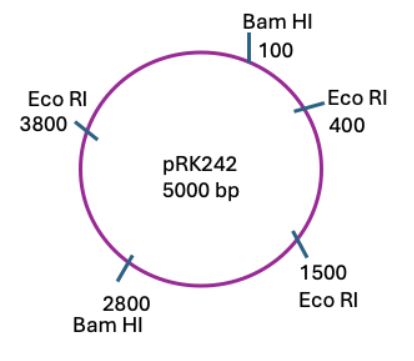
In the bacterial transformation lab, you transformed E. coli with the pRK242 plasmid. You were very happy to see colonies the next day on your plate. Now you isolated plasmid DNA from the cultures of your transformed cells and want to make sure the plasmid is correct. You set up a restriction digest with an enzyme BamHI to validate the plasmid. Here is the plasmid map, based on this what sizes of fragments do you expect to see on your gel?
2700 bp and 2300 bp

You and your friend isolated plasmid DNA from a bactureail culture and measured the concentration on a nanodrop. The concentration your of the plasmid is 500ng/ul with a 260/280 ration of 2.02 and that of your friend's is 15ng/ul. Since your DNA has better concentration you offer your your plasmid DNA to your friend. You both use 1 ug of this DNA to perform two restriction enzyme digests that should give you two bands. Your friend ran their gel and saw two nice bands, but your gel looks like the one below.
What might have gone wrong with the gel?
Placed the gel towards the wrong electrodes
T/F: The restriction enzyme EcoRI cuts the DNA at specific sites which have palindromic DNA sequences.
True
What is a plasmid?
A small, circular, extra-chromosomal DNA molecule found in bacteria.
What is the purpose of plasmid isolation (miniprep)?
To extract and purify plasmid DNA from bacterial cells.
Why are plasmids useful in molecular biology?
They replicate independently and can carry foreign genes
What does “high-copy” plasmid mean?
A plasmid present in hundreds to thousands of copies per cell
Which plasmid is an example of a high-copy plasmid?
pUC19
What does “Ori” stand for on a plasmid map?
Origin of replication.
What is an antibiotic resistance gene used for?
To select bacteria that successfully contain the plasmid
What does AmpR provide resistance to?
Ampicillin
What is bacterial transformation?
The uptake of foreign DNA by bacterial cells
What does it mean for bacteria to be “competent”?
Able to take up foreign DNA.
Is E. coli naturally competent?
No, it must be made competent artificially
What chemical is used to make E. coli chemically competent?
Calcium chloride (CaCl₂)
What is heat shock used for in transformation?
To allow plasmid DNA to enter bacterial cells
What are the four main steps of chemical transformation?
1. Competent cell preparation
2. Transformation (DNA uptake)
3. Recovery
4. Plating
Why is a recovery period needed after heat shock?
To allow expression of the antibiotic resistance gene.
Which medium is commonly used during recovery?
SOC or LB media without antibiotics
Why are transformed cells plated on antibiotic-containing agar?
To select for bacteria that contain the plasmid as the transformed cells gain antibiotic resistance due to presence of the plasmid in them