Chpt 11: Fitness
 Call Kai
 Learn
Learn Practice Test
 Spaced Repetition
 Match
Match Flashcards
 Knowt Play
1/35

There's no tags or description
Looks like no tags are added yet.
Name | Mastery | Learn | Test | Matching | Spaced | Call with Kai |
|---|
No analytics yet
Send a link to your students to track their progress
36 Terms
Fitness - General
Ability to meet demands of a task
Fitness - Cardiorespiratory
Rate at with the circulatory & respiratory systems are able to:
Use oxygen
Provide energy to power muscle contractions
Ability of the working muscles to:
Use oxygen
Provide energy to power muscle contractions
Oxygen Consumption During Exercise
Transfer O2 from lungs to capillaries
The heart pumps thru arteries (bound to Hb)
Oxygen helps liberate energy for muscles to work
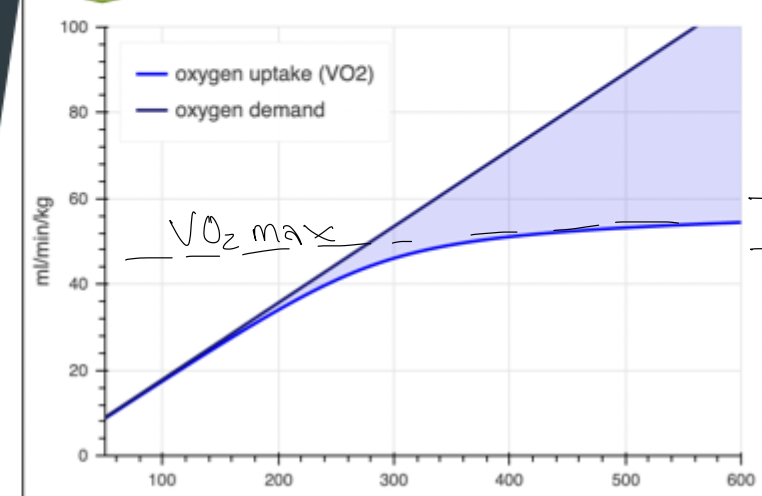
VO2 Max
Maximal volume of oxygen that can be intaken (plateau on curve)
Maximal aerobic capacity
Maximum # of oxygen a person can use during intense exercise
Incremental exercise until exhaustion
Expressed relative to body weight
VO2max Mask
Measues volumes of gas inhaled/exhaled
Defining fitness - Curve
Amount consumed per min per unit of body weight
Work rate > as energy demand >
Increase E demand → > O2 demand
Plateau = no further O2 intake (VO2 max); relative to body weight
Determinants of VO2max
O2 carrying capacity of blood
Ability of heart to pump
VO2 max across levels of fitness
Better fitness = higher VO2max
Substantial genetic component
Influences baseline
Influences trainability (ability to see improvements w/ frequent workouts)
Consequences of increased fitness levels
Smaller effort (less energy output)
Greater CNV amplitude (> task preperation)
Smaller N2 amplitude on NO-GO trial (typ >); reflects inhibition/executive control
No behavioural differences (just less work for the brain)
Difficulties standardizing exercise (equating VO2Max)
Requires expensive equipment
Need to exercise to maximum (inappropriate for some pops)
Variable (prolonged exercise duration, heat conditions, intensity)
VO2 Reserve
Differences btwn VO2 rest & VO2 max
Reflects energy expenditure
VO2 rest can be difficult to measure
Standard VO2
Similar to using a standard output rate
Ways to best equate exercise output
Target heart rate
Maximum Lactate Steady State
Ventilatory Threshold
Catecholamine Threshold (Tcat)
Critical Power
Rating of Perceived Exertion
Equating exercise output - Target Heart Rate
220 - age
Linear relationship btwn HR & VO2 max
Complete overlap btwn genders, races, & age
Target Heart Rate - Influences
Hydration
Temperature
Substances (caffeine, medications)
Mental stress
Target Heart Rate - Heart Rate reserve
HRmax - HR rest
HRrest + % of reserve = target heart rate
Might better reflect energy expenditure
Equating exercise output - Maximal Lactate Steady State
The highest blood lactate concentration & work load that can be maintained/time w/o a continual blood lactate accumulation
Equating exercise output - Ventilatory Threshold
Changing lactic acid into lactate generates carbon dioxide (or pyruvate → lactate)
Parallels the production of lactate
Equating exercise output - Catecholamine Thresholds (Tcat)
Levels > in exponential manner w/ > exercise intensity
May actually determine both lactate & ventilation thresholds
Equating exercise output - Critical Power
Maximum # of work you can due without fatigue
Time-consuming to establish
Aerobic: hours
Anaerobic lactate: 60-90 secs
Alactic: 10-12 sec
Equating exercise output - Rating of Perceived Exertion
Train participants to use a scale
Represents integration of information across
Peripheral working muscles/joints
Cardiovascular system
Respiratory system
CNS (anxiety, etc)
Requires: multiple visits, training w/ levels of exercise
Acute Effects of Exercise - Catecholamines (Review)
Transient > in catecholamines w/ exercise
CNS Animals: > precursors, > CAT
Periphery Humans: indirect evidence in indies w/ > enzymes
Catecholamines - Fitness
10 weeks training (pre/popst VO2 & CAT testing)
Greater NE rxn to exercise (at same relative intensity)
The more you exercise, the better your brain rxn to the exercise is
HPA Axis Hormones (Acute) - Fitness
Review of Acute Effects:
Need > 80% VO2max to > plasma/salivary ACTH & cortisol
Need to exercise for > 45 min if intensity is < VO2 max
With fitness:
This does x chg w/ fitness
If fit, need to exercise harder to reach this lvl of stress rxn engagement (< perceived stress)
HPA Axis Hormones (Chronic) - Fitness
Review of Chronic Effects:
Regular exercise x chg baseline ACTH/cortisol lvls in humans
Animal studies: voluntary x; forced exercise impacts CORT lvls (stress effect)
With fitness:
Stress rxn remains the same (good thing: x want to lose, just x want worse)
Same cortisol lvls/HPA rxn but diff feedback mechanism
Evidence from athletes (fit occupations)
HPA Axis Hormones - Fitness Mechanism
Slightly higher ACTH
No diff in cortisol
< sensitivity to feedback (cortisol binding)
< Glucocorticoid R (DA in HC; impact memory/recall - synaptogenesis)
< expression of GR mRNA in highly trained athletes
BDNF (Chronic) - Fitness
Exercise Review:
Humans: x changes in serum concentation (periphery)
Rodents: > BDNF, > BDNF mRNA expression
chgs BDNF rxn to exercise (blunts)
With fitness (reg exercise):
Stronger rxn to exercise
Sig chg in basal BDNF lvls (> basal lvl)
stabilized effect (more constant large difference)
Though mixed findings
Exercise & Cognition - Performance (fitness)
< basal BDNF (>stress), > response to exercise (sig > BDNF)
Better memory score at rest
Faster rxn time (similar accuracy)
Better performance on WCST
Better Spatial memory
< BDNF in athletes → > performance (likely due to timing of BDNF)
Exercise & Cognition - Morphology Chgs
Dorsolateral PFC
Hippocampus
Basal Ganglia
White fibres (myelination): corticospinal tracts, corpus callosum
Morphology Chgs - Dorsolateral PFC
Exercise = more grey matter volume
Function: executive func, planning, rxn selection, working memory
Helps explain > memory scores, & sorting task
Morphology Chgs - HC
Exercise = > volume
Function: memory formation, spatial memory
Helps explain improved memory scores
Morphology Chgs - Basal Ganglia
Exercise = > volume
Function: sensorimotor learning, motor control (initiation/stabilization)
Helps explain faster rxn time
Morphology Chgs - White fibres
Higher streamline count in athletes
Corticospinal tract: controls voluntary movement (faster rxn time)
Corpus callosum: comm btwn lobes - frontal (> executive func)
Morphology Chgs - Gray/White Matter
Gray matter = cell bodies (> gray, > cell bodies)
White = myelination on axon (> white, > myelinated)
Athletic training = > grey/white matter
Due to > lvls of BDNF → stimulates growth
Fitness - Implications in CNS changes but not periphery
Brain & spinal cord = sep from body by BBB
BDNF is taken from periphery
Catecholamines x cross BBB (affects measurement)
Peripheral catecholamines can only influence vagus nerve (supplement HPA rxn)
Whos smarter - athletes vs non-athletes
Highly variable & too large of a genralization to make that athletes are smarter
For a given indie, regular exercise > cognitive function