ECON 2010 12-15
 Call Kai
 Learn
Learn Practice Test
 Spaced Repetition
 Match
Match Flashcards
 Knowt Play
1/130

There's no tags or description
Looks like no tags are added yet.
Name | Mastery | Learn | Test | Matching | Spaced | Call with Kai |
|---|
No analytics yet
Send a link to your students to track their progress
131 Terms
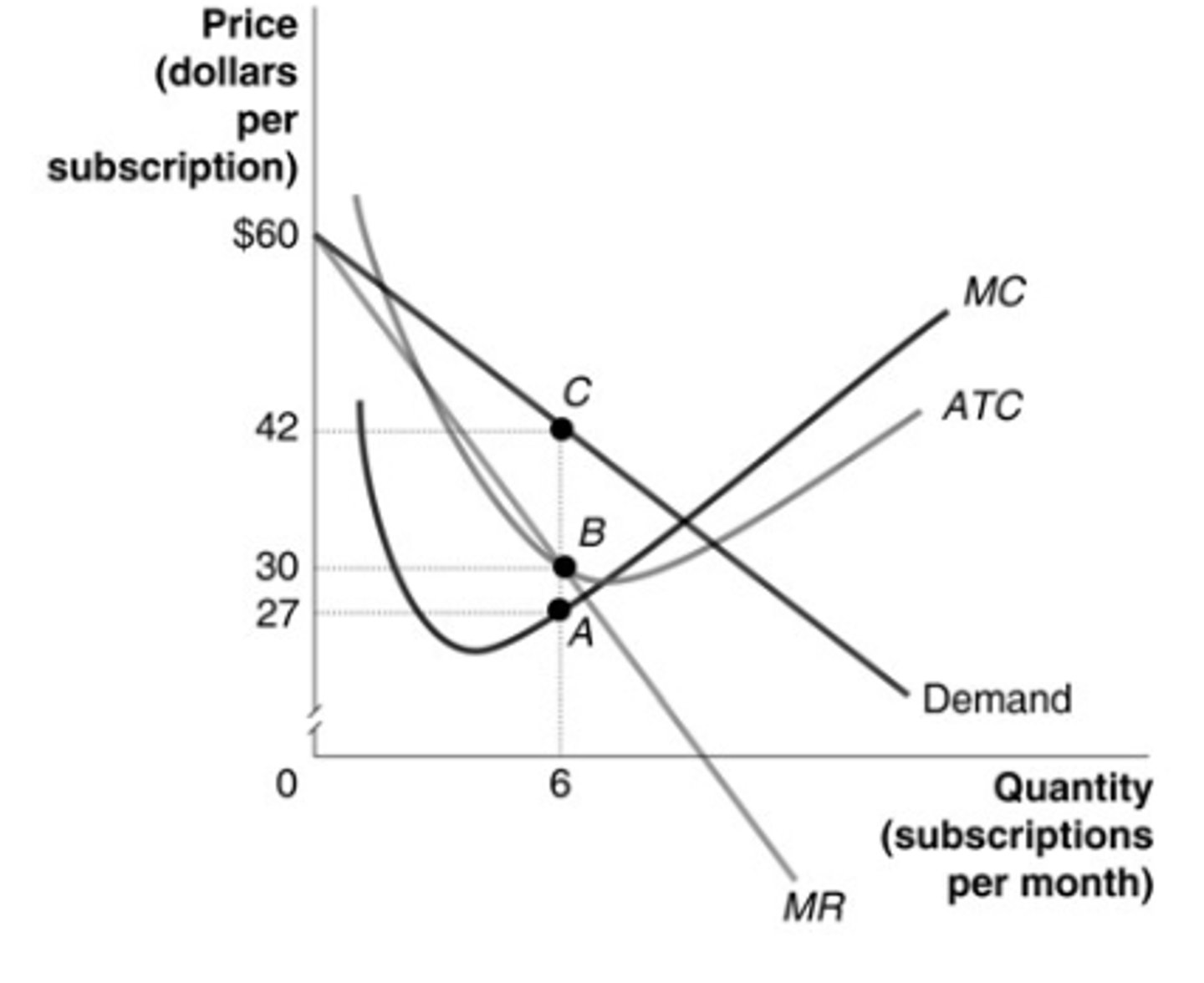
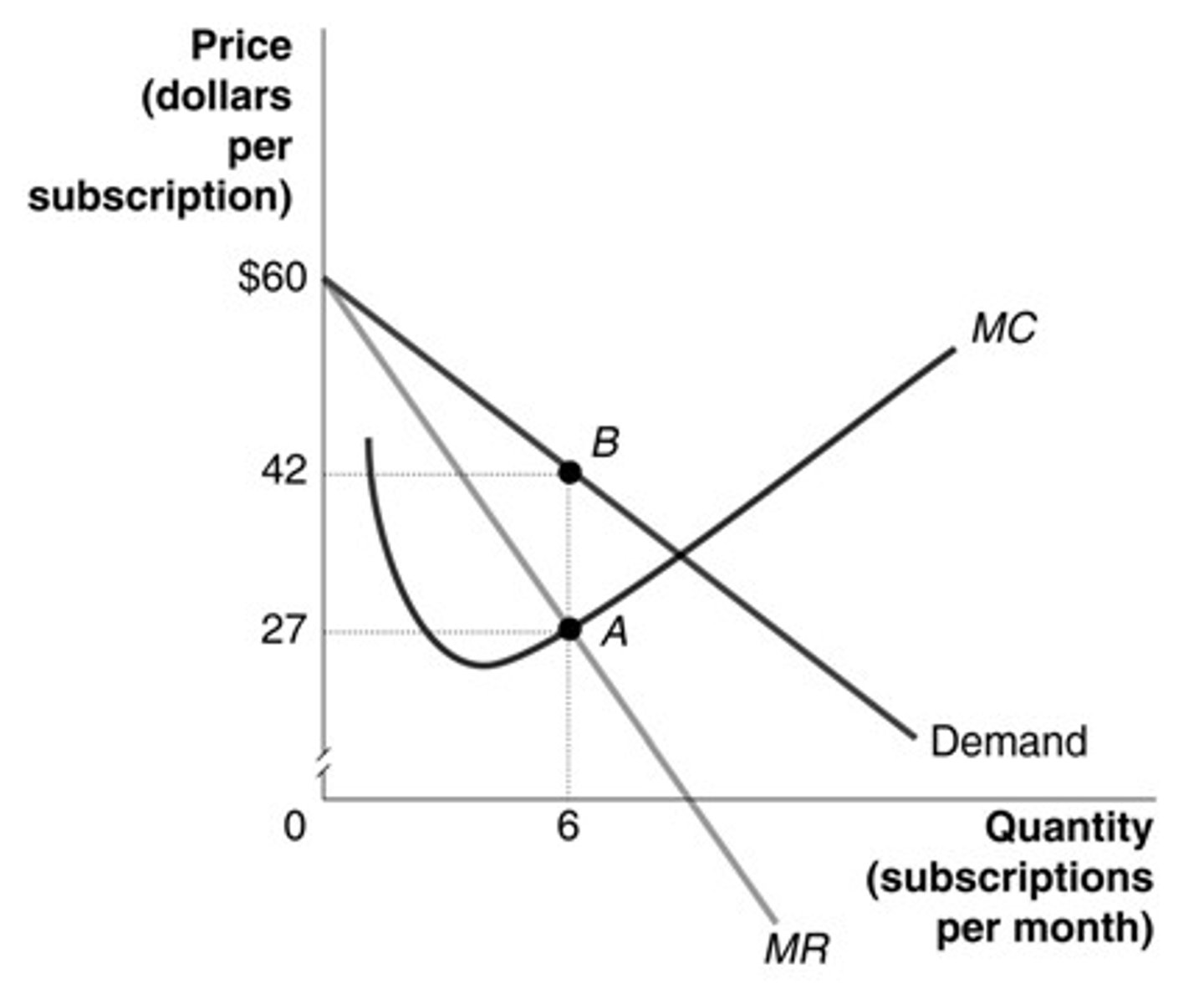
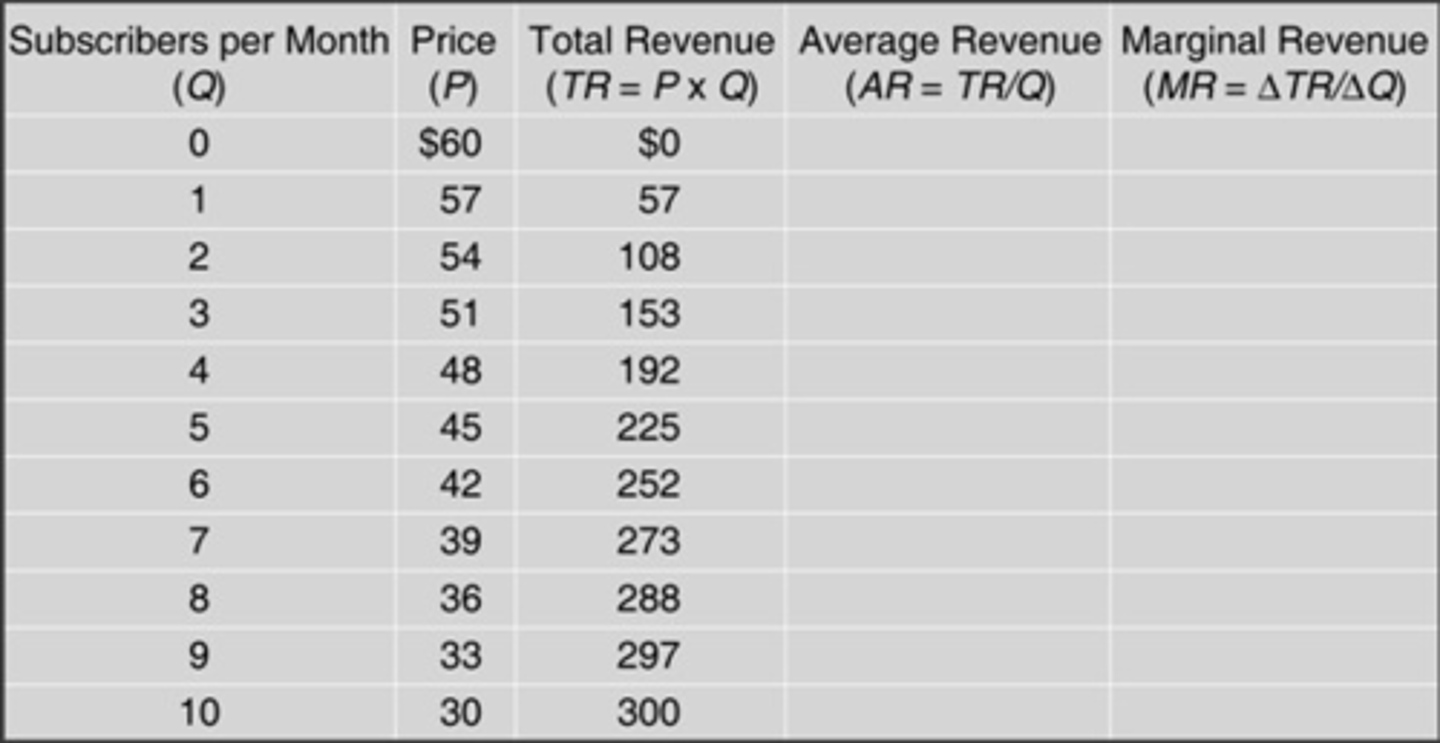
Refer to the graph below. What is firm’s profit when it sells six subscriptions per month?
a. $90
b. $72
c. $42
d. $18
b. $72
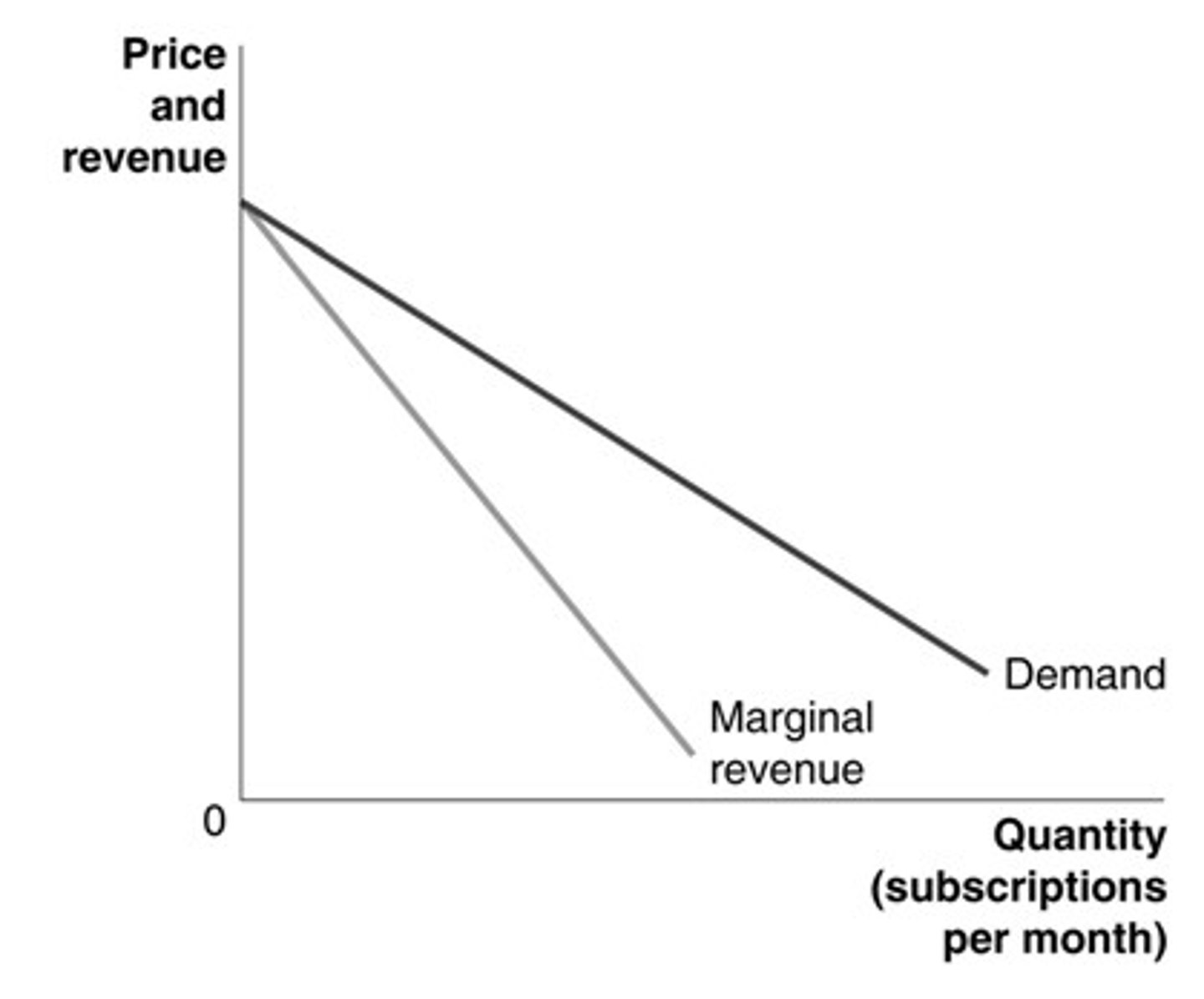
Refer to the graph below. In this graph, which curve is conceptually the same as average revenue?
a. the demand curve
b. the marginal revenue curve
c. both curves
d. neither curve
a. the demand curve
When a firm’s demand curve slopes downward and the firm decides to cut price, which of the following happens?
a. It sells more units and receives higher revenue per unit.
b. It sells more units but receives lower revenue per unit.
c. It sells fewer units and receives lower revenue per unit.
d. It sells fewer units but receives higher revenue per unit.
b. It sells more units but receives lower revenue per unit.
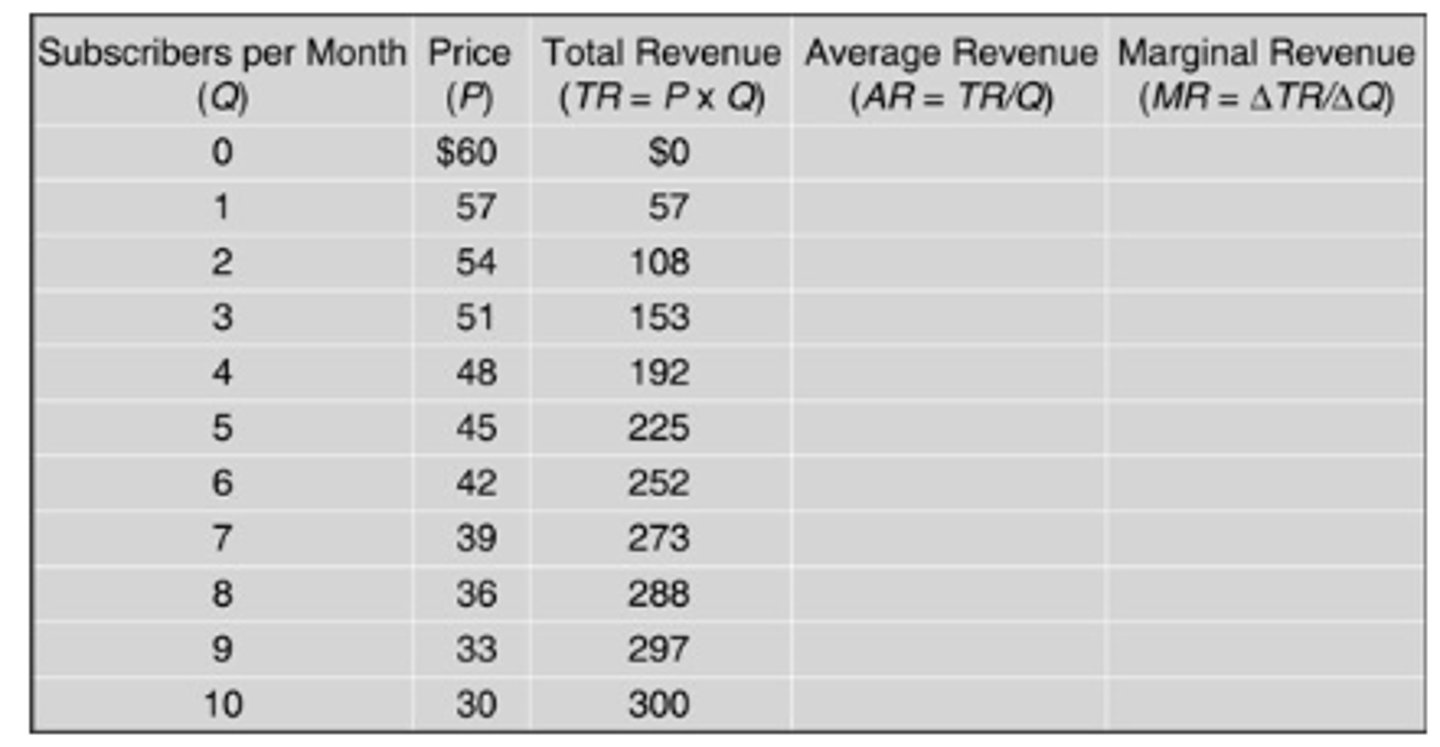
Refer to the table below. How much is the average revenue associated with serving five subscribers per month?
a. $33
b. $45
c. $5
d. none of the above
b. $45
In which of the following situations can a firm be considered a monopoly?
a. when a firm is surrounded by other firms that produce close substitutes
b. when a firm can ignore the actions of all other firms
c. when a firm uses other firms’ prices in order to price its products
d. when barriers to entry are eliminated
b. when a firm can ignore the actions of all other firms
If increased competition leads to higher costs and higher prices in an industry, how should that market be characterized?
a. as a perfectly competitive market
b. as a monopolistically competitive market
c. as an oligopoly
d. as a natural monopoly
d. as a natural monopoly
Which of the following rights is given to the holder of a patent?
a. the exclusive right to a new product
b. control over a key resource used in production of a good or service
c. the right to earn profits from creation of the product indefinitely
d. a public franchise
a. the exclusive right to a new product
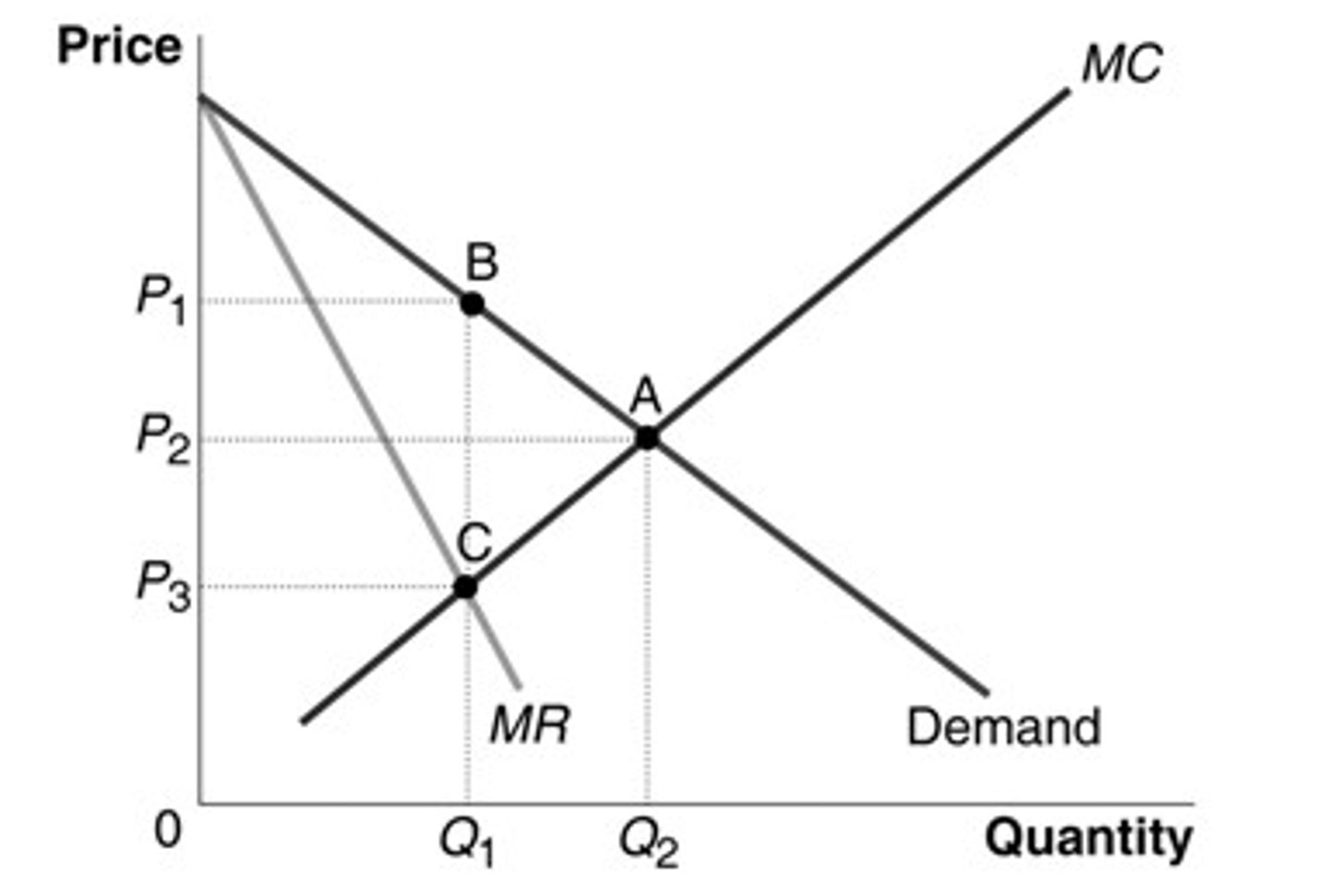
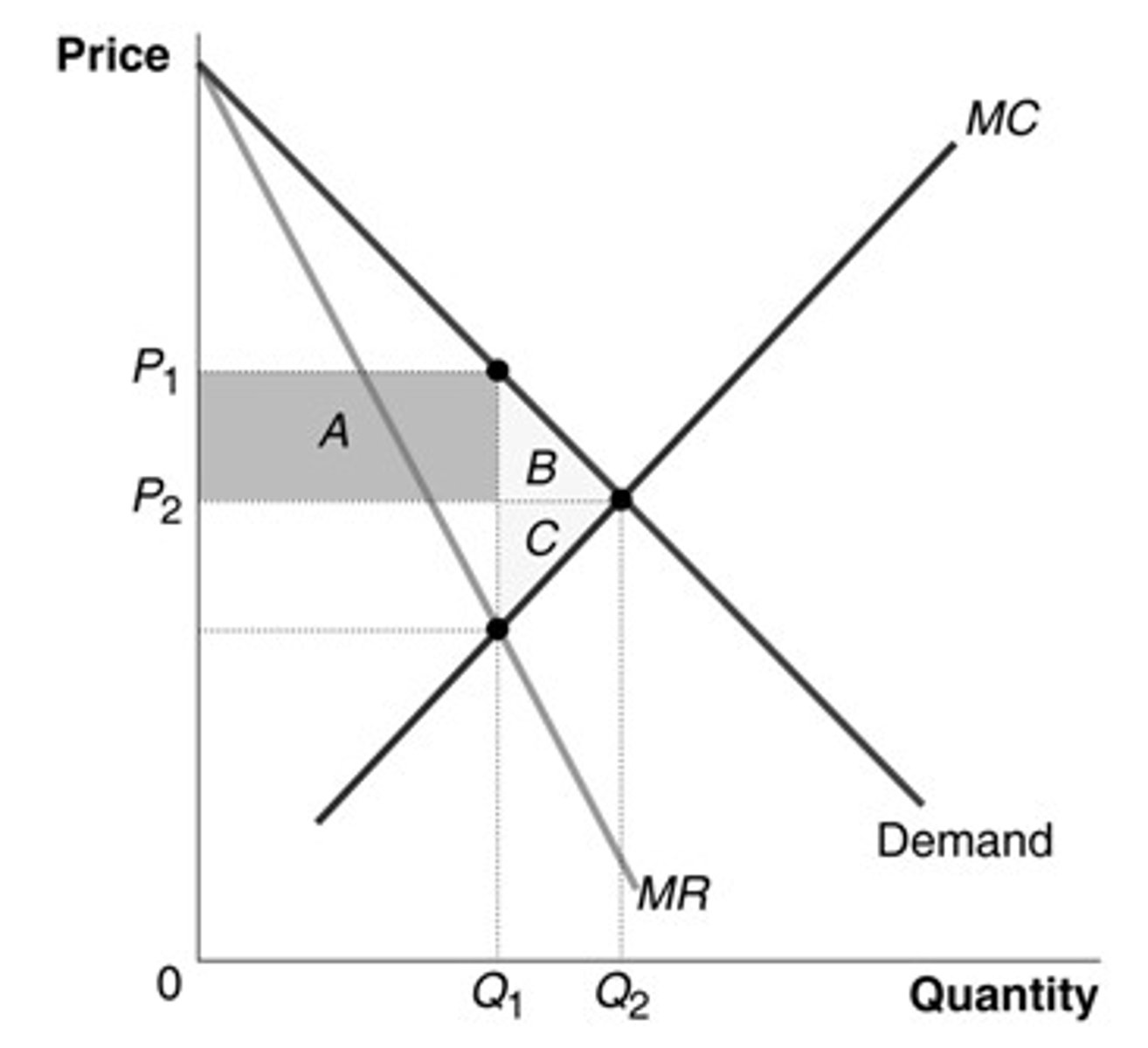
Refer to the graph of monopoly below. What point represents the price and output level that a monopoly will choose?
a. point A
b. point B
c. point C
d. none of the above
b. point B
Refer to the graph of monopoly below. What is profit when the firm sells six subscriptions per month?
a. $90
b. $42
c. $27
d. None of the above; there is insufficient information to answer the question.
d. None of the above; there is insufficient information to answer the question.
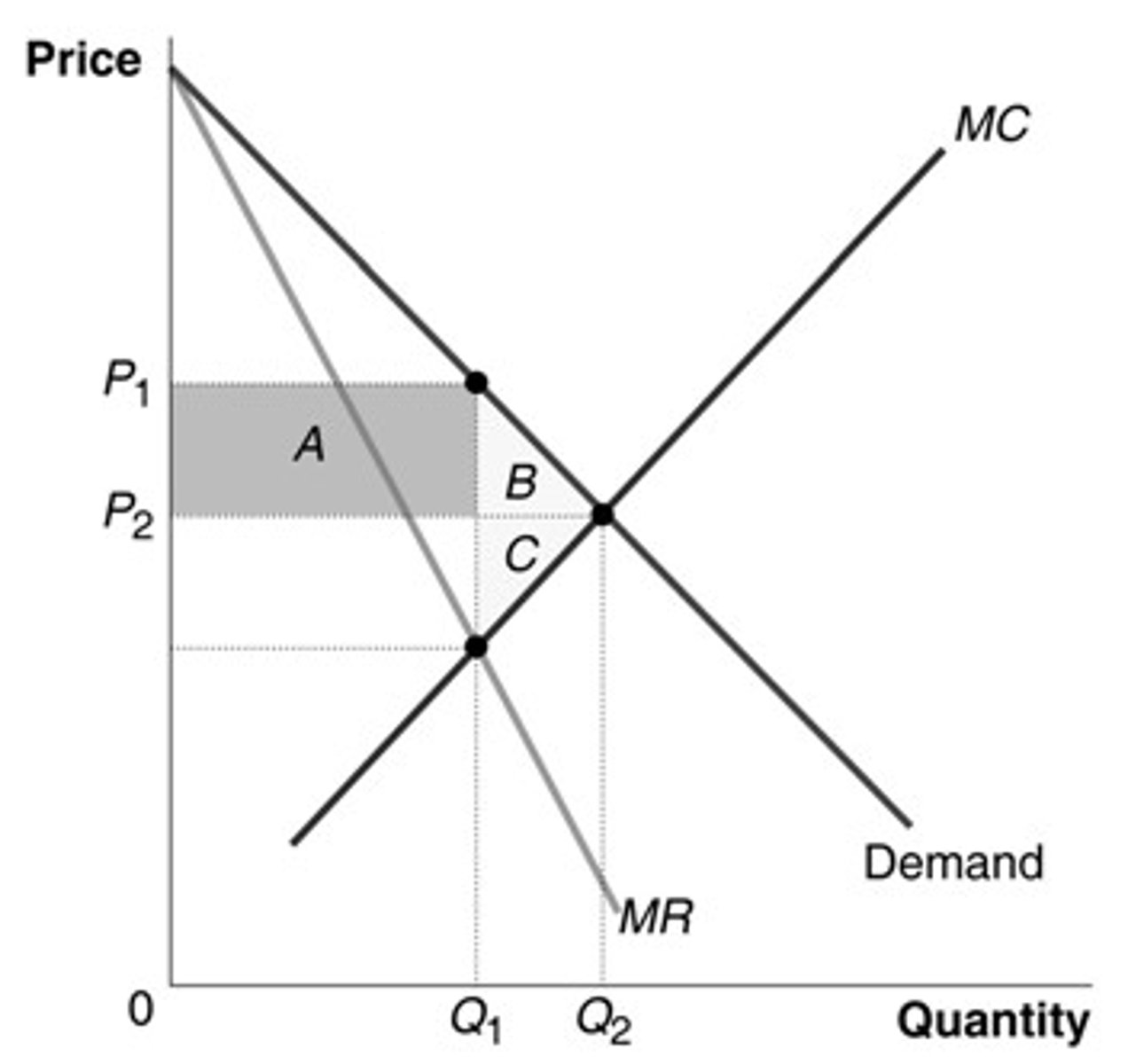
Refer to the graph below. How can the loss of economic efficiency resulting from this market being a monopoly rather than being perfectly competitive be estimated?
a. by estimating the size of the triangle B + C
b. by estimating the size of the rectangle A
c. by estimating the size of the area A + B + C
d. None of the above; the loss of economic efficiency cannot be estimated using this graph.
a. by estimating the size of the triangle B + C
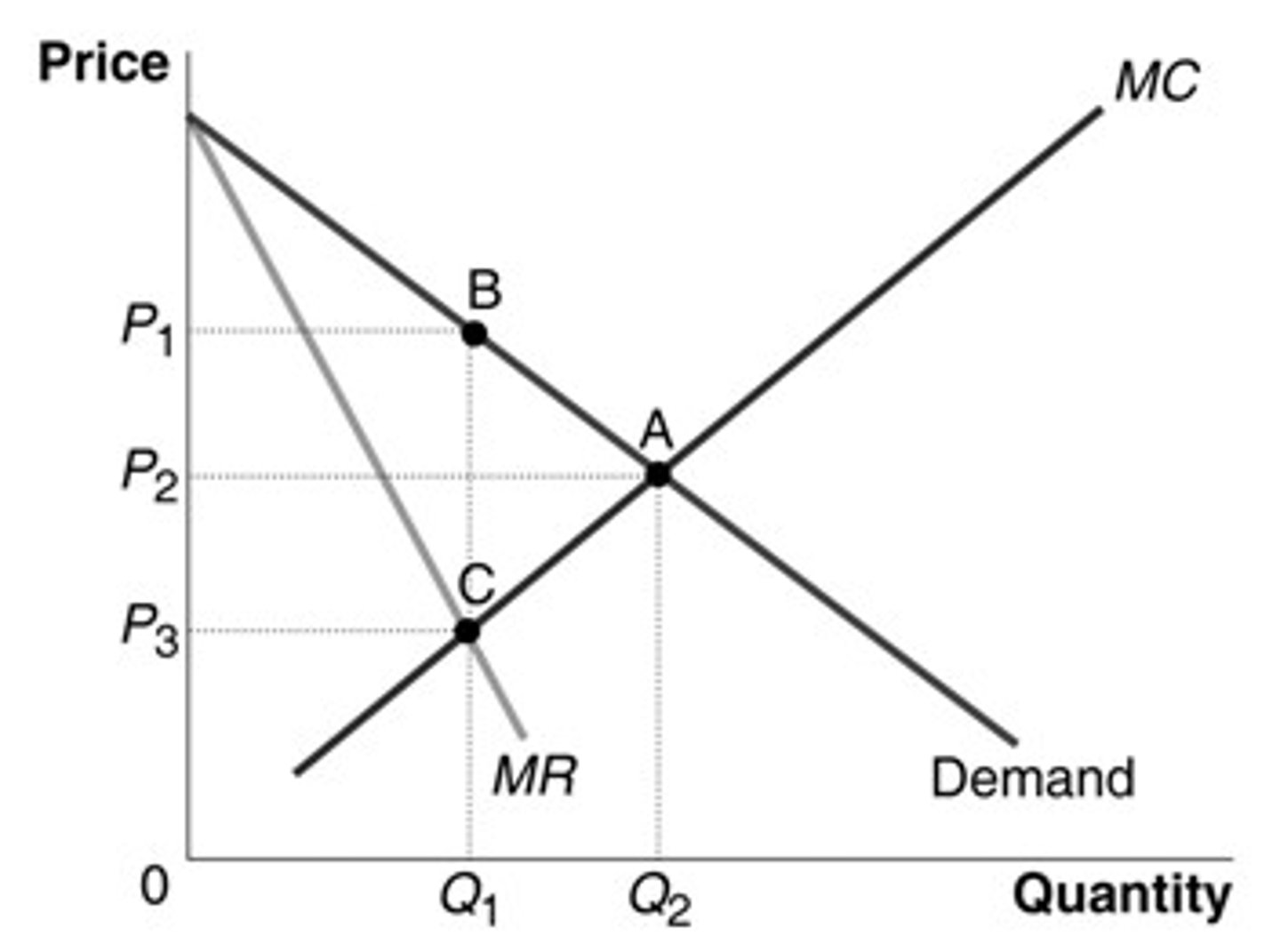
Refer to the graph below. What point represents the price and quantity that will prevail when the industry is perfectly competitive?
a. point A
b. point B
c. point C
d. none of the above
a. point A
The more cell phones in use, the more valuable they become to consumers. This is an example of:
a. what happens when a firm is granted a patent.
b. network externalities.
c. what happens when a firm has control of a key resource.
d. natural monopoly.
b. network externalities.
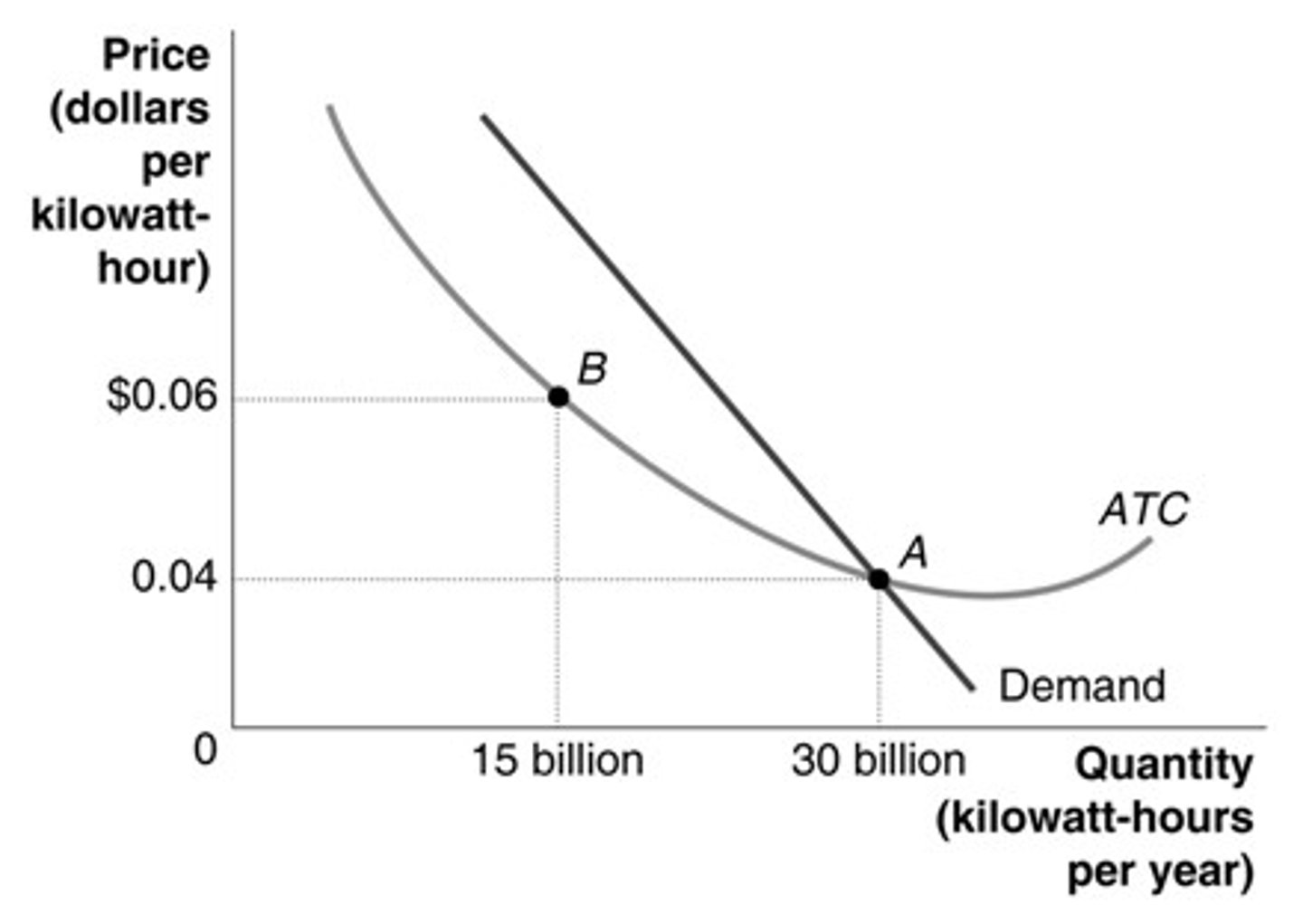
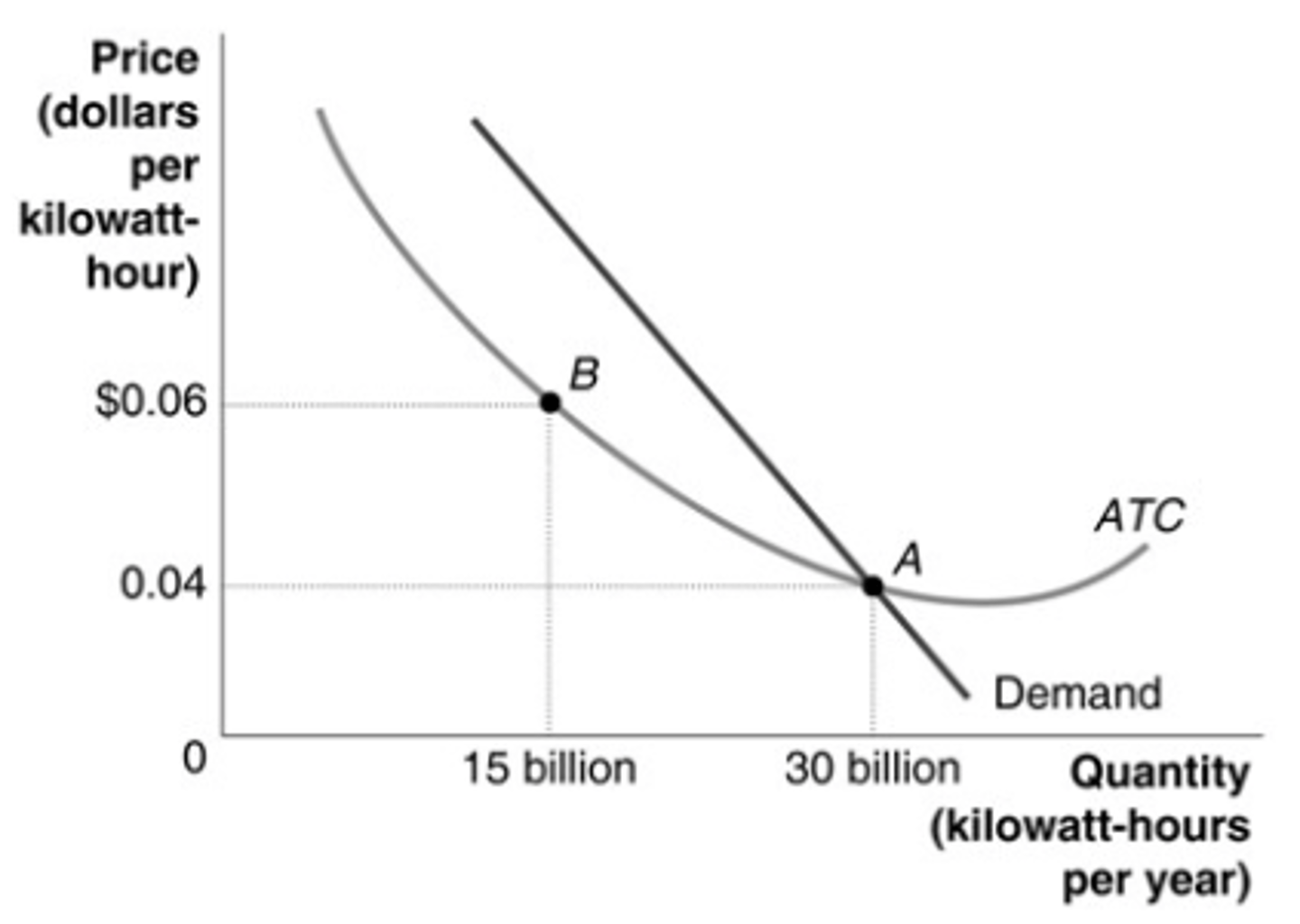
Refer to the graph below. If 30 billion kilowatt-hours of electricity are supplied by two firms who supply 15 billion kilowatt-hours of electricity each instead of by one firm, the average total cost of electricity:
a. rises from $0.04 to $0.12.
b. rises from $0.04 to $0.06.
c. rises from $0.02 to $0.03.
d. falls from $0.06 to $0.02.
b. rises from $0.04 to $0.06.
How do you find the profit maximizing quantity for perfectly competitive firm?
a. For all firm types, it is the same process. Go to the point where MR = MC. Then find the quantity on the x-axis below MR=MC.
b. Make a robust guess.
c. Spin the bottle.
d. Use a magic eight ball.
a. For all firm types, it is the same process. Go to the point where MR = MC. Then find the quantity on the x-axis below MR=MC.
Refer to the table below. How much is the marginal revenue associated with serving seven subscribers per month?
a. $39
b. $45
c. $21
d. None of the above
c. $21
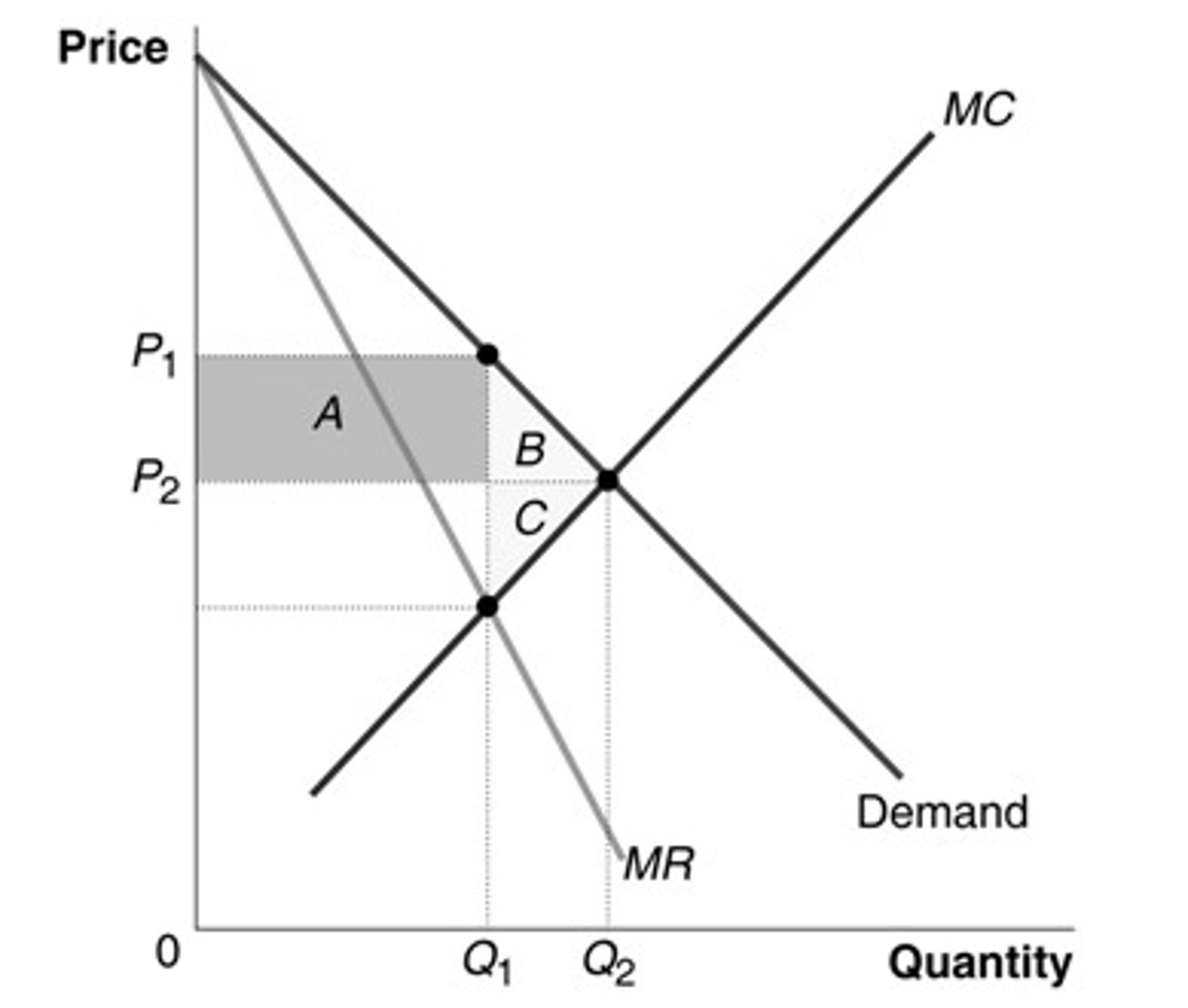
Refer to the graph below. If the industry changes from being perfectly competitive to being a monopoly, what happens to producer surplus?
a. It increases by area A and decreases by area B.
b. It increases by area A and decreases by area C.
c. It increases by area B + C.
d. It increases by area A and decreases by area B + C.
b. It increases by area A and decreases by area C.
What are laws aimed at promoting competition among firms called?
a. collusion
b. antitrust laws
c. laws of comparative advantage
d. merger legislation
b. antitrust laws
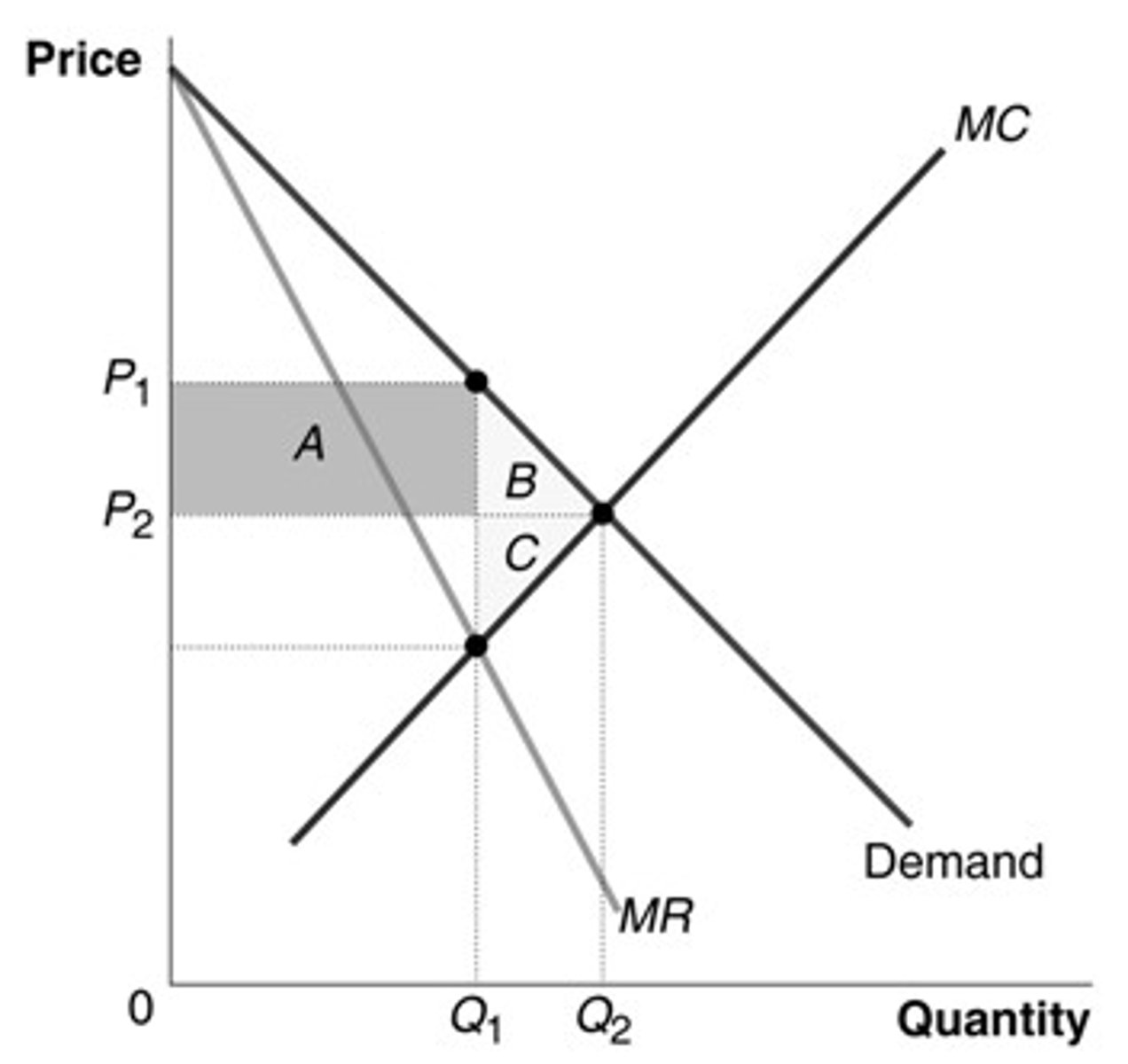
Refer to the graph below. Which area shows the reduction in consumer surplus that results from this industry being a monopoly rather than perfectly competitive?
a. area A
b. area B + area C
c. area A + area B
d. none of the areas indicated on the graph
c. area A + area B
Which type of barrier to entry is the granting of a patent or copyright to an individual or firm considered?
a. entry blocked by government action
b. entry blocked by externalities
c. entry blocked by economies of scale
d. entry blocked by natural or technical constraints
a. entry blocked by government action
Which of the following statements regarding natural monopoly is true?
a. One firm can supply twice as much output as two smaller firms at the same average total cost.
b. One firm can supply the entire market at a lower fixed cost than two or more firms.
c. The source of monopoly power is the control of a key natural resource.
d. Natural monopoly is most likely to occur in markets where fixed costs are very large relative to variable costs.
d. Natural monopoly is most likely to occur in markets where fixed costs are very large relative to variable costs.
How do you find the profit maximizing quantity for a firm under monopoly?
a. Use a trained canine to sniff out the profits.
b. Stop at the nearest service station and ask.
c. For all firm types it is the same process. Go to the point where MR = MC. Then find the quantity on the x-axis below MR = MC.
d. Follow the instructions given to you from the back seat driver.
e. It depends on whether you have Boardwalk by itself or Boardwalk and Park Place
c. For all firm types it is the same process. Go to the point where MR = MC. Then find the quantity on the x-axis below MR = MC.
What is the name given to the situation where economies of scale are so large that one firm can supply the entire market at a lower average total cost than two or more firms?
a. network externalities
b. productive efficiency
c. natural monopoly
d. market power
c. natural monopoly
Which of the following are effects of monopoly?
a. Monopoly causes a reduction in consumer surplus.
b. Monopoly causes an increase in producer surplus.
c. Monopoly causes a reduction in economic efficiency.
d. all of the above
d. all of the above
What is the definition of market power?
a. Market power is the same as inefficiency as measured by the amount of deadweight loss from a monopoly.
b. Market power is the ability of a firm to eliminate competition.
c. Market power is the ability of one firm to control other firms in the market.
d. Market power is the ability of a firm to charge a price greater than marginal cost.
d. Market power is the ability of a firm to charge a price greater than marginal cost.
Which of the following is most likely to increase market power?
a. horizontal mergers
b. vertical mergers
c. stricter enforcement of antitrust laws
d. divestitures
a. horizontal mergers
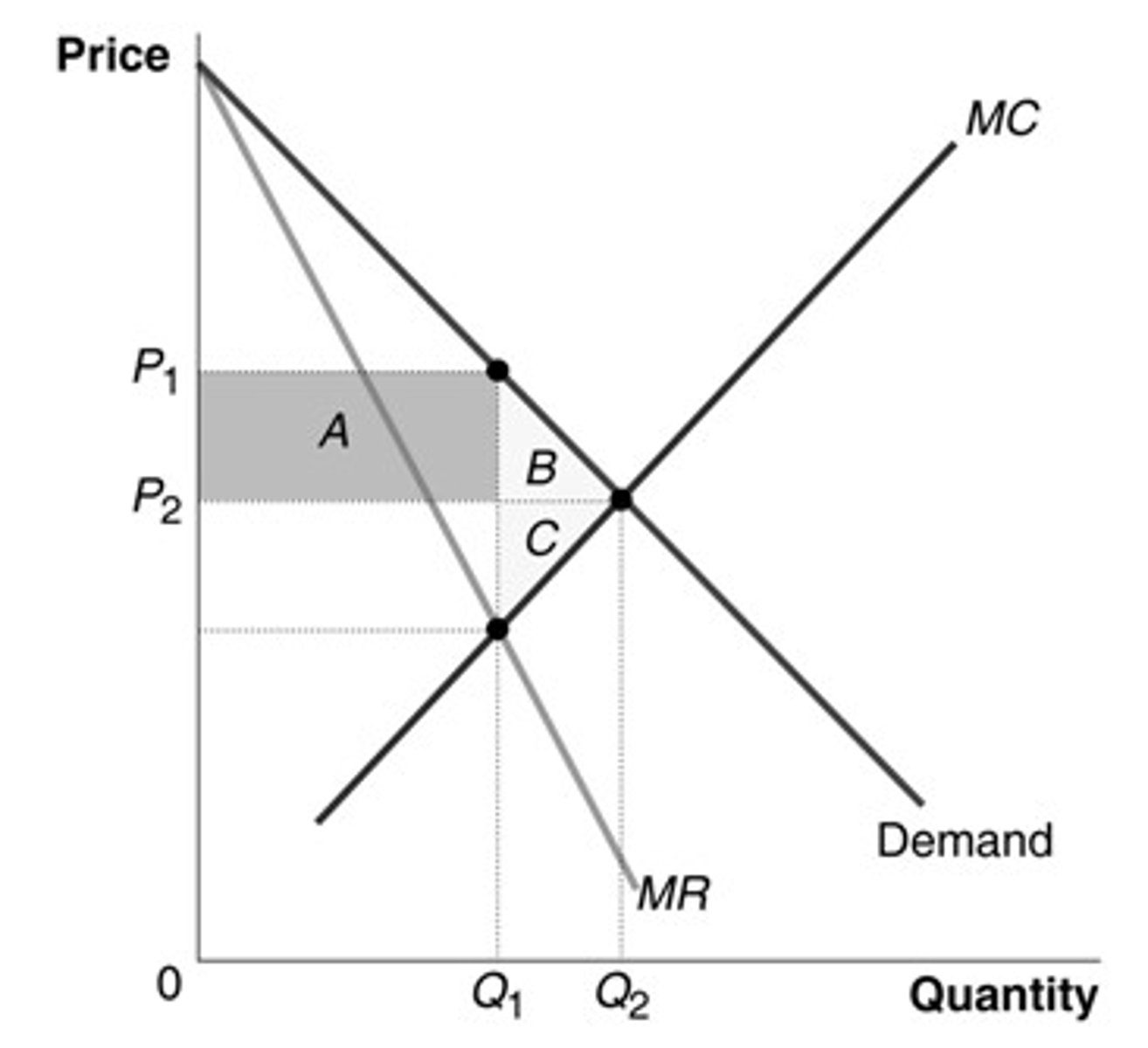
Refer to the graph below. Which area is considered a reduction in economic surplus as a result of this industry being a monopoly rather than being perfectly competitive?
a. area A
b. area B
c. area C
d. area B + area C
d. area B + area C
How do you find the profit maximizing quantity for a monopolistically competitive firm?
a. For all firm types it is the same process. Go to the point where MR = MC. Then find the quantity on the x-axis below MR = MC.
b. Ask Siri.
c. Ask the Google Assistant.
d. Ask Alexa.
a. For all firm types it is the same process. Go to the point where MR = MC. Then find the quantity on the x-axis below MR = MC.
Assume that an industry that began as a perfectly competitive industry becomes a monopoly. Which of the following describes a change in the market as a result of becoming a monopoly? Compared to when the industry was perfectly competitive, the monopolist will:
a. charge a higher price and produce less output.
b. charge a higher price and increase consumer surplus.
c. produce less output and decrease producer surplus.
d. produce more output and increase producer surplus.
a. charge a higher price and produce less output.
What is a merger between firms in the same industry called?
a. a horizontal merger
b. a vertical merger
c. a conglomerate
d. a divestiture
a. a horizontal merger
Using the broader definition of monopoly, in which of the following cases could we argue that Microsoft has a monopoly in computer operating systems?
a. if Macintosh and Linux were not considered close substitutes for Windows
b. if Microsoft charged prices similar to those that Macintosh and Linux charge for their operating systems in order to compete
c. if Macintosh and Linux started to produce operating systems similar to Windows
d. if there are no barriers to entry in the market for computer operating systems
a. if Macintosh and Linux were not considered close substitutes for Windows
Refer to the graph below. Which area shows a reduction in consumer surplus that is transferred to producers as a result of this industry being a monopoly rather than being perfectly competitive?
a. area A
b. area B + area C
c. area A + area B
d. none of the areas indicated on the graph
a. area A
Refer to the graph below. Which point corresponds to a natural monopoly serving this market and breaking even?
a. point A
b. point B
c. Both point A and point B are associated with a natural monopoly breaking even.
d. Neither point A nor point B is associated with a natural monopoly breaking even.
a. point A
Which firms face a downward-sloping demand curve and a downward-sloping marginal revenue curve?
a. all price takers
b. all price makers
c. monopolies only
d. monopolistically competitive firms only
b. all price makers
Which of the following types of firms use the marginal revenue equals marginal cost approach to maximize profits?
a. perfectly competitive firms
b. monopolistically competitive firms
c. monopolies
d. all of the above
d. all of the above
In which of the following market structures is the firm’s demand curve the same as the market demand for the product?
a. perfect competition
b. monopolistic competition
c. monopoly
d. all of the above
c. monopoly
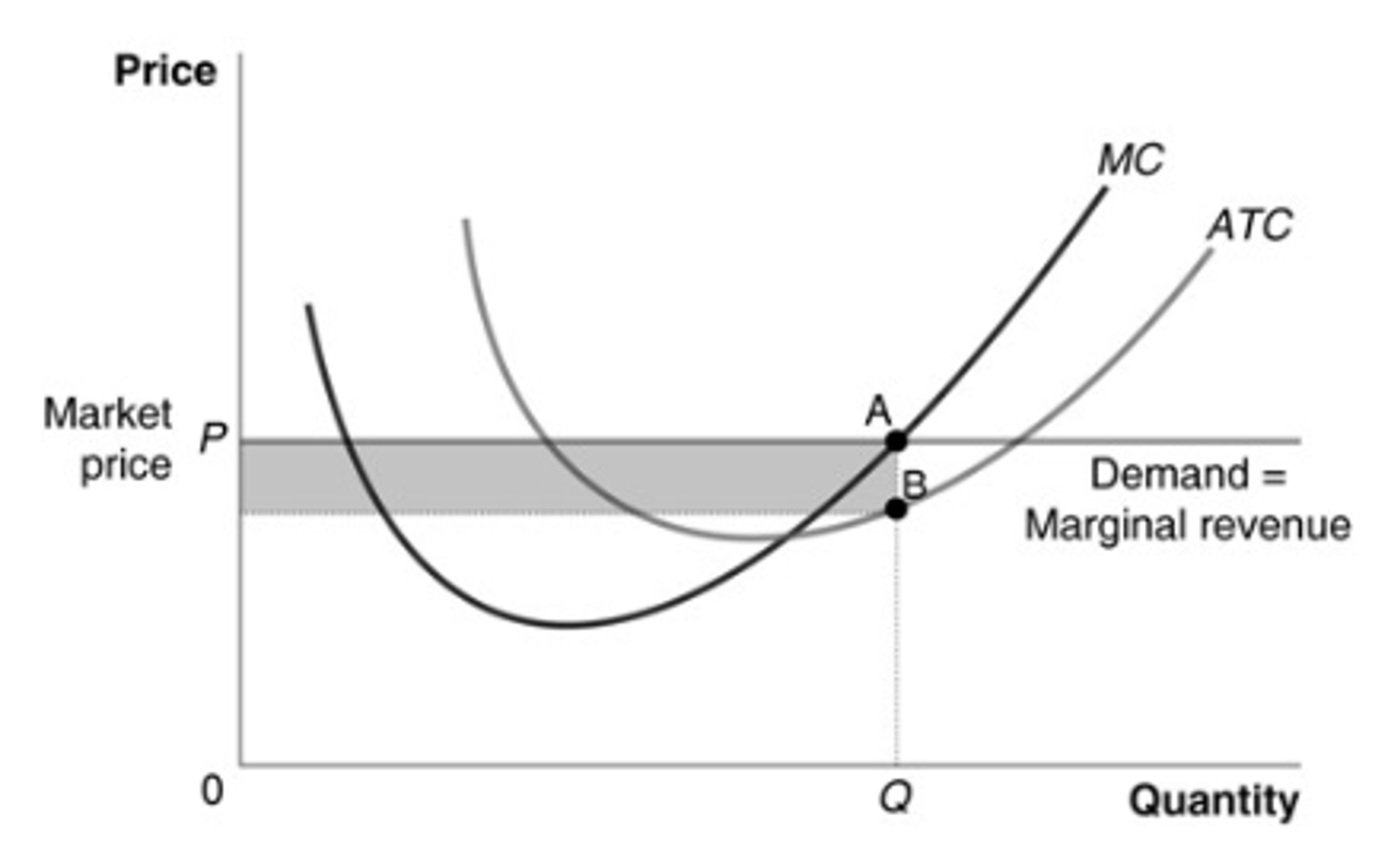
Refer to the graph of costs for a perfectly competitive firm below. Which of the following best represents profit per unit?
a. the shaded rectangle
b. the distance between points A and B
c. the market price
d. none of the above
b. the distance between points A and B
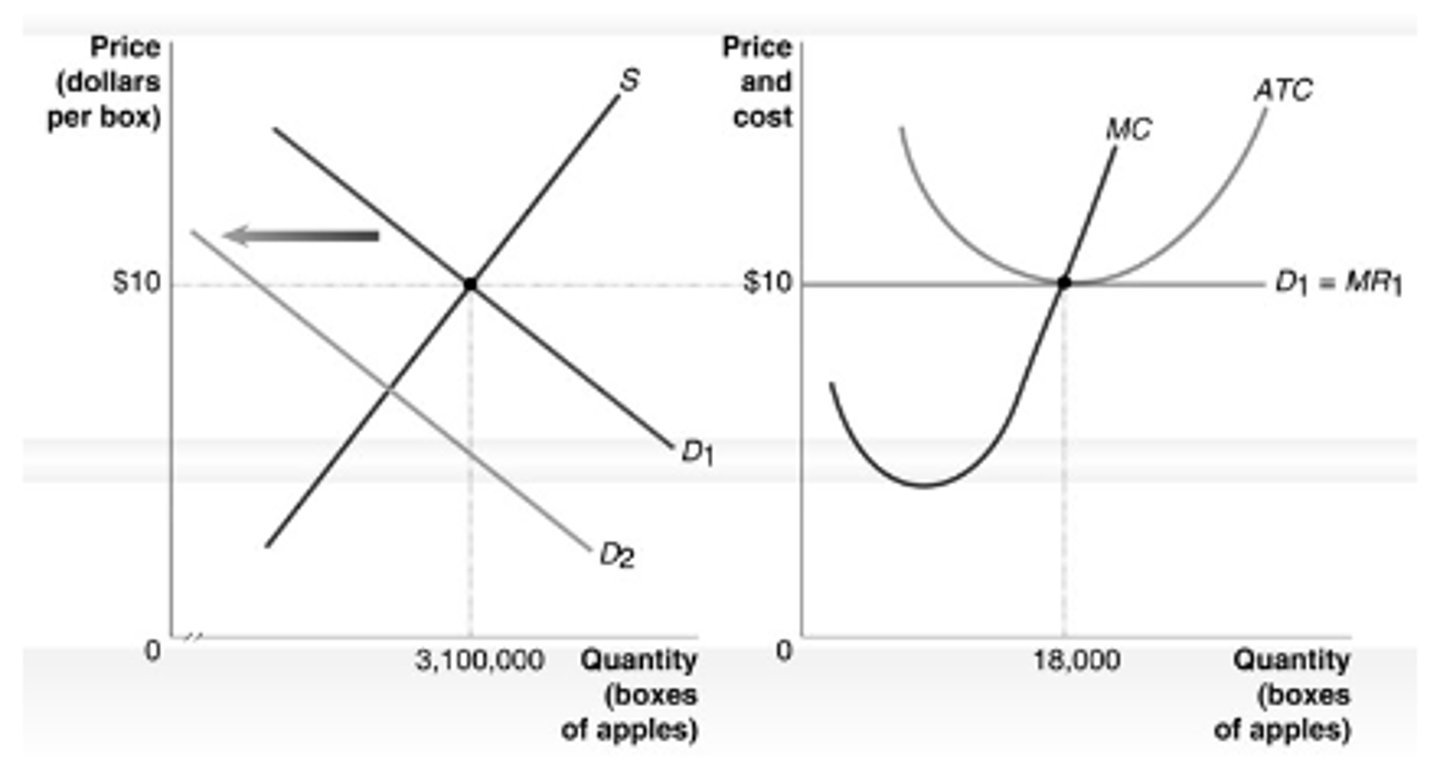
Refer to the graphs below. After the market demand curve shifts to the left, which of the following would happen in this perfectly competitive market as it adjusts to long-run equilibrium?
a. The market demand curve will shift back to the right.
b. The market supply curve will shift to the right.
c. The market supply curve will shift to the left.
d. The market demand curve will shift further to the left.
c. The market supply curve will shift to the left.
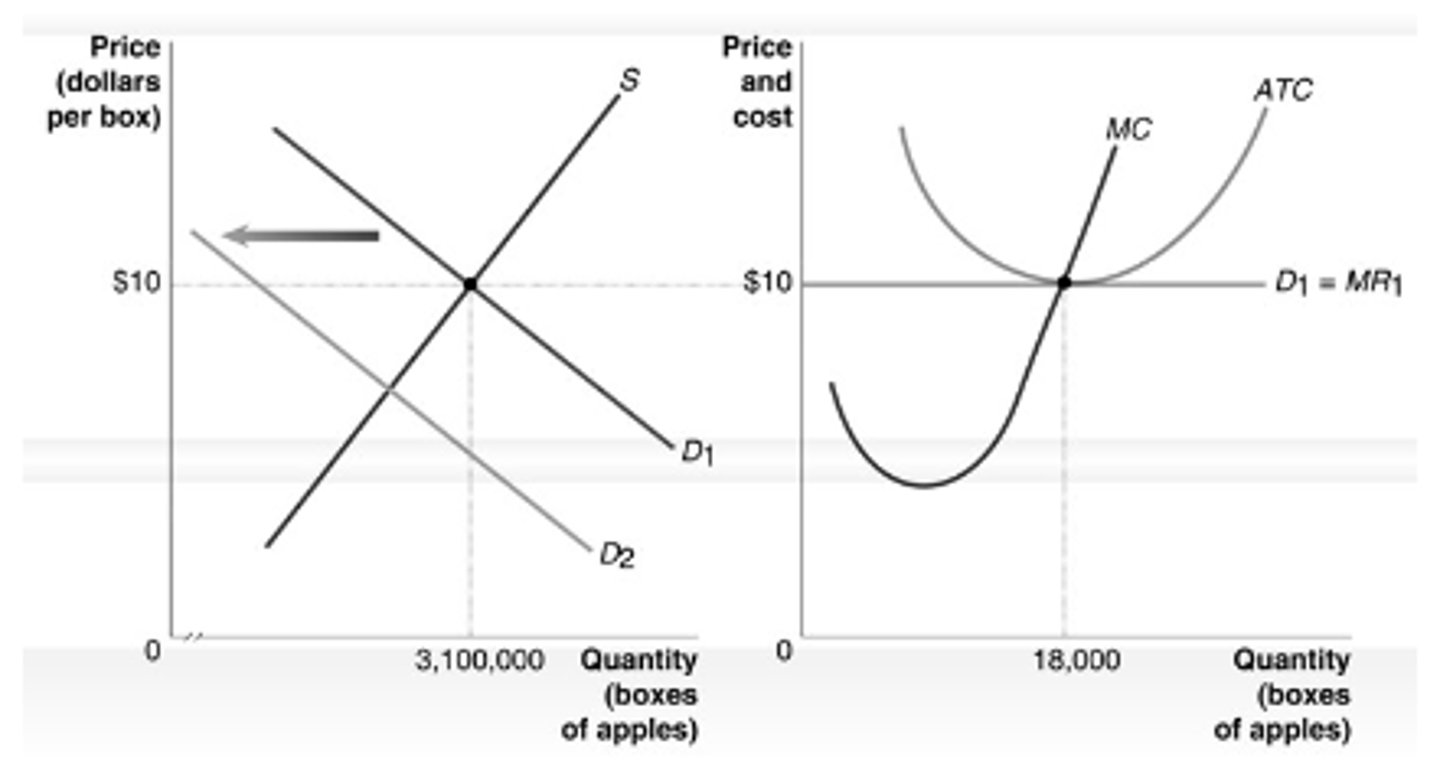
Refer to the graphs below. What do you expect to happen in this market as it approaches long-run equilibrium?
a. a shift to the right of the market demand curve as new firms enter
b. an upward shift of the firm’s demand curve as new firms enter
c. a shift to the left of the market demand curve as new firms enter
d. a shift to the right of the market supply curve as new firms enter
d. a shift to the right of the market supply curve as new firms enter
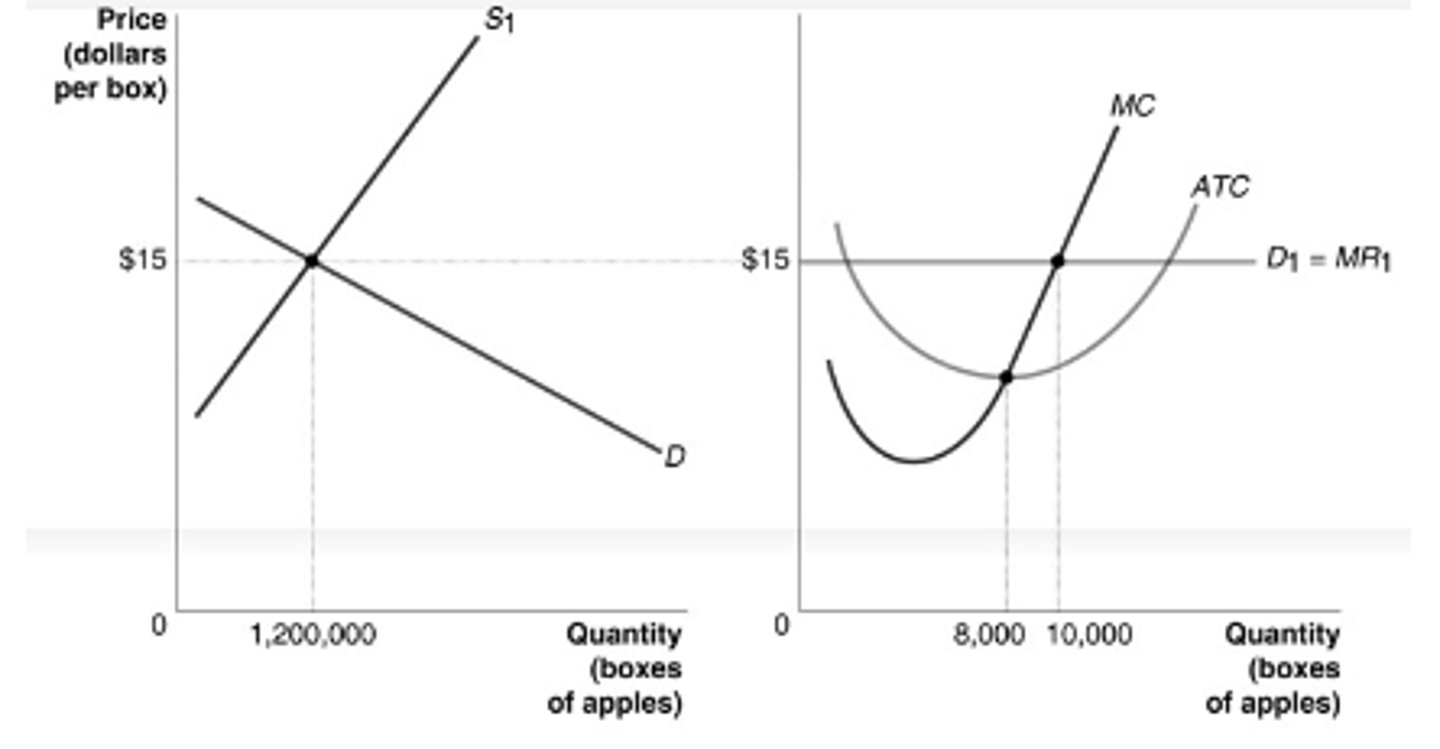
Long-run competitive equilibrium is:
a. the situation in which the entry and exit of firms have resulted in the typical firm just breaking even.
b. a situation in which market price is at a level equal to the minimum point on the typical firm’s marginal cost curve.
c. the end of a process during which firms are prevented from adjusting their production methods.
d. all of the above
a. the situation in which the entry and exit of firms have resulted in the typical firm just breaking even.
If an individual firm in a perfectly competitive market increases its price, the firm will experience:
a. higher revenue.
b. lower average total cost.
c. increased sales.
d. none of the above
d. none of the above
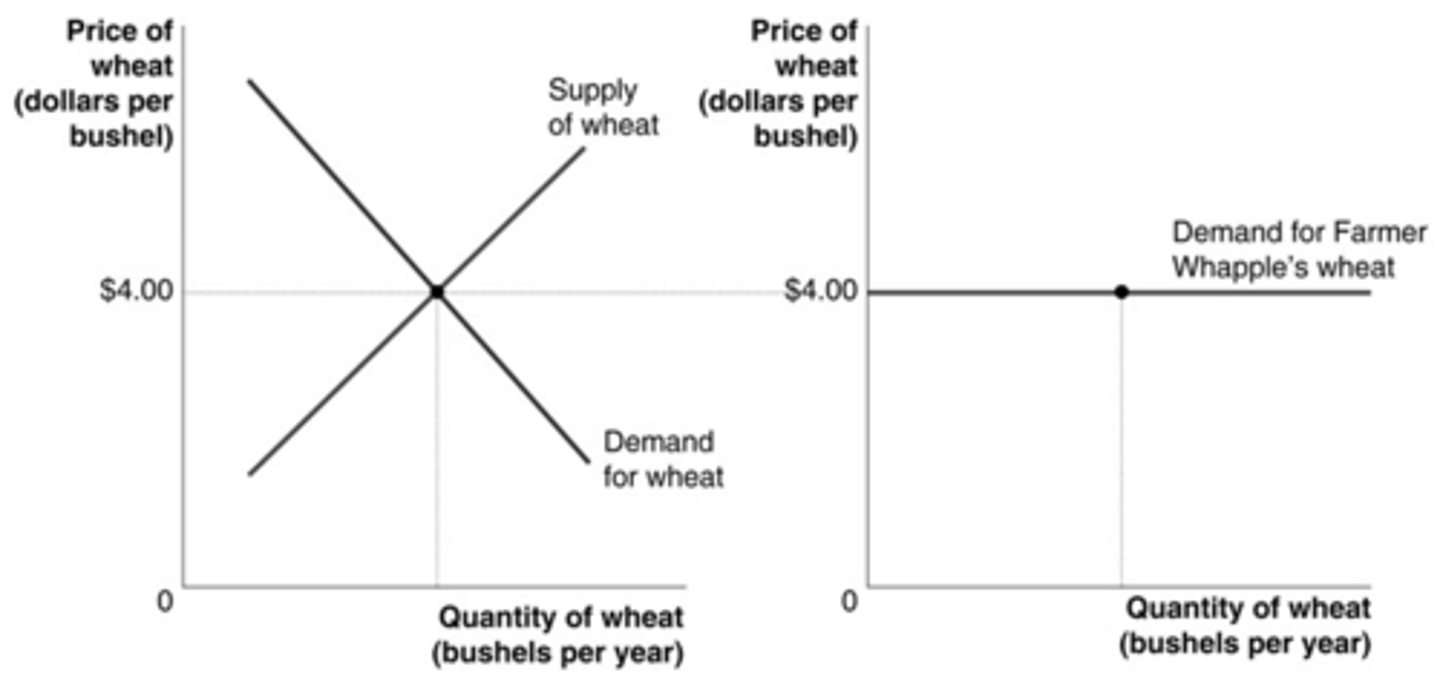
Refer to the graphs below. The graph on the left depicts demand and supply in the competitive market for wheat. The graph on the right depicts the demand curve facing Farmer Whapple, an individual producer in the market for wheat. The demand curve for Farmer Whapple’s wheat is horizontal at the market price of $4.00 because:
a. Farmer Whapple is the only supplier of wheat in this market.
b. Farmer Whapple is a price taker.
c. Farmer Whapple has control over the price of wheat.
d. Farmer Whapple can choose whether he faces a downward sloping demand curve or a horizontal demand curve.
b. Farmer Whapple is a price taker.
What is the term given to a cost that has already been paid and cannot be recovered?
a. unrecoverable cost
b. variable cost
c. sunk cost
d. implicit cost
c. sunk cost
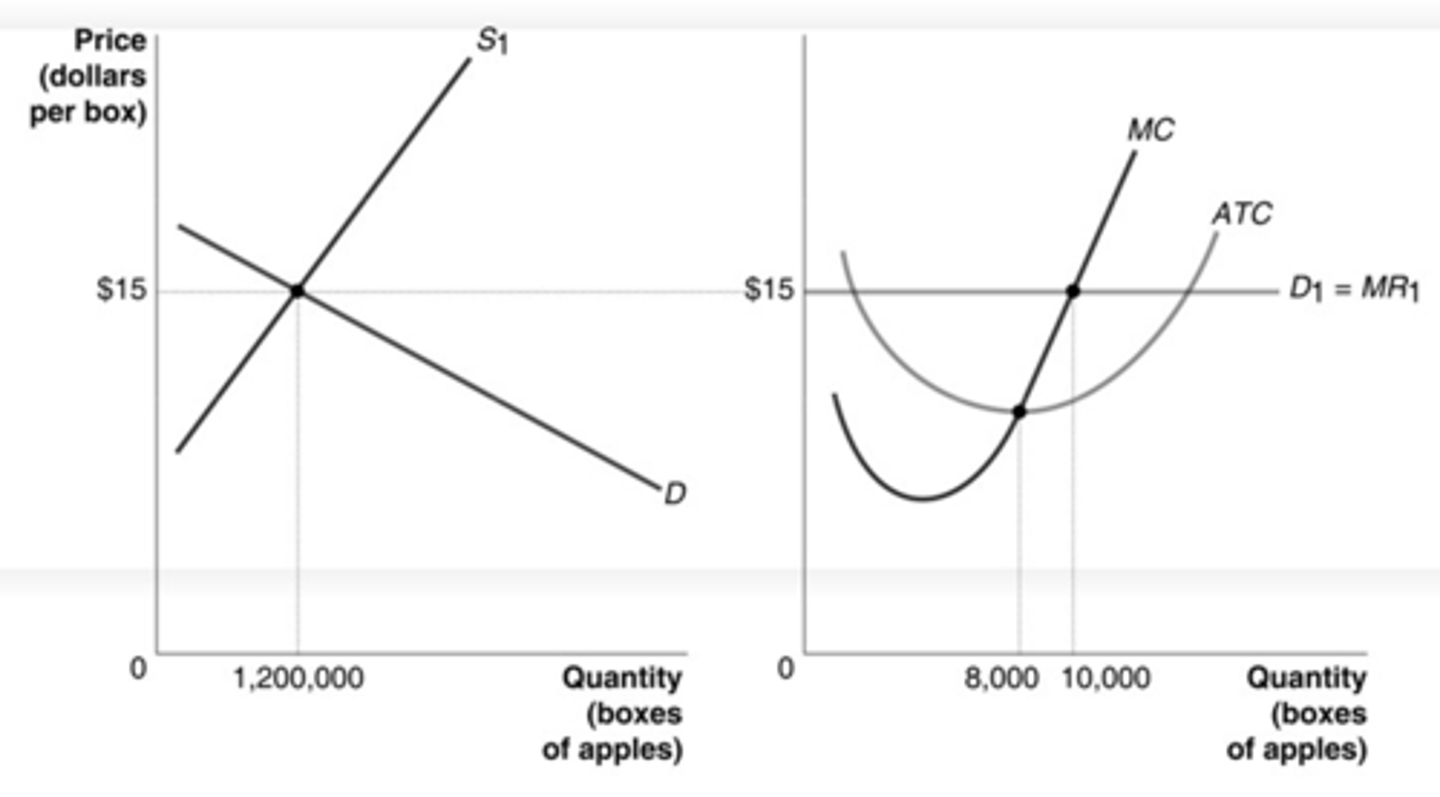
Refer to the graphs below. What do you expect to happen in this perfectly competitive market as it approaches long-run equilibrium?
a. The price will increase and profits will become zero.
b. The price will decrease until it is equal to the minimum of average total cost, and profits will increase.
c. The price will decrease until it is equal to the minimum of average total cost, and profits will become zero.
d. Firms will exit because economic profit will become zero.
c. The price will decrease until it is equal to the minimum of average total cost, and profits will become zero.
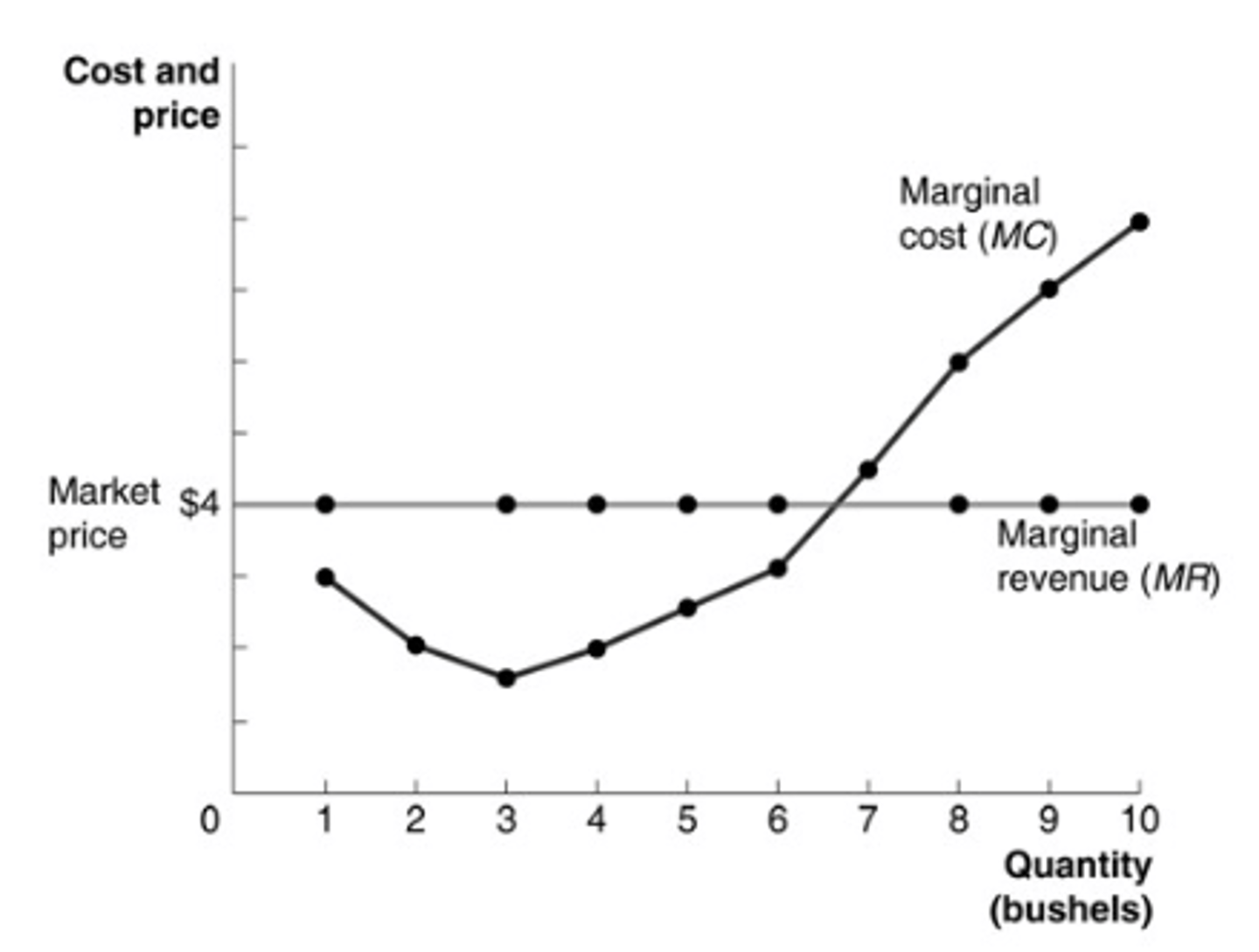
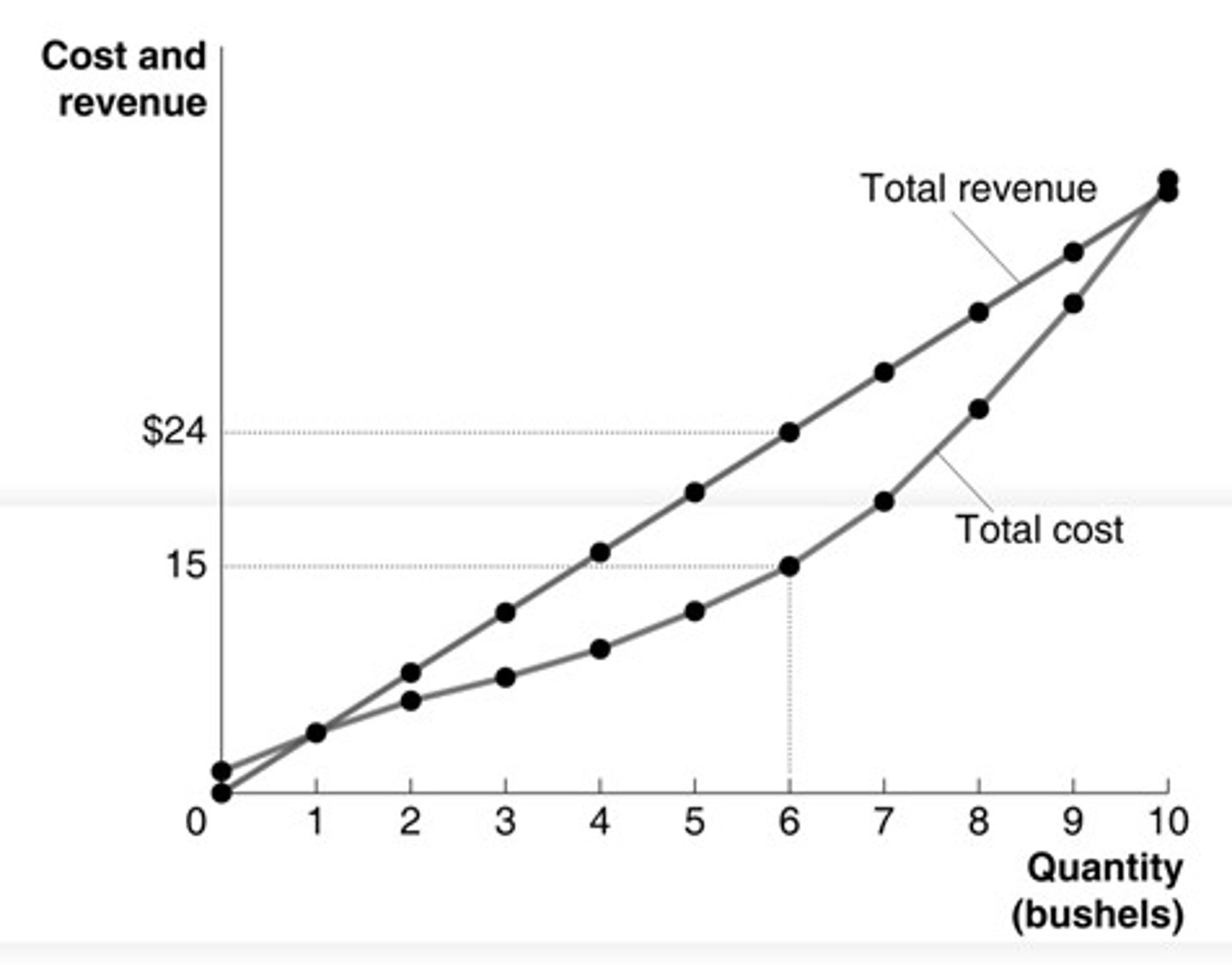
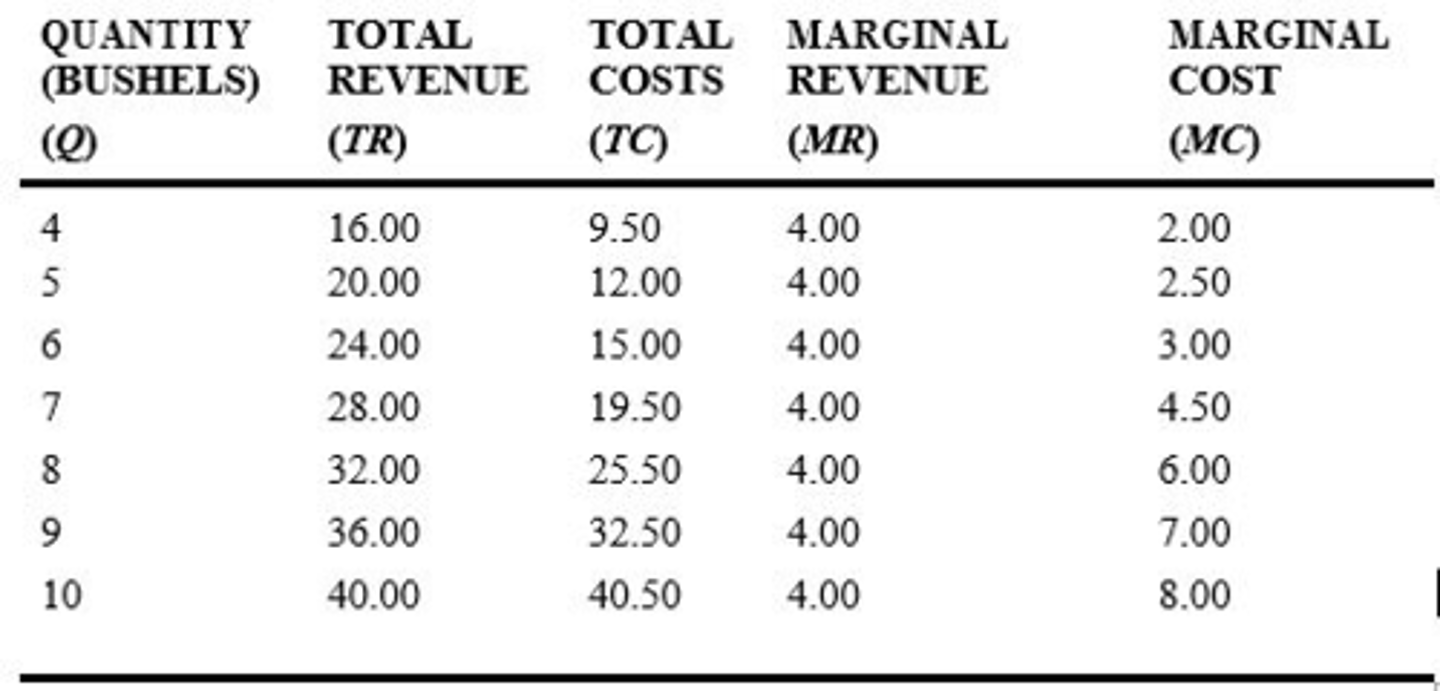
Refer to the graph below which shows the marginal cost and marginal revenue curves for a farmer in the perfectly competitive market for wheat. What is the profit-maximizing level of output if the producer can produce only whole units of output?
a. 3 bushels
b. 10 bushels
c. 6 bushels
d. 8 bushels
c. 6 bushels
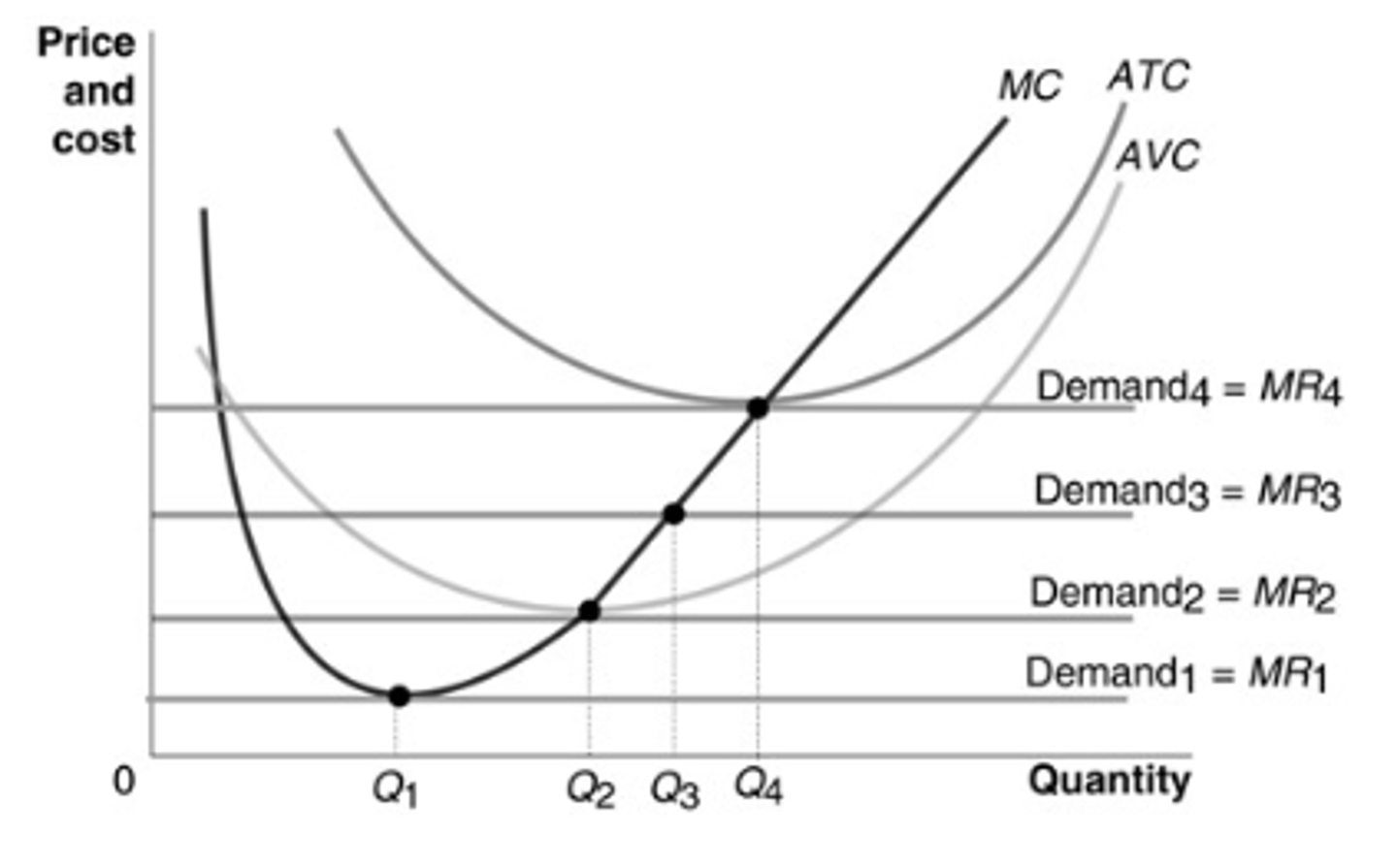
Refer to the graph below. When the perfectly competitive firm faces demand curve Demand3, which of the following is true?
a. The firm is earning positive economic profit.
b. The firm should shut down.
c. The firm will suffer losses, but should continue to operate.
d. The firm should go out of business.
c. The firm will suffer losses, but should continue to operate.
What is the relationship between price, average revenue, and marginal revenue for a firm in a perfectly competitive market?
a. Price is equal to average revenue and greater than marginal revenue.
b. Price is greater than average revenue and equal to marginal revenue.
c. Price is equal to both average revenue and marginal revenue.
d. Price, average revenue, and marginal revenue usually all have different values.
c. Price is equal to both average revenue and marginal revenue.
Refer to the graph below. Based on the information on the graph, what is true about marginal revenue?
a. marginal revenue increases as the quantity of bushels sold increases
b. marginal revenue decreases as the quantity of bushels sold increases
c. marginal revenue remains constant as the quantity of bushels sold increases
d. marginal revenue is always greater than marginal cost
c. marginal revenue remains constant as the quantity of bushels sold increases
Which of the following terms best describes how the result of the forces of competition drives the market price to the minimum average cost of the typical firm?
a. allocative efficiency
b. productive efficiency
c. decreasing-cost industry
d. competitive markdown
b. productive efficiency
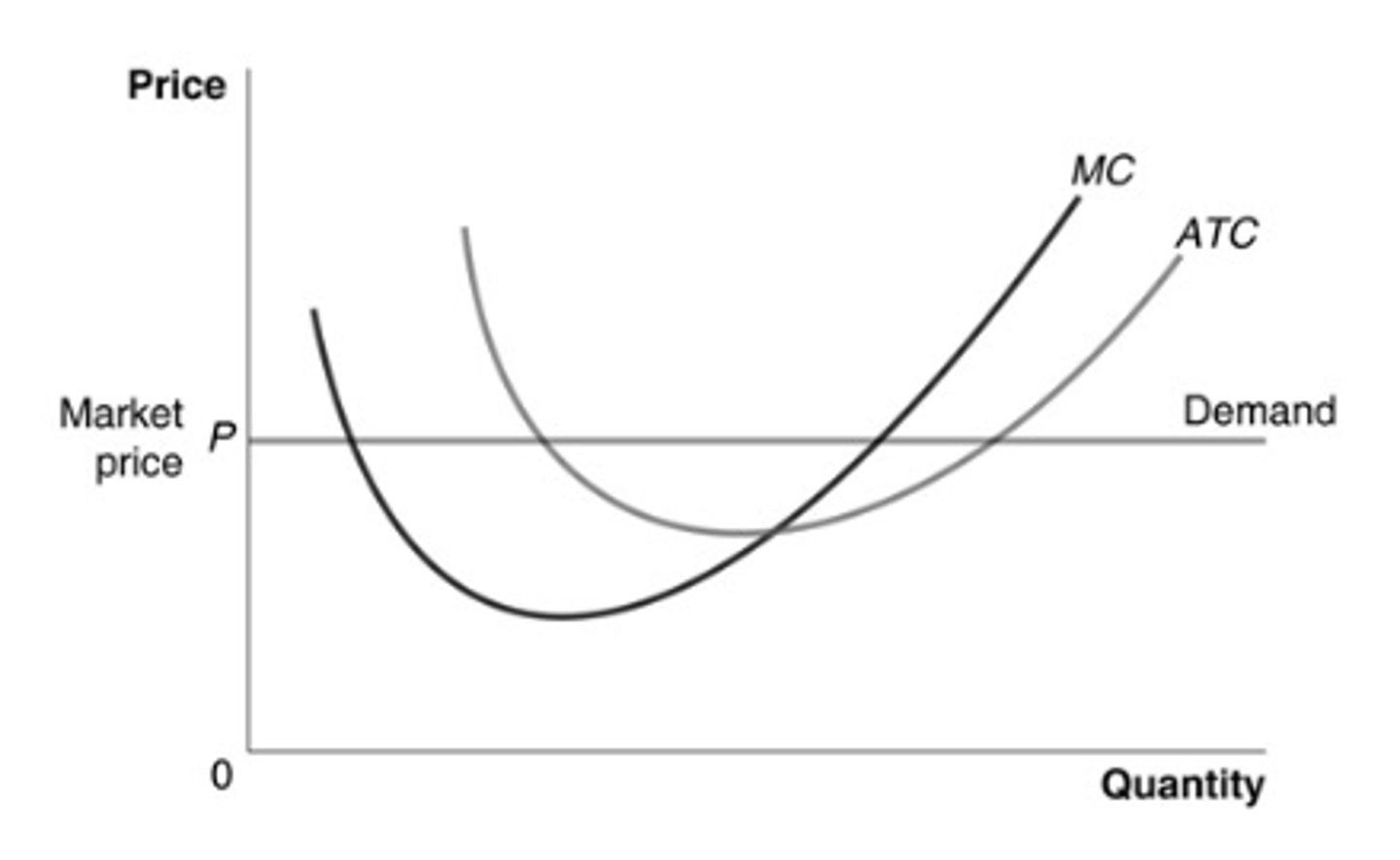
Refer to the graph below. Which of the curves in the graph is not necessary for determining the level of output that maximizes profit for a perfectly competitive firm?
a. the MC curve
b. the demand curve
c. the ATC curve
d. All three curves are needed to determine which level of output maximizes profit.
c. the ATC curve
A buyer or seller that is unable to affect the market price is called?
a. a price maker
b. a price taker
c. an independent producer
d. a monopoly
b. a price taker
Which term best describes the minimum amount that a firm needs to earn on a $100,000 investment to be willing to remain in a perfectly competitive industry in the long run?
a. explicit cost
b. opportunity cost
c. economic profit
d. economic loss
b. opportunity cost
Refer to the graphs below. As market demand shifts to the left, how will the firm’s level of output change?
a. The firm will increase its output to increase its profits.
b. The firm will decrease its output and suffer losses.
c. The firm will maintain its output at the current level but suffer losses.
d. The firm will decrease its output and earn higher profit.
b. The firm will decrease its output and suffer losses.
Refer to the graph below. What is the value of total fixed cost for this perfectly competitive firm?
a. $3,400
b. $5,800
c. $2,400
d. None of the above; there is insufficient information to answer the question.
c. $2,400
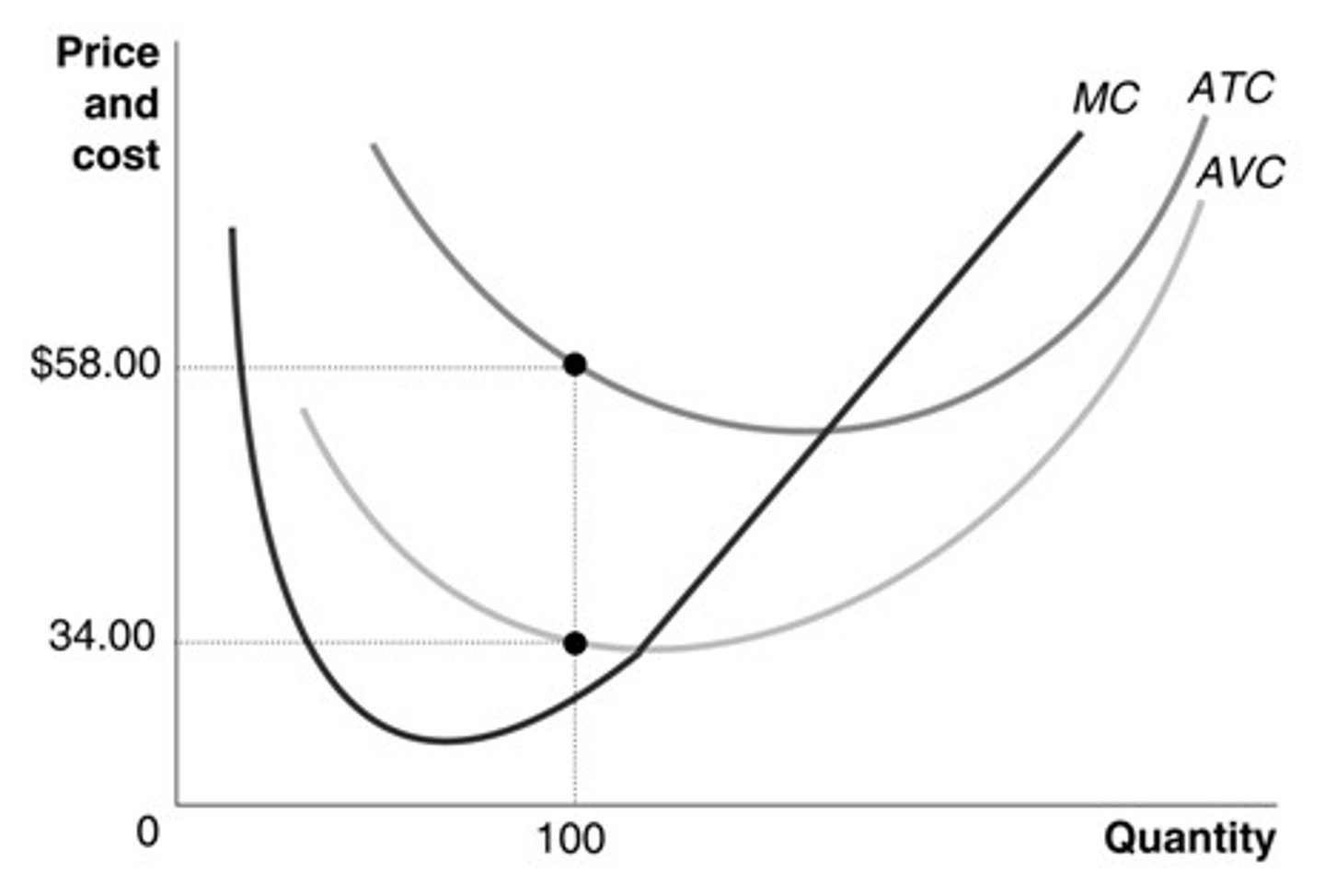
Refer to the graph below. At which of the following prices is the perfectly competitive firm earning negative economic profit?
a. $495
b. $250
c. both $250 and $495
d. any price above $495
b. $250
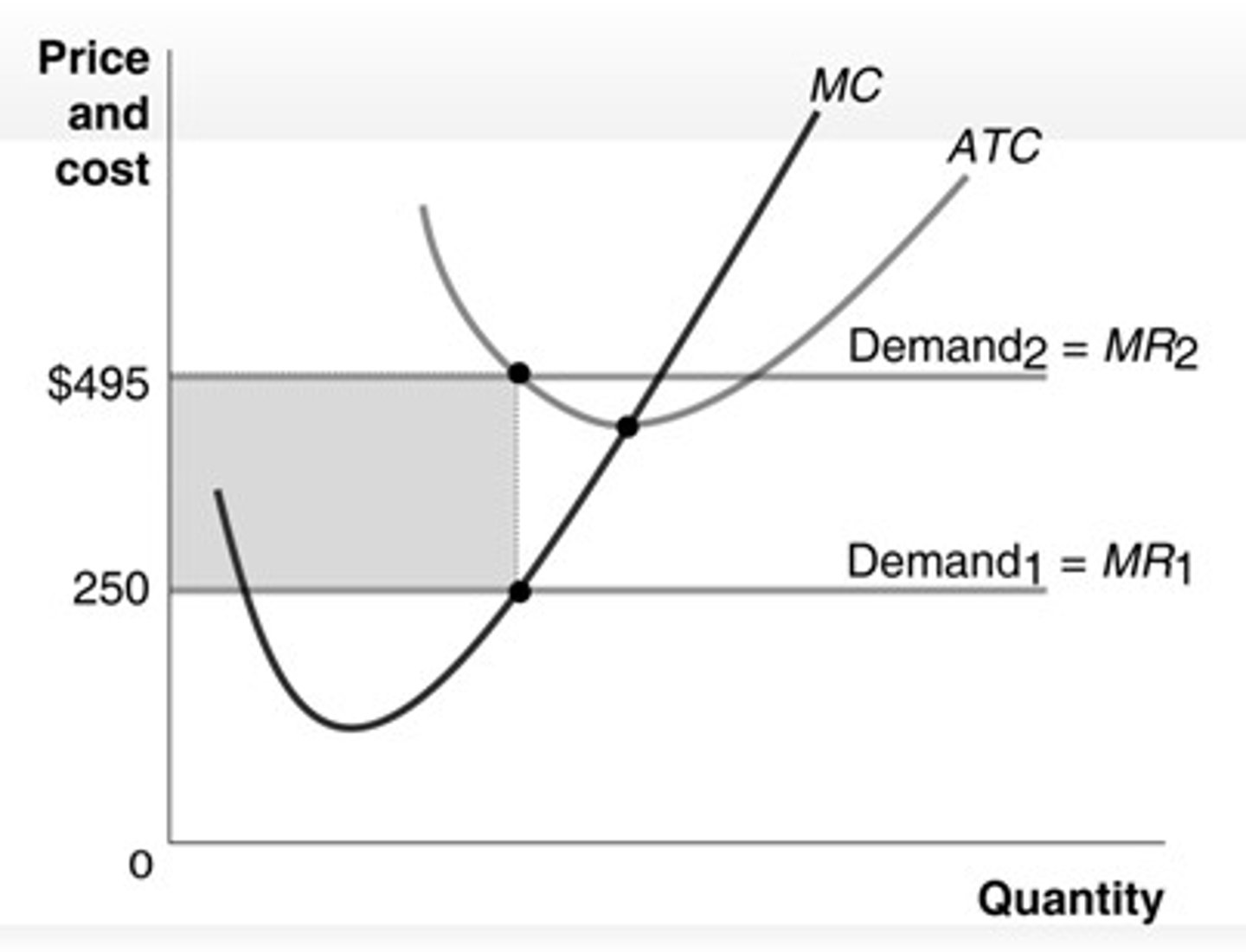
Refer to the graphs below. The perfectly competitive firm represented in the graph on the right is experiencing:
a. a profit in the short run.
b. a profit in the long run.
c. a loss in the short run.
d. a loss in the long run
a. a profit in the short run.
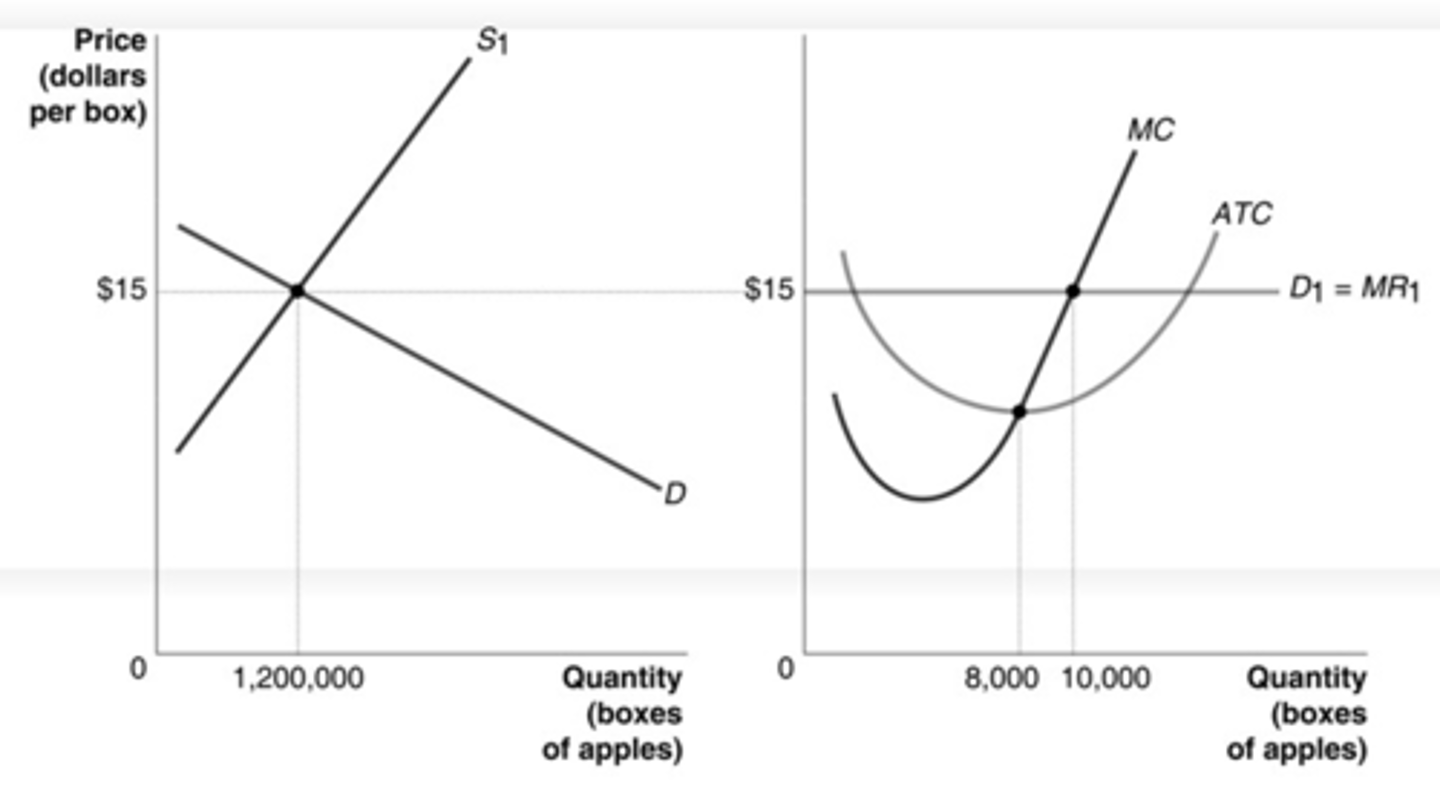
Refer to the graph below. At what level of output does this perfectly competitive firm maximize profit?
a. Q1
b. Q2
c. Q3
d. 0
c. Q3
To maximize profit, which of the following should a firm attempt to do?
a. maximize revenue
b. minimize cost
c. find the largest difference between total revenue and total cost
d. all of the above
c. find the largest difference between total revenue and total cost
If firms in a perfectly competitive industry are earning positive profits, what would you expect to see in the long run?
a. The market demand curve will shift to the left as firms exit the market, prices will rise, and profits will rise.
b. The market supply curve will shift to the right as firms enter the market, prices will fall, and profits will fall.
c. The market supply curve will shift to the left as firms exit the market, prices will rise, and profits will rise.
d. The market demand curve will shift to the right as firms
b. The market supply curve will shift to the right as firms enter the market, prices will fall, and profits will fall.
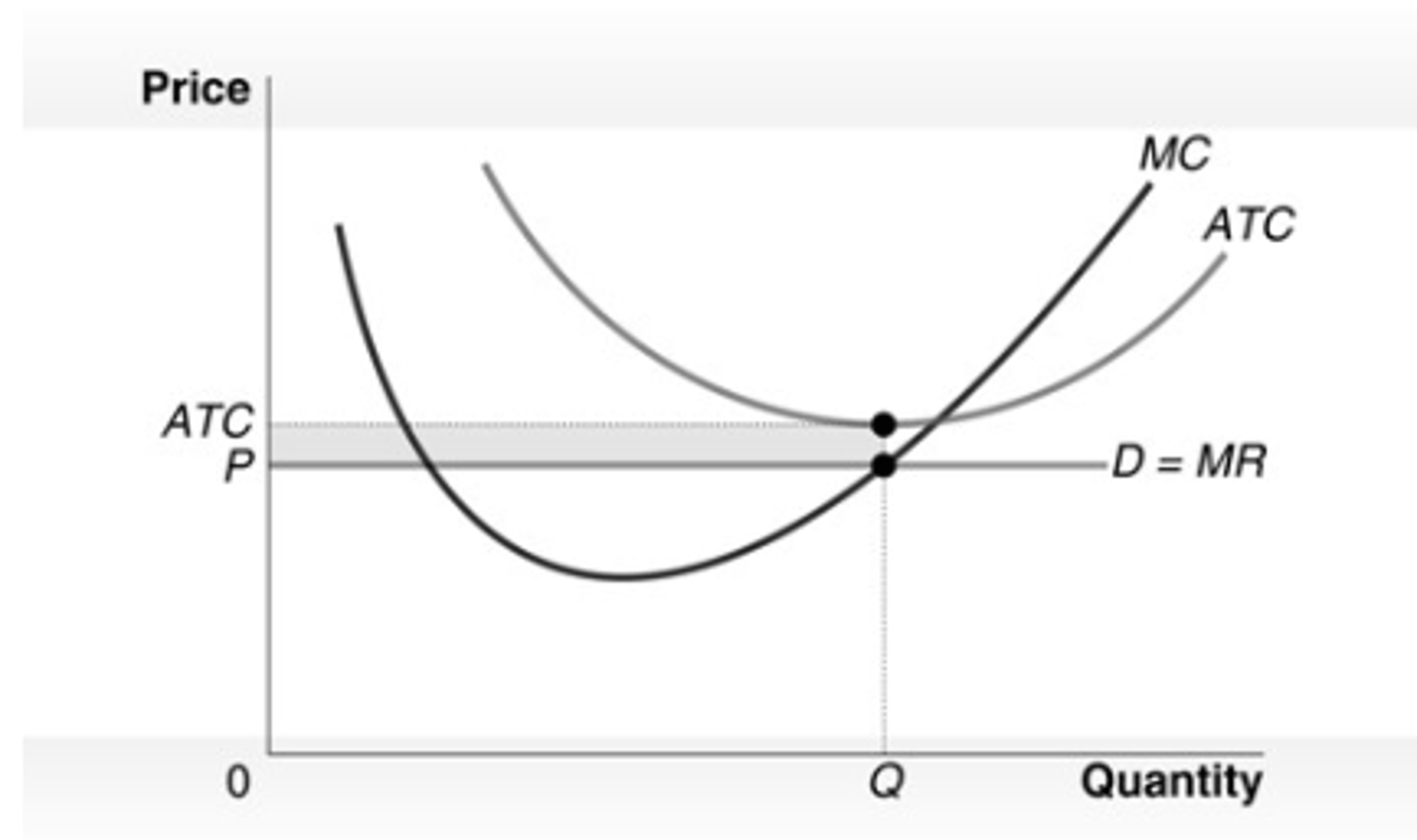
Refer to the graph below. What does the shaded area in the graph represent for a perfectly competitive firm that produces at output level Q?
a. positive economic profit
b. accounting profit
c. negative economic profit
d. total cost of producing Q
c. negative economic profit
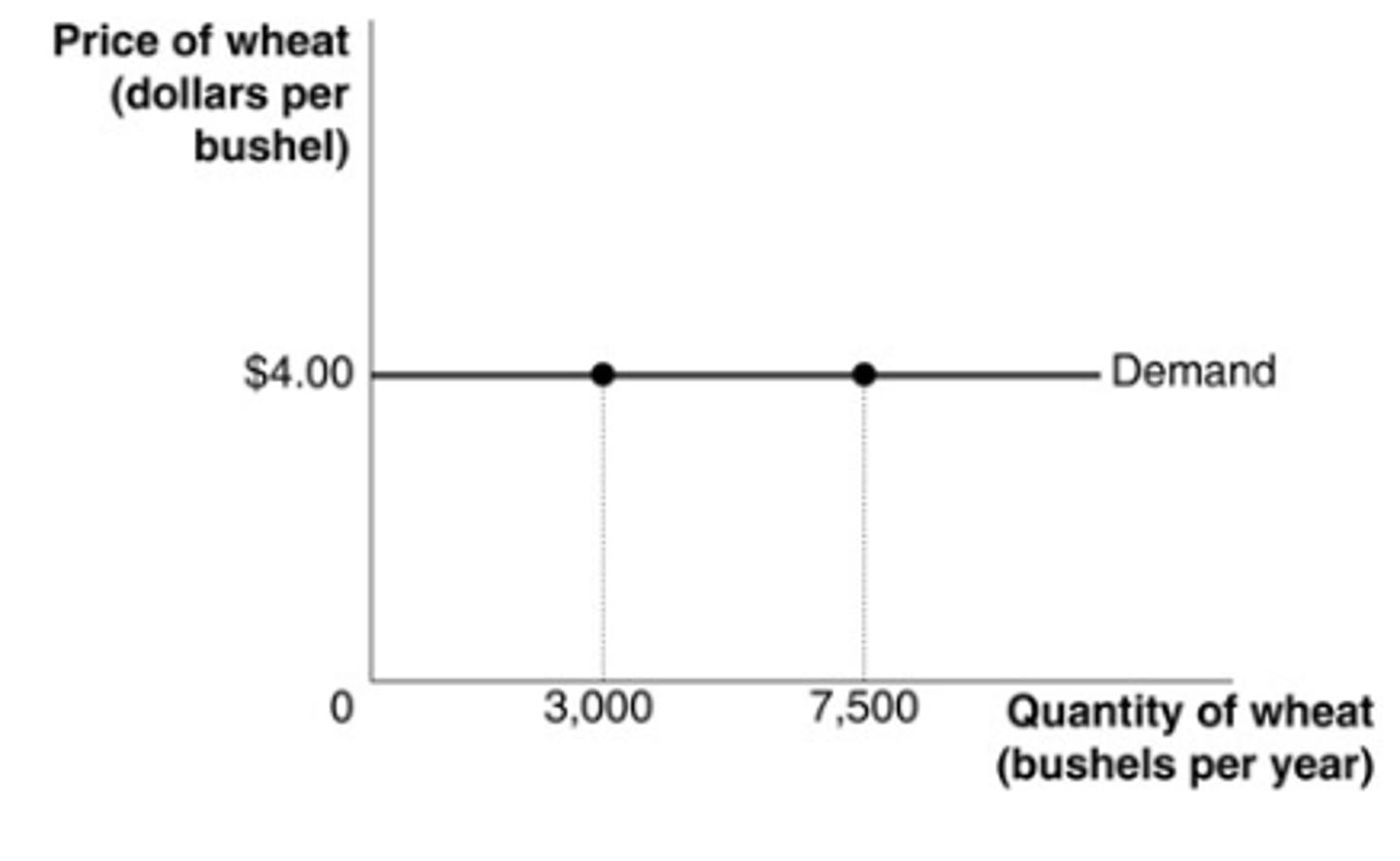
Refer to the graph below of the demand curve facing a firm in the perfectly competitive market for wheat. The fact that the demand curve is horizontal implies which of the following?
a. The firm must lower the price of wheat to increase the quantity demanded.
b. Increasing production of wheat from 3,000 bushels to 7,500 bushels results in an increase in marginal revenue.
c. The market demand for wheat is identical to the demand for wheat faced by an individual firm.
d. The firm can sell any amount of output as long as it accepts the market price of $4.00.
d. The firm can sell any amount of output as long as it accepts the market price of $4.00.
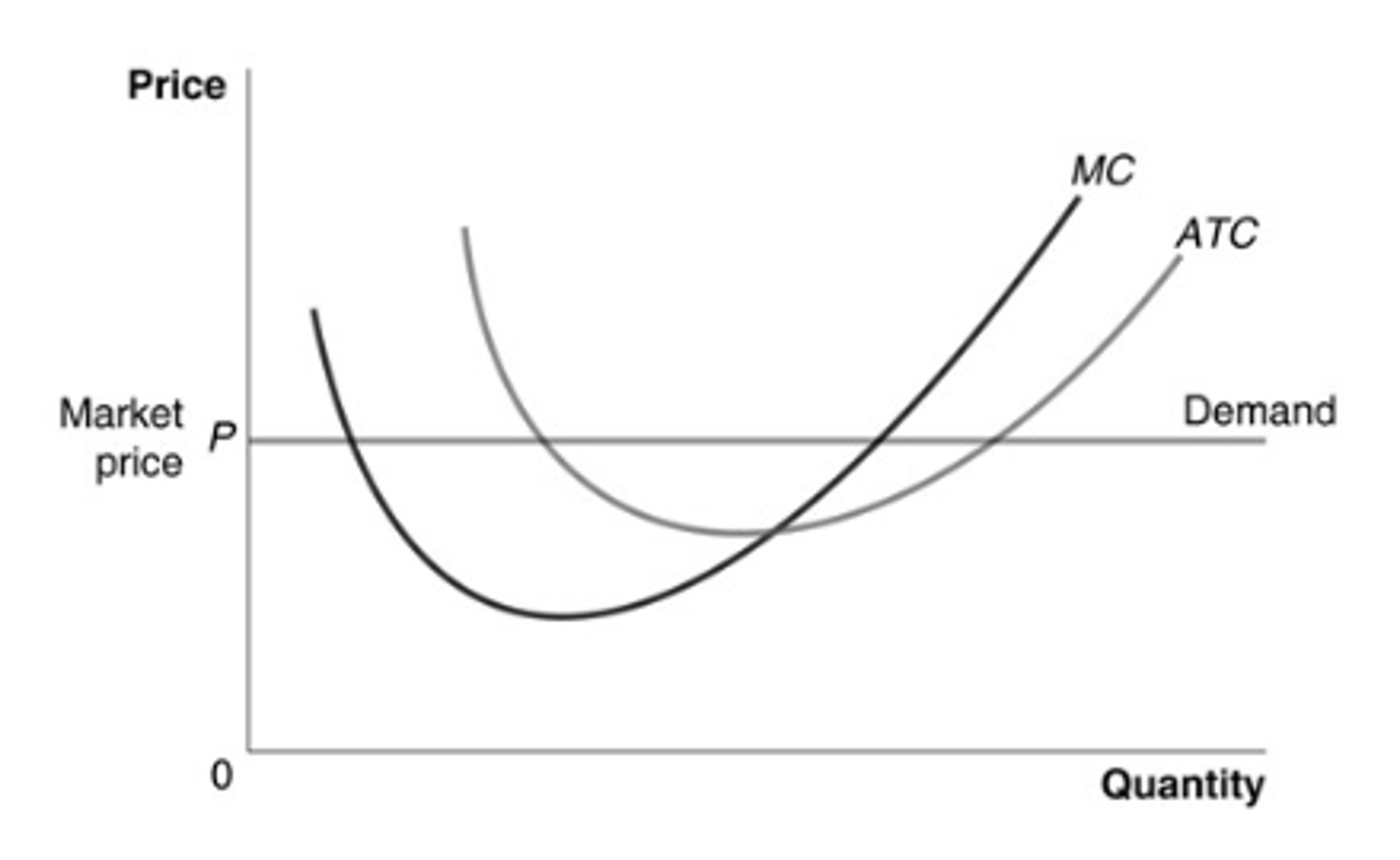
Economic loss refers to a situation in which a firm’s total revenue is less than its total cost. To calculate the amount of a loss, which of the following costs should be included?
a. explicit costs only
b. implicit costs only
c. both explicit costs and implicit costs
d. fixed costs only
c. both explicit costs and implicit costs
Refer to the graph below. Which of the curves is not necessary for determining the level of profit earned by a perfectly competitive firm?
a. the marginal cost curve
b. the demand curve
c. the average total cost curve
d. All three curves are needed to determine the level of profit earned by a perfectly competitive firm.
d. All three curves are needed to determine the level of profit earned by a perfectly competitive firm.
Which of the following are characteristics of a perfectly competitive industry?
a. firms are unable to control the prices of the products they sell
b. firms are unable to earn an economic profit in the long run
c. firms sell identical products
d. all of the above
d. all of the above
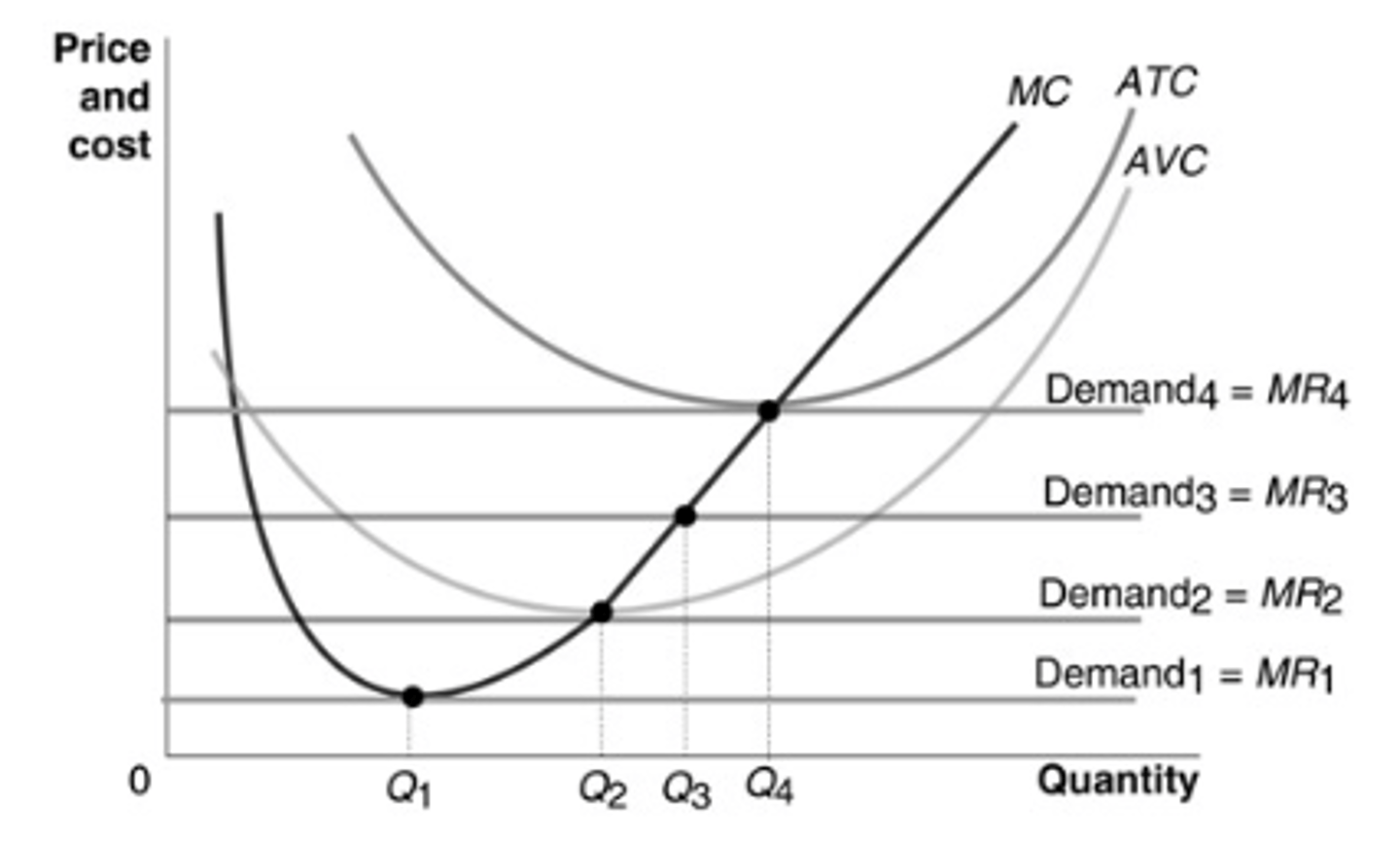
Refer to the graph below. Which demand curve is associated with the shutdown point for this perfectly competitive firm?
a. Demand1
b. Demand2
c. Demand3
d. Demand4
b. Demand2
Which of the following conditions must exist in order to have a perfectly competitive market?
a. There must be many buyers and many sellers, all of whom are small relative to the market.
b. The products sold by firms in the market must be different from each other.
c. There must be some barriers to entry in order to protect perfect competition.
d. all of the above
a. There must be many buyers and many sellers, all of whom are small relative to the market.
Refer to the table below. Based on the numbers in the table, how much should this farmer produce in order to maximize profit?
a. 10 bushels
b. 9 bushels
c. 6 bushels
d. 4 bushels
c. 6 bushels
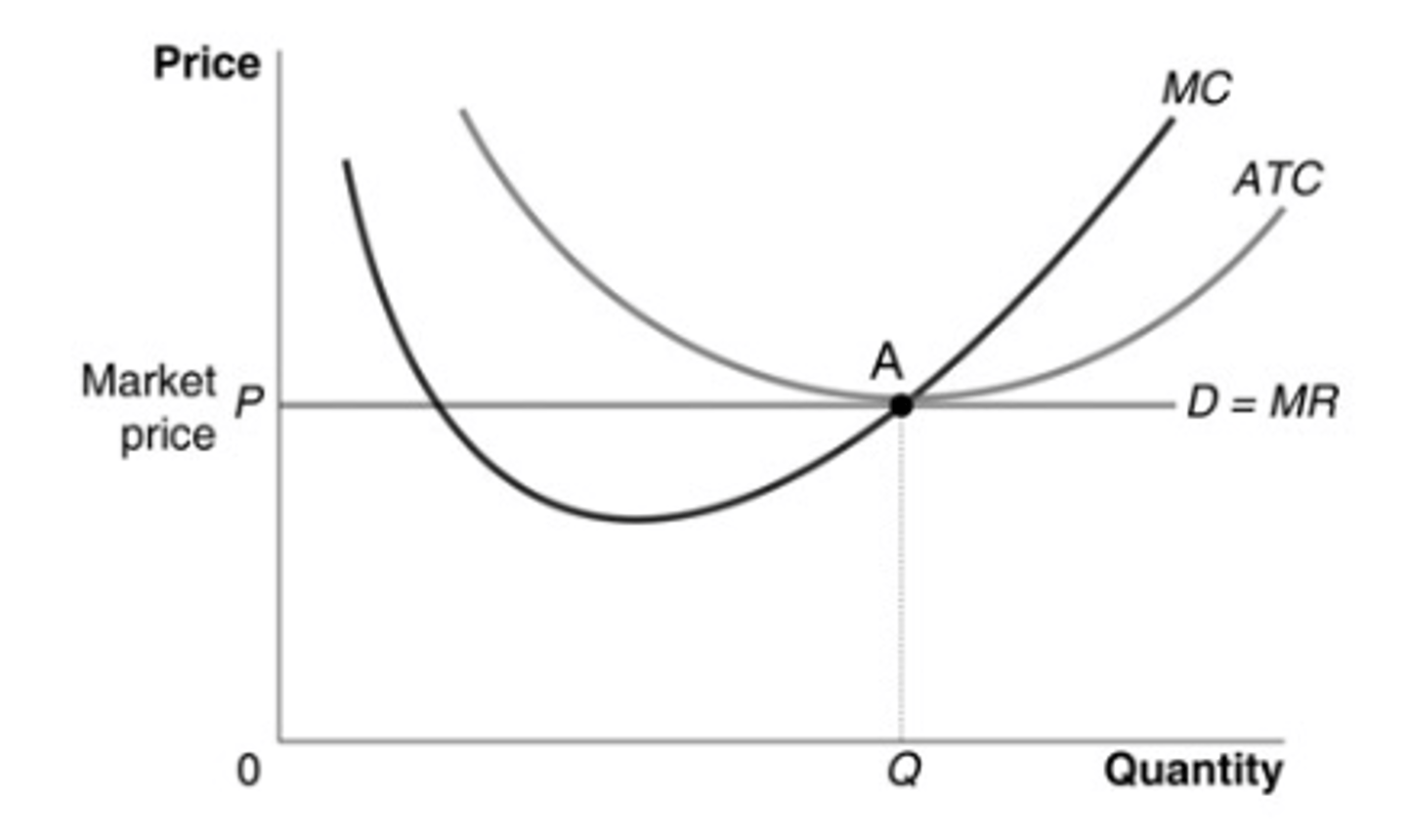
Refer to the graph below. If a perfectly competitive firm is producing at point A, which of the following is true?
a. The firm earns zero accounting profit.
b. The firm suffers a loss.
c. The firm earns zero economic profit.
d. The firm earns positive economic profit.
c. The firm earns zero economic profit.
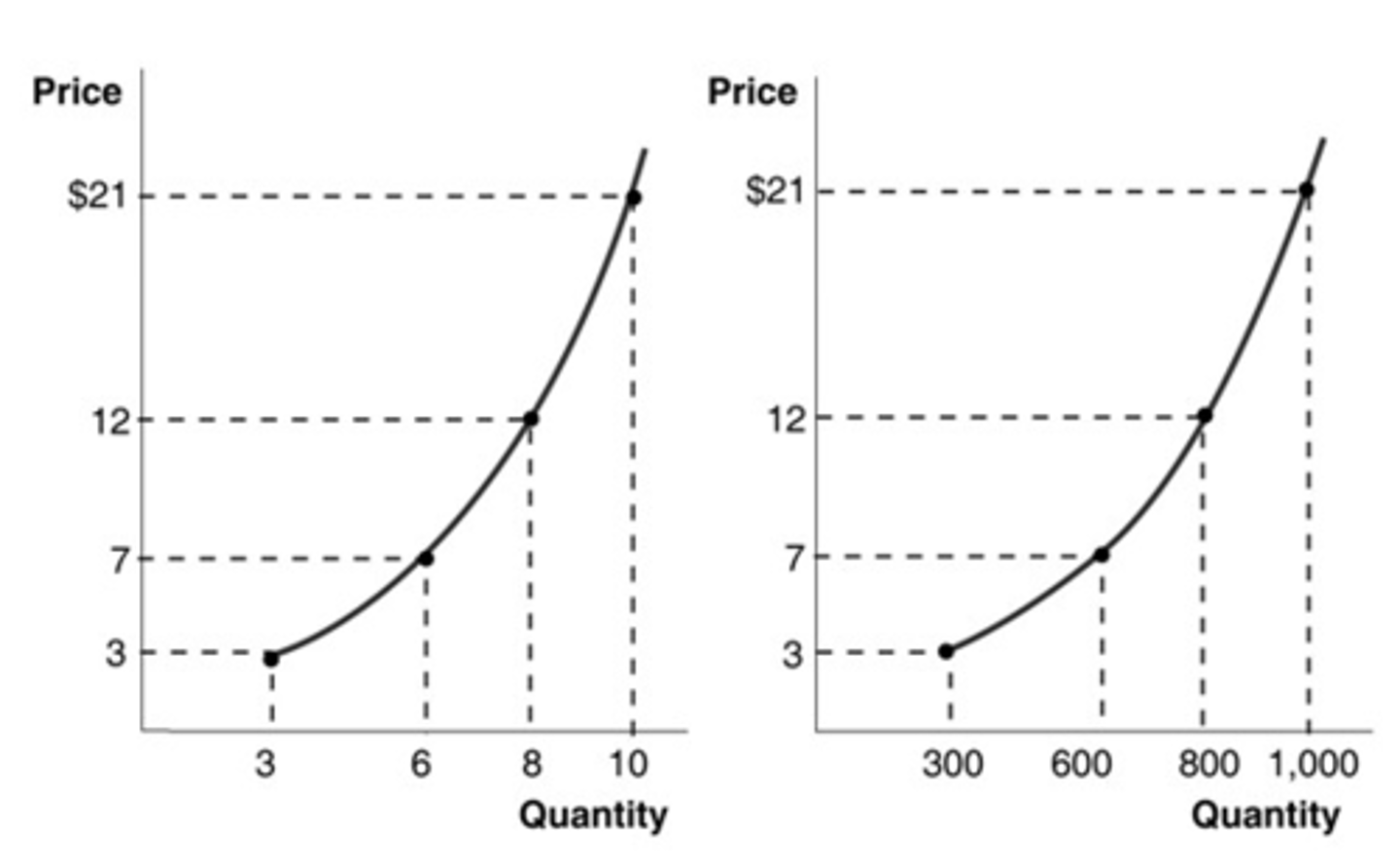
Refer to the graphs below. Suppose the graph on the left represents a typical firm's supply curve in a perfectly competitive industry, and there are 100 identical firms in the industry. Then the graph on the right represents:
a. the market supply curve.
b. the average total cost curve for the industry.
c. the individual supply curve for each firm in the industry.
d. the individual demand curve facing each firm in the industry.
a. the market supply curve.
If market demand shifts to the right, how will a competitive firm’s level of output change?
a. The firm will increase its output, and its profits will increase.
b. The firm will need to decrease its output and suffer losses.
c. The firm will keep its output constant, but its profits will increase.
d. The firm will decrease its output, which will increase its profit.
a. The firm will increase its output, and its profits will increase.
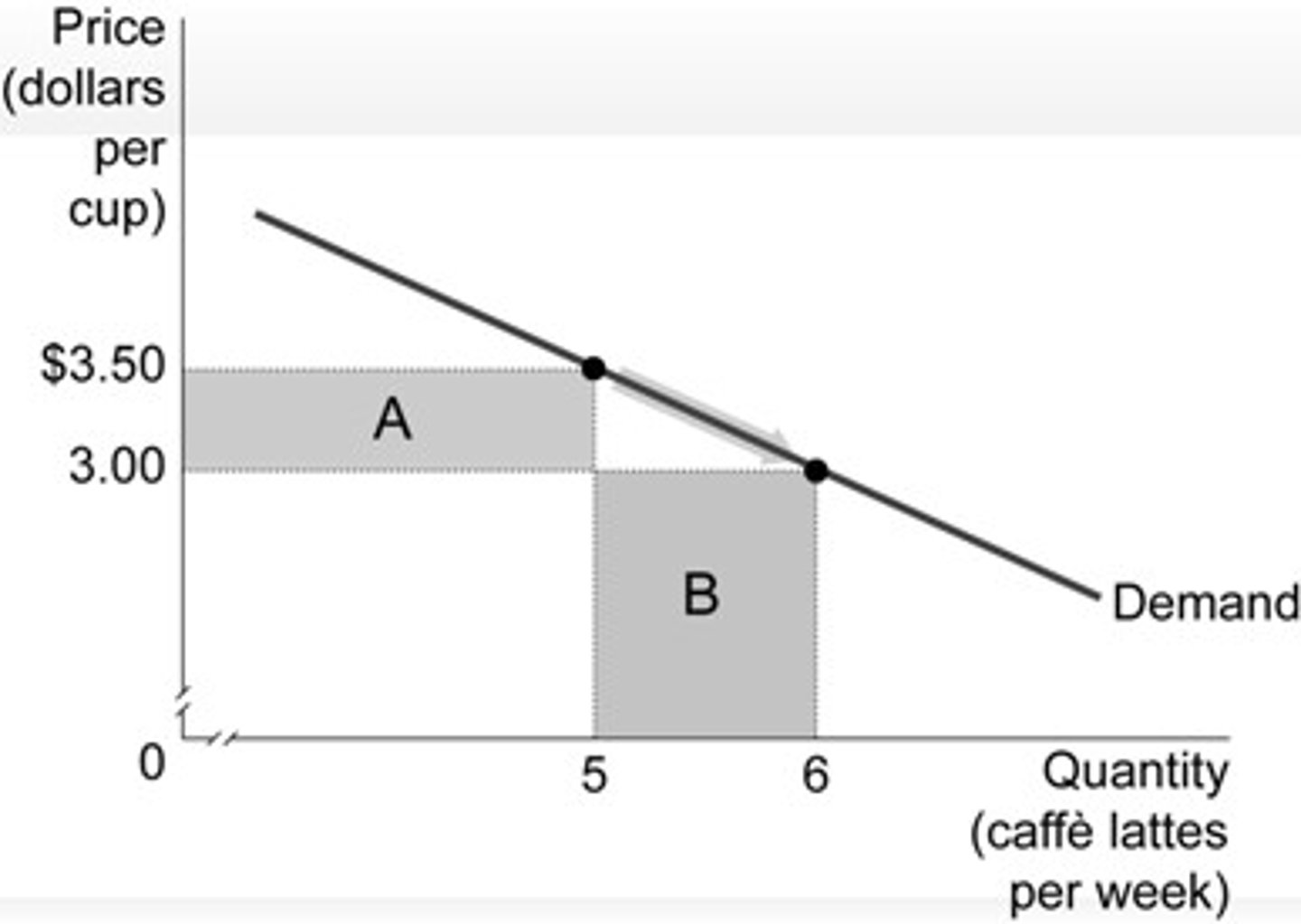
Refer to the graph below. A decrease in price from $3.50 to $3.00 per cup results in a gain and a loss of revenue. Which area represents the loss of revenue?
a. area A
b. area B
c. Areas A and B both represent revenue losses.
d. an area not shown
a. area A
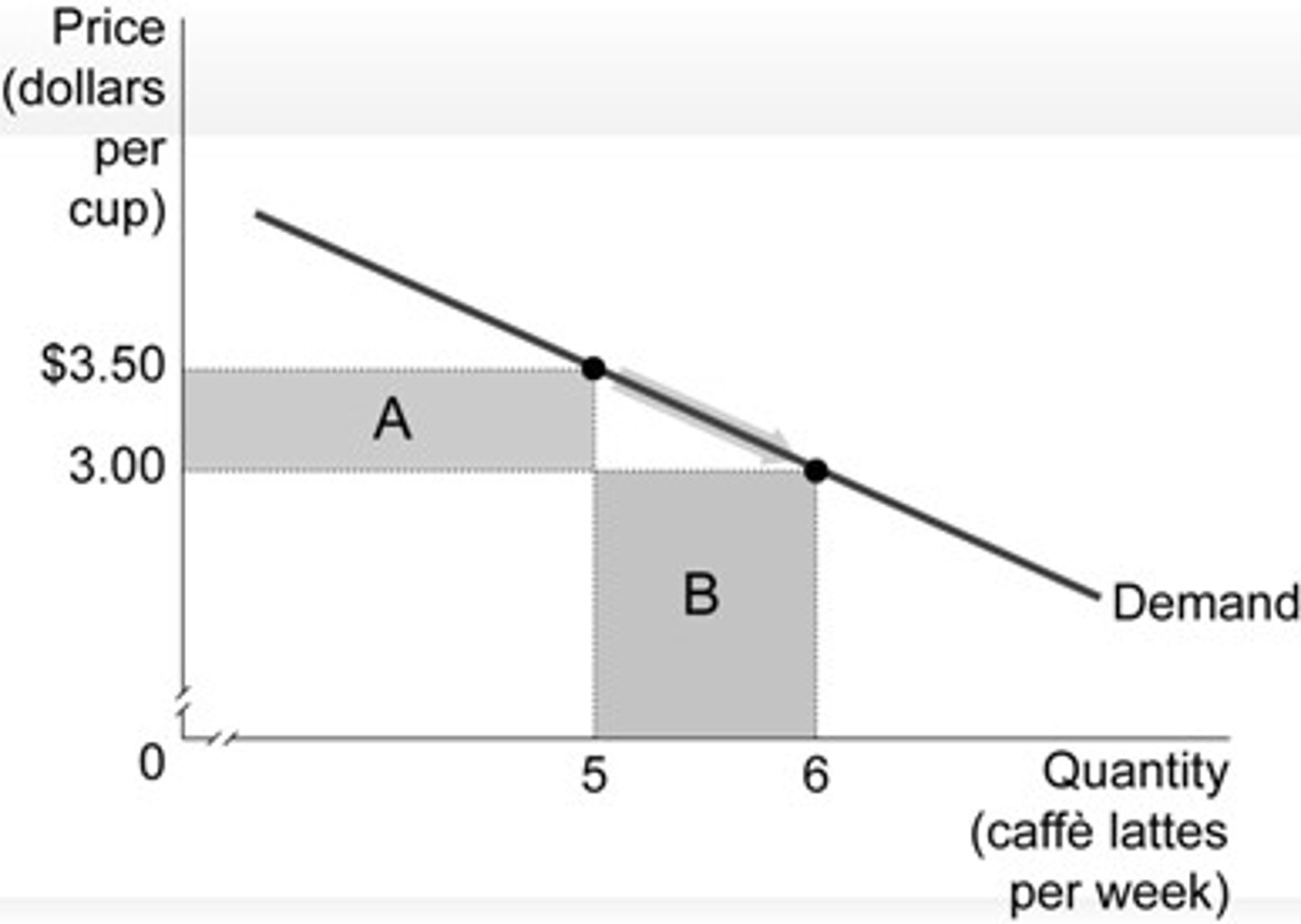
Refer to the graph below. The loss in revenue from decreasing price is greater than the gain in revenue from increasing price whenever:
a. marginal revenue is positive.
b. marginal revenue is negative.
c. marginal revenue equals demand.
d. demand has a negative slope.
b. marginal revenue is negative.
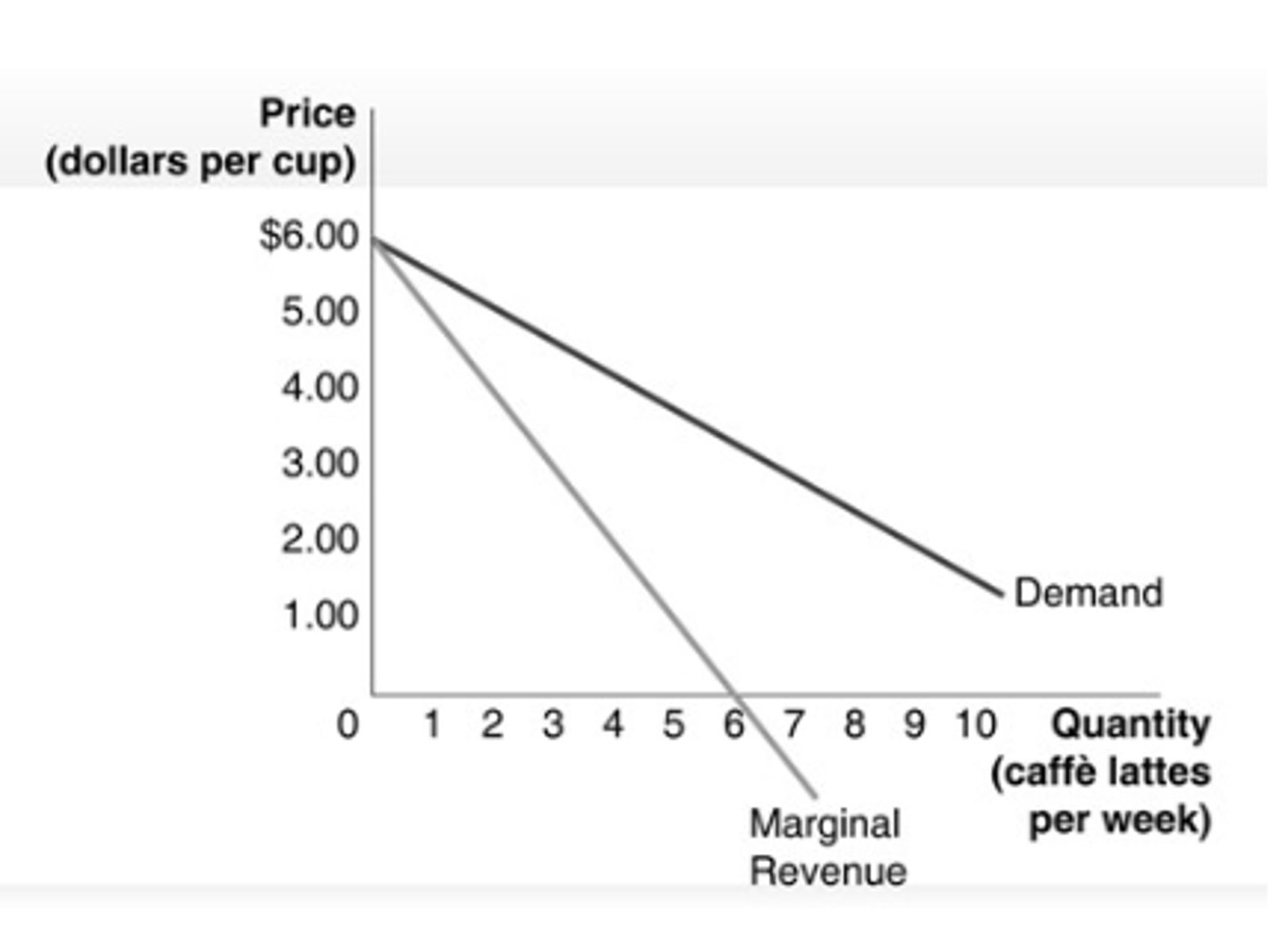
Which of the following are characteristics of monopolistic competition?
a. high barriers to entry
b. few firms compete
c. firms sell similar, but not identical, products
d. all of the above
c. firms sell similar, but not identical, products
How does the entry of new coffeehouses affect the profits of existing coffeehouses?
a. Entry will increase the profits of existing coffeehouses by shifting the market demand curve for coffee to the right.
b. Entry will increase the profits of existing coffeehouses by shifting each of their individual demand curves to the right.
c. Entry will decrease the profits of existing coffeehouses by shifting each of their individual demand curves to the left and making the demand curves more elastic.
d. Entry will not affect the profits of existing coffeehouses.
c. Entry will decrease the profits of existing coffeehouses by shifting each of their individual demand curves to the left and making the demand curves more elastic.
Refer to the graph below. Which level of output indicates excess capacity?
a. Q1
b. Q2
c. both Q1 and Q2
d. neither Q1 nor Q2
a. Q1
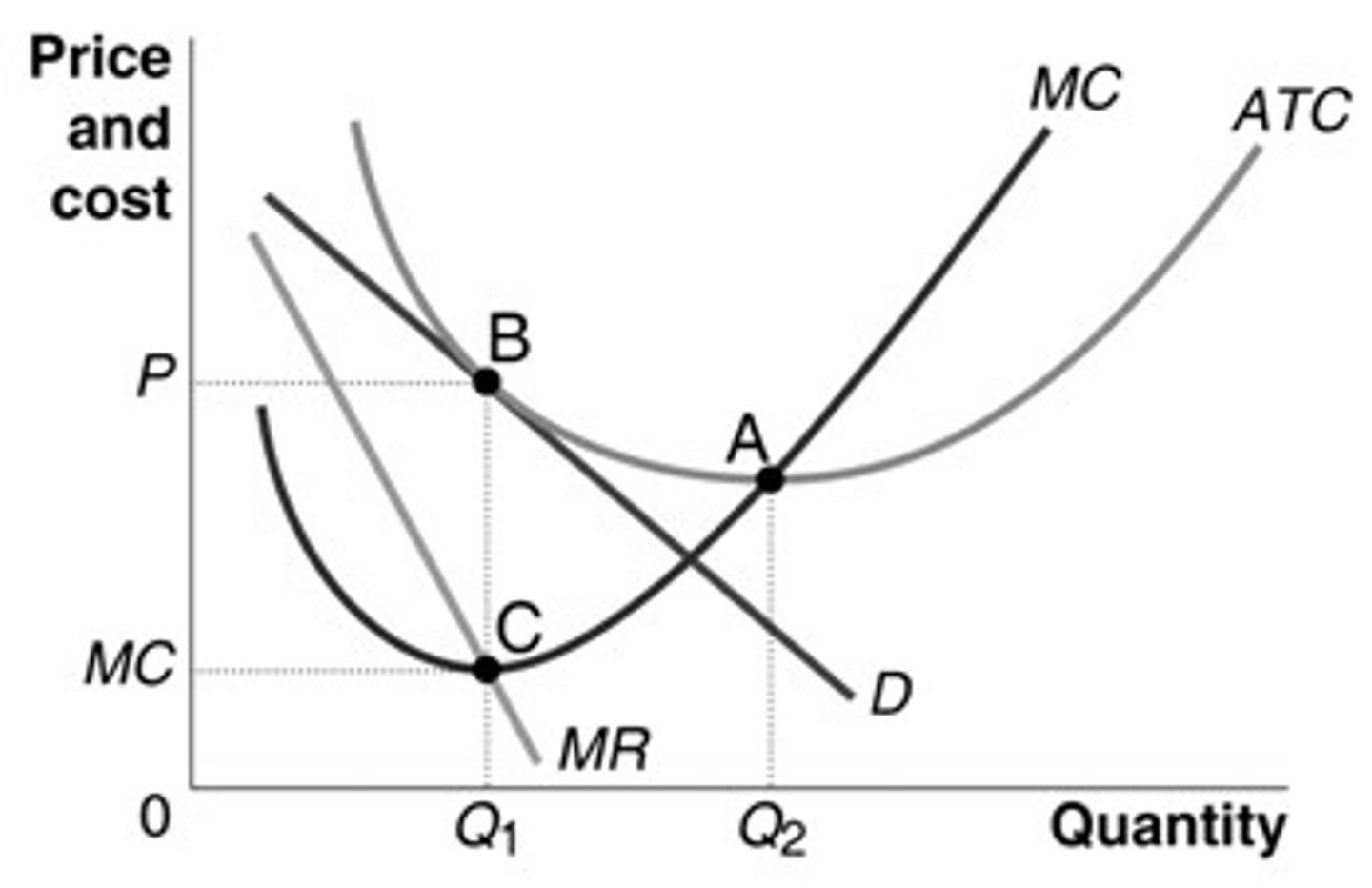
When a monopolistically competitive firm decreases price, good and bad things happen. Which of the following is considered a good thing for the firm?
a. the price effect
b. the output effect
c. the revenue effect
d. all of the above
b. the output effect
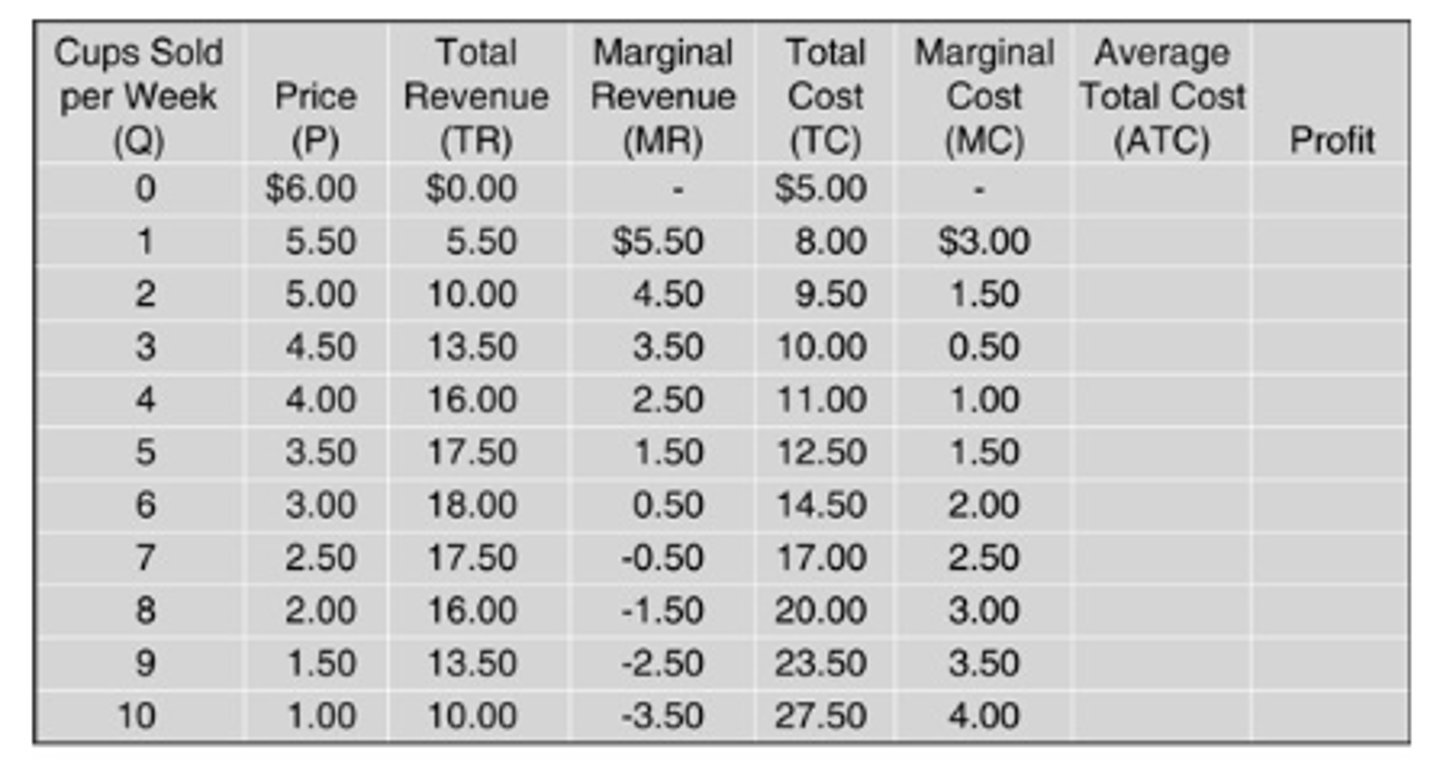
Refer to the table below. What is the marginal revenue associated with the sixth unit of output produced and sold?
a. $3.00
b. $2.00
c. $0.50
d. none of the above
c. $0.50
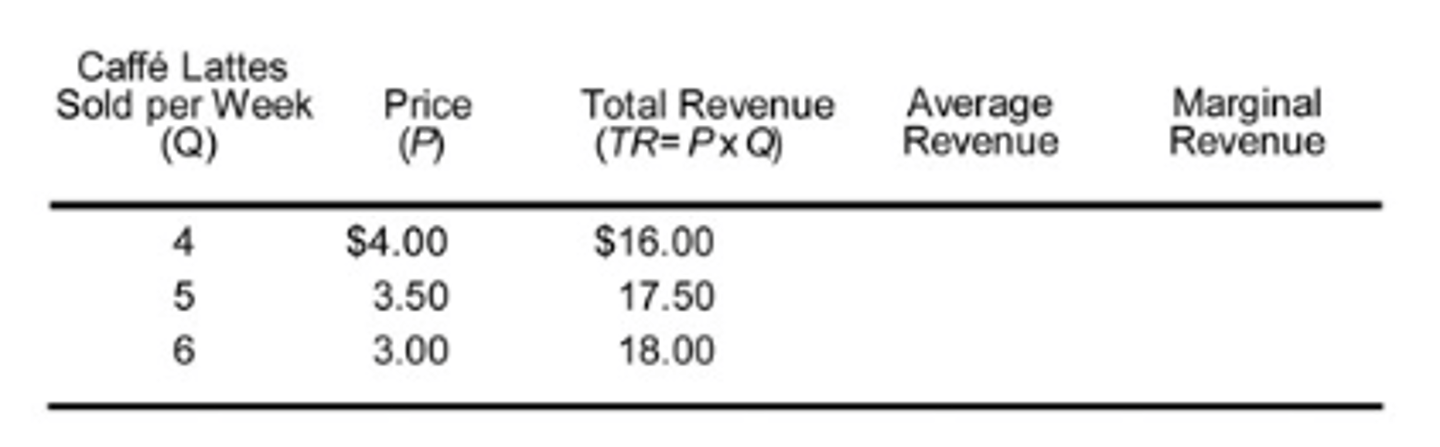
Refer to the table below. What is the average revenue associated with the sixth unit of output produced and sold?
a. $3.00
b. $2.00
c. $0.50
d. None of the above; there is insufficient information to answer the question.
a. $3.00
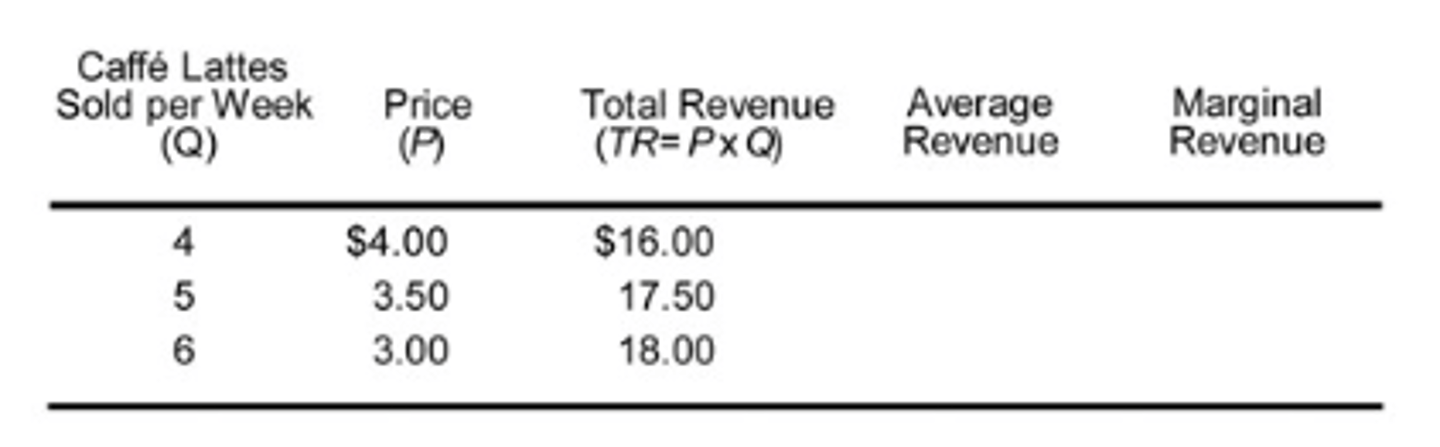
Refer to the graph below. In order to maximize profit, what price should the firm charge?
a. $18
b. $15
c. $8
d. $4
b. $15
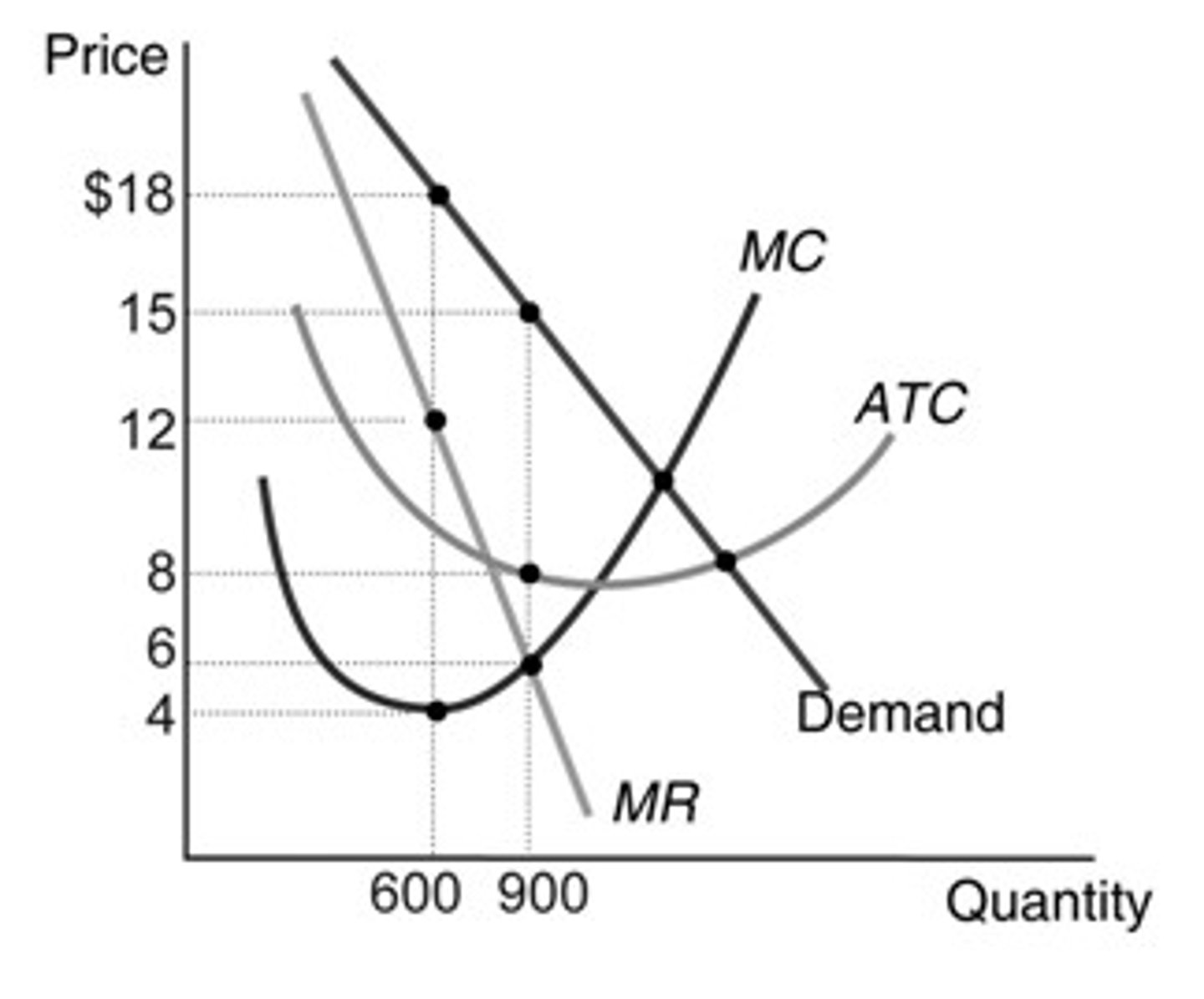
Refer to the graph below. Assume that the firm is producing 600 units. What should the firm do in order to maximize profit?
a. The firm should increase output, because at 600 units, price is above marginal cost.
b. The firm should maintain output at 600 units, because at this output level, marginal revenue is greater than marginal cost, marginal cost is minimized, and price is the highest.
c. The firm should increase the level of output, because at 600 units, marginal revenue is greater than marginal cost.
d. The firm should increase the level of output until it reaches the minimum average total cost.
c. The firm should increase the level of output, because at 600 units, marginal revenue is greater than marginal cost.
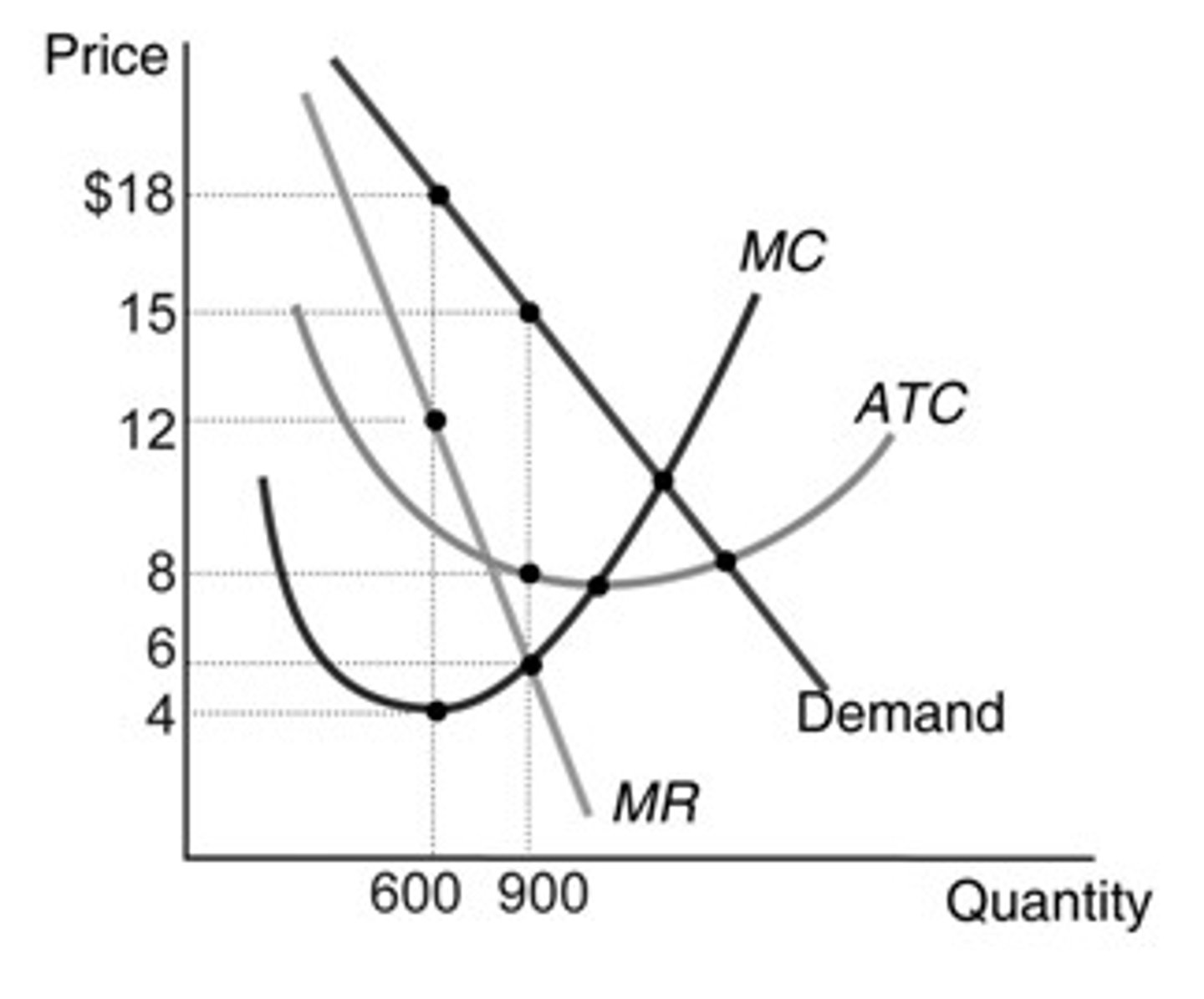
Is zero economic profit inevitable in the long run for a monopolistically competitive firm?
a, Yes; there is nothing the firm can do to avoid zero economic profit in the long run.
b. No; a firm could try to continue making a profit in the long run by producing a product identical to those of competing firms.
c. No; a firm could try to continue making a profit in the long run by reducing production costs and improving its products.
d. No; a firm could try to continue making a profit in the long run by simply offering goods that are cheaper to produce, even if they have less value than those offered by competing firms.
c. No; a firm could try to continue making a profit in the long run by reducing production costs and improving its products.
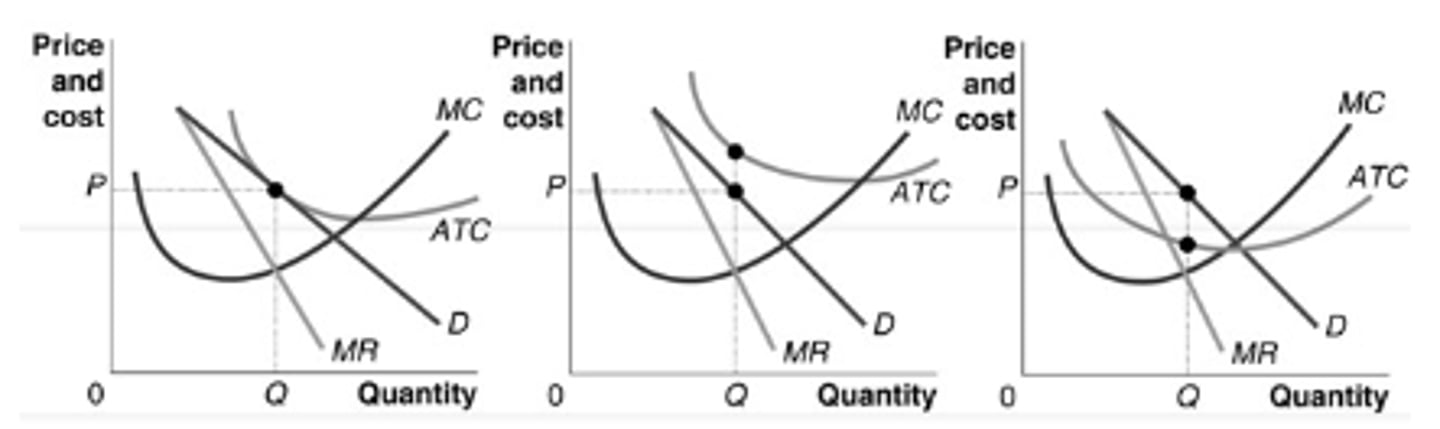
Refer to the graphs below. Assuming both firms are producing 5 cups per week, which firm is maximizing profits?
a. the firm on the left
b. the firm on the right
c. both firms
d. neither firm
c. both firms
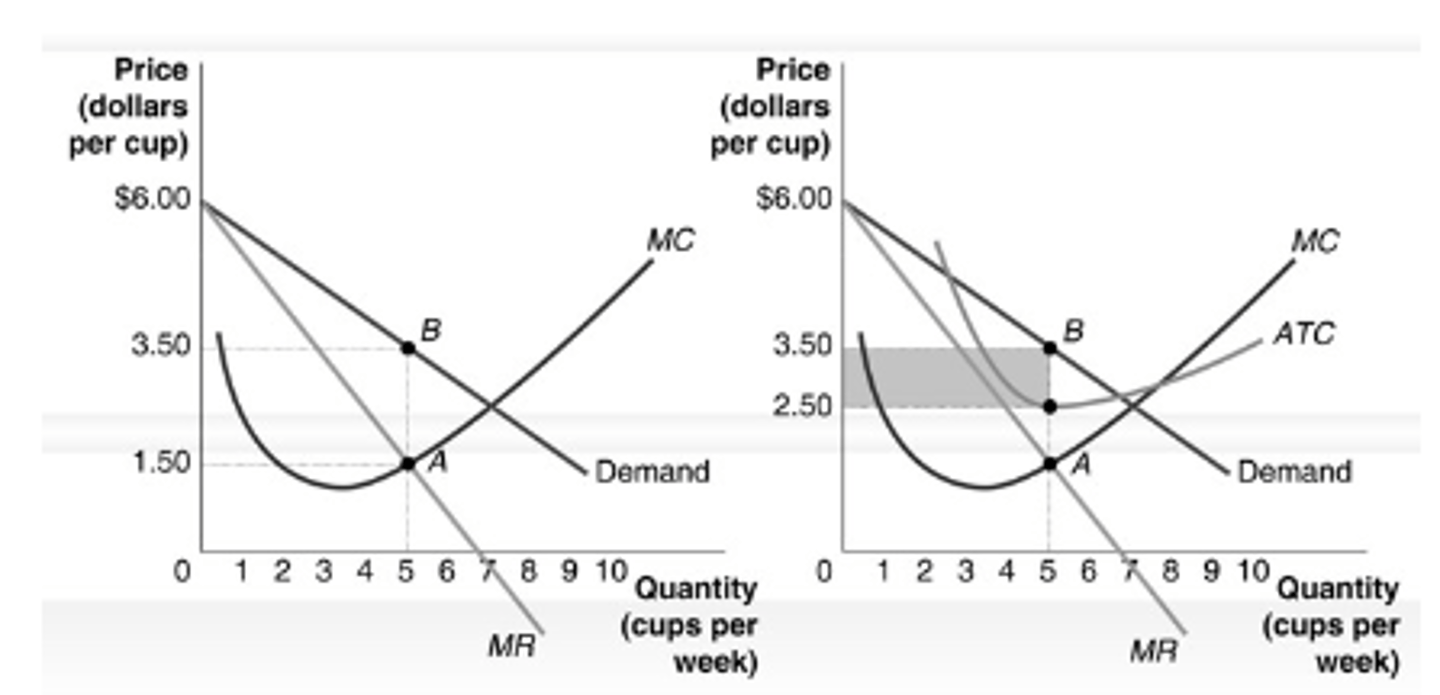
Refer to the graphs below. Which graph depicts a situation in which some firms will exit the industry?
a. the graph on the left
b. the graph in the middle
c. the graph on the right
d. none of the above
b. the graph in the middle
Refer to the table below. When is average total cost minimized?
a. at 1 unit of output
b. at 5 units of output
c. at 6 units of output
d. at 10 units of output
c. at 6 units of output
For what type of market structure is demand curve the same as marginal revenue?
a. monopolistic competition
b. perfect competition
c. both monopolistic and perfect competition
d. neither monopolistic nor perfect competition
b. perfect competition
If marginal revenue slopes downward, which of the following is true?
a. The firm must decrease its price to sell a larger quantity.
b. The firm must increase its price to sell a larger quantity.
c. The firm must decrease its price if it wants to continue selling the same quantity.
d. The firm is unable to adjust price when the quantity sold changes.
a. The firm must decrease its price to sell a larger quantity.
Refer to the graph below. A decrease in price from $3.50 to $3.00 per cup results in a gain and a loss of revenue. Which area represents the revenue gain?
a. area A
b. area B
c. Both shaded areas represent revenue gains.
d. an area not shown
b. area B
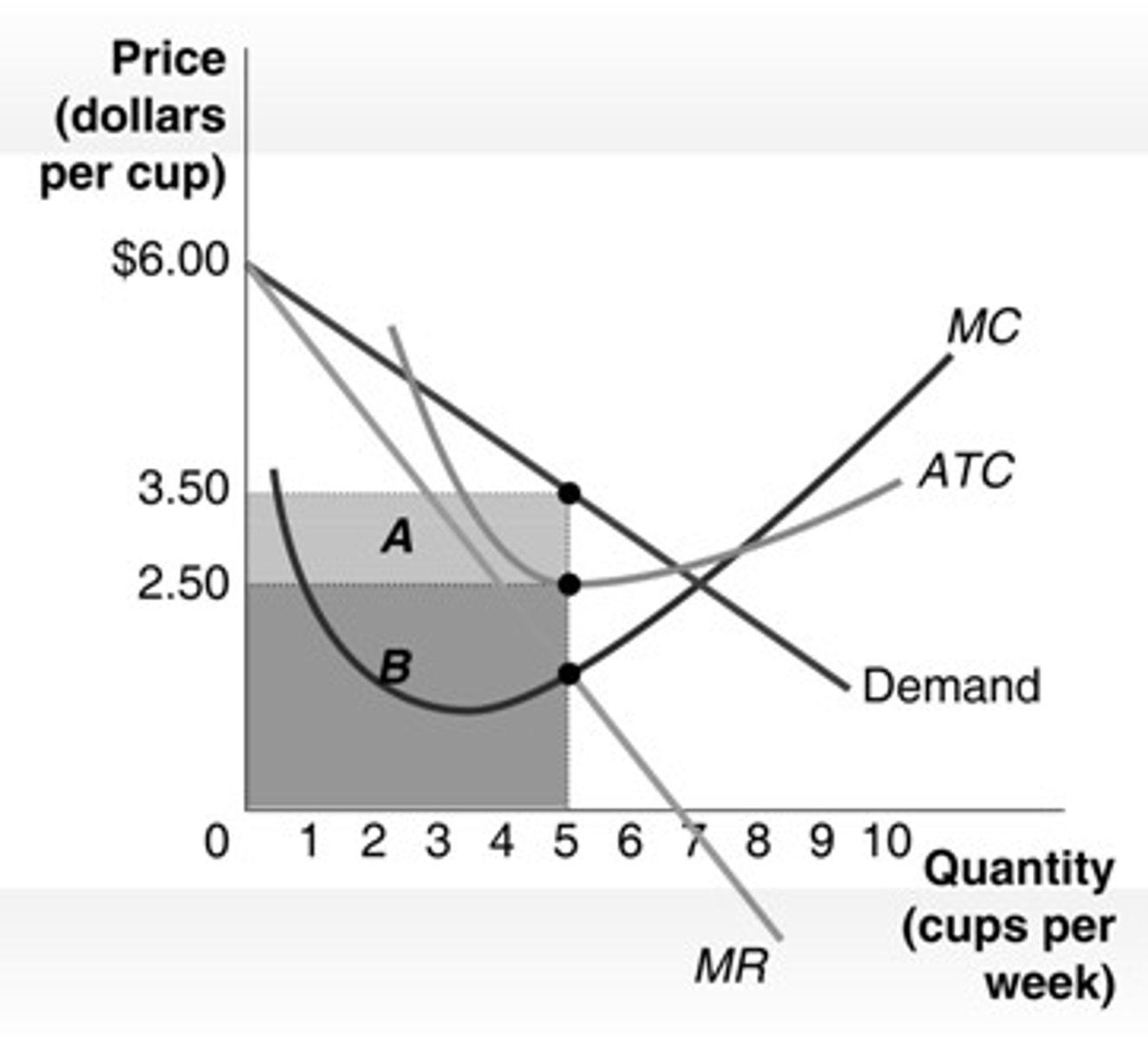
Refer to the graph below. Assume that the firm represented by the cost and demand curves below is maximizing profit. Which area represents the formula: (P – ATC) × Q?
a. area A
b. area B
c. area A + area B
d. area B – area A
a. area A
Which of the following terms best describes the additional revenue associated with selling an additional unit of output?
a. price
b. average revenue
c. marginal revenue
d. total revenue
c. marginal revenue
Which type of efficiency is achieved by a monopolistically competitive firm in the long run?
a. allocative efficiency
b. productive efficiency
c. both allocative and productive efficiency
d. neither allocative nor productive efficiency
d. neither allocative nor productive efficiency
If a firm has the ability to affect the price of the good or service it sells, what is the relationship between its marginal revenue curve and its demand curve?
a. The firm will have a marginal revenue curve that is above its demand curve.
b. The firm will have a marginal revenue curve that is below its demand curve.
c. The firm will have a marginal revenue curve that is the same as its demand curve.
d. The firm will have an upward-sloping marginal revenue curve and a downward-sloping demand curve.
b. The firm will have a marginal revenue curve that is below its demand curve.
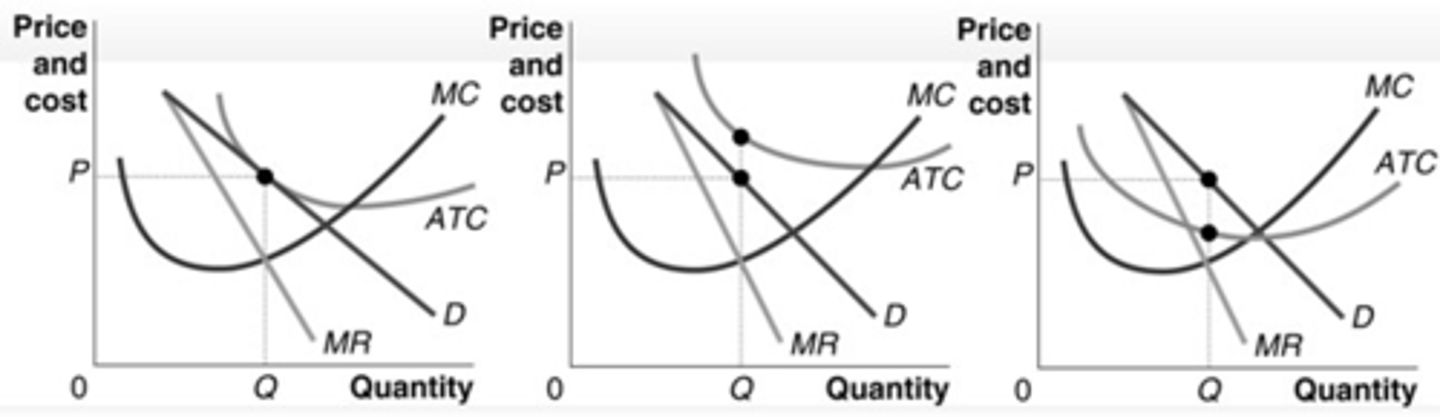
Refer to the graphs below. Which graph best depicts the relationship between price and average total cost in the long run for a monopolistically competitive firm?
a. the graph on the left
b. the graph in the middle
c. the graph on the right
d. none of the above
a. the graph on the left
Why does a monopolistically competitive firm have a downward-sloping demand curve?
a. because its customers only buy goods that are being discounted from their original prices
b. because changing the price will affect the quantity sold
c. because the firm is a price taker, like a wheat farmer
d. because the firm’s level of output produced depends on its cost structure
b. because changing the price will affect the quantity sold
Refer to the graphs below. Which firm is a monopolistic competitor operating in the long run?
a. the firm on the left
b. the firm on the right
c. both firms
d. neither firm
a. the firm on the left
Suppose you invest $200,000 in a business. The return you could earn each year on a similar investment using that money is 10 percent, or $20,000. In an economic sense, the $20,000 is:
a. an economic cost.
b. economic profit.
c. an accounting cost.
d. both economic profit and accounting profit.
a. an economic cost.
Which of the following types of firms use the marginal revenue equals marginal cost approach to maximize profits?
a. perfectly competitive firms
b. monopolistically competitive firms
c. both perfectly competitive and monopolistically competitive firms
d. neither perfectly competitive nor monopolistically competitive firms
c. both perfectly competitive and monopolistically competitive firms
What trade-offs do consumers face when buying a product from a monopolistically competitive firm?
a. Consumers pay a lower price but also have fewer choices.
b. Consumers pay a price greater than marginal cost but also have choices more suited to their tastes.
c. Consumers pay a higher price but are happy knowing that the industry is highly efficient.
d. Consumers pay a price as low as the competitive price but have difficulty finding and buying the product.
b. Consumers pay a price greater than marginal cost but also have choices more suited to their tastes.
Refer to the graphs below. Which graph best depicts a firm in a monopolistically competitive industry that has an incentive to exit the industry in the long run?
a. the graph on the left
b. the graph in the middle
c. the graph on the right
d. none of the above
a. the graph on the left
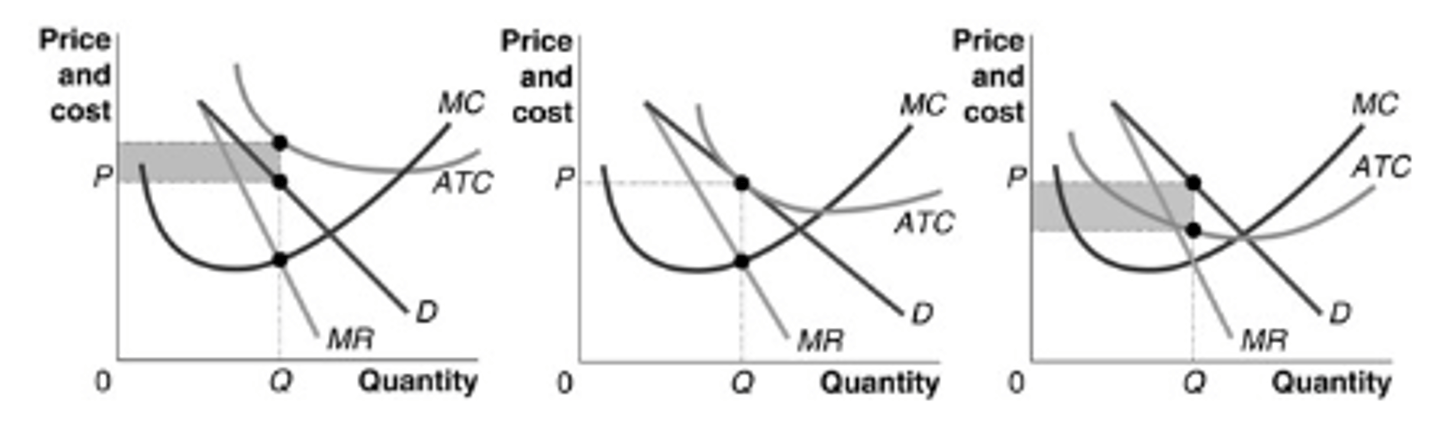
Refer to the graphs below, which represent the situations facing typical firms in three different monopolistically competitive industries. Which graph best represents the situation where new firms are likely to enter the industry?
a. the graph on the left
b. the graph in the middle
c. the graph on the right
d. none of the above
c. the graph on the right
Which of the following measures is conceptually the same as price?
a. marginal revenue
b. total revenue
c. average revenue
d. none of the above
c. average revenue
What is marginal cost?
a. the cost per unit of output produced
b. the increase in total cost resulting from producing one more unit of output
c. the impact of additional output on total fixed cost
d. the cost of production that is independent of the level of output produced
b. the increase in total cost resulting from producing one more unit of output