pe - aos 2
 Call Kai
 Learn
Learn Practice Test
 Spaced Repetition
 Match
Match Flashcards
 Knowt Play
1/43

There's no tags or description
Looks like no tags are added yet.
Name | Mastery | Learn | Test | Matching | Spaced | Call with Kai |
|---|
No analytics yet
Send a link to your students to track their progress
44 Terms
4.7 - qualitative movement analysis
qualitative movement anlysis -
purposes
diagnosis of strengths + weaknesses of players or teams
to obtain a result or rank in competition
for talent identification or team selection
to predict future performance results
4 stages
preparation
observation
evaluation
error correction
4.7 - preparation
aim - what to analyse + the purpose of the analysis
must gather relevant info on
sport - rules + terminology
individual + team - team dynamics, individual’s, age, gender, history, level, etc
performance - what the skill is
technique - how to execute skill successfully
4.7 - observation
aim - consider factors of the performer that may influence their performance + factors that may impact your ability to observe
types
direct
note taking
fill in a sheet/form
digital recording
any recording device (visual/audio) ex. bio trackers
difference is accessibility - digital recording costs more money + time
4.7 - observation - considerations
viewing position
viewing plane
viewing reliability
4.7 - evaluation
aim -
questions asked during evaluation
what is the problem?
what is causing the problem?
how am I going to correct this most effectively?
4.7 - evaluation - subjectivity
this stage is where subjective bias can enter. (during any of above questions)
subjective data - subjective data that can be observed + evaluated differently by different observers → subjective bias
objective data - data, often numerical, that although is observed the same, can be evaluated differently by different observers → subjective bias
to avoid subjectivity:
ask for input from multiple people (best intervention)
ensure significant time is spent on training judges/coaches to accurately evaluate performance
4.7 - evaluation - validity + reliability
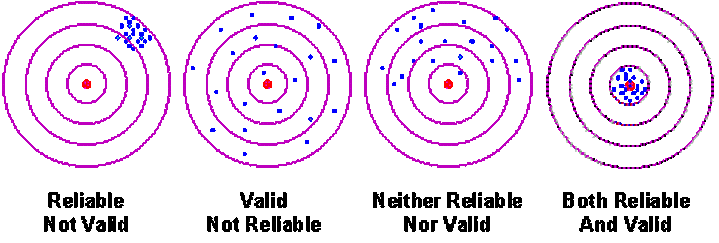
validity - the capacity of a test to measure what it is intended to. is it testing what you’re claiming it tests?
reliability - the ability of a test to reproduce similar results when condicted in identical/similar conditions, contexts and situations. similar results if test is replicated multiple times.
4.7 - error correction
aim - strengths + weaknesses have now been estabilished → correct + create an intervention
implementation
feedback
augmented
instructive correction
providing learner with:
knowledge of performance
feedback on improving technique
modified practice
during practice
breaking skills into easier parts
creating easier game situations then adding difficulty
closed environment then slowly make more open
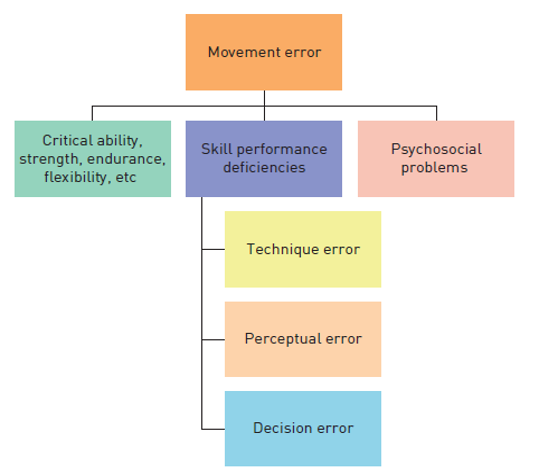
4.7 - error correction - intervention
5.1
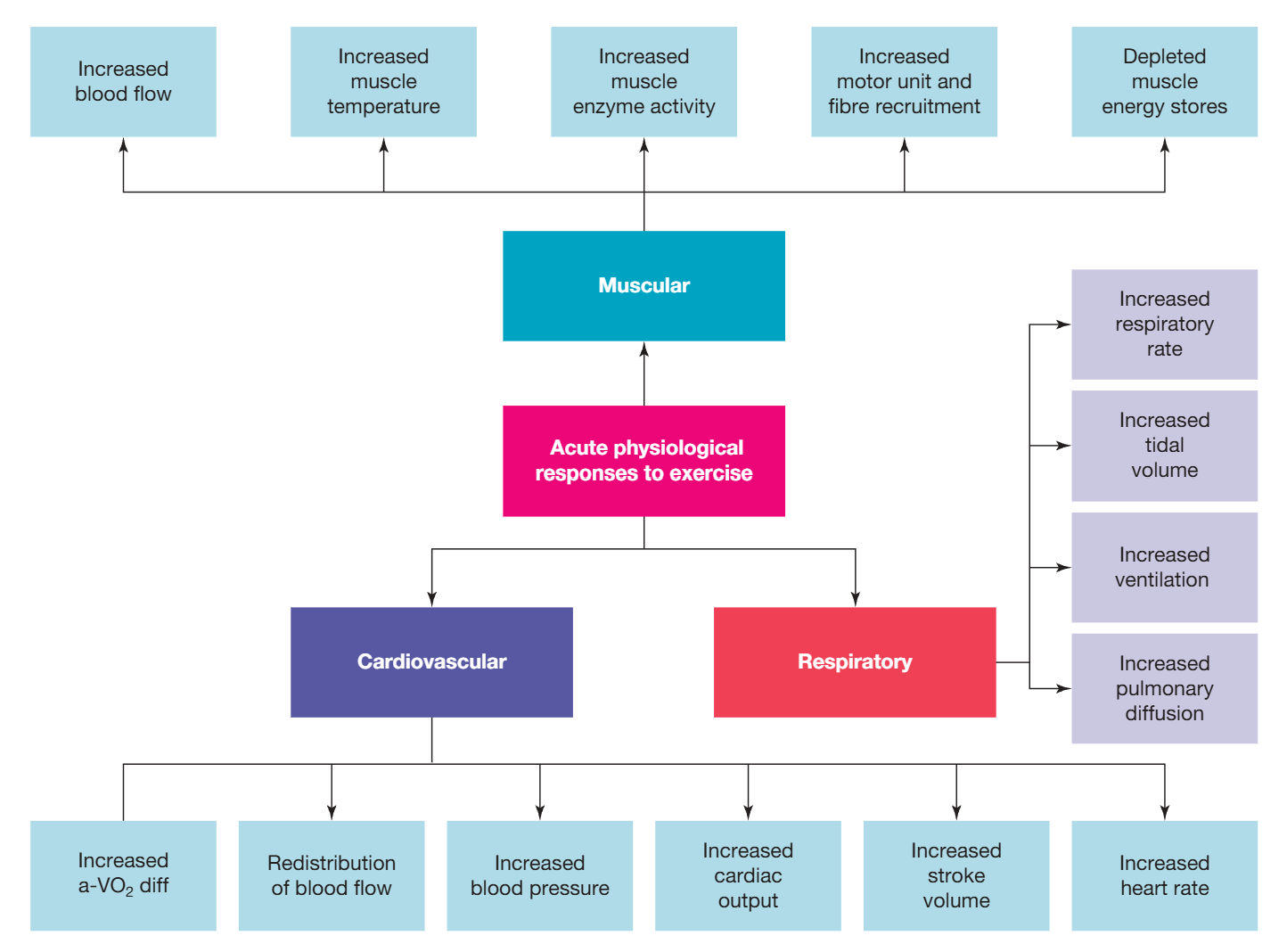
acute responses to exercise - immediate physiological responses in the body to support the increased energy demand during exercise. responses only last for the duration of the activity
depend on the intensity + type of activity
are evident from the start to the end of the activity
due to the increased demande for energy by the working muscles
5.2 - oxygen uptake
oxygen uptake (VO2) - the amount of oxygen transported to, taken up by and used by the body for energy production
when exercise begins, the body’s working muscles immediately have an increased demand for ATP + therefore an increased demand for oxygen. the body tries to meet this demand by increasing oxygen uptake (through cardiorespiratory systems’ acute responses).
5.2 - steady state
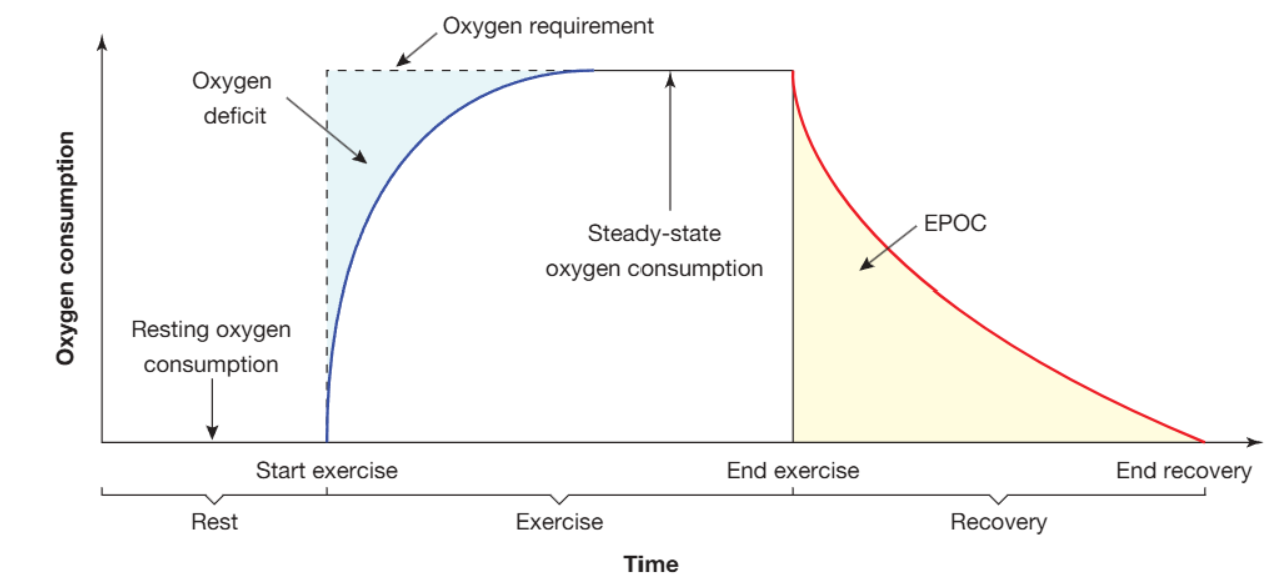
steady state - the state when oxygen supply = oxygen demand. → almost all of the energy demand is met through aerobic respiration (rather than anaerobic)
at rest, oxygen uptake is at a steady state
5.2 - oxygen deficit
oxygen deficit - the state when the oxygen demand exceeds the supply. this occurs because it takes the cardiorespiratory systems some time to adjust to increased oxygen demand/increase oxygen uptake. can take from a few seconds to a minute to adjust, depends on the jump of intensity/steepness of line
oxygen deficit occurs when exercise is started, and when exercise intensity is increased
during oxygen deficit, aerobic pathways don’t supply the level of energy that working muscles demand (because oxygen uptake has not yet met the oxygen demand) → during oxygen deficit there is an increased reliance on anaerobic pathways to supplement the energy demands. this produces lactic acid, meaning too much oxygen deficit can result in a buildup of lactic acid.
5.2 - oxygen debt/EPOC
short aerobic activites = fast EPOC
strenuous or high intensity but short activity = medium EPOC
strenuous + long activity = long EPOC, up to several hours
5.3 - cardiovascular system
Vo2 max - the maximum amount of oxygen the body can uptake, transport and utilise per minute. % of Vo2 max gives best measure of exercise intensity
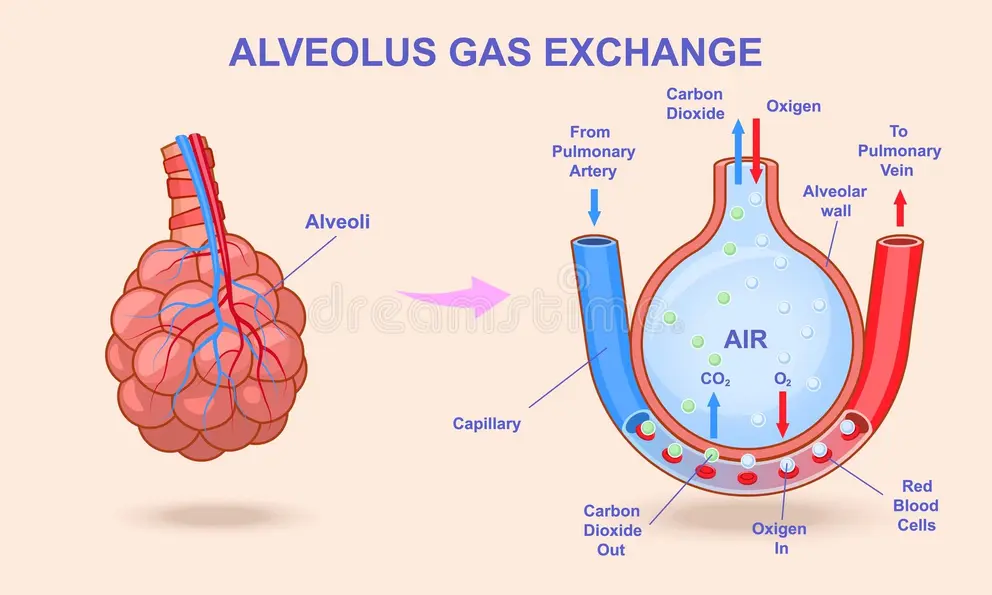
diffusion - CO2 waste product is removed and O2 is added in gaseous exchange between the alveoli (respiratory system) and capillary (cardiovascular system) → capillary leads to pulmonary vein which leads to heart → blood pumped to body where muscles produce energy. (diagram above)
diffusion - occurs when molecules move from an area of high concentration to an area of low concentration
5.3 - acute responses from the cardiovascular system
increased heart rate →
increased stroke volume →
increased cardiac output →
increased blood pressure →
redistribution of blood flow →
increased a-VO2 Diff
5.3 - increased heart rate
heart rate
number of contractions of the heart muscle in a minute, measured in bpm.
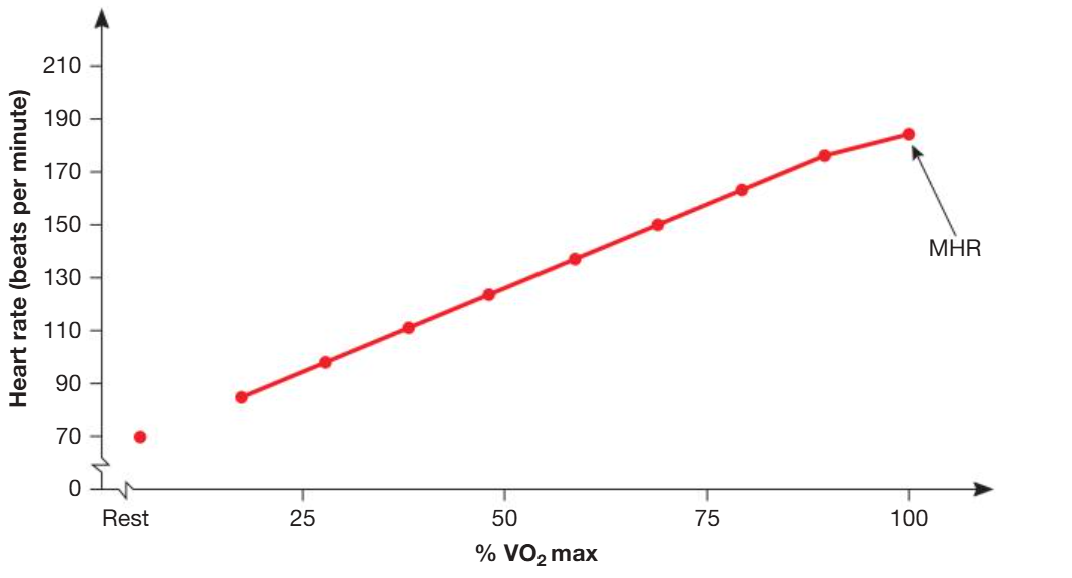
at rest, approximately 60-70. during exercise, increases in a linear fashion with exercise intensity (%Vo2 max), until near-maximal intensity is reached, where it drops a bit. (see graph)
maximum heart rate - highest rate your heart can safely reach during exercise. MHR = 220 - your age
purpose
in response to increased energy demand from muscles → first response is increase in HR
increase in HR → the heart pumps oxygenated blood around the body at a greater rate → greater amount of blood delivered for diffusion and use by working muscles for aerobic energy production + aids in the removal of waste products
a rise in HR before exercise = anticipatory rise
5.3 - increased stroke volume
stroke volume
the amount of blood ejected from the left ventricle with each contraction, measured in mL.
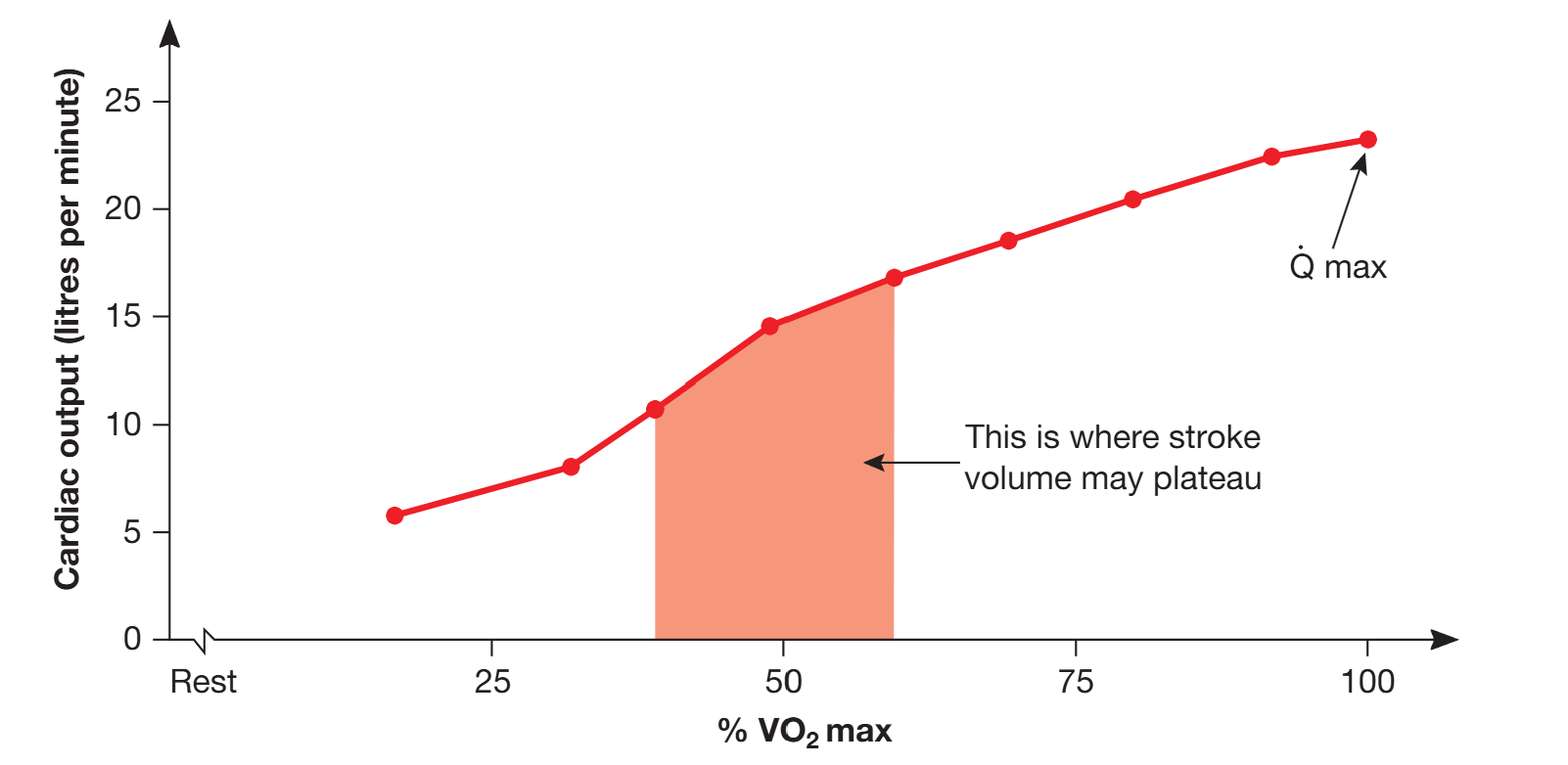
during exercise, SV increases in a linear fashion, until around 40-60% of maximal intensity (% Vo2 max) where SV plateus. Vo2 max differs relative to athlete’s training, therefore point at which SV plateus is relative to athlete’s training.
purpose - increase in SV → more blood pumped per contraction → more blood available for the body
5.3 - increased cardiac output (Q)
cardiac output
the total amount of blood ejected by the left ventricle per minute, measured in L/min
Q = HR x SV
at rest, 5-6L/min. at maximal intensity exercise, can increase to 20-25 L/min (~5x more than rest).
during submaximal intensity exercise, Q increases in a linear fashion in response to intensity, and is a result of both an increase in HR and SV
but as exercise increases towards high intensity, SV plateus, and any increase in Q is due to an increase in HR.
purpose - increase in Q → greater amount of blood pumped per minute → greater amount of blood delivered/transported for diffusion and use by working muscles for aerobic energy production
5.3 - increased blood pressure
blood pressure
the pressure exerted by the blood against the walls of the arteries during different phases of the heart,
blood pressure = systolic/diastolic mmHg (millimitres of mercury).
systolic - when the left ventricle contracts
diastolic - when the left ventricle relaxes
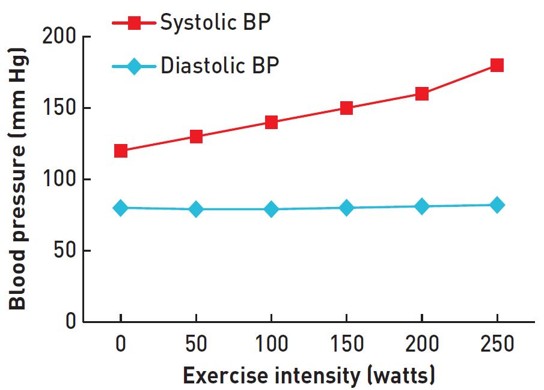
120/80 mmHg = normal bp at rest. (120 systolic, 80 diastolic).
purpose
systolic bp - increases with all types of exercise. during continuous exercises such as running, can increase to 180-200 mmHg (however vasodilation buffers this rise). during resistance-type exercise, can increase to 480 mmHg.
diastolic bp - stays the same during whole body continuous exercises, abnormal to increase more than 10 mmHg. but increases during resistance-type exercise, and can reach 350 mmHg.
5.3 - redistribution of blood flow
involves the redirection of blood away from major organs and towards the working muscles through simultaneous vasodilation + vasoconstriction. measured in % of blood flow to muscles out of total blood flow
purpose
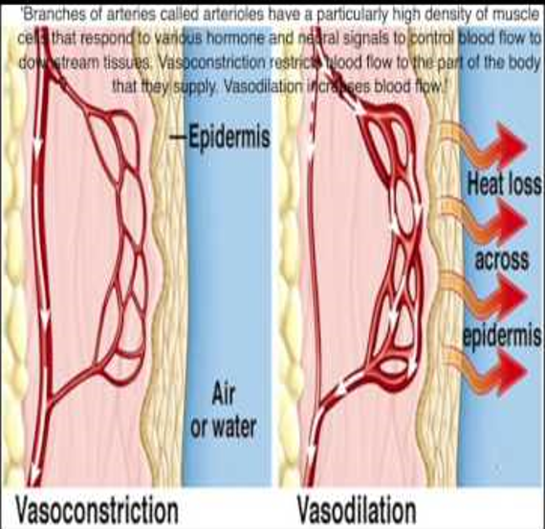
vasodilation - blood vessels (capillaries + arterioles) expand in diameter → allows for increased blood flow.
vasoconstriction - blood vessels constrict (sphincters close?) → decreases blood flow.
at rest, 15-20% of total blood flow is directed to skeletal muscles. during exercise, blood vessels to working muscles vasodilate and blood vessels to major organs (such as digestive system, reproductive system) vasoconstrict, making 80-90% of total blood flow directed to working muscles. increased blood flow to working muscles allows for greater amount of blood delivered/transported for diffusion and use by working muscles for aerobic energy production
purpose - increase of blood flow to working muscles (through redistribution) →
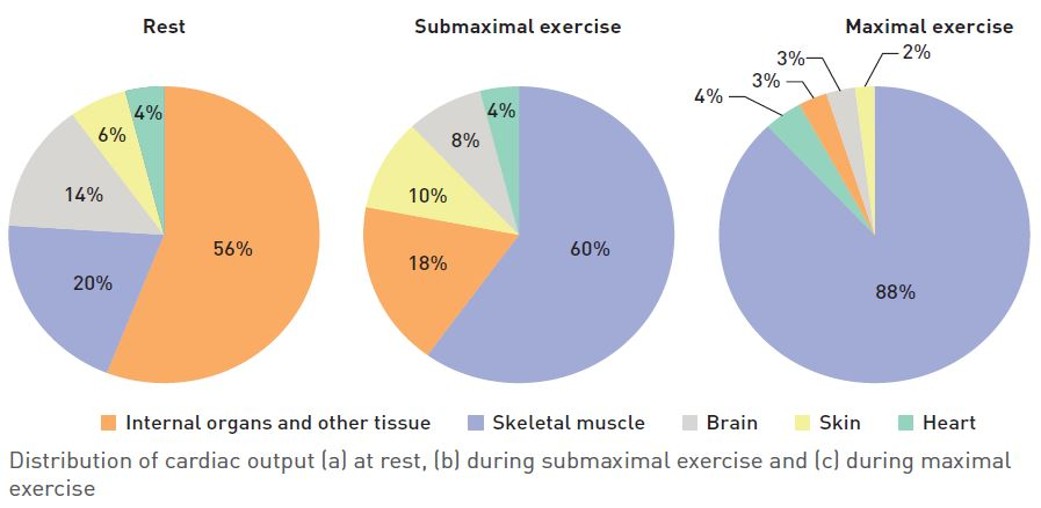
5.3 - redistribution of blood flow to skin (thermoregulation)
thermoregulation - the process by which the body maintains it’s internal temperature of 37℃ despite changes in internal heat production or external environmental conditions.
during exercise, heat is produced as a byproduct (among H2O + CO2) → thermoregulation aims to remove heat during exercise
main heat loss mechanism - vasodilation of blood vessels near the skin, where heat can be released to the envrionment → helps cool the blood
however, this causes a decrease in performance due to less blood being available for working muscles
5.3 - increased arteriovenous oxygen difference (a-VO2 Diff)
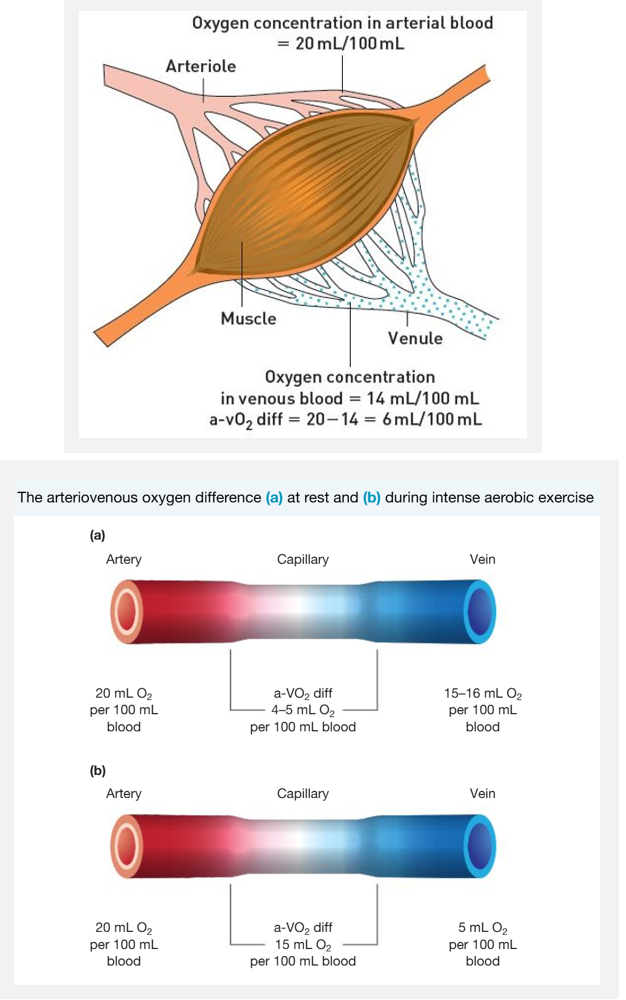
a-VO2 Diff - the measure of the difference of the oxygen concentration in the arterial blood and venous blood, after the muscle is interfaced (a measure of oxygen utilisation by the muscles.) measured in mL of oxygen per 100 mL of blood.
purpose
at rest, arterial O2 concentration is 20mL/100mL, and venous O2 concentration is 5mL/100mL → a-VO2 Diff of 5mL/100mL.
during exercise, arterial O2 concentration stays at 20mL, but venous O2 concentration decreases, because the muscles extract more O2 from the blood. → a-VO2 Diff increases to 15-18mL/100mL, (~3x more than at rest)
5.4 - acute responses in the respiratory system
acute responses to exercise in the respiratory system
increased respiratory rate
increased tidal volume
increased ventilation
increased rate of pulmonary diffusion
5.4 - respiratory rate
respiratory rate - the amount of breaths taken per minute, measured in bpm (not same as beats per minute)
at rest, bpm is often around 12. during exercise, can increase to 35-50 bpm (3-4 times more)
purpose - increases the availability of oxygen that can be diffused into the bloodstream → increases oxygen delivery to the working muscles for aerobic energy production
5.4 - tidal volume
tidal volume - the amount of O2 (oxygen) breathed in or out in one breath, measured in litres
at rest, TV is often around 0.5L. during exercise, can increase to 3-5L (6-10 times more)
tidal volume is limited by the size of your lungs in your thoracic cavity → TV plateaus at a point
purpose - in increase in TV increases the availability of oxygen that can be diffused into the bloodstream → increases oxygen delivery to the working muscles for aerobic energy production
5.4 - ventilation
ventilation - amount of air inspired or expired per minute by the lungs, measured in litres (or litres/min??)
equation: ventilation = respiratory frequency x tidal volume. V = RF ⋅ TV
respiratory frequency contributes the greatest amount to an increase in ventilation as tidal volume plateus earelier
at rest, ventilation is around 5–6 litres per minute. during maximal exercise, it may increase beyond 180 litres per minute for males, and 130 litres per minute for females. this is 25 to 35 times greater than resting values
purpose - increases the availability of oxygen that can be diffused into the bloodstream → increases oxygen delivery to the working muscles for aerobic energy production
5.4 - increased rate of pulmonary diffusion (+ gaseous exchange)
pulmonary diffusion - the movement of oxygen and carbon dioxide from an area of high concentration to an area of low concentration
purpose - pulmonary diffusion occurs via the alveolar-capillary interface
after inspiration, oxygem ,oves from an area of high conc in the l
5.5 - acute responses from the muscular system
increased motor unit recruitment
increased a-VO2 Diff
increased muscle temperature
increased muscle enzyme activity
decreased muscular substrate levels
5.5 - increased motor unit recruitment
motor unit - includes sarcomere + neuron
purpose - increased amount of motor units → increased muslce fibre recruitment + increased contraction force
5.5 - increased a-VO2 Diff
see cardiovascular flashcard
5.5 - increased muscle temperature
5.5 - increased muscle enzyme activity
5.5 - decreased muscular substrate levels
6.1 - energy
energy is required by the body for many different processes, including muscle contraction
the body has 3 energy systems (ways of producing ATP)
ATP - PC system
anaerobic glycolysis
aerobic system
the intensity and time over which muscular contractions can be sustained is determined by the energy system used to create the energy
6.2 - ATP
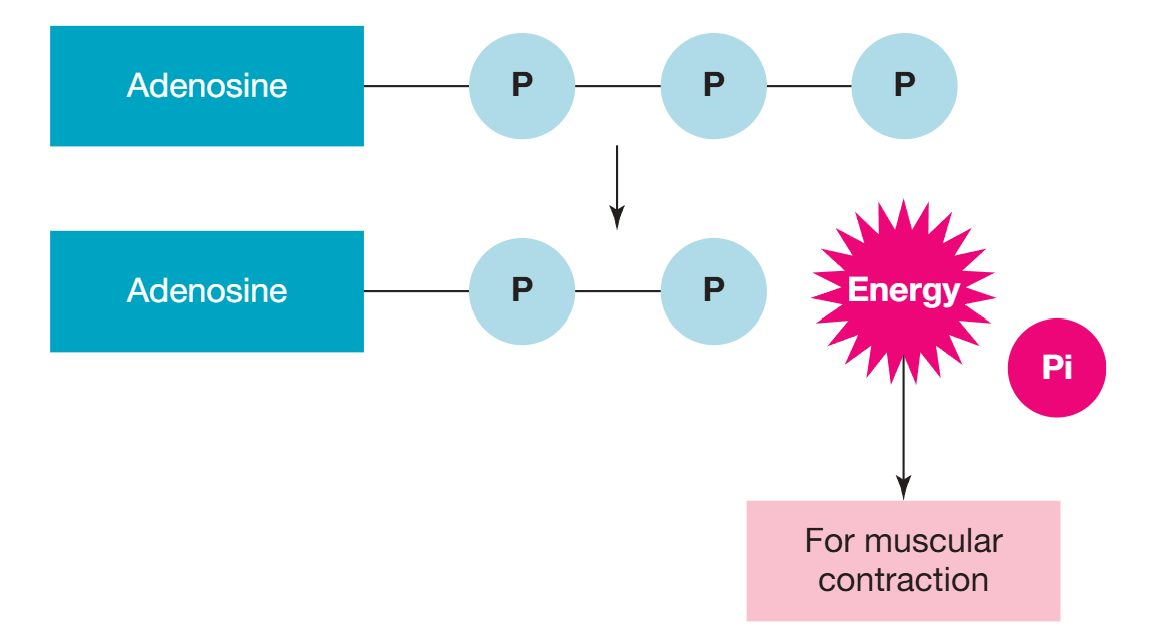
ATP (adenosine tri-phosphate) - consists of adenosine connected to a chain of 3 connected phosphate groups. it is a high energy molecule, with high amounts of available energy stored in the chemical bonds that connect phosphate groups.
ATP releases energy when it is catabolised (broken down). when catabolised, the bonds between phosphate groups are broken, releasing energy.
usually only the outer phosphate is removed. ATP → ADP + Pi (inorganic phosphate) + energy
this energy released is then used to power all metabolic process including muscular contraction → ATP is known as the body’s ‘energy currency’
6.2 - replenishing ATP
the body stores some ATP in cells, but this supply is very limited + used up in 1-2 seconds of maximal intensity activity. → for the body to produce energy, ATP must be constantly replenished
when ATP starts to deplete
6.4 - ATP-PC system (anaerobic)
ATP-PC system - the breakdown of PC with no oxygen present
wh
intensity
6.4 - aerobic system
aerobic system - the complete metabolism of carbohydrates or fats in the presence of oxygen
6.4 - anaerobic glycolysis system
anaerobic glycolysis - the metabolism of carbohydrates to lactic acid with no oxygen present
why is active recovery important
oxidising by-products - oxygen molecule attatching to by-product and taking to blood
interplay statement - all 3 energy systems contribute to energy production during exercise, however the major contributer is determined by intensity and duration
energy systems
aerobic energy system -
atp can be resynthesised from either PC or glucose
carbohydrates → glucose
fats → glycerol + free fatty acids → aerobic respiration
aerobic respiration can use either glucose + glycogen (from carbohydrates) or fats (from lipids). this aerobic energy system resynthesises ATP during prolonged, lower intensity exercise