Cells Structure and Function
 Call Kai
 Learn
Learn Practice Test
 Spaced Repetition
 Match
Match Flashcards
 Knowt Play
1/110

There's no tags or description
Looks like no tags are added yet.
Name | Mastery | Learn | Test | Matching | Spaced | Call with Kai |
|---|
No analytics yet
Send a link to your students to track their progress
111 Terms
The _____ is the __________ unit capable of independently performing all life functions, including metabolism, homeostasis, and reproduction.
cell, smallest
Prokaryotes are
bacteria and archaea
Eukaryotes are
plants, animals, fungi, and protists
Feature | Prokaryotic | Eukaryotic |
|---|---|---|
Nucleus | Membrane / non-membrane bound | Membrane / non-membrane bound |
DNA structure | _____________, in __________ | ________, in ________________. |
Organelles | ||
Cell size | Typically _________ | Typically ___________- |
Cell division | ||
Cell wall | ________________ | _____________ (plants), ________ (fungi), or ____________ (animals) |
Examples |
Feature | Prokaryotic | Eukaryotic |
|---|---|---|
Nucleus | No membrane-bound nucleus | Membrane-bound nucleus |
DNA structure | Circular, in nucleoid | Linear chromosomes |
Organelles | Ribosomes only (70S) | Ribosomes (80S) + membrane-bound organelles |
Cell size | Typically 1–10 µm | Typically 10–100 µm |
Cell division | Binary fission | Mitosis / meiosis |
Cell wall | Peptidoglycan (bacteria) | Cellulose (plants), chitin (fungi), or absent (animals) |
Examples | E. coli, Streptococcus, Archaea | Animals, plants, fungi, protists |
endosymbiotic theory
explains how mitochondria and chloroplasts likely originated as free-living prokaryotes engulfed by ancestral eukaryotic cells.
endosymbiotic theory evidence
Three key pieces of evidence — double membranes, their own circular DNA, and 70S ribosomes
The ____________________ is a double membrane pierced by nuclear pores that regulate the transport of _________, _______________, and regulatory ___________ between the __________ and _________. Inside, the ___________ assembles ______________, which is essential for building the ribosomes that carry out protein synthesis.
nuclear envelope, nuclear pores, mRNA, ribosomal subunits, and regulatory proteins between the nucleus and cytoplasm, nucleolus, ribosomal RNA (rRNA)
What is the function of the nucleus?
The nucleus is the cell’s control center, housing nearly all of the cell’s DNA organized into linear chromosomes.
What is the general function of the ER?
Membrane network for synthesis and transport of proteins and lipids.
What does the rough ER do?
Studded with ribosomes. Synthesizes proteins destined for secretion, membrane insertion, or delivery to other organelles. Proteins are folded and quality-checked within the ER lumen.
What does the smooth ER do?
Lipid synthesis, carbohydrate metabolism, detoxification.
Why is smooth ER abundant in liver cells?
Detoxifies drugs and metabolizes glycogen.
What is the function of the Golgi apparatus?
Modifies, sorts, and packages proteins and lipids for transport from ER.
What types of modifications occur in the Golgi?
Glycosylation, phosphorylation, and other post-translational changes.
Where does the Golgi send products?
Plasma membrane, lysosomes, or outside the cell.
Mitochondria
double-membrane organelles responsible for aerobic cellular respiration.
What is the role of the outer membrane of Mitochondria?
Smooth and permeable to small molecules via porins
Mitochondria inner membrane function
Folds into cristae, dramatically increasing surface area for the electron transport chain (ETC) and oxidative phosphorylation
Mitochondria matrix function
The fluid interior that houses enzymes for the citric acid cycle (Krebs cycle), which generates NADH and FADH2 to feed the ETC
Mitochondria intermembrane space function
Where the proton gradient builds up during chemiosmosis, driving ATP synthase
A single cell can contain hundreds to thousands of mitochondria depending on its energy demands — __________ and ______ are especially mitochondria-rich.
muscle cells and neurons
Lysosomes
membrane-bound vesicles containing hydrolytic enzymes that operate at an acidic pH (~4.5–5.0).
Lysosome 3 main functions
Intracellular digestion — Breaking down macromolecules and food particles
Autophagy — Recycling damaged or worn-out organelles
Apoptosis — Releasing enzymes during programmed cell death to systematically dismantle cellular components
Tay-Sachs disease results from a deficiency in the _________________________ hexosaminidase A, causing lipid accumulation in neurons.
lysosomal enzyme
What is the function of the central vacuole in plant cells?
Stores water, nutrients, and maintains turgor pressure.
What happens when a plant loses water?
Vacuole shrinks → loss of turgor pressure → wilting (plasmolysis).
How are vacuoles in animal cells different?
Smaller; used for storage and transport.
What is the structure of chloroplasts?
Double membrane; thylakoids (grana) inside stroma.
Where do light-dependent reactions occur?
Thylakoid membranes
What happens in light-dependent reactions? They occur in the _________ _________. Water is _____ (photolysis), releasing ___. _______ energy excites _________ through Photosystems II and I, generating ATP via ______________ and __________ through the _________ (reduce/oxidization) of NADP+.
split, O2, light, electrons, chemiosmosis, reduction, NADPH
Calvin cycle (occurs in the _________) — CO2 is fixed by the enzyme ____________ into G3P using the _______ and _________ produced by the ______ reactions. ________ turns of the cycle produce one molecule of _____, which can be used to build __________ and other organic molecules.
stroma, RuBisCo, ATP, NADPH, light, 3, G3P, glucose
The glucose and O2 produced by ___________ serve as substrates for ____________________, which generates _________________________________ — products that feed back into photosynthesis.
photosynthesis, cellular respiration, CO2, ATP, H2O,
Feature | Photosynthesis | Cellular Respiration |
|---|---|---|
Location | ||
Energy input | ||
Reactants | ||
Products | ||
ATP production | ||
Electron carriers |
Feature | Photosynthesis | Cellular Respiration |
|---|---|---|
Location | Chloroplast | Mitochondria |
Energy input | Light energy | Chemical energy (glucose) |
Reactants | CO2 + H2O | C6H12O6 + O2 |
Products | C6H12O6 + O2 | CO2 + H2O + ATP |
ATP production | Chemiosmosis (thylakoid membrane) | Chemiosmosis (inner mitochondrial membrane) |
Electron carriers | NADPH | NADH, FADH2 |
_______ are not separate parts doing random jobs.
They act like a coordinated system, where organelles pass things along like an assembly line.
This system is called the ______________ system
It includes:
Nuclear envelope
Rough ER
Smooth ER
Golgi apparatus
Lysosomes
Vesicles
Plasma membrane
cells, endomembrane system
Cells don’t just ship proteins—they respond to signals.
How it works:
A signal (like a hormone) binds to a receptor on the cell membrane
This triggers a chain reaction inside the cell
The cell changes behavior:
Turns genes on/off
Activates enzymes
Changes shape or movement
Follow the journey of a secretory protein to see this integration in action:
Synthesis — __________ on the ___________ translate _____ into a polypeptide chain, which enters the ER _______
Folding and quality control — The protein ______ into its 3D shape within the ______; misfolded proteins are tagged for degradation
Transport — The protein is packaged in a transport vesicle that buds off the ___ and travels to the cis face of the _______
Modification — The _______ adds carbohydrate chains (glycosylation), phosphate groups, or other __________ as the protein moves from cis to trans face
Sorting and export — The modified protein is packaged into a secretory vesicle at the trans face and transported to the plasma membrane
Exocytosis — The vesicle fuses with the plasma membrane, releasing the protein outside the cell
Follow the journey of a secretory protein to see this integration in action:
Synthesis — Ribosomes on the rough ER translate mRNA into a polypeptide chain, which enters the ER lumen
Folding and quality control — The protein folds into its 3D shape within the ER; misfolded proteins are tagged for degradation
Transport — The protein is packaged in a transport vesicle that buds off the ER and travels to the cis face of the Golgi
Modification — The Golgi adds carbohydrate chains (glycosylation), phosphate groups, or other modifications as the protein moves from cis to trans face
Sorting and export — The modified protein is packaged into a secretory vesicle at the trans face and transported to the plasma membrane
Exocytosis — The vesicle fuses with the plasma membrane, releasing the protein outside the cell
Which organelles are central to cellular energetics?
Chloroplasts and mitochondria.
Which structure is essential for cell communication?
Plasma membrane (receptors) and endomembrane system.
Where is DNA organized in eukaryotic cells?
Nucleus.
Which organelle is directly involved in protein processing after translation?
Rough ER.
What theory explains the origin of mitochondria and chloroplasts?
Endosymbiotic theory.
Difference between photosynthesis and cellular respiration?
Photosynthesis stores energy in glucose; respiration releases energy as ATP.
Where does the electron transport chain occur in mitochondria?
Inner membrane (cristae).
Do plant cells have mitochondria?
Yes.
What type of ribosomes do prokaryotes have?
70S
What type of ribosomes do eukaryotes have?
80S.
Where is the H⁺ concentration high in mitochondria?
Intermembrane space.
Where is the H⁺ concentration low in mitochondria?
Mitochondrial matrix.
Where is the H⁺ concentration high in chloroplasts?
Thylakoid space.
Where is the H⁺ concentration low in chloroplasts?
Stroma.
Lysosomes contain hydrolytic enzymes that function optimally at a pH of approximately 5. Which of the following best explains why sequestering these enzymes within a membrane-bound organelle is essential for cell survival?
Containing the enzymes prevents them from digesting the own cell’s components in the cytoplasm. Lysosomal enzymes are powerful hydrolases that can break down virtually all types of biological macromolecules. If released into the cytoplasm (which has a neutral pH around 7.2), these enzymes could damage cellular components. The lysosomal membrane provides a critical barrier, and the acidic internal pH ensures the enzymes are most active only within the lysosome's controlled environment.
How do phospholipids arrange themselves in water and why?
Into a bilayer with heads facing outward and tails inward. Because phosphate (polar, hydrophilic) heads interact with water and tails (non polar / hydrophobic) avoid it.
What does the hydrophobic interior of the membrane do?
Creates selective permeability.
Which molecules can pass easily through the membrane?
Small, nonpolar molecules (O₂, CO₂).
Which molecules cannot pass easily?
Ions and large polar molecules.
Why do ions need channels to cross the membrane?
They cannot pass through the hydrophobic core.
What are integral proteins?
Proteins that span the entire membrane.
Where are hydrophobic regions of integral proteins located?
In the middle of the membrane.
What are common functions of integral proteins?
Channels, carriers, receptors, adhesion.
What are peripheral proteins?
Proteins attached to the membrane surface.
What are the functions of membrane proteins?
Signaling and maintaining cell shape.
What molecule regulates membrane fluidity in animal cells?
Cholesterol. - a type of steroid
What does cholesterol do at high temperatures?
reduces excessive movement of phospholipids
What does cholesterol do at low temperatures?
prevents tight packing and solidification
Why is membrane fluidity important?
Enables protein movement, vesicle formation, and membrane repair.
Glycoproteins and Glycolipids
These are membrane components with carbohydrate chains attached.
Glycoproteins = _______ + _________
Glycolipids = ________ + ____________
Found on the extracellular side of the membrane
Functions:
Cell recognition (like blood type antigens)
Cell-cell adhesion
Immune system identification
Glycoproteins = protein + carbohydrate
Glycolipids = lipid + carbohydrate
Fluid mosaic model
Phospholipids and many proteins move laterally within the layer.
A patchwork of different components embedded in the bilayer.
How does membrane composition affect function?
Fluidity and stability regulate cell processes.
The membrane controls exchange and communication, not just acting as a __________.
barrier
Key structural components:
Phospholipid bilayer (framework)
Embedded proteins, including channels and peripheral proteins
Cholesterol (in animals)
Glycoproteins and glycolipids
channel proteins : provide pathways for specific _____ to pass
carrier proteins : undergo __________ changes to __________ molecules
pumps : use energy to move substances _________ their _________.
receptor proteins : bind __________ molecules
ions, shape, transport, against, gradient
cytoskeleton
reinforces cells shape, function in cell movement, components made of protein
microfilaments
intermediate filaments
microtubules
centrosome
region where cells microtubules are initiated, in an animal cell, contains pair of centrioles
lacks centrioles in plant cells but still has centrosomes region
In animal cells but not plant cells
lysosomes, centrioles, flagella
in plant cells but not animal cells
chloroplasts, central vacuole and tonoplast (membrane enclosing central vacuole), cell wall, plasmodesmata
plasmodesmata
channels through cell walls that connect cytoplasm of adjacent cells
cell wall
outer later that maintains cell shape and protects cell from mechanical damage, primary component is cellulose, but theres other polysaccharides, and protein in plants
chromatin
complex of DNA and protein housed in the nucleus that is formed from the chromosomes. as cell gets ready for division, the diffuse threads of chromatin condense into visible chromosomes
ribosomes
protein factories. composed of rRNA and protein and are sites of protein synthesis in the cell. Each ribosome consists of a large and small subunit
free ribosomes ________ in the __________ and generally produce proteins that are used ___________________
bound ribosomes are ___________ to the ______________ and make proteins ___________ for ________ from the cell
float, cytosol, within the cell, attached, endoplasmic reticulum, destined, export
prokaryotes and fungi also have cell walls, although they are not formed from ______________.
cellulose
extracellular matrix of animal cells is just outside the plasma membrane, composed of _________ secreted by the cell (collagen most prominent), strengthens tissues and acts as conduit for transmitting external _____ into the cell, which can turn genes ___ and modify biochemical activity.
glycoproteins, external, on
carbohydrates on the membrane are crucial in ______ to _______ rec_______, which is important in the sorting of cells into tissues in an animal embryo and is the basis for rejection of foreign cells by the immune system.
cell to cell, recognition
aquaporins
accelerate the speed that water can cross the membrane
1) How do you calculate the surface-area-to-volume ratio of a cell?
2) What is the surface-area-to-volume ratio of a cell with surface area 60 μm and volume 15 μm
Divide surface area by volume.
60/15=4μm−1
During diffusion, substances move from an area of ______ concentration to an area of ______ concentration, until the concentration becomes ______ throughout a space.
high, low, equal
Although gases can diffuse easily between the phospholipids of the cell membrane, many polar or charged substances (like chloride) need help from membrane proteins. Membrane proteins can be either _______ proteins or _______ proteins.
channel, carrier
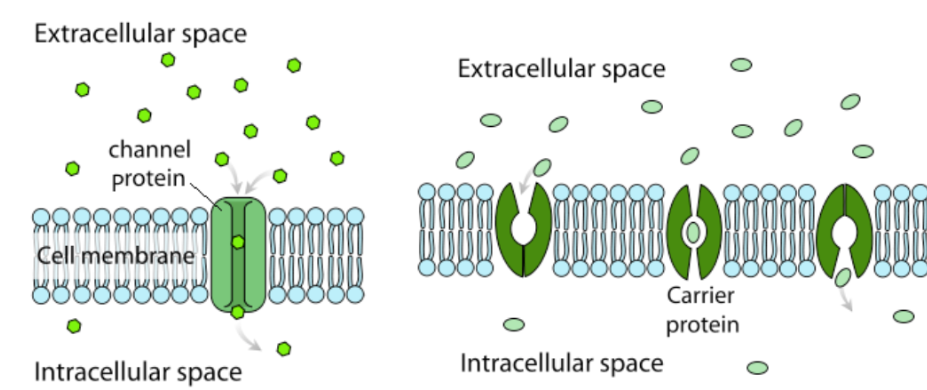
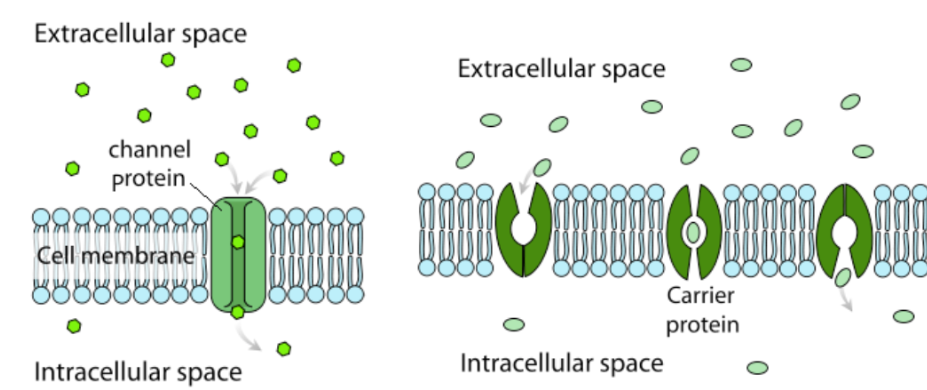
Even though a concentration gradient may exist for these substances, their charge or polarity prevents them from crossing the hydrophobic center of the cell membrane. Substances transported through facilitated diffusion still move with the concentration gradient, but the _________ proteins protect them from the _________ region as they pass through.
transport, hydrophobic
When equilibrium is reached, particles (do / do not) across the cell membrane. Nearly _______ numbers of particles cross the membrane in ______ directions.
do not, equal, both
Active transport
Type of transport that requires an input of energy to occur
goes from low to high concentration
carrier proteins are ___________ during active transport, and that’s what drives the movement.
phosphorylated (gain a phosphate from ATP)
What is bulk transport?
Movement of large particles or large amounts of material using vesicles.
Does bulk transport require energy?
Yes, it is an energy-intensive (active) process.
What does a macrophage do?
Engulfs and digests pathogens and cellular debris.
What is endocytosis?
Process of bringing materials into the cell using vesicles.
What are the basic steps of endocytosis?
Membrane folds inward → forms pocket → pinches off → vesicle forms.
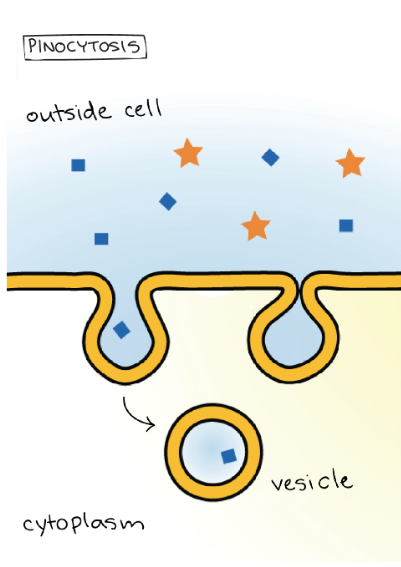
What is pinocytosis?
“Cell drinking” — uptake of extracellular fluid.
Why is receptor-mediated endocytosis efficient?
It allows uptake of rare molecules in low concentrations.
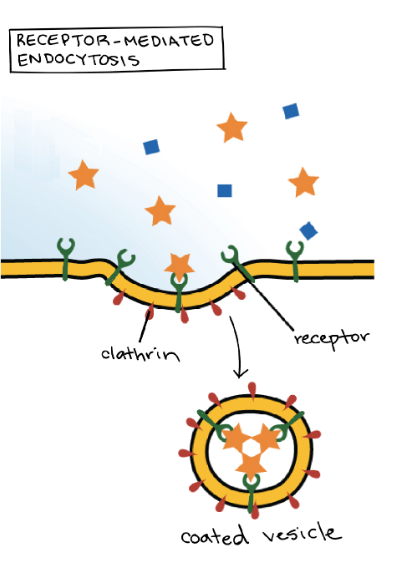
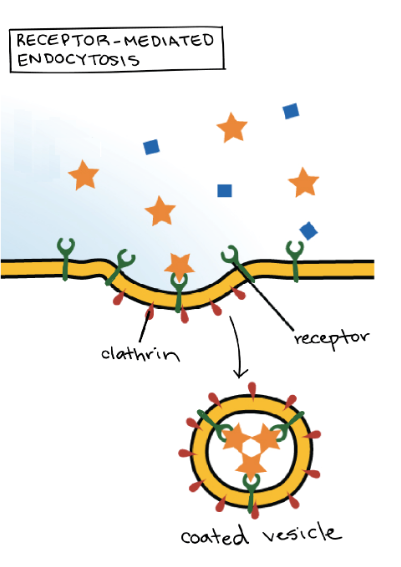
Receptor-mediated endocytosis
form of endocytosis in which receptor proteins on the cell surface are used to capture a specific target molecule.
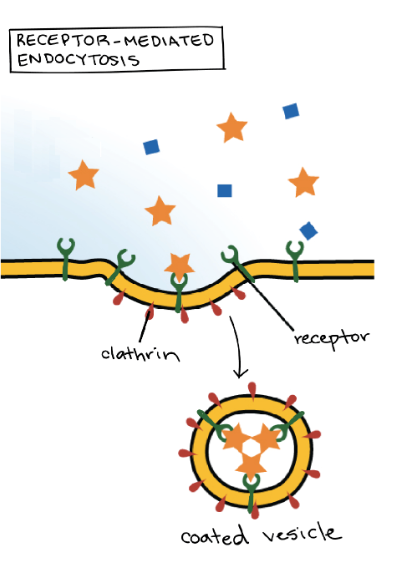
What happens after binding in receptor mediated endocytosis?
The membrane forms a vesicle containing the receptor and molecule.