Zoo unit 5
 Call Kai
 Learn
Learn Practice Test
 Spaced Repetition
 Match
Match Flashcards
 Knowt Play
1/48

There's no tags or description
Looks like no tags are added yet.
Name | Mastery | Learn | Test | Matching | Spaced | Call with Kai |
|---|
No analytics yet
Send a link to your students to track their progress
49 Terms
phylum
Arthropoda
Body segments and exoskeletons of the arthropod
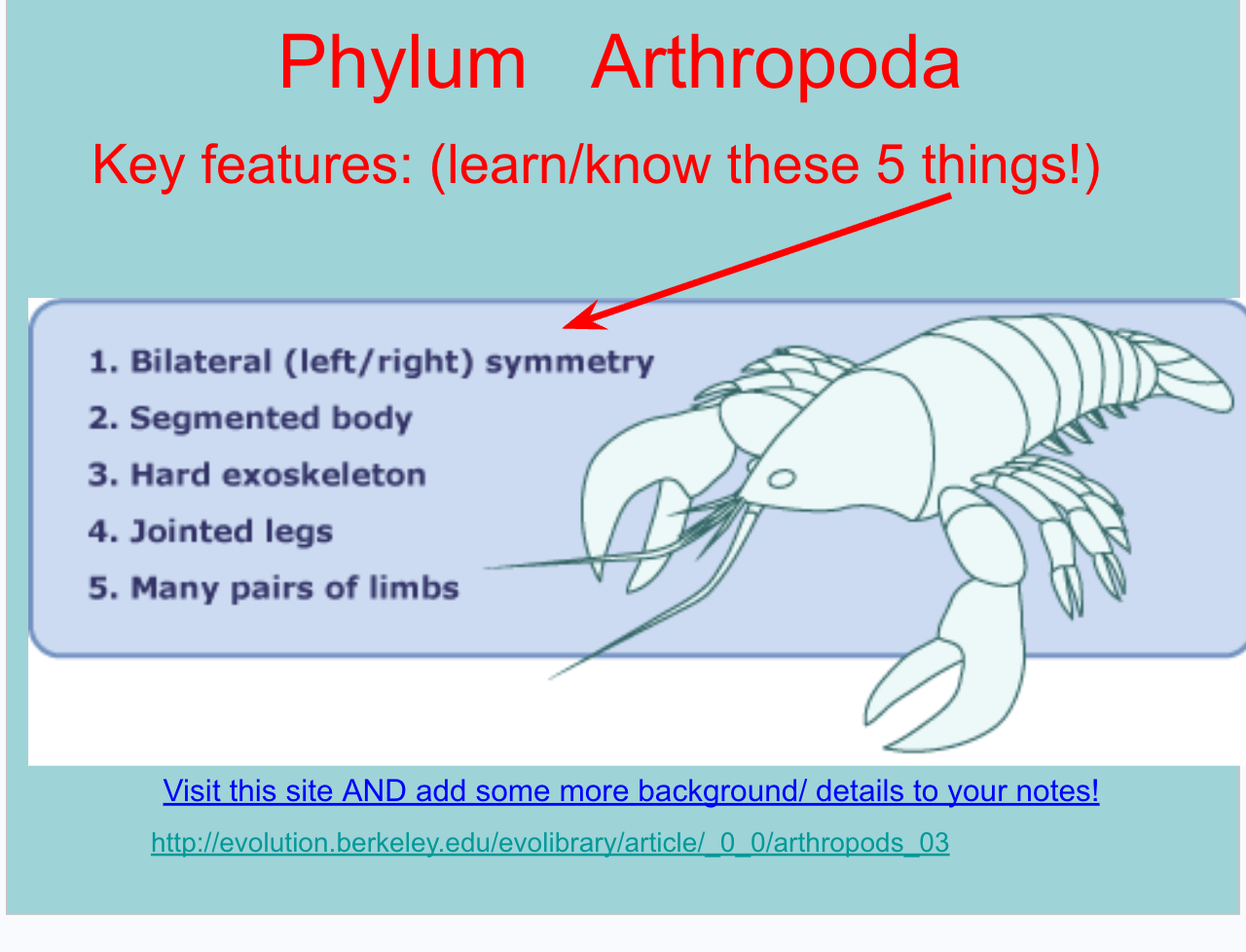
Arthropod is latin for "jointed foot"
all arthropods have jointed appendages
All Have a Segmented body
All have an Exoskeleton for protection & support – It is made of a water proof polysaccharide (complex carbohydrate) called CHITIN
The Exoskeleton is solid – It does not allow for the soft internal body of the Arthropod to actually grow in size – So it must be periodically shed – this is called molting. When the new exoskeleton is still soft the body of an arthropod grows in size
Internal system of a arthropod
They all have an Open circulatory system – this means the blood is not actually always contained inside blood vessels – it is free to circulate and diffuse around the living cells
Most Arthropods have colorless blood as the blood does not actually transport oxygen – Crustaceans are an exception to this – they have blue blood as the molecule that carries oxygen is copper based (not iron based like human red blood)
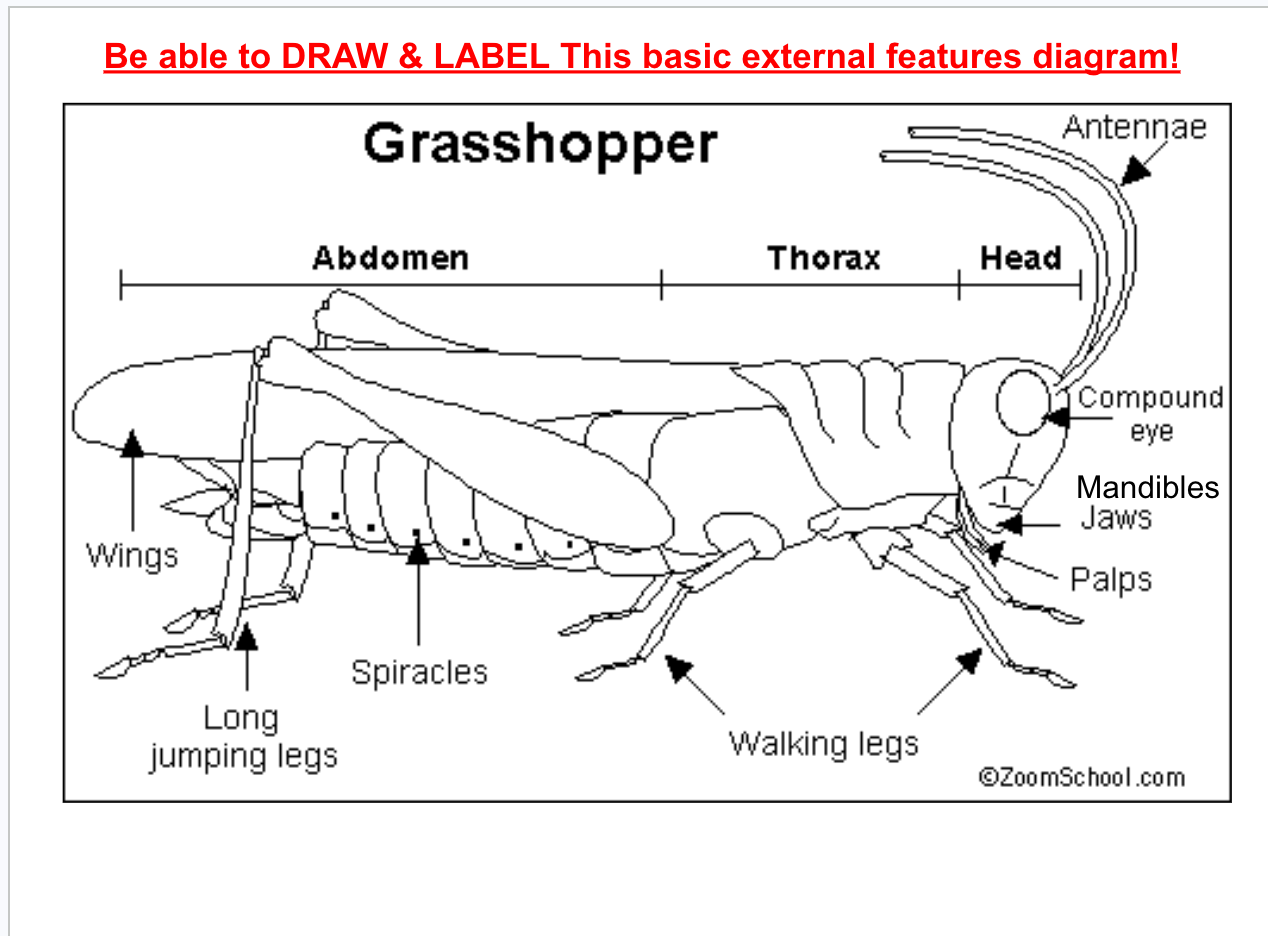
Ventilation (breathing) uses spiracles (breathing holes on the abdomen) and trachea (breathing tubes) some have a structure called a” book lung” (scorpions and spiders).
Note some aquatic arthropods (example – crayfish, crabs and shrimp) have gills instead – crabs can actually live out of water for some time because they can seal them off!
eyes of the arthropod
They have Compound eyes (these have many individual lenses – these are called facets.
Why is the Phylum Arthropoda so sucssesful
This phylum is a real “winning combination” More than 80%
of all animal life on this planet belongs to this one phylum:
There are Two main reasons for the success of the phylum
Diversity: The many structural differences in this Phylum (especially in feeding - mouthparts) allow for a huge variety of Ecological Niches on the planet.
2. Abundance: There are vast numbers of individuals because they can reproduce very quickly!
Learn this fun fact: A tiny arthropod crustacean called a copepod (Also called krill) which are < 1 cm in length is the most common animal (by actual of individuals) in the oceans !
The extinction of the Subphylum Trilobita
The trilobites went extinct along with 90% of all animal species, during a mass extinction event at the end of the Permian period.
This doesn’t mean that they were a failure. On the contrary, the trilobites survived for more than 250 million years (longer than the dinosaurs), and dominated seafloor ecosystems for much of this time.
What percentage of species went estinct in the permian extinction
Know that About 90 % of all species on Earth died in this extinction = The Permian extinction
Ecological niches in arthopods
Know that Arthropods have successfully evolved a huge variety of ecological niches.
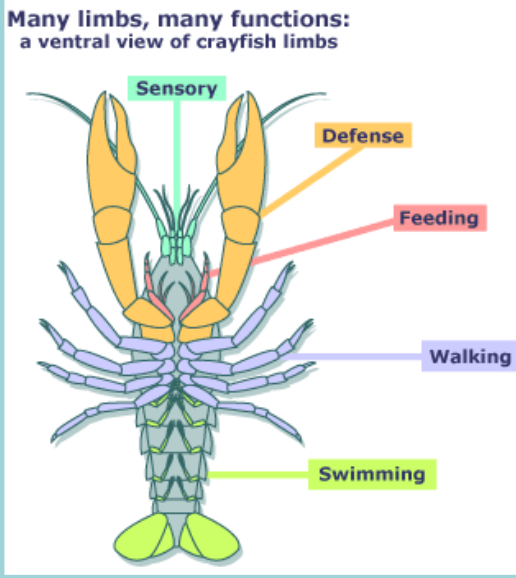
Know that in the Crustaceans appendages are modified to perform different jobs/functions
Arthropods have an Exoskeleton that helps protect them but it also constrains them!”
. While the exoskeleton is an incredibly efficient “suit of armor” for protection and movement, it imposes severe limitations on growth and total body size.
Baics of molting in crabs
Inside its exoskeleton, the arthropod grows.
When the exoskeleton finally gets too tight, the animal begins the molting process by puffing itself up and splitting the exoskeleton.
The new exoskeleton is still soft, so the arthropod wriggles out of the old armor very carefully to avoid damaging its still-vulnerable body.
Then, the arthropod waits — sometimes for days — without protection or body support for its new armor to harden before life as usual begins again.
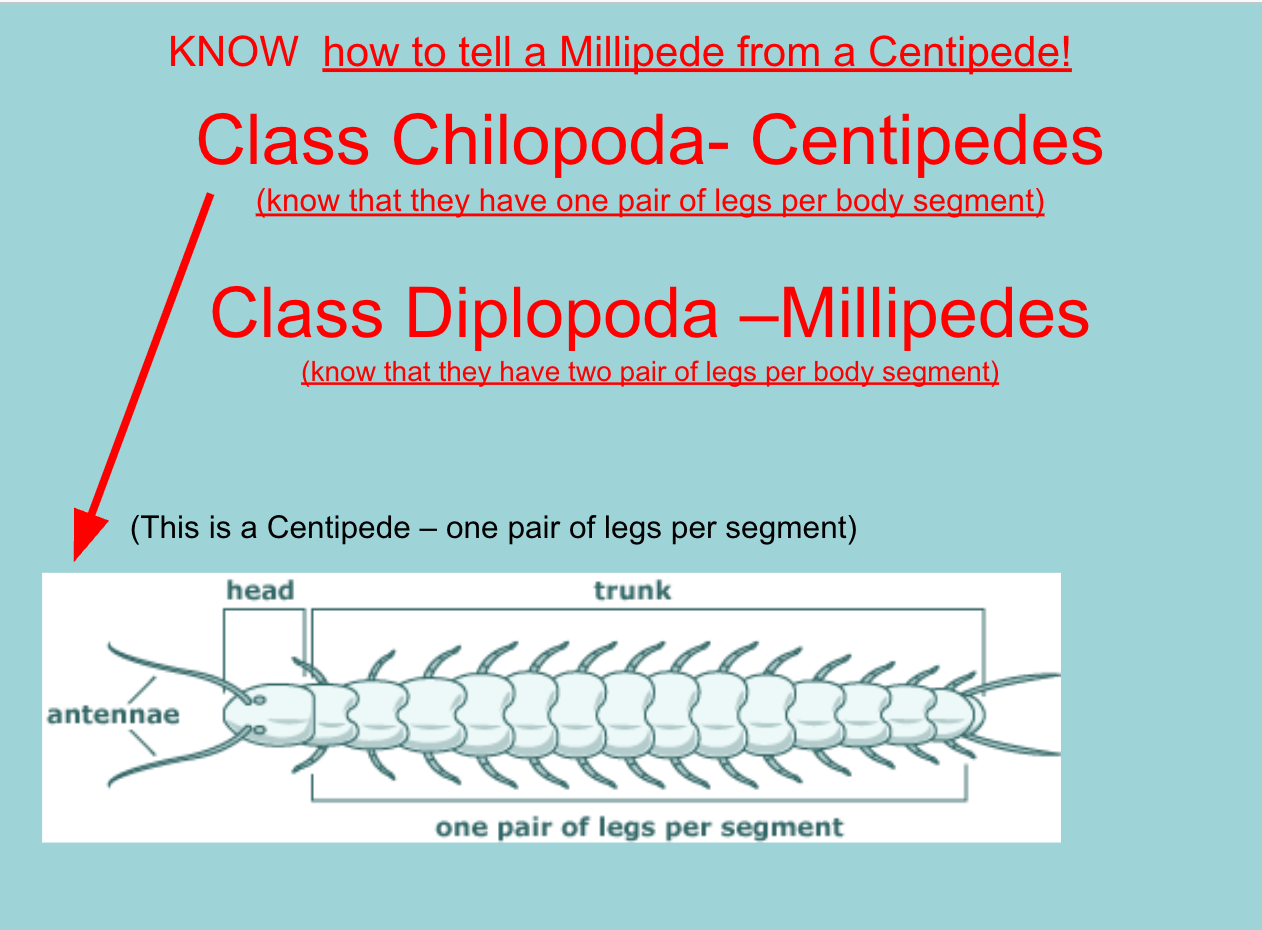
KNOW how to tell a Millipede from a Centipede!
Class Chilopoda- Centipedes
(know that they have one pair of legs per body segment)
Class Diplopoda –Millipedes
(know that they have two pair of legs per body segment)
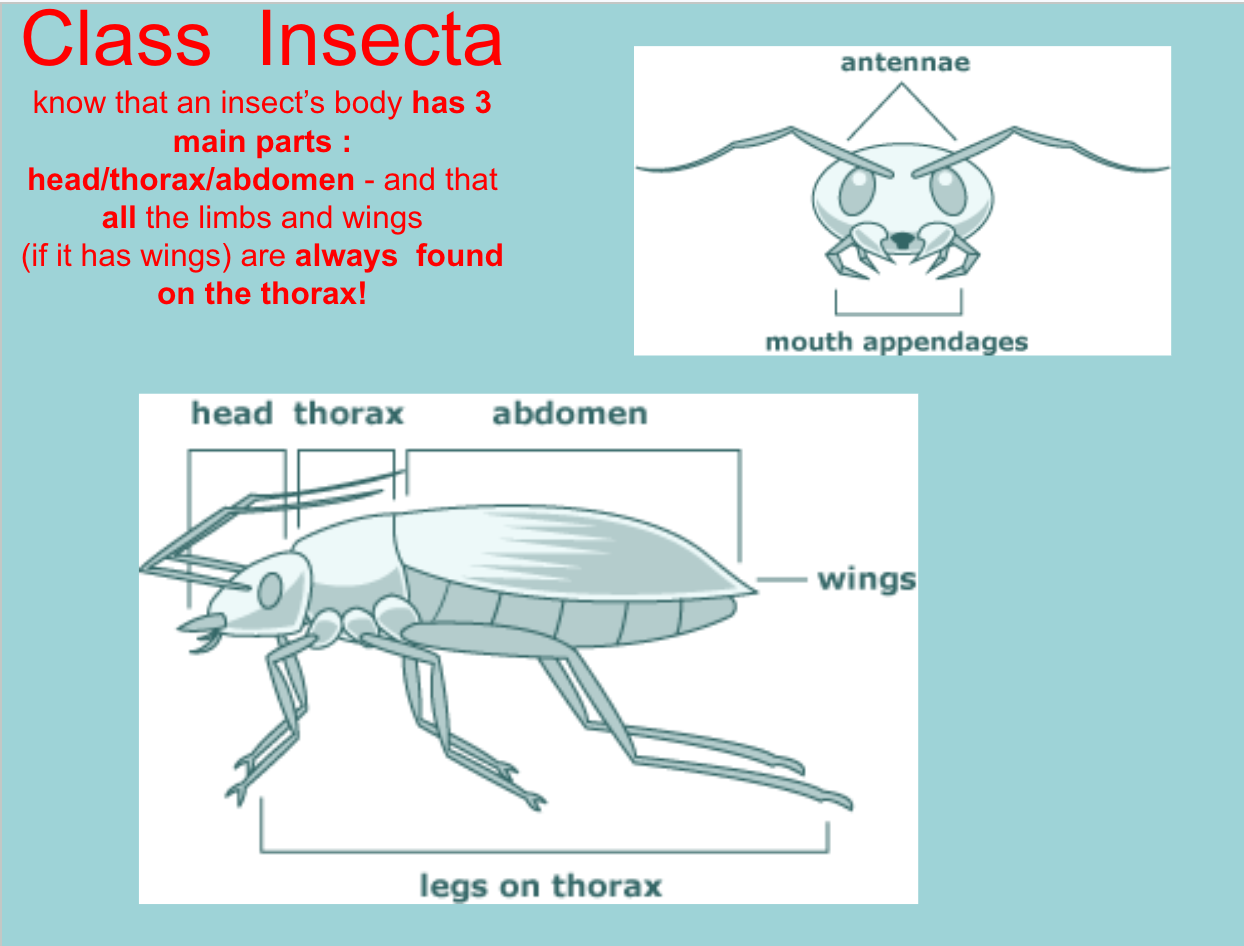
Class Insecta
know that an insect’s body has 3 main parts :
head/thorax/abdomen - and that all the limbs and wings
(if it has wings) are always found on the thorax!
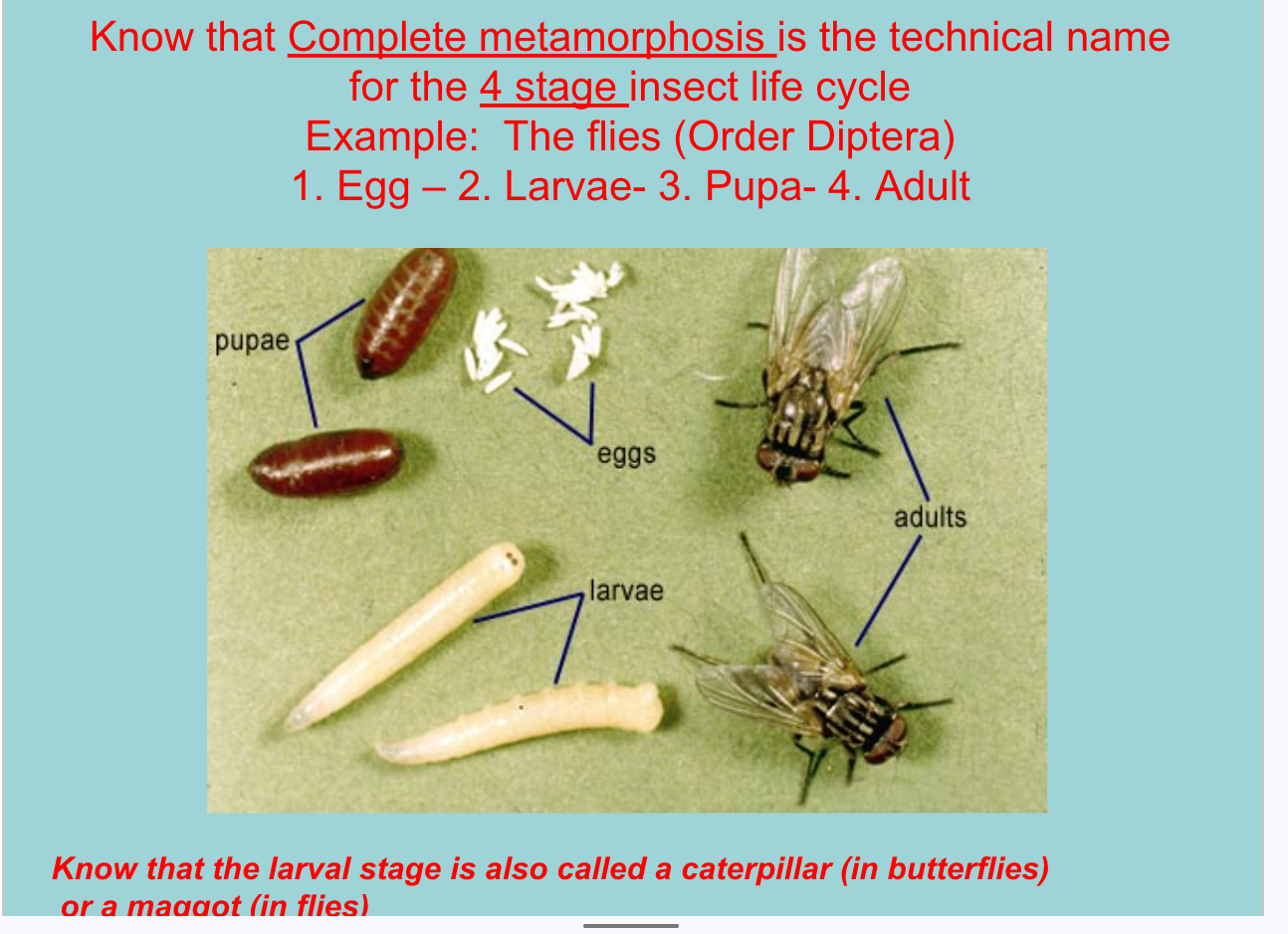
Know that Class Insecta Reproduction can have a 4 stage or 3 stage life cycle
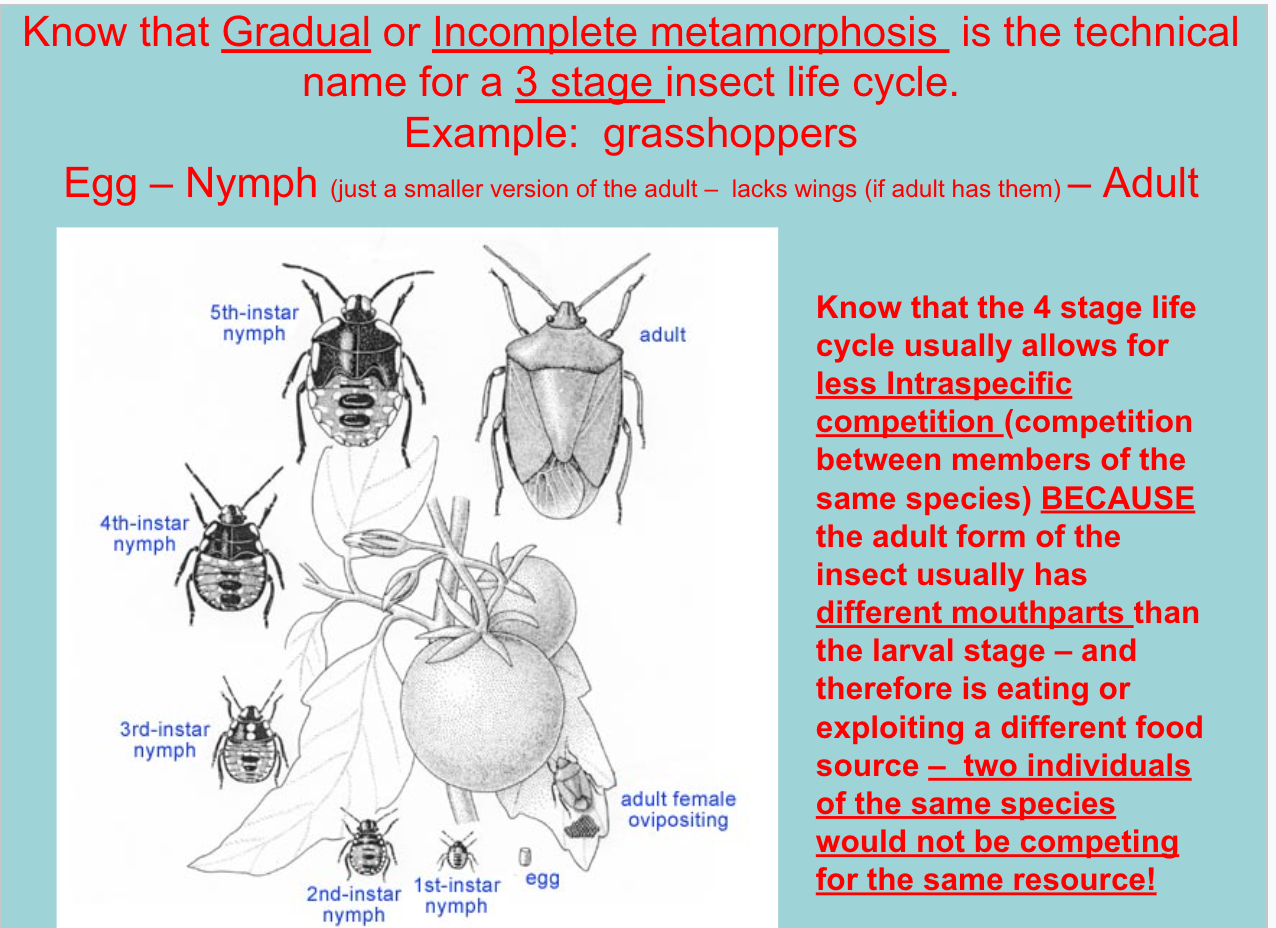
Know that the 4 stage life cycle usually allows for less Intraspecific competition (competition between members of the same species) BECAUSE the adult form of the insect usually has different mouthparts than the larval stage – and therefore is eating or exploiting a different food source – two individuals of the same species would not be competing for the same resource!
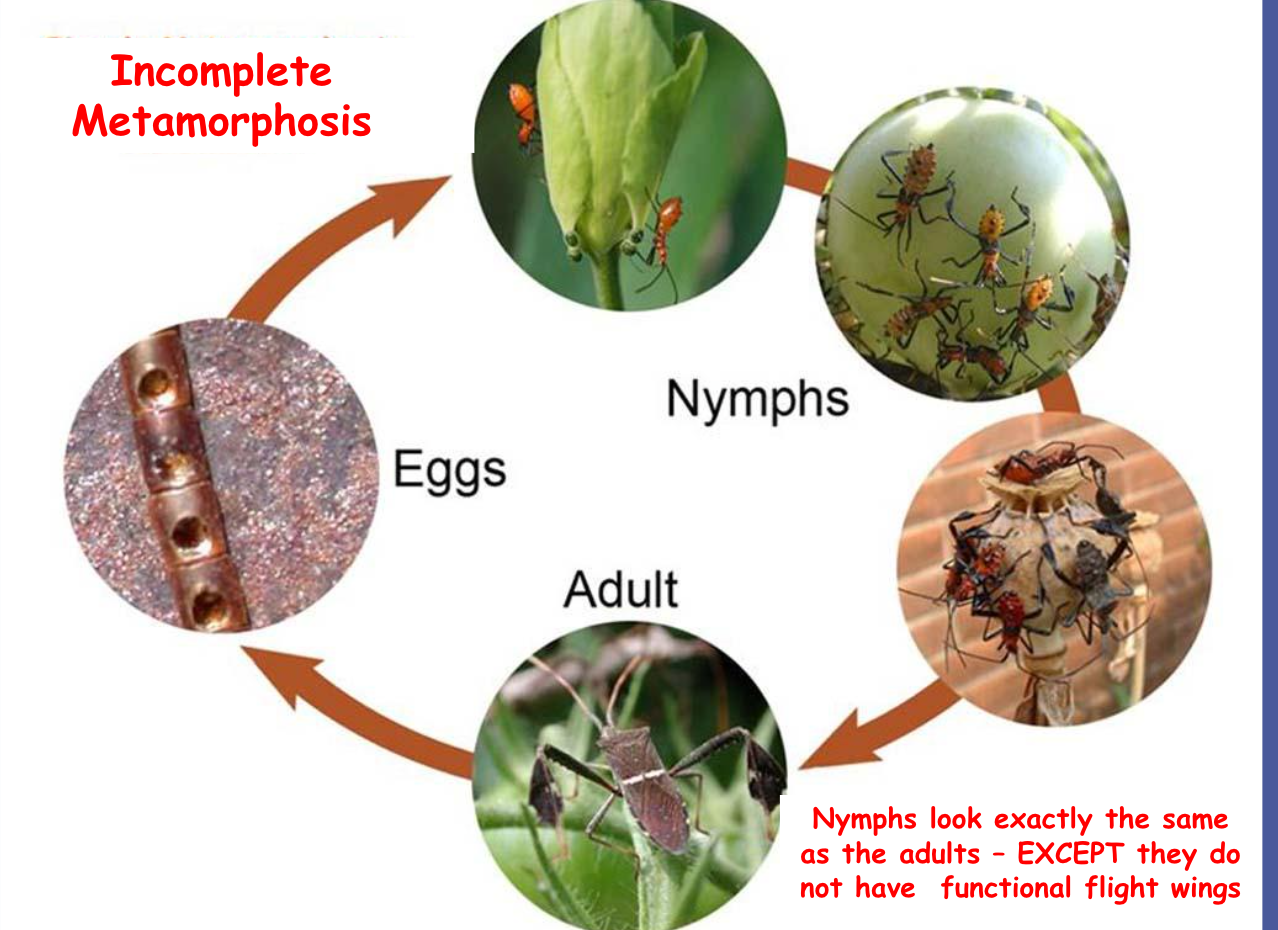
3 stage life - gradual metamorphisis/ incomplete
what color is insect blood
Know that Insect "blood" is colorless and doesn't carry oxygen. It does carry food molecules however
How do they get oxygen
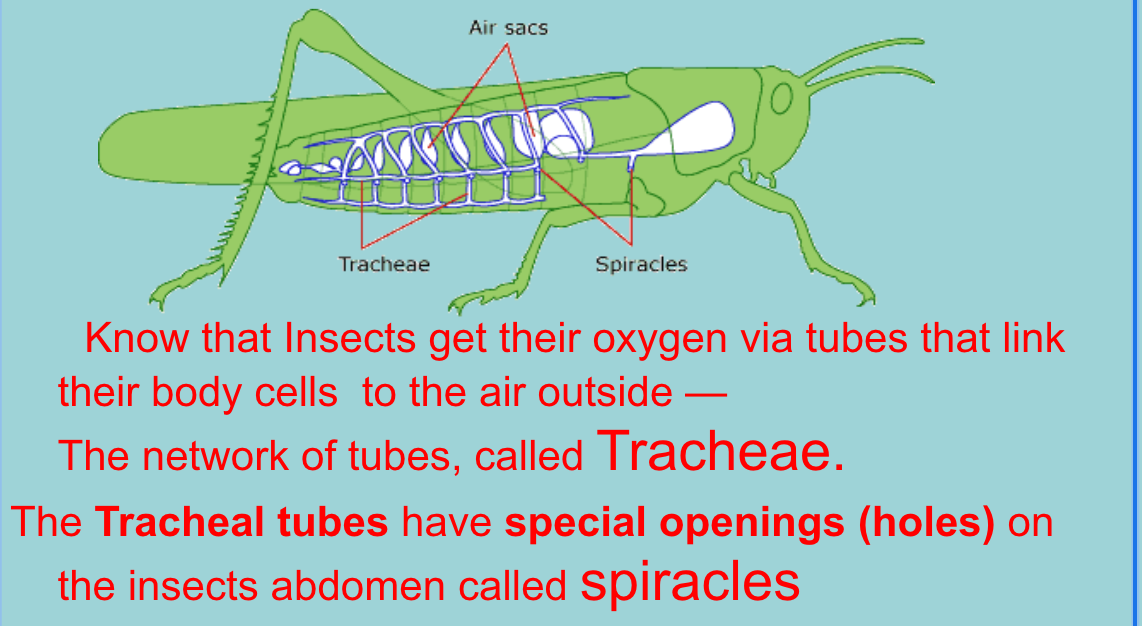
Be able to compare Crustacean respiration to Insect respiration and be able to answer this specific question:
“How is respiration different in the crustaceans? “
In crustaceans, respiration is usually done with gills or through the body surface in very small species, while insects breathe through a tracheal system that sends air directly to tissues.
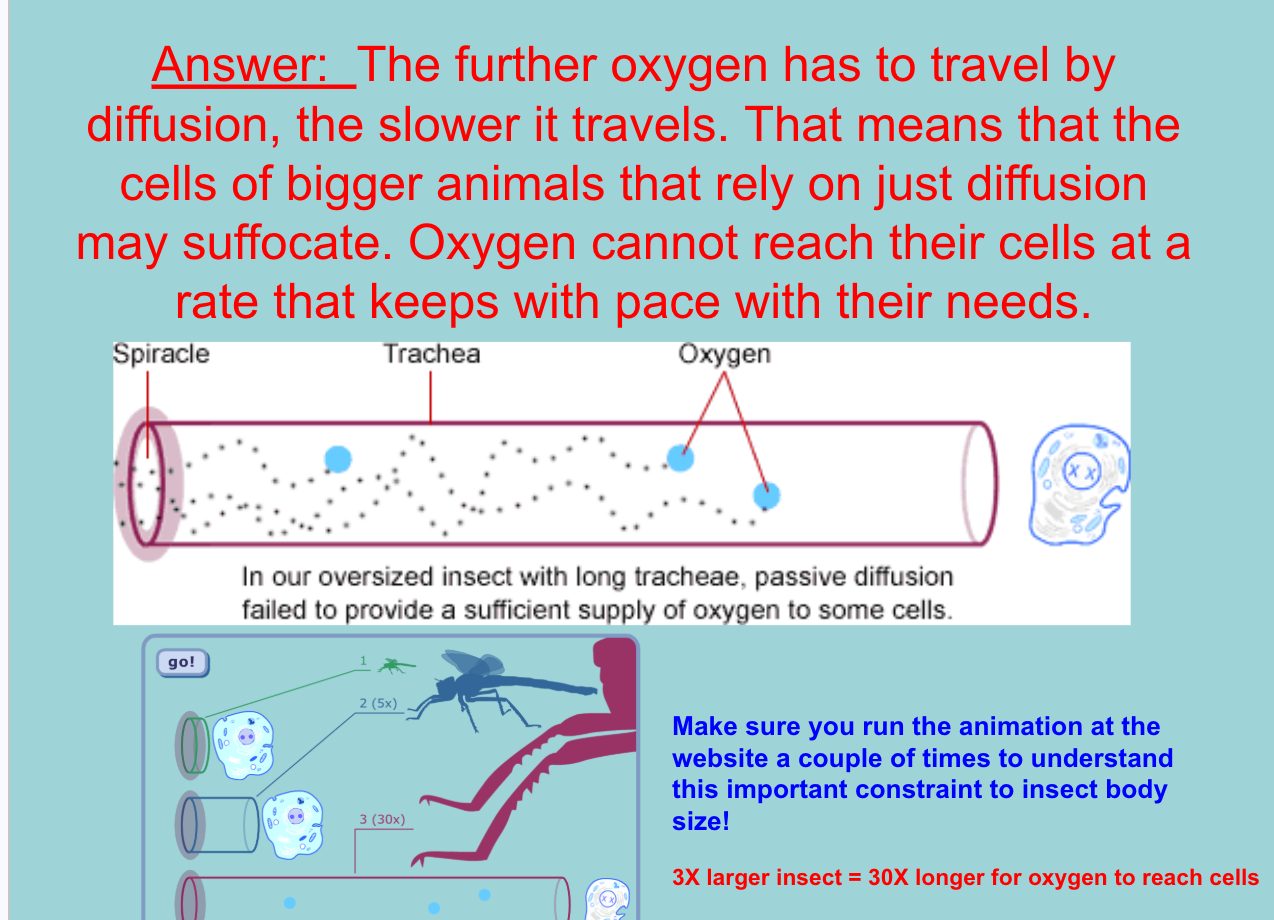
Why don’t we have insects as big as eagles?
Answer: The further oxygen has to travel by diffusion, the slower it travels. That means that the cells of bigger animals that rely on just diffusion may suffocate. Oxygen cannot reach their cells at a rate that keeps with pace with their needs. 3X larger insect = 30X longer for oxygen to reach cells
why were insects bigger 300 million years ago?
Know that Scientists estimate that 300 million years ago, the Earth's atmosphere contained 35% oxygen — compared with only 21% oxygen today!
SO insects were able to have bigger bodies back then even with the problem of diffusion and size!
Be able to STATE the 4 main types of insect mouthparts and be able to give an EXAMPLE for each!
Siphoning and Licking – butterfly/moth
Chewing- grasshopper/locust
Biting/Sucking - Mosquito
Lapping/Licking - fly
Be able to classify a Grasshopper
to the level of order
Kingdom: | Animalia |
Phylum: | Arthropoda |
Class: | Insecta |
Order: | Orthoptera |
Genus: Species
| Romalea guttata |
why cant the lubber fly
This is a large species of grasshopper that is incapable of flight (its wings are very small!). Also it can jump only short distances. So the lubber moves quite slowly and travels by walking.
Ovipositor
– a pointed structure on the last segment of the abdomen
(it is the egg layer!)
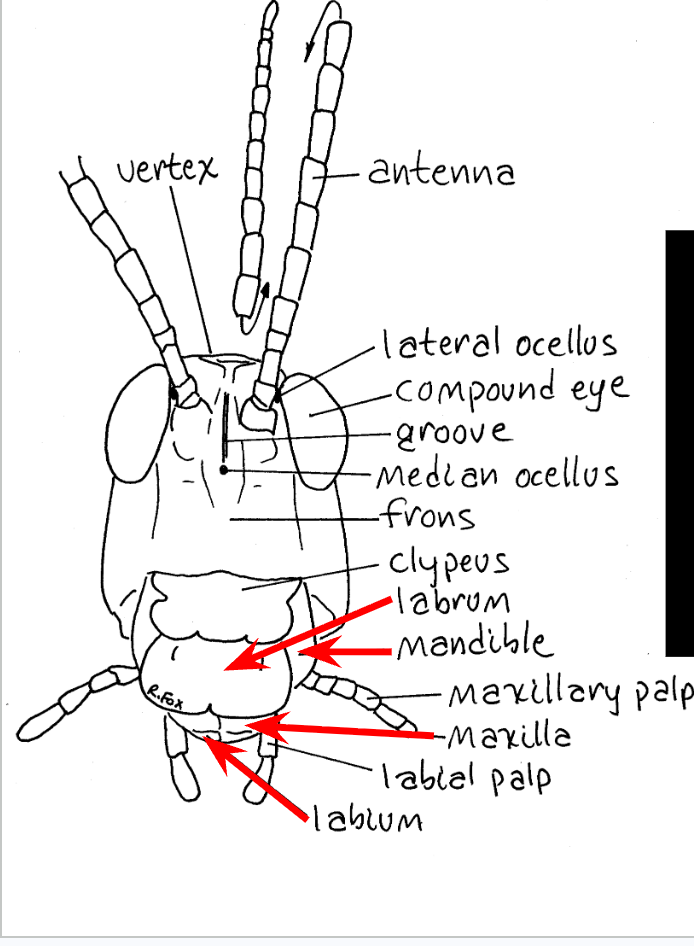
4 main mouth parts of a grasshopper
The stiff labrum (upper lip) and labium (lower lips) hold a leaf in place while the mandibles (jaws) which cut the food, assisted by the maxillas (finger like graspers) which tear off/manipulate pieces of the plant. Note that the labium and maxillae also has palps!
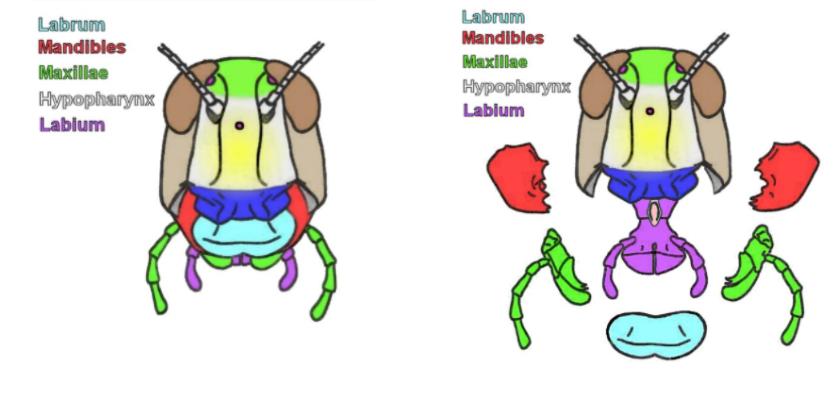
Can you Locate the
4 main mouthparts?
Karl von Frisch
I was the first person to discover how Bee communication works!
The European Honey bee
belongs to the insect order:
Hymenoptera.
Genus = Apis
species = mellifera
what does the colony consist of
Each colony is comprised of a queen bee, an egg-laying machine; workers (females), and drones (males).
“Bee able” to Model and explain in detail both dances - The Round dance and the Waggle dance
ethology
Ethology is the study of animal behavior. This involves observing an organism’s behaviors, interpreting what is observed, and research different organisms. Ethologists study and observe an organism’s reaction to the environment around them.
taxic behaviour
A Taxic behavior is a deliberate movement toward (positive +) or away from (negative - ) any external “stimulus” (factors such as light, water, sound, gravity)
Kinesis
A Kinesis is an increase in a random body movement (usually a “turning” or “tumbling” movement). In other words it is not a directional movement toward or away from the external “stimulus” (for example light, water)
* Note that an decrease/reduction in a random “turning” movement will actually cause a repositioning of an organism further away from the stimulus! (as it travels in a straight direction for more time)
Taxonomy
Kingdom – Animalia
Phylum – Arthropoda
Class - Insecta
Insects Are Arthropods
Insects are the largest Class in the phylum Arthropoda (there are more insects than any other type of Arthropod.)
Jointed appendages
Segmented bodies
Exoskeleton – this is made of a hard waterproof carbohydrate called Chitin.
KNOW that the big problem with the exoskeleton is that it must be molted before the soft tissue can grow/expand while the “new” exoskeleton is still relatively soft.
main characteristics of insects
Three body regions
– head, thorax, and abdomenOne pair antenna (head)
Six legs or 3 pairs (thorax)
One or two pairs of wings (thorax)
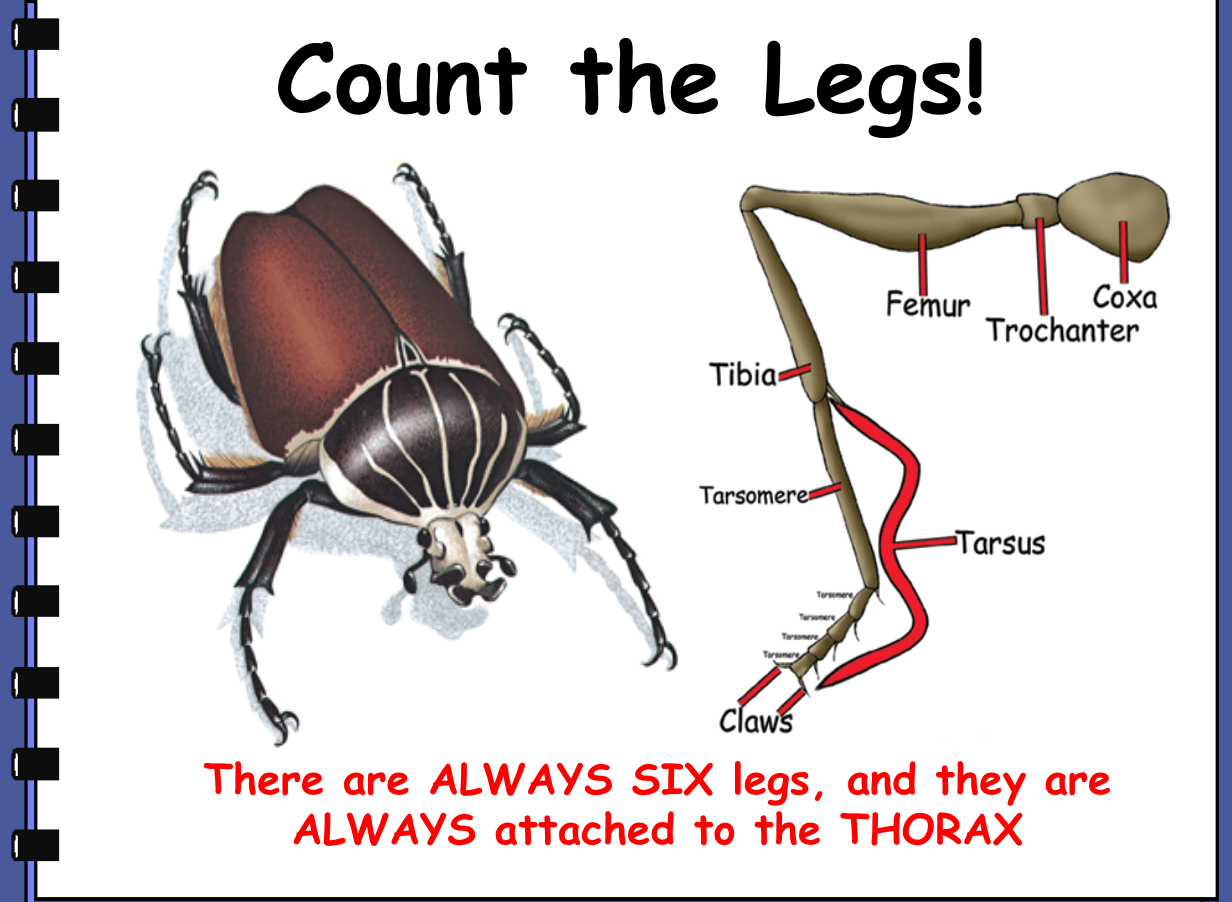
Antenna
One Pair on head
A Jointed appendage
Sensory (smell)
Also called “feelers”
Very sensitive to chemicals
Wings or No Wings
Most adults have 2 pairs of wings
If they have 2 pair of wings they are called forewings and hindwings
Some insects are wingless (example: fleas, ants)
The Flea = wingless
Some Wings Are Covered With Powdery Scales - butterflies and moths
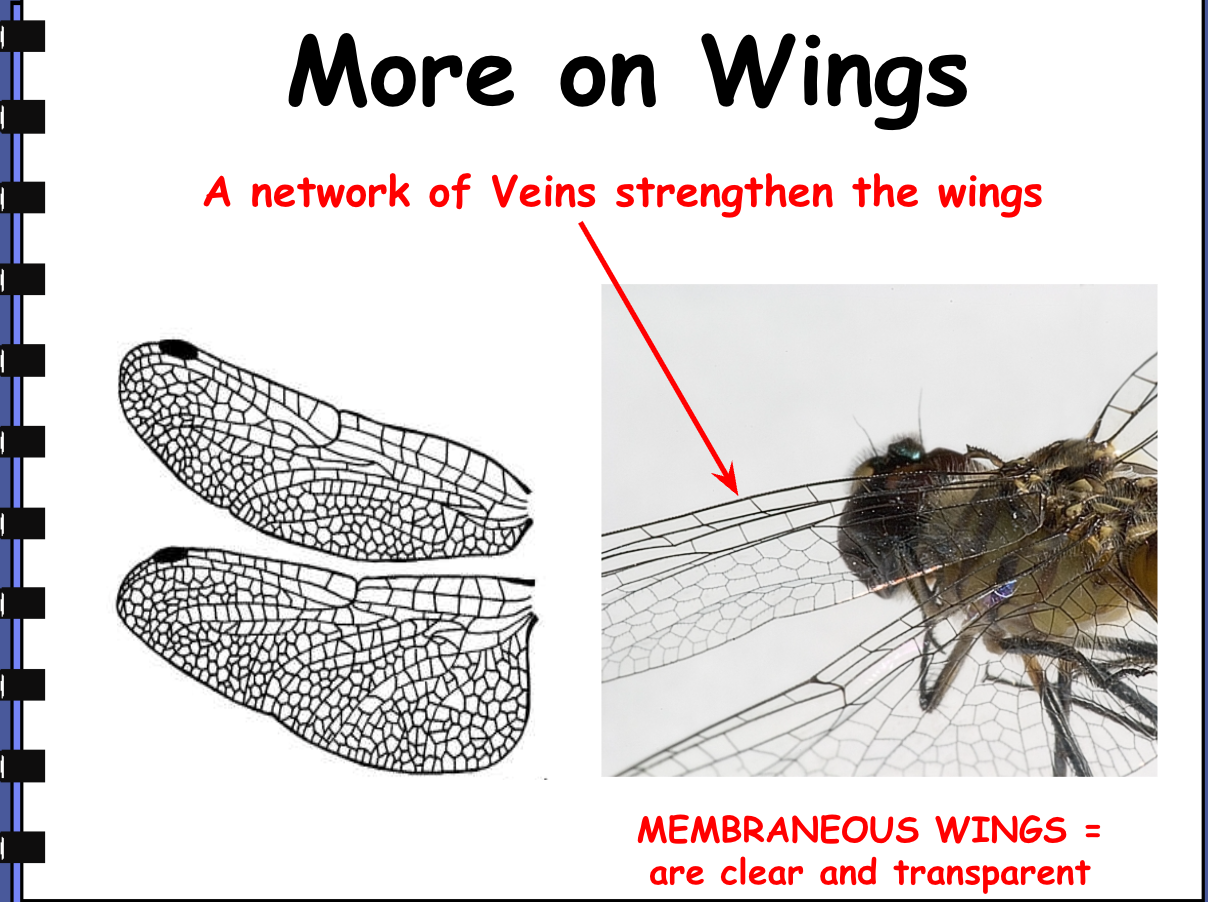
wings may be modified
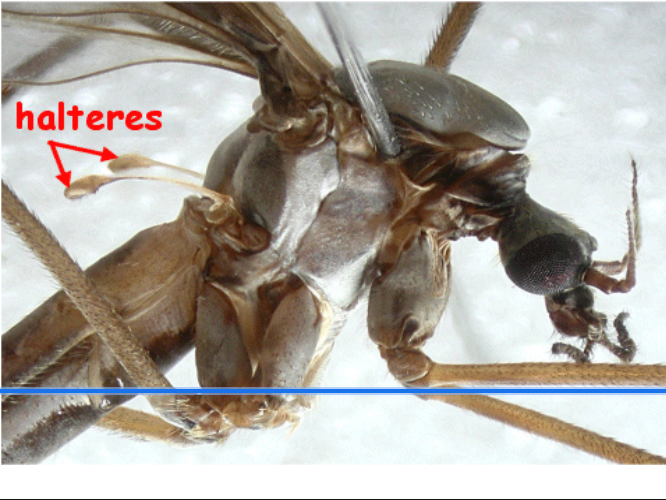
Know that in the Order Diptera (The flies) The 2nd pair of wings have been modified – they have evolved inot tiny club shaped structures that are called HALTERES
These are used for balance – it enables the insect to maintain level flight = hovering
Beetle Wings
Know that in all beetles the Forewing is very much modified = it has become a hard protective structure called the Elytra
A pair of Membranous hind wings – the flight wings are folded and protected underneath the Elytra.
Why did beetles evolve this protective “wing cover”
Their Ecological Niche – foraging in and out of foliage and sharp branches could very easily damage delicate wing membranes
Diptera
Know that Diptera only have one pair (two) of wings
But that they also have special Club-shaped halteres for balance
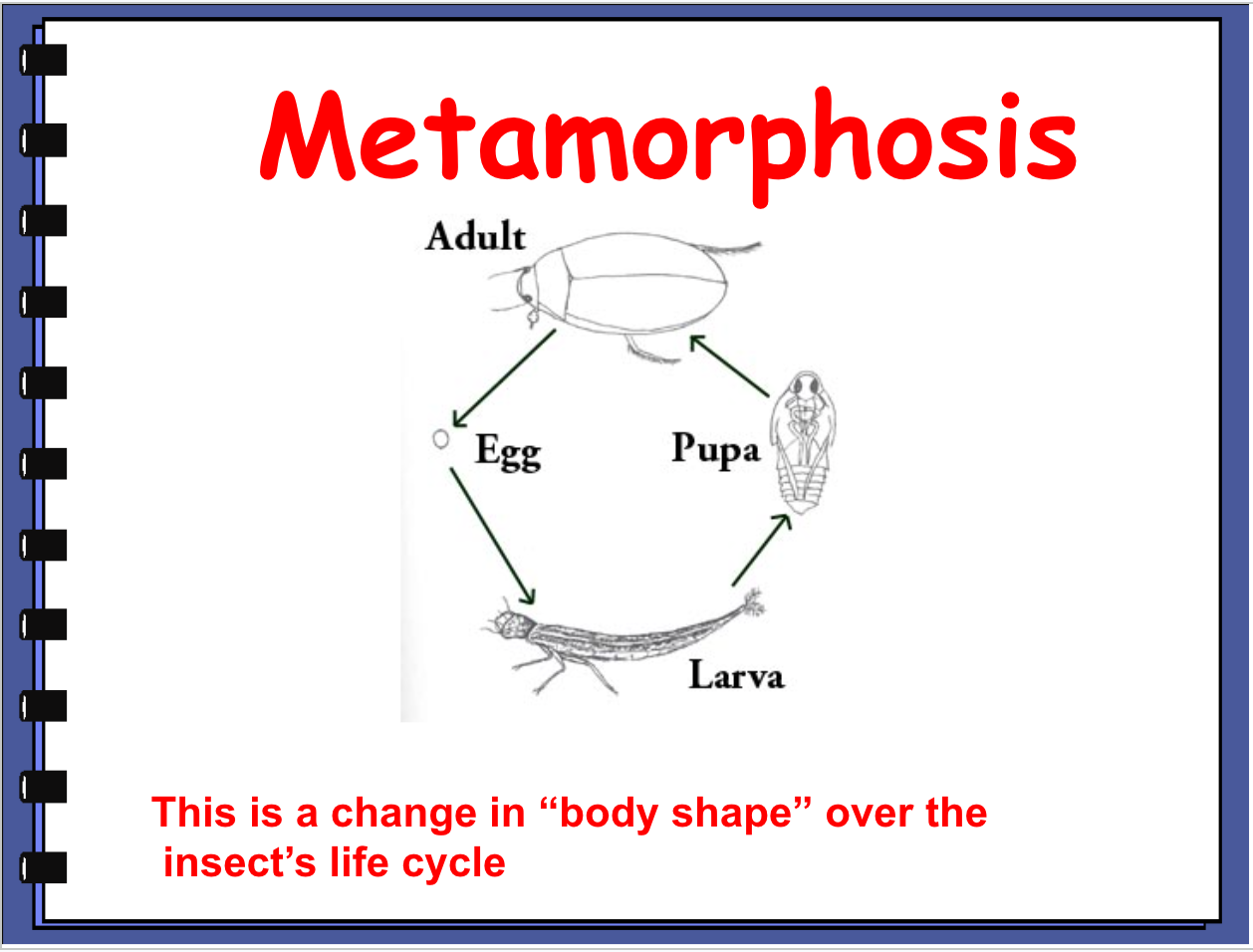
What evolutionary Advantage does complete metamorphosis have over incomplete metamorphosis?
The larval stage does not feed on the same food resource as the adult stage – its mouthparts are different – This means that there is
No INTRASPECIFIC COMPETITION between offspring and adults sharing the same habitat and food resources at the same