Paper 2
 Call Kai
 Learn
Learn Practice Test
 Spaced Repetition
 Match
Match Flashcards
 Knowt Play
1/309

There's no tags or description
Looks like no tags are added yet.
Name | Mastery | Learn | Test | Matching | Spaced | Call with Kai |
|---|
No analytics yet
Send a link to your students to track their progress
310 Terms
Does hexadecimal take up less space in a computer’s memory than binary
No, because it will still be represented using binary in a computer’s memory, so it will take up the same amount of memory space
What is the largest decimal number that can be represented using 5 bits
31
What is represented using binary
All data and instructions
Why is hexadecimal often used instead of binary
It’s easy for people to read, takes less time to type, more compact, reduces the risk of typing errors
How many bits does standard ASCII use for each character
7
How many different characters can be represented with standard ASCII
128
Advantages of UNICODE
Can represent a wider range of characters from other alphabets and more symbols
12KB in bits
96000b
Why do computers use binary
Computers are made from transistors with two states: on if a current is flowing through the component and off if it’s not, so it’s represented with either 1 or 0
Examples of bitmap image file formats (pixels)
PNG, JPG, GIF
Example of vector image file format (algorithms)
SVG
Pixel
A single point in an image
Image resolution
The concentration of pixels within a specific area
How to calculate image resolution
Width x height
PPI
Points per inch
DPI
Dots per inch
Colour/bit depth
Number of combinations
Bit depth to represent an image with 3 colours
2
Image file size in bits
image resolution x colour depth
Metadata
A set of data that describes and gives information about other data
ADC
Analogue to digital converter
DAC
Digital to audio converter
Amplitude
Height of a wave
How are soundwaves converted (5 bp)
Analogue sound is received by a microphone
Converted into an electrical analogue signal
The amplitude is measured at regular intervals (samples)
Values are rounded to a level (quantisation)
Values are stored as a series of binary numbers
Why does sound need to be converted to a digital format before it can be stored on a computer system
Sound is analogue and computers use discrete values
Sample resolution
Number of bits per sample
Advantage of a high sample resolution
Better sound quality
Disadvantages of a high sample resolution (2)
Takes up more storage space, will take longer to download
Sampling rate (unit)
Frequency with which you record the amplitude of a sound (Hz)
Hz
One sample per second
Sound file size in bits
Sampling rate x resolution x duration in seconds
Why is compression used (3)
Reduces the amount of storage to save files, uses less bandwidth (saves money), makes it faster to transmit
Lossy compression
Where files are compressed by permanently removing some of the detail
Disadvantage of lossy compression
Can decrease quality
Uses lossy compression
JPEG, MP3
Lossless compression
Reduces file size without losing any info
Why is lossless compression important
Essential for text and data files
Uses lossless compression
PNG, GIF
Feature needed for Run Length Encoding (RLE)
Lot of runs
Important things for huffman encoding
Characters with the lowest frequencies should be combined, table sorted by frequency
Hardware
The physical components that make up a computer system
Software
The programs that are stored and executed by a computer system (hardware)
System Software
Programs that provide a platform for other software to run on and manages computer systems
Application Software
Programs that enable a user to perform a specific task
Operating System (OS) Software
A group of programs that manages computer hardware, users, and the resources used by software
How does the OS manage processors?
It allocates where and for how long tasks/programs will run on the processors
Multi-Tasking
Where an OS manages simultaneous tasks
How does the OS manage memory?
It allocates and records where in the memory programs are stored
How does the OS manage input/output devices?
It controls the sending of data from the memory to the device driver
Device Driver (eg printers, monitors)
A program that controls peripheral devices
Interrupts
Signals sent to the CPU by external devices to indicate an event needs immediate action
How does the OS manage applications?
It runs programs to install applications and allows the user to interact with them
Graphical User Interface (GUI)
A visual system that allows users to interact with electronic devices
Application Programs Interface (API)
Allows applications to communicate with the OS
How does the OS manage security?
It keeps the computer system, application programs, and user data secure
User Management/ Access rights
Controls access to a computer by setting up passwords/different users with different privileges to files
What is encrypted for security management?
Hard drives and removable media
How does the OS protect the memory?
It prevents programs from overwriting eachother in the RAM
Utility Software
System software designed to help maintain, enhance, and troubleshoot a computer system
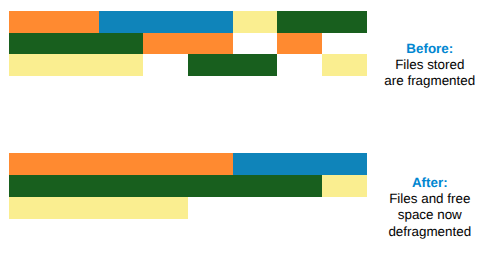
Disk defragmentation
Reorganises files so they are stored together to make them easier to access and optimises disk performance
Encryption software
Uses an algorithm and key to transform plaintext into ciphertext to keep sensitive data safe
Embedded system
A computer system with a specific function built into a physical device
Read Only Memory (ROM)
Non-volatile memory that can’t be changed
What are embedded systems used for?
Devices with simple inputs such as microwaves
Compression software
Reduces the size of a file
Low-level languages
A programming language that is closer to machine code and the hardware’s instructions
High-level languages
A programming language that is closer to human language, designed for ease of use, readability, and portability across different computer architectures
Processors
Can only execute instructions in machine code
Can you use machine code instructions on any device?
No, machine code instructions are specific to a particular processor
Machine code
The lowest-level programming language, specific to a processor, consisting of binary instructions that a computer’s CPU can directly execute
3 advantages of using a high level language
Easier for humans to debug as it’s closer to English, has data structures, portable between different hardware
2 disadvantages of using a high level language
Slower to execute, needs to be translated into machine code
2 advantages of low level languages
Faster and more efficient to execute, gives more control over specific hardware components
2 disadvantages of low level languages
Harder to read and write, not portable
Why might a programmer who can use high and low level languages use high level
Built in functions/libraries, data structure, easier to read and debug
What type of device is assembly language often used
Embedded systems
What does an assembler do?
Converts assembly language into machine code
How does a compiler work
It takes the source code and translates it all at once producing executable object code. It produces a list of syntax errors after translation
Why are compilers often used for copyright software
The end user can’t see the source code when the program is distributed and doesn’t need a compiler installed
How do interpreters work
Translates source code line by line and executes it immediately. If there is a syntax error it will stop
2 Disadvantages of using interpreters
End users can see the source code, interpreter software need to be installed
Which are faster, compilers or interpreters
Compilers
How does an assembler work
It translates all of the assembly code at once and outputs machine code. Users only need the compiled program
Central Processing Unit (CPU)
Processes and executes instructions
What is stored in the RAM?
Program instructions and data
Registers
Stores small amounts of data used when executing/processing instructions to be quickly accessed
Arithmetic Logic Unit (ALU)
Performs arithmetic, logical and shift operations
Control Unit (CU)
Controls and coordinates the execution of instructions by sending control signals, decodes instructions
Clock
Synchronises all CPU operations, controls the number of executed instructions per second, sends regular electronic pulses
Cache
Stores frequently used data and instructions in memory for fast access
Clock frequency (unit)
Number of clock cycles per second (Hz)
How does clock speed affect CPU performance
The greater the clock speed, the more FDE cycles/executed instructions per second, increasing peformacne
How does cache size affect CPU performance
Less need for the CPU to access the RAM (slower to access), improves the speed of performance, allows more data to be held
How does the number of processors affect CPU performance?
Allows more instructions to be executed simultaneously per second, different cores can deal with different types of instructions
Rank types of memory/storage by capacity (largest first)
Secondary storage, RAM, cache, registers
Buses
Used to transfer data/instructions between components in the CPU
Address bus
Stores the address of the memory/device controller location
Data bus
Carries data throughout the computer system
Control bus
Carries control signals (from the clock) to control all CPU activities
How is main memory used
It stores data/instructions whilst a program is being executed. Every memory location has a unique address so it can be found later when needed