ASTR 42 Final Exam
 Call Kai
 Learn
Learn Practice Test
 Spaced Repetition
 Match
Match Flashcards
 Knowt Play
1/111

There's no tags or description
Looks like no tags are added yet.
Name | Mastery | Learn | Test | Matching | Spaced | Call with Kai |
|---|
No analytics yet
Send a link to your students to track their progress
112 Terms
What was the first observational evidence that the geocentric model of the Solar System was wrong?
A. Some planets were observed to undergo phases, like the Moon does.
B. Some planets were observed to undergo retrograde motion in the sky.
C. The Sun stopped rising in the East.
D. Two planets were always observed in front of the Sun.
B
Recall that the “eccentricity” of a perfectly circular orbit is zero (e = 0). With what eccentricity would a planet be in an open orbit? In other words, with what orbital eccentricity would a planet not repeatedly orbit the Sun?
e > 1
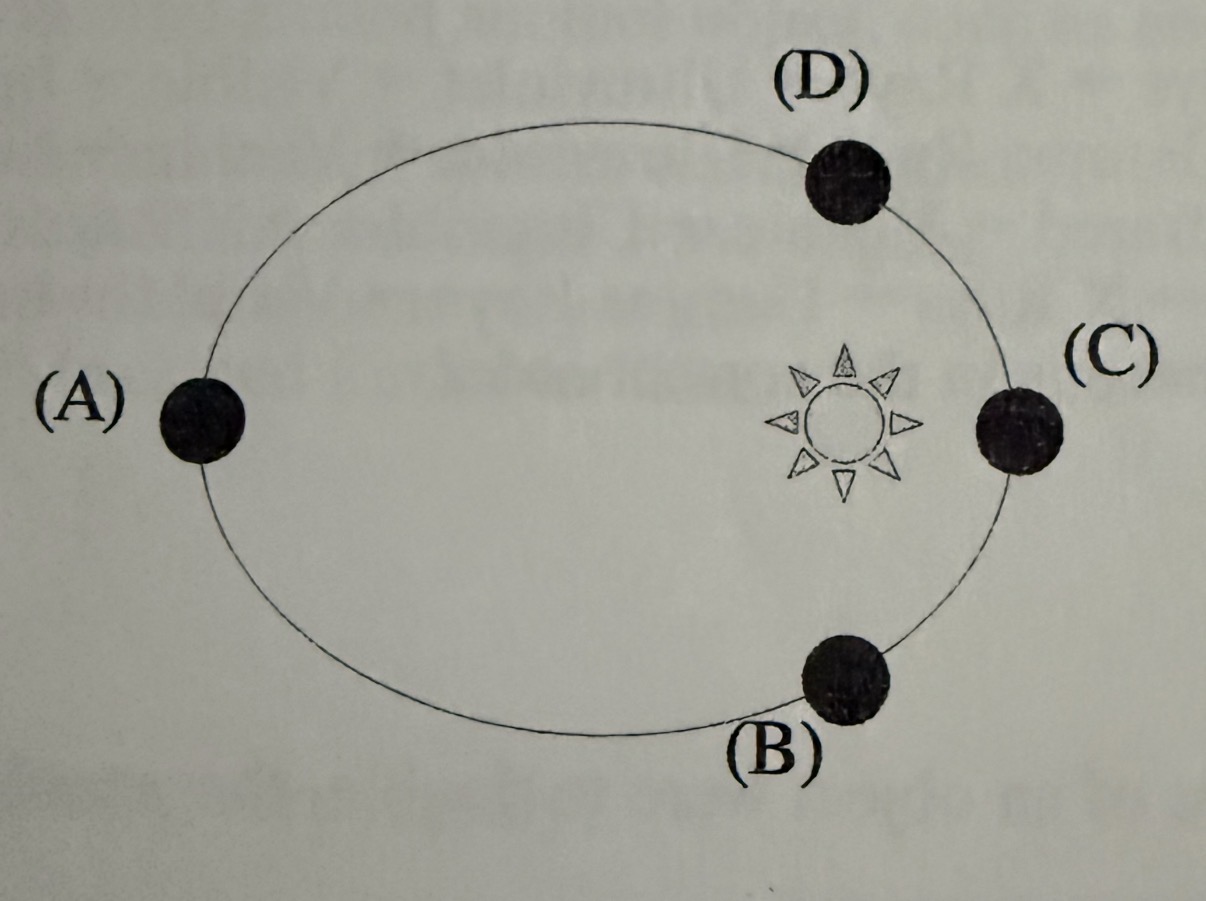
Consider the following diagram of a planet’s orbit around a star. At which position is the planet moving the slowest?
A
If a new planet were to be discovered orbiting the Sun at a distance of 2 AU from the Sun, what would be its orbital period? In other words, if the planet is 2x Earth’s distance from the Sun, how many years would it take for that planet to complete one orbit around the Sun?
A. ½ of a year
B. 1 year
C. 2 years
D. 4 years
E. NONE of these are correct
E
What determines the resolution of a telescope?
A. The size of the telescope
B. The wavelength of the light being observed with the telescope
C. Both A & B are correct
D. NONE of the above
C
Which of the following telescope resolutions is the best?
A. 25”
B. 250’
C. 2.5°
D. NONE: these are all the same resolution
A
Scientists use the ___________ temperature scale, which sets the point where all thermal motion stops equal to a temperature of 0.
Kelvin
The regions of the light spectrum, in order of highest to lowest energy, are:
A. Gamma Rays → X Rays → Ultraviolet → Visible → Infrared → Radio
B. X Rays → Gamma Rays → Ultraviolet → Visible → Infrared → Radio
C. Radio → Infrared → Visible → Ultraviolet → X Rays → Gamma Rays
D. Ultraviolet → X Rays → Gamma Rays → Visible → Infrared → Radio
A
If the temperature of an object were to double, the wavelength at which it emits the most amount of radiation will:
A. Double (2x)
B. Quadruple (4x)
C. Be cut in half (1/2x)
D. Be reduced to a factor of 4 (1/4x)
C
If the temperature of an object were to double, the total power radiated by the object will increase by a factor of ______.
16
An electron that transitions from a higher energy state to a lower energy state _________________.
emits light
Consider a star that is emitting light with a wavelength of precisely 486.1 nm. If that star is moving toward you with a speed of 600 km/s, at what wavelength will you detect the light emitted by the star?
485.1 nm
How might you detect that a star is in orbit around another object, such as another star or a planet?
A. Its observed spectrum will be shifted toward shorter wavelengths.
B. Its observed spectrum will be shifted toward longer wavelengths.
C. Individual lines in its spectrum will appear very wide.
D. Its observed spectrum will shift back and forth over time.
D
How might you detect that a star is rotating very rapidly?
A. Its observed spectrum will be shifted toward shorter wavelengths.
B. Its observed spectrum will be shifted toward longer wavelengths.
C. Individual lines in its spectrum will appear very wide.
D. Its observed spectrum will shift back and forth over time.
C
![<p>Which arrow represents an electron transition that <strong><em>emits </em></strong>violet light? [HINT: the energy of this violet light is 3 eV]</p>](https://assets.knowt.com/user-attachments/e4c5dd89-e34d-41ea-88fd-3a17cc4e6eff.jpg)
Which arrow represents an electron transition that emits violet light? [HINT: the energy of this violet light is 3 eV]
B
Copernicus realized that ________ is never found farther than 47° from the Sun in the sky.
Venus
Copernicus realized that ________ is never found farther than 28° from the Sun in the sky.
Mercury
How many different colored filters are required in order to measure the temperature of a star using a telescope?
2
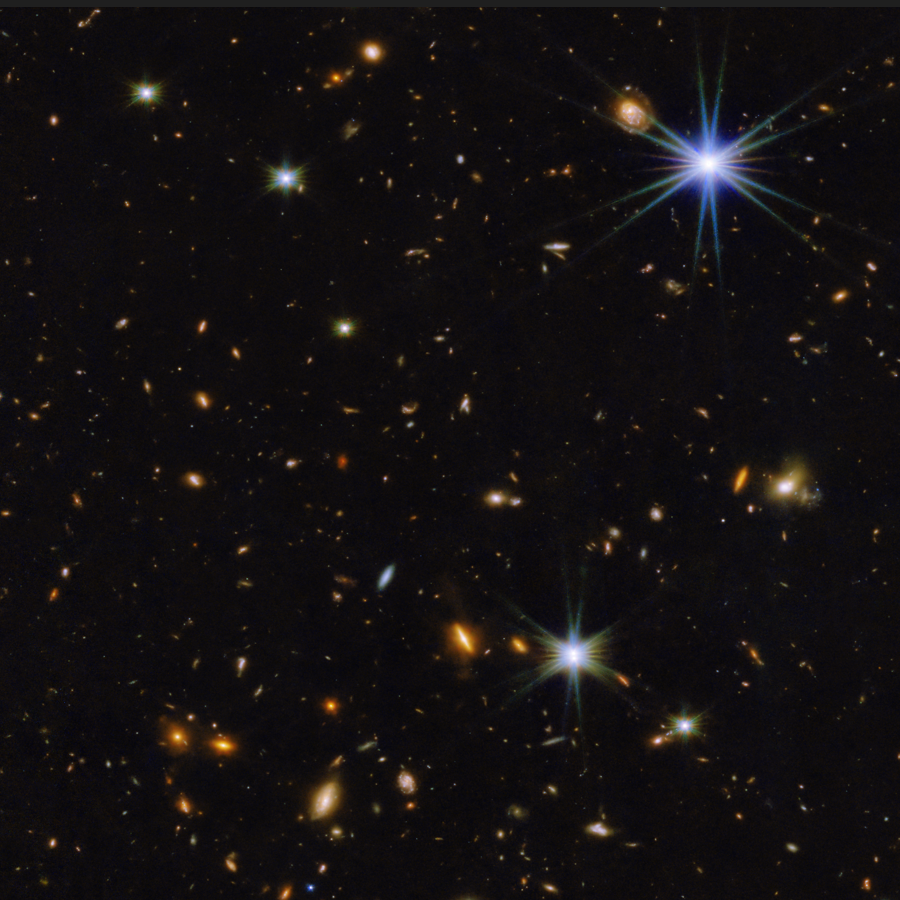
The radial patterns around the bright stars in this photo are called diffraction spikes and are caused by __________________.
A. the star’s magnetic fields
B. the structure of the telescope that was used
C. the high amount of power radiated by the star (flux)
D. the black-body curve of the star
B
Chromatic aberration is the separation of colors in the light focused by what type of telescope?
Refracting
Which type of telescope focuses light using glass lenses?
Refracting
The wavelength at which a star emits the most light depends on which three properties of the star?
Radius, surface temperature, rotation rate
The color of a star is an indicator of the star’s ___________________.
surface temperature
A star produces an absorption spectrum. Which part of the star provides the bright continuum?
The surface
A star produces an absorption spectrum. Which part of the star produces the dark absorption lines?
The atmosphere
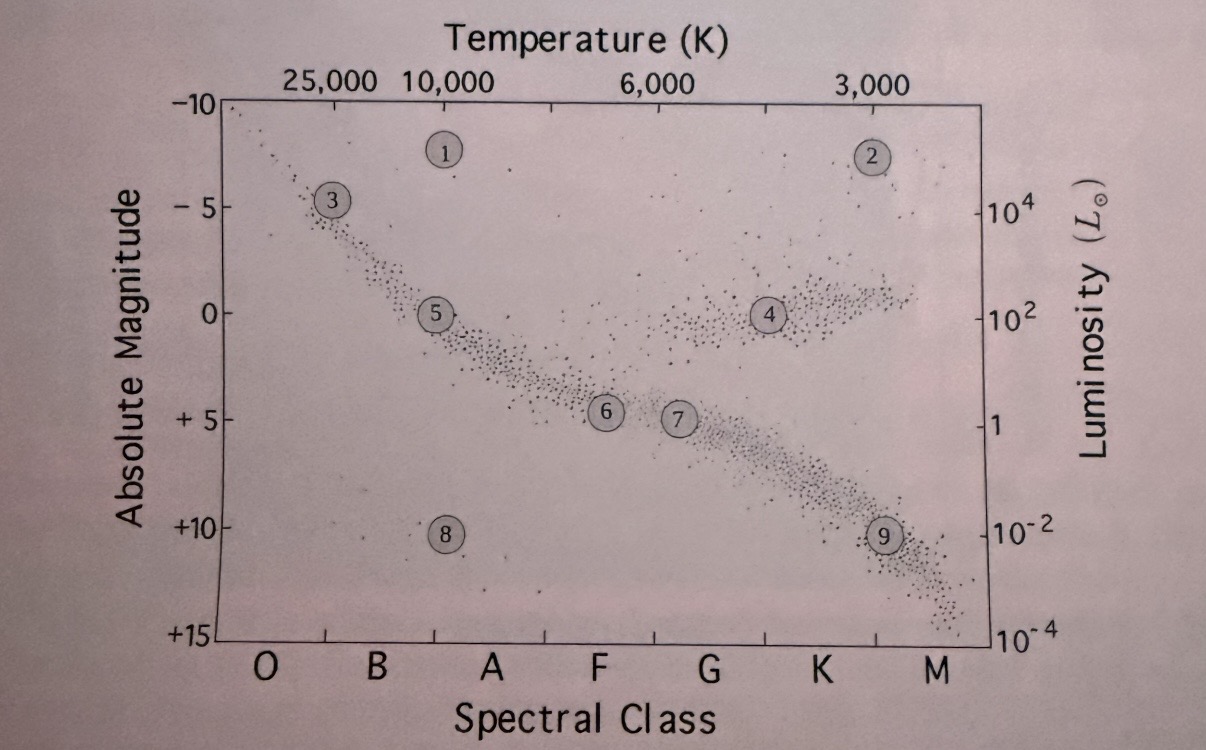
Which star represents the Sun?
7
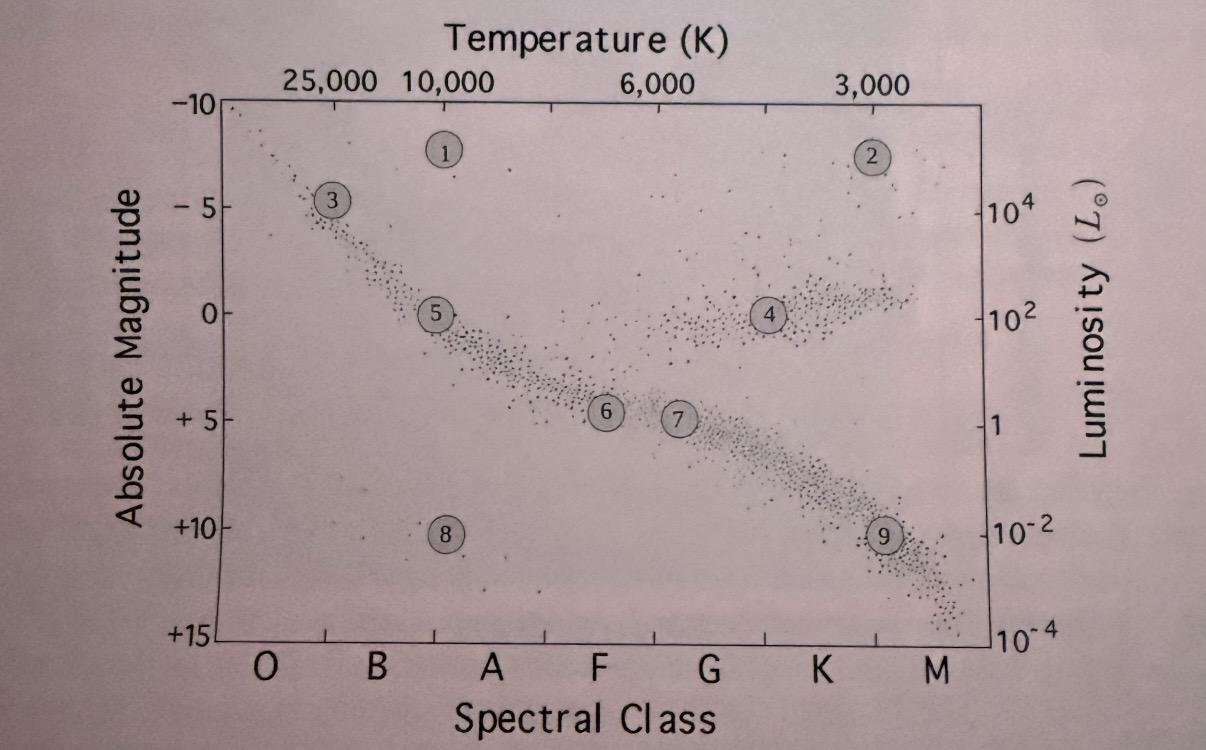
Which one is a burned-out white dwarf made entirely out of carbon?
8
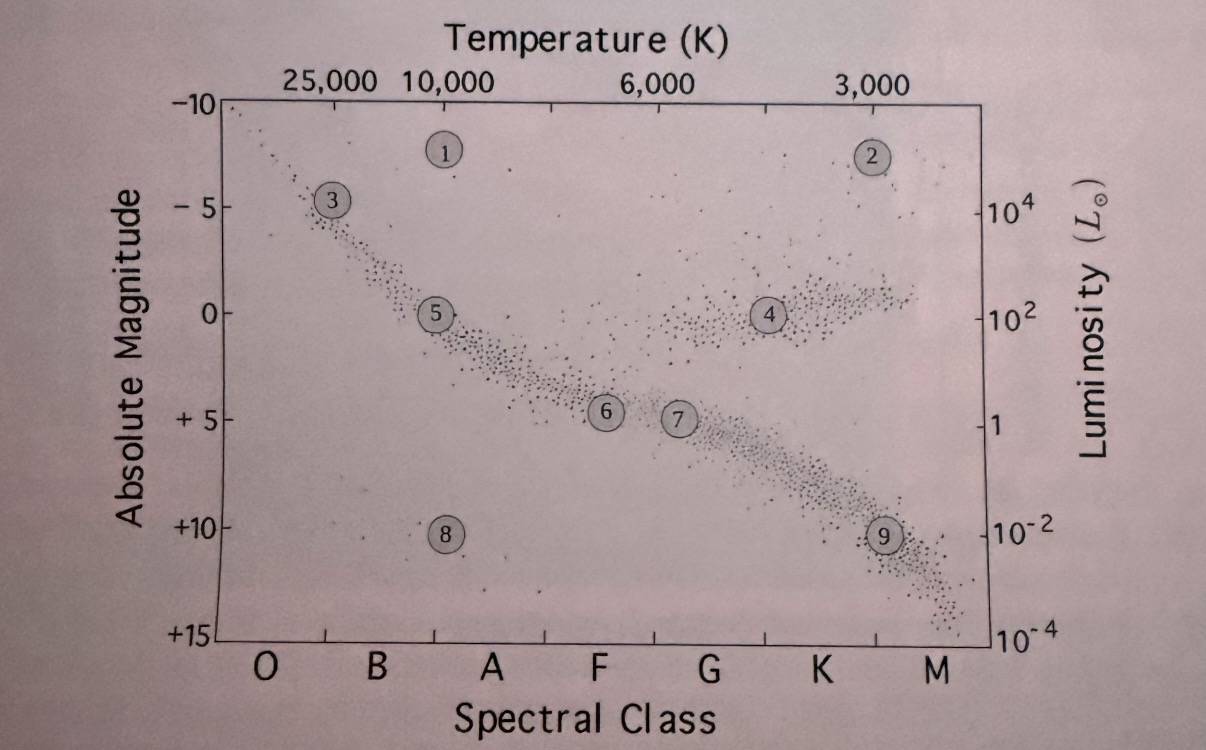
Which main-sequence star will have the longest lifetime?
9
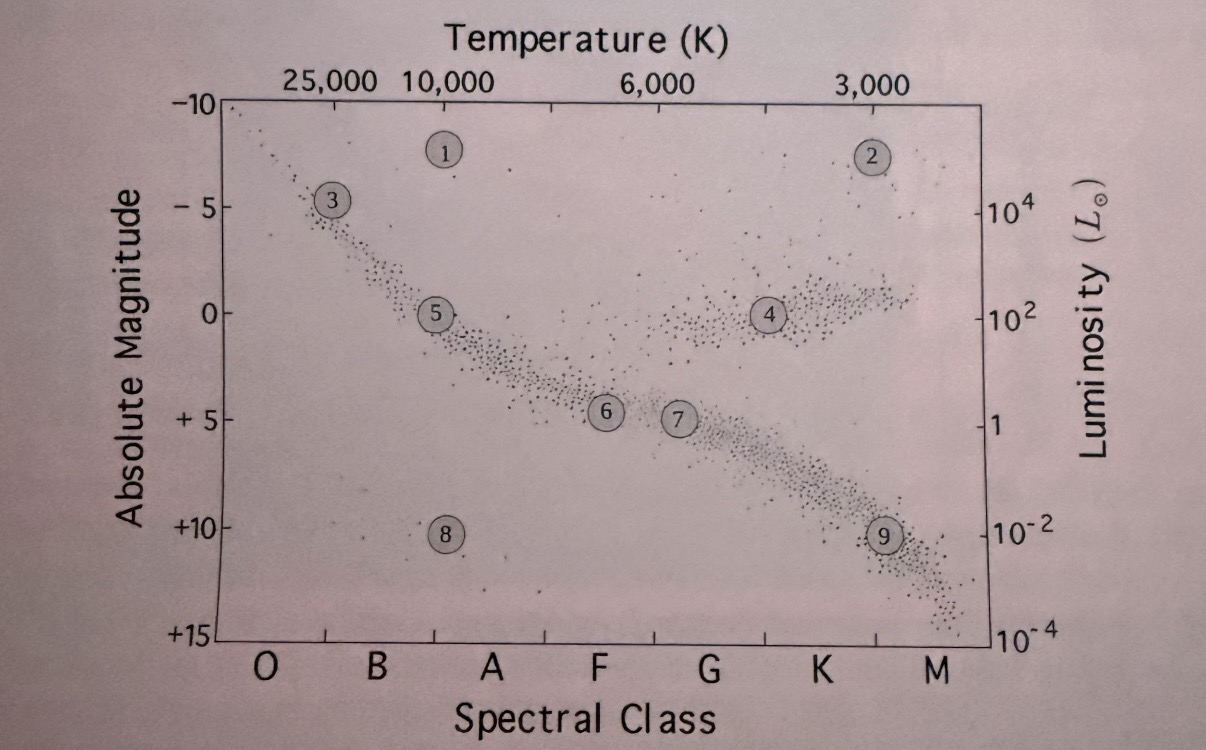
Which star has the largest radius?
2
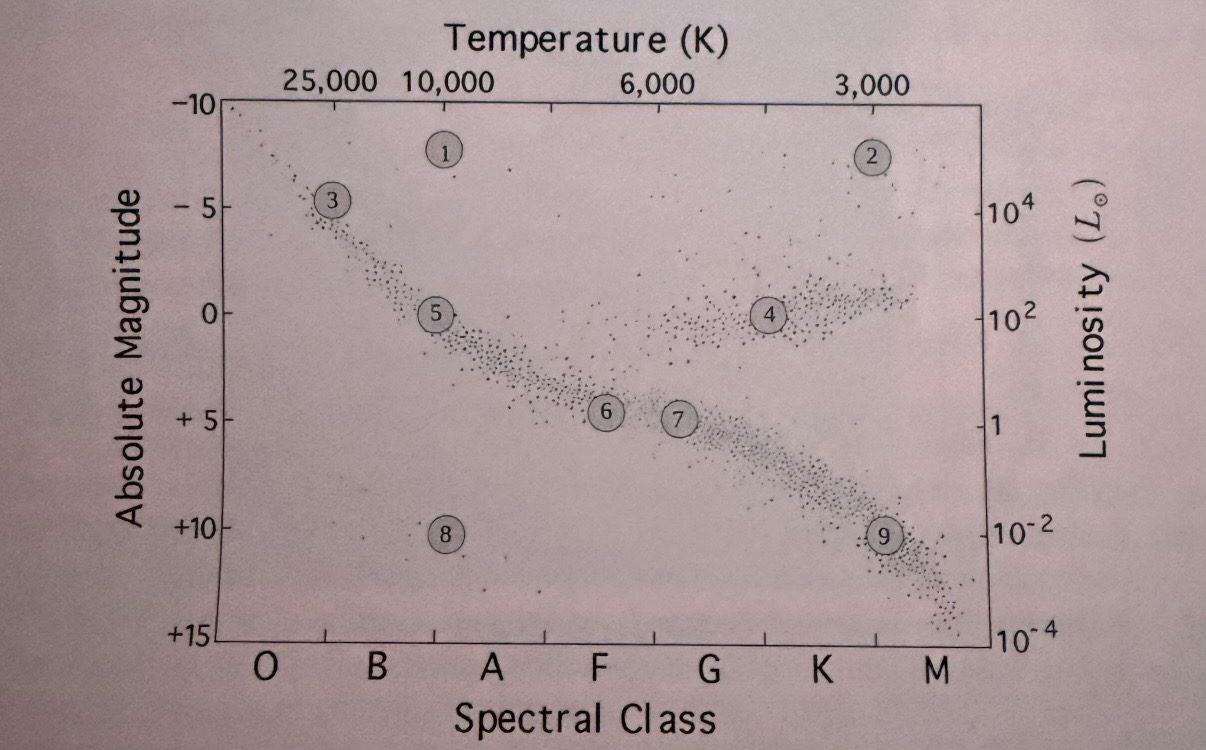
Which one is a small red star?
9
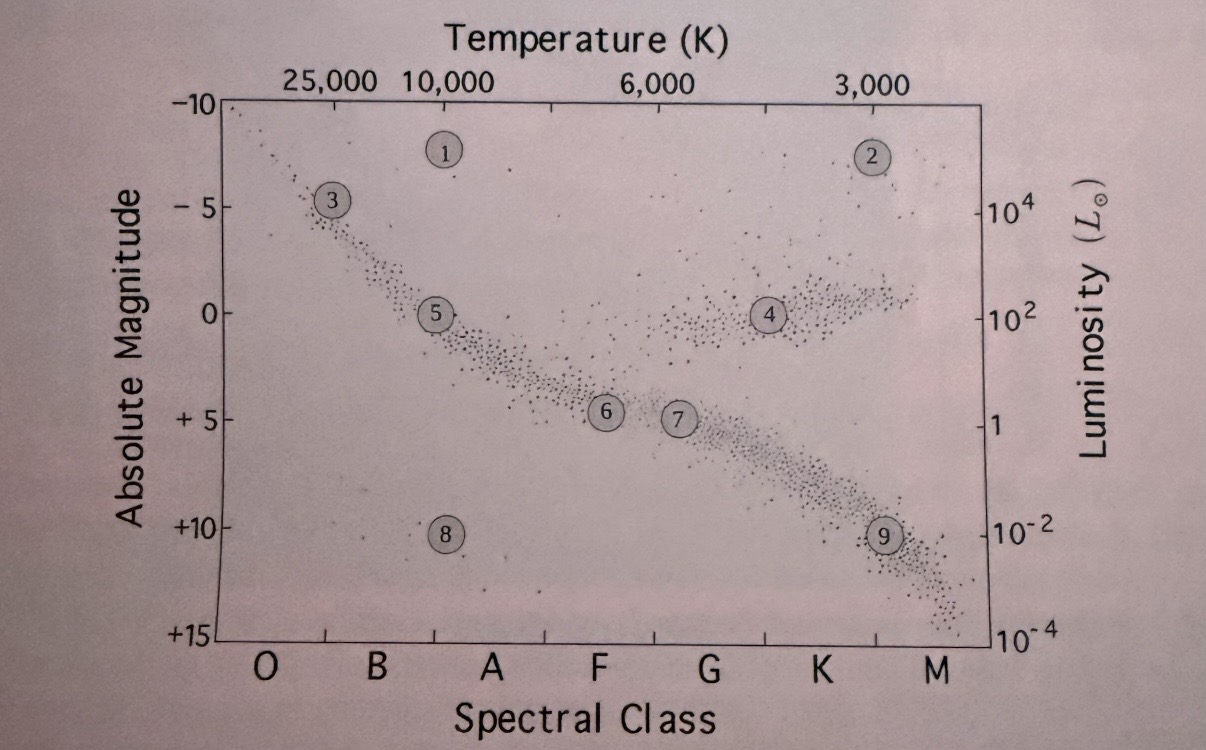
Which is the most massive main-sequence star?
3
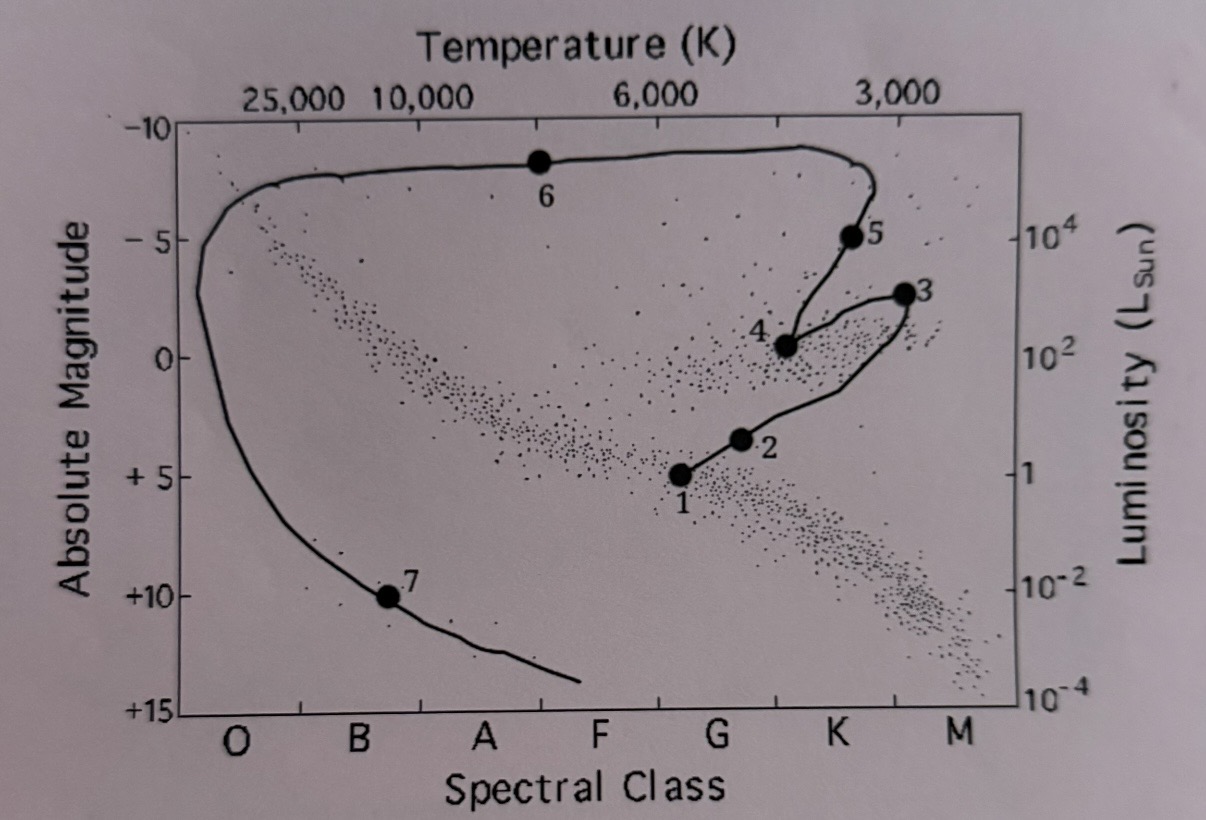
At this position, the star is expanding because it has run out of Helium in its core and has built up a core of inert Carbon.
5
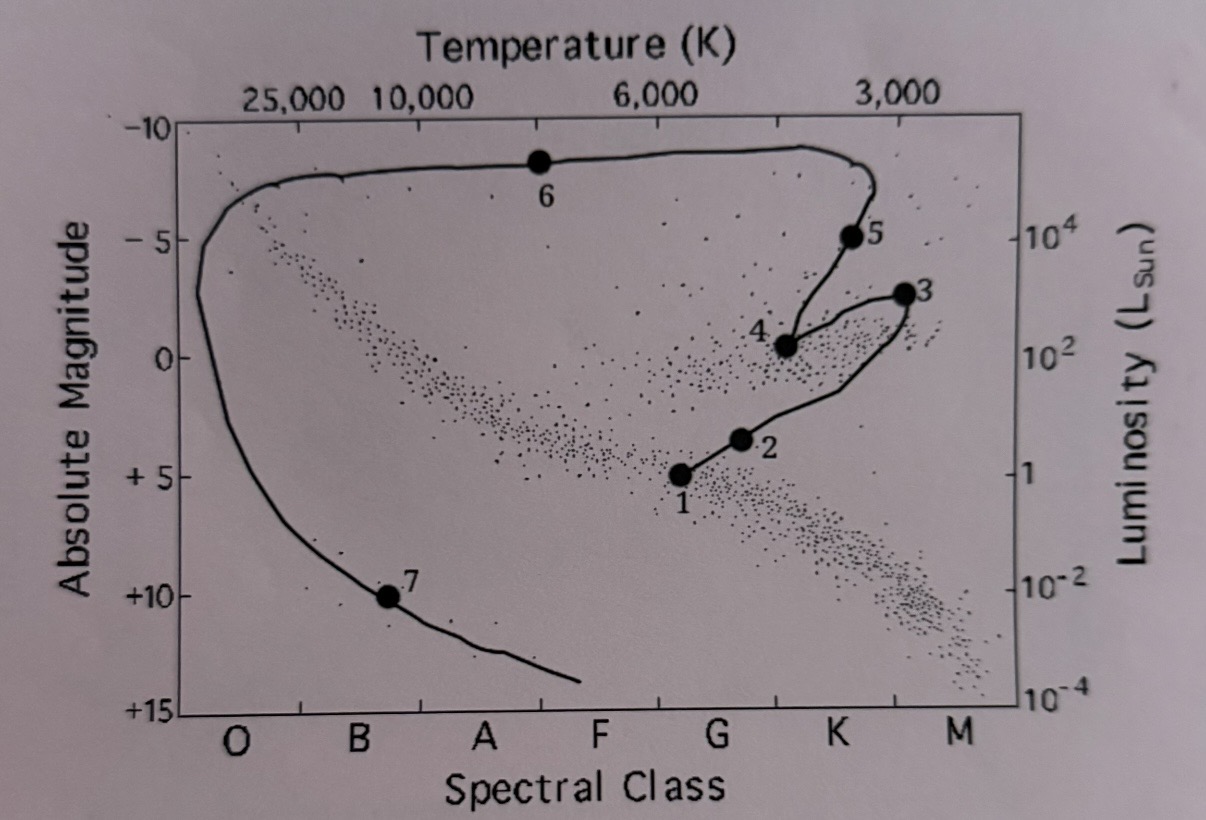
At this position, the star is a main-sequence star.
1
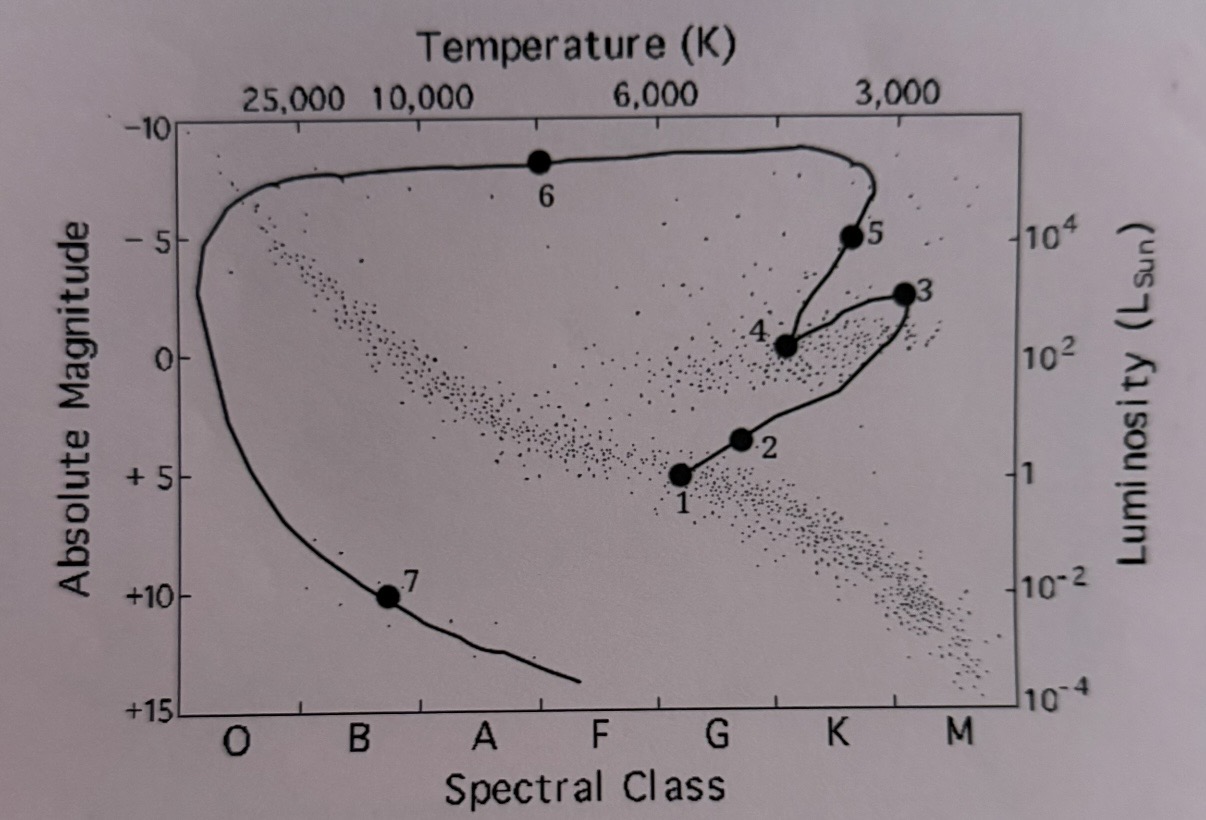
At this position, the star is releasing its outer layers into a “planetary nebula.”
6
At this position, the star’s core becomes hot enough that Helium begins to fuse.
3
At this position, the star is expanding because it has run out of Hydrogen in its core and has built up a core of inert Helium.
2
At this position, the star has a Helium-burning core surrounded by a Hydrogen-burning shell.
4
What does it mean to say that the Sun is in “equilibrium”?
A. The inward force of gravity is balanced by the outward force of radiation pressure.
B. The outward force of gravity is balanced by the inward force of radiation pressure.
C. The inward force of gravity is balanced by the outward force of magnetic fields.
D. The outward force of gravity is balanced by the inward force of magnetic fields.
A
What two properties of the Sun are responsible for producing Sunspots?
Differential Rotation and Magnetic Fields
What is the fuel that powers the Sun?
Protons and Hydrogen
Magnetic activity on the surface of the Sun produces sunspots (large, dark spots on the Sun), prominences (loops of glowing gas ejected from the Sun's surface), flares, and coronal mass ejections (large explosions that blast material from the Sun into space). The Sun's magnetic activity strength periodically increases and decreases, which was discovered by seeing the amount of sunspots on the Sun increase and decrease over time. This increase and decrease in solar activity happens roughly every ____ years.
11
White Dwarf stars are composed primarily of _________.
Carbon
Why is iron (Fe) the most stable element in the known Universe?
It has the least mass per nuclear particle
All main-sequence stars that are more luminous than the Sun .
A. fuse hydrogen into helium more rapidly than the Sun does
B. contain more heavy elements than the Sun does
C. have longer lives than the Sun
D. were born before the Sun was
A
What event triggers a star to evolve past the main-sequence stage of its life?
The core of the star turns into helium
When the Sun became a protostar, during its pre-main-sequence evolution, its size was roughly its current size.
100 times
What is the difference between a protostar and a star?
A. A star is powered by gravitational potential energy.
B. A star is powered by nuclear fusion in its core.
C. A star is much cooler than a protostar.
D. A star has a surface while a protostar does not.
B
Which of the following is a major difference between a Type I Supernova and a Type II Supernova?
A. A Type I Supernova can happen over and over again with the same star.
B. Type I supernovae are only about half as luminous as Type II supernovae.
C. The spectrum of a Type II Supernova shows the presence of a lot of hydrogen, while that of a Type I Supernova does not.
D. A Type I Supernova is the result of the collapse of the core of a high-mass star, while a Type II Supernova results from the detonation of a carbon white dwarf.
C
Red Supergiant stars are among the stars.
largest, most luminous
The Sun's convection zone is responsible for which of the Sun's characteristics?
its granulated surface
Consider a star with a luminosity of L = 100L. How would its luminosity change if its radius were to double?
A. Its luminosity would remain: L = 100L
B. Its luminosity would decrease to: L = 25L
C. Its luminosity would increase to: L = 400L
D. Its luminosity would increase to: L = 1600L
C
Consider a star with a luminosity of L = 100L. How would its luminosity change if the distance between Earth and the star were to double?
A. Its luminosity would remain: L = 100L
B. Its luminosity would decrease to: L = 25L
C. Its luminosity would increase to: L = 400L
D. Its luminosity would increase to: L = 1600L
A
Our solar system contains some heavy elements, such as iron, because .
A. the heavy elements condensed out of the protoplanetary disk that orbited around the Sun when it was a protostar
B. the universe was formed with a small amount of heavy elements in it
C. earlier generations of stars in our galaxy produced heavy elements while exploding
D. the Sun began generating a small amount of heavy elements once nuclear fusion ignited in its core
C
Is the following statement true or false?
“The Sun’s magentic activity cycle affects Earth’s temperature.”
True
What is the primary factor that has contributed to the overall rapid increase in Earth’s temperature over the past 100 years?
A. The amount of greenhouse gases in Earth’s atmosphere
B. The increased output of energy from the Sun during periods of strong magnetic activity
C. The current distance between Earth and the Sun
D. NONE of the above
A
When the Sun was born, it had enough fuel to power itself as a main-sequence star for approximately how many years?
10 billion
The Sun is currently approximately how many years old?
5 billion
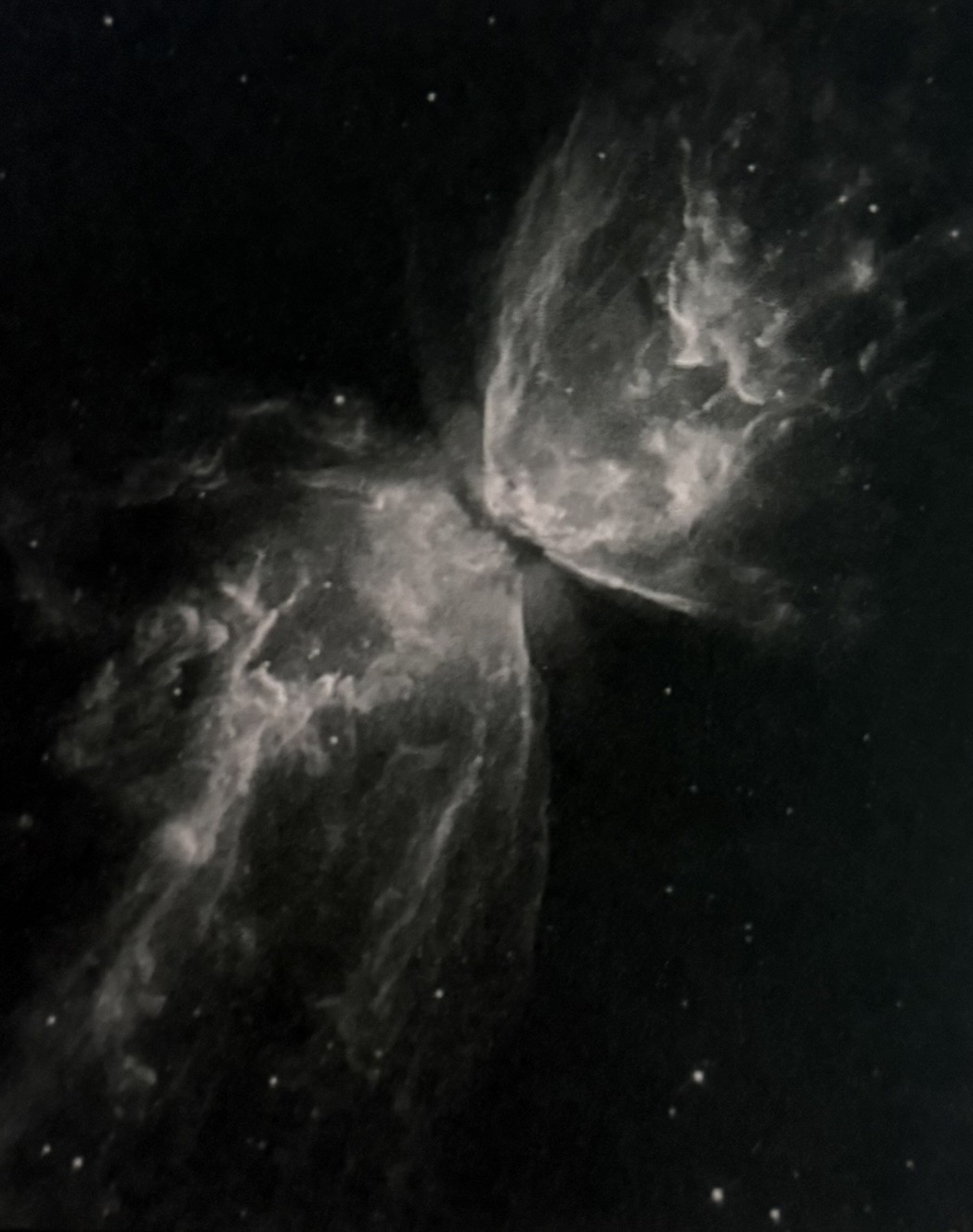
Which statement best describes the formation of this planetary nebula?
A. A low-mass binary star system expelled it.
B. A high-mass star exploded to create it.
C. A high-mass binary star system exploded to create it.
D. A single, Sun-like star expelled it.
A
How will the Sun die?
A. It will explode as a Type I supernova.
B. It will explode as a Type II supernova.
C. It will collide with another star, becoming engulfed in the other star’s atmosphere.
D. It will expel a planetary nebula and leave a small white dwarf behind.
D
In Albert Einstein’s famous equation, E = mc2, what does the c stand for?
A. the speed of light
B. the speed of sound
C. the cosmological constant
D. the mass of a hydrogen atom
A
The rate at which the Sun is emitting energy from its surface as light is equal to…
A. the rate at which the Sun is expanding
B. the rate at which the Sun is contracting
C. the rate at which the Sun is generating energy in its core
D. the rate at which the Sun is generating a magnetic field in its convection zone
C
A star with a mass of 5 times that of our Sun will last approximately how many years as a main sequence star?
100 million
The rate at which a star ages depends primarily on the star’s ______.
mass
Very young star clusters contain more _______________ than very old star clusters do.
blue stars
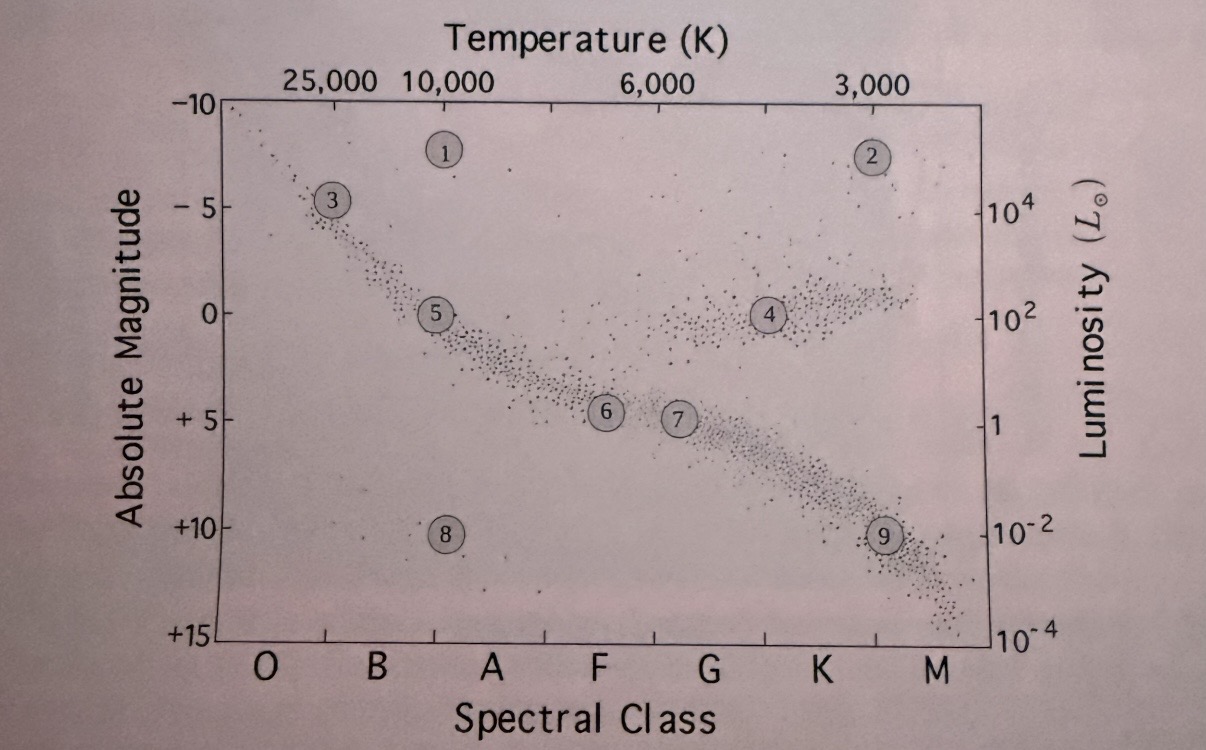
Consider Star 5 and Star 7 on this H-R diagram. Assume they are born at the same time in a close binary star system. Which of the stars will evolve into a red giant first?
Star 5
A high-mass star explodes as a supernova. The star's mass, before exploding, was 20 times the mass of the Sun, but 2 Solar masses of the star's core remains after the supernova and becomes a(n) .
neutron star
A neutron star's strong gravity is caused mostly by its small size and .
large mass
Globular clusters are found mainly .
in the Galactic halo
In the Milky Way Galaxy, our Sun is located .
about halfway out from the center
Astronomers classify different types of elliptical galaxies by .
how flattened they are
We calculated in class that the escape speed from Earth is 11 km/s. What would be the escape speed from a planet the same size as Earth, but 4 times as massive as Earth?
22 km/s
A black hole with a mass of 4 Solar masses would have a Schwarzschild radius of about .
12 km
Consider a star in a circular orbit around a supermassive black hole at the center of a distant galaxy. If the distance from the central black hole to the star is 1,000 AU and the star orbits once every 10 years, what is the mass of the black hole?
10 million solar masses
Where in a galaxy would you find newly formed stars?
in the disk of a spiral galaxy
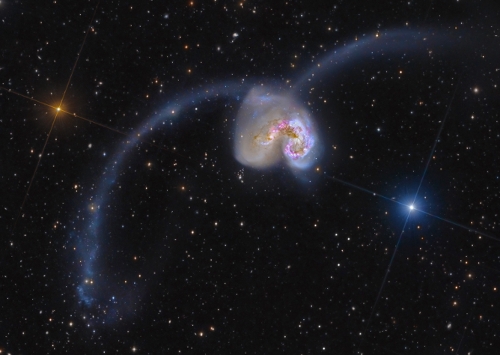
Consider the galaxy in this photograph. How did the galaxy get its shape?
A. A large burst of supernova explosions distorted an elliptical galaxy into this shape.
B. This is the product of the dynamic merger of two spiral galaxies.
C. This galaxy was created with the shape it has.
D. This was originally an elliptical galaxy, but a near encounter with a small irregular galaxy perturbed it into this shape.
B
A very large, perfectly spherical collection of stars would be classified as an galaxy.
E0
Which of the following represents Newton's modification to Kepler's 3rd law?
A. where M is the mass (of the Sun + planet), measured in Solar Masses.
B. where B is the strength of the Sun's magnetic field, measured in Gauss.
C. where v is the orbital velocity of the planet, measured in km/s.
D. where R is the radius of the Sun, measured in Solar Radii.
A
By knowing the strength of an object's surface gravity, you can determine ...
A. how much you would weigh if you could stand on the object.
B. how fast the object can spin before breaking apart.
C. the speed required to escape the object's gravity.
D. ALL of the above
D
We know that a supermassive black hole must reside at the center of our Galaxy because ...
A. the Galaxy rotates faster than astronomers would expect.
B. stars near the center of the Milky Way are orbiting some unseen object.
C. no stars can be seen in the vicinity of the Galactic center.
D. stars near the center of the Milky Way are disappearing.
B
Henrietta Leavitt's work on gave astronomers like Edwin Hubble a vital tool for measuring the distances to other galaxies.
Cepheid variable stars
Why are black holes called black holes?
A. They are called black holes because their gravity prevents any form of radiation or light from escaping them.
B. They are called black holes because they are very poorly understood objects.
C. Nobody knows why they are called black holes.
D. They are called black holes because their surface temperature is such that the light they emit is black.
A
How can you measure the mass of a planet like Jupiter?
By studying the orbits of Jupiter’s moons
Which statement best describes a pulsar?
A. A pulsar is caused by material falling onto a black hole. The material gets so hot that it flashes brightly at predictable intervals.
B. A pulsar is the direct result of two galaxies merging together.
C. A pulsar is a neutron star, with an intense beam of radiation that flashes toward Earth each time the neutron star spins around.
D. A pulsar is an unstable star that gets brighter and dimmer each time it expands and contracts.
C
Consider how the gravitation force depends on the distance between the objects. For example, tripling the distance (r) between two objects will cause the gravitational force between them to .
become 9 times weaker
The Andromeda Galaxy is a nearby, large, spiral galaxy. The Andromeda galaxy was originally thought to be .
A. much farther and larger - a merger of four other galaxies.
B. much farther and larger - a super-cluster of galaxies at the edge of the observable Universe.
C. much closer and smaller - a planet forming in our own Solar system.
D. much closer and smaller - a nebula in our own Galaxy.
D
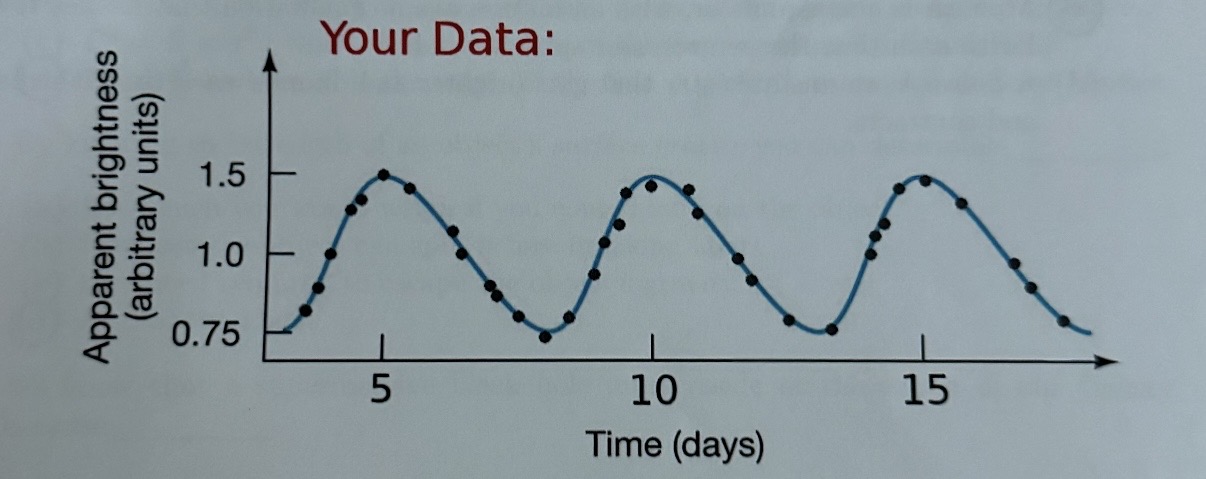
Imagine that you have observed a Cepheid variable star over the course of about a month. Your data are shown in this image (gray points) along with a best-fit curve for the data (solid line). What is the luminosity of the star?
1,000 L
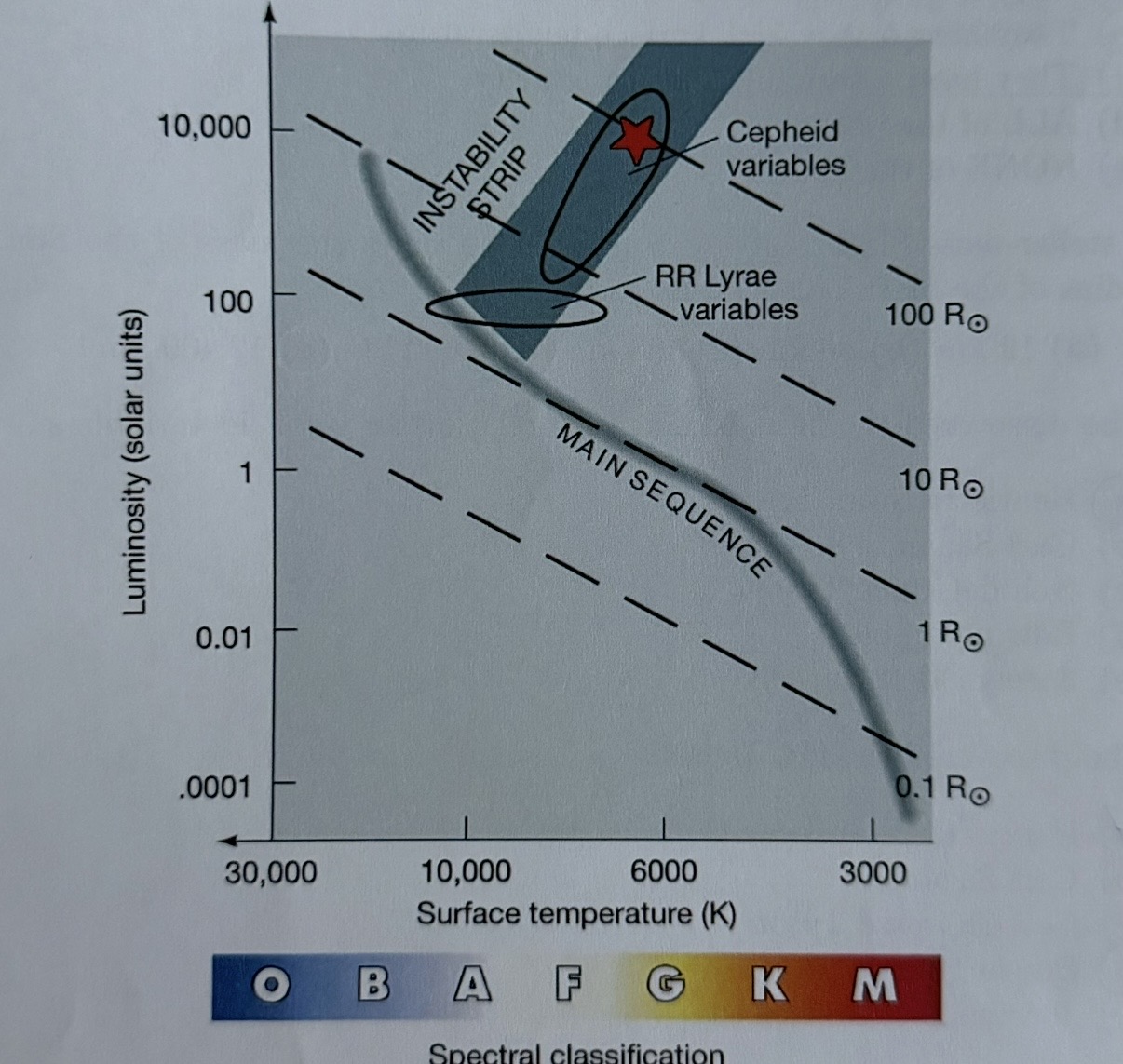
The Cepheid variable star labeled with a red star on the diagram below is expected to pulse once every ______ days.
20
Suppose you find a star in an orbit around an unseen object (black hole), and the star’s orbit has the following properties:
Orbital Period = P = 5 years
Semimajor Axis = a = 1,000 AU
Determine the mass of the black hole.
40,000,000
If an astronaut weighs 160 pounds on Earth, about how much would they weigh on Pluto?
12 pounds
Neutron stars can spin hundreds of times per second without breaking apart. Why is that?
They have a very high surface gravity
A stellar-mass black hole has a mass of 12 times the mass of the Sun. What is the radius of the black hole’s event horizon?
36 km
Who discovered the period-luminosity relation for Cepheid variable stars?
Henrietta Leavitt
Who discovered the first pulsar?
Jocelyn Bell Burnell
What does Hubble’s tuning fork diagram classify?
galaxies based on their shape
What is a neutron star?
A. A type of black hole
B. A dying red giant
C. The remnant of a massive star after a supernova
D. A planet made entirely of neutrons
C
A galaxy with a lot of dark matter will than a similar galaxy with less dark matter.
spin faster
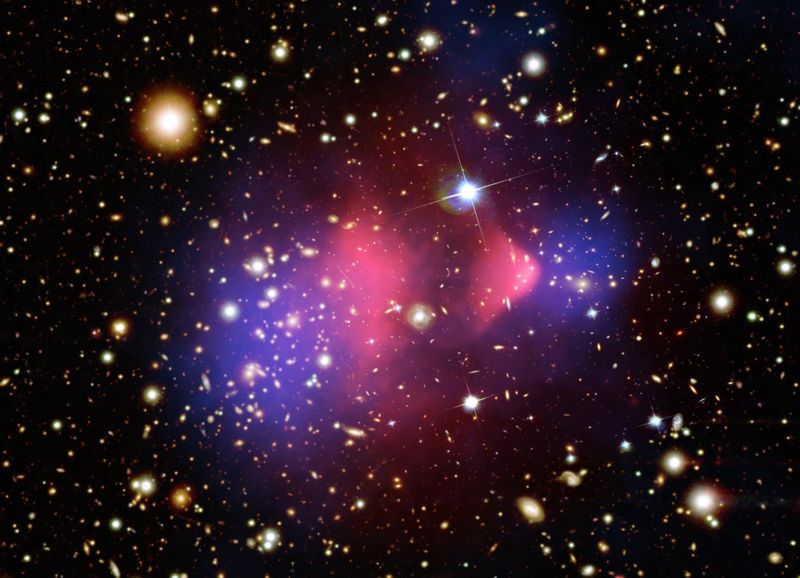
This is an image of the "Bullet Cluster" of galaxies. An analysis of this image seems to confirm that ...
A. dark matter surrounding a galaxy cluster directly interacts with all other matter (including normal luminous matter and other dark matter) by colliding with it.
B. dark matter surrounding a galaxy cluster directly interacts only with normal luminous matter.
C. dark matter surrounding a galaxy cluster passes through all other matter (including normal luminous matter and other dark matter) without directly interacting.
D. dark matter surrounding a galaxy cluster directly interacts only with other dark matter.
C
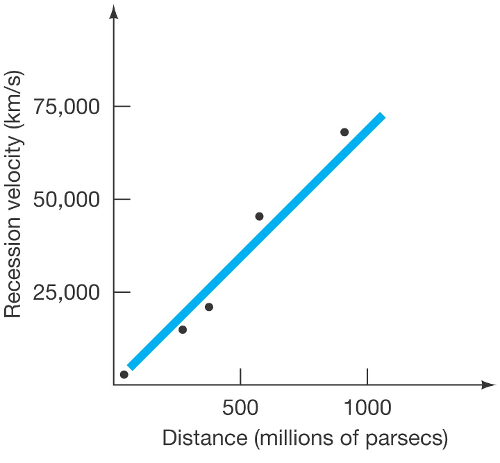
How fast would you expect a galaxy lying 300 Mpc from Earth to appear to be moving?
21,000 km/s
Which of the following statements most accurately describes our observational evidence for dark energy?
A. Observations of individual galaxies indicate that galaxies appear to be rotating more quickly than they should be.
B. Observations of very distant galaxies indicate that the universe was expanding more slowly in the distant past than it currently is.
C. Observations of individual galaxies indicate that galaxies appear to be rotating more slowly than they should be.
D. Observations of very distant galaxies indicate that the universe was expanding more quickly in the distant past than it currently is.
B
states that the farther away a galaxy is from us, the faster it appears to be moving away from us.
Hubble’s Law