Topic 18: arterioles and distribution of blood flow
 Call Kai
 Learn
Learn Practice Test
 Spaced Repetition
 Match
Match Flashcards
 Knowt Play
1/18

There's no tags or description
Looks like no tags are added yet.
Name | Mastery | Learn | Test | Matching | Spaced | Call with Kai |
|---|
No analytics yet
Send a link to your students to track their progress
19 Terms
how does blood flow throgh out bosy/system, and why is it that way?
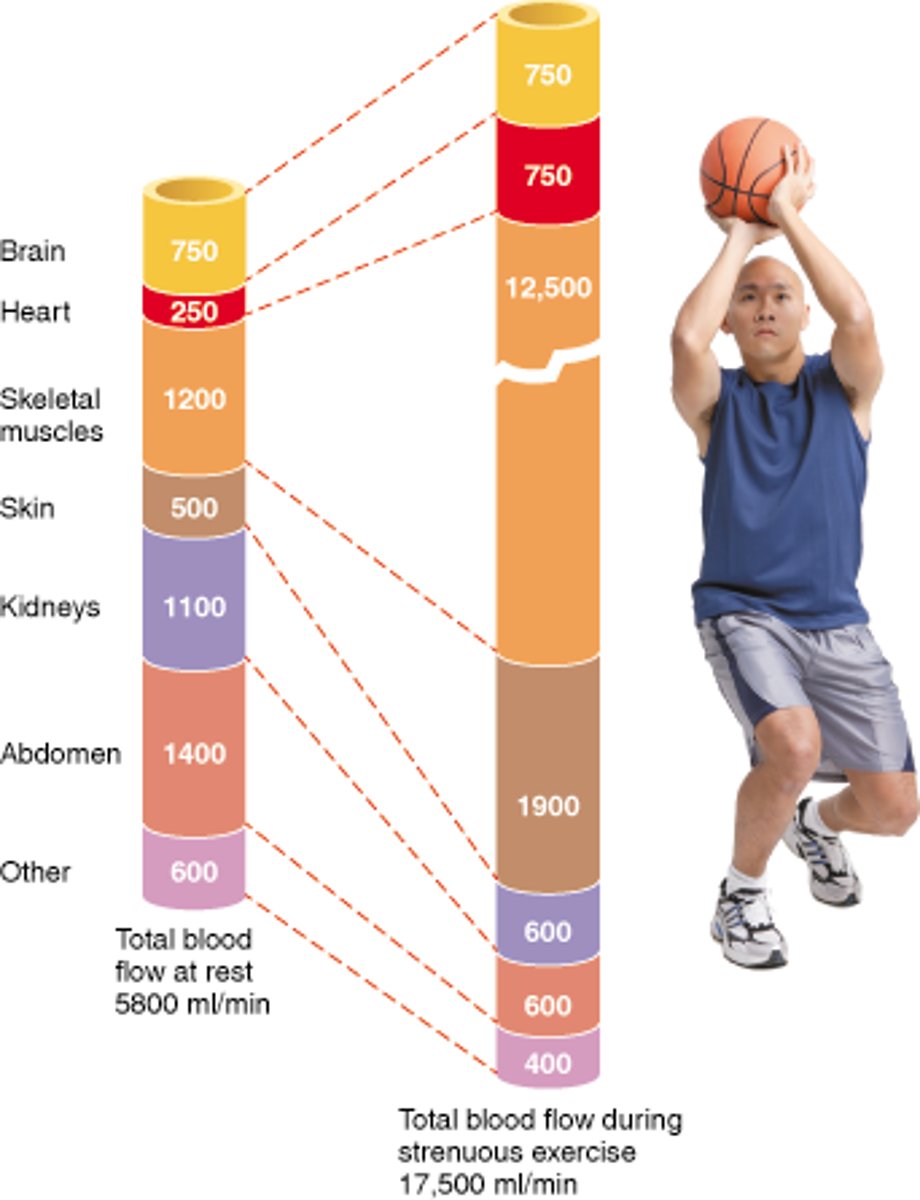
selective distribution = not all tissue recieve equal blood volumes, and blood flow to an organ can vary over time (eg. redistriution of flow with exercise)
why?
because tissues all have diff oxygen needs (*not based on mass)
what is %cardiac output (CO)
tells you how much of the cardiac output is going to a tissue
**RELATIVE NO. because CO cahnges eg when u exercise
what is Flow (mL/min)
the absolute number of how much blood a tissue is getting at a certain time
brain bloodflow and %CO
Brain absolute flow is constant during rest and exercise (always 650ml/min)
as you exercise %CO to brain DECR but brain is sstill getting 650ml/min
redistribution of flow with exercise: which tissues inc flow and whihc ↓ flow during exercise
inc flow:
- skeletal muscle
- heart
- skin
↓ flow:
- digestive system
- liver
- kidneyes
- bone and more
constant: brain
how do microvesssels ensure this selective distribution so that dif blood flows get to dif tissues
the arterioles act like control valves to change how much blood flow is enetering each tissues
how?
- by decresing resistance in arterioles (i.e. opening the valve) it allows more blood
- by increasing resistance in arterioles (i.e. closing the valve) it allows less blood
**note this is is done by arterioles, capillaries hnadle distribute blood across a tissue
Distribution of blood to skeletal muscle suring dif times - stress/blood loss normal activity and exercise
stress/bloodloss: higher resistance in arterioles no flow to muscles
normal: moderate resistance in artieroles
exercise: low resistance --> larger flow to muscles
3 facts Arterioles
- Are located within individual organs
- Determine blood flow to individual organs
- Are the greatest contributors to "total peripheral resistance", thus important regulators of MAP
intravital microscopy
formulas for effect of radius on flow:
Flow = ∆P/R(esistacne)
resistance = 1/r(adius)^4
**not a linear relationship → For every 1 unit increase in flow there is a 4 fold incr in radius
resistance increases and flow decreases by...
Decreases radius
Inc tube length
Inc viscosity of blood
composition of arterioles: what are the major functiosn of the 2 cells
2 cell types:
1. Endothelial cells (inside layer)
Major Functions of Endothelial Cells in arterioles
- Prevent blood cell and platelet adherence (thrombosis)
- Control the exchange of fluid and nutrients in capillaries
- Modify arteriole diameter
2. Smooth muscle (outside layer)
Major functions of smooth muscles cells in arterioles
- Structural support: Matain bv shape
- Regulate local blood flow by changing diameter
how do endothelial cells modify arteriole diameter
secreting vasodilator [Nitric Oxide] and vasoconstrictor [Endothelin] substances
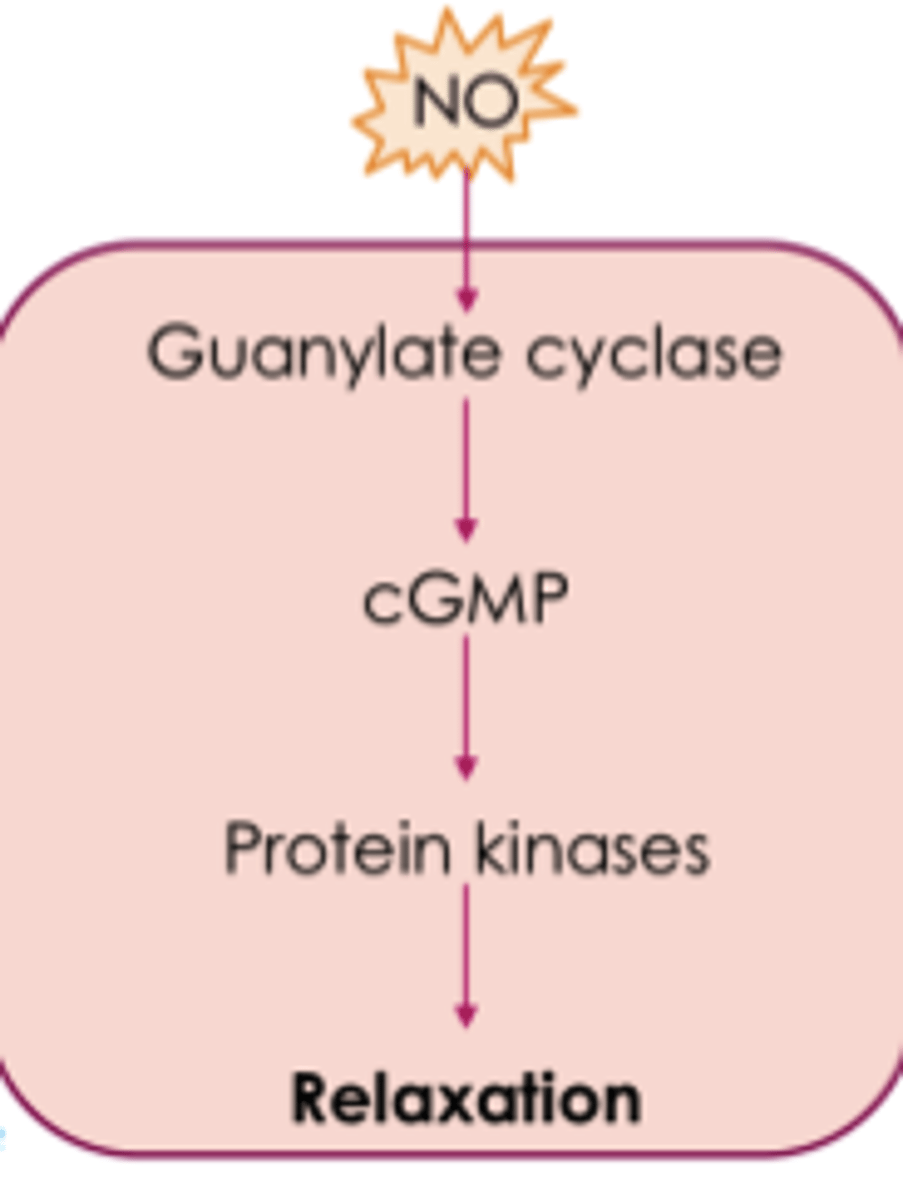
what is the mechnism of nitric oxide vasodilation
1. Nitric oxide is produce byy endothelial cells by:
L-arginine --(NO Synthase)-->NO
2. NO diffuses into smooth
3. NO activated guanylate scyclase via cGMP causing RELAXATION and vasodilation --> ↓ resistance and ↑ flow
NO mechanism in cardiovascular disease
Endothelial cells make less NO in cardiovascular disease → no/less vasodilation → too many crossbrudges forming
High resistance and lower blood flow
what are nitric oxide donors
molecules that help creat NO when ur endothelial cells cannot. this NO can go directly into the smooth muscle cells by passing the damages endothelial cells
eg.: Nitroglycerin
How do smooth muscles cells contract in arterioles:
- a actin -myosin crossbrdge forms
Signals that increase actin-myosin x-bridges cause vasoconstriction
cnstrictions = more crossbridges
Signals that decrease actin-myosin x-bridges cause vasodilation
dilation = less crosbridges forming
***NOte there is partial vasoconstriciton in normal condition
smooth muscle organization
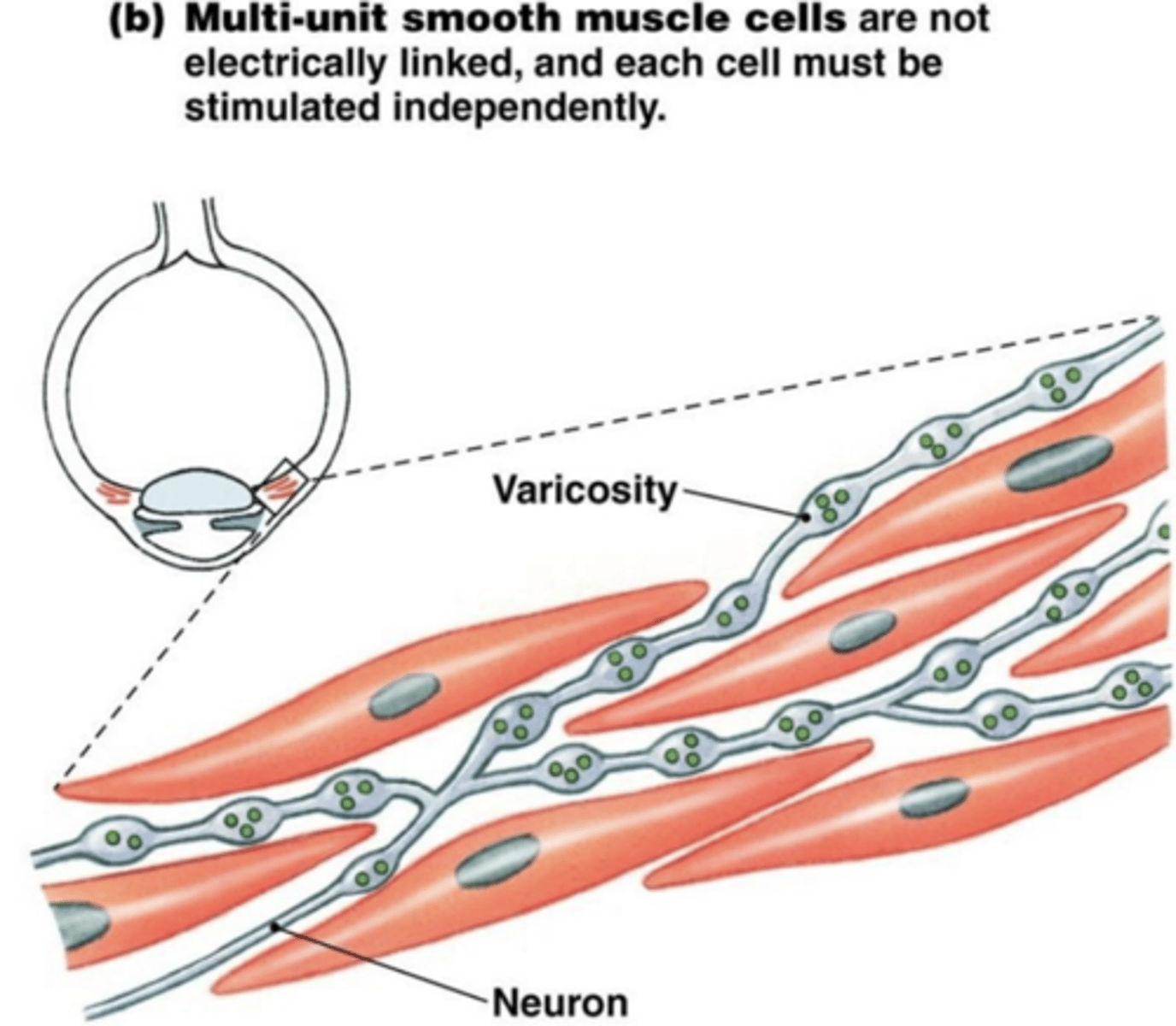
Organization of smooth muscle cels vs skeletal and cardiac:
- Filaments arranged diagonally , no sarcomeres
- dense bodies that tether the contractile units together rather than a z line.
- Ends attach to the muscle cell membrane
Because of the criss crossing pattern:
- Can generate much shorter units of contraction
- Contraction in multiple planes
what is the mechanism of nitric oxi de vasodilation
1. endothilial cell produce NO via: L-arginine --(NO synthase)--> NO