RL Circuit
 Call Kai
 Learn
Learn Practice Test
 Spaced Repetition
 Match
Match Flashcards
 Knowt Play
1/29

There's no tags or description
Looks like no tags are added yet.
Name | Mastery | Learn | Test | Matching | Spaced | Call with Kai |
|---|
No analytics yet
Send a link to your students to track their progress
30 Terms
RL Circuit
A circuit that contains both resistance and self-inductance, typically consisting of a resistor and an inductor connected together.
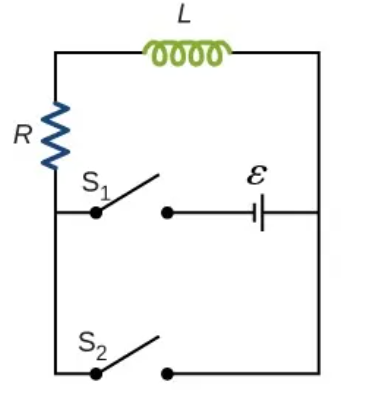
RL Circuit with S1 and S2 switches
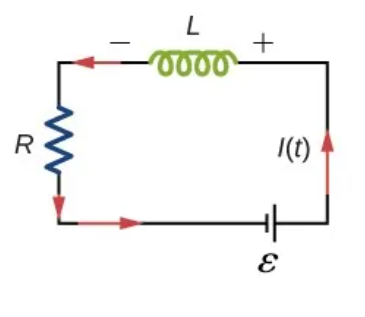
RL Circuit with S1 closed and S2 opened
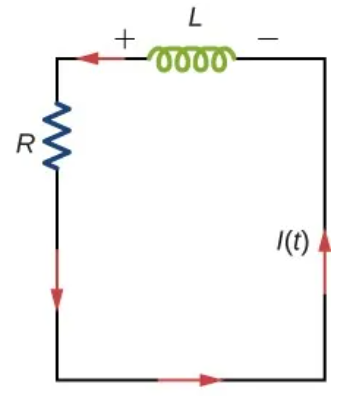
RL Circuit with S1 opened and S2 closed
The source of emf drives a current in the circuit, but the current does not rise instantly due to the opposing induced emf in the inductor
What happens in an RL circuit when the switch is closed?
Because the inductor produces an induced emf that opposes the change in current, according to Lenz’s law.
Why does current not increase instantly in an RL circuit?
V_L = -L(d(I)/dt)
The induced EMF across an inductor in an RL circuit which opposes changes in current.
ε - L(d(I)/dt) - IR = 0
Differential equation describes an RL circuit
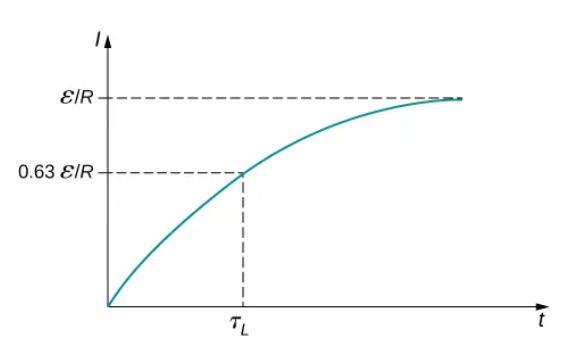
I(t) = (ε/R)(1 - e^-(t/τ_L))
Expression for current growth in an RL circuit
τ_L = L/R
Inductive time constant which determines how quickly the current reaches its steady-state value.
Time variation of current in the RL circuit
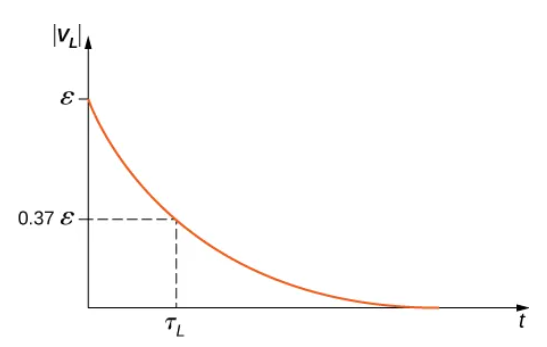
Time variation of induced voltage across the coil in the RL circuit
The current approaches its maximum value of ε/R
What is the behavior of current as time approaches infinity in an RL circuit?
The current reaches approximately 63% of its final value
What fraction of the final current is reached after one time constant?
V_L(t) = -ε(e^-(t/τ_L))
How does the induced voltage across the inductor change over time?
Decreases to zero as the current reaches its steady value.
What happens to the voltage across the inductor as time increases?
U = (1/2)L(I^2)
The energy stored in an inductor
The energy increases from zero and approaches a maximum value of (1/2)L((ε/R)^2) as the current reaches steady state.
How does the energy in an inductor change during current growth?
The current begins to decrease as the stored energy in the inductor is dissipated through the resistor
What happens when the source is removed from an RL circuit?
IR + L(d(I)/dt) = 0
Differential equation describing current decay in an RL circuit?
I(t) = (ε/R)e^-(t/τ_L)
Expression for current decay in an RL circuit?
The current decreases exponentially from its initial value to zero over time
How does current behave during decay in an RL circuit?
V_L(t) = εe^-(t/τ_L)
How does the voltage across the inductor behave during decay?
37%
At one time constant, the voltage drops to approximately ___ of its initial value
faster, slower
A smaller time constant results in a ______ change in current, while a larger time constant results in a ______ response
The energy stored in the inductor decreases exponentially and is dissipated as heat in the resistor
What happens to the energy stored in the inductor during decay?
t = (τ_L)ln(2)
How long does it take for current to drop to half its initial value?
t = -(τ_L/2)ln(0.01)
How long does it take for energy to drop to 1% of its initial value?
Because both exhibit exponential growth and decay governed by a time constant
Why is the RL circuit behavior similar to an RC circuit?
Because, at steady state, the current becomes constant, making d(I)/dt = 0, so the inductor produces no induced emf and offers no opposition to the current.
What is the physical reason an RL circuit eventually behaves like a simple resistor?