Part 2.3.1 - Autonomic Drugs - Parasympathetic drugs - Introduction, Cholinomimetics
 Call Kai
 Learn
Learn Practice Test
 Spaced Repetition
 Match
Match Flashcards
 Knowt Play
1/52

There's no tags or description
Looks like no tags are added yet.
Name | Mastery | Learn | Test | Matching | Spaced | Call with Kai |
|---|
No analytics yet
Send a link to your students to track their progress
53 Terms
ACETYLCHOLINE is located in:
(Multiple Answers)
a. vesicle
b. Cholinergic Post gangllion
c. Central Nervous System
d. Skeletal Muscles
e. Stomach
All
Choline is transported into the presynaptic nerve terminal by ________.
a. VAT
b. CHT
c. SNAPs
d. VAMPs
b. choline transporter (CHT)
Choline transport is sodium-________.
a. activated
b. inhibited
c. dependent
d. independent
c. dependent
Drug that inhibits the choline transporter (block entry of choline)
a. Vesamicol
b. Hemicholinium
c. Botulinum toxin
d. Acetylcholinesterase
b. Hemicholinium
Acetylcholine is synthesized from choline and ________.
a. Dopamine
b. Acetyl-CoA
c. Serotonin
d. ATP
b. Acetyl-CoA
Enzyme that synthesizes acetylcholine
a. Acetylcholinesterase
b. Choline acetyltransferase
c. MAO
d. COMT
b. Choline acetyltransferase
Acetylcholine is transported into the storage vesicle by ________.
a. CHT
b. VAT
c. SNAPs
d. VAMPs
b. vesicle-associated transporter (VAT)
Drug that inhibits VAT (inhibits storage of ACh into the vesicle)
a. Hemicholinium
b. Botulinum toxin
c. Vesamicol
d. Anticholinesterases
c. Vesamicol
Substances stored in the vesicle aside from Acetylcholine
a. ATP
b. Histamine
c. Insulin
d. Cortisol
e. Proteoglycan
f. Peptides (P)
a. ATP
e. Proteoglycan
f. Peptides (P)
Release of transmitter occurs when voltage-sensitive ________ channels are opened.
a. Sodium
b. Potassium
c. Calcium
d. Chloride
c. Calcium
-Allowing an influx of calcium
-The resulting increase in intracellular calcium causes fusion of vesicles with the surface membrane and exocytotic expulsion of acetylcholine and cotransmitters into the junctional cleft
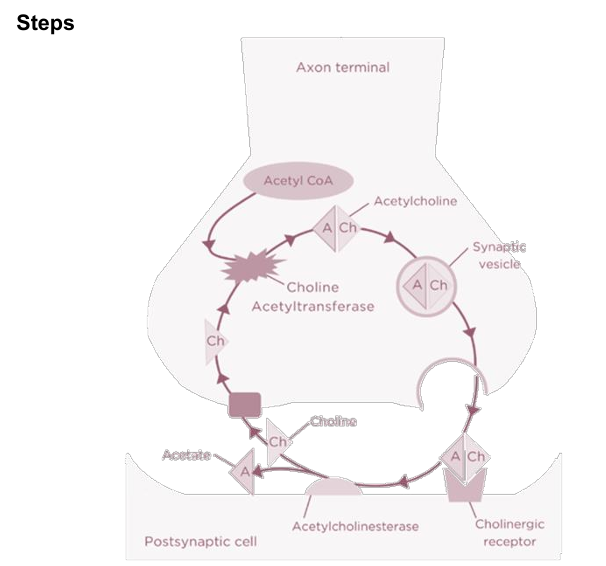
Drug that blocks exocytotic expulsion of acetylcholine (inhibit exocytosis of Ach)
a. Vesamicol
b. Hemicholinium
c. Botulinum toxin
d. ATP
c. Botulinum toxin
Acetylcholine action is terminated by metabolism through ________.
a. ChAT
b. MAO
c. Acetylcholinesterase
d. COMT
c. Acetylcholinesterase
-Receptors on the presynaptic nerve ending modulate transmitter release. SNAPs, synaptosome-associated proteins; VAMPs, vesicle-associated membrane proteins.
Muscarinic 1 (M1) receptors are ________ linked.
a. Gi-linked
b. Gs-linked
c. Gq-linked
d. Na-linked
c. Gq-linked
M1 receptors are located in the ________ gland.
a. Lacrimal
b. Gastric
c. Salivary
d. Sweat
b. Gastric
Stimulation of M1 receptors causes ________ secretion.
a. Insulin
b. HCl
c. Dopamine
d. Histamine
b. HCl
Muscarinic 2 (M2) receptors are ________ linked.
a. Gq-linked
b. Gi-linked
c. Gs-linked
d. Ca-linked
b. Gi-linked
M2 receptors are found in the ________.
a. Gastric gland
b. Exocrine glands
c. Heart (atria)
d. Neuromuscular endplates
c. Heart (atria)
M2 receptor stimulation effects
a. bradycardia
b. tachycardia
c. bronchoconstriction
d. bronchodilation
a. Bradycardia
-↓heart rate and contractility of the atria
Muscarinic 3 (M3) receptors are ________ linked.
a. Gi-linked
b. Gs-linked
c. Gq-linked
d. Na-linked
c. Gq-linked
M3 receptors stimulate secretion in ________ glands.
a. Endocrine
b. Exocrine
c. Sebaceous
d. Thyroid
b. Exocrine
Which is an exocrine gland secretion stimulated by M3 receptors?
(Multiple Answers)
a. Eccrine
b. Lacrimal
c. Renin
d. Insulin
e. Salivary
f. Gastric acid
a. Eccrine
b. Lacrimal
e. Salivary
f. Gastric acid
M3 receptor stimulation in smooth muscles causes ________.
a. Relaxation
b. Contraction
c. Sedation
d. Tremors
b. Contraction = Miosis, Bronchospasm, Diarrhea, Urination (DUMBELS)
Nicotinic neural (Nn) receptors are located in the ________.
a. Gastric gland
b. Neuromuscular endplates
c. Ganglion and CNS
d. Exocrine glands
c. Ganglion and CNS
Nn receptor stimulation causes ________ release.
a. Histamine
b. Renin
c. Epi
d. Insulin
c. Epi
Nm receptors are located in the ________.
a. Ganglion
b. CNS
c. Neuromuscular endplates
d. Gastric glands
c. Neuromuscular endplates
Skeletal muscle contraction due to Nm receptor stimulation may cause ________.
a. Tremor
b. Bronchospasm
c. Diarrhea
d. Miosis
a. Tremor
Parasympathomimetics are also called ________.
a. Adrenergic antagonists
b. Cholinergic agonists
c. Beta blockers
d. Antimuscarinic
b. Cholinergic agonists
-aka Cholinomimetics
-aka Mimicry
Parasympathomimetic classifications:
a. Direct-Acting
b. Indirect-Acting: Cholinesterase Inhibitors
c. both
c. both
Indirect-acting parasympathomimetics work by inhibiting metabolism of ________.
a. Dopamine
b. Epi
c. ACh
d. Histamine
c. ACh
[DIRECT-ACTING: Choline esters]
Non selective or Muscarinic-selective
___a. Acetylcholine
___b. Betanechol (Urecholine)
___c. Carbachol
___d. Metacholine
Non selective______a. Acetylcholine
Muscarinic-selective_b. Betanechol (Urecholine)
Non selective______c. Carbachol
Non selective______d. Metacholine
[DIRECT-ACTING: Alkaloids]
Non selective or Muscarinic-selective or Nicotinic-selective
___a. Muscarine
___b. Nicotine
___c. Arecholine
___d. Pilocarpine
___e. Lobeline
___f. Varenicline
Muscarinic-selective_a. Muscarine
Nicotinic selective___b. Nicotine
Non-selective______c. Arecholine
Muscarinic-selective_d. Pilocarpine
Nicotinic-selective___e. Lobeline
Nicotinic-selective___f. Varenicline
[DIRECT-ACTING]
Management of Urinary retention
a. Metacholine
b. Betanechol
c. Pilocarpine
d. Acetylcholine
b. Betanechol
[DIRECT-ACTING]
Post-operative abdominal distention and gastric atony
a. Metacholine
b. Betanechol
c. Pilocarpine
d. Acetylcholine
b. Betanechol
[DIRECT-ACTING]
Pulmonary challenge test (provocative test for bronchial hyperactivity)
a. Metacholine
b. Betanechol
c. Pilocarpine
d. Acetylcholine
a. Metacholine
[DIRECT-ACTING]
Reduces intraocular pressure in open angle and narrow angle glaucoma
a. Metacholine
b. Betanechol
c. Pilocarpine
d. Acetylcholine
c. Pilocarpine
[DIRECT-ACTING]
Binds preferentially at muscarinic receptors
a. Metacholine
b. Betanechol
c. Pilocarpine
d. Acetylcholine
c. Pilocarpine
[DIRECT-ACTING]
Produce miosis in ophthalmic surgery
a. Metacholine
b. Betanechol
c. Pilocarpine
d. Acetylcholine
d. Acetylcholine
[DIRECT-ACTING]
Nicotinic-selective alkaloids (Nicotine, Lobeline, & Varenicline) are used in
a. Urinary retention
b. Glaucoma
c. Smoking cessation
d. Gastric atony
c. Smoking cessation
Organophosphates are _____ inhibitors
a. Irreversible
b. Reversible
a. Irreversible
[INDIRECT ACTING]
Aminoalcohol are _____ inhibitors
a. Irreversible
b. Reversible
b. Reversible
[INDIRECT ACTING]
Carbamates are _____ inhibitors
a. Irreversible
b. Reversible
b. Reversible
Nerve Gases:
I. Sarin
II. Malathion
III. Tabbun
IV. Soman
Sarin
Tabbun
Soman
Organophosphates:
I. Echothiophate
II. Malathion
III. Parathion
IV. Nerve Gases
V. Endrophonium (Tensilon)
I. Echothiophate
II. Malathion
III. Parathion
IV. Nerve Gases
Endrophonium (Tensilon) is an Aminoalcohol
[INDIRECT ACTING]
Aminoalcohol or Carbamates or CNS-acting
___a. Demecarium
___b. Physostigmine/Eserine
___c. Tacrine
___d. Endrophonium (Tensilon)
___e. Donepezil
___f. Pyridostigmine
___g. Neostigmine
___h. Galantamine
___i. Rivastigmine
___j. Ambenonium
Carbamates___a. Demecarium
Carbamates___b. Physostigmine/Eserine
CNS- acting___c. Tacrine
Aminoalcohol__d. Endrophonium (Tensilon)
CNS- acting___e. Donepezil
Carbamates___f. Pyridostigmine
Carbamates___g. Neostigmine
CNS- acting___h. Galantamine
CNS- acting___i. Rivastigmine
Carbamates___j. Ambenonium
[INDIRECT ACTING]
Physostigmine indication
a. Myasthenia Gravis
b. GI and Urinary Tract Anatomy
c. Glaucoma
d. Alzheimer’s Disease
c. Glaucoma
[INDIRECT ACTING]
Demecarium indication
a. Myasthenia Gravis
b. GI and Urinary Tract Anatomy
c. Glaucoma
d. Alzheimer’s Disease
b. GI and Urinary Tract Anatomy
[INDIRECT ACTING]
Edrophonium indication
a. Myasthenia Gravis
b. GI and Urinary Tract Anatomy
c. Glaucoma
d. Alzheimer’s Disease
a. Myasthenia Gravis
[INDIRECT ACTING]
Tensilon Test is used to diagnose:
a. Myasthenia Gravis
b. GI and Urinary Tract Anatomy
c. Glaucoma
d. Alzheimer’s Disease
a. Myasthenia Gravis
[INDIRECT ACTING]
An autoimmune disease (Progressive muscle, weakness, dropping of eyelids, Repiratory paralysis)
a. Myasthenia Gravis
b. GI and Urinary Tract Anatomy
c. Glaucoma
d. Alzheimer’s Disease
a. Myasthenia Gravis
[INDIRECT ACTING]
CNS-acting Cholinomimetics (like Tacrine, Donepezil, Galantamine, Rivastigmine) indication
a. Myasthenia Gravis
b. GI and Urinary Tract Anatomy
c. Glaucoma
d. Alzheimer’s Disease
d. Alzheimer’s Disease
Symptoms included in cholinergic toxicity
Adverse Effects: "DUMBELS"
Diarrhea
Urination
Miosis
Bradycardia, Bronchoconstriction
Emesis
Lacrimation
Salivation, Sweating
Primary treatment for cholinergic toxicity
a. Pralidoxime
b. Diacetylmonoxime
c. Atropine
d. Pilocarpine
c. Atropine
cholinesterase reactivators:
a. Pralidoxime
b. Scopolamine
c. Bethanechol
d. Diacetylmonoxime
a. Pralidoxime
d. Diacetylmonoxime