4. First Language Acquisition
 Call Kai
 Learn
Learn Practice Test
 Spaced Repetition
 Match
Match Flashcards
 Knowt Play
1/56

There's no tags or description
Looks like no tags are added yet.
Name | Mastery | Learn | Test | Matching | Spaced | Call with Kai |
|---|
No analytics yet
Send a link to your students to track their progress
57 Terms
First Language Acquisition
______________:The emergence of language in children with seemingly little effort. Doesn’t seem to be an active learning process—more passive
•Speech errors provide valuable clues about how the acquisition process works; children don’t just imitate what they hear, but create rules of their own to capture the regularities they observe (and sometimes apply them incorrectly)
Grammar
_____________: The mental system of rules that allows people to speak and understand a languages
Mature language learners are able to produce and understand an unlimited number of novel sentences; simple memorization of a fixed inventory of words and sentences would not equip learners to deal with previously unheard utterances
Methods
Naturalistic Approach
Diary Study
Experimental Approach
Cross-sectional
Naturalistic Approach
Methods
______________:Observe and record children’s spontaneous utterances
Recordings of interactions with caregivers
Tend to be longitudinal—track language development over an extended period of time (years)
CHILDES database
Diary Study
Diary Study
Naturalistic Approach
______________: A researcher (usually a parent) keeps daily notes on a child’s linguistic process
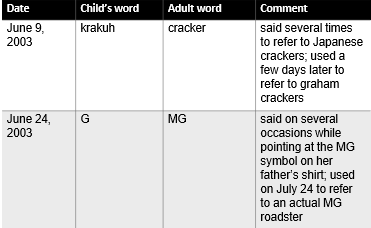
Pros of a Naturalistic Study
______________: Massive amounts of information (CHILDES) as it occurs naturally in first language acquisition
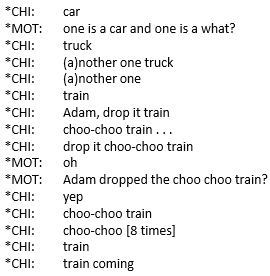
Cons of a Naturalistic Study
______________: Particular structures and phenomena may occur rarely in children’s everyday speech, making it difficult to gather enough information
Experimental Approach
Methods
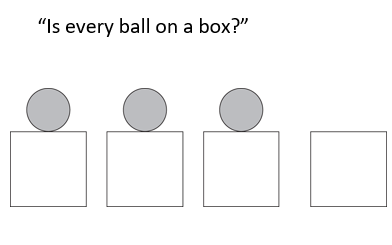
______________: Elicit particular linguistic activity through specially designed tasks
Try to gauge their comprehension of a sentence like this and at what age it begins
Cross-sectional
Cross-sectional
Experimental Approach
______________: Typically compares different children at one particular point in time (e.g., a single experiment with 2-yr-olds, 4-yr-olds, and 6-yr-olds)
Pros of Experimental Approaches
______________: Can elicit a specific type of data (e.g. fronting of the auxiliary verb when asking a question)

Cons of Experimental Approaches
______________: Many structures are hard to elicit; a child’s performance will be affected by extraneous factors, such as inattention, shyness, or a failure to understand what is expected
Phonological Development
______________: Children seem to be born with a perceptual system that is especially designed for listening to speech.
Newborns respond differently to human voices than to other sounds,
show a preference for the language of their parents over other languages,
can recognize their mother’s voice
Hearing begins in the womb, they first hear intonation (pool underwater experiment)
By one month, English babies can perceive the phonemic difference between [p] and [b]
Sucking Paradigm, Babbling, Order, Early & Universal Processes
Sucking Paradigm
______________: high-amplitude sucking technique (HAS), (non-nutritive sucking), a specially designed soother
an experimental method for testing infants from birth to age 4 months
The number of high amplitude sucks produced is used as an index of interest.
can be used to test infants’ discrimination of and preference for a variety of language stimuli
A change in the children’s sucking rate indicated that they perceived the difference between the two syllables [pa] and [ba] and that they were therefore able to distinguish between [p] and [b].
![<p><strong>______________: <span>high-amplitude sucking technique (HAS), (non-nutritive sucking), a specially designed soother</span></strong></p><ul><li><p><span>an experimental method for testing infants from birth to age 4 months</span></p></li><li><p><span>The number of high amplitude sucks produced is used as an index of </span><strong><span>interest.</span></strong></p></li><li><p><span>can be used to test infants’ discrimination of and preference for a variety of language stimuli</span></p><ul><li><p><span>A change in the children’s sucking rate indicated that they perceived the difference between the two syllables [pa] and [ba] and that they were therefore able to distinguish between </span><strong><span>[p] and [b].</span></strong></p></li></ul></li></ul><p></p>](https://knowt-user-attachments.s3.amazonaws.com/77c46536-467d-4b1a-9204-1f4dd0c51d43.png)
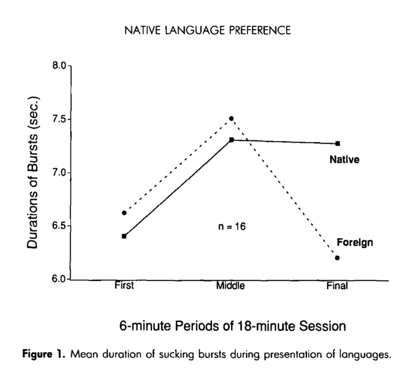
Native Language Preference
______________: More sucking activity, more interested in what they’re hearing/ Increase at beginning because interested, but for foreign speakers it drops off. Attuned very soon to their own language.
Adoption implications
Babbling
Phonological Development
______________: the ability to produce speech sounds
6 mos.
Babies practice using their vocal apparatus
Early _________ seems at least partly independent of language
Developmental Order
Phonological Development
______________: Intelligible words by about 12 mos.
Vowels tend to be acquired before consonants (by age 3).
Stops tend to be acquired before other consonants.
Labials are acquired first (they can watch parents produce them), then alveolars, velars, and alveopalatals. Interdentals are acquired last
Phonemic contrasts are acquired word-initially first (pat-bat before cap-cab)
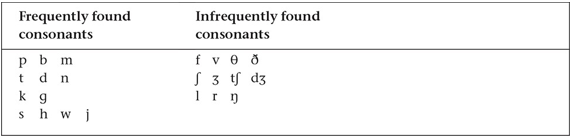
Typical Consonant Inventory
Developmental Order
______________:In general, the relative order in which sounds are acquired reflects their distribution in the world’s languages: sounds acquired early are found in more languages, and sounds that are acquired late are more rare.
[θ] [ð] [ʒ] age 5-6
![<p>Developmental Order</p><p><strong>______________:<span>In general, the relative order in which sounds are acquired reflects their distribution in the world’s languages: sounds acquired early are found in more languages, and sounds that are acquired late are more rare.</span></strong></p><ul><li><p><span>[θ] [ð] [ʒ] age 5-6</span></p></li></ul><p></p>](https://knowt-user-attachments.s3.amazonaws.com/d7f10904-f39c-4cc8-a338-b07bdc4a1b01.png)
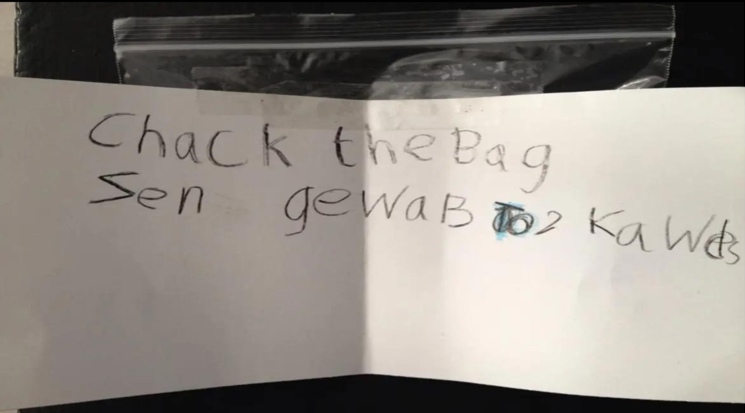
Orthography
___________: Can give us clues on how to pronounce
Early Phonetic Processes
___________: Comprehension comes before production.

Universal Phonetic Processes
Syllable deletion
Syllable Simplification
Substitution
Assimilation
Syllable Deletion
Stressed syllables are retained while unstressed syllables are deleted
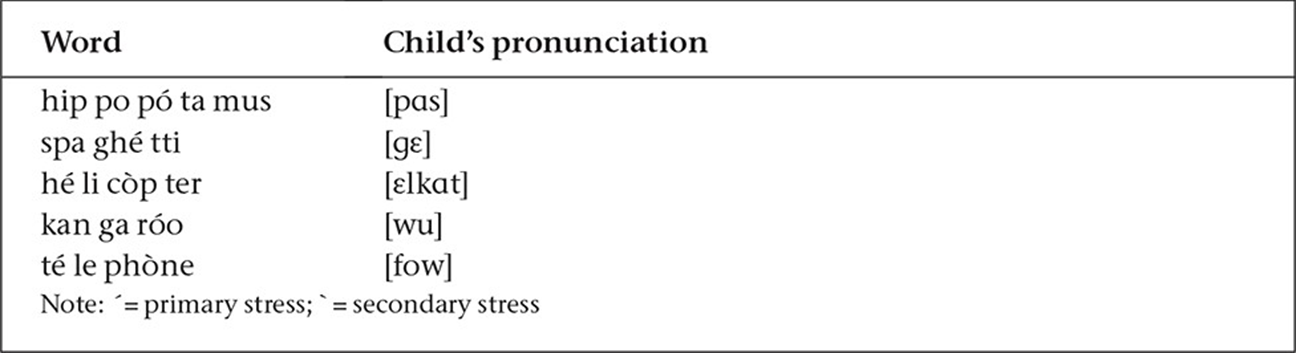
Unstressed syllables in final position tend to be retained
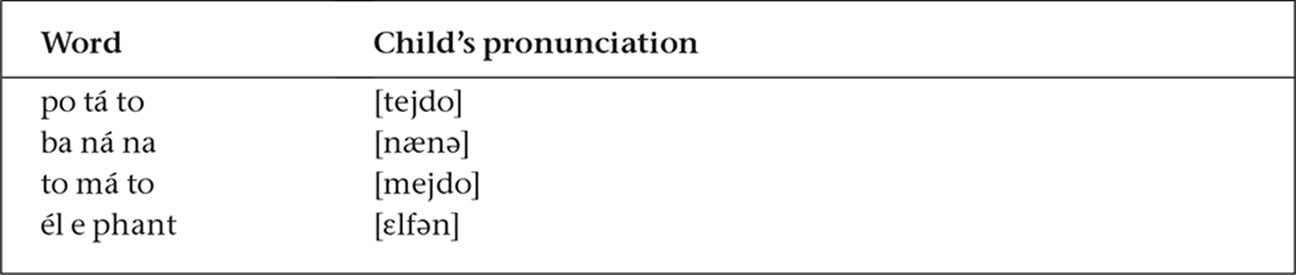
Syllable Simplification
___________: Systematic deletion of certain sounds to simplify syllable structure
Final Consonant Deletion dog→[dɑ], bus→[bʌ] boot→[bu]
Reduction of consonant clusters
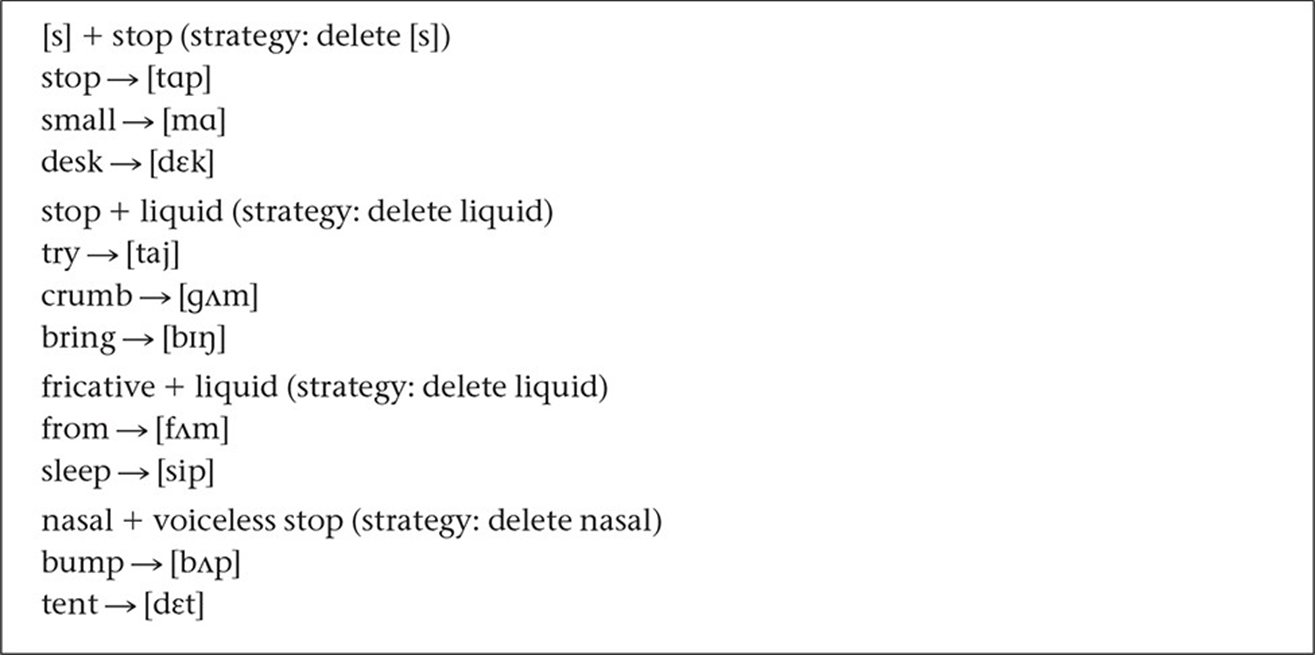
[s] + stop strategy
Reduction of consonant clusters
___________: delete [s]
stop → [tap]
small → [ma]
desk → [dek]
stop + liquid strategy
Reduction of consonant clusters
___________: delete liquid
try → [taj]
crumb → [gum]
bring → [bing]
fricative + liquid strategy
Reduction of consonant clusters
___________: delete liquid
from → [fum]
sleep → [sip]
nasal + voiceless stop
Reduction of consonant clusters
___________: delete nasal
bump → [bup]
tent → [det]
Substitution
___________: Systematic replacement of one sound by an alternative (“easier” sound)
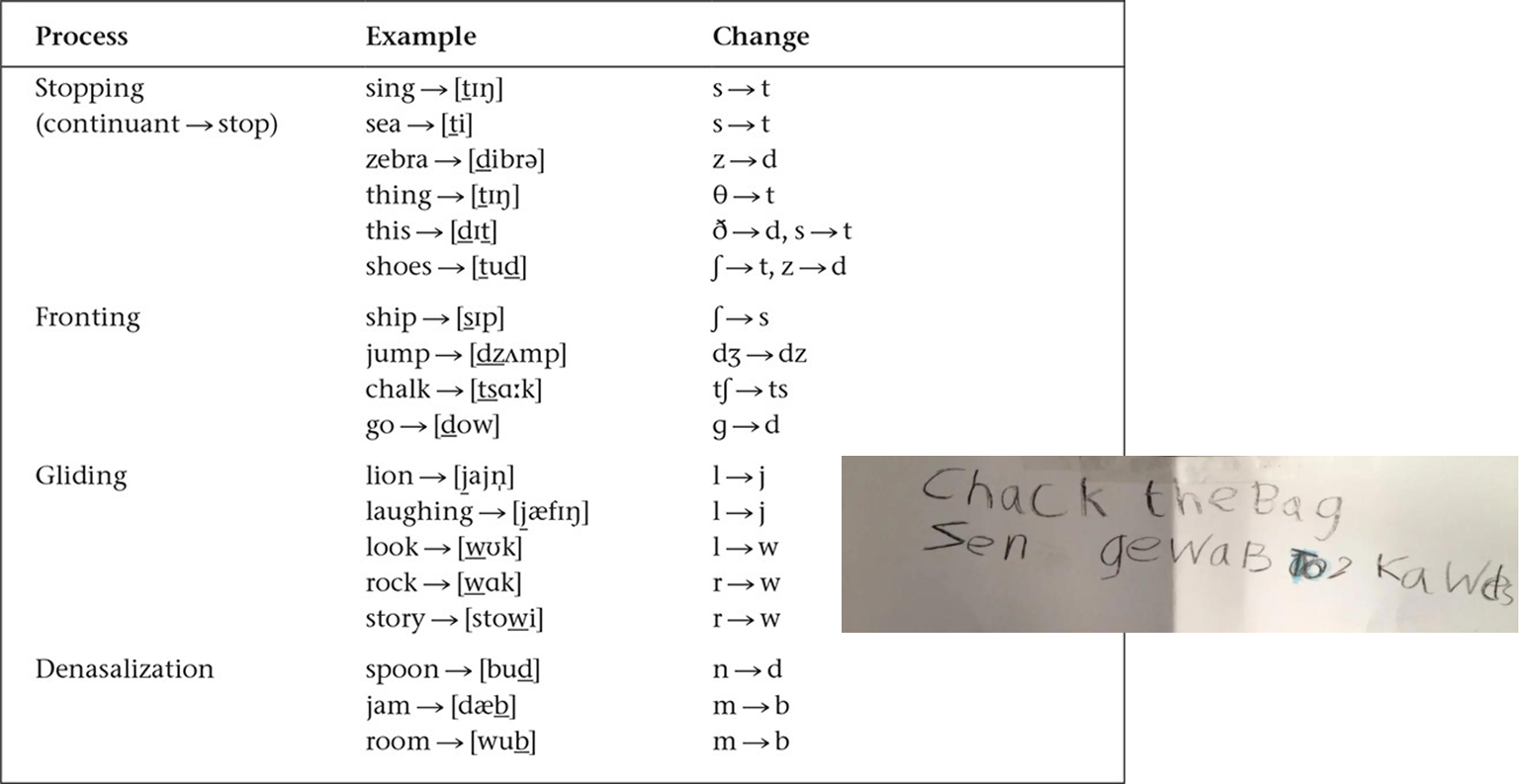
Stopping
Substitution
____________: continuant → stop
s→t
sing→[tiŋ]
sea→[ti]
z→d
zebra→[dibrə]
θ→t
thing→[tiŋ]
ð→d
this→[dis]
ʃ→t
shoes→[tus]
Fronting
Substitution
____________: moving a sounds place of articulation forward
ʃ→s
ship→[sIp]
d3→dz
jump→[dzump]
tʃ→ts
chalk→[tsak]
g→d
go→[dow]
Gliding
Substitution
____________:Replacing a liquid with a glide
l→j
lion→[jajn]
l→w
look→[wuk]
r→w
story→[stowi]
Denasalization
Substitution
____________:Replacing a nasal with a non-nasal stop
n→d
spoon→[spud]
m→b
jam→[daeb]
Assimilation
___________: Modification of one or more features under the influence of neighbouring sounds
Voiceless sound becomes voiced when next to voiced sounds
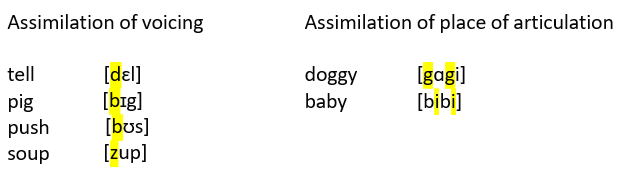
Vocabulary Development
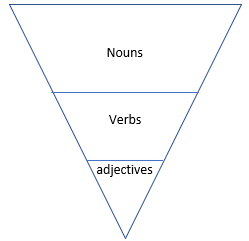
___________: 50 words or more by 18 mos. Dominated by nouns, verbs, then adjectives
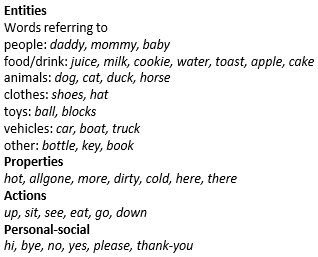
Common items in the first fifty words
Meaning Errors
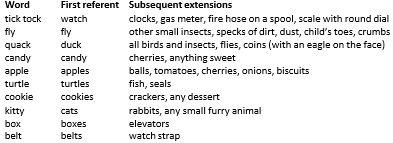
Overextensions
Underextensions
Overextensions
Meaning Errors
____________: the meaning of the child’s word is more general or inclusive than the adult form
typically compensate for vocabulary limitations, and disappear when children learn the correct word for the objects they have been mislabelling (like “cat,” “crumb,” “grapefruit,” or “button”).
Underextensions
Meaning Errors
____________: the meaning of the child’s word is more restricted than the adult form
E.g.: “kitty” is only the family pet; “dog” refers to labs and retrievers, but not chihuahuas.
show preference for the prototype (labs and retrievers have more properties associated with the concept dog than tea-cup chihuahuas or hairless dogs).
Morphological Development
Overgeneralization/Undergeneralization
A developmental sequence
Word formation processes
Overgeneralization/Undergeneralization
Morphological Development
____________: Children may have to hear an irregular form up to 100 times before eliminating ___________.
(Hence, words with irregular inflection that occur more frequently (go/went, child/children) are learned quicker than less frequent words (sink/sank, ox/oxen).
One of the best indications that children have mastered an inflectional rule is their ability to apply it to forms they have not heard before.
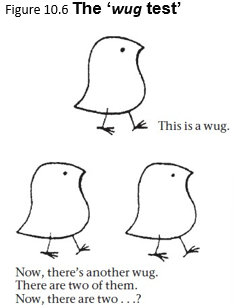
The development of affixes
Stage 1: Case-by-case learning (plural boys, men, etc.; past tense walked, ran, etc.)
Stage 2: Overuse of general rule (plural mans; past tense runned) May seem like they’re moving backwards, but they’re not
Stage 3: Mastery of expectations to the general rule (plural men; past tense ran)
A developmental sequence
Morphological Development
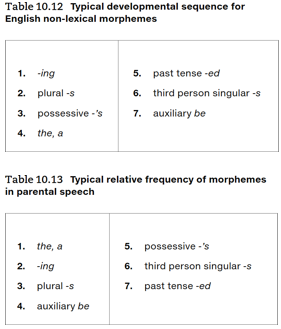
____________:The development of bound morphemes and functional categories (determiners and auxiliaries) is surprisingly regular. First the -ing morpheme, then plural s, etc.
And seems to be at least partly independent of adult speech. Adults say the most, but children acquire if 4th
Word formation processes
Morphological Development
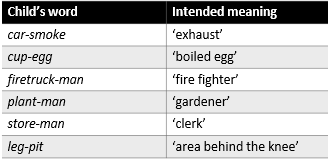
____________: The major word formation processes are derivation (adding affixes) and compounding (sticking two words together)
Suffixes in the speech of a child prior to age 4
Ending | Meaning | Example |
-er | ‘doer’ | walker |
-ie | ‘diminutive’ | doggie |
-ing | ‘activity’ | Running is fun. |
-ness | ‘state’ | happiness |
Innovative N-N Compounds
Word Formation Processes
____________: Building words with known words may be less demanding on the memory than learning an entirely new word for each concept.
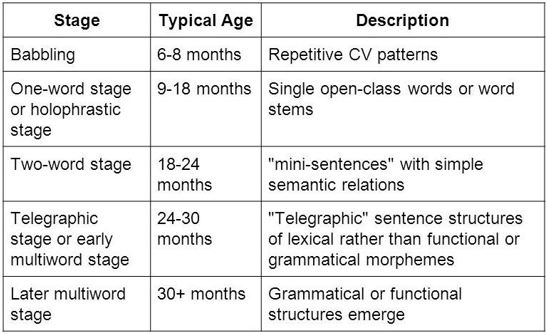
Syntactic Development
Babbling
One-word stage/holophrases (1-1.5 yrs)
Two-word stage (1.5-2 yrs)
Telegraphic stage (2-2.5 yrs)
Later Development (2.5+ yrs)
One-word stage/holophrases (1-1.5 yrs)
Syntactic Development
__________:Single open-class words or word stems
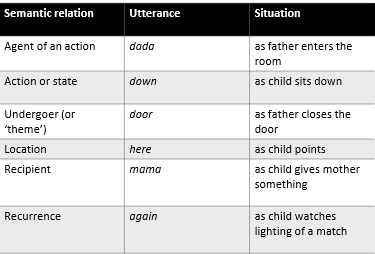
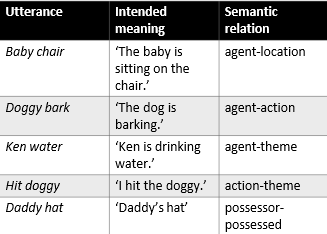
Two-word Stage (1.5-2 yrs)
Syntactic Development
__________: ”Mini-sentences” with simple semantic relations, almost always exhibit appropriate word order (general word order rule by 3 years old)
Telegraphic stage (2-2.5 yrs)
Syntactic Development
__________: Sentence structures of lexical rather than functional or grammatical morphemes. Starting to create phrases consisting of a head and a component ([her name], [ride bus])
![<p>Syntactic Development</p><p><strong>__________: Sentence structures of lexical rather than functional or grammatical morphemes. </strong>Starting to create phrases consisting of a head and a component ([her name], [ride bus])</p>](https://knowt-user-attachments.s3.amazonaws.com/6e16da0c-794c-491c-a8a6-97697324eb92.png)
Later Development (2.5+ years)
Syntactic Development
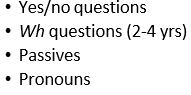
_________: Grammatical or functional structure
What makes language acquisition possible?
Experience
Feedback
Cognitive Development
Inborn Knowledge
Experience
What makes language acquisition possible?
___________: Exposure to large amounts of speech
Motherese/caregiver speech
Carefully articulated speech
Note: in Western Samoan, speech to children is not simplified, yet Samoan children have no trouble learning Samoan
Motherese/Caregiver Speech
All languages seem to possess this
Phonetic
Slow, carefully articulated speech Higher pitch
Exaggerated intonation and stress
Longer pauses
Lexical and semantic
More restricted vocabulary
Concrete reference to the here and now (not existential)
Syntactic
Few incomplete sentences Short sentences
More imperatives and questions
Conversational
More repetitions
Few utterances per conversational turn
IDS/CDS child or infant directed speech
Feedback
What makes language acquisition possible?
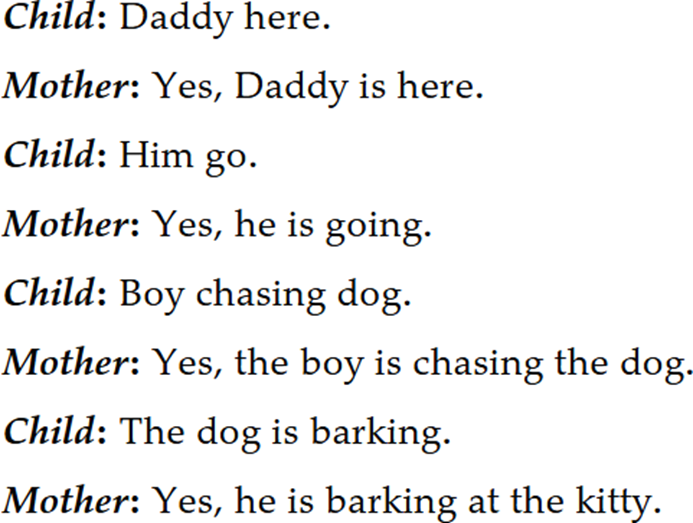
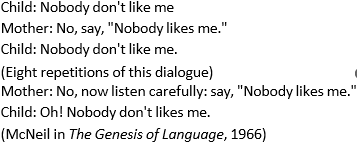
___________: Corrections have little impact
Recasts may help: providing with potentially useful information that might be helpful to move from the target form (adding a missing verb, etc.)
Cognitive Development
What makes language acquisition possible?
___________:Language acquisition appears to be independent of other types of cognitive development to a large extent
Inborn Knowledge
What makes language acquisition possible?
___________: Are children born with a Universal Grammar, a set of inborn categories, operations, and principles common to all human languages? (Noam Chomsky)
Phrases embedded within each other
Why do languages all have nouns and verbs, embedding?
LLMs have causes us to challenge the idea that we have an inborn grammatical template
Is there a critical period?
___________: The ability to acquire a first language in an effortless and ultimately successful way begins to decline from age 6 and is likely linked to brain lateralization
Before 6, using our whole brain, after it begins to lateralize
Genie Wiley: Genie was not spoken to until the age of 13
It has been reported that hearing children growing up in homes with non-speaking deaf parents cannot learn spoken language from radio or even television.
Can you think of any reasons for this?
What are the implications of these findings for our understanding of the type of experience that is required for language acquisition?
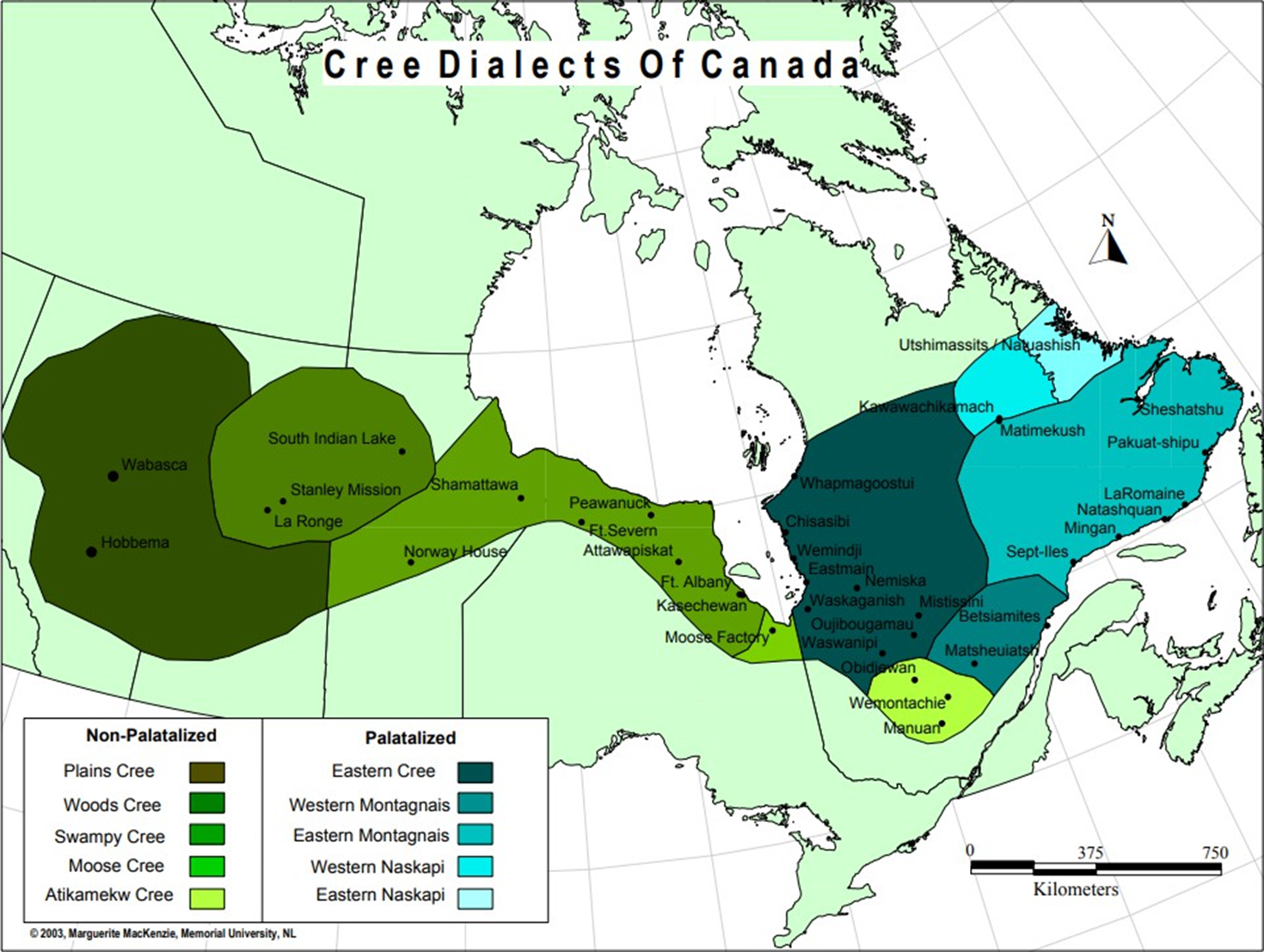
Language Acquisition in Chisasibi language (eastern cree)