Unit 4 Ch 21 - CR and PSP Plates
 Call Kai
 Learn
Learn Practice Test
 Spaced Repetition
 Match
Match Flashcards
 Knowt Play
1/50

There's no tags or description
Looks like no tags are added yet.
Name | Mastery | Learn | Test | Matching | Spaced | Call with Kai |
|---|
No analytics yet
Send a link to your students to track their progress
51 Terms
What are the two types of digital radiography systems?
computed radiography and digital radiography
what is computed radiography
photostimulable phosphor imaging plates (PSP IP)
-developed in 1980s-pased out 2010
-uses technology of storing phophors
-analog imaging=film/screen
what is digital radiography?
- flat-panel detectors (indirect conversion and direct conversion)
-charged couple devices (CCD)
-complementary metal oxide semiconductor (CMOS)
what is computed radiography's 2 step process?
1. acquisition
2. image processing and display
What is being phased out and what is replacing it??
CR (computed radiography) is being phased out and replaced by photostimulable phosphor imaging plates (PSP IP)
the cassette has 2 uses. what are they
1. protects IP from damage
2. provides ligthtweight, sturdy vehicle for IP transportation and placement under patient (IP is flexible and fragile)
what is the cassettes construction?
frame, front panel, anti-static felt, back panel, and a memory chip or bar code
Cassette Construction: Frame
aluminum, plastic, or steel
Cassette Construction: Front Panel
radiolucent carbon fiber
Cassette Construction: Anti-static Felt
protects against static build-up and provides cushion
Cassette Construction: Back Panel
lined with lead foil (backscatter)
Cassette Construction: Memory Chip or Bar Code
to match patient information with cassette
rigid sheet of several layers which records and transmits image from xray beam inserted into cassette
What is the PSP IP construction (describe it, don't tell me what it contains)
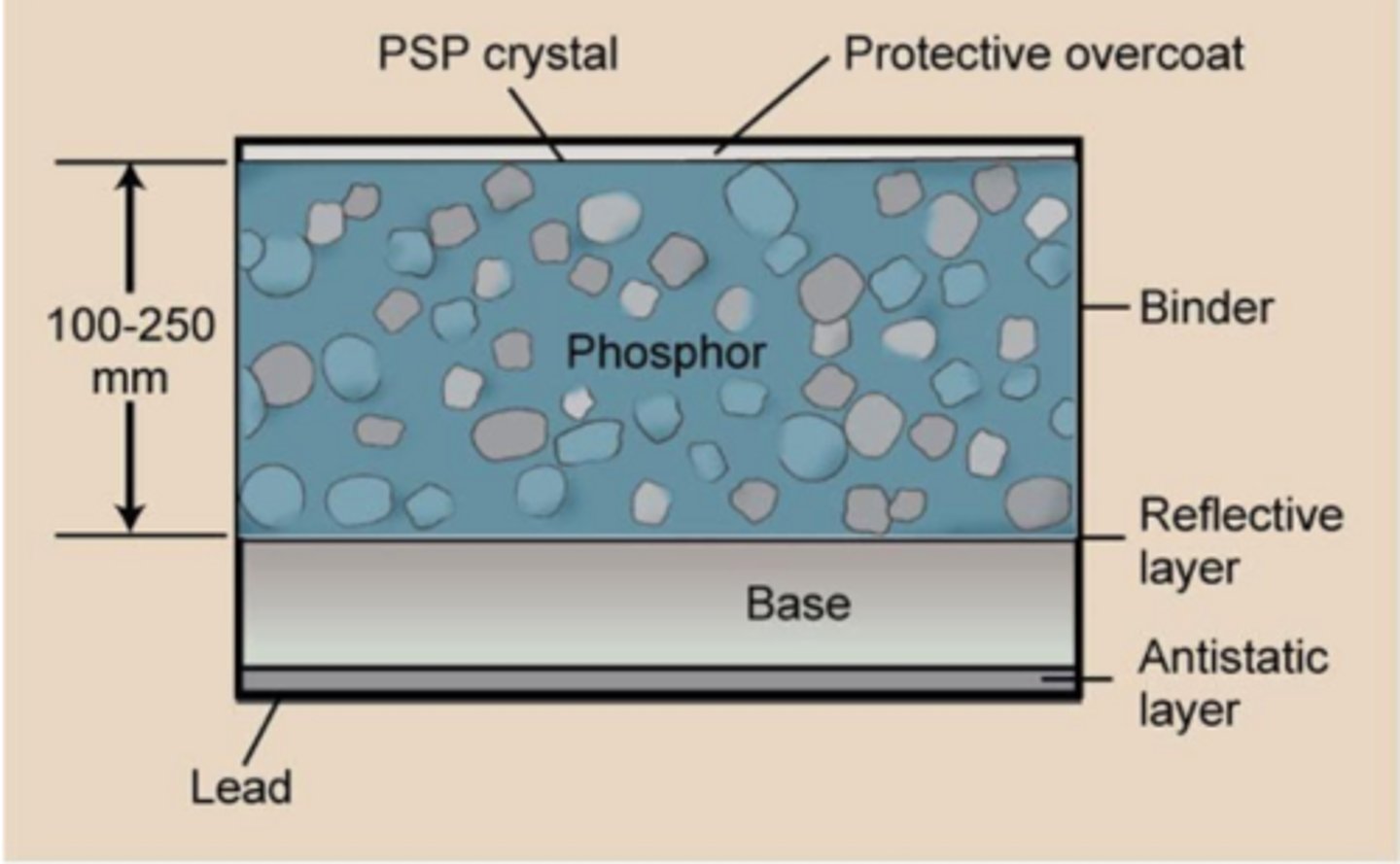
protective layer, phosphor layer, conductor layer, support layer, light shield layer, and backing layer
PSP Plate Construction: what are the layers?
protects phosphor from mechanical wear and cleaning solutions
-provides a smooth surface that improves signal to noise ratio (S/N ratio)
PSP Plate Construction: Protective Layer
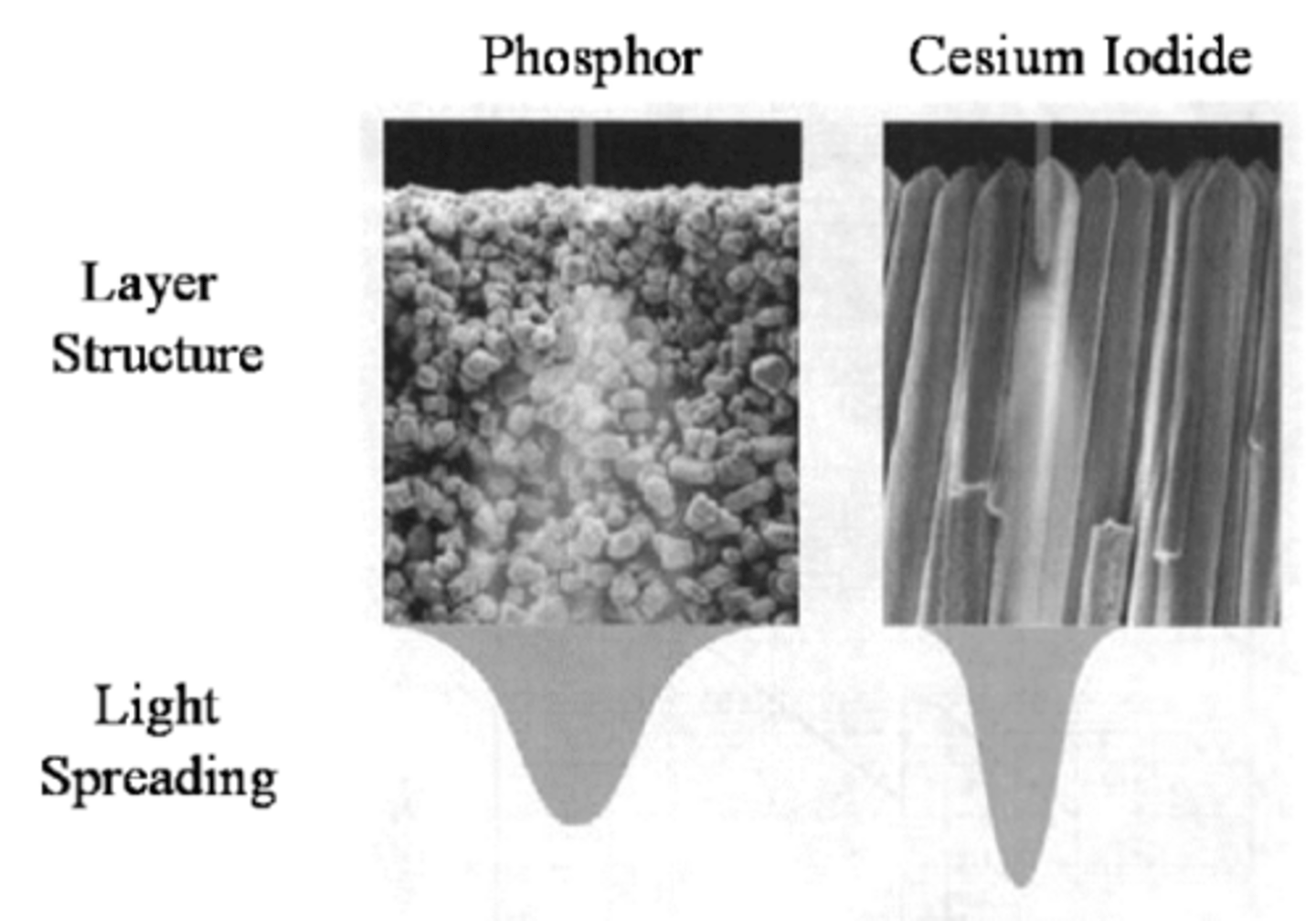
- where the image is trapped; considered the active layer; has a scintillator
-USES barium fluorohalide (bromide and iodide) with europium activators
- "conventional powder" where the light goes in all directions
OR
-uses europium-doped cesium bromide
-needle shaped crystals - channels light up and down
PSP Plate Construction: Phosphor layer
reflects light forward so that it can be captured in the image reader device (IRD)
PSP Plate Construction: reflective layer
provides support and strength for the IP
PSP Plate Construction: Base layer
conducts static electricity away from phosphor layer because potential cause for artifacts; grounds the plate
PSP Plate Construction: Conductor layer (or antistatic layer)
prevents extraneous light from hitting phosphor layer
PSP Plate Construction: light shield layer
thin sheet of lead foil that absorbs backscatter and is a protective layer
PSP Plate Construction: backing layer
barium fluorohalide (bromide and iodide) with europium activators
- "conventional powder" [light in all directions]
OR
europium-doped cesium bromide
-needle shaped crystals [channels light up and down]
the phosphor layer. of the PSP IP uses what 2 PSPs (a powder or a crystal)
it's an object that fluoresces (emits light) when hit by ionizing radiation
within the phosphor layer, what does the scintillator do?
10 times
how much more sensitive are CR phosphor plates to scatter and background radiation than conventional film
as little as 24 hrs - this is why it is the best practice to erase any cassette prior to use if there is a chance it has been in storage for 2 days or more
a fog can be produced in how little of time for PSP IPs
1. upon exposure, X-rays strike the cassette and phosphor layer
2. some X-rays get absorbed (photoelectric absorption)
3. this absorption of energy ejects photoelectrons, results in "holes" in the phosphor
what are the 3 steps to latent image production?
fluorohalides or cesium bromide
during the latent image production, in step 2, it says "some X-rays get absorbed (photoelectric absorption)"...what other 2 absorb some of the beam through photoelectric interactions?
they immediately return to their original position <--- fluorescence occurs
OR become trapped in "F centers" <--- traps e- in excited state
what are the 2 outcomes for the freed electrons from latent image production?
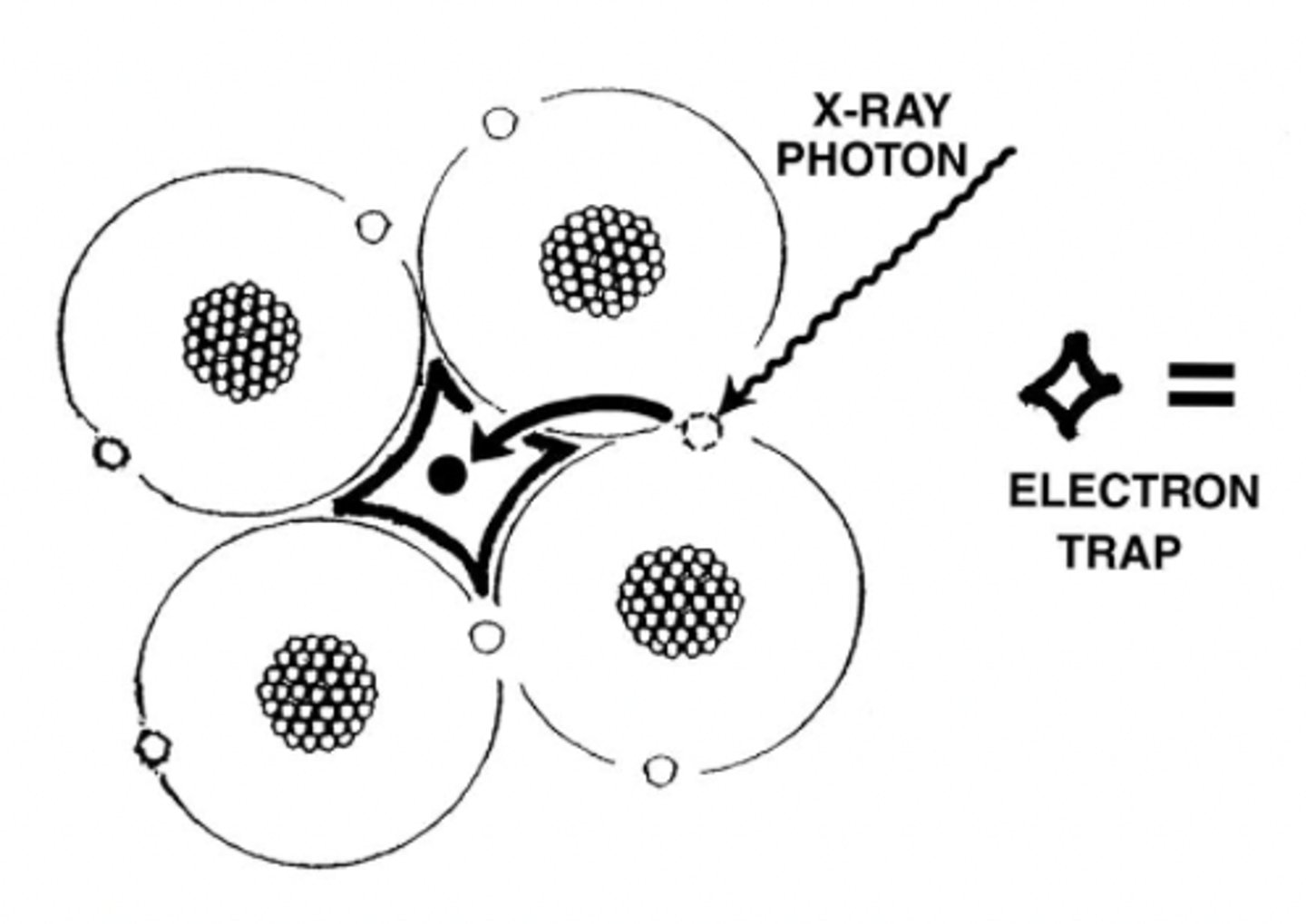
because of europium
why are F centers present?
the latent image (hidden, not visible image yet)
in the F centers, what do the freed electrons that get trapped there contain?
8 hours - this is why it's important to [rocess cassette quickly after exposure
how long does it take for a latent image to lose 25% of its energy?
they're scanned in an image reader device (IRD)
a minute and a half per cassette
how do we read PSP image data?
how long does it take to read the image?
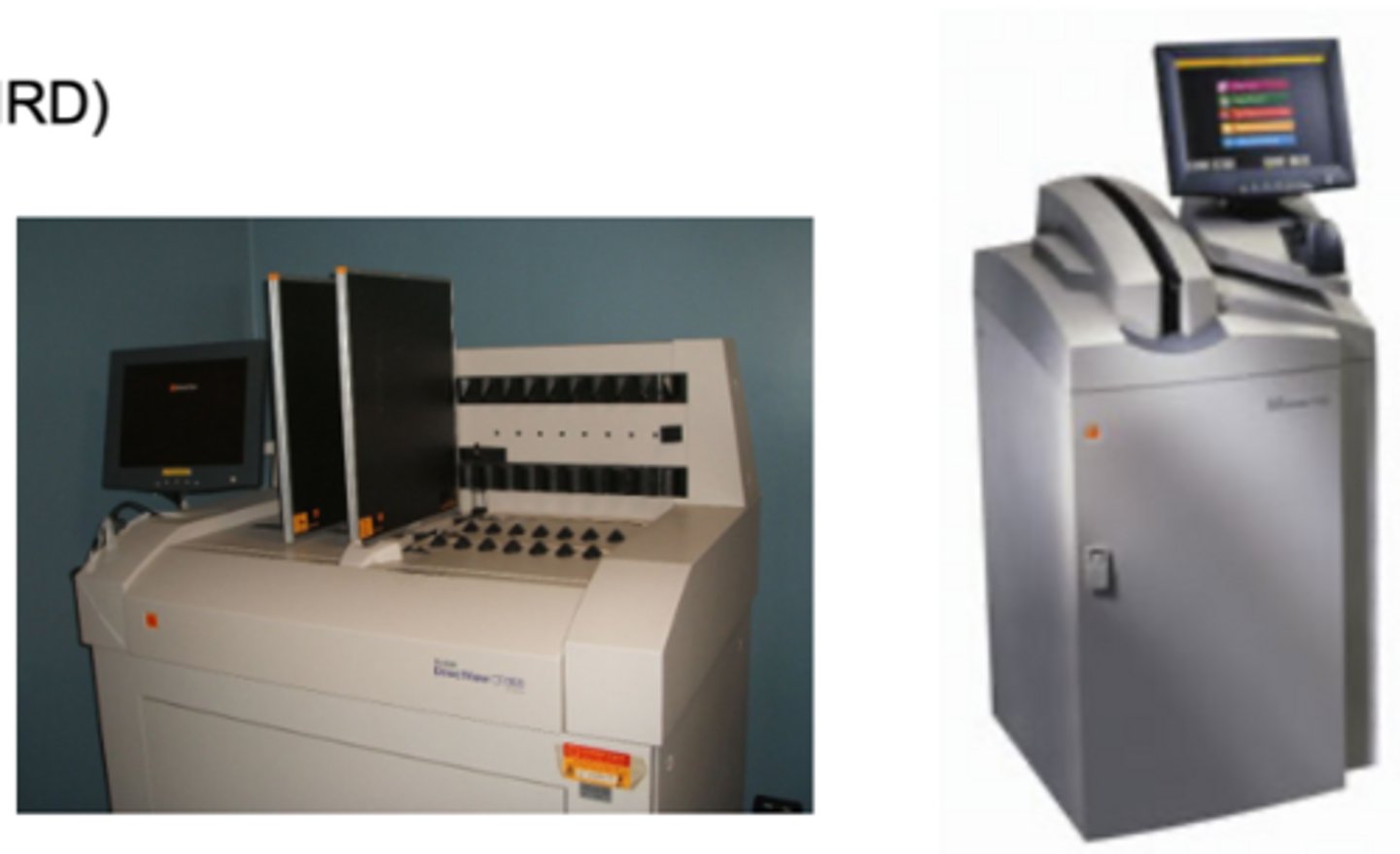
latent image is scanned by high intensity helium-neon or solid state red laser beam in a raster pattern, which reflects off a mirror onto the IP as the IP is transported through the rollers using fast scan direction or slow scan direction
Steps to reading PSP image data: FIRST step
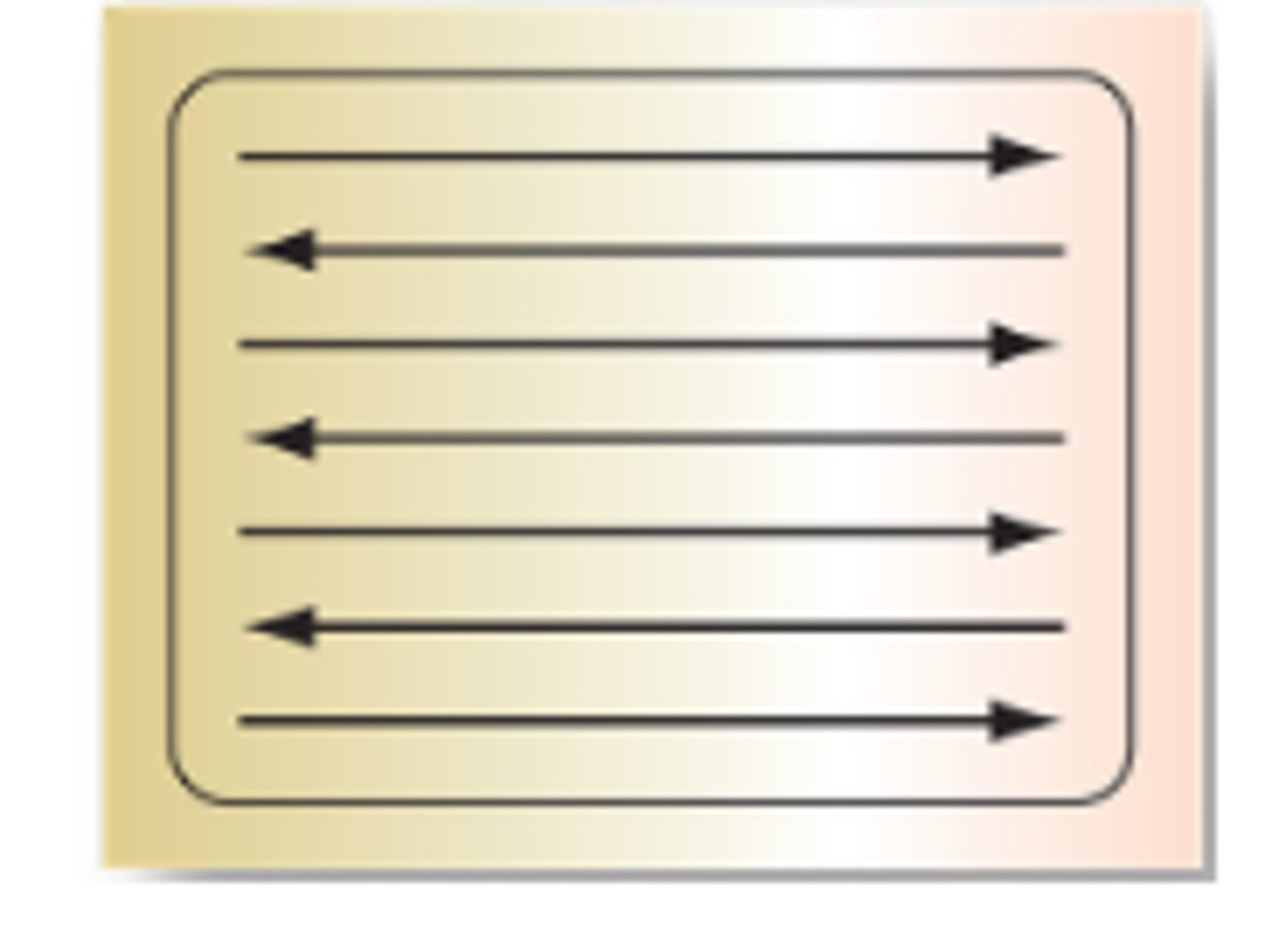
when the laser hits the phosphor layer, the trapped electrons in the F centers are freed and return to a lower energy state
-(energy is released as a blue-purple light called photo stimulated luminescence (PSL))
Steps to reading PSP image data: SECOND step
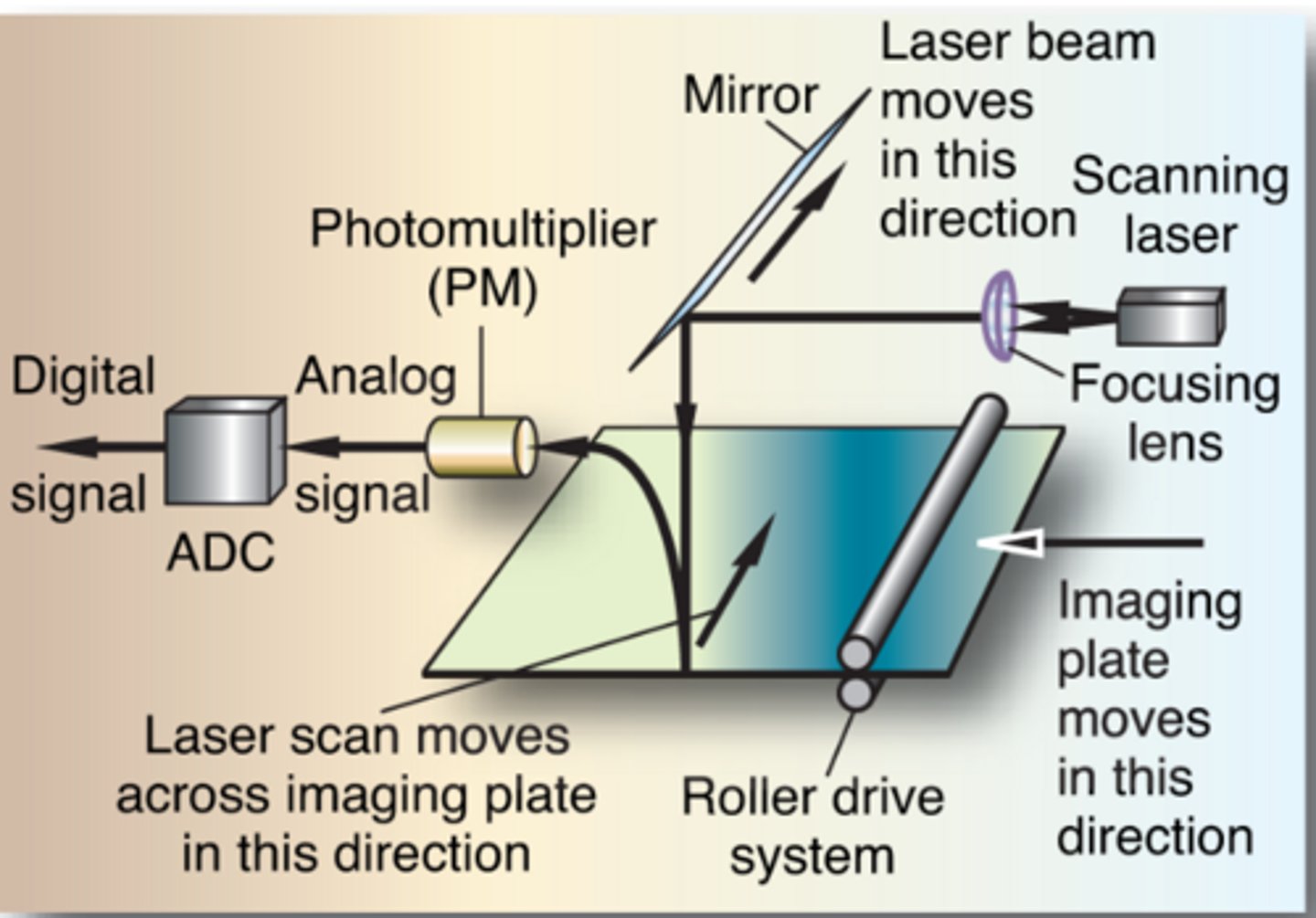
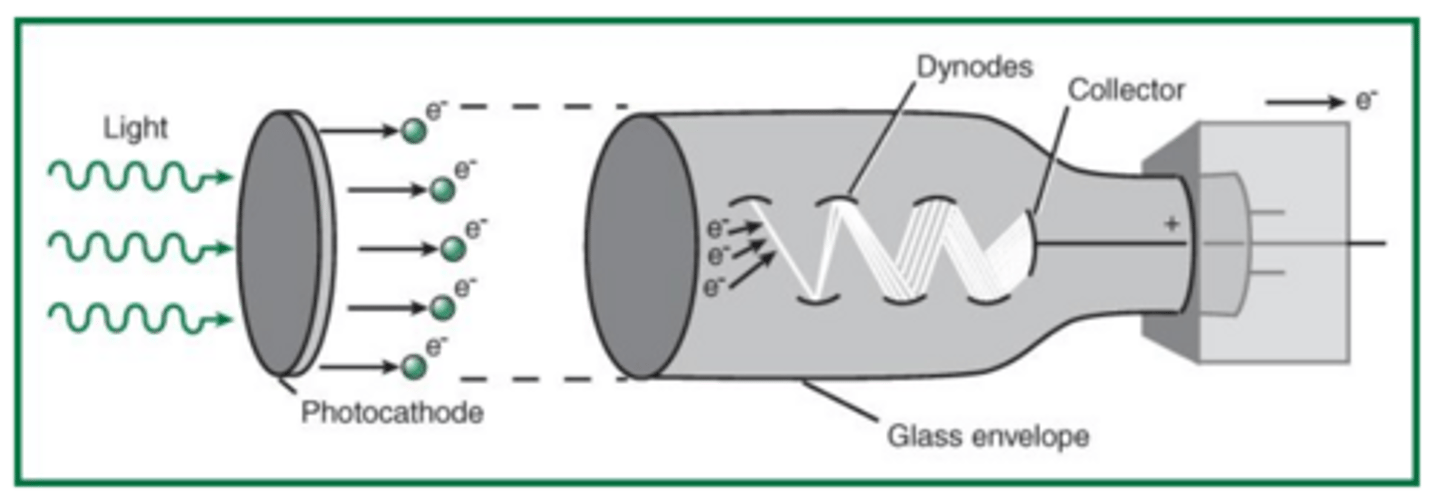
this light is captured by photodetector (or photomultiplier tube or charged couple device (CCD)
Steps to reading PSP image data: THIRD step
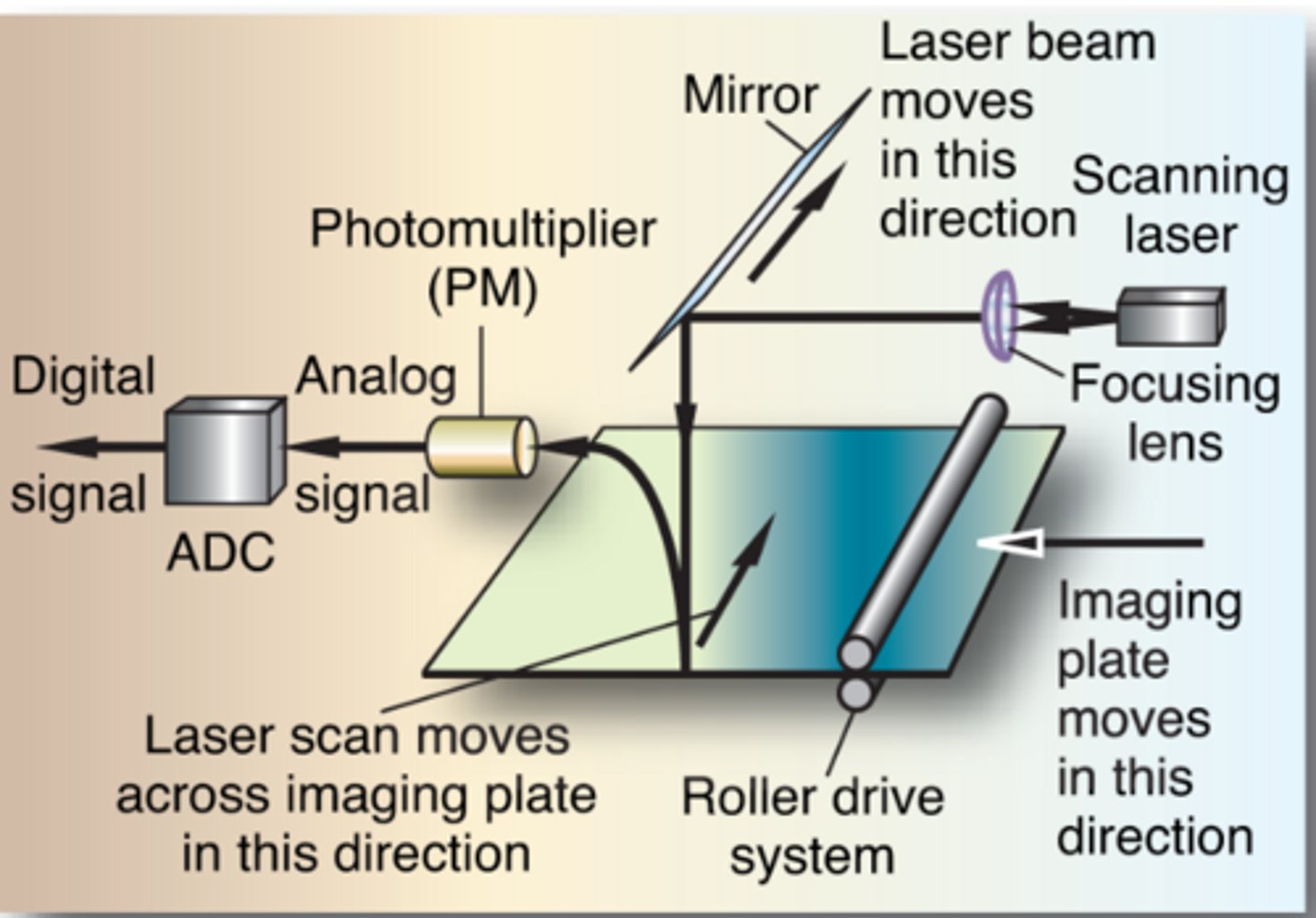
photodetector (photomultiplier [PM]) tube or charge coupled device (CCD) converts light to electrons
Steps to reading PSP image data: FOURTH step
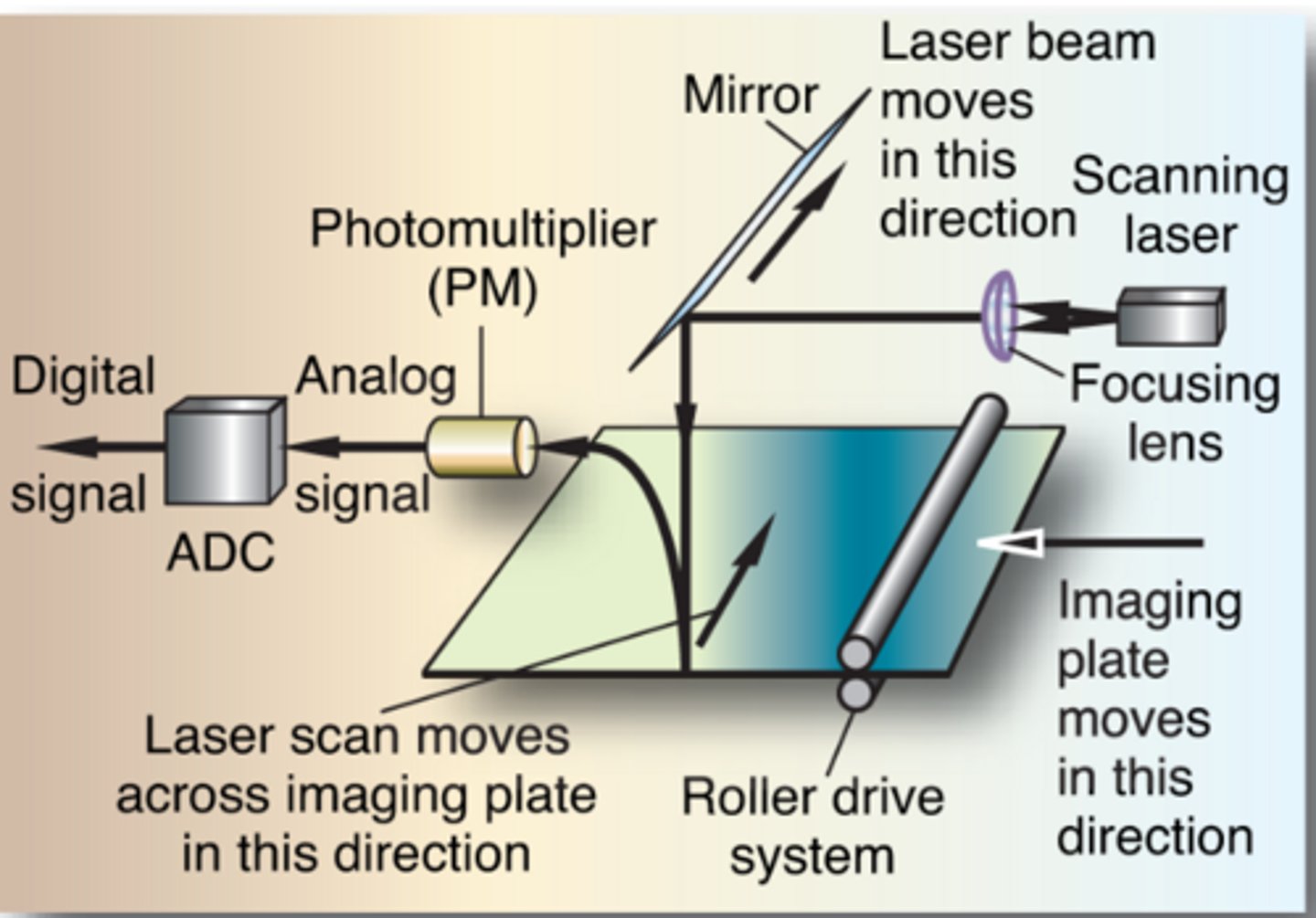
an analog to digital converter (ADC) converts electrons to digital data and receives electron stream from photodetector and converts it to a digital signal to be sent to computer
Steps to reading PSP image data: FIFTH step
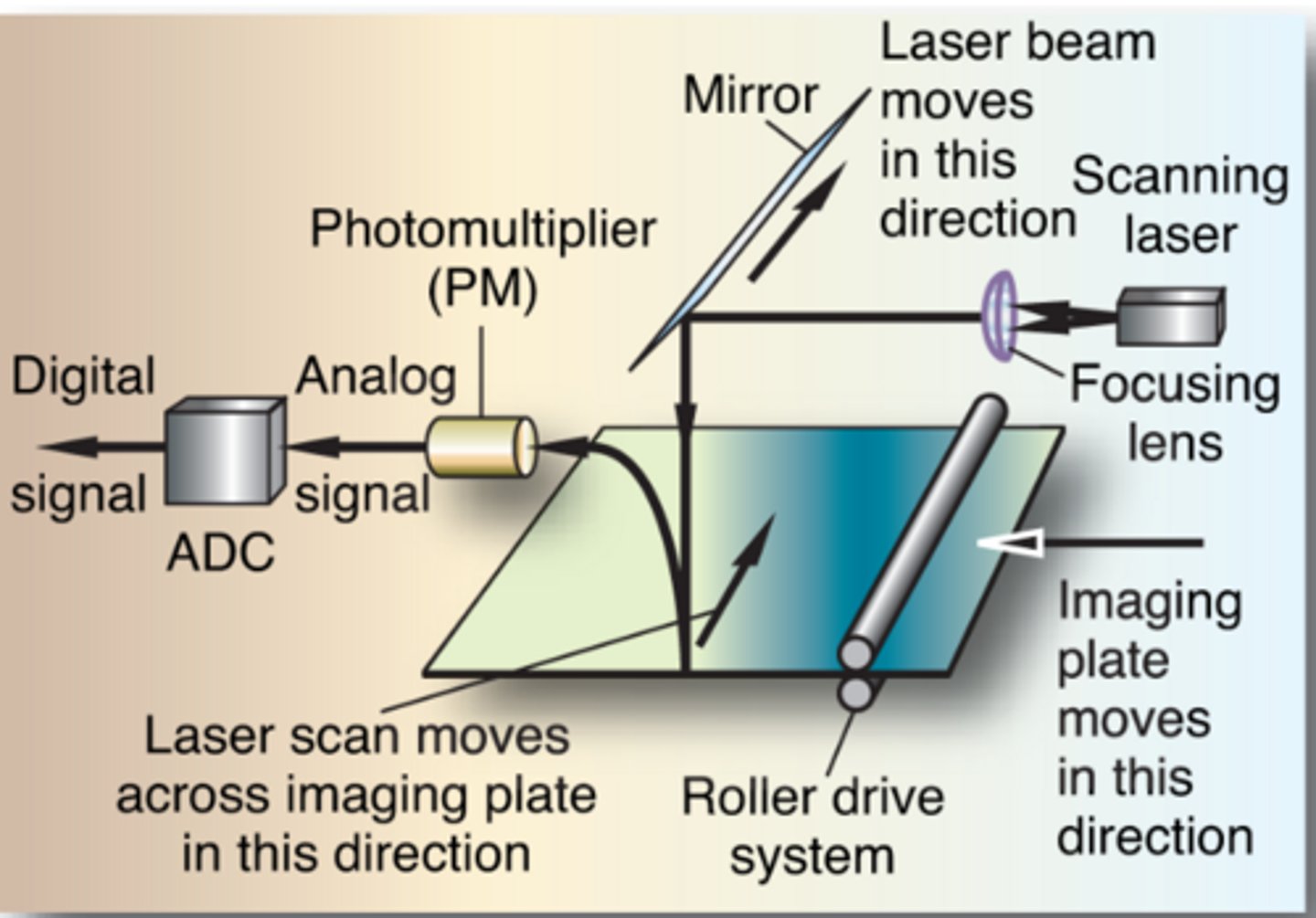
digital signal data is sent to the computer for additional processing
Steps to reading PSP image data: SIXTH step
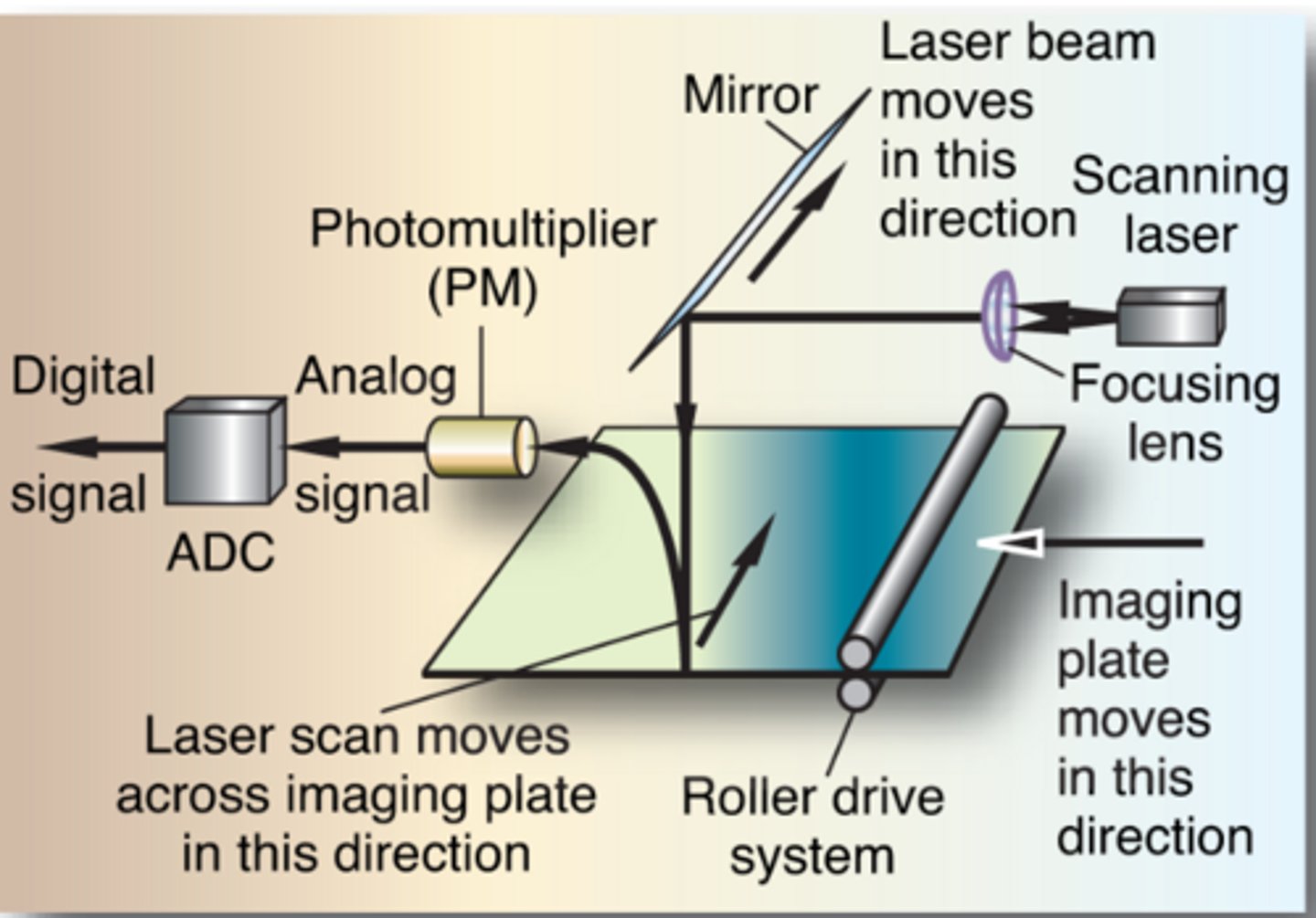
imaging plate is then completely erased by exposure to intense white light (analog in ADC, digital OUT)
Steps to reading PSP image data: SEVENTH step
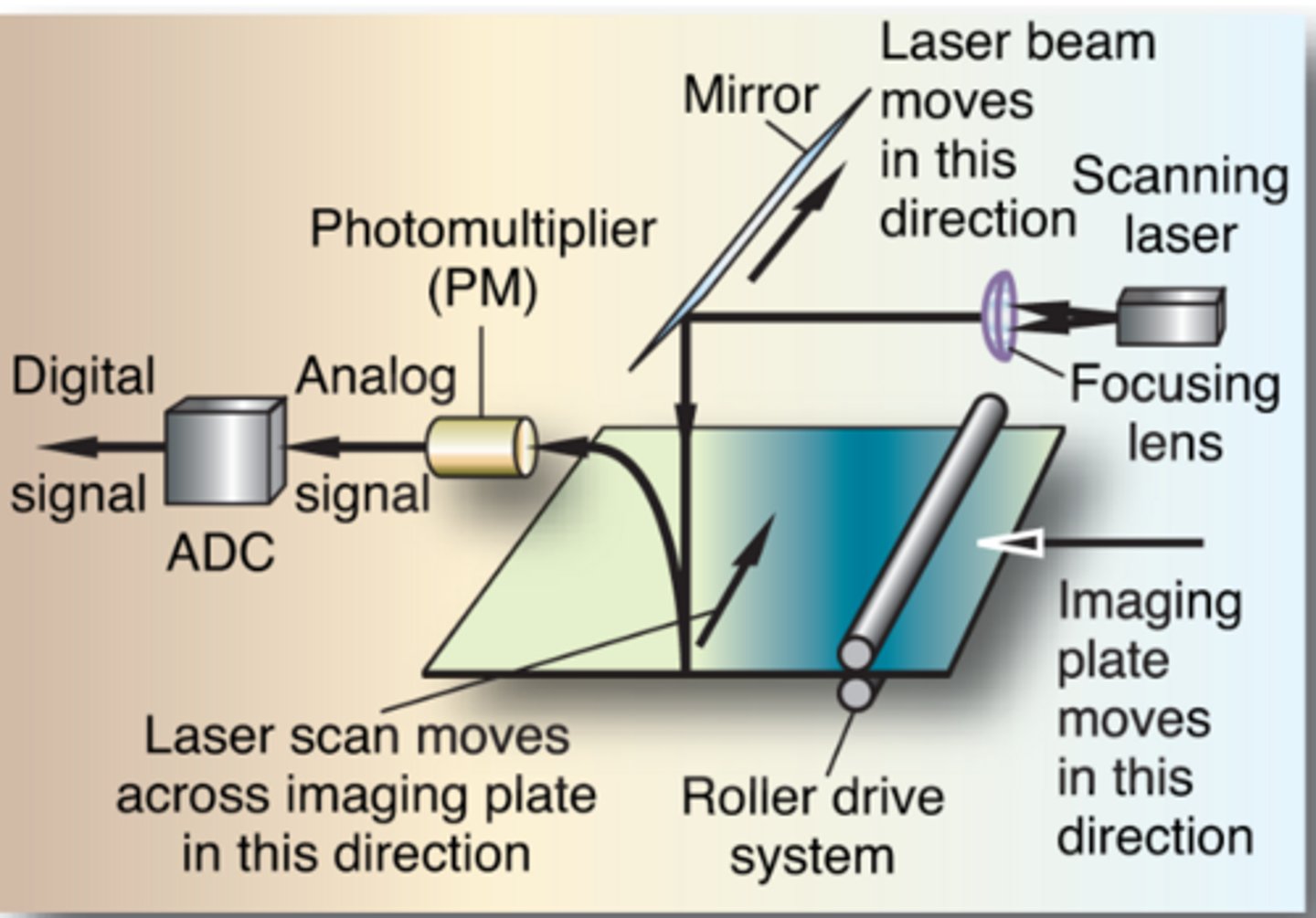
CsBr:Eu (cesium bromide with europium) - because phosphor is needle-shaped and increases resolution
if there is photostimulated luminescence (PSL) divergence, what can decrease the amount of divergence?
aka Laser scan direction; laser light moving back and forth across IP (raster pattern)
what is fast san direction?
aka Plate scan direction; direction of IP movement as it is transported through the rollers
what is slow scan direction?
refers to any emission of light in general
define luminescence
refers to the immediate emission of light under stimulation
define fluorescence
is the delayed emission of light some time after the original stimulus/exposure has occurred..."glowing in the dark"
define phosphorescence
requires re-stimulation
define stimulated phosphorescence
very similar to CCDs used as IRs
define charged couple device
a photocathode plate attached to an electronic amplifier
-dynodes are a series of plates that can be switched back/forth between relative positive and negative charge to continuously accelerate and multiply the electron stream
define photomultiplier tube
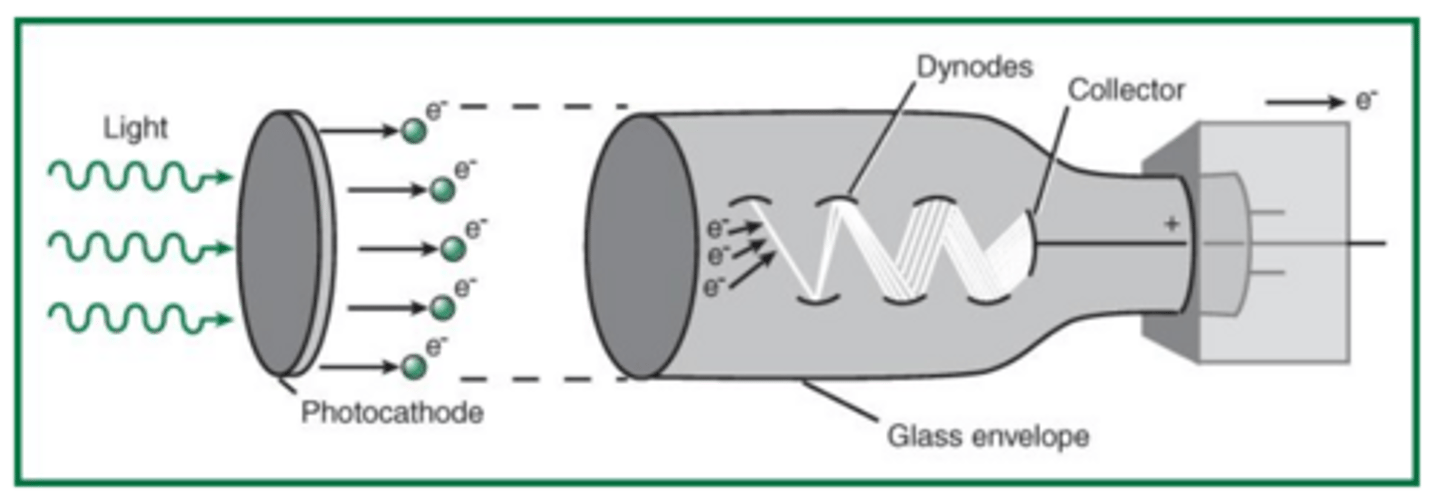
a later of material that releases electrons when light strikes it, through the photoelectric effect
define photocathode
the number of electrons trapped
in terms of the latent image, WHAT is proportional to the number of xray photons that interact with the imaging plate
Still learning (3)
You've started learning these terms. Keep it up!