TMJ Unit 5 - Treatment of Masticatory Muscle Disorders
 Call Kai
 Learn
Learn Practice Test
 Spaced Repetition
 Match
Match Flashcards
 Knowt Play
 Podcast
1/17

There's no tags or description
Looks like no tags are added yet.
Name | Mastery | Learn | Test | Matching | Spaced | Call with Kai |
|---|
No analytics yet
Send a link to your students to track their progress
18 Terms
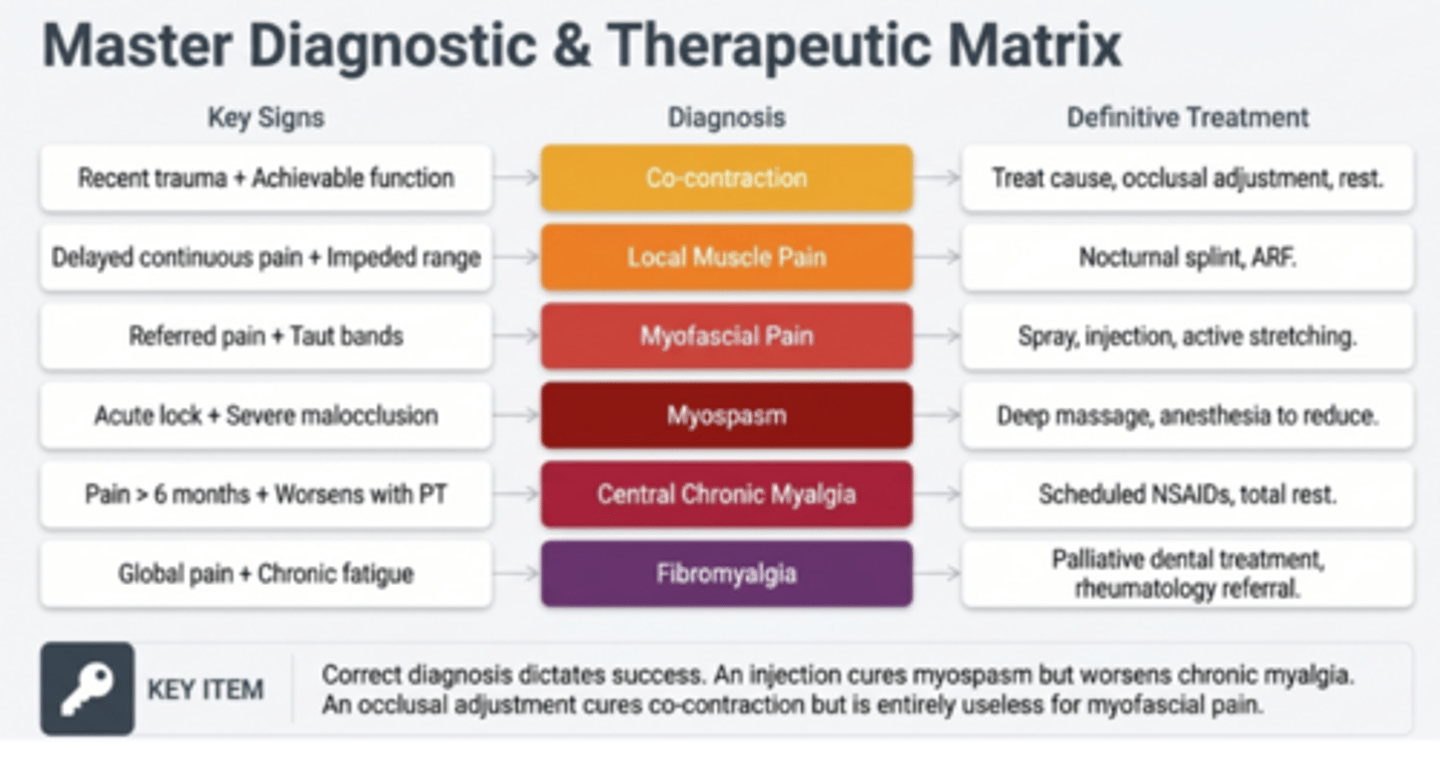
How do we split up muscle disorders?
1) Acute
2) Chronic
3) Systemic
What are acute muscle disorders?
Acute muscle disorders have a rapid resolution, and are split into:
1) Protective Co-contraction
2) Local muscle pain
What are chronic muscle disorers?
complex + mediated/sustained by CNS
1) Myofascial Pain
2) Myospasm
3) Chronic Myalgia
What are systemic muscle disorders?
Fibromyalgia
What is protective co-contraction? (5)
acute muscle disorder where the muscle splints itself to protect an injured area (physiological response)
causes include: Changes in sensory stimulus (poorly adjusted filling), constant deep pain, or acute emotional stress.
Appears immediately but stays for only a few days
Reduced range of motion (but can open mouth fully at request) + Minimal pain at rest (increases with function)
Feeling of "muscle weakness."
How do we treat protective co-contraction?
definitive TX = eliminate etiological factor, e.g. treating a poorly adjusted filling.
If stress —> stress management + relaxation techniques
restrict mandible use to painless limits + soft diet.
Can use short-term analgesics (NSAIDs), but only if local tissue pain.
DO NOT allow them to do vigorous physical exercise.
What is local muscle pain? (6)
An acute, primary, non-inflammatory myogenic pain disorder.
Caused by: prolonged protective co-contraction, local tissue trauma, or chronic stress.
delayed onset - hours or days after event (injection/ excessive mouth opening
"true" change in the muscle tissue, unlike protective co-contraction
CANNOT reach max mouth opening + significant pain with function
not CNS protective response.
How do we treat local muscle pain?
definitive TX = muscle relaxation device (i.e. a splint) if we have sleep bruxism
education (ARF) and physical therapy
NO absolute rest !! (need to use muscle in pain free threshold)
Scheduled NSAIDs (ibuprofen) for 5-7 days (not on demand)
What is myofascial pain? (4)
regional myogenic disorder with hard, hypersensitive bands of muscle tissue (trigger points)
Caused by: Constant deep pain, stress, sleep issues, bad posture, fatigue
Symptoms: CNS effect will generate referred "heterotopic" pain. E.g. trap or neck pain that we think is a headache (secondary symptom)
To test: If we stimulate or palpate the affected muscle, it will increase the referred pain.
How do we treat myofascial pain? (3)
eliminate TRIGGER POINT ! - painless stretching , correct posture + sleep habits
Spray and Stretch: vapocoolant spray (fluoromethane) + stretch muscle to full length
Pressure and Massage: Pressure - up to 9kg for 30-60 seconds, without causing excess pain
Inject and Stretch: Inject local anaesthesia (1-2% lidocaine, no vasoconstrictor) directly, then stretch.
Anaesthesia only helps block pain, the stretching is the TX
What is myospasm? (6)
acute, involuntary CNS-induced tonic muscle contraction (spasm).
Caused by: Long deep pain, severe muscle fatigue, electrolyte imbalance.
It's sudden and abrupt
Very severely restricts jaw movement + produces obvious acute malocclusion
muscles feel very hard, rigid and painful on palpation
Intense pain, even at total rest (muscle is physiologically locked)
How do we treat myospasm?
pain reduction - deep massage, ice/vapocoolant/LA
passive stretch - of muscle to full length
To prevent it: Rest muscles and keep electrolyte balance
If it recurs: Inject with botox, which keeps it paralysed for 3-4 months.
What is centrally mediated chronic myalgia? (6)
continuous chronic muscle pain from peripheral CNS effects.
Caused by: Presence of algogenic substances for a long time, because of neurogenic inflammation.
constant primary pain, derived from an unresolved acute issue
Symptoms: Difficult to open, severe pain at rest and on palpation.
Risk, long-term = muscle atrophy or myostatic contracture
untreated acute muscle pain —> CNS develops plasticity + pain stays permanently
How do we treat chronic myalgia? (5)
1) Severe restriction - use mandible as LITTLE AS POSSIBLE.
2) Total soft diet
3) Local moist heat
4) We CAN use scheduled NSAIDs, but with caution - Ibuprofen, 600mg 4x a day for 2 weeks.
5) Also relaxation splint, but with caution.
What is contraindicated with chronic myalgia?
1) Local injections - makes more trauma in already inflamed tissue
2) Early stretching exercises, no aggressive physical therapy. It's from the CNS, not the muscle.
What is fibromyalgia?
Chronic, systemic musculoskeletal pain disorder.
general pain, severe fatigue, bad sleep quality.
Tender in 11+/18 specific tender points.
Usually always alongside chronic masticatory muscle pain.
TX = only conservative + palliative (stabilisation splints, NSAIDs)
low-dose tricyclic antidepressants, like Amitriptyline 10-50mg to help with sleep, but generally refer to a rheumatologist.
What are disuse sequelae?
Symptoms of disuse of the muscle after we get rid of a chronic disorder. We see:
1) Hypotrophic alterations, like loss of strength + mass in elevator muscles (temporalis, masseter)
2) Myostatic contractures - painless shortening.
To treat, we slowly reintroduce activity after we get rid of all acute and inflammatory symptoms. Gentle isometric exercises against resistance, controlled passive stretching.
summary