Infection and response
 Call Kai
 Learn
Learn Practice Test
 Spaced Repetition
 Match
Match Flashcards
 Knowt Play
1/43

There's no tags or description
Looks like no tags are added yet.
Name | Mastery | Learn | Test | Matching | Spaced | Call with Kai |
|---|
No analytics yet
Send a link to your students to track their progress
44 Terms
What is the difference between communicable and non communicable diseases
communicable: infectious diseases spread between organisms through a pathogen
non communicable: chronic diseases that cannot be spread between organisms, not through a pathogen
What are the main bacterial diseases and their characteristics
tuberculosis: kills cells, mainly affecting lungs
meningitis: swells the meninges surrounding brain and spinal cord
ring rot: decay in vascular tissue of potato tuber or tomato, wilts leaves
What are the main viral diseases and their characteristics
HIV/AIDS: attacks cells in immune system - antiretroviral drugs
influenza: attacks respiratory system causing muscle pain and headaches
TMV: mottles and discolours leaves
What are the main fungal diseases and their characteristics
black sigatoka: causes leaf spots on bananas
ringworm: growth of fungus in skin with spore cases erupting, causing rash
athletes foot: growth under skin of feet between toes
What is direct and indirect transmission
direct: immediate transfer of pathogens through physical contact
indirect: transfer of a pathogen through a vector or medium
How are pathogens directly transferred in animals
touching
biting
sexual contact
How are pathogens transferred directly in plants
entering wounds
How are pathogens indirectly in animals
airborne droplets
contaminated surfaces
ingestion of infected food/water
vectors - mosquitoes
How are pathogens indirectly transmitted in plants
wind
water
soil
vectors - aphids
What factors affect transmission
overcrowding
poor ventilation
poor health/diet
working/living with those who have migrated from areas where disease is common
What are ways to reduce chances of transmission
vaccinations
needle exchange programmes
washing hands frequently
What are physical defences plant have to prevent entry of disease and how do they work
waxy cuticle - waterproof
bark - protective outer layer
cellulose cell walls - form rigid barrier
thorns/spikes - deter herbivores
trichromes - trap pathogens
stomatal closure
callose - blocks plasmodesmata
What are chemical defences plants have and how do they work
alkaloids - disrupt metabolic reactions
phenols & terpenoids - antibacterial and antifungal properties
hydrolytic enzymes - chitinase breaks chitin in fungal cell walls
defensins - disrupt pathogen membranes
What is the name of the organism that causes malaria
plasmodium
What is a parasite
an organism that lives inside another organism (host) from which it obtains nutrients which causes harm to host cells
Explain how a person is likely to acquire malaria
person gets bit by a pregnant female mosquito
parasite is injected into the bloodstream via saliva
parasite grows in liver cells
State ways HIV is transmitted
exchange of bodily fluids
shared needles
blood to wound
breastfeeding
blood transfusion
What are the two types of human defence mechanisms
specific
non-specific
What does the specific defence do
creates antibodies which are specific to antigens
different responses for each type of pathogen
What does the non-specific defence do
first line of response including physical barriers
protects against multiple types of pathogens through phagocytosis which occurs in tissue fluid
What are the two types of specific defences
cell mediated response
humoral response (antibody production)
What are the primary defences and what do they do
skin - prevents entry of microorganisms
mucus - traps dust, pathogens
blood clotting - platelets cause scab to form which acts as temporary barrier
cough&sneeze - removes mucus out of body
inflammation - causes vasodilation so capillary walls are permeable to WBCs
tear fluid - contains lysosymes which hydrolyse bacterial cell walls
What are antigens
(glyco)proteins which are attached to the surface of a pathogen
stimulates the immune response
What are secondary defences
phagocytosis (NS)
antibody production (S)
What are phagocytes and examples
specialised cells in blood and tissue fluid which engulf and breakdown pathogens
neutrophils
macrophages
What are types of macrophages
lymphocytes
monocytes
What are the key features of neutrophils
multi-lobed nuclei
engulf and digest pathogens
short lived
released in large numbers
travel in blood and sometimes tissue fluid
What are key features of macrophages
oval/kidney shaped nucleus
larger than neutrophils
produces antigen-presenting cells
initiate specific responses to invading pathogens
Explain how pathogens are destroyed by phagocytosis
phagocyte is attracted to pathogen and recognises the antigen on surface
phagocyte engulfs pathogen
pathogen is enclosed in vesicle - a phagosome
lysosome fuses with phagosome which contains lysosymes/lytic enzymes
pathogen is digested/destroyed
How can a macrophage act as an antigen-presenting cell
antigen is removed from pathogens surface
macrophage sticks antigens onto its own surface
antigen is exposed so T lymphocytes can recognise it and become activated
the activated T cells initiate specific immune response
What takes place in active immunity
antigen presentation
specific immune response
What is the purpose of the specific immune response
produced antibodies
produces memory cells which provide immunological memory
provides long-term protection from disease
What are the roles of T helper cells and what chemicals do they use
produce interleukins (cytokine)
stimulate B cells and antibody production
attracts other cells and antibodies
What are the roles of T killer cells
kill pathogens by producing perforin
makes holes in pathogens plasma membranes
What are the roles of T memory cells
remain in blood to provide immunological memory
when second infection occurs, they divide rapidly to form Tk cells
What are the roles of T regulator cells
prevent an autoimmune response
represses immune system after all pathogens are destroyed
What is a plasma cell and its role
B lymphocyte that produces antibodies specific to invading antigen
What is the role of B memory cells
provide immunological memory
What are the stages of the specific immune response
infection & reproduction of pathogen
presentation of antigens
clonal selection
proliferation
differentiation
action
Outline what happens in the specific immune response
pathogen enters the body by passing primary defences
antigen removed from pathogen and moved onto surface of macrophage (APC) allowing immune system to recognise
antigen on pathogens are detected by T and B cells that carry specific receptor molecules on their plasma membrane
T/B cell becomes activated when binded to an antigen, they increase in number by mitosis
B and T lymphocyte clones develop into a range of useful cells
each of the T and B cells produced have a different action within immune response
What is the difference between cell mediated and humoural response
cell mediated: activated T lymphocytes undergo clonal selection and differentiate into T killer cells which destroy infected body cells and T memory cells which provide a faster secondary response
humoural: activated B lymphocytes undergo clonal selection and differentiate into plasma cells which secrete specific antibodies and B memory cells which enable faster secondary response
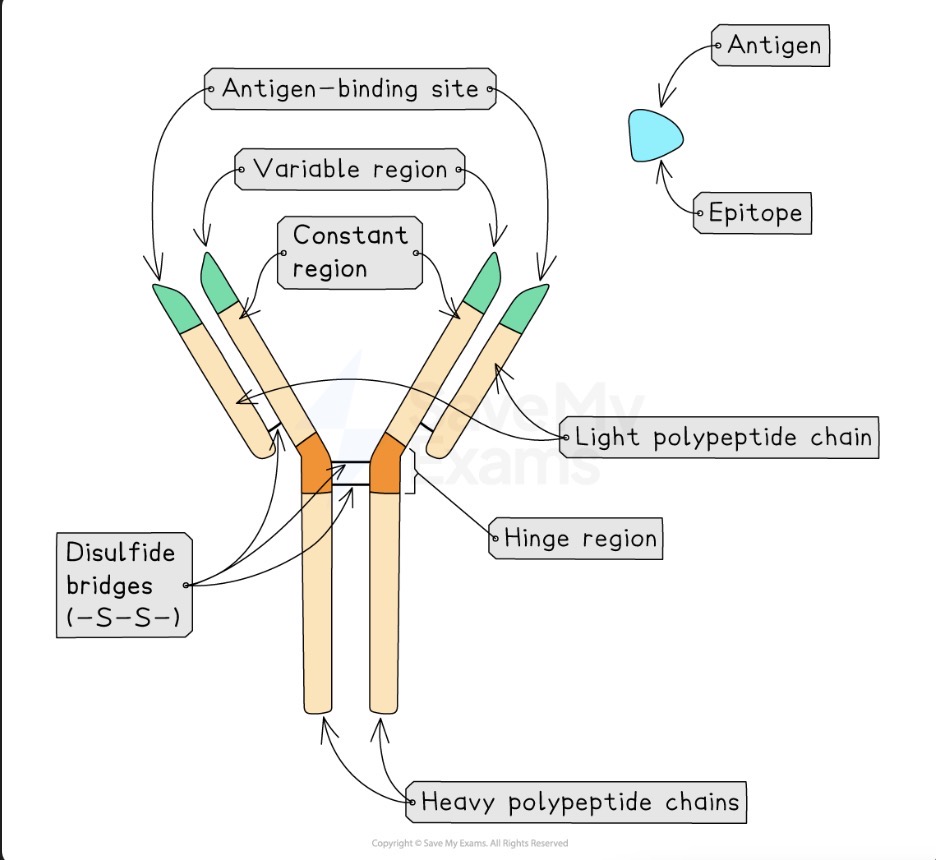
What is an antibody
Y-shaped protein produced by plasma cells
has specific shape with a region that’s complimentary to antigen
What is the structure of an antibody
variable region: containing antigen binding site which is complimentary to antigen
constant region: stem which allows binding to receptors on immune system cells - phagocytes
hinge region: allows flexibility when antibody binds to antigen
2 heavy and 2 light polypeptide chains
constant region has same 1° as they all have same function but variable region has different 1°, 2°, and 3° as they are specific to different antigens
What are the 3 ways that antibodies act on antigens
agglutination
opsonisation
neutralisation