Parenting styles
 Call Kai
 Learn
Learn Practice Test
 Spaced Repetition
 Match
Match Flashcards
 Knowt Play
1/39

There's no tags or description
Looks like no tags are added yet.
Name | Mastery | Learn | Test | Matching | Spaced | Call with Kai |
|---|
No analytics yet
Send a link to your students to track their progress
40 Terms
What are the foundation of parenting styles?
In the 1930s to the 1960s researchers employed a variety of theoretical perspectives and methodologies approaches to identify the major dimensions underlying observer ratings of general parenting characteristics.
The two dimensions of parenting behaviour emerged from the research: parental acceptance, warmth or support and parental control.
In later years, a third general dimension was added to the assessment of parenting: structure.
Warmth/acceptance refers to emotional support, affection, and responsiveness.
Control refers to behavioural regulation, supervision, and rule‑setting.
Structure (added later) refers to predictable routines, consistency, and clear expectations.
These dimensions form the basis for later typologies, including Baumrind’s three styles and Maccoby & Martin’s two‑dimensional model.
What are the four aspects of family functioning (Baumrind, 1967)?
These four aspects were used by Baumrind to classify parents into their original three parenting styles.
warmth or nurturance- reflects emotional climate and parental sensitivity.
clarity and consistency of rules- Reflects behavioural control and structure.
levels of expectations (“maturity demands”)- reflect expectations for responsibility and self‑regulation.
communication between parent and child- reflects openness, reasoning, and negotiation.
Together, these aspects help distinguish authoritative (high in all four) from authoritarian (high control, low warmth) and permissive (high warmth, low control).
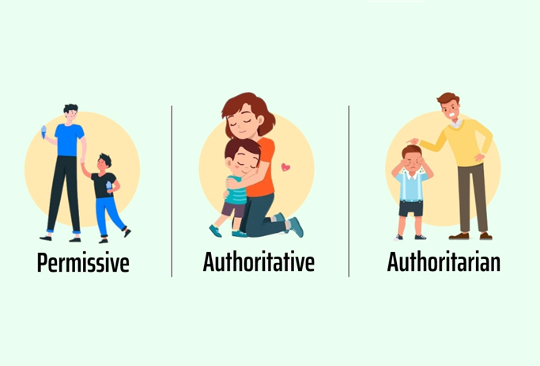
What are the parenting styles (Baumrind, 1967)
Baumrind identified these styles based on observed patterns of warmth, control, and communication.
Authoritative: warm, firm, autonomy‑supportive.
Authoritarian: strict, punitive, low warmth.
Permissive: warm, indulgent, few rules.
Warmer and more autonomy granting than controlling. try to shape, control and evaluate their children’s behaviour based on the absolute set of standards.
Baumrind later added neglectful (low warmth, low control).
These styles became the foundation for Maccoby & Martin’s later two‑dimensional model.
Support for Baumrind 3 parenting style model?
Baumrind et al., 2010
Dornbusch et al., 1987
What did Baumrind et al., 2010 find?
Analysed longitudinal data from early childhood to adolescence.
Used behavioural ratings and parent reports.
Key findings:
Authoritative parenting predicted the best long‑term outcomes (academic competence, low externalising).
Authoritarian predicted higher externalising and lower social competence.
Permissive predicted poor self‑regulation and higher problem behaviour.
Why this supports the model:
Confirms that the three-style structure remains empirically meaningful decades later.
Shows longitudinal stability of the three categories.
What did Dornbusche et al., 1987 find?
Surveyed over 7,000 adolescents.
Classified parents into Baumrind’s three styles using behavioural indicators.
Key findings:
Authoritative parenting → highest grades and engagement.
Authoritarian → lower grades.
Permissive → lowest academic performance.
Why this supports the model:
Demonstrates that Baumrind’s three styles predict real-world academic outcomes.
Shows the model works beyond preschool children.
Criticisms of Baumrinds model…
over simplistic- real parenting is continuous not categorical.
Western and middle class bais
ignores psychological control
limited attention to fathers and co-parenting
assumes parents use these styles constantly
doesnt explain why these styles work.
What is the parenting styles revised?
Maccoby and Martin (1983) develop Baumrind’s parenting styles.
Based on the combination of two dimensions – demandingness (behavioral control, rules, maturity demands) and responsiveness (warmth, support, sensitivity) – they define 4 parenting styles:l.
They formalised Baumrind’s ideas into a 2 × 2 matrix.
This produced four styles: authoritative, authoritarian, indulgent, uninvolved.
Their model is now the most widely used in research.
It clarified differences between permissive (warm but undemanding) and neglectful (low warmth, low demands).
What were the four parenting styles developed by Maccoby and Martin (1983)?
Authoritative – high demanding and high responsive
Authoritarian – high demanding and low responsive
Indulgent (or permissive) – low demanding and high responsive warth and nurturing can communicate- perform less in school and become more aggressive
Uninvolved – low demanding and low responsive- no interest from this parent, negative outcomes are associated with this outcome
This model emphasises responsiveness (warmth, acceptance) and demandingness (control, expectations).
It is the basis for most modern parenting research.
Distinguishing indulgent vs neglectful is important because they lead to different developmental outcomes.
How did Baumrind expand her work from thid?
Added a fourth parenting style- neglectful
Neglectful parents show low warmth and low control.
Associated with the worst developmental outcomes (academic, emotional, behavioural).
This addition aligns Baumrind’s model with Maccoby & Martin’s four‑style framework.
How does Bi et al., 2018 support the parenting styles?
Shows that authoritative and authoritarian styles are associated with different qualities of parent–adolescent relationships, mediated by autonomy and parental authority. This supports the idea that the four styles have predictable relational consequences.
Highlights that distinguishing indulgent from neglectful permissiveness is crucial because they lead to different developmental outcomes—supporting Maccoby & Martin’s addition of the neglectful category.
Confirms that the four styles have predictable relational consequences.
Supports the idea that responsiveness and demandingness shape adolescent outcomes.
Reinforces the importance of separating warm permissiveness from uninvolved neglect.
How does Lamborn 1991 support parenting styles?
When parents were classified using responsiveness and demandingness, the four styles (authoritative, authoritarian, indulgent, neglectful) predicted academic competence, psychosocial maturity, and problem behaviour.
Why it supports M&M: This is the landmark empirical validation of the four‑style model.
This was the landmark empirical validation of the four‑style model.
It used adolescent self‑reports and parent reports.
Authoritative → best outcomes; neglectful → worst.
How does Steinberg 1994 support parenting styles?
Longitudinal adolescent cohort
Finding: Authoritative parenting predicted school engagement, lower delinquency, and better emotional adjustment.
Why it supports M&M: Confirms the predictive validity of the two‑dimension model over time.
Longitudinal design strengthens causal inference.
Confirms predictive validity of the two‑dimension model over time.
How does Louis 2022 support parenting styles?
Finding: The Baumrind–Maccoby–Martin model maps cleanly onto contemporary factor structures.
Why it supports M&M: Shows the two‑dimension model remains psychometrically robust.
Shows the model remains psychometrically robust.
Confirms that responsiveness and demandingness still explain modern parenting patterns
How does Amato & Fowler 2002 support parenting styles?
Finding: Neglectful parenting predicts the poorest outcomes in academic achievement and internalising/externalising symptoms.
Why it supports M&M: Validates the necessity of distinguishing indulgent vs neglectful parenting.
Validates the need to distinguish indulgent vs neglectful.
Shows neglectful parenting predicts both internalising and externalising symptoms.
What are individual differences in parenting styles?
Differences in parenting between mothers and fathers
differences in parenting based on personality aspects
Individual differences show that parenting styles are not uniform within families.
They demonstrate that Baumrind’s categories may oversimplify real‑world parenting.
These differences also highlight that parent characteristics (gender, personality, mental health) influence parenting style beyond warmth and control.
What are differences in parenting between mothers and fathers?
mothers are found to be more accepting, responsive, and supportive, as well as more behaviourally controlling, demanding, and autonomy-granting than fathers
father are reported to be more restrictive, coercive and harsher- (as well as more punitive), and to show less parental concern than mothers.
These parental differences seem to apply to both boys and girls, regardless of their age.
Parents perceive themselves higher on either parental dimension (responsiveness and demandingness) than adolescents perceive their parents.
Mothers tend to exercise a warmer type of parenting and more confrontive type of parental control (i.e., authoritative parenting patterns), while fathers tend to exercise a more coercive type of parental control (i.e., authoritarian parenting patterns).
Mothers reported employing a more authoritative style of parenting than fathers did, and fathers reported employing a more authoritarian style of parenting patterns than mothers did.
These differences suggest that parenting style is not a single “family style” but may differ by parent.
Mothers’ higher warmth and responsiveness align with authoritative patterns.
Fathers’ higher coercion aligns with authoritarian patterns.
Adolescents’ lower ratings of parents indicate perceptual differences, which may affect research validity.
These findings challenge the assumption that Baumrind’s categories apply uniformly across caregivers.
What are the differences in parenting based on personality aspects?
Frost et al. (1991) found that in a sample of college women, perfectionism was associated with reports of harsh parenting styles.
Rice et al. (1996) found that those with maladaptive perfectionistic styles described their parents as being more demanding and more critical than did those with more adaptive perfectionistic styles.
Flett et al. (1995) also found an association between maladaptive perfectionism and reports of exposure to authoritarian parenting styles.
Personality traits influence parenting style independently of cultural norms.
Maladaptive perfectionism is linked to high control, low warmth, resembling authoritarian parenting.
These findings show that parenting style is partly shaped by internal psychological traits, not just deliberate choices or cultural expectations.
This complicates Baumrind’s model because it assumes parents intentionally adopt a style, rather than being influenced by personality.
What did Frost et al 1999 find about personality?
found that in a sample of college women, perfectionism was associated with reports of harsh parenting styles.
What did Rice et al., 1996 find about personality?
ound that those with maladaptive perfectionistic styles described their parents as being more demanding and more critical than did those with more adaptive perfectionistic styles.
What is parenting based on personality aspects from the five factor model?
Extraversion seems to be associated with authoritative parenting (Belsky & Barends, 2002).
Losoya et al. (1997) found that conscientiousness was related to higher levels of supportive parenting and less negative control.
Agreeableness has been shown to be positively associated with positive support and inversely with negative, controlling parenting (Losoya et al., 1997). On the other hand, disagreeableness interfered with adaptive parenting, one aspect of authoritative parenting (Kochanska et al., 1997).
Higher levels of parental agreeableness have been found to be associated with increased coercion (Prinzie et al., 2004) a part of parenting that is known to be ineffective for eliciting lasting positive behaviour from children (Strassberg et al., 1994).
Extraversion and agreeableness were related to levels of supportiveness (Huver et al., 2010).
Neuroticism is thought to be most predictive of parenting styles (Belsky et al., 1995) and neurotic parents are believed to be less competent or capable of exerting authoritative parenting (Downey and Coyne, 1990, Kochanska et al., 1997). Kendler et al. (1997) found neuroticism to be related to less parental warmth.
According to Prinzie et al. (2004) and Huver et al., (2010), reduced emotional stability is associated with more overreacting (e.g., more strict control).
Openness and parental support have been reported to coincide (Clark et al., 2000, Losoya et al., 1997).
Authoritative mothers had high scores in extraversion, openness to experience, and conscientiousness, and a low score in neuroticism.
Authoritarian and permissive mothers had high scores in neuroticism but low scores in extroversion, agreeableness and openness (in comparison to authoritative mothers).
Authoritarian and authoritative mothers had the highest and a high score in conscientiousness, respectively.
Personality traits predict consistent patterns in parenting behaviour, supporting the idea that parenting style is partly dispositional.
Neuroticism is the strongest predictor of negative or inconsistent parenting, aligning with authoritarian or permissive styles.
High conscientiousness supports structured, consistent parenting, explaining why both authoritarian and authoritative parents score high on this trait.
These findings highlight that Baumrind’s categories may reflect underlying personality profiles, not just parenting choices.
This adds nuance to the model and suggests that interventions may need to target parent personality traits, not just parenting practices.
Five factor model openness
Openness is associated with parental support
Clark et al. (2000); Losoya et al. (1997)
Links to Baumrind’s styles
Authoritative mothers score high in openness
→ aligns with warmth, flexibility, and reasoning.Authoritarian and permissive mothers score low in openness
→ reflects rigidity (authoritarian) or lack of engagement (permissive).
Five factor model conscientiousness
Higher conscientiousness → more supportive parenting, less negative control
Losoya et al. (1997)
Authoritarian and authoritative mothers both score high in conscientiousness
→ but express it differently:Authoritative: structured + warm
Authoritarian: structured + harsh
Interpretation
Conscientiousness predicts consistency, structure, and rule‑setting, explaining why:
Authoritative parents use consistent boundaries
Authoritarian parents use strict control
Five factor model extraversion
Extraversion is associated with authoritative parenting
Belsky & Barends (2002)
Extraversion predicts higher supportiveness
Huver et al. (2010)
Links to Baumrind’s styles
Authoritative mothers score high in extraversion
→ fits with warmth, communication, and responsiveness.Authoritarian and permissive mothers score low in extraversion
→ less emotional engagement.
five factor model agreeableness
Agreeableness → more positive support, less negative control
Losoya et al. (1997)
Disagreeableness interferes with adaptive parenting
Kochanska et al. (1997)
Higher agreeableness sometimes linked to increased coercion
Prinzie et al. (2004)
→ surprising finding; may reflect conflict‑avoidant parents who give in until they snap.
Agreeableness predicts supportiveness
Huver et al. (2010)
Links to Baumrind’s styles
Authoritative parents: high agreeableness → warmth, responsiveness
Authoritarian parents: low agreeableness → harshness, coercion
Permissive parents: may show high agreeableness but low control → indulgence
Five factor model Neuroticism
Neuroticism is the strongest predictor of negative parenting
Belsky et al. (1995)
Neurotic parents show less warmth
Kendler et al. (1997)
Neuroticism → less authoritative competence
Downey & Coyne (1990); Kochanska et al. (1997)
Low emotional stability → more overreactive, strict control
Prinzie et al. (2004); Huver et al. (2010)
Links to Baumrind’s styles
Authoritarian and permissive mothers score high in neuroticism
→ authoritarian: harsh, reactive
→ permissive: inconsistent, emotionally overwhelmedAuthoritative mothers score low in neuroticism
→ emotional stability supports consistent, warm parenting
What are the developmental outcomes of differing parenting styles?
An authoritative parenting style has consistently been associated with positive developmental outcomes in youth, such as psychosocial competence (e.g., maturation, resilience, optimism, self-reliance, social competence, self-esteem) and academic achievement (e.g., Baumrind 1991; Lamborn et al. 1991; Steinberg et al. 1994).
Findings regarding permissive/indulgent parenting have been inconsistent, yielding associations with internalizing (i.e., anxiety, depression, withdrawn behaviour, somatic complaints) and externalizing problem behaviour (i.e., school misconduct, delinquency), but also with social skills, self–confidence, self–understanding and active problem coping (e.g., Lamborn et al. 1991; Steinberg et al. 1994; Williams et al. 2009; Wolfradt et al. 2003).
An authoritarian parenting style has consistently been associated with negative developmental outcomes, such as aggression, delinquent behaviours, somatic complaints, depersonalisation and anxiety (e.g., Hoeve et al. 2008; Steinberg et al. 1994; Williams et al. 2009; Wolfradt et al. 2003).
Children of neglectful parents have shown the least favourable outcomes on multiple domains, such as lacking self-regulation and social responsibility, poor self-reliance and social competence, poor school competence, antisocial behaviour and delinquency, anxiety, depression and somatic complaints (e.g., Baumrind 1991; Hoeve et al. 2008; Lamborn et al. 1991; Steinberg et al. 1994).
Authoritative parenting consistently produces the most adaptive outcomes across emotional, social, and academic domains.
Permissive parenting’s mixed outcomes show that warmth alone is not enough; lack of structure can lead to behavioural issues.
Authoritarian parenting’s negative outcomes reflect the harm of low warmth + high coercion.
Neglectful parenting is universally harmful due to low involvement + low monitoring.
These outcome patterns support the validity of the responsiveness × demandingness model.
What methodological issues exist in research on developmental outcomes?
1. Problems with early empirical research
Early studies forced families into predefined parenting style categories using cut‑off scores (e.g., above/below median).
This risks artificially fitting families into boxes, reducing validity.
2. Why clustering methods are better
To identify real parenting patterns, researchers now use exploratory clustering (Everitt et al., 2001; Mandara, 2003).
Clustering groups parents based on naturally occurring patterns, not imposed categories.
hese studies usually find 3–4 styles, similar but not identical to Baumrind’s.
3. Limitations in Baumrind’s original model
Baumrind ignored psychological control (e.g., guilt, shame, love withdrawal).
Her “control” only meant behavioural regulation, not emotional manipulation.
Psychological control is now known to predict negative outcomes across cultures.
4. Lack of research on mothers + fathers together
Most studies examine one parent at a time.
We know little about how maternal and paternal styles combine or jointly affect development (Kuppens & Ceulemans, 2019).
5. Western bias in the literature
Parenting style research is dominated by White, Western, European/American samples (Checa, 2018).
This limits cross‑cultural generalisability.
Baumrind’s model often fails in non‑Western cultures
Many non‑Western families do not fit the four‑style model:
Arab adolescents reported three patterns: controlling, flexible, inconsistent (Dwairy et al., 2006).
Only 26% of Korean American families fit Baumrind’s categories (Kim & Rohner, 2002).
Fletcher et al. (1999) had to drop one‑third of a multi‑ethnic sample to force Baumrind’s categories.
Rohner (2000) had to eliminate two‑thirds of African American and European American families.
What are cross cultural evidence challenges Baumrind’s model?
Arab societies → 3 patterns (controlling, flexible, inconsistent)
Only 26% of Korean American families fit Baumrind’s categories
Multi‑ethnic samples require dropping large portions to fit categories
Chinese parents more authoritarian
Chinese children perform equally or better academically
Malaysian parents view authoritarian parenting positively
Nigerian students show no differences across styles
Spain: indulgent parenting = equal/better outcomes
India: authoritative best, authoritarian/neglectful worse
Asia: authoritarian linked to academic success
These findings show that Baumrind’s model is not culturally universal.
The meaning of “control” varies: in collectivist cultures, strictness may reflect care, involvement, and moral guidance, not hostility.
Authoritarian parenting can be adaptive in cultures valuing obedience, respect, and academic achievement.
Western measures may misclassify culturally normative behaviours as “negative.”
Cross‑cultural variation suggests parenting styles are culturally embedded, not universal prototypes.
What are the differences in parenting styles across different cultures? Chinese
Compared with American and Canadian parents, Chinese parents are more restrictive, controlling or authoritarian, and less affectionate, autonomy encouraging or authoritative (Chiu, 1987; Dornbusch, Ritter, Leiderman, Roberts & Fraleigh, 1987; Lin & Fu, 1990; Liu, Chen, Rubin et al., 2005; Steinberg, Dornbusch & Brown, 1992).
Chinese mothers display relatively higher rates of authoritarian behaviours than Canadian mothers, while Canadian mothers displayed relatively higher rates of authoritative behaviours than Chinese mothers (Liu & Guo, 2010).
Compared with American and Canadian parents, Chinese parents are more restrictive, controlling or authoritarian, and less affectionate, autonomy encouraging or authoritative.”
Chinese mothers show higher authoritarian behaviours than Canadian mothers.
Canadian mothers show higher authoritative behaviours than Chinese mothers.
What did Chiu 1987 find?
Compared with American and Canadian parents, Chinese parents are more restrictive, controlling or authoritarian, and less affectionate, autonomy encouraging or authoritative
What did Liu & Guo, 2010 find?
Chinese mothers display relatively higher rates of authoritarian behaviours than Canadian mothers, while Canadian mothers displayed relatively higher rates of authoritative behaviours than Chinese mothers
What are the differences in parenting styles acorss different cultures? North american
Children of authoritative Canadian parents are more likely to perform better in math (Pratt et al., 1992), and to become better emotion regulators (Coplan et al., 2009) than children of authoritarian parents.
Although Chinese parents are more controlling and authoritarian than North American parents, Chinese children perform equally well as, or even better than, their North American counterparts on academic achievement (e.g. Dornbusch et al., 1987; Stevenson, Lee, Chen, Stigler, Hsu & Kitamura, 1990).
In North America, authoritative parenting aligns with cultural values of autonomy, open communication, and independence.
This explains why authoritative parenting predicts better academic and emotional outcomes in Western samples.
The contrast with Chinese outcomes shows that the same parenting behaviours have different effects depending on cultural norms.
This is strong evidence that Baumrind’s model is culture‑bound, not universal.
What cultures run an authoritarian approach?
Malaysian parents from Malay, Chinese and Indian ethnic groups, promote authoritarian parenting and do not regard it as an unfavourable style of parenting (Keshavarz & Baharudin, 2009).
College students from Nigeria, who were raised under authoritative, authoritarian, and authoritative/authoritarian parenting styles, were not different in their levels of sense of competence, need for achievement, locus of control, and academic achievement (Akinsola, 2011).
In Malaysia, authoritarian parenting is culturally accepted and not associated with negative outcomes.
In Nigeria, authoritarian parenting does not harm academic or psychological outcomes, suggesting cultural buffering.
These findings undermine the assumption that authoritarian parenting is universally maladaptive.
They support the idea that cultural normativeness moderates the impact of parenting style.
What did Akinsola, 2011 find?
College students from Nigeria, who were raised under authoritative, authoritarian, and authoritative/authoritarian parenting styles, were not different in their levels of sense of competence, need for achievement, locus of control, and academic achievement
What are the differences in parenting styles across different cultures? Spain
In Spain, adolescents from permissive/indulgent parenting style families showed equal to or better scores in youth outcomes (academic, social, emotional, family and physical) than their peers from authoritative style families (Garcia & Gracia, 2009).
Spanish school-age children showed that sensitive parenting style was not related to academic achievement but to school adjustment; meanwhile, coercive parenting style was negatively related to academic achievement (Checa & Abundis-Gutierrez, 2017).
Spain is one of the strongest examples where permissive/indulgent parenting is adaptive, contradicting Baumrind’s model.
High warmth and emotional closeness are culturally valued, making indulgent parenting effective.
This shows that demandingness is not always necessary for positive outcomes.
It also demonstrates that Baumrind’s “optimal” style (authoritative) is not optimal everywhere.
What did Garcia & Garcia 2009 find?
In Spain, adolescents from permissive/indulgent parenting style families showed equal to or better scores in youth outcomes (academic, social, emotional, family and physical) than their peers from authoritative style families
what did Checa et al., 2017 find?
Spanish school-age children showed that sensitive parenting style was not related to academic achievement but to school adjustment; meanwhile, coercive parenting style was negatively related to academic achievement
What are the differences in parenting styles across different cultures? West and India
The effect of parenting styles on children appear to be similar across cultures (West and India), and culture did not serve as a moderator for parenting style and child outcome. An authoritative parenting style was associated with better outcomes than authoritarian and neglectful/uninvolved parenting style in both Western countries and in India (Sahithya et al., 2019).
As mentioned, 26% of Korean American families fit into the Baumrind parenting categories (Kim & Rohner, 2002).
The authoritative parenting style in this sample was positively associated with adolescents’ academic achievement. This association differed depending on the gender of the parent: mothers’ parenting styles were not associated significantly with adolescents’ academic achievement. (Kim & Rohner, 2002).
India shows a pattern closer to Western findings: authoritative parenting is beneficial.
However, the Korean American data show that many families do not fit Baumrind’s categories, even within the same country.
The lack of association between mothers’ parenting and academic achievement suggests cultural variation in parental influence.
This mixed evidence shows that Baumrind’s model applies in some cultures but not others.
What are the differences in parenting styles across different cultures? Asia
Asian cultures show authoritarian parenting when compared to the U.S. and Europe (Masud et al., 2014).
Asian students demonstrate more effective academic achievement with parents who have attributes of authoritarian parenting as compared to the West and European countries where the majority of students’ academic achievement is the result of authoritative parenting (Masud et al., 2014).
Parenting styles vary across different cultures. Authoritative parenting style affects European American adolescents for the better while authoritarian parenting improves the academic performance of Asian American adolescents (Dornbusch et al.,1987).
This is one of the strongest challenges to Baumrind’s universality:
Authoritarian parenting → negative outcomes in the West
Authoritarian parenting → positive academic outcomes in Asia
This suggests that authoritarian parenting is adaptive in collectivist cultures that value obedience, respect, and academic excellence.
It also shows that Baumrind’s model is culturally biased toward Western values of autonomy and open communication.