Block 7 Lesson 1
 Call Kai
 Learn
Learn Practice Test
 Spaced Repetition
 Match
Match Flashcards
 Knowt Play
1/13

Earn XP
Description and Tags
The Sun: Energy and Atmosphere
Name | Mastery | Learn | Test | Matching | Spaced | Call with Kai |
|---|
No analytics yet
Send a link to your students to track their progress
14 Terms
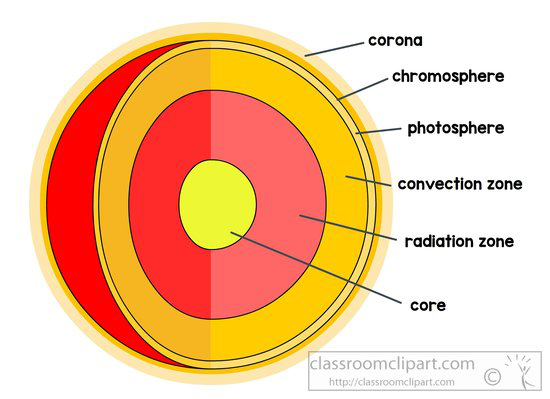
What are the layers of the Sun? (6)
Core
Radiative zone
Convective zone
Photosphere
Chromosphere
Corona
Where is the core and how hot is it?
The very centre of the Sun
Where the Sun produces energy
15 million°C
Where is the radiative zone and how hot is it?
2nd inner part of the Sun
Light and heat moves through this layer
7 million°C
Where is the convective zone and how hot is it?
between radiative zone and photosphere (2nd outer layer)
Light and heat moves through this layer
2 million°C
Where is the photosphere and how hot is it?
Outermost layer of the Sun
This is the layer of the sun we can see
6000°C
Where is the chromosphere and how hot is it?
It is the part of the Sun’s atmosphere that’s closest to the Sun
The chromosphere is thousands of kilometers thick
Can be faintly observed on a solar eclipse where it appears as a pink rim around the sun
6000°C
Where is the corona and how hot is it?
The outer layer of the Sun’s atmosphere
It consists of parts of the Sun’s atmosphere that got expelled
Best seen in an eclipse when the moon blocks out the chromo- and photosphere
It is stretched for millions of kilometers with particles interacting with the Sun’s magnetic field and getting flung off into space, forming solar wind
1 million°C
What is fusion?
Fusion is when two small nuclei join together. The number of protons and neutrons also has to be the same at the start and end of the reaction.

What is fission?
Nuclear fission is the splitting apart of large nuclei into smaller nuclei. The total number of neutrons and protons has to be the same as the start of the equation.

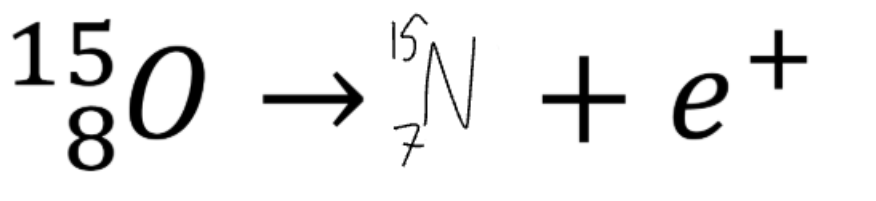
What is decay?
This happens inside one nucleus, when the nucleus is unstable enough that either a proton changes into a neutron or a neutron changes into a proton. This causes a charge imbalance, since, for example, a neutral particle got turned into a positively charged particle. This means that an electron needs to be emitted to balance it out. In the opposite, when a proton turns into a neutron, a positively charged particle must be released. It cannot be a proton since it’s too massive so a positron is released instead. A positron is the antimatter version of an electron.
What is the Sun’s proton-proton cycle?
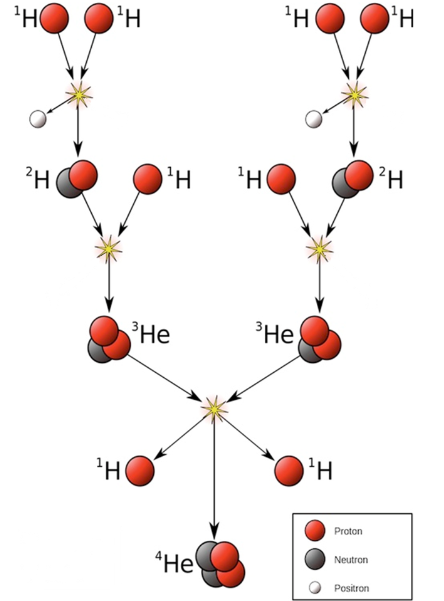
Two hydrogen nuclei fuse to form a heavy hydrogen nucleus, releasing a positron.
The heavy hydrogen nucleus fuses with another hydrogen nucleus, making a helium-3 nucleus.
Two of those then fuse into a helium-4 nucleus and two protons (hydrogen nuclei)
What are the reactants of the Sun’s proton-proton cycle?
6 hydrogen atoms turn into one He-4 atom and two hydrogen nuclei.
What frequencies of light does the Sun emit?
The Sun emits light in all frequencies of the electromagnetic spectrum.
What wavelengths are commonly used to observe the Sun?
As well as observations in the common wavelengths (infrared, ultraviolet, x-ray), H-Alpha is also used. It is a specific wavelength that allows astronomers to study nebulae and the Sun’s surface. Calcium-K is also a filter that works in similar ways.