materials
 Call Kai
 Learn
Learn Practice Test
 Spaced Repetition
 Match
Match Flashcards
 Knowt Play
1/25

There's no tags or description
Looks like no tags are added yet.
Name | Mastery | Learn | Test | Matching | Spaced | Call with Kai |
|---|
No analytics yet
Send a link to your students to track their progress
26 Terms
limit of proportionality
the point after which extension is no longer directly proportional to the force applied
hooke’s law
force applied is directly proportional to extension up to the limit of proportionality
on a graph - passes through the origin and is a straight line
elastic material
returns to its original length when the force is removed
tensile
deformation that stretches an object
shear
deformation that twists an object
compressive
deformation that compresses an object
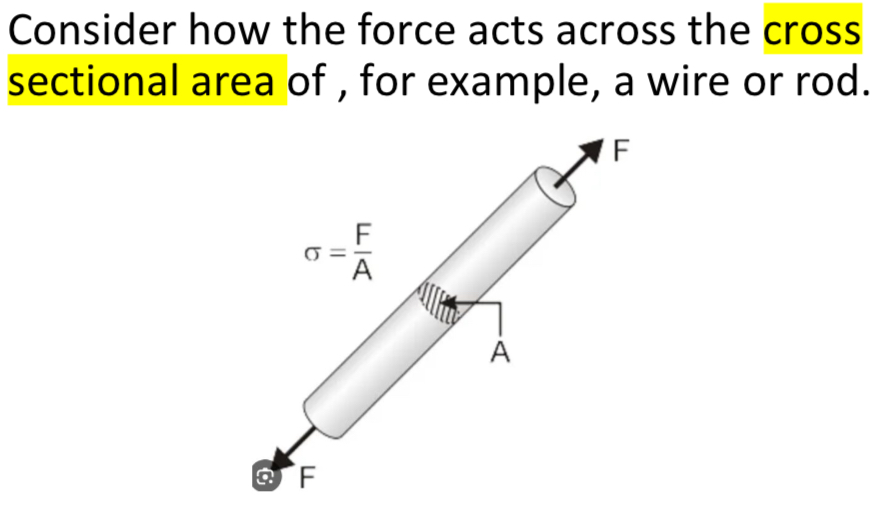
tensile stress σ
the force per unit perpendicular cross sectional area
tensile strain Ɛ
the extension per original unit length
no unit as it is a ratio
young’s modulus
stress / strain
provided that the limit of proportionality has not been exceeded
E=AΔLTL
wire of uniform diameter
brittle
material snaps without any noticeable / significant yield (after little to no plastic deformation)
ductile
noticeable yield before breaking - the material can be drawn into a wire
explain how the formula for energy stored in a spring can be dervived
work done = force x distance
area beneath line of force extension graph
springs in series and in parallel
series
effective spring constant (1/k1 + 1/k2)-1
same force in both springs
parallel
effective spring constant k1+k2
same extension in both springs
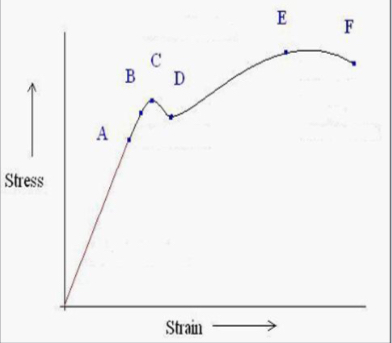
graph of tensile stress against tensile strain for metal wire
from origin to limit of proportionality, tensile stress is proportional to tensile strain - stress / strain is gradient - also youngs modulus - constant and obeys hooke’s law
beyond this, graph curves and continues beyond elastic limit - wire permanently stretched - plastic deformation
yield point - wire temporarily weakens
beyond this - small increase in the tensile stress causes a large increase in tensile strain - plastic flow
ultimate tensile stress - breaking stress
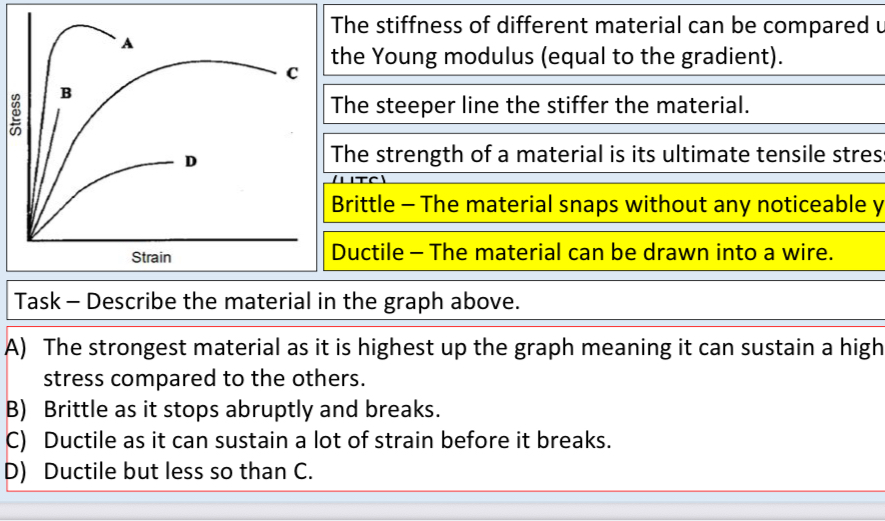
stress- strain curves for different materials
strength of a material is its ultimate tensile stress
stiffness is its young’s modulus - greater gradient means stiffer material
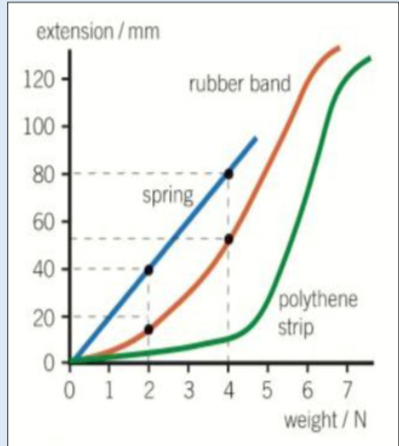
loading and unloading curves (force against extension)
metal wire - loading and unloading curves are the same - provided elastic limit has not been reached - wire returns to its original length when unloaded. beyond elastic liimit, unloading line is parallel to loading line - wire permanently extended
rubber band - change of length during unloading is greater - unloading curve below loading curve except at 0 and max extension - remains elastic - very low limit of proportionality.
polythene - the extension during unloading is greater than during loading - strip does not return to same initial length - plastic deformation- low limit of proportionality
work done to deform and strain energy
total work done to deform object is total area under loading curve
strain energy is the energy that is stored in the material’s elastic potential store - area under unloading curve
work done to permanently deform is the energy that is stored internally in the material’s molecules when deformation continues past elastic limit - this energy cannot be recovered - area enclosed between loading and unloading curve
metal wire: work done = ½ TdeltaL - provided limit of proportionality not exceeded - energy stored in elastic potential as elastic limit not reached - all energy stored in wire can be recovered when unloaded
rubber band : work done = area under loading curve. area between the loading curve and the unloading curve - difference in energy stored in stretched rubber band and the useful energy recovered in unloading - some energy becomes stored in interernal energy of the molecules when the rubber band unstretches
rubber band: area under the loading curve and the unloading curve = work done to deform the material permanently, as well as internal energy retained when it unstretches
permanent deformation
caused by realignment of bonds in material
energy stored in a stretched spring
Ep = ½ F delta L
since F = k delta L
Ep = ½ k (delta L)²
uses average force since force is not constant - variest linearly with extension
density
the mass of a substance per unit volume
density measurements
regular solid
measure its mass using a top pan balance
measure dimensions using vernirer callipers or a micrometer
calculate volume using suitable equation
calculate ddensity from mass / volume
liquid
measure mass of an empty measuring cylinder
pour some liquid into into measuring cylinder and easure volume - use as much as possible to reduce percentage error in measurement
measure mass of cylinder and liquid and subtract mass of cylinder
calculate density by mass / volume
irregular solid
measure mass of solid with top pan balance
immerse object on a thread in liquid in measuring cylinder
observe the increase in liquid level - this is the volume of the object
calculate density by mass / volume
alloy
solid mixture of two or more metals
ρ=V(ρ1V1+ρ2V2)
stress in a uniform cable with non negligible mass
stress increases linearly with distance from the bottom
extra mass added due to mass per unit length of cable μ
Tension at bottom = mg
tension at top mg+μgL
string / wire under very high tension
diameter would reduce, reducing cross sectional area
using a thinner wire / beam and applying tension
advantage - will extend more for the same force applied by the masses, reducing the percentage uncertainty
disadvantage - may not be able to withstand as much stress before breaking - cannot get unloading data / safety hazard
may undergo plastic deformation - non linear
reduces range of data, increasing scatter
a longer, less stiff and thinner material will give more measurable extension
determination of young’s modulus
measure original length with metre rule
measure diameter (if circular cross section) or width and thickness (if rectangular cross section) with vernier callipers / micrometer screw gauge
repeat experiment
find mean for displacement / extension for each value of mass
plot a suitable force extension graph or mass extension graph