ornithology exam 4/final
 Call Kai
 Learn
Learn Practice Test
 Spaced Repetition
 Match
Match Flashcards
 Knowt Play
1/45

There's no tags or description
Looks like no tags are added yet.
Name | Mastery | Learn | Test | Matching | Spaced | Call with Kai |
|---|
No analytics yet
Send a link to your students to track their progress
46 Terms
Eggs can be shaped or colored to fit their environment. What did the recent study teach us about egg shape? What best predicts ellipticity and asymmetry of eggs?
It’s apparently flight ability (hand-wing index WL/SL). (carpal joint to tip of longest primary divided by carpal to tip of longest secondary) Pointy wings=pointy eggs
Why do some eggs have narrower, more asymmetrical shape?
Birds that are good fliers seem to have narrow, stream- lined bodies. These bodies place pressures on developing eggs (egg membranes in particular)
What are indeterminate layers?
Where a females lays multiple eggs at several times
What are determinant layers?
Females produce a fixed clutch size for any given nesting attempt
What are the basics about nests?
Select a site (can be reused). Nests are made by one or both pair members out of any materials.
What are the functions of nests?
Safety from predators, keeping warm, avoiding ectoparasites, and sexual selection.
What is incubation?
the direct transfer of heat from a parent to the egg. A specialized patch of highly vascularized skin aids this process called brood patch
Do all bird eggs need to be incubated?
No- Megapodes use heat from decaying vegetation or sunlight to warm the eggs, though they do monitor and regulate the temperature
Who usually incubates the eggs? How long does it take?
both sexes (49.7% of families) or by the female alone (37.4%). 10-90 days
What is the ‘pipping’?
Ultimately, the hatchling begins to break out of the egg using an egg tooth
What are brood parasites?
where a bird lets another bird take care of their young
What species is an example of a brood parasite?
Cowbirds
What is the evolutionary arms race?
two or more species or populations continuously adapt and counter-adapt to each other
What is egg mimicry?
some brood parasites lay eggs that are a match for their host
What are gentes?
Genetically distinct local populations of cuckoos that specialize on one host
What is nestling mimicry?
Some brood parasites are host- specific and mimic the distinct gape marks of their finch host
What is raptor mimicry?
Many cuckoos show a remarkable resemblance to small bird-eating hawks when they fly. This is speculated to be mimicry that facilitates access to host nests
Why are some eggs strong-shelled?
Hosts will sometimes try to puncture and eject foreign eggs. To resist this, brood-parasites often lay eggs with thicker shells than non-parasites. Its the brood parasite’s interest to remove competitors as soon as possible.
What is an example of a bird with a thicker shelled egg?
Molothrus cowbirds
Why do brood parasites lay large clutches?
Energy saved on parental care can be placed into egg production
What is the competitive advantage with a short incubation time?
Generalist brood parasites like the Brown-headed Cowbird often hatch about 1 day before their hosts. They develop faster than other birds
What is cooperative breeding?
In some species, birds that are not the genetic parents of the offspring will help care for the young. (ex: florida scrub-jay)
What are some examples of cooperative breeding?
Florida Scrub-jays are territorial (0-5 helpers of both sexes)
Red-Cockaded Woodpecker groups are highly territorial (0-2 helpers that are male)
White throated Bee-eater families are organized within colonies (1-5 helpers of both sexes)
Acorn Woodpecker communal groups defend territories (communal nesting)
What are the results for helpers helping?
More helpers means more reproductive success in White- throated Bee-eaters and Red-cockaded Woodpeckers. More helpers also means longer lifespan for breeders, probably because of reduced workload. Helpers are usually direct kin of the breeders, so they benefit via kin selection
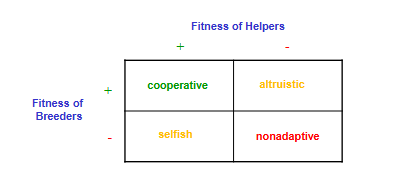
Even if you are related to those you are helping, breeding on your own is still the better option. Why stay and help?
The key is that there are constraints on independent breeding.
We can see the restraints on independent breeding by looking at the types of environments in which cooperative breeding occurs
In stable, predictable environments populations are at carrying capacity (few vacancies). Thus, birds tend to delay dispersal (especially males). The same problem occurs in unpredictable, harsh environments. Breeding opportunities are rare. A common response is to stay home and gain some reproductive success via kin selection
What does it mean by ‘benefits of philopatry’?
There is also the possibility (particularly for males) that you will inherit your father’s territory (staying where you were born)
What is unique about cooperative breeding in white-throated bee-eaters?
Some cooperative breeders have helpers that are not kin. White-throated bee-eaters form “clan” alliances where both kin and non-kin reciprocate helping over long lifespans. Individuals can switch roles, going from helper to breeder and back to helper throughout their life.
What is Territoriality?
behavior associated with the establishment of an exclusive area.
What are territories are usually associated with?
A fixed area, primary or exclusive use of an area, or displays or defense
What is a Type-A territory?
All-purpose territories used for feeding, mating, nesting, etc. These are common in songbirds
What are Type B and C territories?
Territories used for mating and nesting, but feeding occurs elsewhere. Can be quite small. These are common in seabirds, swallows, shorebirds, herons, etc
What is a Type D territory?
Territories used for pairing and mating only. These are the leks used by grouse, manakins, birds-of-paradise, etc
What are type E territories?
Territories established around roost sites. These are uncommon but can be seen in creepers and starlings
What are Type F territories?
Winter feeding territories; no mating or nesting. In some cases these can be established only briefly, or they may last all winter
What are the benefits of defending an area?
Territories can provide an exclusive feeding area; an individual can monopolize resources.
Territories eliminate or reduce interference with mating or nesting
What are the costs/risks of defending territory?
The cost boils down to time, energy, and risk. It takes time and energy to sing, be vigilant, and drive away intruders.
What is the Ideal Free Distribution Concept?
it assumes that foragers act in an ideal manner to maximize their reward and are free to move between patches without hinderance
What are floaters?
They seek mating opportunities or vacant territories among the territory holders
What is social dominance?
It is priority of access to resources that is not tied to defense of a specific area.
Territoriality creates an asymmetry; territory owners typically drive intruders away; they have an advantage tied to a specific area. However, such asymmetries do not have to be tied to a specific area.
How do birds signal their status?
plumage and displays
In Golden-crowned sparrows, the gold dot on its head helps signal its dominance. Why is giving a bird an artificial gold dot not beneficial?
Dominant birds tend to be bigger, older, and male. Cheating might ultimately lead to more physical confrontations
What are the two views on the net advantages of dominance?
Its always good to be dominant. You access food or other resources when and where you want (better survival)
The “Shepards hypothesis”. Dominants must display and expend energy to establish and maintain status. Subordinates expend less energy and feed relatively undisturbed, though perhaps feeding is delayed in time.
What is a colony?
the nesting group of many individuals of the same species
What are the costs for colonies of birds?
Competition for food, competition for mates and nest sites, attracts predators (you can’t hide a whole colony), parasites, disease, brood parasitism, and offspring recognition (remembering who is your kid)
What are the benefits of being in a colony?
Promoting safety (by mobbing, alarm calling, selfish herd effects, rapid predator detection, etc), provides social benefits (mate finding, social stimulation, synchrony of breeding, etc), finding unpredictable and patchy resources, information centers