bio 1002 Neurons and Synapse
 Call Kai
 Learn
Learn Practice Test
 Spaced Repetition
 Match
Match Flashcards
 Knowt Play
1/61

There's no tags or description
Looks like no tags are added yet.
Name | Mastery | Learn | Test | Matching | Spaced | Call with Kai |
|---|
No analytics yet
Send a link to your students to track their progress
62 Terms
Neurons
are nerve cells that transfer information within the body
cell types of the nervous system that exemplify the close relationship between form and function that arises during evolution
Neurons two types of signals to communicate
– electrical signals (long-distance)
– chemical signals (short-distance)
Interpreting signals in the nervous system involves __
sorting a complex set of paths and connections
Processing of information takes place either in:
– simple clusters of neurons called ganglia
– a more complex organization of neurons called a brain
Neuron organization and structure reflect __
function in information transfer
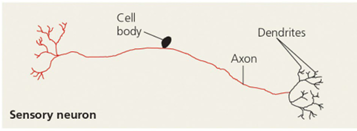
cell body
• Most of a neuron’s organelles are in the cell body
dendrites
Most neurons have dendrites, highly branched extensions that receive signals from other neurons
axon
The axon is typically a much longer extensions that transmits signals to other cells at synapses
axon hillock
The cone-shaped base of an axon is called the axon hillock
synaptic terminal
The synaptic terminal of one axon passes information across the synapse as chemical messengers called neurotransmitters
synapse
A synapse is a junction between an axon and another cell
• At electrical synapses, the electrical current flows from one neuron to another through gap junctions
• At chemical synapses, a chemical neurotransmitter carries information between neurons
• Most synapses are chemical synapses
Information is transmitted from a __to a __
presynaptic cell (neuron) , postsynaptic cell (neuron, muscle, or gland cell)
• Nervous systems process information in three stages:
sensory input, integration, and motor output
sensory neurons
Sensors detect external stimuli and internal conditions and transmit information along
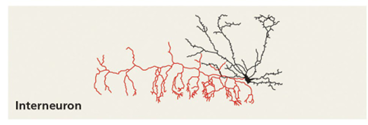
interneurons
Sensory information is sent to the brain or ganglia, where interneurons integrate the information
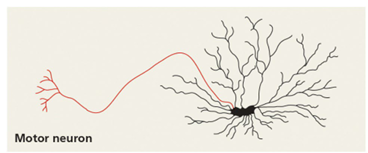
motor neurons
Motor output leaves the brain or ganglia via motor neurons, which trigger muscle or gland activity
Many animals have a complex nervous system that consists of:
– A central nervous system (CNS) where integration takes place; this includes the brain and a nerve cord
– A peripheral nervous system (PNS), which carries information into and out of the CNS
– The neurons of the PNS, when bundled together, form nerves
Most neurons are nourished or insulated by cells called __
glia
Membrane potential changes occur because neurons contain __ that open or close in response to stimuli
gated ion channels
Hyperpolarization and Depolarization
• The resting membrane potential of a neuron depends on the net movement of ions in and out of the cell.
• When positive ions move into the cell (or negative ions move out), the membrane becomes less polarized, or depolarized.
• For example, depolarization occurs if Na+ channels open and Na+ diffuses into the cell
• When positive ions move out of the cell (or negative ions move into the cell), the membrane becomes more polarized, or hyperpolarized.
• For example, hyperpolarization occurs if K+ channels in the neurons open.
Graded potentials
changes in polarization where the magnitude of the change varies with the strength of the stimulus
• These are not nerve signals that travel along axons, but they do have an effect on generation of nerve signals 48 - 20
action potential
• If a depolarization shifts the membrane potential sufficiently, it results in a massive change in membrane voltage called an action potential
• Action potentials have a constant magnitude, are all or-none, and transmit signals over long distances
• They arise because some ion channels are voltage gated, opening or closing when the membrane potential passes a certain level
resting potential
1. Most voltage-gated sodium (Na+) and potassium (K+) channels are closed
When an action potential is generated:
2. Voltage-gated Na+ channels open first and Na+ flows into the cell
3. During the rising phase, the threshold is crossed, and membrane potential increases
4. During the falling phase, voltage-gated Na+ channels become inactivated; voltage-gated K+ channels open, and K+ flows out of the cell
action potential: undershoot
During the undershoot, membrane permeability to K+ is at first higher than at rest, then voltage-gated K+ channels close and resting potential is restored
action potential":refractory period
• During the refractory period after action potential, a second action potential cannot be initiated
• The refractory period is a result of a temporary inactivation of the Na+ channels
Conduction of Action Potentials
• Where an action potential is generated, usually the axon hillock, an electrical current depolarizes the neighboring region of the axon membrane
• Action potentials travel in only one direction: toward the synaptic terminals
• Inactivated Na+ channels behind the zone of depolarization prevent the action potential from traveling backwards
Evolutionary Adaptation of Axon Structure
• The speed of an action potential increases with the axon’s diameter
• In vertebrates, axons are insulated by a myelin sheath, which causes an action potential’s speed to increase
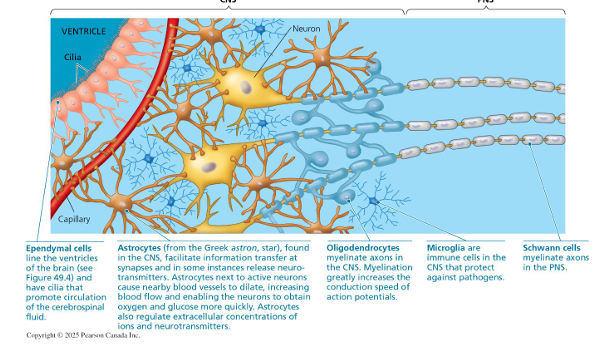
• Myelin sheaths are made by glia— oligodendrocytes in the CNS and Schwann cells in the PNS
• Action potentials are formed only at nodes of Ranvier, gaps in the myelin sheath where voltage gated Na+ channels are found
• Action potentials in myelinated axons jump between nodes of Ranvier in a process called saltatory conduction
Neurons communicate with other cells at __
synapses
when did specialized systems of neurons had appeared that enable animals to sense their environment and respond rapidly
By the time of the Cambrian explosion more than 500 million years ago
The simplest animals with nervous systems, cnidarians, have neurons arranged in __
nerve nets
nerve net
A nerve net is a series of interconnected nerve cells
• Sea stars have a nerve net in each arm that are connected by radial nerves to a central nerve ring
complex animals have __
nerves
Nerves
are bundles that consist of axons of multiple nerve cells
cephalization
• Bilaterally symmetrical animals exhibit cephalization, the clustering of sensory organs at the front end of the body
Relatively simple cephalized animals, such as flatworms, have a __
central nervous system (CNS)
The CNS consists of
a brain and longitudinal nerve cords
The peripheral nervous system (PNS) consists of
neurons carrying information in and out of the CNS
ganglia
Annelids and arthropods have segmentally arranged clusters of neurons called ganglia
Nervous system organization usually correlates with __
lifestyle
Sessile molluscs (for example, clams and chitons) have __systems, whereas more complex molluscs (for example, octopuses and squids) have more __systems
simple , sophisticated
In vertebrates– The CNS is composed of
brain and spinal cord
In vertebrates The PNS is composed of
nerves and ganglia
Why have many animals evolved with most of their sensory equipment at the front end of their bodies?
u get the most information the quickest at the front
• The CNS develops from the
hollow nerve cord
The cavity of the nerve cord gives rise to the __
narrow central canal of the spinal cord and the ventricles of the brain
• The canal and ventricles fill with __filtered from blood and functions
cerebrospinal fluid
functions of cerebrospinal fluid
– to cushion brain and spinal cord
– to provide nutrients and remove wastes
The brain and spinal cord contain
Gray matter
White matter
Gray matter
which consists of neuron cell bodies, dendrites, and unmyelinated axons
White matter
which consists of bundles of myelinated axons
Organization of the Vertebrate Nervous System
• The spinal cord conveys information to and from the brain and generate basic patterns of locomotion
• The spinal cord also produces reflexes independently of the brain
• A reflex is the body’s automatic response to a stimulus
• For example, a doctor uses a mallet to trigger a knee jerk reflex
The Peripheral Nervous System
• The PNS transmits information to and from the CNS and regulates movement and internal environment
• In the PNS, afferent neurons transmit information to the CNS, and efferent neurons transmit information away from the CNS
• The PNS has two efferent components: the motor system and autonomic nervous system
enteric division
motor system
The motor system carries signals to skeletal muscles and is voluntary
autonomic nervous system
The autonomic nervous system regulates smooth and cardiac muscles and is generally involuntary
The autonomic nervous system has sympathetic and parasympathetic divisions
sympathetic division
The sympathetic division regulates arousal and energy generation (“fight-or-flight” response)
parasympathetic division
The parasympathetic division has antagonistic effects on target organs and promotes calming and a return to “rest and digest” functions
**afferent vs efferent
Afferent neurons carry sensory information to the central nervous system, while efferent neurons carry motor commands from the central nervous system to muscles and glands
The Parasympathetic and Sympathetic Divisions of the Autonomic Nervous System
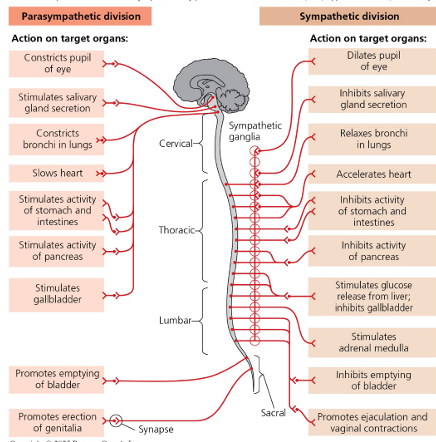
enteric division
The enteric division controls activity of the digestive tract, pancreas, and gall bladder
Glia
• Glia cells, or glia have numerous functions to nourish, support, and regulate neurons
– Embryonic radial glia form tracks along which newly formed neurons migrate–
Astrocytes induce cells lining capillaries in the CNS to form tight junctions, resulting in a blood-brain barrier and restricting entry of most substances into the brain 49
• Radial glial cells and astrocytes can both act as stem cells
• Researchers are trying to find a way to use neural stem cells to replace brain tissue that has ceased ti function normally
• The major types of glia in adult nervous system