Cognitive dissonance
 Call Kai
 Learn
Learn Practice Test
 Spaced Repetition
 Match
Match Flashcards
 Knowt Play
1/8

There's no tags or description
Looks like no tags are added yet.
Name | Mastery | Learn | Test | Matching | Spaced | Call with Kai |
|---|
No analytics yet
Send a link to your students to track their progress
9 Terms
What is cognitive dissonance?
Mental discomfort when we hold 2 contradicting beliefs, values, or behaviours at the same time
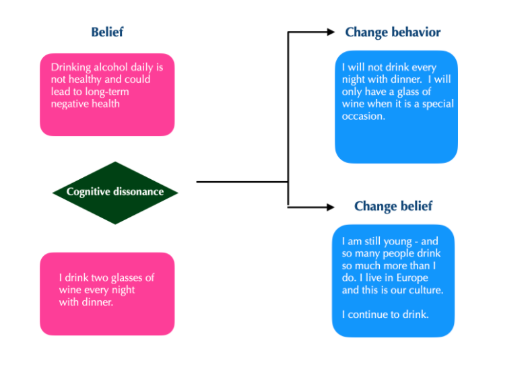
What are the ways to reduce cognitive dissonance?
change behaviour: Stop drinking
Justify behaviour: Alcohol helps me relax
Increase significance of behaviour: I enjoy drinking, part of my culture
Reduce important of belief: I don’t smoke (worse)
Discredit belief: Research shows wine is good for health
What is self consistency in cognitive dissonance
Need to keep your behaviour and self-image (who you think you are) alaigned
Describe the study of Festinger et al (Cognitive dissonance)
Aim: Investigate how people respond when beliefs are proven wrong
Procedure: Researchers joined doomsday cult (covert participation observation), cult believed world would end on specific day due to flood & will be rescued by aliens —> leaving jobs
Conclusion: Prophecy failed, beliefs were not abandoned but adjusted to reduce dissonance (eg. we saved the world)
Apply the study of Festinger et al to cognitive dissonance
Psychological discomfort: “the world will end” (strong belief) vs “the world did not end” (reality) —> discomfort from 2 opposing beliefs
Reduce importance of belief (approach to reducing dissonance): Reduced importance of initial “world would end” belief to “prophecy was answered” → reduce dissonance
What are the strengths and limitations of cognitive dissonance study (Festinger et al)
+ High ecological validity: Covert participation in natural setting → natural behaviour of participants
— Ethical consideration: Covert participation means participants did not give informed consent → violated privacy
— Researcher bias: Observation of participants relies on researchers interpreting behaviours → info may be interpreted through cognitive filter
— Sampling bias: Study focus on 1 cult group → limits generalizability to other groups
What is resistance to change in cognitive dissonance?
When people do not change contradicting beliefs because it is too difficult, costly, or threatening to identity
What factors increase resistance to change in cognitive dissonance?
Cost of changing behaviour → time consuming, mentally & emotionally damaging, etc
Belief is central to identity -—> Change threatens self-concept (who am I?)
Behaviour is rewarding —> Benefit outweigh discomfort & can lose something (emotion, social, physical)
What is insufficient justification in cognitive dissonance (w. example)?
Reward is too small to justify behaviour so you change belief instead
e.g: Task is boring & you tell someone it was fun (cognitive dissonance) —> If someone gives you 1 euro to say it was fun it is not good enough to justify behaviour so you change belief and think it was more fun.