CH 9 Language and Thought
 Call Kai
 Learn
Learn Practice Test
 Spaced Repetition
 Match
Match Flashcards
 Knowt Play
1/61

There's no tags or description
Looks like no tags are added yet.
Name | Mastery | Learn | Test | Matching | Spaced | Call with Kai |
|---|
No analytics yet
Send a link to your students to track their progress
62 Terms
language (def)
communication system using signals combined through grammar rules to convey meaning
grammar (def)
rules specifying how language can be combined to produce meaningful messages
human language is _____ (more/less) complex than other forms of communication. it differentiates from other animal species because it is used to ____ and ____
[more] [think] [conceptualize]
there are _____ human languages
7,100
phoneme VS morpheme
phoneme: smallest unit of sound recognized as speech
morpheme: smallest meaningful unit of language (content vs function)
phonological rules VS morphological rules VS syntactical rules
phonological rules: rules indicating how phonemes combine to produce speech sounds
morphological rules: rules indicating how morphemes combine to form words
syntactical rules: rules indicating how words combine to form sentences and phrases (noun, verb, adjective, noun phrase, verb phrase → sentence)
3 characteristics of language development in children
children rapidly learn language
children make few errors when learning to speak
children’s language comprehension is faster than language production
describe the speech sound test
infant watches toy animal while single speech sound plays
sound and display change after a few repetitions
if infant switches attention when sound changes, they are anticipating the new display = can discriminate between sounds
first words occur at ______ months
[10-12]
many aspects of language acquisition are completed by ____ years
[4-5]
name the 8 language milestones (month + milestone)
0-4 months: differentiating phonemes
4-6 months: babble consonants
6-10 months: understand words, simple requests
10-12 months: begin use of single words
12-18 months: 30-50 word vocabulary
18-24 months: 50-200 word vocabulary; two-word phrases using syntactical rules
24-36 months: 1,000 word vocabulary; phrases and incomplete sentences
36-60 months: 10,000 word vocabulary; full sentences, grammatical morphemes (-ed for past tense), function words, questions
over-regularizing (def, example)
evidence of children acquiring grammatical rules through errors
ex/ you eated, i runned / throwed / catched
fast mapping
when children map words onto underlying concepts after a single exposure
telegraphic (two-word) speech (months developed, def)
24 months
no function morphemes, mainly content words
the orderly progression of language development depends on…
[general cognitive development] [experience with a certain language]
name 3 theories of language development
behaviourist explanations
nativist explanations
interactionist explanations
behaviourist explanation (founder, def/theory)
language development theory by BF Skinner
language learned through operant conditioning → word produces response/reinforcement or punishment
not supported
nativist explanation (def/theory)
language development theory
language is innate, its development is an innate biological capacity
human brain is equipped with universal grammar (processing facilitating language learning)
elaborate on why nativist explanation is supported or disputed
language ability is slightly separated from general intelligence (single dominant gene issues)
language is harder to learn after puberty (1-5 yrs of age vs 9 yrs)
interactionist explanation (def/theory)
language development theory
social interactions influence language
social experience combines with innate biological language abilities to develop language
language development is allowed because as the brain _____, ______ of specific neurological _____ takes place
[matures] [specialization] [structures]
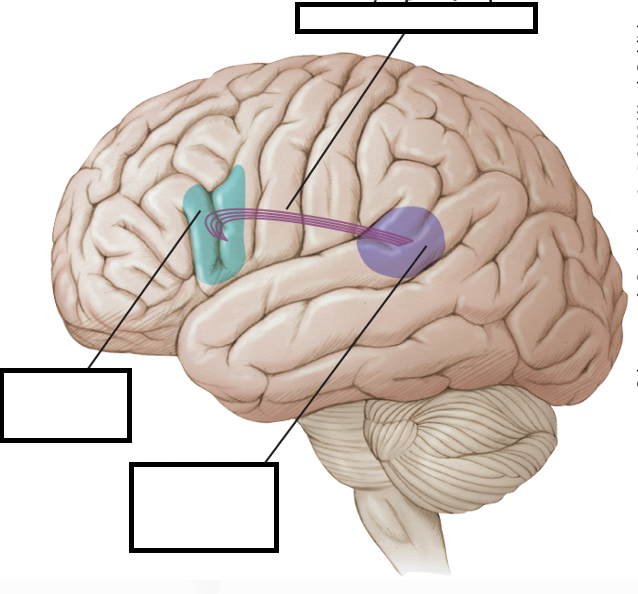
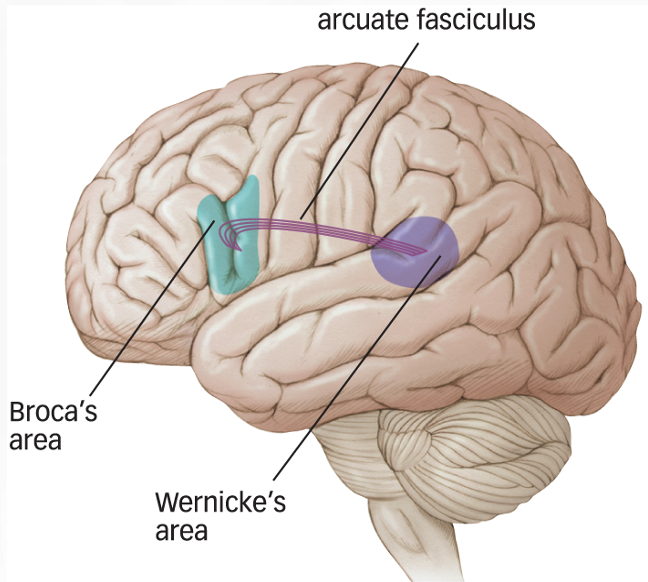
aphasia
difficulty in producing or comprehending language
broca’s aphasia or wernicke’s aphasia
broca’s area
language production
broca’s aphasia
wernicke’s area
language comprehension
grammatical speech produced, but meaningless
wernicke’s aphasia
broca’s aphasia VS wernicke’s aphasia
broca’s aphasia
cannot produce sentences ; language production
wernicke’s aphasia
can produce sentences without meaning ; language comprehension
linguistic relativity hypothesis (def, founder)
language shapes the nature of thought (benjamin whorf)
theory is supported (ex/ perception of colour variations show differences between languages)
is the linguistic relativity hypothesis correct?
benjamin whorf created linguistic relativity hypothesis
newer studies support the theory (names for colour tiles)
whorf would be incorrect in stating that language directly determines thought
whorf is correct in saying that language influences thought
language and thought are not the same thing
concept
mental representation grouping/categorizing shared features of stimuli/objects
conditions for concepts and categories
necessary condition: true of the object to belong to the category
sufficient condition: if true to the object, proves it belongs to the category
2 theories of concepts and categories
prototype theory
exemplar theory
prototype theory
theory of concepts and categories
objects classified by comparing them to the “best”/most typical member of a cateogry
prototype = the best/most typical member
exemplar theory
theory of concepts and categories
category judgements made by comparing new object with all category members
if we remember it belonging to the category, we classify it as such
category-specific deficit
neurological syndrome with inability to recognize objects belonging to certain categories
category-specific brain organization _____ (is/is not) innate. explain why
it might be - evidence suggests so
blind adults display similar activity patterns of category-specific organization to sighted adults
rational choice theory
apply it to the following example: 10% chance of $500 or 20% chance of $2000?
decisions are made by determining likeliness of something to occur, judging outcome value, then multiplying the two
(500 × 0.1) and (2000 × 0.2)
= $50 vs $400
people are good at estimating the ____ (ex: ____) of an event, but are poor at tasks requiring thinking in terms of ____ (ex:____)
[frequency: 1% or 5 cups of coffee] [probabilities: 1 in 100 people]
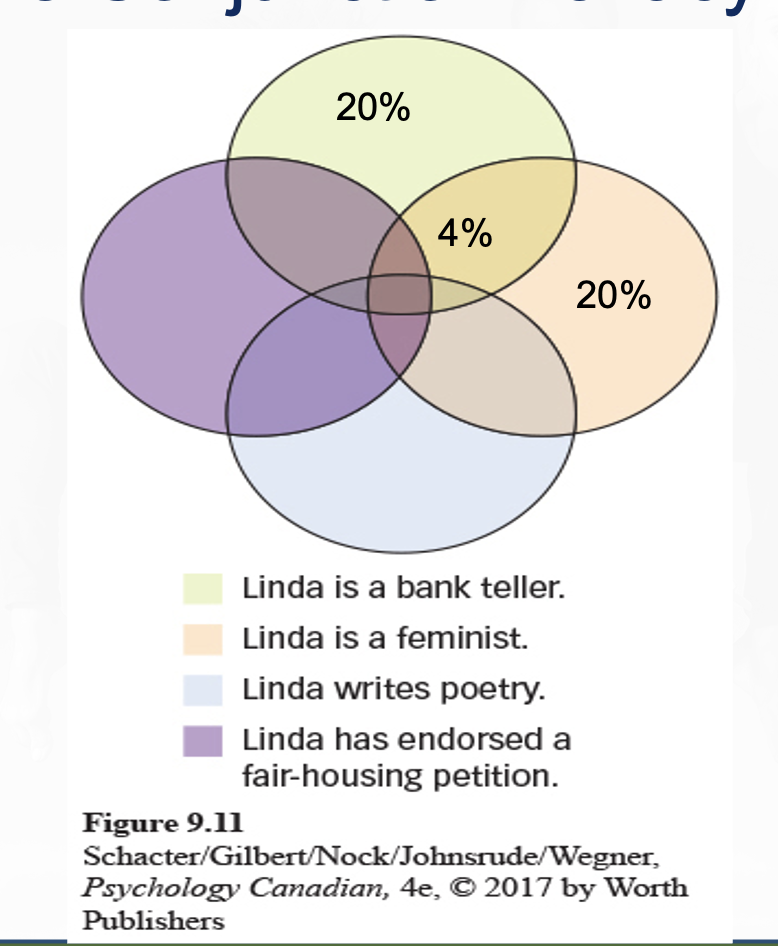
conjunction fallacy
thinking that two events are more likely to occur together than both events occurring individually
is a fallacy b/c combined probability is always less than independent probability of each event
heuristics
fast strategy facilitating decision-making, but not guaranteeing that a solution will be reached
availability heuristic
items more readily available in memory are misconstrued as having occurred more frequently
representativeness heuristic
estimating the probability that something belongs to a specific category by comparing it to the category’s prototype
the greater the similarity, the more likely the people in the descriptions are judged to be members of that category
[p] representativeness heuristic: define how it works for the following scenario
you meet a quiet person wearing glasses
the prototype you have for science professions categories matches the person’s external features
you automatically assume that they are a science professional, ignoring statistical realities that sales/service jobs are more common probability-wise
algorithm
sequence of procedures or rules guaranteeing a solution to a problem
[p] how would you use an algorithm and heuristic to find guava juice at a grocery store?
framing effects
people giving different answers to the same problem depending on how it is phrased/framed
sunk-cost fallacy is a framing effect
functional fixedness is a framing effect
sunk-cost fallacy
making decisions about a current situation based on what they have previously invested in it
apply the sunk-cost fallacy to the following:
a book you have spent 3 hours reading, but you do not find interesting
a car that continuously needs repairs, that you have spent
you have already spent 3 hrs of your life invested in the book, so you might not want to quit it
it needs many repairs but you have already spent so much money on it you can’t let it go
prospect theory
how people make decisions when considering risks (evaluating potential losses when taking on risks) (evaluating potential gains and avoiding risks)
compare choices to a reference point
in the prospect theory, people are more willing to take risks to ____ losses than to _____ gains
[avoid] [achieve]
2 major kinds of problems
ill-defined problems (no clear goals or well-defined solutions)
well-defined problems (clearly specified goals and solutions)
means-end analysis (def + steps)
(problem-solving)
process of searching for steps that reduce the difference between the current situation and the desired goal
analyze goal state
analyze current state
list differences btwn states
reduce differences:
direct means
subgoal
find similar problem with known solution
analytical problem solving
(problem-solving)
solving problem by finding a similar problem with a known solution and applying it to the problem
insights involve the spontaneous _____ of a problem or unconscious _____ processes
[restructuring] [incremental]
functional fixedness
tendency to see the functions of objects as unchanging
there is a fundamental distinction in reasoning between the ____ of statements and the ____ of an argument
[truth] [validity]
reasoning (def)
mental activity of organizing information and beliefs into a series of steps to reach conclusions (logical)
belief bias
judgements about accepting conclusions depend on how believable they are instead of if the arguments are logically valid
syllogistic reasoning
syllogistic reasoning
(belief bias)
determining whether a conclusion follows from 2 statements that are assumed to be true
explain why the following is an example of a valid syllogism:
statement 1: all mammals are warm-blooded
statement 2: all whales are mammals
conclusion: therefore all whales are warm-blooded
syllogistic reasoning determines a conclusion following 2 true statements
this conclusion is valid because it must be true if its premises/statements are also true
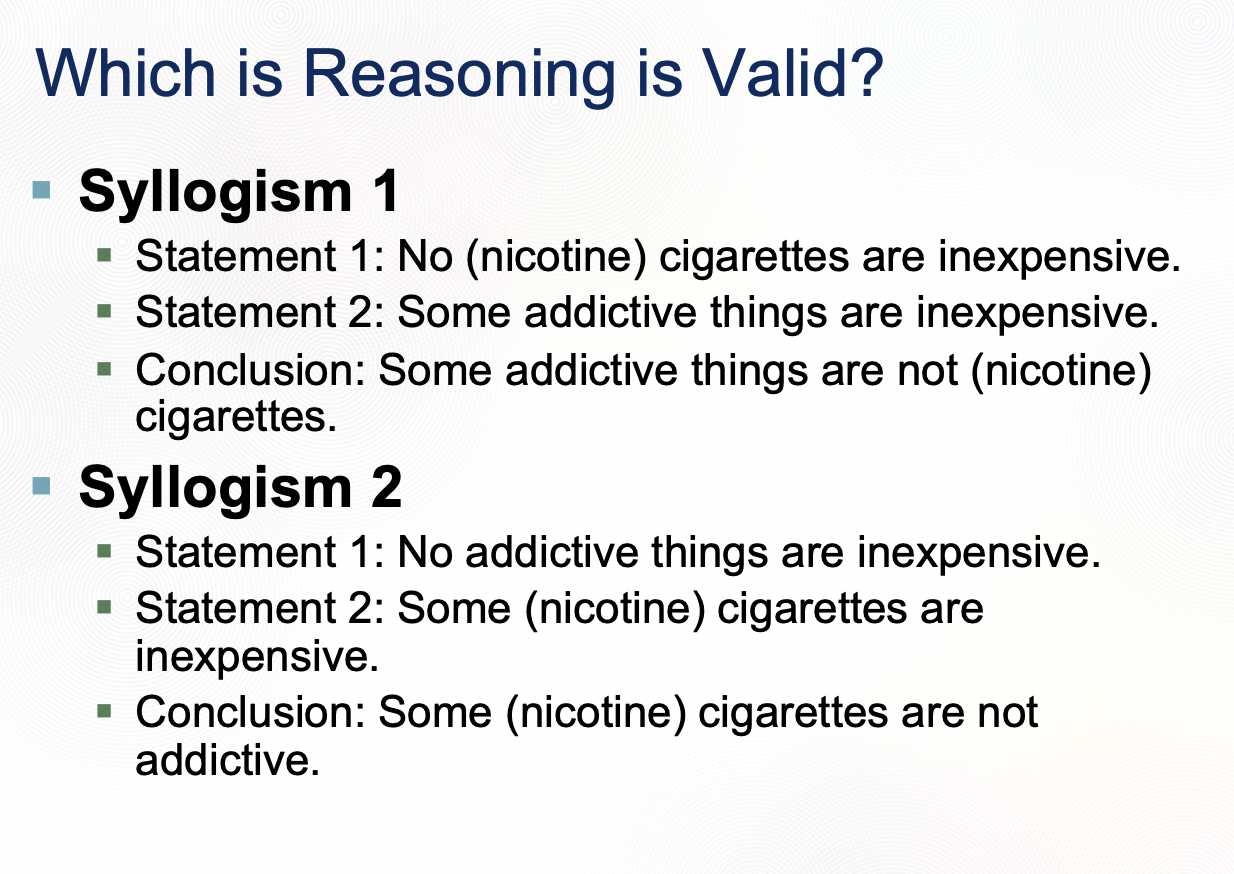
1 is valid, 2 is invalid
no cigarettes are inexpensive (therefore they are all expensive)
some addictive things are inexpensive (cigarettes are all expensive)
therefore cigarettes are NOT inexpensive, therefore they are NOT addictive
premise 2 is incorrect b/c
no addictive things are inexpensive (therefore all addictive things are expensive)
SOME cigs are inexpensive (indicating SOME are expensive)
conclusion is not valid v/c some cigs are expensive, and therefore addictive
illusory truth effect
occurs when repeated exposure to statement increases likelihood that it is assumed to be true (repeated exposure causes familiarity)
illusion of explanatory depth
illusion occurring when people overestimate the depth of their understanding
asking individuals to explain a concept can help them recognize the gaps in their knowledge