cognitive ageing
 Call Kai
 Learn
Learn Practice Test
 Spaced Repetition
 Match
Match Flashcards
 Knowt Play
1/65

There's no tags or description
Looks like no tags are added yet.
Name | Mastery | Learn | Test | Matching | Spaced | Call with Kai |
|---|
No analytics yet
Send a link to your students to track their progress
66 Terms
what are examples of crystallised abilities + do they change over time
semantic (factual memory) → this does not change over time
what are examples of fluid abilities + do they change over time
includes online processing e.g. working memory + reasoning, as well as episodic memory
this deteriorates with older age, beginning around the 40s-50s
(recap) what was Baltes (1987)’s idea of multidirectionality
development doesn’t follow one trajectory → even within the same developmental period, some systems of behaviour show increases in functioning, while others show decreases
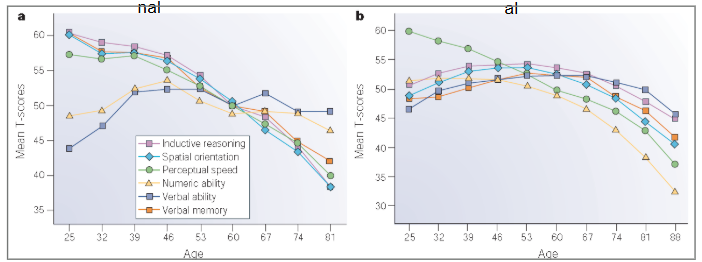
what do cross-sectional studies of ageing assess + what findings do they often display (Hedden + Gabrieli, 2003)
they compare different groups (e.g. 3) of different ages in the same timespan → in these studies as we age, abilities have a fairly linear decline
this suggests younger people are much better at certain abilities, e.g. inductive reasoning, spatial orientation + perceptual speed
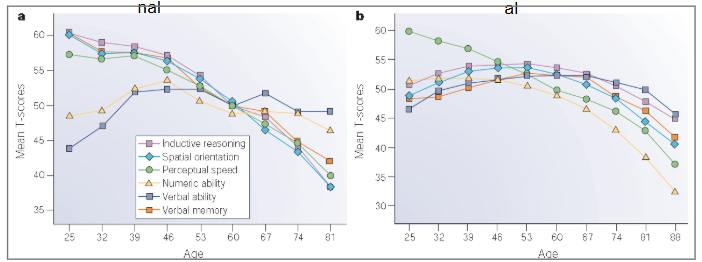
what do longitudinal studies of ageing assess + what findings do they often display (Hedden + Gabrieli, 2003)
these assess the same people’s cognitive abilities at different time points → these studies often see a much flatter trajectory of cognitive decline, with general abilities (barring perceptual speed) improving slightly in the 30s, and declining in much older age (70s onwards)
what is a strength + limitation of studying ageing using longitudinal methods
participants act as their own control conditions, nullifying participant effects
it’s more likely that people that attend a study for multiple years share particular traits (e.g. diligence), that may not be representative of a whole population
overall, a true representation of cognitive abilities with age is probably somewhere between the cross-sectional + longitudinal values
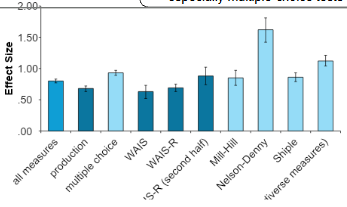
what semantic memory ability did Verhaeghen (2003) study + what did they find
type of crystallised ability → vocabulary test, in which participants had to match a word with the most semantically-related one (e.g. probably → likely)
found that older adults substantially outperform younger adults (with effect size of 1SD on average), especially on multiple-choice tests
vocab findings tend to correlate with other language abilities, though this test involves recognition rather than retrieval
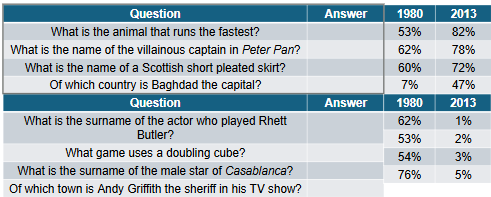
what aspect of semantic memory did Eich et al. (2013) + Sitzman et al. (2015) study, and what did they find
performed longitudinal study assessing retrieval of factual information, e.g. ‘what is the animal that runs the fastest’, and cultural info e.g. ‘what game uses a doubling cube’
for the most part, as life experience increases, our crystallised knowledge of factual info increases (top section), resulting in 2013 group outperforming 1980s group
however crystallised knowledge isn’t magic/everlasting → cultural knowledge varies depending on our environment e.g. exposure to media, meaning we are less likely to be able to recall things that we haven’t had exposure to in years (bottom section
what aspect of semantic memory did Maylor et al. (1994) study and what did they find
researcher contacted previous mastermind participants (contains a specialised subject + general knowledge questions) to see whether performance correlates with age
found in specialist subjects, correlation with age was weak
found in general knowledge, correlation with age was strong + significant (.343), showing general knowledge = robust example of crystallised knowledge
what is Laver + Burke (1993)’s hypothesis regarding semantic memory in order adults
sees semantic memory as an associative network of spreading activation → because of their breadth of experience, older adults may have a more densely populated network of semantic memory, resulting in better access in semantically-related words when presented with primes
how did Laver + Burke (1993) test their hypothesis + what were their findings
assessed younger + older participants on a lexical decision task (assesses semantic priming)
found people generally respond faster to semantically-associated words (e.g. doctor → nurse) than unassociated (e.g. doctor → book)
found semantic priming (response time) tends to increase slightly with age, though general processing speed decreases
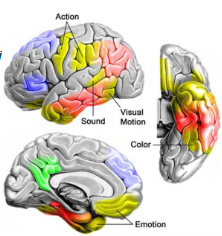
what did Binder & Desai (2011) find regarding the neural connectivity + tendency to decay in semantic brain regions
semantic memory is enabled by a diffuse network of different brain regions, which are shared with other sensory/perception + motor areas that tend to decay less with age
semantic memory is less dependent on regions known to decline with age, e.g. the hippocampus
what are 2 examples of fluid abilities
fluid intelligence
episodic memory
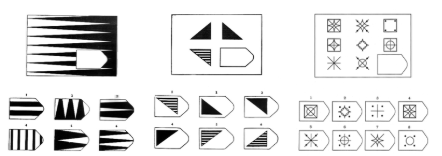
what is abstract reasoning + what does it involve
a dynamic process that requires us to process + make inferences about novel info, meaning we cannot rely on previously-acquired knowledge (e.g. semantic memory) to give us the answer
e.g. choosing from various options which shape fits into a larger pattern - uses logic
what is episodic memory
a type of LTM that allows us to recall specific personal experiences, e.g. where you left keys/favourite childhood present
what are 2 ways episodic memory is measured
recollection → retrieving the specific contextual, associative + perceptual details in the event (remembering without cues)
familiarity → memory in the absence of retrieving specific details; awareness a stimulus has been encountered before
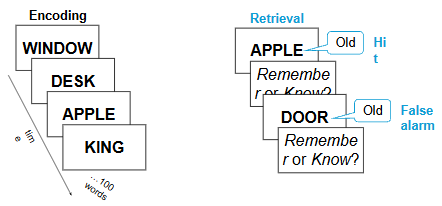
what method did McCabe et al. (2009) use to measure recollection + familiarity of EM
younger + older participants had to encode 100 words and:
familiarity condition → shown a word at retrieval and asked whether it was a new or old word
recollection → were shown a string of words + participants had to indicate whether they were old (already shown) or new
what were McCabe et al. (2009)’s findings + what theory do these relate to
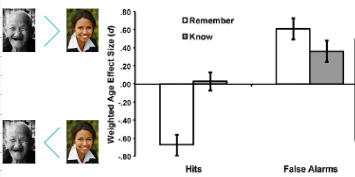
results suggested that accurate recollection (‘remembering’) declines in older age due to young people showing a stronger advantage for explicit recall
accurate familiarity (‘knowing’) has no significant differences in performance
false alarms for recollection + familiarity both increase with age
relates to dual process theory
what is dual process theory + how does it relate to ageing (Raze et al., 2005)
there are two main memory systems → episodic + semantic
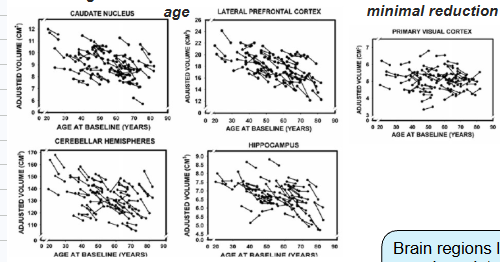
areas involved with semantic memory/vague familiarity, e.g. the entohinal + primary visual cortices stay relatively stable while aging
areas involved with episodic memory e.g. the hippocampus, caudate nucleus + PFC decline in structural integrity with age
how did Yonelinas et al. (2007) study links between neuroanatomy + cognitive performance to assess validity of the dual process theory
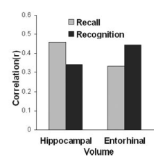
measured the volume of specific memory-relevant brain areas + took measures of both recall + recognition memory to see whether these were associated
what were Yonelinas et al. (2007)’s findings
a double dissociation was found:
hippocampal volume was strongly associated with recall
entorhinal cortex volume was strongly associated with recognition
what are 3 main theories of ageing + episodic memory
dual process theory (believes recollection = less deficient, whether familiarity = less deficient)
associative deficit hypothesis
source monitoring framework
what is an overview of the beliefs of the associative deficit hypothesis (Naveh-Benjamin, 2000)
believes the memory for associations within episodic memory becomes more deficient with age, while memory for individual items is less deficient
what is an overview of the beliefs of the source monitoring framework (Hashtroudi et al., 1998; Mitchell + Johnson, 2009)
memory for source + context of episodic memory becomes more deficient with age (meaning the ability to recall context of info decreases), while memory for specific content or items is less deficient
how did Jarjat et al. (2021) assess interactions between memory systems
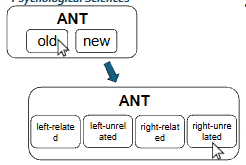
study compared episodic + semantic memory performance together in younger + older adults → participants were asked to study + remember pairs of words, while decide whether the words in each pair were semantically related
participants were then given a recognition test → at retrieval, participants had to report whether words they recognised were presented as semantically related or unrelated, and whether they appeared on the left or right
what were Jarjat et al. (2021)’s findings + what does this imply
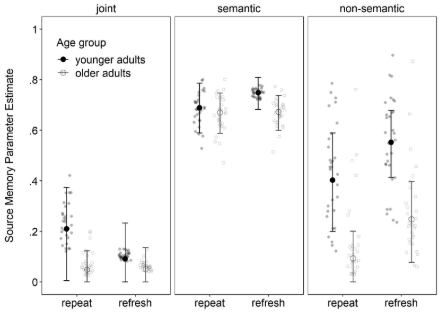
found memory for meaningful source info is preserved in older age
older participants performed just as well when asked whether words were part of a semantically related or unrelated pair
older participants were less good at source memory judgements (e.g. whether they were presented on the left or right
findings show older adults use intact semantic memory to scaffold diminished episodic memory
overall, what aspect of episodic memory displays the greatest deficit with age
arbitrary associative/context-bound information that requires explicit recollection
what is one method of measuring processing speed + how does it work
the digit symbol test → requires observing + reproducing symbols
doesn’t require reasoning/manipulating information, just measures how many symbols you can draw in a specific time frame
how integral is processing speed to our cognitive systems
it is a basic property of all cognitive systems + all cognitive tasks reflect the processing speed of that system, as it is fundamental to every cognitive operation we carry out
how does processing speed relate to our cognition + how does this work
processing speed constrains cognitive processes due to declining as we get older → there is only limited time to execute cognitive operations on info in the working memory before that info is lost (memory has finite window)
slower processing speed means fewer cognitive operations are executed in that time, causing a reduction in the amount of simultaneously available info → cognitive output is poorer, so impacted as you age
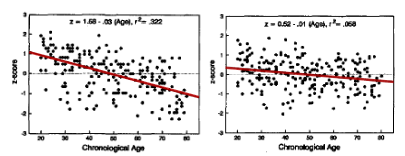
what evidence did Salthouse (1996) find that processing speed constrains cognition
when controlling for processing speed (graph on right) for results on a visual reasoning task, decline in performance isn’t as steep
shows cause of decline is processing speed, as we can only carry out fewer operations
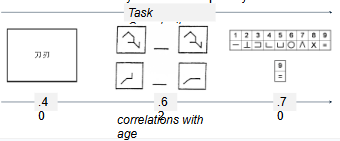
what are Chen + Li (2007)’s findings on processing speed and cognition that opposes previous findings
the complexity of processing speed tasks one completes acts as a moderator between processing speed + age → the more complex the task, the stronger the correlation is between processing speed performance + age
implies speed difference may not be the cause, but rather a consequence of, the age difference in WM capacity → if we cannot keep things in the mind well (WM decline), we may be slower
what was Starns & Ratcliff (2010)’s finding that supports Chen + Li (2007)’s hypothesis
older adults typically prioritise accuracy over speed in comparison to younger adults, which may impact results → the speed-accuracy trade-off
what is working memory
the active store of info in the mind short-term, requiring attention + ability to maintain/manipulate it
also known as memory from moment-to-moment, and is what we use to keep track of our goals
how does age tend to impact working memory (Bopp + Verhaeghen, 2005)
older adults tend to have a lower WM capacity than younger adults
what are 2 versions of the arrow span task to test WM + which more accurately measures WM
participant is shown a series of arrows, and has to recall the accurate sequence of directions they were pointing in
participant is shown a series of the letter ‘R’ pointing in different directions → needs to recall the direction it was pointing in + say whether it is flipped or not (distractor)
the second task is a better measure of WM, as it requires actively holding information while manipulating other aspects of it (via spatially rotating)

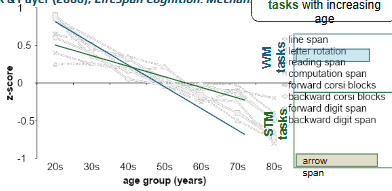
what are Park + Payer' (2006)’s findings on age affecting WM vs STM performance + what does this imply
found though performance declines on both STM + WM tasks with age, there is a steeper decline for WM tasks e.g. the R task
implies that WM is an important construct that underpins many aspects of cognition, and therefore acts as a bottleneck for other cognitive capabilities
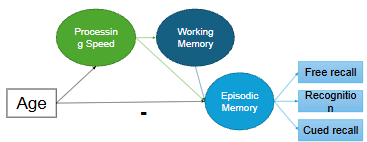
what did Park et al. (1996) + McCabe et al. (2010) find regarding what WM capacity accounts for
large individual differences studies found that WM capacity accounts for age-related variability in cognition over + above processing speed
though processing speed contributes to WM, the effect of age on episodic memory (+ its abilities e.g. free/cued recall + recognition) decreases when controlling for both PS + WM, indicating that both distinctly constrain EM
shows age itself doesn’t particularly constrain EM, but the cognitive abilities that underpins it do
what factor did Marshall et al. (2015) identify that impacts WM performance
found an association between cumulative stressful experiences + WM performance → larger amounts of cumulative stress correlates to more diminished WM abilities later in life
shows cognitive functions are partially a product of our environment
what is an example of the impacts of aging in the real world + what factors did this study control for
many studies have shown that older adults are 7x more likely to disseminate fake news than younger adults
this was consistent even after controlling for education, baseline level of posting activity + political alignment
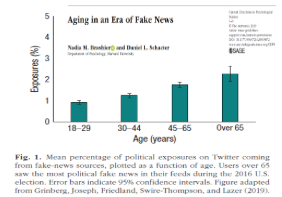
why does the dual process theory suggest that older adults are more likely to disseminate fake news
older adults may be more likely to due to remembering the information itself, but not its source → if we cannot remember the source, the defense mechanism of evaluating what to trust becomes less efficient
what is the information processing model (Cavanaugh & Blanchard-Fields, 2018)
akin to a computer’s function, information enters the brain system, and is transformed, coded + stored temporarily, until it becomes stored more permanently on a hard-drive (LTM)
at a later time, info can be retrieved in response to a cue e.g. a command
what 3 assumptions is the information processing model based on (Neisser, 1976)
people are active participants in the info manipulation + storing process
both quantitative (how much info is remembered) + qualitative (what kinds of info) aspects of performance can be examined
info is processed through a series of processes → it is transformed based on what a person knows about it (if more info is known, it is more easily incorporated), and can change throughout ages in terms of how much info is processed + what types of info are best-remembered, as well as whether it is attention or more active processes transferring info into LTM
what is sensory memory + what effect does age have on it (Cavanaugh & Blanchard-Fields, 2018)
a brief + almost identical representation of the stimuli that exists in the observable environment → earliest-occurring step in info processing which takes in large amounts of info rapidly
age differences are not typically found in sensory memory, as this is not yet limited by attention
what is attention + what are 2 main aspects of it (Cavanaugh & Blanchard-Fields, 2018)
attention, from a functional perspective, is composed of separate dimensions which control different attentional functions. completing complex tasks requires switching between functions + is influenced by:
speed of processing
processing resources
what is speed of processing + how does it effect age-related cognitive decline (Cavanaugh & Blanchard-Fields, 2018)
how quickly + efficiently early steps in info processing are completed
it was previously believed that processing speed explained age-related changes in cognitive function, but this was disproved by rate of slowing depending on the task that is undertaken
however, amount of beta-amyloid protein found in CNS (bio-marker for dementia) has been correlated with degree that processing speed slows
what are processing resources + 2 possible approaches to it (Cavanaugh & Blanchard-Fields, 2018)
the amount of attention one has to apply to a particular situation → 2 possible hypotheses for why this decreases with age are:
inhibitory loss → older adults have difficulty inhibiting the processing of irrelevant info (Aslan et al., 2015)
attentional resources → concerns how well people perform multiple tasks simultaneously; older adults tend to be just as able to multitask, but perform each task more slowly (though performance suffers as tasks become more complex)
what is automatic processing (Cavanaugh & Blanchard-Fields, 2018)
processing that places minimal demands on attentional capacity + gets info into the system without conscious awareness
what is effortful processing
processing that requires all of the available attentional capacity, and usually is done consciously
what were Oosterman et al. (2011)’s findings relating to age-related decline of working memory
spatial working memory decline with age tends to be greater than verbal working memory decline, though there is a decline in both
greater prior knowledge in older adults also seems to counterbalance WM decline in some situations
what is the difference between implicit + explicit memory
implicit (or procedural) memory involves unconscious retrieval of info + often involves actions e.g. brushing teeth, whether explicit (or declarative) memory involves intentional + conscious recollection of info learned + remembered at a specific point in time (e.g. LTM)
how does encoding differ between younger and older adults (Cavanaugh & Blanchard-Fields, 2018)
encoding abilities generally decline in older age → spontaneous use of strategies while learning new info declines, though if instructed can use encoding strategies well
means encoding generally becomes slightly poorer
how does ageing generally affect retrieval
older adults are generally poorer at retrieving info, even when encoding strategies are provided
what are 2 age-related changes in neural activity that affect encoding + retrieval (Cavanaugh & Blanchard-Fields, 2018)
in older adults, the degree to which the hippocampus + PFC work together when retrieving info dues not change depending on the extent the task requires relations to be made between info being remembered, in contrast to younger adults
older adults have less extensive neural connections in parietal + frontal regions involved in retrieval, but they show higher levels of activity in these regions (indicating compensatory strategies)
what is Shimamura (2014)’s theory on decline in encoding + retrieval of episodic memory
believes the PFC drives retrieval, which is facilitated by the medial temporal lobe, and the parietal lobe is where info from these regions converges
what is prospective memory + how is it affected in older age (Cavanaugh & Blanchard-Fields, 2018)
remembering to remember something in the future, which requires monitoring both time + event cues
time-based tasks show more age differences when using self-generated strategies for retrieval
what is autobiographical memory (Cavanaugh & Blanchard-Fields, 2018)
remembering info + events from one’s own life → it’s a form of episodic memory (recollection of temporal + spatial events), but can involve semantic components (knowledge + facts of one’s past)
what is source memory (Cavanaugh & Blanchard-Fields, 2018)
the ability to remember the source of a familiar event + determine whether the event was imagined or actually experienced → involves retrieving context in which the event occurred
in what ways does source memory change with age (Cavanaugh & Blanchard-Fields, 2018)
older adults are worse than younger adults at connecting items to be remembered with context they were learnt in
there is a general linear decrease in source memory performance with age, excluding when source memory info is emotional → may be that source info is less important to older adults
older adults display overactivation in PFC when completing these tasks (shows compensatory behaviour)
what did Naveh-Benjamin et al. (2016) find relating to retrieval cues in memory functioning
found contextual details serve as retrieval cues, so without access to them (due to poor source memory), older adults can have more difficulty remembering events, and therefore have poorer episodic memory
what 2 aspects of memory are often deficient in older age (Loaiza, 2024)
contextual + associative details of previously experienced events, compared to memory for item-specific content
what did Loaiza (2024) in relation to the discrepancy between cross-sectional + longitudinal data on age-related cognitive decline
in a quasi-longitudinal design, Salthouse found trajectories of speed, reasoning + episodic LTM showed declines more comparable to cross-sectional data, suggesting cohort differences don’t play major role affecting results + they best represent cognitive decline
when does more pronounced cognitive decline tend to occur (Loaiza, 2024) + what is this known as
decline in fluid abilities = more pronounced after 65
decline significantly accelerates in the last few years of life → the ‘terminal drop’, which doesn’t display much variability, suggesting tracking cognitive abilities can be used to predict mortality
what 4 factors have been found to affect individual trajectories of cognitive ageing (Loaiza, 2024)
being privileged in these categories often tends to slow cognitive decline:
socioeconomic background
physical + sensory disabilities
racial/ethnic disparities in access to education
whether someone is living with dementia → e.g. presence of the condition causes deficits in both familiarity + recollection, as well as in feature binding
suggests multidirectionality depends on individual characteristics
what does Loaiza (2024) theorise about different aspects of WM in cognitive decline
that there are different functions of WM, e.g. feature binding or direction attention, that are relatively spared in older age in comparison to other functions of WM e.g. encoding bindings between arbitrary pieces of info (relates to associative deficit hypothesis)
what are two strategies to combat against cognitive decline + how successful are they (Loaiza, 2024)
improve elaborative encoding strategies to improve retrieval → though while spontaneous elaborative strategies are equally beneficial for younger + older adults, instructed strategies were less consistently beneficial, and age differences in WM still persist after
may be that elaborative strategies act as additional demands, or they fail to access mediational strategies
encouraging older people to rely on other stable factors e.g. prior knowledge to incorporate new info → e.g. retrieval is usually bittern when info is familiar or meaningful. this capitalises on intact crystallised abilities