Science Test Study: FINAL
0.0(0)
Studied by 8 people Call Kai
 Learn
Learn Practice Test
 Spaced Repetition
 Match
Match Flashcards
 Knowt Play
Card Sorting
1/52

Last updated 2:35 AM on 11/2/22
Name | Mastery | Learn | Test | Matching | Spaced | Call with Kai | Chat |
|---|
No analytics yet
Send a link to your students to track their progress
53 Terms
1
New cards
What is force?
A contact or distance push or pull that acts on an object due to the interaction with another object
2
New cards
What is true about forces?
Forces always act in opposite directions and come in pairs. The same force will be acting in the pair: either a push or a pull.
3
New cards
What are balanced forces?
Multiple forces that are the same magnitude that cancel each other because they act in different directions
4
New cards
Do balanced forces change the object's speed or direction?
No: an object with no motion will continue to have no motions, while an object in constant motion will keep moving in a straight line at the same speed.
5
New cards
What are is state(s) that are related to BALANCED forces?
Canceled forces
6
New cards
What are unbalanced forces?
Forces that cause a change in the motion of an object (direction and speed), and the forces don't cancel.
7
New cards
How can unbalanced forces be determined?
If the net force isn't 0, and it can never be 0 with unbalanced forces.
8
New cards
What state(s) are associated with unbalanced forces?
Reinforced and Counteracting
9
New cards
What is compression?
The force that presses on an object, being applied inward toward the object. This causes the object to get compacted.
10
New cards
What is tension?
A force that stretches and elongates an object. The tension force is going in the outward direction away from the object.
11
New cards
What is normal force?
The force that opposes gravity, and is used when one object is on top of another.
12
New cards
What is an applied force?
The force applied from one object to another one, through a push or a pull.
13
New cards
What is friction?
The force that resists motion on any given object. Friction is always a contact force because of the "rub" of objects, causing the motion to slow down.
14
New cards
What are the byproducts of friction?
Friction creates thermal energy.
15
New cards
What is static friction?
When the force acts on an object when it is stationary, and the object doesn't move because the friction is too great.
16
New cards
What is sliding/kinetic friction?
The force that resists motion from 2 surfaces sliding against each other.
17
New cards
What is rolling friction?
The force that resists the motion of a rolling object like a ball or a wheel. It is the weakest type of friction.
18
New cards
What is fluid friction?
The force that resists the motion of an object in a liquid or a gas, where the magnitude of the friction force is dependent on the "viscosity" and mass of the object and environment.
19
New cards
What is gravity? (Come on, get this right)
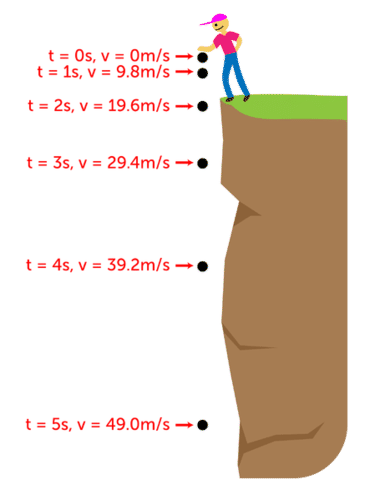
The force that acts on an object drawing it in toward Earth or any other object having a mass. It is not a constant force proportional to distances between objects, as it is exponentially stronger as 2 or more objects get closer.
20
New cards
What is a free fall?
When an object is falling without any friction or air resistance affecting it. The only force affecting the object would be gravity, and this effect of free fall can be achieved in a vacuum state.
21
New cards
What is the acceleration due to gravity?
An object accelerating/moving only due to gravity.
A free fall is a good example of this because gravity causes the object to keep moving faster and faster (accelerating) purely due to gravity until it reaches terminal velocity.
A free fall is a good example of this because gravity causes the object to keep moving faster and faster (accelerating) purely due to gravity until it reaches terminal velocity.
22
New cards
What is the equation for the acceleration caused by gravity?
9.8/m/s^2
23
New cards
What is drag?
The frictional force that resists the movement of an object through a fluid (gas or liquid). EXP: Squirrel falling through air with arms out. Physics.com
24
New cards
What is terminal velocity?
The fastest an object can fall. From rest, an object accelerates until it reaches terminal velocity.
25
New cards
When does terminal velocity occur?
This occurs when drag equals the force of gravity and the object now moves at a constant speed.
26
New cards
What is speed?
"How fast an object is moving", or just the rate at which an object covers a distance per unit of time.
27
New cards
What is velocity?
The rate at which an object changes its position, so it is just speed with a direction.
28
New cards
What is potential energy?
The energy stored in an object as a result of position. Potential energy could be GPE or EPE.
29
New cards
What is gravitational energy (or GPE)?
The potential force that is caused by gravity due to its change in position.
30
New cards
What is chemical energy?
The energy that comes from molecules and atoms in a "chemical compound".
31
New cards
What is thermal energy?
The energy coming from heat. Heat is just defined as thermal energy flowing, and it is responsible for the temperature in a system.
32
New cards
What caused thermal energy?
Friction. Friction. Friction.
33
New cards
What is Newton's first law?
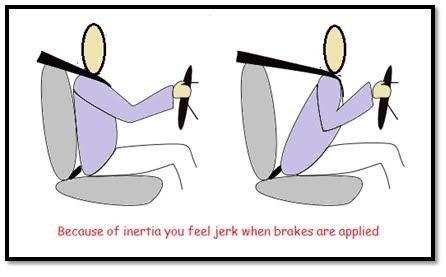
An object at rest stays at rest and an object in motion stays in motion with the same speed and in the same direction unless acted upon by an unbalanced force.
34
New cards
What is inertia?
The tendency to resist a change in motion: more mass, more inertia. Can be described as one word: lazy.
35
New cards
What is Newton's second law?
Force = mass * acceleration.
36
New cards
What are ALL the equations in newton's second law?
F = m * a
A = f / m
M = f / a
A = f / m
M = f / a
37
New cards
What is mass?
A quantitative measure of inertia. Has nothing to do with gravity. It is also the amount of matter in an object.
38
New cards
What is acceleration?
Acceleration is the rate of change (vector) for any object with relation to time. Or just the rate at which velocity changes.
39
New cards
What is weight?
Weight is the measure of an object with gravity acting on it. In other words, it is how "heavy" an object feels. It is VERY dependent on gravity.
40
New cards
Can you have weightlessness?
Yes
41
New cards
Can you ever be without a mass?
No
42
New cards
What is a load?
Load is the force exerted onto an object or surface.
43
New cards
What is Newton's third law?
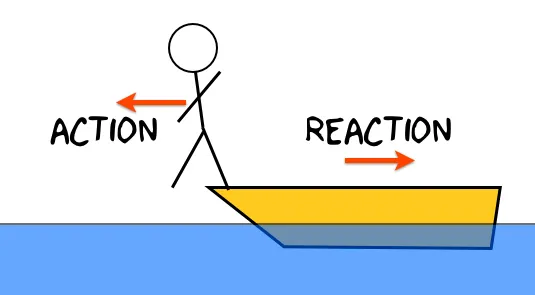
For every action there is an equal and opposite reaction
44
New cards
What is an action force?
An action force is an initial force that is applied to an object.
45
New cards
What is a reaction force?
The reaction force is the subsequent force that "reacts" back onto the original action force in the opposite direction with equal strength.
46
New cards
Can action and reaction forces be balanced?
NO, Action and reaction forces can never be balanced because they act on different objects. For them to be balanced, they have to act on the same object. **They come in pairs but are unbalanced.**
47
New cards
How much grams are in ONE newton?
100g
48
New cards
What is motion caused by?
Forces
49
New cards
Forces always...
Have a direction, magnitude, are always present, have an opposing force (counter, cancel, reinforce)
50
New cards
What is always the independent variable?
The x-axis
51
New cards
What is the relationship of distance and gravity?
When distance goes down, gravity goes up. This is an inversely proportional relationship.
52
New cards
What is the relationship between mass and gravity?
When mass goes up, gravity goes up. This is a proportional relationship.
53
New cards
A very massive object A and a less massive object B move toward each other under the influence of mutual gravitation. Which force, if either, is greater?
Both forces are the same.