Social Psychology
 Call Kai
 Learn
Learn Practice Test
 Spaced Repetition
 Match
Match Flashcards
 Knowt Play
1/106

Earn XP
Description and Tags
Name | Mastery | Learn | Test | Matching | Spaced | Call with Kai | Chat |
|---|
No analytics yet
Send a link to your students to track their progress
107 Terms
Structure of knowledge - evidence level
•what empirical evidence is there
Structure of knowledge - ontology and epistemology
•what is reality and how do we know what we know
•positivism vs social constructionism
Structure of knowledge - rationale level
•what are the debates or tensions around areas of research
•e.g. historical and ideological contexts, key theories
Positivism
•objective, strong prediction, what is general and representative, laws and absolute rules
Interpretivism
•socially constructed, understanding “weak” prediction, what is specific and unique, meanings and relative rules, interactive
Decolonisation
•process of undoing the effects of colonisation, involves addressing the legacies of imperialism, eurocentrism, cultural dominance
Social psychology
•Allport (1954)
•attempt to understand and explain how the thoughts, feelings and behaviours of individuals are influenced by the actual, imagined or implied presence of other human beings
Replication crisis
•only one third of the experimental studies published in psychological journals could be replicated
WEIRD problem
•our knowledge about psychology is based on samples that are mainly western, educated, industrial, rich and democratic
•does not represent the world’s populations
World-making
•the fact that humans at both an individual and collective level contribute to the making of societies, social relations and cognition
•difference between the study of people making worlds and the role of social psych in contributing to this world making
•bad world making is inaccurate research generating knowledge that informs everyday understandings, that are self interested and incomplete
Understanding the self
•Darwin 1872 exploring orangutans - didnt know it was them in the mirror when kissing it
•understanding that we are a separate entity from other people and objects in the world
Mirror self recognition test (Gallup,1970)
•a mark placed on chimpanzee body where they cant normally see e.g. forehead
•when infront a mirror if the chimp thinks its another chimp it will show social behaviour
•if it understands the self, it will touch the mark
•chimps touched the mark showing physical awareness and other studies show asian elephants, killer whales, dolphins and magpies pass this test
Self-concept
•personal summary of who we are, including our positive and negative qualities, relationships to others
Introspection
•process when one observes and examines one’s internal states for behaving in a certain way
Choice blindness study - Johansson et al 2005
•answering which person they found most attractive, experimenter swapped the photo meaning participants had to explain their choice when handed the one they did not choose
•73% did not notice the swap
•offering introspectively derives reasons
Repressing study - Macrae et al 1994
•asked to avoid stereotypical thinking about skinheads yet when expecting to meet the individual they sat further away
•therefore have limited self-insight about those aspects of ourselves we wish were not true
The dynamic self
•self is highly variable and socially contextualised
•you develop a sense of who you are through your interactions with others
•we interpret social feedback not absorb it
Self-construal (active)
•Morf & Koole 2015, a persons views about themself is shaped through an active construal process
•motivated by how one would like to see oneself
Self-perception theory
•Bem 1972 - people can infer states by observing their own behaviour, behaviour leads to attitudes
Intrinsic motivation
•motivated by internal factors like interest, challenge, enjoyment
Extrinsic motivation
•motivated by external factors like praise, money
Social comparison theory
•Festinger 1954 - uncertain of their own abilities so evaluate themselves through comparison with others and benchmarking
•Klein 1997 - we are happier with a low score that is above average over a high score that is below average
Self expansion theory
•Aron et al 1995 - become ourselves through relationships as others resources and perspectives are experienced as ones own
•students who had recently fallen in love included features of their new partner in their self concept
Generalised other
•Mead 1934 - guiding concept in knowing what to do with yourself in such situations
•formed by how children have to be a good at games by understanding the role of others - must form an idea of a generalised other
Intersubjectivity
•Gillespie and Cornish 2010 - variety of possible relations between people’s perspectives
•Gillespie & Zittoun 2010 - intersubjectivity is shaped by social situations, groups, norms, cultures and imaginations
•Heasman & Gillespie 2019 - how people create a shared understanding
Conversation analysis
•method for gathering data involving naturalistic interactions and systematically analysing its structural organisation
•studies power, co-constructed meaning, norms in conversations
Adjacency pairs
•cooperative aspects of language mean that statements we make are linked together
•greeting-greeting response
•question-answer
•compliment-acceptance/refusal
•beckon-response
Repairs
•Schegloff 1992 - mechanism through which a speaker recognises a misalignment of perspective and attempts to correct it
•Schegloff 1997 - other initiated repair
•Schegloff 1992 - self initiated repair
•third turn repairs
Attribution
•attribution is identifying the source or cause of something
•attributing causes and reasons to observed behaviour and events
Naive psychology - Heider 1958
•argued that people have 2 needs: to form a coherent view of the world, to gain control over the environment
•we therefore look for stable features
•Heider & Simmel, 1944 - some interpretating moving shapes as a social interaction, minority just as moving shapes
Correspondent Inference Theory
•Jones & Davis 1965 - what does a behaviour tell me about a person, we prefer to attribute to underlying dispositions of person
•renders the world stable, understandable and predictable
•narrow
Covariation model
•Kelley 1967 - covariation of behaviour with other factors - a systematic approach
•3 types of information: consistency, distinctiveness, consensus
•when consistency is high, distinctiveness and consensus is low we tend to make internal attributions
•wide
Configuration
•Kelley, 1972 - causal schema - a general conception that a person has about certain kinds of causes to produce a specific kind of effect
•kicks in when information is missing or not worth collecting
Fundamental Attribution error
•tendency to attribute to internal, dispositional causes rather than situational causes
•Jones & Harris 1967 - when p’s where aware speakers had no choice whether they made a pro or anti castro speech, internal attributions were made
•Miller 1984 - americans internal attributions increase with age but indians external attributions increase with age
Actor-observer effect
•Jones & Nisbett, 1972 - more likely to attribute others behaviour to internal causes and own behaviour to external causes
•e.g. someone else fails driving test they are a bad driver but if you fail it was dodgy examiner
Self-serving bias
•Olson & Ross 1988 - tendency to attribute own success to internal behaviours ( self enhancing bias) and attribute own failure to external factors (self-protective bias)
Malle, B.F. 2006
•meta analysis of 173 published attribution experiment, participants typically interacted with another person, read behavioural scenarios, performed tasks and explained them
•data collected was when p’s asked questions to why they behaved that way and rated causes using scales like personality, attitudes etc
•actor-observer effect was extremely small, asymmetry only occurred when events were hypothetical, events were negative, actor was idiosyncratic, reverse effect observed when events were positive
•malle evidence shows that effect is not as strong as thought, it depends on the nature of event, linguistic interpretation, self-presentation and motivation explanation for all variables
Ratcliff et al 2006
•p’s watched police interrogation, 2 cameras filmed same interrogation either suspect or detective focus, p’s shown a photo of r&pe victim and asked to remember victims face (perceptual interference) and mentally rehearse 8 numbers (conceptual interference), asked if suspect confession was forced or not
•conceptual interference condition was rated more voluntary where perceptual interference showed no effect of camera perspective
•dispostional bias
Choi, Nisbett & Norenzayan 1999
•explores whether FAE appears outside of western populations, eastern cultures may be less susceptible to FAE because of the difference in what people understand a person to be
•Western model = person is autonomous and behaviour reveals internal traits, East asian = focusses more on a person embedded in relationships and behaviour reveals context and social roles
•2 matches groups where they read a capital punishment essay, p’s were told the student freely chose and some were told they were assigned position, asked to rate the students beliefs
•no difference is susceptibility to FAE between american and korean students
•second study asked students to write an essay taking a position they didnt believe and then rate a students essay
•americans continued to have correspondence bias but korean students changed judgements
Technology
•created by humans to extend human abilities
•practical technologies: these are used to act on the world directly
•cognitive technologies: these are used to act on the mind, self or other. they change what is recalled, thought or experienced
Language
•Tomasello 1999 - form of cognition
•used to manipulate the attentions of others but it can influence our own thoughts and actions
Writing
•extend our capacity for memory and facilitate communication
•enables one person to speak to many people
Possible selves
•Markus and Nurius 1986 - people have an idea of what they would like to be but also what they are afraid of becoming
storytelling
•enabling us to live out an unactualized aspect of the self and explore alternative worlds and versions of the self
Proteus effect
•Yee & Bailenson, 2007 - users infer from their avatars appearance expectations around attitudes and behaviour, then conform to these behaviours
•p’s were given an avatar taller/shorter or same height as confederate
•p’s in tall condition split the money more in their favour and short condition were more likely to accept the unfair offer
Birchmeier et al 2011
•argue that existing social psychological theories already account for many of the psychological phenomena that take place via digital technology
•online interactions are unique to physical e.g. anonymity/ choice
Social Identity theory
•explains intergroup relations as a function of group-based self definitions
•work to protect and bolster self identity
interpersonal-intergroup continuum - personal identity, social identity
positive self esteem and intergroup differentiation - people seek to maintain positive identities, make comparisons with relevant outgroups
strategies to avoid negative social identities - groups to which we belong to may not satisfy so we do individual mobility (leaving), social creativity (changing comparison) and social conflict (engaging in collective action)
Contact hypothesis - Allport 1954
•there is a set of conditions to be met for in person contact to create a positive effect between 2 different ethnic groups
•equal status, cooperation, intimate contact, institutional support and willingness to participant
•Amichai-hamburger 2008 - internet supports these conditions
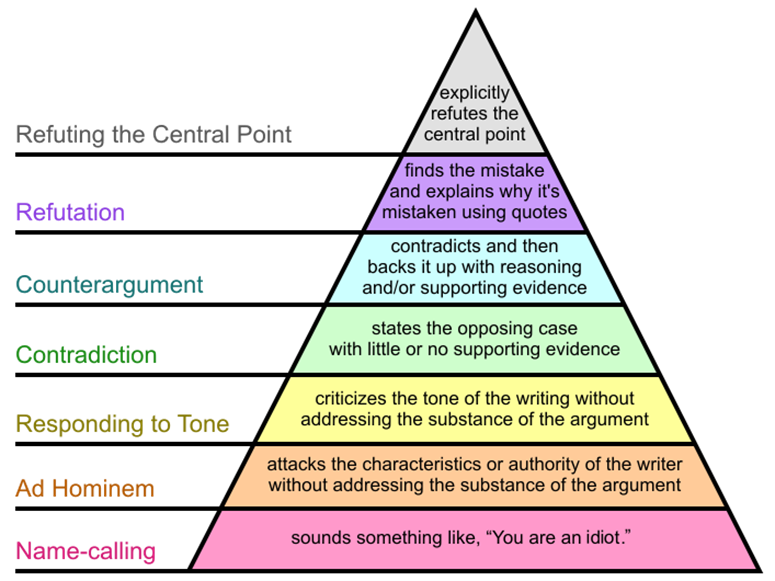
Ad hominem attack
•internet has changed writing - so people attack the character of a person instead of the argument they make
Anderson & Dill 2000
•study 1 found that real-life violent video game play was associated with aggressive behaviour and delinquency. stronger for men
•study 2 - lab exposure to graphically violent video game increased aggressive thoughts and behaviour. stronger for men
Beck et al 2021
•degree of exposure to violent games did not increase negative attitudes towards women, however associated between violence and increase in r&pe myth acceptance for male participants
Turing test
•measure of artificial intelligence based on human social intelligence
Echoborg research
•echoborg is a human shadowing the speech of a chatbot, so p’s either interact with a chatbot with echoborg or human
•human shadowing showed increased life-like perceptions of chat bot but not chances of passing turing test, majority didnt sense robotic interaction
Slop - pendergrass et al 2025
•slop = low-quality, mass produced ai content created to attract attention
•this cycle of content production has real social effects like disorted beauty standards
Affectivism
•emphasises the motivational processes that direct cognition and behaviour
Emotions
•no consensus on how to define emotions
•emotions are brief responses to challenges or opportunities that we appraise as important to our goals (Scherer, 2005)
Darwin’s ideas about emotion - 1872
•hypothesised that a finite set of emotions evolved to solve challenges encountered by humans and their ancestors
•shared with other species
•involve specific patterns of expression and physiology
•because all humans use same 30-40 facial muscles to communicate, people in all cultures will communicate in similar fashion
Basic emotions theories
•Ekman 1992, Keltner et al 2016
•proposes that there are limited set of basic emotions, that should be discrete, distinct components and are universal
•argues emotions are caused by affect programs - each emotion corresponds to a specific affect
Emotional expressions
•multimodal, dynamic patterns of behaviour, involving facial action, vocalisation, bodily movement, bodily movement, gaze, gesture, head movements, touch - Keltner et al 2019
Barret 2006
•challenges the view that emotions are discrete, functionally distinct and separately evolved
•no clear evidence for distinct neural circuitry causing a specific emotion, responses arent uniquely tied to specific emotions
Constructionist theories
•Barret 2006, Mesquita et al 2016, Russell 2003
•argues against basic emotion theories, propose internal sensory or affective states and conceptual knowledge as two building blocks for emotions
•two dimensions of core affect (valence and arousal)
•subjective experience of feelings arise when people interpret their core affect state with contextual information and culturally relative knowledge.
Appraisal theories
•Ellsworth and Scherer 2003, Lazarus 1991, Moors et al 2013
•propose that stimuli cause emotions via a process called appraisal (assesses the significance of the environment for well-being)
•look at whether event is good or bad for goals (goal congruence), who caused this(agency), how unexpected (novelty), can i change it (control)
Social functionalist theories
•Fischer and Manstead 2008, Keltner and Haidt 1999, Keltner et al 2022
•understanding what emotions are for, emotions solve problems
•help us appraise others, emotions are associated with social categories, help us regulate our own behaviour, give sincere communication
Keltner and Haid 1999 - 4 level of analysis
•individual level - inform and prepare the individual
•dyadic level - coordinate the interactions of individuals in relationships
•group level - establish group identities, shared goals and group roles
•cultural level - historical and economic factors shape emotions, regulate expressions and experiences
Embarrassment
•Keltner and Buswell, 1997
•self-conscious emotion involving personal failures or violation of social convention
Shame
•sense that we look foolish or weak, a bad person
Guilt
•sense that we have harmed them, done something wrong
Functional smiles
•a social-functional account that holds that there are three types of smiles, each serving basic social functions: rewarding behaviour, bonding socially, negotiating hierarchy
Display rules
•culturally specific rules about how, when and to whom people express emotion
•Matsumoto et al 2008 - greater expressivity to ingroup, individualist cultures were more expressive overall
Emotional mimicry
•imitation of the emotional expressions of others
•simulation of smiles: people respond to smiles with mimetic behaviour (Niedenthal, 2010)
•two functions of mimicry: reinforcing social and facilitating understanding of others’ emotions
Why are relationships important to social psych?
•a fundamental need for human affiliation - Ainsworth 1989, Kameda & Tindale, 2006
•social support and wellbeing - Williams et al 1992, emotional support = partner providing reassurance, instrumental = providing practical assistance
•social comparison - Festinger, 1954
•effects of social exclusion - William et al 2000
•learning and development - Vygotsky ZPD
What increases liking?
•physical appearance - attractive person is more successful in job interview (Huang & Lin, 2016)
•matching phenomenon - people choose partners similar attractiveness (Bershcheid et al, 1971)
Contextual influences on liking?
•proximity - Back et al 2008 - closer students sat to a person the more they like them
•closing time effect - Pennebaker et al 1979 - attractiveness increased nearer closing time in bar
•familiarity - Moreland and Beach 1992 - new student was rated more attractive the more the others saw her
•arousal- attraction effect - Dutton & Aron 1974 - men who crossed shaky bridge described researcher in a more s*xual way
•similarity - Galton 1870/1952 - married couples similarity
•mutual liking - Gold et al 1984 - woman who expressed interest in male participants was liked more when there was no interest expressed
Social exchange theory
•posit that relationships work like economic exchanges (Homans, 1961, Kelley & Thibaut 1978; Thibaut & Kelley 1959)
•interpersonal resources like love,status may be exchanged - Foa & Foa 1974
Equity theory
•people are happiest in equitable relationships in which cost-reward payoff is same for both parties (Adams 1965, Hatfield et al 1978)
•people who percieved their relationships to be unfair felt more unhappy and distressed (Schafer & Keith, 1980)
Evolutionary approaches
•concerned with how various behaviours promote the survivals of genes into subsequent generations
•romantic relationship - people select partners who enhance their chances of reproductive success (Trivers, 1972)
•Kinship, friendship, hierarchies (Kenrick & Trost, 2004)
Cognitive-behavioural approaches
•perception of relationship events affects subjective experience
•balance theory (Heider, 1958) people sharing similar attitudes are likely to reach balance
•CBT helps people evaluate their maladaptive thinking and attribution
Attachment theory
•need for affiliation is fundamental and powerful
•Harlow 1958 - monkeys with attachment study
Attachment styles
•Hazan and Shaver 1987
•secure: trust and secure feeling
•avoidant: low trust and avoidance
•anxious: concerned feelings aren’t reciprocated
Societal structures of mind
•Foa and Foa 1974 - people learn what is acceptable to give or take away from each other in various relationships through socialisation into cultures and societies
Commitment
•type of social exchange approach where someone may be motivated to commit to a relationship either because they want to be in a relationship, they ought to be, and because they have to
what is love
•Hatfield, 1987
•passionate love: intense and occasionally confused emotions
•companionate love: calmer, friendly affection and attachment
passionate love scale
•Hatfield and Sprecher, 1986 - scale to explore three facets of love:
•cognitive components - intrusive thinking
•emotional components - attraction to partner
•behavioural components - actions to determine other’s feelings
love attitudes scale
•Lee 1973/1976 - identified six basic love styles and referred them as colours - Henedrick and hendrick 1986 developed the LAS based on this
•eros - passionate love
•storge - friendship/ companionate love
•ludus - game playing love
•mania - possessive and dependent love
•pragma - logical/practical/realistic love
•agape - selfless/ transcendent love
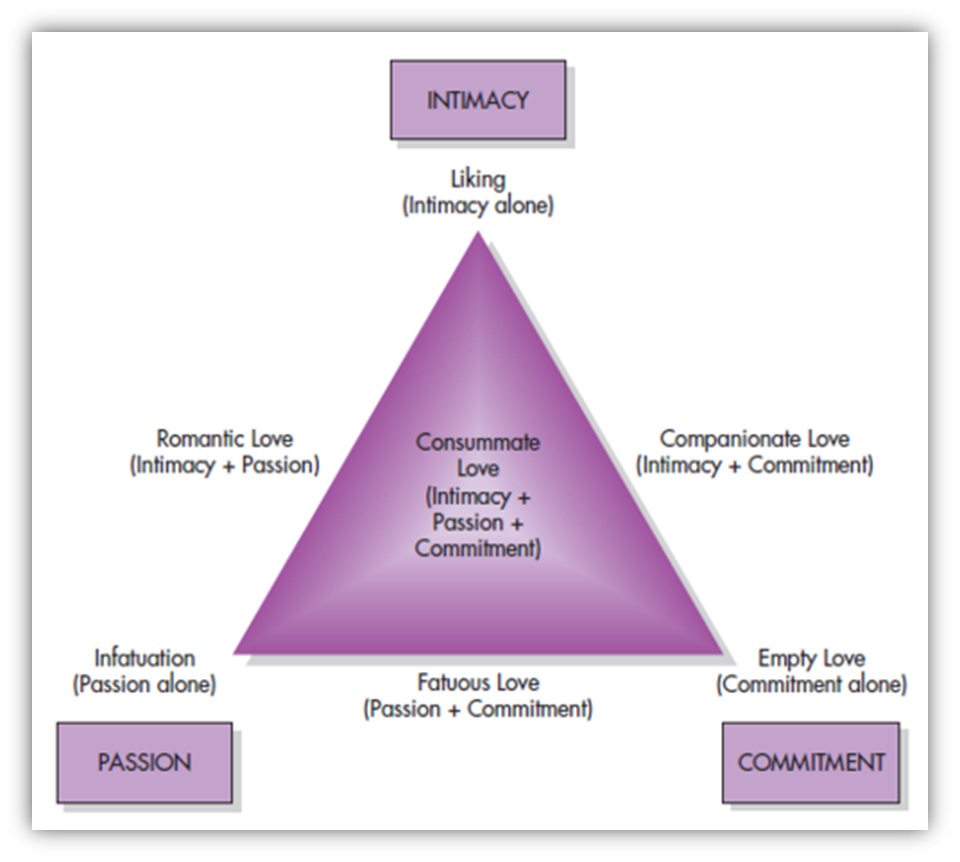
triangular theory of love
•Sternberg 1988 - three key factors of love: intimacy, passion and commitment
social constructionist view of love
•argues that love is a social construction (Beall & Sternberg, 1995)
•societies/ cultures in different time periods differ in their understanding of love
Sherif 1936
•autokinetic effect - p’s had to estimate how much a light had moved and half came together in groups where everyone called out their estimate
Compliance
•public change in behaviour, no private changes in attitudes, research has focussed on factors affecting compliance
Foot-in-the-door
•asking small request then asking big request - Freedman & Fraser 1966
•it works because we infer who we are from what we do - links to Bem
Door-in-the-face
•big request first is more likely to be unsuccessful - follow it with more reasonable request - Cialdine et al 1975
Information influence
•Deutsch & Gerard 1955 - desire to be right
Majority influence
•Asch 1951 - line experiment, majority effect
Normative influence
•social influence that occurs because of pressures to fit in with a group
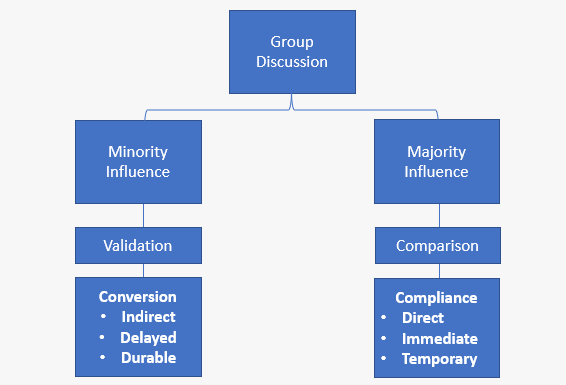
Minority influence
•minorities lack strength that would allow them to exert informational influence
•Moscovici 1976 - minorities require consistency to overcome majority
Conversion theory
Dissociation theory
•social categorisation can disrupt validation processes either non dissociative (SC contaminates validity) or dissociative (SC and validation are processed separately)
•leads to paradox - outgroup minorities are more effective than ingroup minorities
Obedience
•Milgram 1963 - obedience to authority
Prejudice
•antipathy or derogatory social attitude towards particular social groups or their members
•Allport 1954
Social discrimination
•explicit display of negative or disadvantaging behaviour towards particular social groups or their members
Intergroup relations approach
•realistic conflict theory
•social identity theory