Final Econ Test - Chapters 15, 16, 17, 18
 Call Kai
 Learn
Learn Practice Test
 Spaced Repetition
 Match
Match Flashcards
 Knowt Play
1/56

Earn XP
Description and Tags
Name | Mastery | Learn | Test | Matching | Spaced | Call with Kai | Chat |
|---|
No analytics yet
Send a link to your students to track their progress
57 Terms
If merchandise exports exceed merchandise imports, the trade balance is in
Surplus
If merchandise imports exceed merchandise exports, the trade balance is in
deficit
Balance on the goods and services
The portion of a country’s balance-of-payments account that measures the value of a country’s exports of goods and services minus the value of its imports of goods and services
net investment income from abroad
Investment earnings by U.S. residents from their foreign assets minus investment earnings by foreigners from their assets in the United States
net unilateral transfers abroad
The unilateral transfers (gifts and grants) received from abroad by U.S. residents minus the unilateral transfers U.S. residents send abroad
balance on the current account
The portion of the balance-of- payments account that measures a country’s balance on goods and services, net investment income from abroad, plus net unilateral transfers abroad
financial account
The record of a country’s international transactions involving purchases and sales of financial and real assets
exchange rate
The cost measured in one country’s currency of one unit of another country’s currency
currency depreciation
With respect to the dollar, an increase in the number of dollars needed to purchase one unit of foreign exchange in a flexible rate system
currency appreciation
With respect to the dollar, a decrease in the number of dollars needed to purchase one unit of foreign exchange in a flexible rate system
arbitrageur
Someone who takes advantage of tiny differences in the exchange rate across markets by simultaneously purchasing currency in one market and selling it in another market
speculator
Someone who buys or sells foreign exchange in hopes of profiting from fluctuations in the exchange rate over time
purchasing power parity (PPP) theory
The idea that the exchange rate between two countries will adjust in the long run to equalize the cost of a basket of internationally traded goods
flexible exchange rate
Rate determined in foreign exchange markets by the forces of demand and supply without government intervention
fixed exchange rate
Rate of exchange between currencies pegged within a narrow range and maintained by the central bank’s ongoing purchases and sales of currencies
currency devaluation
An increase in the official pegged price of foreign exchange in terms of the domestic currency
currency revaluation
A reduction in the official pegged price of foreign exchange in terms of the domestic currency
gold standard
An arrangement whereby the currencies of most countries were convertible into gold at a fixed rate
nternational Monetary Fund (IMF)
An international organization that establishes rules for maintaining the international monetary system and makes loans to countries with temporary balance-of- payments problems
managed float system
An exchange rate system that combines features of freely floating rates with sporadic intervention by central banks
Crowding Out
.
a concept that has gained significant attention in the field of economics. It refers to the situation where the government's increased spending in the economy ends up reducing the level of private investment. This phenomenon occurs due to the limited availability of resources in an economy.
When the government decides to ramp up its spending, it often needs to finance these expenditures through borrowing or increased taxation. This leads to a decrease in the amount of money available for private investors to borrow and invest in various sectors of the economy. As a result, private investment tends to decline, which can have adverse effects on economic growth and long-term development.
The mechanism behind crowding out can be understood through the concept of interest rates. When the government borrows money to finance its spending, it increases the demand for loanable funds in the market. This increased demand puts upward pressure on interest rates, making it more expensive for private investors to borrow money for their own projects. Consequently, many potential private investments become less attractive due to the higher cost of borrowing, leading to a decrease in overall private investment levels.
Moreover, this
can also occur through the displacement of resources. When the government increases its spending, it often requires additional resources such as labor, raw materials, and capital goods. This increased demand for resources can drive up their prices, making them less available or more expensive for private firms. As a result, private businesses may find it challenging to obtain the necessary inputs for their projects, further discouraging private investment.
The implications of crowding out are significant. A decrease in private investment can hinder economic growth and job creation. It can also limit the innovation and competitiveness of the private sector, as fewer resources are allocated towards research and development or expanding productive capacities. Ultimately, crowding out can have long-term consequences for an economy's productivity and overall well-being.
In conclusion, crowding out is an economic phenomenon where increased government spending leads to a decrease in private investment. It occurs due to the limited availability of resources and the upward pressure on interest rates caused by government borrowing. Understanding the implications of crowding out is crucial for policymakers and economists to make informed decisions about fiscal policies and their potential impact on private sector investment.
Crowing In
refers to the phenomenon where increased government spending stimulates private sector investment and economic growth. It is an expansionary fiscal policy approach aimed at boosting aggregate demand and creating a multiplier effect in the economy.
The 4 Lags in Economics
Flashcard: "The 4 Lags in Economics"
Recognition lag: The time it takes for policymakers to identify an economic problem.
Decision lag: The time it takes for policymakers to make a decision to address the problem.
Implementation lag: The time it takes for policies to be put into effect.
Impact lag: The time it takes for the policies to have an effect on the economy.
Equation of Exchange
A monetary theory that states the total amount of money spent in an economy is equal to the price level multiplied by the quantity of goods and services exchanged. It is represented as MV = PQ, where M is the money supply, V is the velocity of money, P is the price level, and Q is the quantity of goods and services exchanged.
How to shift the Demand for Money
"The demand for money can shift due to changes in interest rates, income levels, and inflation expectations. When interest rates rise, the demand for money decreases as people prefer to hold less cash and invest more. An increase in income leads to a higher demand for money as individuals have more purchasing power. Expectations of higher inflation can also increase the demand for money as people want to hold more cash to protect against rising prices."
Real Output
refers to the total quantity of goods and services produced by an economy, adjusted for inflation. It is a measure of the actual physical output, excluding the impact of price changes. Real output helps gauge the growth and productivity of an economy over time.
Real GDP
The total value of all goods and services produced within a country's borders, adjusted for inflation. It measures the economic output adjusted for changes in prices, providing a more accurate representation of economic growth over time.
Tariff Effects on Consumer and Producer Surpluses
Tariff Effects on Consumer and Producer Surpluses:
Consumer Surplus: Tariffs decrease consumer surplus by increasing the price of imported goods, reducing the quantity demanded, and limiting consumer choices.
Producer Surplus: Tariffs increase producer surplus by protecting domestic industries from foreign competition, allowing them to charge higher prices and increase their profits.
Note: Surpluses refer to the difference between the price consumers are willing to pay and the price producers are willing to accept.
Things that affect Aggregate Demand
consumption, investment, government spending, and net exports. These elements determine the level of economic activity and can lead to changes in GDP, inflation, and employment rates.
Things that affect Short Run Aggregate Supply
changes in production costs, such as wages, raw material prices, and taxes; technological advancements and changes in the availability of resources; Other factors include government regulations, inflation expectations, and changes in exchange rates.
Nominal Wage
The amount of money an employee earns per hour, day, or year before accounting for inflation or other adjustments.
Phillips Curve
Relationship between inflation and unemployment; suggests that there is a trade-off between the two. As unemployment decreases, inflation increases and vice versa.
Comparative Advantage
Ability of a country to produce a good or service at a lower opportunity cost compared to other countries. Leads to specialization and trade between nations.
Absolute Advantage
Ability of a country to produce a good more efficiently than another country, using fewer resources.
Things that affect Demand for Money
1. Interest rates 2. Inflation 3. Income levels 4. Economic stability 5. Financial technology 6. Consumer confidence 7. Government policies 8. Demographics 9. Cultural factors 10. Availability of credit.
Credit
The ability to borrow money or obtain goods or services before payment, with the promise to repay the lender or provider at a later date, often with interest.
Debit
A transaction that subtracts funds from a bank account. It represents an outgoing payment or a decrease in the account balance. It can be used to make purchases, pay bills, or withdraw cash. Debit cards are commonly used for these transactions, providing a convenient and secure way to access funds.
Spending Multiplier
The spending multiplier measures the impact of an initial increase in spending on the overall economy. It shows how much the total output increases compared to the initial increase in spending. It is calculated by dividing the change in real GDP by the initial change in spending.
How does aggregate demand relate to the money market?
Aggregate demand represents the total amount of goods and services that all individuals, businesses, and the government are willing and able to purchase at a given price level. It is influenced by factors such as consumer spending, investment, government spending, and net exports. The money market, on the other hand, refers to the buying and selling of short-term debt instruments, such as Treasury bills and commercial paper. The relationship between aggregate demand and the money market is that changes in the money market, such as interest rates, can impact the level of aggregate demand. For example, when interest rates decrease, it becomes cheaper to borrow money, leading to increased consumer spending and investment, thereby boosting aggregate demand.
Factors that determine the Long Run Philips Curve
Factors that determine the Long Run Philips Curve:
Inflation expectations: Higher expectations lead to higher inflation.
Labor market flexibility: More flexibility reduces the trade-off between inflation and unemployment.
Supply shocks: Positive shocks increase both inflation and unemployment.
Wage bargaining power: Stronger bargaining power leads to higher inflation and lower unemployment.
Productivity growth: Higher growth reduces inflation and unemployment.
Decision Lag
Decision Lag
The delay in making a decision due to uncertainty, analysis paralysis, or lack of information. It can lead to missed opportunities and decreased effectiveness in problem-solving.
Recognition Lag
The delay between perceiving a stimulus and recognizing its meaning or significance.
Implementation Lag
The time delay between the formulation of a policy and its actual implementation, caused by bureaucratic processes, political obstacles, and logistical challenges.
Effectiveness Lag
The time delay between implementing a strategy or intervention and seeing its desired impact or results.
4 Main Issues with Active Policy
We don’t know out potential output definitevely
Knowledge is always an issue
“Forecasting” is difficult and can never be truly accurate given how many factors there are
The 4 lags
3 tools of the Fed in active policy when shifting aggregate demand via the money market
Open Market Operations: The buying or selling of government securities by the Fed to influence the money supply and interest rates.
Discount Rate: The interest rate at which banks can borrow from the Fed, affecting the cost of borrowing and lending.
Reserve Requirements: The amount of funds banks must hold in reserve, impacting the amount of money available for lending.
When reserve requirements go down
The supply of money shifts right
When reserve requirements go up
The supply of money shifts left
When the discount rate goes down
The supply of money shifts right
When the discount rate goes up
the supply of money shifts left
When the Fed uses market operations of buy
the supply of money shifts right
when the fed uses market operations to sell
the supply of money shifts left
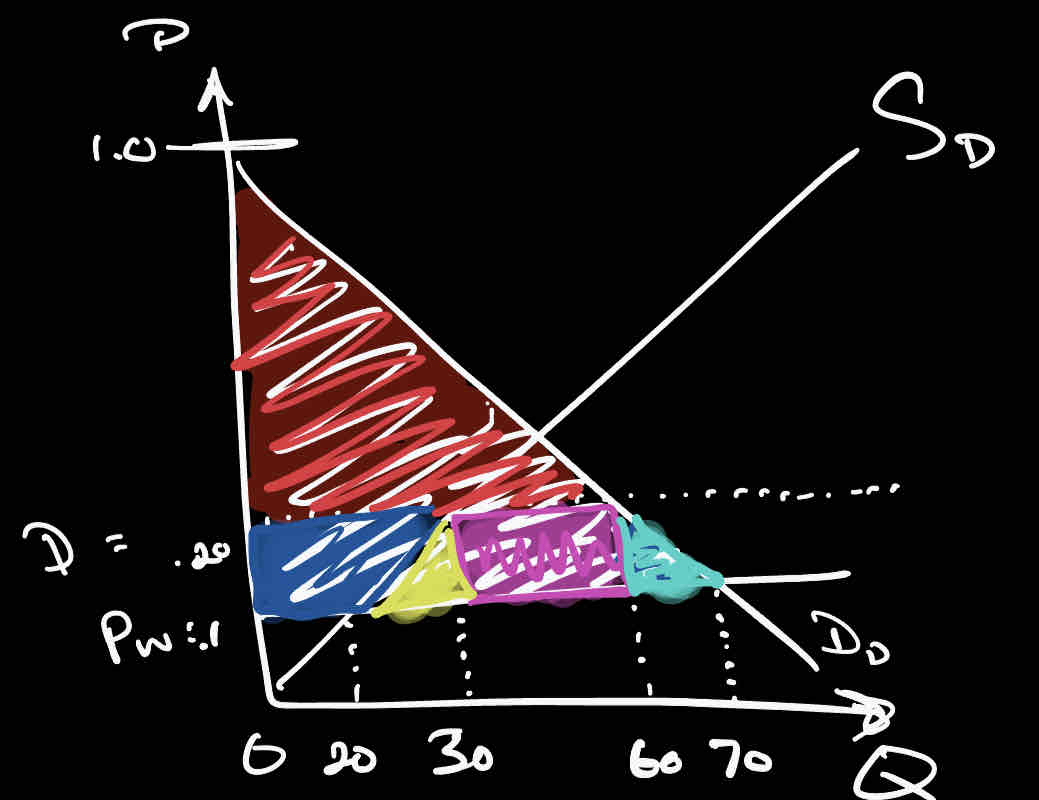
red is
Consumer Surplus
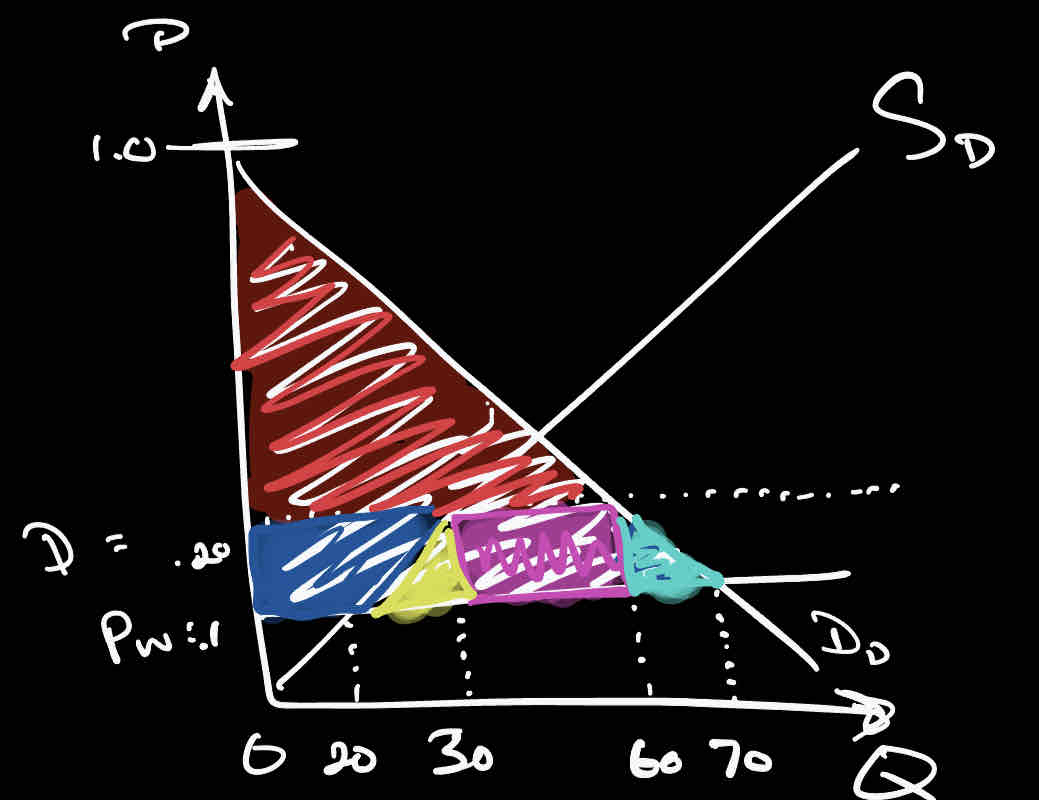
Dark Blue is
Producer Surplus
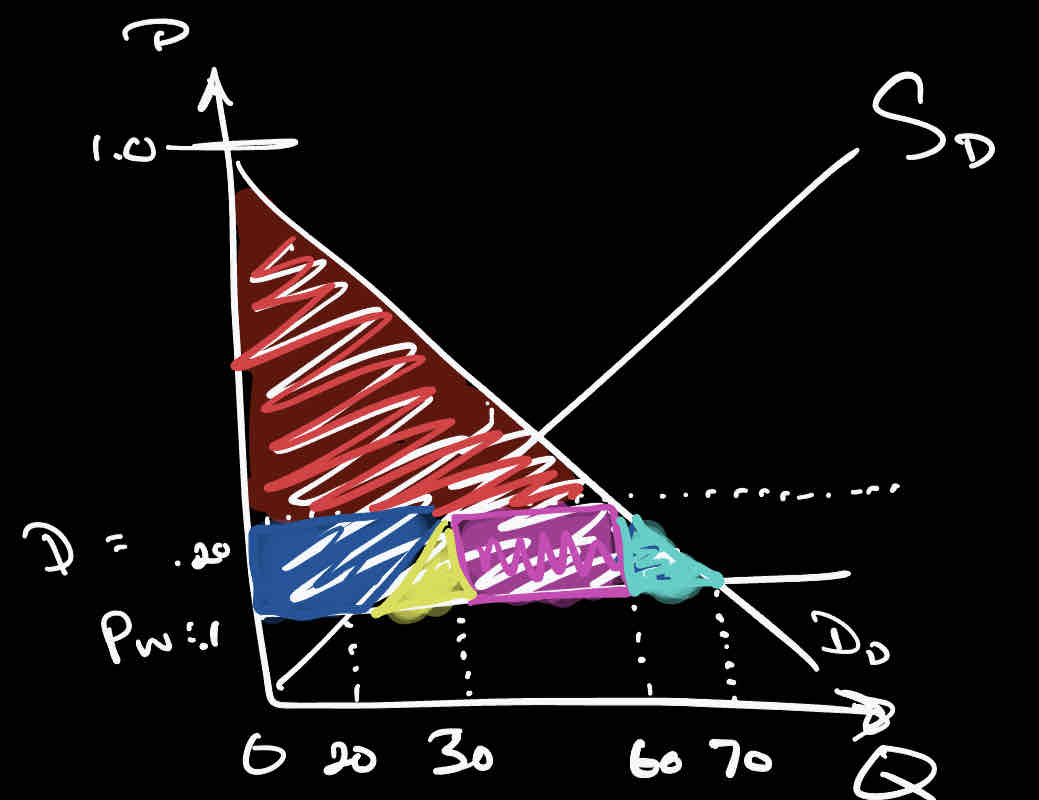
Yellow is
Deadweight loss
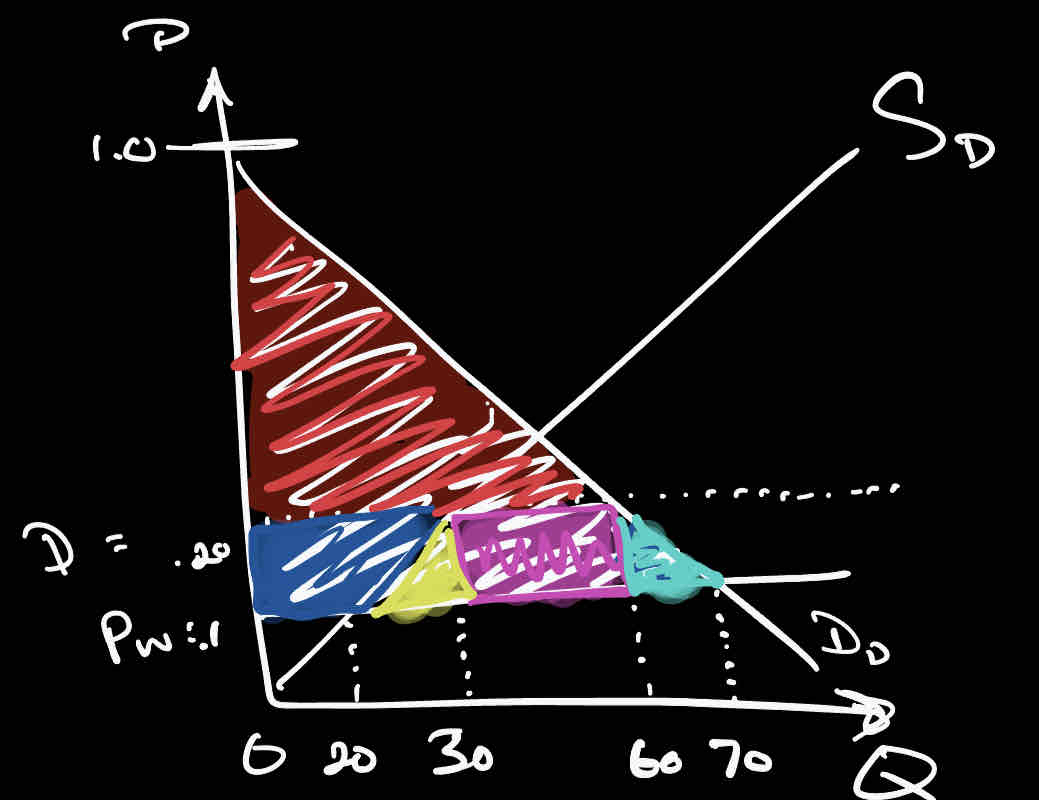
Light Blue/Cyan is
Deadweight loss
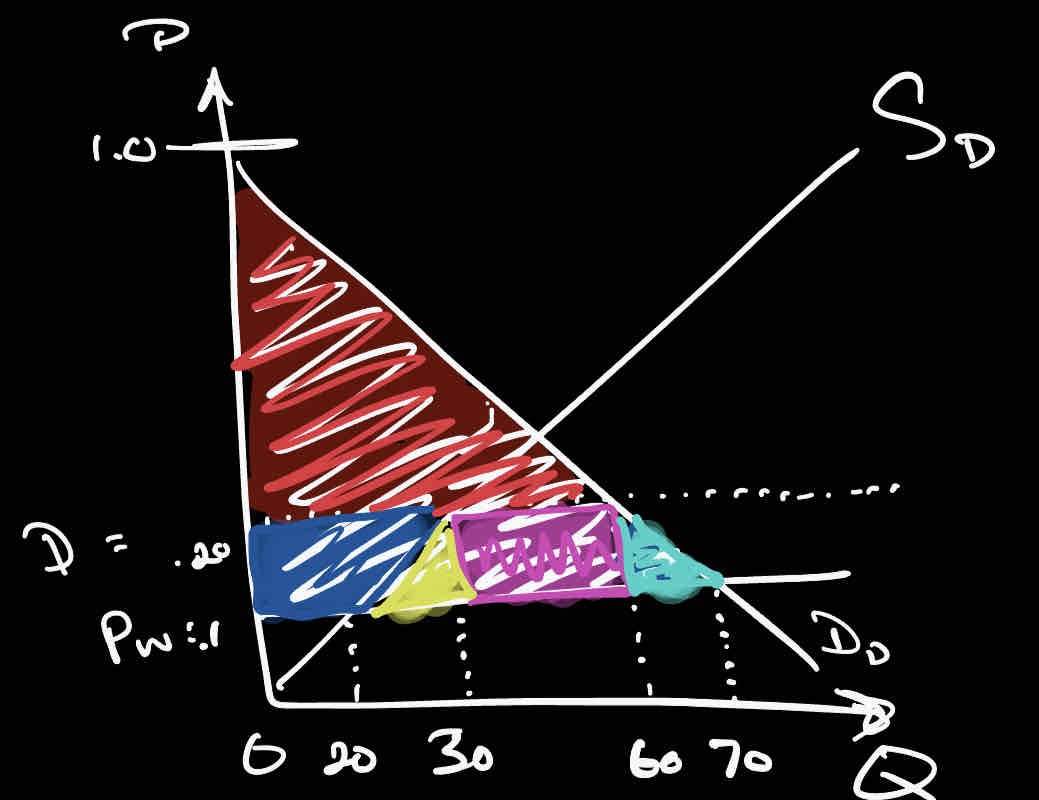
Purple is
Government revenue