L25- Electrical signaling 2
 Call Kai
 Learn
Learn Practice Test
 Spaced Repetition
 Match
Match Flashcards
 Knowt Play
1/27

There's no tags or description
Looks like no tags are added yet.
Name | Mastery | Learn | Test | Matching | Spaced | Call with Kai |
|---|
No analytics yet
Send a link to your students to track their progress
28 Terms
• Each subunit (VGCK) or domain (VGCNa) contains 6 transmembrane α-helices, S1-S6
S_ contains the “voltage sensor”
S5-S6 line ___
S4 contains the voltage sensor
4 sensors per channel
S5-S6 line the pore
pore aas are polar/charged bc wanna create safe space for ions to go through lipids
Why might changes in voltage impact protein structure
Voltage gated channel reg domain includes
inactivating particle which inserts into channel→ blocks
unstruc intracellular loop bw domains 3 + 4
Selectivity (K+ Na+=key) det. by size of central pore + position of O2 atoms (lock)
Ionic radius K+ ≅ 0.138 nm
Ionic radius Na+ ≅ 0.102 nm
If “lock” is right shape for ”key”, then O outcompete H2O in ion hydration shells
Toxins that impact VGCs
Pore blockers→ small molecules that bind + block the pore
ex) tetrodotoxin (puffer fish)
peptidic gating modifier toxins→ peptides that bind + lock channel in a particular conformation
lock in open or closed→ loss of dynamic regulation
ex) spider venom
Ligand gated channel structure
ex) The nicotine acetylcholine receptor
Ligand (acetylcholine) gated Na+ channels
channel opens, Na+ goes into cell through diffusion Vm more positive towards 0→ membrane depolarizes
5 transmembrane protein subunits→ heteropentameric complex
2x a subunits= ligand binding site-β, δ, γ subunits
Each subunit has 4 transmembrane a-helices, M1-M4
2 binding sites for acetylcholine (a-subunit)
acehtylcholine receptor is a key link bw
the brain and muscles
so blocking this signal can lead to paralysis
Cobra venom, nicotine, venome are neutrotoxins that covalently bind tightly + specifically to AchR
prevents it from being let go cause receptor to be open permanently
What process is important for dynamically regulating sigalling
exocytosis
What factors impact how much current will flow
Electrical potential
potnetial for electrical charge (ions) aka voltage to move
if low, less current (less ion flow) vice vera
Electrical conductance
Ability of electrical charge to move across distance
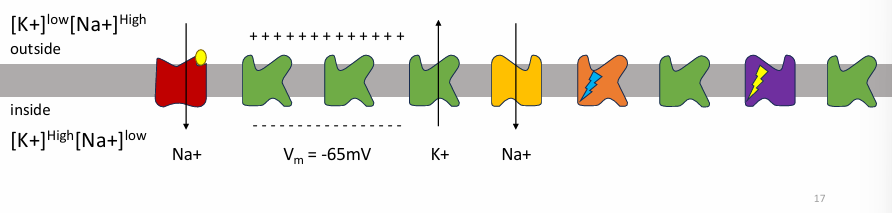
Vm depends on
Ion gradients (diffusion→ potential to move)
Ion permeability (channels→ ability to move)
What is action potential
a brief reversal of resting membrane potential
Inside of neuronal membrane becomes + charged, compared to outside (flipped)
Outline what happens when ligand binds
Permability of Na increases bc ligand gated Na+ channel opens
Na+ flows into cell
Vm rises toward 0 (less negative)→ depolarized cell membrane
Voltage gated channels now open
Incremental changes in potential are called
post synaptic potentials (PSPs)
one ligand-gated Na+ channel opening not enough to depolarize a cell
Can be excitatory or inhibitory postsynaptic potentials (ESP/IPSP)
Excitaroty→ depolarization (Na+ in)
inhibitory→ hyperpolarizing (K+ out)
How to trigger a receiving neuron to undergo an action potential
large # of EPSPs must be recieved
Temporal integration
if multiple small influxes of Na+ occur from same postsynaptic terminal, 1 right after another
these small depolarizations build + summate
Spatial integration
If an influx of Na+ occurs from multiple nearby postsynaptic terminals
these small depolarizations build + summate
If depolarization reaches a critical value (threshold) and if it doesnt what happens
reaches threshold= action potential
DOES NOT reach threshold= no action potential
All or nothing
Outline the action potential
Ligand binds→ channels open→ Na+ IN
threshold reached→ ACTION
Depolarization= voltage gated channels opening→ more Na+ in
Positive feedback loop= hodgkin cycle
Permeability of Na+ increases→ ligand gated Na+ channel opens
Membrane depolarizes
VGC Na open so Na+ floods in→ Vm Reverses (+) → VGC Na closes
Vm (+) now→ VGC K open (permeability of K+ increases)
K+ floods OUT of cell→ hyperpolarization (overshoot)
Membrane repolarizes→ back to resting equilibrium
(somewhere here the particle blocks Na from coming in when open channel)
Action potential phases
Depolarizing phase
VGC Na open→ Na+ flux in, ACTION at -40mV
Membrane potential quickly rises to +40mV
Repolarizing phase
Reversed polarity closes + inactivates VGC Na, OPENS VGC K
Membrane potential slowly drops
Hyperpolarizing phase
VGC K stays open, VGC Na stays closed (due to the gag)
Membrane potential drops below resting (-75 mV)
Return to rest
Vm stabilizes again at resting potential (-60 mV)
Na+/K+ pump pumps 3 Na+ out/2K+ in
requires ATP (moving against gradient)
During absolute and relative refractory periods
Absolute→ cannot trigger another action potential
Na channels inactivated by inactivating particle (gag)
cannot be opened by depolarization
Relative→ difficult to trigger another action potential
Na channels active (gag removed)
membrane hyperpolarized
K channels still open
Propagation of action potentials
signal received at dendrites
moves passively through cell body (change ion conc)
Action potential starts at axon hillock increases [VGC]
depolarization of adjacent membranes like dominos
ONLY MOVES 1 direction bc of inactivating particle
VGC Na cannot reopen behind action potential
The myelin sheath
Discontinuous myelin sheath made of glial cells
Breaks in myelin= nodes of ranvier
Directs electrical potential down the axon
DECREASES conductivity of membrane
retain electric charge→ insulation
signal travel farther, faster
Insulates axon, and assembles specialized molecular strucs at NoR