Antibiotic Use

0.0(0)
Studied by 0 people
call kaiCall Kai
learnLearn
examPractice Test
spaced repetitionSpaced Repetition
heart puzzleMatch
flashcardsFlashcards
GameKnowt Play
Card Sorting

1/17

encourage image

There's no tags or description

Looks like no tags are added yet.

Last updated 2:56 PM on 5/4/26
Name
Mastery
Learn
Test
Matching
Spaced
Call with Kai

No analytics yet

Send a link to your students to track their progress

18 Terms

1
New cards

How do we go about selecting an antibiotic?

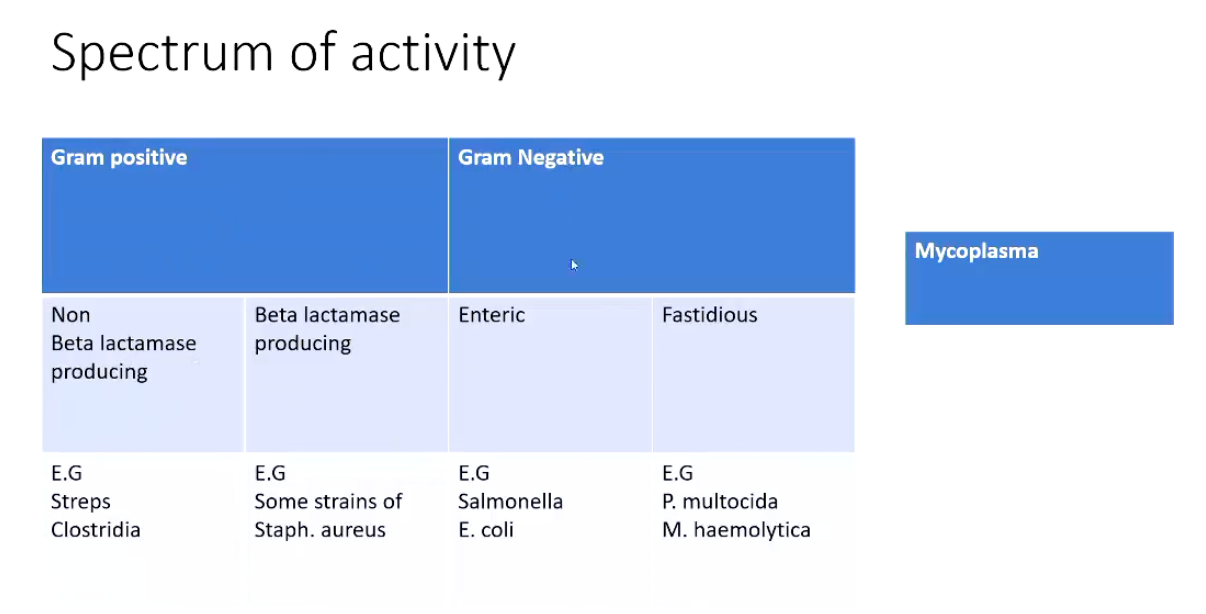
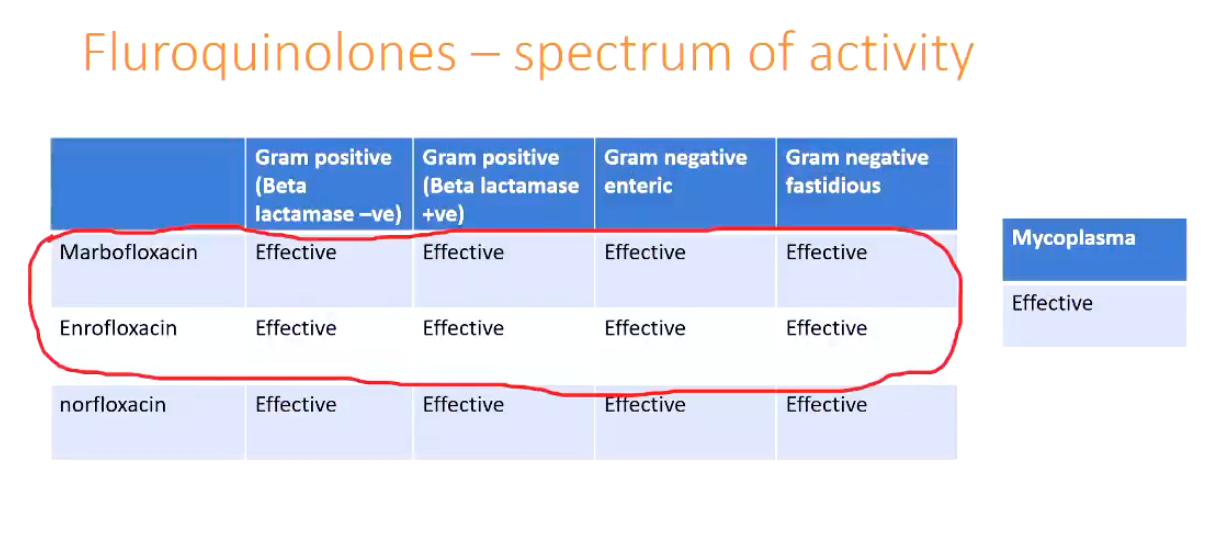
  • Consider spectrum of activity (Image)

  • Pharmacokinetics- How an organism affects a drug

    • Does it get to where we need it?

    • How is it excreted?

    • How is it metabolised?

    • What is the pH?

  • Pharmacodynamics- How a drug affects an organism

    • The mechanism of action can be really important when making clinical choices

  • Mechanism of Action = bacteria involved + bacteria location

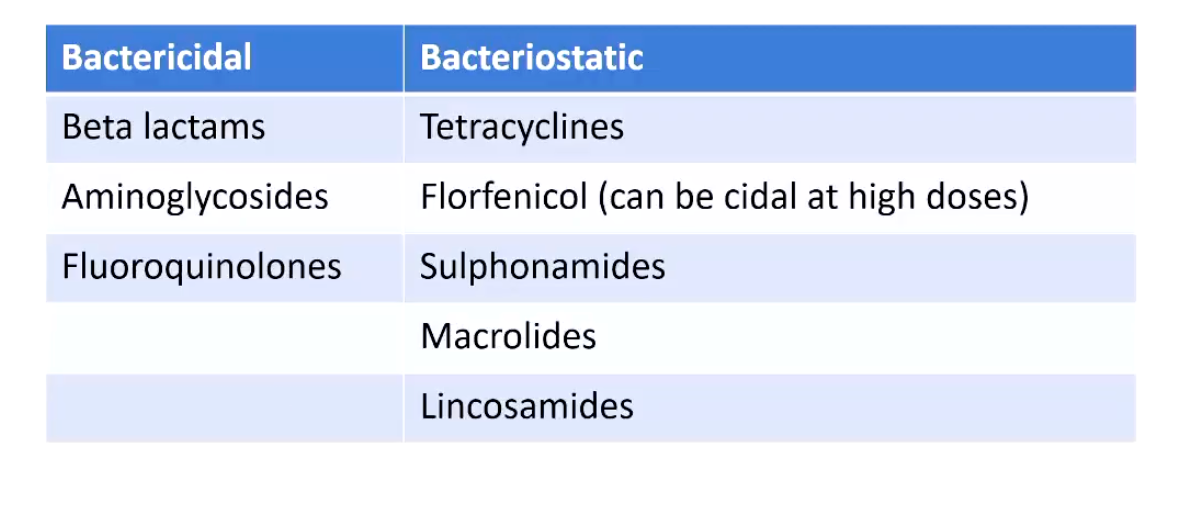
    • Bacteriostatic (stops bacteria from growing) May be preferable in situations where killing bacteria can cause harm such as endotoxic shock

    • Bactericidal (actively kills the bacteria) Advantageous in animals which are immunosuppressed or neonatal animals

    • • In many situations either is fine

      • This can sometimes be affected by dose

  • Licensing and Withdrawals

    • Check your data sheets!

    • Are there products licensed for this use in this species?

    • These are food producing animals

      • withdrawal periods are critical

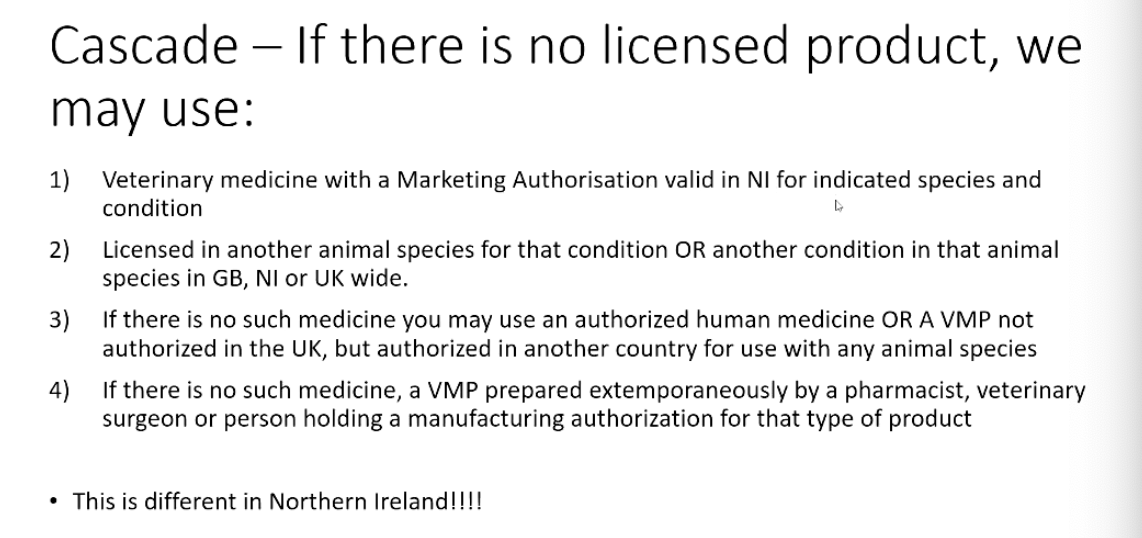
    • If there is no licensed product we have access to the cascade

  • Practicalities

    • Route of administration

    • Duration of Action

    • Volume of administration

    • Cost

  • Responsible use of antibiotics

  • Length and Course - long acting or daily

  • Withdrawal Periods

<ul><li><p>Consider <strong>spectrum of activity (Image)</strong></p></li><li><p><strong>Pharmacokinetics</strong>- How an organism affects a drug</p><ul><li><p>Does it get to where we need it?</p></li><li><p>How is it excreted?</p></li><li><p>How is it metabolised?</p></li><li><p>What is the pH?</p></li></ul></li><li><p><strong>Pharmacodynamics</strong>- How a drug affects an organism</p><ul><li><p>The mechanism of action can be really important when making clinical choices</p></li></ul></li><li><p><strong>Mechanism of Action = bacteria involved + bacteria location</strong></p><ul><li><p><strong>Bacteriostatic (stops bacteria from growing)</strong> May be preferable in situations where killing bacteria can cause harm such as endotoxic shock</p></li><li><p><strong>Bactericidal (actively kills the bacteria)</strong> Advantageous in animals which are immunosuppressed or neonatal animals</p></li><li><p>• In many situations either is fine</p><p>• This can sometimes be affected by dose</p></li></ul></li><li><p><strong>Licensing and Withdrawals</strong></p><ul><li><p>Check your data sheets!</p></li><li><p>Are there products licensed for this use in this species?</p></li><li><p>These are food producing animals</p><ul><li><p>withdrawal periods are critical</p></li></ul></li><li><p>If there is no licensed product we have access to the cascade</p></li></ul></li><li><p><strong>Practicalities</strong></p><ul><li><p>Route of administration</p></li><li><p>Duration of Action</p></li><li><p>Volume of administration</p></li><li><p>Cost</p></li></ul></li><li><p><strong>Responsible use of antibiotics</strong></p></li><li><p><strong>Length and Course - long acting or daily</strong></p></li><li><p><strong>Withdrawal Periods</strong></p></li></ul><p></p>
2
New cards

What is the drug “cascade”?

• The cascade is a mechanism for vets to use when a suitable licensed product is not available

• Use of the cascade is justified when there is a risk to animal welfare

• Cost is not a justification for cascade use

• Any time we are using an unlicensed product OR using a product in a way in which it is not specifically licenced we are using the cascade and we must be able to justify it

3
New cards

If there is no licensed product for the desired condition, we can follow what four steps?
knowt flashcard image
4
New cards

What are the additional requirements in using drugs for food producing animals?

• Must have known maximum residue limits (MRL - allowed annexes)

• Must be licensed for food producing animals in country of origin

• Apply minimum withdrawal periods

  • 1.5 times the longest withdrawal period listed on the datasheet for any species

  • 1 day if the longest withdrawal period listed is 0 days

  • If no withdrawal is listed then eggs: 14 days, milk: 7 days, meat: 28 days

• Keep specific Records for 3 years

• Single holding (CPH) only

5
New cards

What does responsible use of antibiotics involve?

• Every time we use antibiotics we select for resistant bacteria

• The most responsible use is not to use them at all

• When we need to use antibiotics, we use them properly

• We protect the most critically important classes

6
New cards

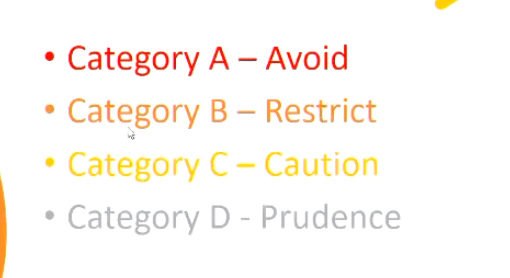
What is the RUMA categorization?

Responsible Use of Medicines in Animals - Driving change to reduce Abs use in general, and focusing on reducing use of critically important Abs

• Category A - Avoid

• Category B - Restrict

• Category C- Caution

• Category D - Prudence
<p>Responsible Use of Medicines in Animals - Driving change to reduce Abs use in general, and focusing on reducing use of critically important Abs</p><p><mark data-color="#dba1a1" style="background-color: rgb(219, 161, 161); color: inherit;">• Category A - Avoid</mark></p><p><mark data-color="#e6cb92" style="background-color: rgb(230, 203, 146); color: inherit;">• Category B - Restrict</mark></p><p><mark data-color="#efbd77" style="background-color: rgb(239, 189, 119); color: inherit;">• Category C- Caution</mark></p><p>• Category D - Prudence</p>
7
New cards

Describe main features of the Beta Lactams.

Beta Lactams

• Penicillin

• Amoxycillin

• Potentiated Amoxicillin (With clavulonic acid - which works against Beta lactamase)

• 1st and 2nd generation cephalosporins

• 3rd and 4th generation cephalosporins

Characteristics:

• Bactericidal

• Act by breaking down bacterial cell walls

• Excreted via kidneys and urinary tract

• Versatile and widely used

• 3rd and 4th generation cephalosporins are HPCIA

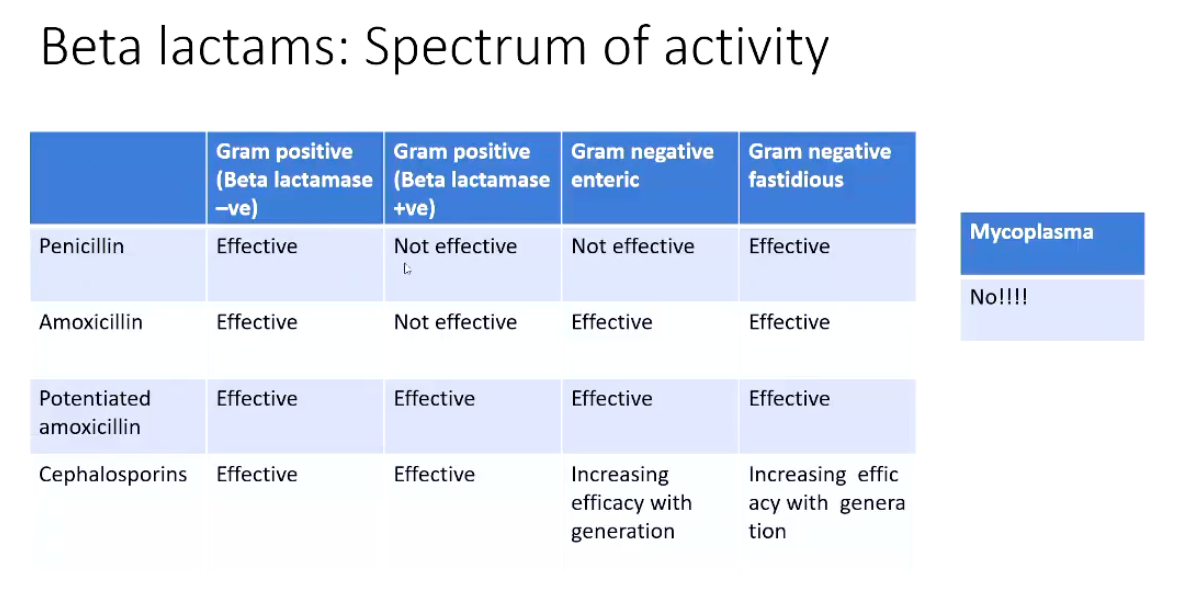
Spectrum of Activity: Image

  • **Mycoplasma - no cell wall, beta lactams not effective

  • Image

<p><strong>Beta Lactams</strong></p><p>• Penicillin</p><p>• Amoxycillin</p><p><mark data-color="#e1ceac" style="background-color: rgb(225, 206, 172); color: inherit;">• Potentiated Amoxicillin (With clavulonic acid - which works against Beta lactamase)</mark></p><p><mark data-color="#e1ceac" style="background-color: rgb(225, 206, 172); color: inherit;">• 1st and 2nd generation cephalosporins</mark></p><p><mark data-color="#f4bd84" style="background-color: rgb(244, 189, 132); color: inherit;">• 3rd and 4th generation cephalosporins</mark></p><p></p><p><strong><u>Characteristics:</u></strong></p><p>• Bactericidal</p><p>• Act by breaking down bacterial cell walls</p><p>• Excreted via kidneys and urinary tract</p><p>• Versatile and widely used</p><p>• 3rd and 4th generation cephalosporins are HPCIA</p><p></p><p><strong><u>Spectrum of Activity: Image</u></strong></p><ul><li><p>**Mycoplasma - no cell wall, beta lactams not effective</p></li><li><p>Image</p></li></ul><p></p>
8
New cards

What is Beta lactamase?

  • Defines the spectrum of activity for gram positive bacteria

  • Some bacteria produce an enzyme called beta lactamase which is able to break down many of the Beta lactams (The Abs)

  • These bacteria would therefore be resistant to those classes of Beta lactam

9
New cards

Describe main features of the Tetracyclines.

Tetracyclines

• Inhibit bacterial protein synthesis

• Bacteriostatic

• Broad spectrum

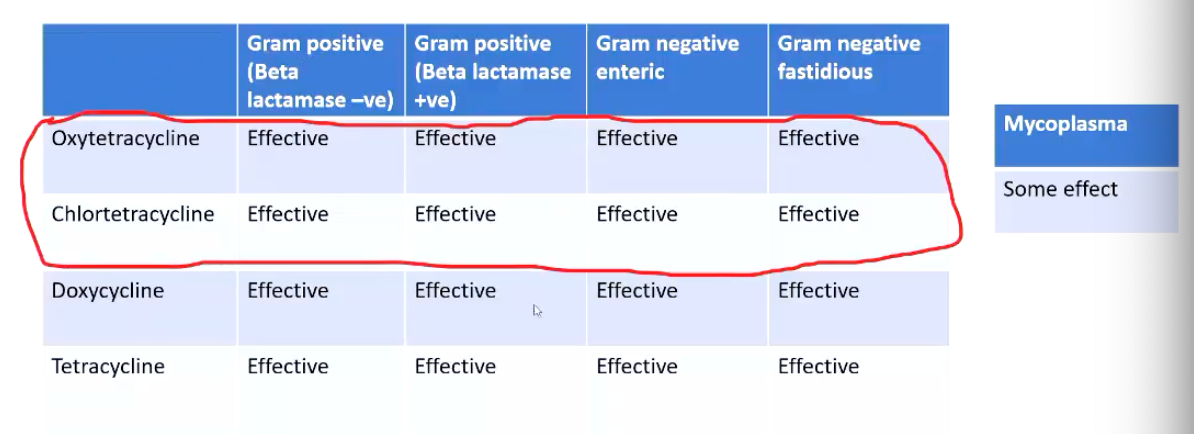
• Variable activity against mycoplasma

• Concentrate well in areas of inflammation due to their pH

• Antagonistic to Beta lactams

Spectrum of Activity

  • **Circle = commonly used in large animal medicine

  • Image

<p><strong>Tetracyclines</strong></p><p>• Inhibit bacterial protein synthesis</p><p>• Bacteriostatic</p><p>• Broad spectrum</p><p>• Variable activity against mycoplasma</p><p>• Concentrate well in areas of inflammation due to their pH</p><p>• Antagonistic to Beta lactams</p><p></p><p><strong><u>Spectrum of Activity</u></strong></p><ul><li><p>**Circle = commonly used in large animal medicine</p></li><li><p>Image</p></li></ul><p></p>
10
New cards

Describe main features of the Aminoglycosides.

Aminoglycosides

• Inhibit protein synthesis

• Bactericidal

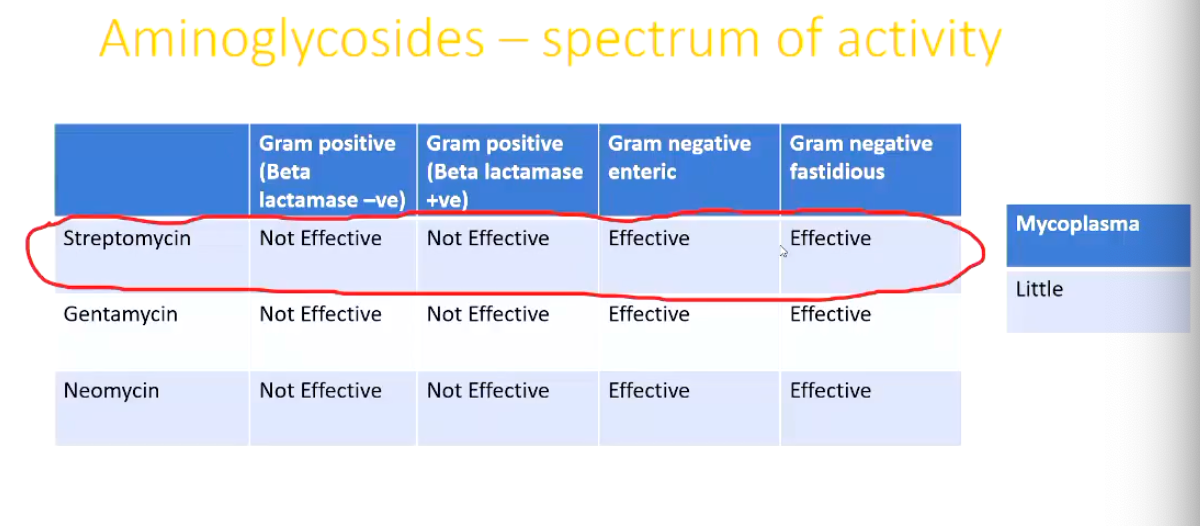
• Gram negative spectrum of activity

• Often used in combination with penicillin

• Streptomycin is very effective agains A. lignieresii (wooden tongue)

Spectrum of Activity

  • **Circle = commonly used in large animal medicine

  • Image

<p><strong>Aminoglycosides</strong></p><p>• Inhibit protein synthesis</p><p>• Bactericidal</p><p>• Gram negative spectrum of activity</p><p>• Often used in combination with penicillin</p><p>• Streptomycin is very effective agains A. lignieresii (wooden tongue)</p><p></p><p><strong><u>Spectrum of Activity</u></strong></p><ul><li><p>**Circle = commonly used in large animal medicine</p></li><li><p>Image</p></li></ul><p></p>
11
New cards

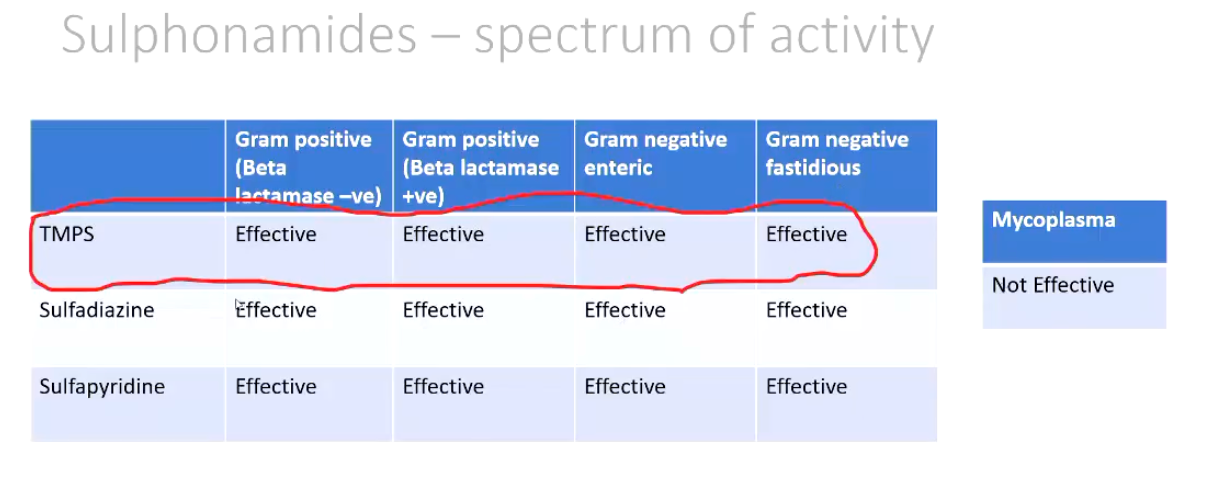
Describe main features of the Sulphonamides (TMPS).

Sulphonamides

• Inhibit bacterial folate synthesis

• Broad spectrum

• Bacteriostatic (may be cidal in some instances)

• Good gut penetration

• Some protozoal activity

• Inhibited by pus

Spectrum of Activity

  • Image

<p><strong>Sulphonamides</strong></p><p>• Inhibit bacterial folate synthesis</p><p>• Broad spectrum</p><p>• Bacteriostatic (may be cidal in some instances)</p><p>• Good gut penetration</p><p>• Some protozoal activity</p><p>• Inhibited by pus</p><p></p><p><strong><u>Spectrum of Activity</u></strong></p><ul><li><p>Image</p></li></ul><p></p>
12
New cards

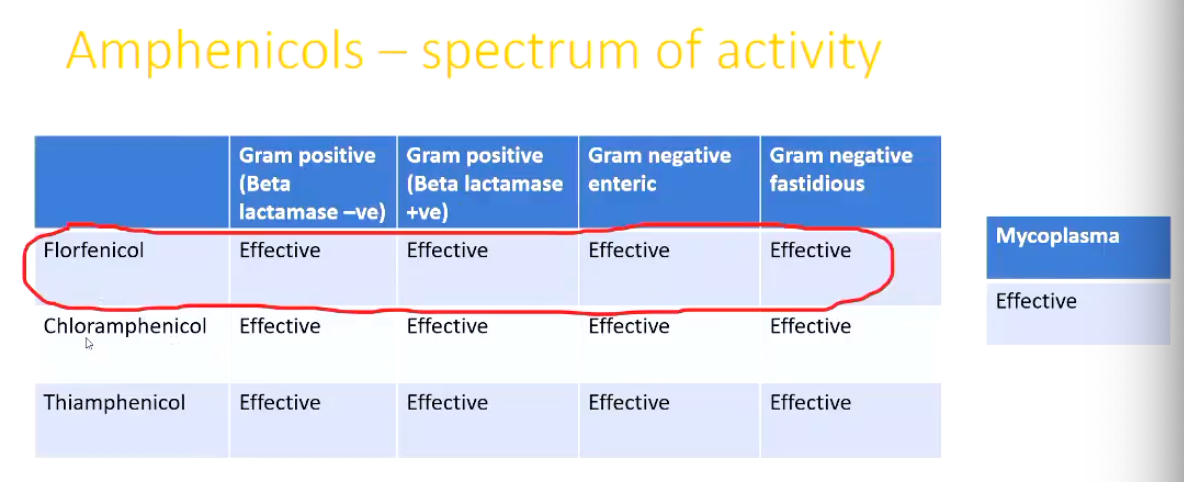
Describe main features of the Phenicols (Florfenicol used in farm med).

Phenicols

• Disrupts bacterial protein synthesis

• Bacteriostatic (can be cidal at higher doses)

• Broad spectrum

• Some products have a mycoplasma licens.

• Very good tissue penetration - penetrates joints, testicles, lungs and crosses blood brain barrier

• Commonly used for pneumonia and joint ill

Spectrum of Activity

  • Image

<p><strong>Phenicols</strong></p><p>• Disrupts bacterial protein synthesis</p><p>• Bacteriostatic (can be cidal at higher doses)</p><p>• Broad spectrum</p><p>• Some products have a mycoplasma licens.</p><p>• Very good tissue penetration - penetrates joints, testicles, lungs and crosses blood brain barrier</p><p>• Commonly used for pneumonia and joint ill</p><p></p><p><strong><u>Spectrum of Activity</u></strong></p><ul><li><p>Image</p></li></ul><p></p>
13
New cards

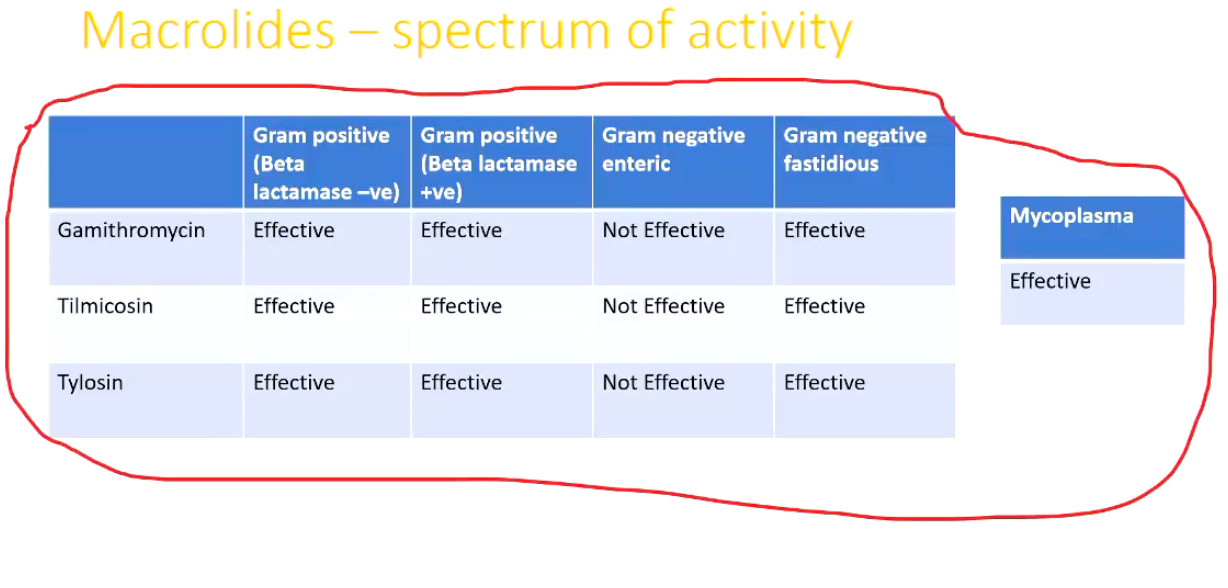
Describe main features of the Macrolides.

Macrolides

• Inhibit bacterial protein synthesis

• Bacteriostatic

• Gram +ve and fastidious Gram -ve

• Good choice for mycoplasma

• Enter macrophages so concentrate well in areas of inflammation

• Often long duration of action

• Commonly used for pneumonia and lameness

Spectrum of Activity

  • Image

<p><strong>Macrolides</strong></p><p>• Inhibit bacterial protein synthesis</p><p>• Bacteriostatic</p><p>• Gram +ve and fastidious Gram -ve</p><p>• Good choice for mycoplasma</p><p>• Enter macrophages so concentrate well in areas of inflammation</p><p>• Often long duration of action</p><p>• Commonly used for pneumonia and lameness</p><p><strong><u>Spectrum of Activity</u></strong></p><ul><li><p>Image</p></li></ul><p></p>
14
New cards

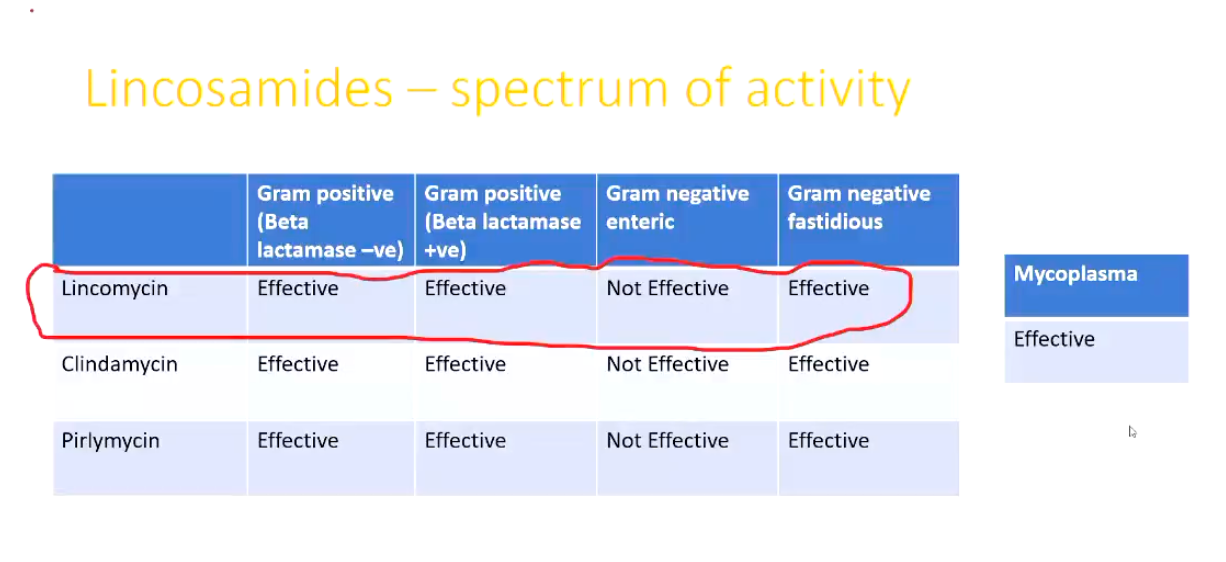
Describe main features of the Lincosamides.

Lincosamides

• Inhibit bacterial protein synthesis

• Have a similar mechanism of action to macrolides

• Bacteriostatic at therapeutic concentrations

• Mainly gram positive spectrum of activity

• Good activity against anaerobic bacteria

Spectrum of Activity

  • Image

<p><strong>Lincosamides</strong></p><p>• Inhibit bacterial protein synthesis</p><p>• Have a similar mechanism of action to macrolides</p><p>• Bacteriostatic at therapeutic concentrations</p><p>• Mainly gram positive spectrum of activity</p><p>• Good activity against anaerobic bacteria</p><p><strong><u>Spectrum of Activity</u></strong></p><ul><li><p>Image</p></li></ul><p></p>
15
New cards

Describe the main features of the Fluroquinolones.

Fluroquinolones

• Inhibit bacterial DNA synthesis

• Bactericidal

• Broad spectrum including mycoplasma

• HP CIA - avoid wherever possible

Spectrum of Activity

  • Image

<p><strong>Fluroquinolones</strong></p><p>• Inhibit bacterial DNA synthesis</p><p>• Bactericidal</p><p>• Broad spectrum including mycoplasma</p><p>• HP CIA - avoid wherever possible</p><p><strong><u>Spectrum of Activity</u></strong></p><ul><li><p>Image</p></li></ul><p></p>
16
New cards

Summarize the criteria for antibiotic selection?

• Bacteria involved

• Bacteria location

• Bacteristatic or Bactericidal

• Licensing

• Responsible use of antibiotics

• Route of administration

• Length of course - long acting or daily?

• Withdrawal Periods

17
New cards

Summarize bactericidal vs. bacteriostatic.
knowt flashcard image
18
New cards

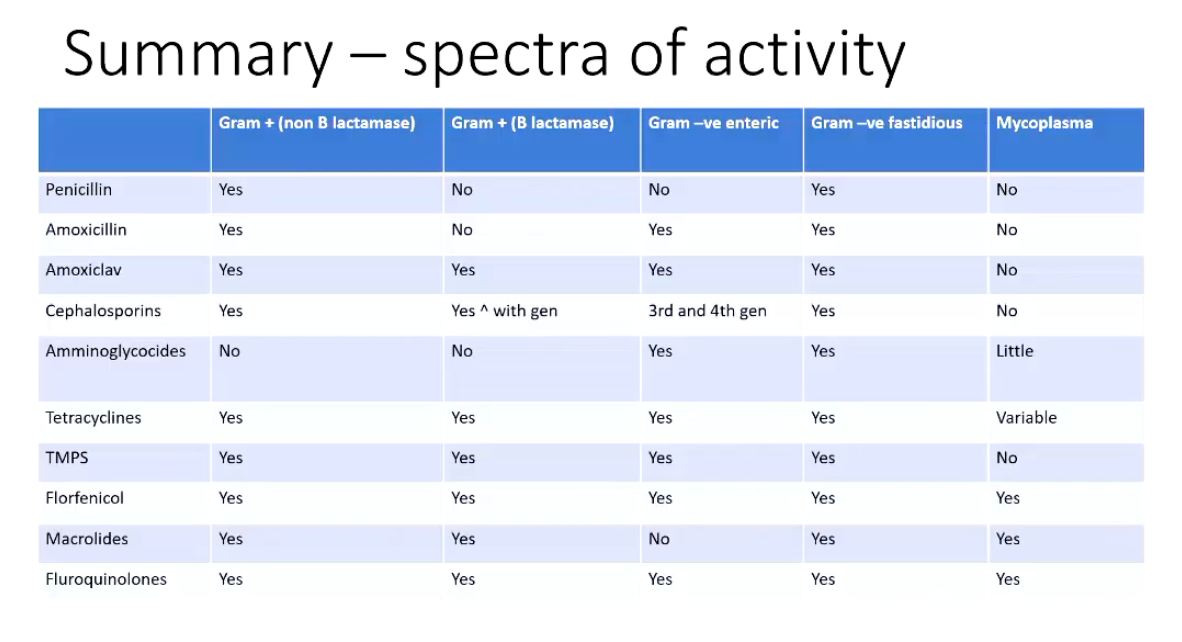
Summarize - spectrum of activity for antibiotics.
knowt flashcard image