Physical Chemistry: Spectroscopy
0.0(0)
Studied by 5 people View linked note
 Call Kai
 Learn
Learn Practice Test
 Spaced Repetition
 Match
Match Flashcards
 Knowt Play
Card Sorting
1/60

There's no tags or description
Looks like no tags are added yet.
Last updated 5:20 AM on 4/16/23
Name | Mastery | Learn | Test | Matching | Spaced | Call with Kai | Chat |
|---|
No analytics yet
Send a link to your students to track their progress
61 Terms
1
New cards
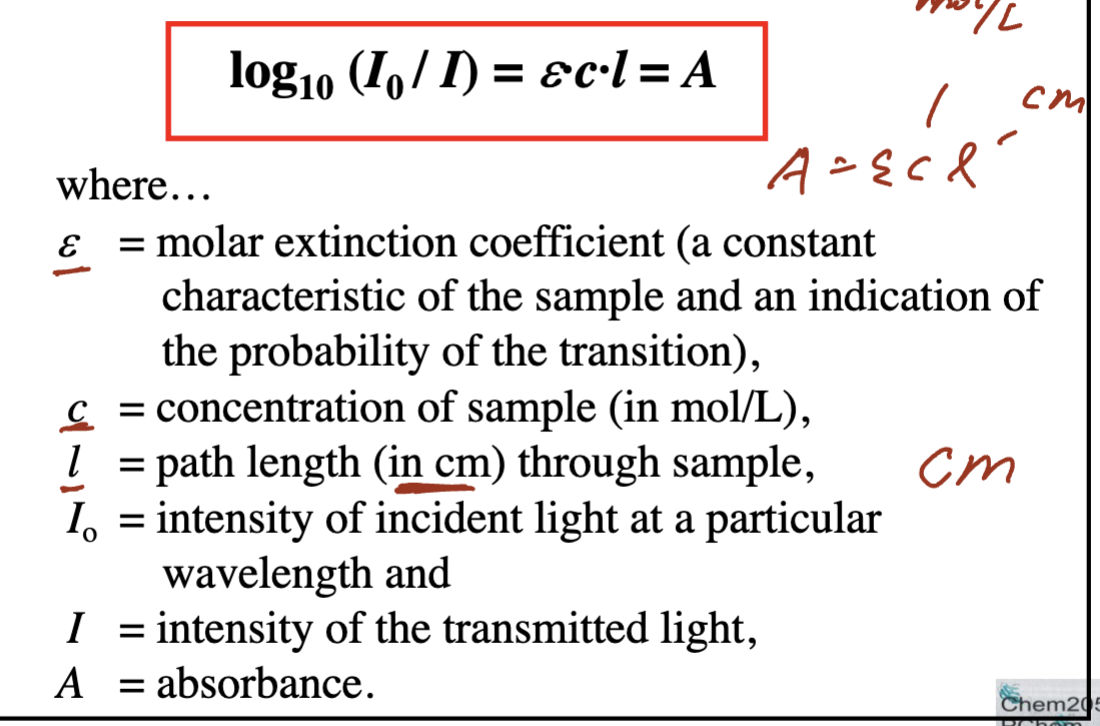
Beer-Lambert
Use the ________ law to calculate concentration, molar extinction coefficient, path length, the intensity of incident light, the intensity of transmitted light or absorbance.
2
New cards
electromagnetic radiation
In spectroscopy, we analyze the ________ (light) absorbed, emitted, or scattered by matter consisting of molecules or atoms.
3
New cards
Convert energy
________ from Joules to wavelength (m, cm, nm or Å), to wavenumber (cm- 1) or to frequency (Hz or s- 1) using Plancks constant and /or the speed of light.
4
New cards
Spectroscopic investigations
________ give us information about the structure of the molecules of a sample or its chemical composition.
5
New cards
The relationship between frequency, wavelength and velocity
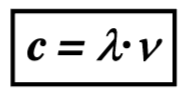
6
New cards
Quantum theory
________ states that the energy levels in atoms and \n molecules are quantized in specific allowed energy levels (i. e. discontinuous). The energy difference between two levels E1 and E2 can be measured by the absorption of emission of light using photons with the energy difference DE.
7
New cards
Beer-Lambert Law
8
New cards
Selection Rule
a statement about when a transition is allowed or forbidden, because not all transitions that fulfill the resonance condition can be observed. Some of them are not allowed for symmetry reasons
9
New cards
Spectrometer
detects the light absorbed, emitted, or scattered by a sample. It consists of a light source, a dispersing element, and a detector
10
New cards
Radiofrequency region
\
Electromagnetic radiation used for NMR spectroscopy typically lies in the _____________.
Electromagnetic radiation used for NMR spectroscopy typically lies in the _____________.
11
New cards
quantized spin angular \n momentum
Any atomic nucleus which possesses either odd mass number, odd atomic number or both, has a ____________, I, and since it is positively charged, a magnetic moment, μ, associated with it.
12
New cards
Common nuclei that possess spin are
1 H (I=1/2), 13 C (I=1/2), 19 F (I=1/2), 2 H(I=1), 31 P (I=1/2), 14 N (I=1)), and two common nuclei that are not magnetic are 12 C (I=0) and 16 O (I=0)
13
New cards
NMR active nuclei can be in
2I + 1 possible quantized spin states, which only fit either the integer of half-integer sequence
14
New cards
1H and 13C nuclei only have 2 active NMR
m= +1/2 and m= -1/2
15
New cards
nuclear magnetic resonance (NMR)
is the observation of the frequency at which magnetic nuclei in \n molecules come into resonance with an electromagnetic field \n when the molecule is exposed to a strong magnetic field.
16
New cards
The great utility of NMR as a structure determination tool is due \n to two major effects felt by the magnetic nuclei:
1) the resonant frequency n varies due to local magnetic fields \n felt at the nucleus (called chemical shift, d) and \n 2) splitting of resonance into fine structure due to neighboring \n magnetic nuclei (called J-coupling or spin-spin \n coupling).
17
New cards
Shielding and deshielding depend on
electronegativity of neighbouring atoms
18
New cards
The number of signals in the 1H NMR spectrum is dependent on
how many kinds of chemically nonequivalent protons the compound has.
19
New cards
chemically equivalent protons
two nuclei are equivalent if they are interchangeable by a symmetry operation
20
New cards
chemical shift
depends on the electron density around the nucleus, it is responsive to the effects of electronegativity in the bonds and therefor the amount of shielding
21
New cards
proportional to the number of protons
The area under each signal is _____________ that cause the absorption
22
New cards
relative number ; absolute number
The integration tells us the _________ of protons that give rise to each signal, not the __________
23
New cards
Libile H’s (e.g. -OH, -NH, etc)
\
can exchange with solvent, this leads to line broadening in the 1H NMR spectra. Splittings due to other nuclei are not observed.
can exchange with solvent, this leads to line broadening in the 1H NMR spectra. Splittings due to other nuclei are not observed.
24
New cards
The splitting of a signal in H-NMR
is described by the N+1 rule, where N is the number of equivalent protons bonded to an adjacent carbon
25
New cards
proton AX spin systems
if coupled always gives a pair of doublets. The two orientations of the magnetic field of the Hx proton causes the Ha resonance to split into a doublet of peaks. Likewise, the Hx resonance is also split into a doublet by Ha’s two spin states
26
New cards
spin coupling constant, J
The frequency distance in Hz between the peaks in each doublet, can take on a range of values from \~20Hz to <0.1Hz. Are constants only depending on the molecule and therefore independent of Bo field unlike Larmor frequencies
27
New cards
Larmor frequency
depends on the value of the magnetic field at the nucleus, induced by the applied field Bo due to deshielding efect depending on the orientation of the local induced field. Increases linearly with Bo.
28
New cards
AX2 spin system
an Ha proton is split by two equivalent Hx protons and the Hx resonance will split into a doublet just as it is jut above the AX system. The Ha resonance will however be split into a 1:2:1 triplet due to probabilities of the spin orientation of two Hx nuclei.
29
New cards
Pascal’s Triangle
The relative intensity of the lines in the multiplet in NMR is given by the “binomial coefficients of order n “ also known as ________
30
New cards
three σ
Protons normally do not split each other if they are separated by more than ________ bonds.
31
New cards
number of distinct 13C environments
The numbers of resonances visible in a 13C NMR spectrum \n immediately indicates the ______ in the molecule. If the number of 13 C resonances is less than the number in the molecule, then the molecule must have some symmetry that dictates this.
32
New cards
The areas under
_________ the 13C singlets in 13C NMR do not correspond to the number of carbons present in the molecule; consequently integration of decoupled carbon spectra is not done.
33
New cards
Broadband decoupling
Decoupling 1H from 13C resonance, so that each distinct 13C environment gives rise to a separate singlet peak. Dramatically improves the signal/noise of the 13C resonance peak.
34
New cards
Distortionless Enhancement by Polarization Transfer (DEPT)
is a double resonance pulse program that transfers polarization from an excited nucleus to another – most commonly 1H → 13C. This results in a sensitivity enhancement relative to the standard decoupled 1D carbon spectra
35
New cards
Ultraviolet (UV) / Visible (VIS) Spectroscopy
In UV/VIS spectroscopy transitions between different electronic states of molecules are considered. By absorption or emission of light electrons are transferred between energetically different energy molecules. UV/VIS spectra often give broad spectra because electronic transitions are accompanied by many vibrational and rotational transitions.
36
New cards
electronic absorption spectrum
Tell if an organic molecule has conjugated double bonds \n from an ______________
37
New cards
wavelength of maximum absorption
Estimate the length of a conjugated p system from the \n _____________ observed in the UV- \n Vis spectrum.
38
New cards
Molecular Orbital Models
give us a simplified picture of the types of electronic transitions that occur in UV/VIS spectroscopy.
39
New cards
Franck-Condon principle
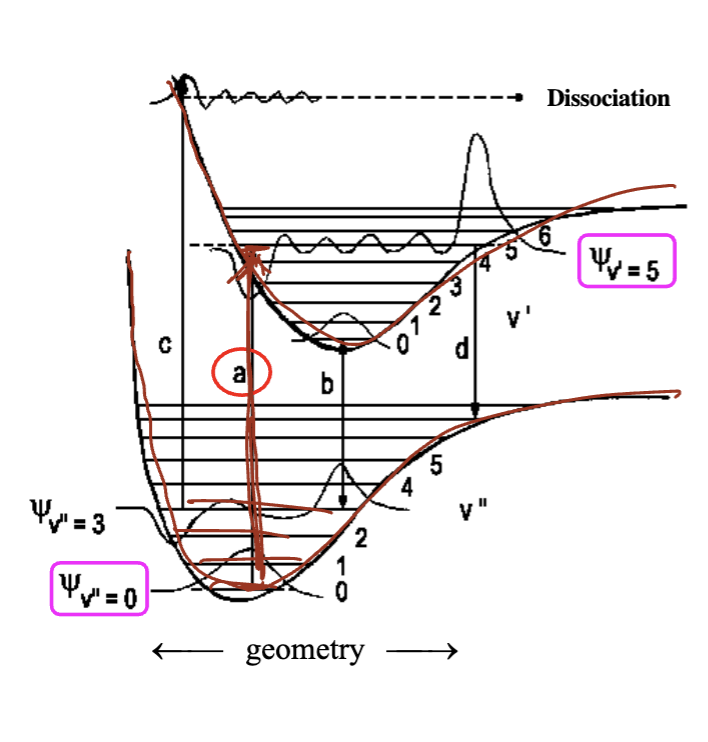
Because nuclei are so much more massive than electrons, an \n electronic transitions takes place faster than the nuclei can respond. That means that the geometry of the nuclei does not change upon the transition. As outlined below it makes a statement about the intensity of electronic transitions.
40
New cards
Transition a
If one starts in the electronic ground state in the lowest vibrational state labeled v" the Franck-Condon principle says \n that the geometry does not change upon electronic \n excitation. This means one follows the arrow a (vertical transition) and ends up in the excited electronic state in the vibrational excited state labeled v'.
41
New cards
Chromophere
Use the term in UV/VIS spectroscopy to indicate a part of the molecule that gives rise to the UV/VIS electronic absorption
42
New cards
Examples of MOs that are chromopheres
carbon-carbon double bonds, extended conjugated \n series of double bonds, phenyl rings, isolated carbonyl groups or carbonyls conjugated with extended p systems
43
New cards
more conjugated double bonds are present
The ________, the lower is the energy of the transition and the longer the wavelength of the absorption
44
New cards
Types of radiative decay
\n - Fluorescence is an allowed transition from a singlet state to a singlet state. It is fast (ns). \n - Phosphorescence is a “forbidden” transition from a singlet state to a triplet state. It is slow (s).
45
New cards
Steps of Fluorescence
\
1\. Step: Excitation of a molecule from the singlet ground \n state an excited singlet state (Franck-Condon).
\n 2. Step: By collisions with neighbouring molecules \n part of the energy is discarded as heat to the \n surroundings (radiationless transition).
\n 3. Step: Radiative decay from the lowest \n vibrational state of the excited electronic state to \n an excited vibrational state of the electronic \n ground state (Franck-Condon).
\n 4. Step: Radiationless decay to the \n vibrational ground state.
1\. Step: Excitation of a molecule from the singlet ground \n state an excited singlet state (Franck-Condon).
\n 2. Step: By collisions with neighbouring molecules \n part of the energy is discarded as heat to the \n surroundings (radiationless transition).
\n 3. Step: Radiative decay from the lowest \n vibrational state of the excited electronic state to \n an excited vibrational state of the electronic \n ground state (Franck-Condon).
\n 4. Step: Radiationless decay to the \n vibrational ground state.
46
New cards
Extended X-Ray Absorption Fine Structure (EXAFS)
Information about interatomic distances, coordination numbers, higher energy than UV
47
New cards
X-Ray Photoelectron Spectroscopy (XPS, ESCA)
chemical composition of the sample, higher energy than UV
48
New cards
stronger the absorption
The bigger the value E, the _______
49
New cards
The harmonic oscillator
The simplest model that describes molecular vibrations of \n diatomic molecules is the harmonic oscillator, in which a particle is restrained by a spring that obeys Hooke’s law
50
New cards
Hooke’s law
Restoring force = -kx (k is the force constant; \[k\] = \[N/m\])
51
New cards
gross selection rule
for vibrational spectra is that the electric dipole moment of the molecule must change during the vibration
52
New cards
Diple moment
the size of an electric dipole
53
New cards
Homonuclear diatomics
(e.g. O 2 or N2 ) are IR inactive since there can be no dipole moment change during their one and only stretch mode. So the vibrations neither absorb nor generate radiation.
54
New cards
Heteronuclear diatomics
will all be IR active since each will have a dipole that will change on stretching.
55
New cards
Common vibrational modes
* symmetrical stretching
* asymmetrical stretching
* scissoring (bending)
* rocking
* wagging
* twisting
* asymmetrical stretching
* scissoring (bending)
* rocking
* wagging
* twisting
56
New cards
Selection rules for infrared spectra of polyatomic molecules
depend on the symmetry of the molecules. These rules say which transitions are allowed (can be observed) and which transitions are forbidden (cannot be observed)
57
New cards
fingerprint region
contains all the possible bending vibrations of a molecule
58
New cards
Mass spectrometry
is used to determine the mass of atoms and molecules and for the structure determination of molecules through characterization of characteristic fragments
59
New cards
Ionization in Mass Spectroscopy
The molecules (M) can be ionized/fragmented by light (PI: \n photoionization) or by bombarding them with an electron beam (EI: electron impact ionization) having sufficient energy to ionize/fragment the molecules.
60
New cards
Mass selection in mass spectroscopy
can be done through magnetic field and by time of flight
61
New cards
labile bonds
Fragmentation of the most ________ leads to characteristic fragments. From these fragments structural information about the molecule can be obtained.