Anth 309 Post middy lec + lab content
 Call Kai
 Learn
Learn Practice Test
 Spaced Repetition
 Match
Match Flashcards
 Knowt Play
1/97

There's no tags or description
Looks like no tags are added yet.
Name | Mastery | Learn | Test | Matching | Spaced | Call with Kai |
|---|
No analytics yet
Send a link to your students to track their progress
98 Terms
What notable shifts in features do we see between australopiths and homo?
Increased brain size
Increased body size (mass, height)
Change in body proportions (long legs, shorter arms)
Decreased sexual dimorphism
List the species in the grade “Habilines”, include dates and location
Homo sp. 2.8Ma Eastern Africa
Homo habilis 2.4-1.4Ma Eastern and South Africa
Homo rudolfensis 2.0-1.8Ma Eastern Africa
Homo sp. (Ledi Geraru Manidble)
Likely a new species, more primitive than H.habilis
Mandible from Hadar, Ethiopia
2.8Ma
Derived Features: small molas/premolars, corpus shape
Primitive: sloping mandibular symphysis
+ KNM-ER 5431 set of teeth from Koobi Fora could be same taxon
Homo habilis
Where: Olduvai Gorge, Tanzania Turkana Basin, Kenya Omo and Hadar, Ethiopia Sterkfontein and Swartkrans, South Africa
Age: 2.4-1.4Ma
Oldest material from east Africa (2.4Ma), South Africa younger (2.0Ma)
Type: OH7 Juvenile Partial Skeleton
Key Features: Brains size >600cc, tool making, primitive limb proportions, obligate biped, precision grip
Homo habilis cranial features
Brain size 600cc (larger than apes/australopiths)
Widely spaced temporal lines
Supraorbital sulcus
Double arched, small supraorbital torus
Small dentition
Rounder cranium
reduced prognathism
Homo rudolfensis cranial features
Brain size 752cc
No supraorbital sulcus
small supraorbital torus
Large flat face - wide maxilla
Larger anterior dentition
What are the apomorphies of H.erectus?
Sagittal keel
Occipital torus
Long skull (football shape)
Homo erectus cranial features
Brain size 1000cc
Sagittal keel
Large, shelf-like supraorbital torus
Occipital torus
Almost orthognathic
Long skull, football shape
Rounder/domed skull
Smaller dentition (than H.habilis)
Home rudolfensis
Where: Turkana Basin, Kenya Omo, Ethiopia
Age: 2.0-1.8Ma
Type: no typ designated, lectotype: KNM ER 1470 skull
Key features:
Brain size 752cc
Large, flat face
Larger molars than H.habilis
What material/info confirms that H.habilis and H.rudolfensis are different species?
A mandible (KNM-ER 6000) and face (KNM-ER 6200) attributed to H.rudolfensis show:
Larger anterior dentition than H.habilis
Large, flat face, not H.habilis-like
What was the historical view of what makes a species “Homo” and what has discredited this?
The 1960s view:
Larger brain size
Language
Tool use
Precision grip
We now know that australopiths had tool use and precision grip, blurring the lines between these two genus
What primitive features do we see in Habilines? Derived features?
Primitive:
Small body size
Australopith body proportions
Teeth larger than later Homo
Derived:
Larger cranial capacity (still smaller than later Homo)
somewhat reduced dentition
more developed precision grip
rounder cranium shape
Homo erectus
Where: Africa, China, Indonesia, Georgia. Very wide dispersion (oldest fossils in Africa)
Key sites: Turkana basin, Kenya. Dmanisi, Georgia
Age: 1.9-0.4Ma
Type: Dubois’ skull cap (Trinil, Java)
Key features:
Brain size +1000cc
Molars similar size to modern humans (slightly larger)
Acheulean Industry tools
Postcrania similar to modern humans
Homo erectus postcrania
Long legs and short arms
Narrow pelvis
Large leg joints
Long femoral neck
(Very modern human-like)
What are the 2 hypothesis about H.erectus? What is the support for each?
H1: 1 variable species; Homo erectus
Quantitative analysis (measurements): shows continuous variation and cannot separate asia and africa specimens
H2: 2 species; Homo ergaster (early african) and Homo erectus (asia)
Qualitative analysis (presence/absence of traits): Suggests that the variation is geographically distributed and there is too much variation for this to be a single species
Explain the first out of africa event, why did it occur?
Homo erectus appears to be the first to disperse out of Africa
Left by 1.8-2.1Ma
Very quickly spread across Asia
Why? Many possible reasons or a combination of them:
Following prey
Change of climate in Africa: middle pleistocene had lots of changes in climates
population growth
competition with other animals or hominin species
Explain the findings at the Dmanisi site
Site: ~1.8Ma
5 crania and 5 sets of postcrania + oldowan tools
Lots of variation (including high sexual dimorphism)
Small brain and body size (below 800cc)
cranially oriented glenoid (like lucy, climbing feature)
Derived:
Cranium shape
limb proportions
Gibbons 2013 paper
What dietary shift do we see with the appearance of H.erectus? What evidence supports this?
Increase in brain size and body size in H.erectus suggests an increase in available energy, main suggestion for where this energy came from is a major increase in meat consumption
Evidence:
Hominin anatomy
New tools (Acheulean tools, often found with animal bones)
Animal bones (increase in sites with stone tools present too, extensive processing)
Changes in African communities (larger herds, carnivore decline)
Tapeworms from raw meat consumption
Explain the Expensive Tissue Hypothesis and its relation to early Homo diet
Bigger brains and bigger bodies evolve ~2Ma in H.erectus which requires great energy to maintain
The expensive tissue hypothesis suggests that energy budgets are fixed and therefore tradeoffs occur between expensive tissues (in this case brain and gut)
H.erectus able to have a shorter,smaller gut because they consume meat (higher energy with less consumption needed)
When do we see first evidence of fire use?
Solid evidence that hominins used fire by at least 1Ma
Soil chemistry changes that match campfires: high heat for prolonged periods produces oxidized soils
Bones and plant remains that show changes consistant with >400°C
Controversial sites from 1.5-1Ma
What makes hominin carnivory unique amongst primates?
Use/manufacturing of stone tools
Acquisition of resources from animals larger than themselves
Complex mix of hunting strategies + scavenging
How does Hominin anatomy (H.erectus) support the theory of an uptick in meat eating?
Dentition: reduced teeth size, jaw size and muscle size
Larger bodies: easier to hunt large prey
Longer legs: can travel further for prey
Thorax shape: cone-shaped thorax no longer present in H.erectus, suggests smaller guts
Explain hypervitaminosis A and how this is evidence of H.erectus meat-consumption
Hypervitaminosis A is a condition that can be acquired by eating the liver of carnivores and can be evident on the bones
A 1.7Ma erectus skeleton from Koobi Fora displays this condition
Explain how tapeworms provide evidence of H.erectus meat-consumption
Tapeworms are gotten from consuming raw or undercooked meat
All human-specific tapeworm species are closely related and giverged 780,000-1.7Ma
+Our tapeworms are most closely related to those that live in African Carnivores
Suggests that meat-eating was occuring with enough frequency that tapeworms adapted specifically to hominin hosts around this time
What is the alternate hypothesis to increased meat-consumption in H.erectus?
Suggests that the major change was cooking of plant foods, specifically of underground storage organs (tubers). This would reduce the energy needed to process these foods and make them more easily digestible and the energy more available
However there is lots of evidence that stone tools were being used to process meat specifically. Plus there is no compelling evidence of fire use 2ma
Homo aff. erectus
Homo affinity erectus as in similar to erectus but is something different
Where: Sima del Elefante, Atapuerca, Spain
Age: ~1.2Ma
Type specimen: none
Key material: facial fragment and mandible, tools, processed animal bones
Key features: First European hominin
narrow face and distinct nasal region compared to erectus
taller midface than H.antecessor
Homo antecessor
Where: Gran dolina, Atapuerca, Spain
Age: 900,000 - 800,000
Type specimen: ATD 6-5 mandible
Key material: 11 individuals to date - all but 1 juveniles/infants
Key features:
Clear evidence of cannibalism
Posses canine fossa
short midface (more modern)
infraorbital plate (under eye) sloped posteriorly
Explain the network of caves in Atapuerca, Spain. What has been found in each cave?
A network of caves varying in age
Cave 1: Sima del Elefante
Age ~1.2Ma
facial fragment and mandible of Homo aff. erectus
tools and processed animal bones
Cave 2: Gran Dolina
Homo antecessor- 11 individuals (all but 1 juveniles/infants)
cannibalism evidence
stone tools and animals bones
Cave 3: Sima de los Huesos
Age: ~400,000
>5,000 bones (MNI=28) most agree to assign this material to H.heidelbergensis
However share some features with Neanderthals (possibly ancestors to or early version of): midface projection, taurodont molars
Provides evidence that H.heidelbergensis may be the ancestor of neanderthals
Most died in their prime (18yrs old)
Unknown how so many bounds ended up in this pit but was not accidental
Homo heidelbergensis
Where: Europe, Asia, Africa
Age: ~800,00 - 200,000
Type specimen: Mauer mandible (from Germany)
Key features:
brain size ~1200cc
Human-like postcrania
Culture: Levallois tradition, hunting, fure, range expansion
Homo heidelbergensis technology and culture
Strong evidence for active hunting of big game:
Butchered horses, rhinos etc.
possible game drives
Schonigen spears (wooden tools)
Aucheulean industry tools + levallois technique: major innovations in flake preparation
Fire/cooking
Homo naledi
Where: Rising star cave system, South Africa
Age: 236,000-350,000 (controversial)
Type specimen: DN1 male cranium
Key features:
small brained 456-610cc
Habiline-like (compatible w/ ~2ma): similar to H.habilis or A.sediba
Curved phalanges, cranially oriented glenoid, short stature
BUT: modern limb proportions, smaller supraorbital torus, modern hands
Dr.cote puts this species in with the Habiline grade
Explain the rising star cave system, what was found in each cave?
A cave system in South Africa contained H.naledi specimens, 3 main areas:
Dinaledi:
At least 15 individuals
Dated but shows clear disturbance (+hard to access)
Lesedi:
At least 3 individuals
not dated
UW110:
Found recently
contains “Leti” - juvenile
Homo neanderthalensis
Where: Europe, Middle East, Central Asia
Age: 150,000 - 30,000
Type specimen: Feldhofer 1 - skull cap and partial skeleton
Key features:
Brain size 1450cc
Cold-adapted, robust postcrania
Culture: Mousterian tradition, hunting, fire
Homo neanderthalensis cranial features
Brain size 1450cc
small, sloped forehead
supraorbital sulcus + torus
Tall midface with large nasal openings
long, round skull
Apomorphies:
Occipital bun
Retromolar space
midface projection
Taurodont molars
Classic features (seen in other hominins, separates them from homo sapiens)
no chin
mental foramen below M1 (below p4 in sapiens)
Absence of canine fossa
Homo neanderthalensis postcranial features
Short and stocky with large muscle attachment areas. Compared to Homo sapiens:
Hyoid bone like modern humans
Larger, wider thorax (larger lung size)
shorter radius & ulna
Wider pelvic inlet
Larger, strongly muscled hands
Ant-post bowed femur
tibia shorter relative to femur
What is the origin of Neanderthals?
Likely evolved from European branch of H.heidelbergensis
Evident from Sima de los Huesas hominins which show some neanderthal traits
“Classic” Neanderthal features don’t appear until later
What does Neanderthal tooth ware say about their behaviour?
Large, worn anterior teeth suggest paramasticatory activity: pulled meat or hide through their teeth
Describe the life history of neanderthals
Neanderthals grow differently/faster than humans
Teeth form quicker
M3 erupted at age 14 (18 to humans)
Rapid cranial growth early + late growth spurt in brain, especially occiptial lobe (hence occipital bun)
Neanderthal birth likely difficult but not the same as humans
somewhat wider pelvis
Do not experience the twist if fetus moving from pelvic inlet to outlet that humans do
Age of death 40-45yrs
many older individuals
many healed injuries
suggests altruistic care
Describe the cold adaptions of Neanderthals, why would they need this?
During the upper pleistocene (when neanderthals existed) there was an ice age from 120-12Ka which means much of the Neanderthals range in time and space was associated with cold climates
Large projecting nose: increase surface area to warm and humidify air
short and stocky- allens rule
Describe the technology used by Neanderthals
Mode III tools:
300,000 - 35,000
fewer bifacial cutting tools
appearance of Levallois technique
Mousterian industry (a specific predominant industry within mode III):
appears later with Neanderthals and includes Levallois-prepared tools
Evidence of complex tools
Hafting points onto spears
What evidence is there for meat-eating in Neanderthals
Climate
Human arctic foragers used as models (but they consume aquatic mammals so not exactly alike)
Nitrogen isotopes
Neanderthals consuming more protein than cave bears from same archaeological sites
Animal bones
Majority of animal bones found in and around neanderthal sites are from large prey
Coprolites
Fossilized faeces contain meat
What evidence is there for plant-eating in Neanderthals
Dental calculus
scraped from teeth of 3 neanderthals
microfossils of plant starches and phytoliths preserved in the calculus
barley starch grains show damage similar to having been cooked
Coprolites
Fossilized faeces contain some plant material
Is there evidence of cannibalism in Neanderthals?
Yes it was relatively common behaviour, 25% of Neanderthal sites have some evidence of cannibalism
Abri Moula best evidence: pattern of cut marks and bone breakage of neanderthal bones matches the butchery marks on deer of same site
What evidence of cilture/symbolic behaviour do we see in Neanderthals
Art/Symbolism
cut marks on bones in simple patterns unrelated to butchering
shells and talens perforated- looks like wearing as some sort of adornment
controversial but some cave paintings have been re-dated prior to Homo sapiens arrival in area
Jaubert et al.
Stalagmite accumulations/arrangements
Burial of dead
carefully done with characteristic positions
possible grave goods: animal bones, flowers, shells
What factors possibly played a role in Neanderthals becoming extinct?
Climate change: warming, megafaunal extinction
Homo sapiens: competition, disease introduction.
Demographics: small populations, inbreeding depression, reproduce slowly
What is aDNA? What challenges does this method have?
aDNA: ancient DNA recovered from fossils
Challenges:
DNA can be destroyed by time, temp., oxygen, and water
Nuclear DNA degrades faster than mtDNA, so often mtDNA is what is the aDNA available
aDNA can be very easily contaminated by modern DNA
Very time consuming and expensive to ‘amplify’ the tiny amounts of DNA extracted
How does aDNA tell us Neanderthals, Modern Humans and Denisovans related?
Neanderthal DNA demonstrates that Neanderthals are not part of Homo sapiens (genetically distinct) but there has been admixture (hybridization)
aDNA indicates that LCA of Neanderthals and Modern humans >650,000
Denisovans are more closely related to Neanderthals than Homo sapiens but interbred with both
aDNA indicates LCA of Neanderthals and Denisovans >400,000
What hominin species do we have aDNA from?
Neanderthals
Denisovans
Modern humans
How old of a specimen can we likely get aDNA from? What is the half life of DNA?
currently thought that sequences older than ~1.5Ma will not be properly readable even with good preservation because DNA has a half life of 521yrs (meaning half the bonds between nucleotides are destroyed after 521yrs) so after a certain point so many of the bonds are broken that it is not possible to piece together
What is the oldest aDNA to date? What about oldest from a hominin species?
From frosen conditions we have siberian mammoths (>1Ma), a horse from a leg bone (560,000-780,000) and envrionmental DNA (2Ma) that is readable to the family level
Oldest hominin aDNA: Sima de los Huesos (that Neanderthal ‘pit of bones”)
~400,000 yrs old
Femur and incisor have produce aDNA
Denisovans
Where: Denisova Cave, Siberia, Russia
Age: ~40,000 - 160,000
Type: none designated (species hasnt been named)
Key features: Large molars (for age/time period, larger than modern humans and neanderthals)
Material: 1 finger bone, 3 molars, skull fragment (from older layers, could be 285,000yrs old)
Explain the Denisova cave and what aDNA has told us about the specimens here
Denisova cave in Siberia, Russia contains a long archaeological sequence of bones and artifacts. It was known from archaeology that both Neanderthals and modern humans had occupied this cave over time but aDNA of the hominin bones allowed us to identify the Denisovans.
aDNA of the bones in this cave also allowed identification of interbreeding between the 3 species and their phylogenetic relationship
Denisovans vs Homo longi
A cranium in Harbin,China was published as a new species Homo longi but through preoteomics and the discovery of Denisovan eDNA at the site it is likely that this is actually Denisovans from China
+similar molar size and morphology
Many similarities to Neanderthals (like Denisovans)
What species are still present during the Late Pleistocene and where?
Homo neanderthalensis (Europe)
Homo longi/Denisovans (China)
Homo Erectus (China)
Homo floresiensis (Flores, Indonesia)
Homo sapiens (Africa → disperse)
Describe the model for the origin of modern humans: Multiregional model
Argues for a singular Out of Africa event, H.erectus. So has all been 1 species since about 2ma and evolves into modern humans:
Suggests that the spreading of Homo erectus out of Africa led to populations in Europe, Asia and Africa, interbreeding between these populations maintain them as a singular species (continuous gene flow between regions)
Describe the model for the origin of modern humans: Out of Africa model
Suggests 2 Out of Africa events and Homo sapiens evolving completely independently within Africa before dispersing and replacing other hominins in Europe and Asia:
Suggests that Homo erectus spreads out of Africa and other hominin species (ex. Neanderthals) persist in Europe, Asia and Africa. Then Homo sapiens evolve in Africa and disperse out of Africa replacing the other hominin species in each area
Describe the model for the origin of modern humans: Admixture model
The middle ground model: Argues that Homo sapiens mark a second out of Africa event but as they dispersed they interbred with other hominin species (rather than just replacing them)
Suggests that Homo sapiens evolve independently in Africa and disperse out of Africa after H.erectus. As the disperse some interbreeding with other hominin species occurs
What predictions come with the Admixture model for the origin of modern humans? Does evidence support these predictions?
P1: Small genetic differences between groups, most variation is within groups
Based on genetic/DNA data we can see a serial founder effect: genetic diversity decreases with distance from Africa
This aligns with the model because the groups that migrated out of Africa would be quite small and as would each migration beyond that (founder effect occurs in each new place) + farther areas from Africa would have been founded more recently so less time for genetic diversity development
P2: Shallow genetic roots because all humans are derived from a recent speciation event
both mtDNA and nDNA shows the greatest variation in African populations and that the LCA of all humans today was ~200,000 - 300,000 yrs ago
P3: Modern humans appear in Africa first
oldest Homo sapien specimens found in Jebel Irhoud, Morocco (North Africa), dated to 300,000 (some consider these late H.heidelbergensis)
Oldest widely accepted Homo sapiens fossils are from Ethiopia (Omo Kibish skulls 200,000+)
P4: Evidence of interbreeding with other hominin species
Homo sapiens moved into the Eastern Mediterranean and lived in this region with Neanderthals for 60,000yrs, this aligns with when genetics tells us the first admixture event occurred
See evidence of interbreeding with Neanderthals and Denisovans in genomes of modern humans
P5: Modern human archaeology appears in Africa first
Evidence of blade technology, bone tools, long distance trade and use of pigments/decoration in Africa during Middle Stone Age
Describe the 2 models for the development of behavioural modernity
Cognitive leap at ~50,000
Richard Klein suggests there was a “creative explosion” - modern human behaviours arose suddenly and simultaneously throughout the Old World about 40,000 - 50,000yrs ago
is based on archaeological evidence of Europe that shows advanced tools, art etc. around this time
Gradual increase throughout modern human history (the correct theory)
Africa evidence shows that the archaeological evidence found in Western Europe dated to the Upper Paleolithic era (40,000 -50,000) are evident in Africa during the Middle Stone Age (different naming method for time periods in African research, this era is earlier than the upper paleolithic)
This suggests that lots of this technology, cognitive abilities and culture existed before Homo sapiens left Africa and their behaviour/technology gradually developed as they dispersed/time progressed
Homo sapiens
Where: Africa first, the everywhere
Age: Molecular clock says earlier, fossils 200,000+
Type specimen: Carl Linnaeus
Key features:
Brain size 1350cc average
chin
forehead
small face
culture: art, symbolism, language
slow maturation and extended juvenile period
What are the theories on why chins evolved in Homo
Helps a thin mandible to resist bending forces from chewing/talking
Sexual sexual for chins
Not an adaption, a by-product of something else (aka a spandrel)
H3 is the leading hypothesis
Homo floresiensis
Where: Island of Flores, Indonesia
Age: ~100,000–60,000 (bones), 190,000–50,000 (stone tools)
Type specimen: LB1 skull and partial skeleton
Material: At least 9 individuals in the Ling Bua cave, stone tools, evidence of fire use
Key features:
Short stature (3.5’ tall)
Small brain ~400cc (chimp. sized)
Postcrania is a mix of early Homo and Australopithecus features
Culture: Tools similar to H.erectus in Asia, big game hunting, fire use
When and how did Hominins arrive in Flores
The island of Flores in Indonesia has been isolated for a long time so to get to the island either they would have had to use “boats” or sweepstake dispersal occurred - transported there during a storm/weather event
Evidence (stone tools) suggests that hominins arrived on the island ~1Ma
What are the 3 hypothesis of what H.floriesensis are? What evidence supports/discredits each?
H1: These are just small Homo sapiens and LB1 (type) is microcephalic
Discredits:
- Reconstruction of LB1 brain compared with many humans shows that not similar in shape to H.sapiens
- Discovery of more specimens shows they are of similar stature and brain size to LB1
H2: Descendants from a population of Homo erectus that evolved reduced body size
Supports:
Reconstruction of LB1 brain is most similar in shape to H.erectus reconstructions
Insular dwarfism is a common occruance when large mammals are isolated on islands
Discredits:
Brain size-body size ratio more like australopiths and in insular dwarfism brain size usually reduces at the same rate as body size
postcrania not similar to H.erectus
H3: Descendants from an earlier unknown immigrant hominin species from mainland Asia
Supports:
Postcranial features similar to Australopith or H.habilis, but with longer feet
Evidence of hominin activity on the island much earlier than H.floriesensis:
Mata Menge, Flores is a 700,000yr old site that contains mandible, cranial fragment and teeth of individuals that were all smaller than LB1
+ site has tools similar to H.floresiensis (behavioural stability?)
Homo luzonensis (+validity of species)
Min. 3 individuals found in Callao Cave, Phillipines dated to 50,000-67,000
Poorly known: Dwarf species, teeth smaller than H.floresiensis, curved phalanges
Argued that there is not enough comparison to H.floresiensis to prove they are different species
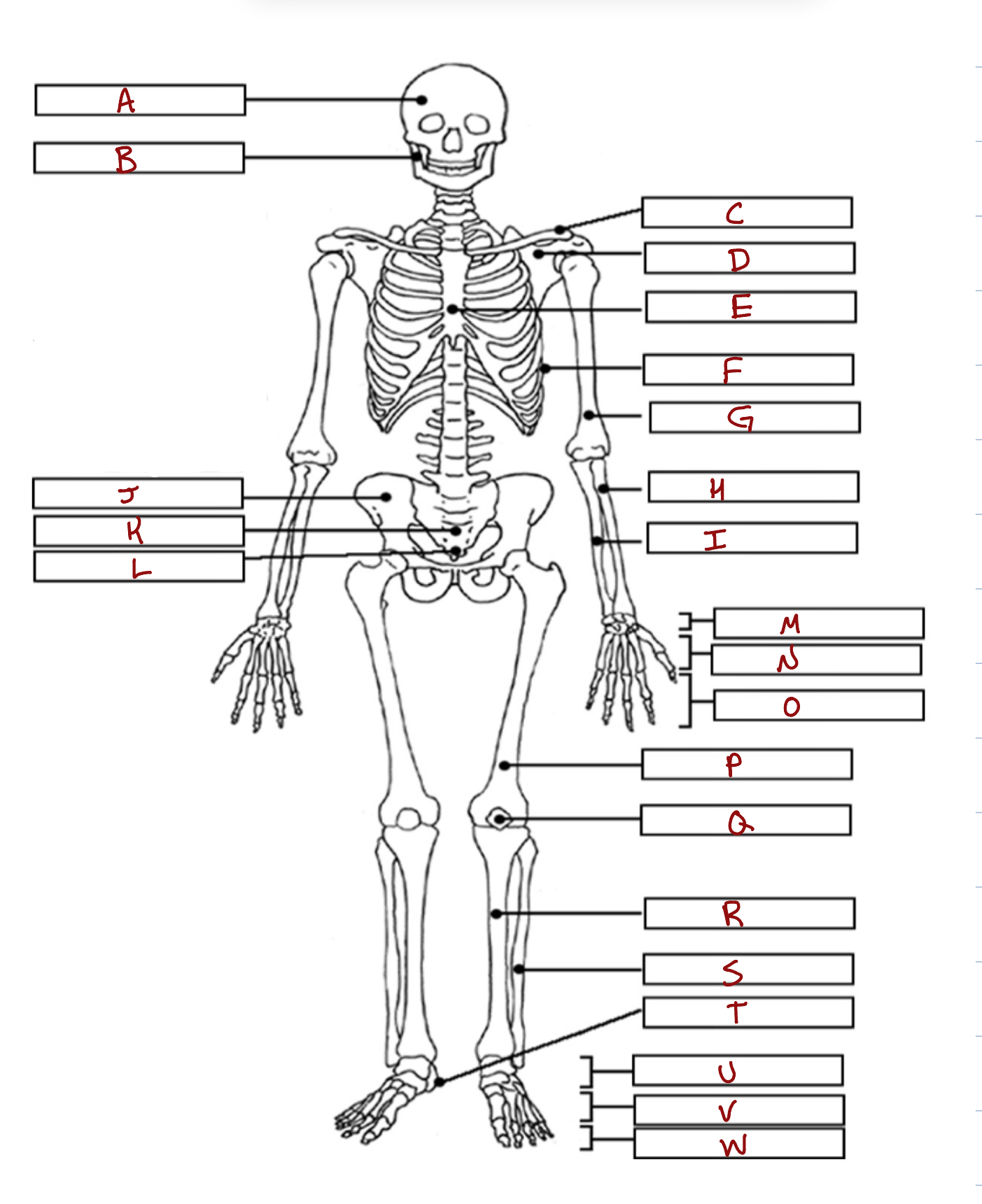
Label the skeleton
A- skull
B- mandible
C- clavicle
D- scapula
E- thorax
F- ribs
G- humerus
H- radius
I- ulna
J- pelvis
K- sacrum
L- coccyx
M- carpals
N- metacarpals
O- phalanges
P- femur
Q- patella
R- tibia
S- fibula
T- calcaneus
U- tarsals
V- metatarsals
W- phalanges
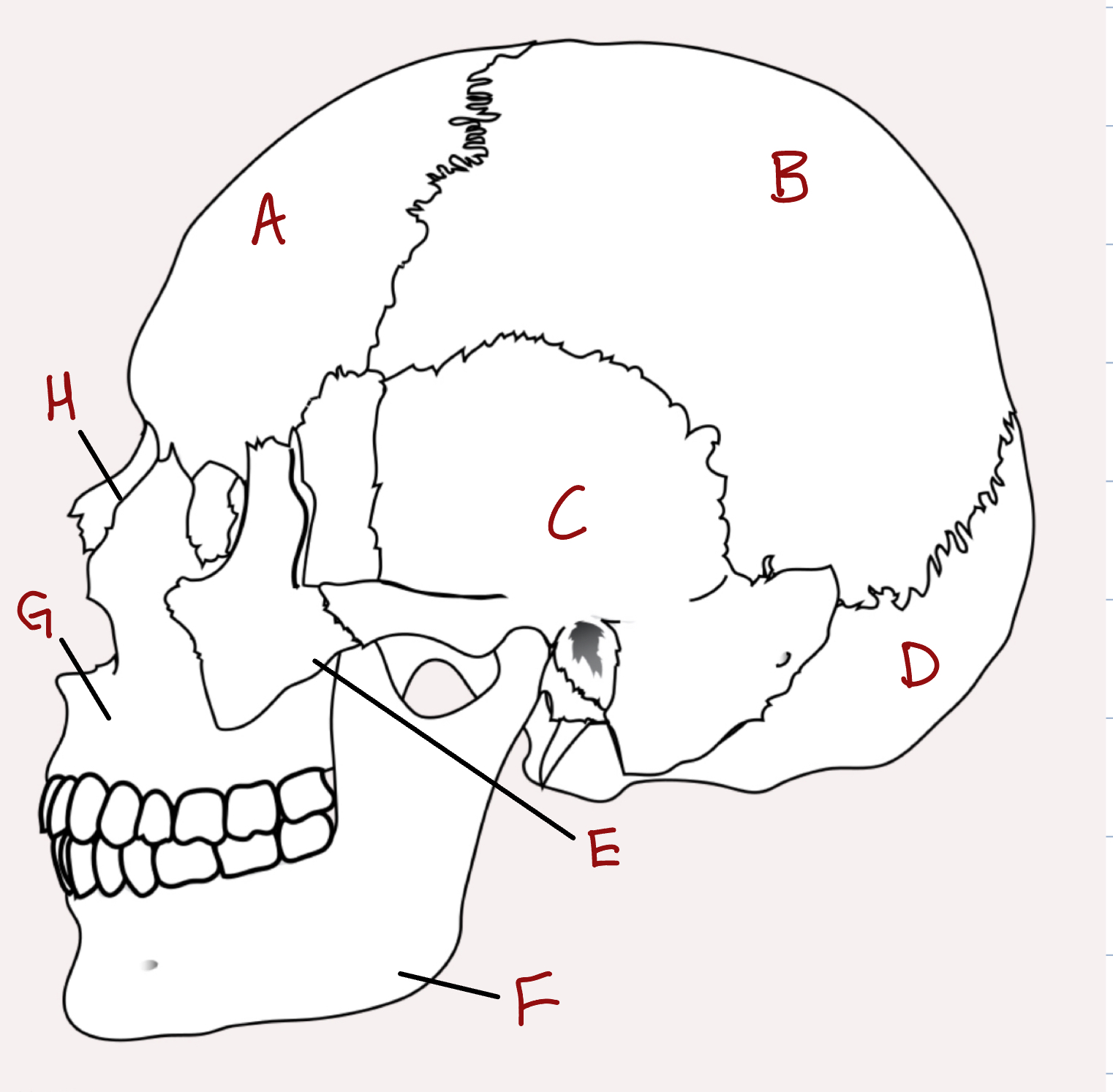
Label the skull
A- frontal
B- parietal
C- temporal
D- occipital
E- zygomatic
F- mandible
G- maxilla
H- nasal
What differences do we see between human and chimpanzee skulls?
Foramen magnum location
Inferior and more anterior on human
more posterior on chimp
Temporal lines
Less prominent, widely spaced in humans
Prominent and close together in chimps
Supraorbital torus
Reduced, not prominent in humans
Large, prominent in chimps
Prognathism
Flat face in humans
Strong prognathism in chimps
Nuchal line position
more inferior, smaller in humans
more superior, larger in chimps
Post orbital constriction
not present in humans
present in chimps
Dental formula for chimps? Humans?
The dental formula for both chimps and humans is 2123
What features of the Toumai skull of Sahelanthropus tchadensis cause disagreement about the sex of the specimen?
Large supraorbital torus suggests male
Small canines suggest female
Explain the basics of writing tooth positions
When you write out a tooth, you would use lower case or subscript for teeth of the lower jaw, and upper case or superscript for teeth of the upper jaw, as follows:
Upper jaw (Maxilla): I1, I2, C, P3, P4, M1, M2, and M3 OR I1 , I2 , Cx , P3 , P4 , M1 , M2 , and M3
Lower jaw (Mandible): i1, i2, c, p3, p4, m1, m2, and m3 OR I1 , I2 , Cx , P3 , P4 , M1 , M2 , and M33
What is a key postcranial feature of ardipithecus ramidus that differentiates this species from others?
Opposable hallux (big toe)
What do the features of ardipithecus ramidus suggest about the species’ locomotion? What feature that is no preserved would be helpful in better understanding their locomotion
Opposable hallux suggests not a committed biped
Phalange length and curvature suggest strong muscle attachment, useful for climbing
Calcaneus (a foot bone) is not preserved, this would be useful to see if they had an arch, a feature that helps with bipedalism
How does the pelvis of Australopithecus afarensis (lucy) compare to chimps and humans?
Lucy’s pelvis is much more similar to humans than chimps:
Wide, short sacrum in lucy/humans, narrow and long in chimps
Short illiac blade in lucy/humans, tall in chimps
Deep sciatic notch in lucy/humans, shallow in chimps
Anterior/inferior illiac spine present in lucy/humans, absent in chimps
large area for hip abductors in lucy/humans, small in chimps
How do the cranial features of Australopithecus afarnesis compare to chimps and humans?
Prognathism
Intermediate prognathism in lucy, chimps more prognathic and humans orthognathic face
Sagittal crest/temporal lines
Close together temporal lines (almost sagittal crest) in lucy, sagittal crest presence varies in chimps, widely spaced temporal lines in humans
Zygomatic arch
Thick and laterally wide in lucy, narrow in chimps and humans
Post-orbital constriction
Strong in lucy, stronger in chimps and not present in humans
Dental arcade
angled teeth rows so intermediate inn lucy, parallel in chimps and parabolic in humans
Mandibular symphysis
intermediate thickness in simian shelf + small slope in lucy, thick with sloping simian shelf in chimps and thin + vertical with no simian shelf in humans
How do the molars and premolars of gracile Australopiths compare to chimps and humans?
In size the molars and premolars of Australopithecus are larger than both chimps and humans
premolars are “molarized” in Australopithecus like humans: bicusped, ant-post expanded, no honing
What 2 features can be used to indicate the size of the temporalis muscle?
Temporal lines/sagittal crest: this is where the temporalis muscle initiates
Lateral width of zygomatic arches: the temporalis muscle fits behind the arch to connect to the coronoid process
What are the 2 main muscles involved in mastication?
Temporalis muscle (temporal lines → coronoid process)
Masseter muscle (ascending ramus → zygomatic process)
What cranial differences do we see between H.erectus and H.habilis?
Supraorbital torus
larger shelf-like supraorbital torus (more developed supraorbital sulcus) in H.erectus
less prominent in H.habilis
both have double-arch
Prognathism
stronger in H.habilis
H.erectus almost orthognathic
Cranial vault
Smaller and less round in H.habilis
rounder and larger, football shaped from side in H.erectus
What cranial differences do we see between H.rudolfensis and H.erectus?
Supraorbital torus/sulcus
Supraorbital sulcus present in H.erectus, not in H.rudolfensis
Large shelf-like torus in H.erectus, smaller in H.rudolfensis
Sagittal keel
Present in H.erectus, not in H.rudolfensis
Occipital torus
Present in H.erectus, not in H.rudolfensis
H.rudolfensis has a large, flat face. It is wide particularly around the maxilla
List the key features of Sehelanthropus tchadensis
Foramen magnum is intermediately positioned (between chimps and humans)
Large brow ridges
No sagittal crest
Honing canines (but reduced compared to chimps)
List the key features of Orrorin tugenesis
small molars (relative to chimps)
curved phalanges
Femur indicates bipedalism: long femoral neck, large femoral head, wide shaft
List the key features of Ardipithecus ramidus
Abducted hallux
Larger molars and premolars (than chimps, relative to size)
No honing
Foramen magnum anterior, inferior
Long phalanges with bony ridges
What are the key features of Australopithecus afarensis
Superior temporal lines
Curved tooth rows
No honing complex
Wide, Large and anteriorly positioned zygomatic arch
Human-like pelvis
What are the key features of Australopithecus africanus
Large molars and premolars
Reduced supraorbital torus (compared to aferensis)
zygomatic positioned further anteriorly
What are the key features of Kenyanthropus platyops
Large, flat face (NOT DISHED) + zygomatic positioned anteriorly
small molars
very wide maxilla
How can we differentiate between Australopithecus , Paranthropus and Homo skulls?
Australopithecus
Larger post-canine dentition than homo, smaller than paranthropus
No sagittal crest
less zygomatic flaring than paranthropus
Paranthropus
Large post-canine dentition
Dished face
Zygomatic flaring= large face
Sagittal crest (variably present)
Homo
Rounding of cranium
Very reduced prognathism
Reduced post-canine dentition
Large cranial vault
What are the key features of Australopithecus anemensis
Simian shelf present: mandibular symphysis (middle of mandible) thick and posteriorly sloped
Parallel tooth rows
Honing complex (in males)
Buccolingually expanded molars
What are the key features of P.aethiopicus
Very large sagittal crest (largest of paranthropus species)
More posteriorly positioned zygomatic arches
long skull
face positioned in front of brain case
How can we differentiate between the species of Paranthropus
P. boisei is the MOST robust- widest zygomatic arches, largest M and P
P. aethiopicus is the intermediate: large sagittal crest, long skull with face positioned fully in front of brain case
P.robustus is the LEAST robust
H.habilis vs H.rudolfensis vs H.erectus skulls
H.habilis
Supraorbital sulcus
Small double-arches supraorbital torus
H.rudolfensis
No supraorbital sulcus
relatively small supraorbital torus
Wide (especially maxilla) flat face
H.erectus
Shelf-like large supraorbital torus
Occipital torus
Long skull (football from the side, teardrop from the top)
Large cranial vault
sagittal keel
smaller dentition
**+ major height increase
What are the key features of H.habilis
Has a supraorbital sulcus
Double arched, small supraorbital torus
Smallest brain size/cranial vault of Homo species
What are the key features of H. rudolfensis
No supraorbital sulcus
Relatively small supraorbital torus
Large, flat face (wide maxilla)
What are the key features of H.erectus
Sagittal keel
Shelf-like supraorbital torus + supraorbital sulcus
Occipital torus
Long skull (football from size)
H. erectus vs H. heidelbergensis skull
skull shape
Long, low, stretched → H. erectus
Higher, rounder → H. heidelbergensis
brain size (relative)
Smaller → erectus
Larger → heidelbergensis
brow ridge
Straight, thick bar → erectus
Segmented / double-arched → heidelbergensis
Occipital torus
Prominent → erectus
Variable, less prominent, more rounded cranium → heidelbergensis
What are the key features of Homo neanderthalensis
Occipital bun
Mid-face projection: puffiness in nasal and maxillary region
Retromolar space: empty space behind m3 and M3
Mental foramen is below m1
H. neanderthalensis vs H. sapiens skull/femur
Neanderthals
Skull
occiptal bun
mid-face projection
retromolar space
supraorbital torus
mental foramen below m1
small, sloped forehead
Femur
Bowed anteriorly-posteriorly
more robust
Humans
Skull
mental foramen below p4
canine fossa
Boney chin
large, vertical forehead
Femur
less robust