Art History Midterm 3
 Call Kai
 Learn
Learn Practice Test
 Spaced Repetition
 Match
Match Flashcards
 Knowt Play
1/261

Earn XP
Description and Tags
Ah, woe is me, its midterm three, I hope I see, at least a ninety (wee, it rhymes see?)
Name | Mastery | Learn | Test | Matching | Spaced | Call with Kai |
|---|
No analytics yet
Send a link to your students to track their progress
262 Terms
What is Late Antiquity and its characteristics?
It defines a specific geography (the Roman Empire) and culture rather than a time period; it is characterized by a shared Greco-Roman culture and religious diversity
Who was Septimius Severus and what did he do?
He was a North African-born general who becomes emperor which began the Severan Dynasty
Septimius Severus needed to win the support of the Roman people and as part of his effort to do so he had himself adopted into the Nerva-Antonine by making himself the son of Marcus Aurelius who had been deified after his death; he chose this dynasty because it included the Five Good Emperors who were known for their great governance
Severus used art to reinforce his connection to Nerva-Antonine family
What is tempera?
A fast-drying paint made from a mixture of powdered pigment and a binding agent, typically egg yolk
What is panel painting?
A painting on a plank of wood or multiple planks joined together and was made with tempera (a fast-drying paint made from a mixture of powdered pigment and a binding agent, typically egg yolk)
What is a tondo (pl. tondi)?
A work of painting or relief sculpture in a circular format
What is Damnatio memoriae?
It means “damnation of memory”, referring to the practice of erasing a person’s presence from history by destroying or defacing their images and removing their names from inscriptions and documents; the Senate had to vote to approve this
Who was Caracalla?
He was one of the sons of Septimius Severus who had his brother killed and then had damnatio memoriae proclaimed to erase his brother from existence
Portrait of Septimius Severus and His Family, Egypt, c. 200 CE (Late Antiquity)
Septimius Severus needed to win the support of the Roman people and so he used art to legitimize his rule by connecting himself to Roman tradition
Family faces us large and intensive eyes and clothing is white and purple which is typical imperial dress
Septimius Severus has gray hair which shows he is mature
All of the family members are wearing crowns with jewels on them
Painting uses iconography which connects Severus to Marcus Aurelius:
Has a split beard with corkscrew curls which was iconography in images of Marcus Aurelius, linking the two
Has links to culture of Leptis Magna in North Africa where Septimius Severus grew up
Style and level of detail and the jewelry on the head are similar to what is seen in mummy portraits from Rome and Egypt
Use of tempera paint is also characteristic of Roman and Egyptian art
Caracalla (the son with a face) had Geta’s face removed after he had him murderer
Used a fixed portrait type (which was sent all over the empire which served as a representation of the emperor) which participates in Roman imperial tradition (to have a fixed portrait type), but uses a style that is more typical of the North African province from which he came from
How does the Portrait of Septimius Severus and His Family combine aspects of imperial Roman and provincial Roman art?
The style of the piece is representative of Egyptian mummy portraits in the province in which Septimius grew up
Use of tempera paint is also an aspect of provincial art
The use of this piece as a fixed portrait type participated in Roman imperial tradition
The family is wearing clothes that are white and purple, which is imperial Roman attire
Piece uses corkscrew curls on Severus which links him to the good emperor Marcus Aurelius
The crowns are a Roman imperial tradition
What is a triumphal arch and its characteristics?
It is a freestanding archway that often spans a road or marks an entrance and is often decorated with relief carvings that celebrate a significant event
Purpose was to honor a specific achievement of an important Roman, such as the emperor or a victorious general
Was a Roman tradition and honor and was a mark of achievement to have a triumphal arch
A two way arch was the norm
What is a tetrapylon?
A four-way arch with two barrel-vaulted passageways that cross at right angles; usually located at a crossroads
What is the attic?
The section above the entablature on the facade of the arch; this is typically where the dedicatory inscription typically lies in a traditional Roman triumphal arch
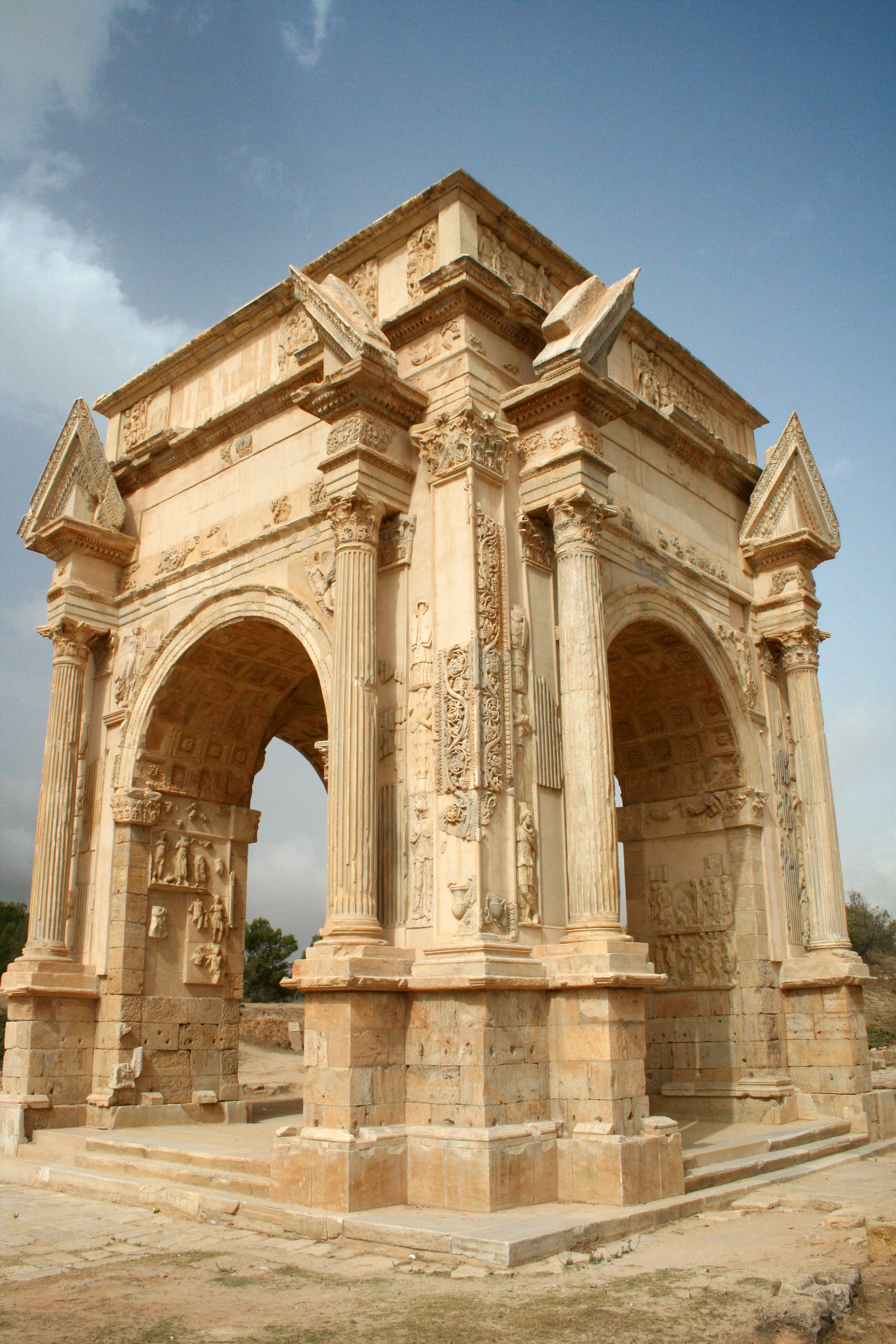
Triumphal Arch of Septimius Severus, Leptis Magna, Roman Province of Africa, c. 203 CE (Late Antiquity)
The Arch of Septimius Severus is located at the intersection of main north-south and east-west roads in the city
Was built to celebrate that the Emperor visited the province of North Africa
“Broken” pediments atop Corinthian columns
Was made to look broken on purpose
Motif associated with Hellenistic and eastern Mediterranean architecture rather than standard Roman arches in Italy
The attic of the arch contains a bunch of sculpted friezes instead of a dedicatory inscription as is the norm
The friezes show Septimius Severus and his sons in some sort of military procession
In the center of the frieze is Septimius Severus with infantry in front of him and cavalry behind him; he is positioned frontally and so are his sons (facing the viewer)
Severus is on a chariot with his sons
The frontal facing pose shows that they are calm and the way they are presenting themselves is as if they are doing a throne viewing, not leading a war; shows that they are dignified and regal despite what is going on around them
All the figures in the frieze are looking at the members of the dynasty
Focus of the composition is less on naturalism and more focusing on the message and symbolism of the piece is more important than adhering to naturalism
Seen by the figures in the background behind the horses not having any legs (are just there to give a little bit of three dimensionality to the piece
This frieze is meant to be a symbol of imperial power and is meant to celebrate the elevation of Severus who is from this city to emperor
What is a vault?
A vault is an arched structure of concrete which covers an area
What is a groin vault?
A groin vault is a type of vault which is created by the intersection of two barrel vaults
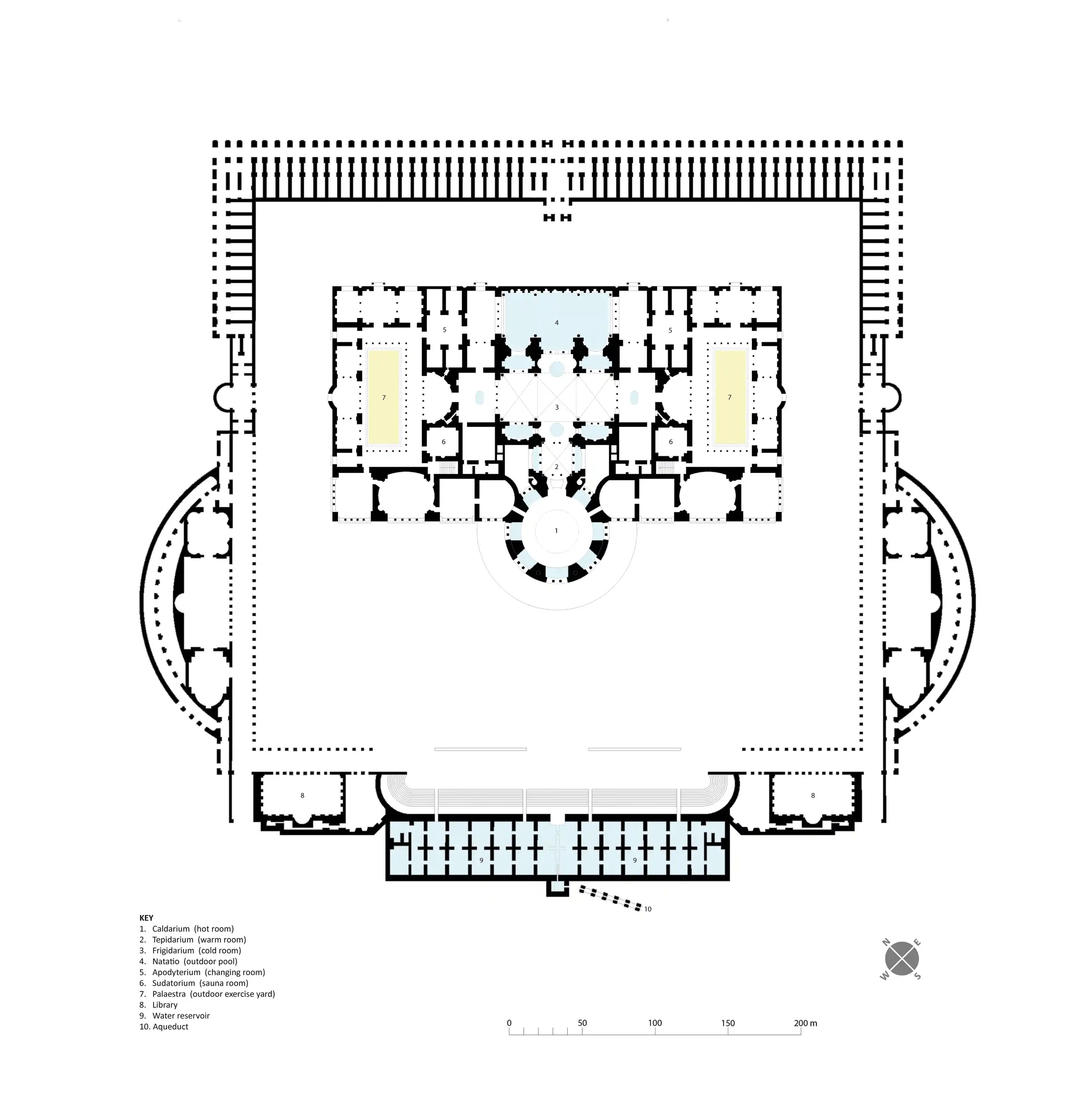
Baths of Caracalla, Rome, Italy, early 3rd century CE (Late Antiquity)
Severan Emperors also appealed to the citizens of Rome by making public architecture that helped the people
Huge and very tall
The caldarium was roofed by a massive dome
The frigidarium was a huge space which had a ceiling consisting of three concrete groin vaults
The space showed what Roman architectural innovations like barrel vaults and concrete made possible
The facility had facilities for more than just bathing (had libraries and gardens and whatnot)
Baths were decorated with marble and decorated with mosaics and sculptures; the sculptures were the Farnese Bull and the Farnese Hercules (both copies of earlier Greek works)
The creation and display of these earlier Greek works is an example of classizing
The copies were even bigger than the originals
What features of the Baths of Caracalla demonstrate the full potential of the Roman architectural innovations that we discussed in Unit 2?
The massive dome over the caldarium
The groin vaults
Both are only possible because of Roman innovations like Roman concrete and the barrel vault
What is a Tetrarchy?
It is a form of government characterized by two Augustuses and two Caesars. The Augustuses were the co-rulers and the Caesars helped out the Augustuses
For example, the Emperor of the East was Diocletian, Emperor of the West Maximian, Galerius assisted Diocletian, Constantius assisted Maximian
This change of government ushered in stability and addressed one of the problems of the Roman Empire which was that it was too big to be governed by one man
What is porphyry?
It is a hard purple stone from Egypt which was reserved for sculptors of the imperial family and the gods
Portrait of the Tetrarchs, formerly in Constantinople (Istanbul, Turkey), c. 305 CE (Late Antiquity)
Carved from porphyry
Previous portraits emphasized individual features and personality while these portraits used generality and abstraction
No distinction is made in facial features, stature, dress, or gesture
Except the two beards worn by the two augusti to show that they are older than the caesars
The caesars are hugging the augustuses to show their unity
Schematic representation of clothing (abstract), not naturalism
Eagle sword is carried by each of them and each figure has one and the eagle is a symbol of the Roman empire so they are showing that they all share power equally
Principle of concordia (harmony)
Emphasis on the message not the style
The co-rulers knew the impression of unity was essential
What are spolia?
They are a term used to describe building materials or relief salvaged from other works and reused in a different structure
What does iconic mean?
With regard to style, a term that refers to a simplified, highly symbolic way of representing a subject that favors instant recognition over realistic detail.
In this sense, an image acts like a "visual shorthand"—using flat shapes, bold lines, and specific colors to transform a complex person or idea into a permanent, universal sign
Who was Constantine I?
He was the emperor who took over after the tetrarchy collapsed and he needed to legitimize his rule since he didn’t get voted into Emperor as is traditional; thus, he resorted to art
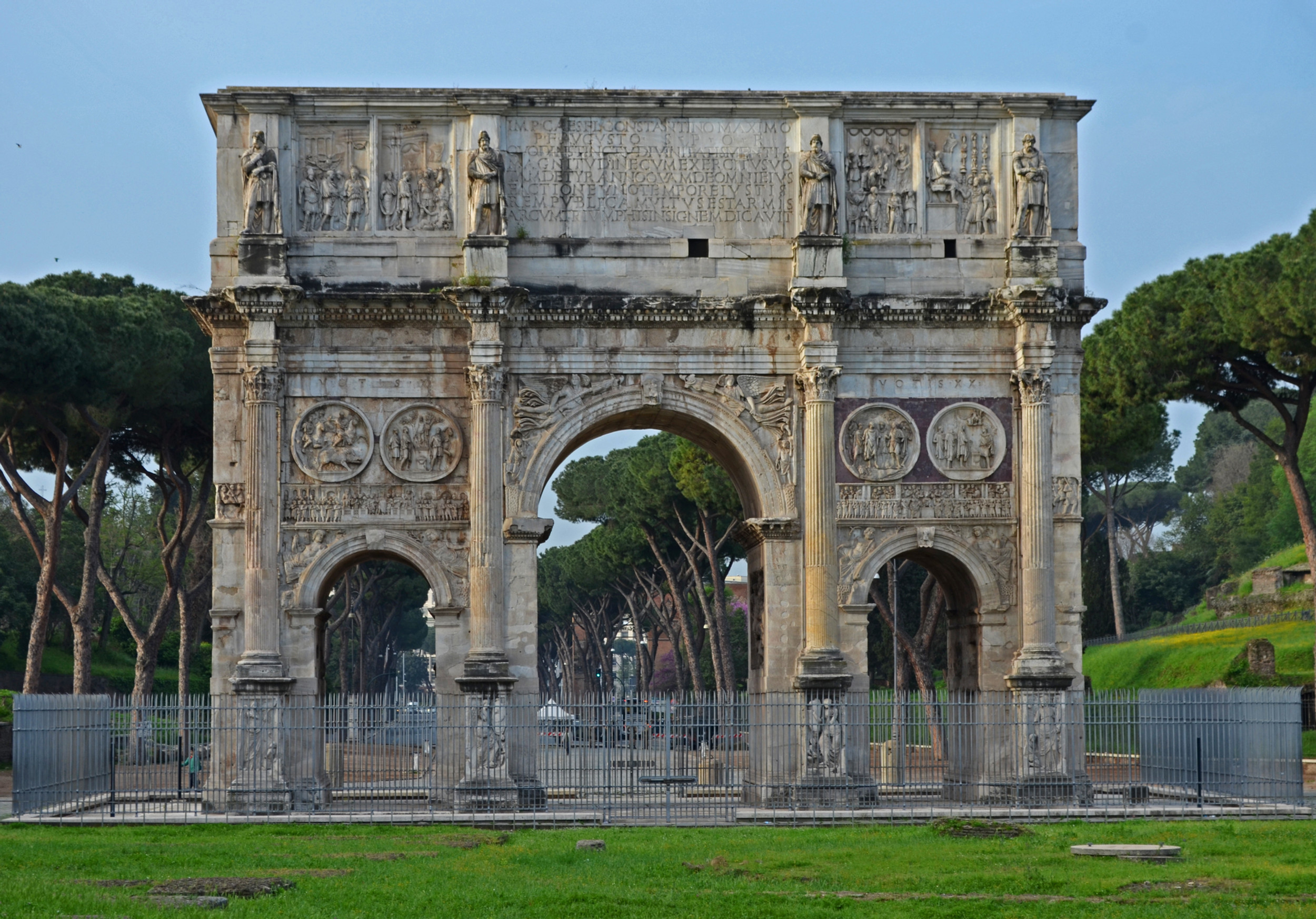
Arch of Constantine, Rome, Italy, c. 312-315 (Late Antiquity)
Is a triple span because it has three arches
Is on the traditional route that victorious generals walked through and close to the Roman Forum
The dedicatory inscription on the attic states that the Senate and people of Rome dedicated to Constantine from saving them from a tyrant
Differs from other traditional triumphant arches because it had spolia and original art in it (that mixing didn’t happen before)
Could have been used to legitimize rule because the spolia are from three of the good emperors, thus associating himself with them
The heads of the other emperors (on the piece) were modified to look like Constantine (so the emphasis was on Constantine)
Spolia:
The figures on the pillars were taken from the Forum of Trajan because Trajan defeated the Dacians and incorporated it into Roman territory
The panels between the statues were taken from an arch dedicated to Marcus Aurelius who was a philosopher king and placed the needs of the people before himself
The tondi (circular pieces) were taken from a monument associated with Hadrian who was known for being cultured and educated and marked the height of the Roman empire
These pieces depicted pious Roman activities like waging war and making sacrifices which strengthened Constantine’s position as emperor
The original art:
Consisted of many low-relief iconic friezes
Show shift to more stylized and less naturalistic style
These friezes represent themes that were common in the depictions of the good emperors
The Oratio relief depicts Constantine giving a speech to the people from the Rostra in the Roman Forum
The emperor promises order, generosity and protection in response for the people’s loyalty and these are popular for propaganda because they suggest harmony between the ruler and the people
Depicts Constantine addressing the audience from a Rostra, which is the speaker’s platform, and he is standing between seated sculptures of Marcus Aurelius and Hadrean; he is standing frontally while all the other figures look at him
The head of Constantine is now lost (although it likely had identifiable portrait features)
All other heads and figures have indescript features which is similar to the abstraction present in the Tetrarchs piece; the point is not naturalistic depiction (as seen by clothes not following body form)
Additional row of heads behind the main people which is meant to indicate somewhat that the scene is 3D (perspective not a priority); naturalism is present in the depiction of the space itself so that people would know its the Roman forum
Donatio relief: Constantine gives charity to the Roman people
They proclaim the emperor’s virtue of being generous and giving; frames the relationship between people and emperor as reciprocal (people give him support, he gives them money, grain, etc.)
Constantine depicted in the center and frontally again and he is rendered in hierarchical scale (if he stood up he would be larger than everyone else around him)
Constantine is positioned on a throne above those receiving donations from him
The emperor’s image was being transformed into one where the emperor possessed superhuman majesty and above the ordinary world and ordinary mortals (not a god, but an elevated status)
Because of hierarchical scale, because he is above people, and because he is positioned like an icon (looking at frontally and calm despite what is going on around him)
Oratio and Donatio were both iconographies
Describe with examples how Constantine used art as propaganda
Used spoila from three of the Good Emperors in order to associate himself with them
The spoila also depicted Roman pious activities like waging war and religious activities
Oratio relief suggests harmony between the ruler and the people because the people respond with loyalty to the speech of the emperor
Donatio relief proclaims the emperor’s virtue of being generous and giving; frames the relationship between people and emperor as reciprocal (people give him support, he gives them money, grain, etc.); also gives him superhuman character
Give two (2) examples of artworks from this lecture that demonstrate the move from an emphasis on naturalism in style to a style that was more iconic, symbolic, and abstract. What historical and cultural factors can explain this change?
Portrait of the Tetrarchs demonstrated increased emphasis on abstraction which was shown through generalized facial features and stature along with the schematic representation of their clothing; this abstraction and generalization was done in order to demonstrate the unity of rule of the tetrarchs in order to portray a message of harmony and unity; this can be further seen by the symbolic eagle swords that each of them are caring, representing the fact that each member shares power equally
The relief on the Arch of Constantine is a great example of this shift to a more iconic, abstract style. The Oratio relief shows simplified heads and figures to represent the audience listening to Constantine’s speech as the message of harmony between the ruler and the people was more important than depicting everything in a naturalistic manner. The Donatio relief shows is yet another example of this where the message of that Constantine is generous and that the relationship between the people and emperor was reciprocal was more important than depicting the people in the relief naturalistically
Constantine brought empire from split rule to single, unified rule and he needed to set himself apart from the normal person which explains the more iconic style as it makes Constantine more distinguishable from everyone else because he still was drawn somewhat naturalistically
What is a pier?
It is an upright post that supports horizontal elements, such as a ceiling
What are Coffers?
Coffers are a recessed panel or series of panels in a ceiling; they reduced the weight of the ceiling and allowed the piers to support the structure
What is a clerestory?
A clerestory is the term used to describe the upper story of a basilica extending above the roofs of the aisles
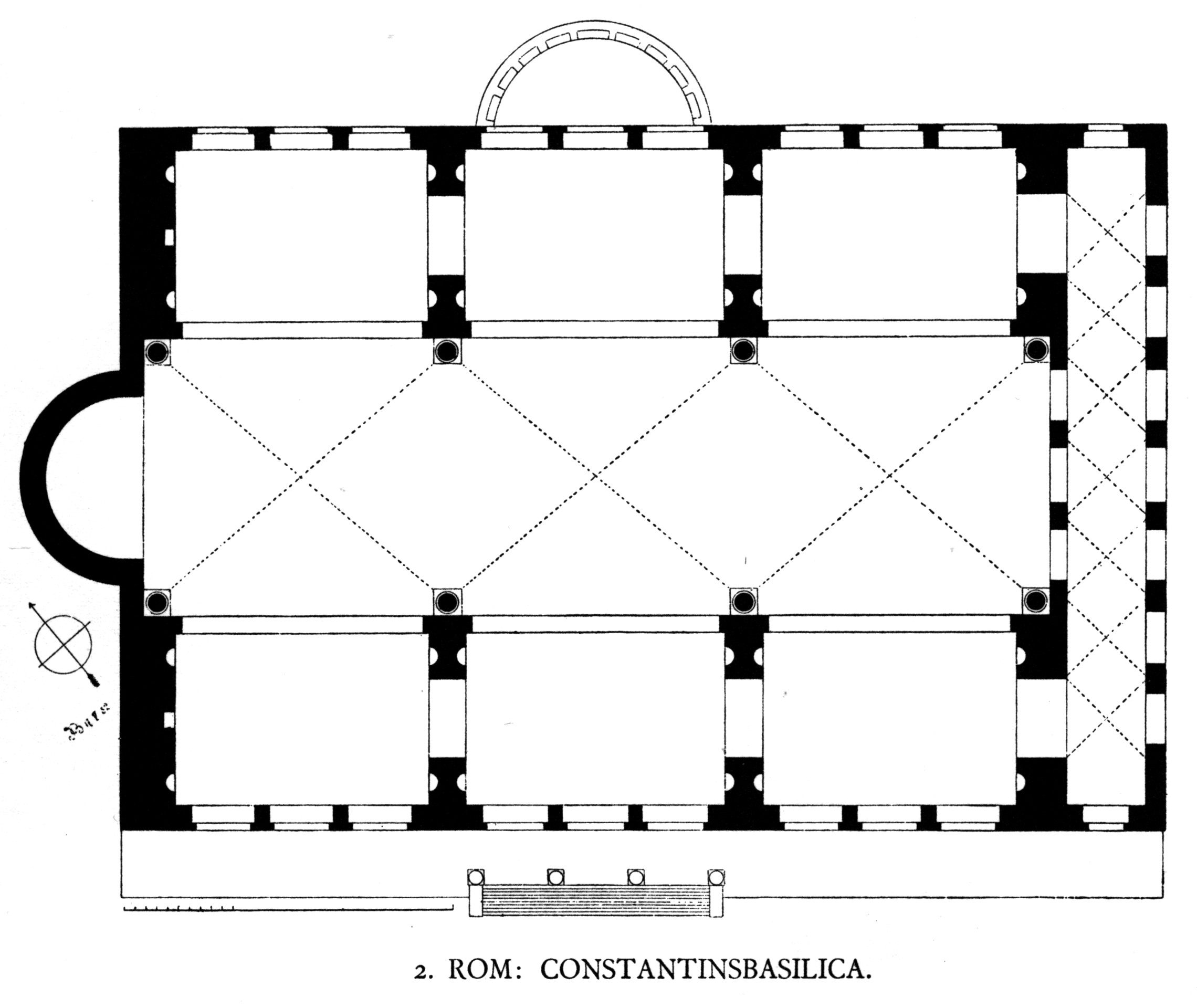
Basilica Nova (Basilica of Maxentius and Constantine), Rome, Italy, c. 306-313 CE (Late Antiquity)
Was a civic building and was one of the largest built in Rome
The purpose of the basilica form was to serve as an administrative building and where government functions occur
This basilica served to legitimize Constantine’s rule and serves to glorify him due to its sheer scale
Has a central nave with an apse at the end and Constantine added an entrance on the Southern side of the building and an additional apse across from the second entrance
The central nave was roofed with three massive groin vaults, differing from other basilicas at the time
Roof was supported by 4 massive piers
The aisles had barrel vault roofs with coffers on them
In the Western apse, there was a huge statue of Constantine
Was meant to awe the viewer and remind them of Constantine’s virtual present (statue was present in place of him)
Head and limbs made of marble, torso made of wood and stone which was covered with gilded bronze
Used a form associated with statues of the gods; he wasn’t claiming to be a god, but was claiming he had the same power and authority as the gods
Break from abstraction and a more classical style was used in order to associate himself with previous emperors who were famous and had similar statues
His hairstyle was modeled on one of the good emperors
His strong jawline and nose are reminiscent of Julius Caesar’s portraits
The big eyes are similar to the Portraits of the Tetrarchs
The combination of naturalistic and abstract elements gives Constantine’s face a distinct, recognizable look; sculpture was meant to represent a powerful individual ruler with imperial aspirations
Did not want to identify himself with the Tetrarchs and their shared rule
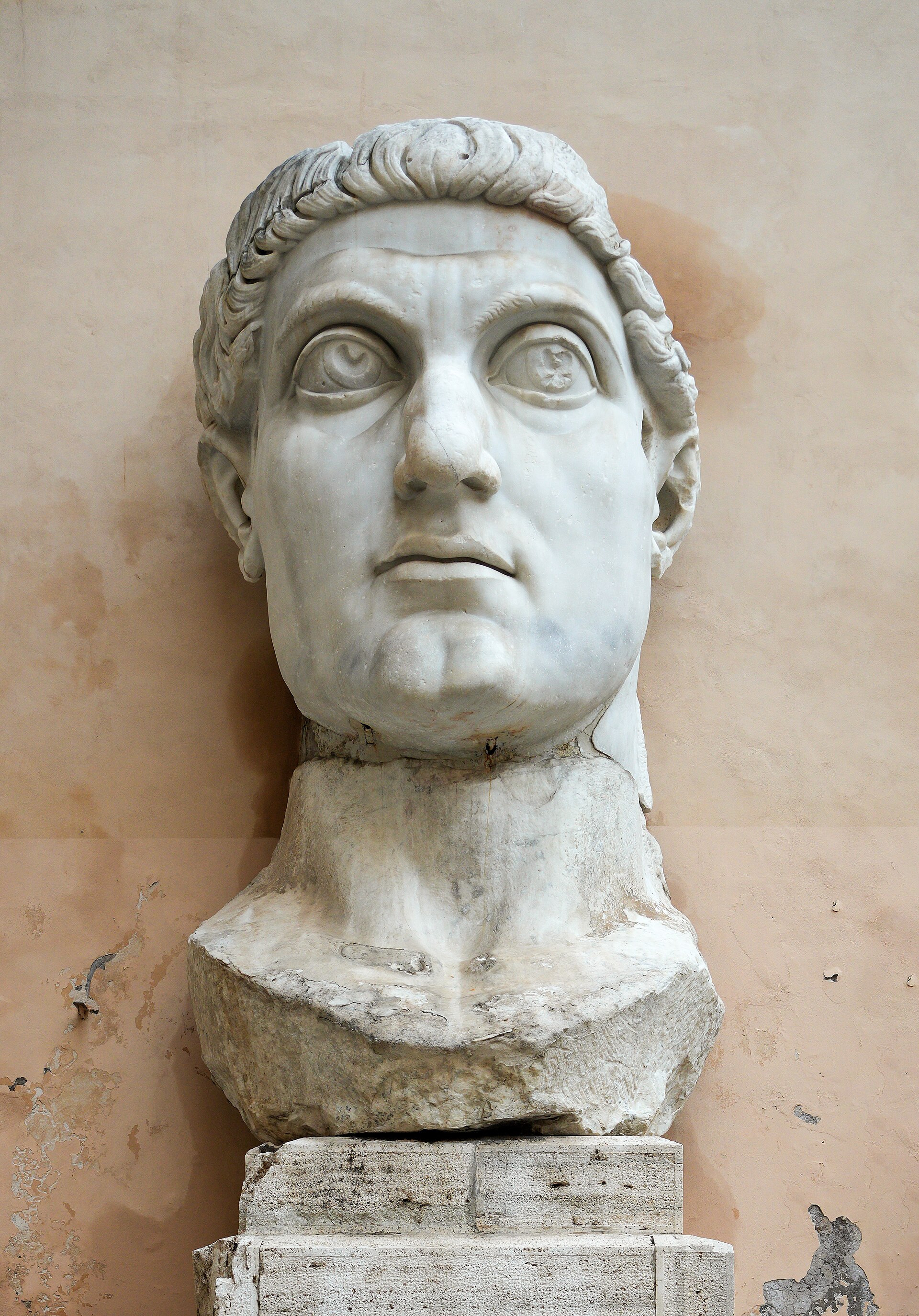
Head of the Colossal Seated Statue of Constantine, from the Basilica Nova, Rome, Italy, c. 315-330 CE (Late Antiquity)
In the Western apse, there was a huge statue of Constantine
Was meant to awe the viewer and remind them of Constantine’s virtual present (statue was present in place of him)
Head and limbs made of marble, torso made of wood and stone which was covered with gilded bronze
Used a form associated with statues of the gods; he wasn’t claiming to be a god, but was claiming he had the same power and authority as the gods
Break from abstraction and a more classical style was used in order to associate himself with previous emperors who were famous and had similar statues
His hairstyle was modeled on one of the good emperors
His strong jawline and nose are reminiscent of Julius Caesar’s portraits
Elongated shape of the head is similar to the Portraits of the Tetrarchs
The big eyes are similar to the Portraits of the Tetrarchs
The combination of naturalistic and abstract elements gives Constantine’s face a distinct, recognizable look; sculpture was meant to represent a powerful individual ruler with imperial aspirations
Did not want to identify himself with the Tetrarchs and their shared rule
What is visual culture?
The shared language of sight that shapes, reflects, and interprets our understanding of reality. Focuses on how visual experiences construct meaning, reinforce social values, and influence identity
What is subject matter?
It is what the work of art is about; the narrative, iconographic, or non-objective meaning conveyed by an abstract or a figurative composition. It is what is depicted in and by a work of art
What is style?
It refers to the “how” -- the distinctive visual approach and techniques an artist uses to represent a subject, including choices in color, form, and medium
What is the difference between style and subject matter? Why is this difference significant with regard to Jewish and Christian art in Late Antiquity?
The subject matter is what is being depicted by the art while the style refers to the techniques and visual approach used in an artwork to represent a subject; this matters because Jewish and Christian art both used the same style but had a different subject matter
What is polytheism?
It is the belief in and worship of multiple gods
What is monotheism?
It is the belief in and worship of one god
What do Jews believe? What do Christians believe?
Jews believe that God made a covenant with them and that they are the chosen people waiting the coming of the Messiah
Christians believe that Jesus Christ was the Messiah
What is a diaspora?
It is the movement, migration, or scattering of a people from an established or ancestral homeland, resulting in communities living outside their original territory but maintaining culture and social connections to it
What was Dura-Europos?
It was a religiously diverse city in the Roman Empire where the Synagogue at Dura-Europos was built
What is a synagogue?
A synagogue is a place of worship in the Jewish religion
What is figural imagery?
It refers to art that features recognizable human or animal forms
What is an aedicula?
It is a miniature building or architectural frame; often a niche marked by columns and a pediment
What is the dry fresco technique?
It refers to wall or ceiling paintings that are done on dry plaster
Describe the Synagogue at Dura-Europos
Sculpture was prohibited in synagogues due to prohibition of it in the Jewish religious text
Some paintings were allowed though, mostly scenes from Hebrew Bible
Presence of narrative figural reliefs in synagogue dispelled belief that Jews had for a long time not allowed such depictions
This means in the past some groups of Jews embraced images in their religious environments
Featured an assembly hall with an aedicula with the Torah inside of it
Was on the West of the structure (the sacred direction)
Emphasized the centrality of the Tora
The walls were covered with frescos arranged in three horizontal registers which represent stories from the Hebrew Bible
Paintings done with dry fresco technique
Scenes were separated by thick borders
The functions of these paintings were:
Illustrated important moments in Jewish history, reminding visitors of their heritage
Illustrated the power of God and his continued protection of the Jewish people
May have hinted at God’s promise of future salvation
What was the Tabernacle?
The Tabernacle was a portable tent sanctuary and served as the earthly dwelling place of God’s presence after the exodus from Egypt and before the temple of Jerusalem was built
What are acroteria (sing. acroterion)?
They are ornamental architectural features—statues, pedestals, or carved motifs like palmettes—placed at the apex and lower corners of a pediment, gable, or roofline
What is the menorah?
The Menorah is an important symbol of the God’s covenant and his command to be the light onto the nations and made of pure gold and was placed in the Tabernacle; is seven-branched with a central shaft with three branches branching off on each side which represent light and divine wisdom; it also symbolized the eternal presence of God
What is the Ark of the Covenant?
It is a the gold--plated wooden chest which held the 2 tablets on which the 10 Commandments were inscribed
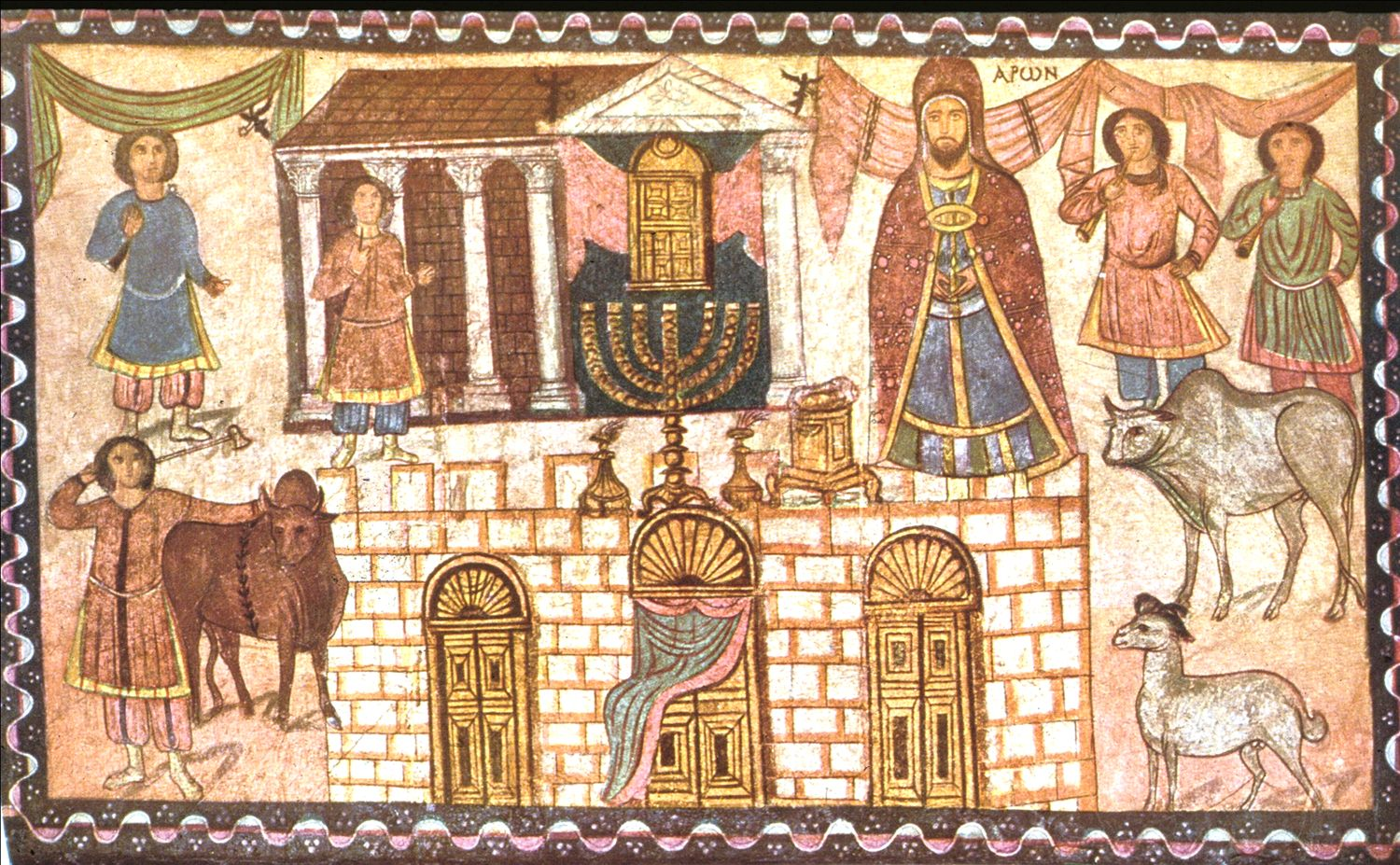
Consecration of the Tabernacle, western wall of the synagogue at Dura-Europos, Syria, c. 245 CE (Late Antiquity)
Features the Tabernacle as the form of a Roman temple; featured Corinthian columns, acroteria at the corner of the roof depicting the goddess Nike, the Art of the Covenant is seen inside the temple
The art symbolized God’s covenant with the Israelites and his continued protection and his promise that the Jews would be able to return to their homeland
The menorah is placed inside of the Tabernacle
To the right of the temple stands Aaron who was the brother of Moses and first high priest
Dressed in contemporary Persian style and was depicted in red purple and blue, which is what the Hebrew Bible calls for
Hierarchical scale present as Aaron is bigger than everyone else
The animals in the scene are a bull, a ram, and the cow and these animals were used for sacrifices for ancient Jewish religious practice
Style is a mixture of abstract and naturalistic; the space of the composition is mostly flat and perspective is not used much; examples of perspective present:
The banner hanging on the middle door shows 3D
We can see shadows which give perspective
Head of the cow looking at us
The frontal, flat space, and hierarchical scale are reflective of Roman artwork of the period
Compare the style of the Consecration of the Tabernacle from the synagogue at Dura-Europos to the style of the Portrait of Septimius Severus and His Family. What can account for stylistic similarities?
The two pieces have a lot of similarities which are:
The eyes have similar shapes and the beards of both Aaron and Severus are rendered as individual strands of hair (simplified style)
The shape of the faces is similar
Mostly flat with minimal use of perspective
Degree of naturalism and abstraction present in both artworks
What can account for the stylistic similarities is that they are both in the same period (Late Antiquity) and thus have a shared visual culture (accounting for the similarities)
What is a mosaic?
It is a medium in which small, roughly cubic pieces of colored material are embedded in mortar to create patterns or images
What are tesserae (sing. tessera)?
They are the small, roughly cubic piece of colored material which are embedded in a mosaic
What was Hammat Tiberias?
It was the city in which the synagogue at Hammat Tiberias was built
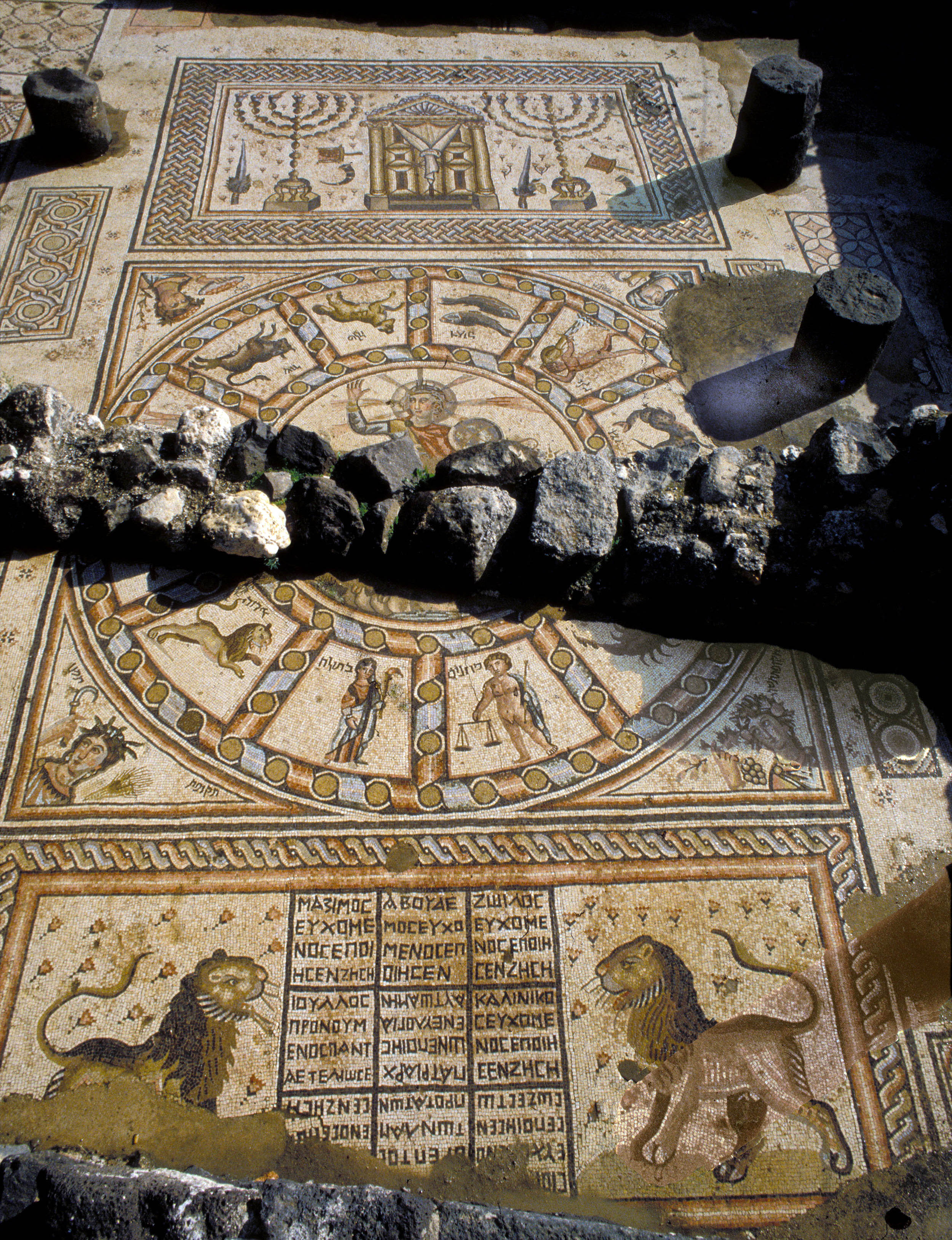
Floor mosaics (view from entrance towards sanctuary) from the synagogue at Hammat Tiberias, Israel, late 4th-5th century (Late Antiquity)
The figural imagery dispels the myth that Jews always prohibited the use of figural imagery in their artworks
Can see a panel depicting the Temple of Solomon. The panel also has the following symbols:
Ark of the Covenant
Iulav and etrog
Menorah
Shofar
Incense shovel
Below that panel is a depiction of the sun god (Sol) in the center and a zodiac around it and this references the Jewish solar calendar
Zodiac signs were a repeated motif in Jewish places of worship
Closest to the northern wall of the building is a dedication panel (in Greek); the purpose of this dedication panel was for the patrons to be remembered as someone who helped this synagogue to be built
What can the wall paintings at the synagogue of Dura-Europos tell us about the relationship between the Jewish faith and images within sacred spaces?
It dispels the myth that Jews from all time periods avoided figural imagery due to the prohibition in the Torah
What is a catacomb?
It is a network of underground burial tunnels
What is typology?
It is a method of biblical interpretation in which persons, events, or institutions in the Old Testament are seen as foreshadowing or anticipating persons, events, or institutions in the New Testament; for example, the story of Jonah being swallowed by a whale being like the resurrection of Jesus Christ
Describe Christ as the Good Shepherd
Christ is carrying/surrounded by sheep
Symbolic of the protective role of Christ in the lives of Christians
Christ watches over and protects his people like a shepherd watches over and protects his flock
Popular during the Early Christian period, when Christians were often persecuted; example of iconography
Is an example of Typology
Describe the Catacomb of Saints Peter and Marcellinus
Christianity was illegal before the Edict of Milan so it was practiced in private and secret; some of the earliest Christian art is found in tombs
Had pictorial narratives with saints and other important figures along with traditional Christian symbols
Matched style of non-Christian of Roman catacombs
Paintings of narratives were common and linked these narratives to events that were hoped for in the future (just like the Jews did)
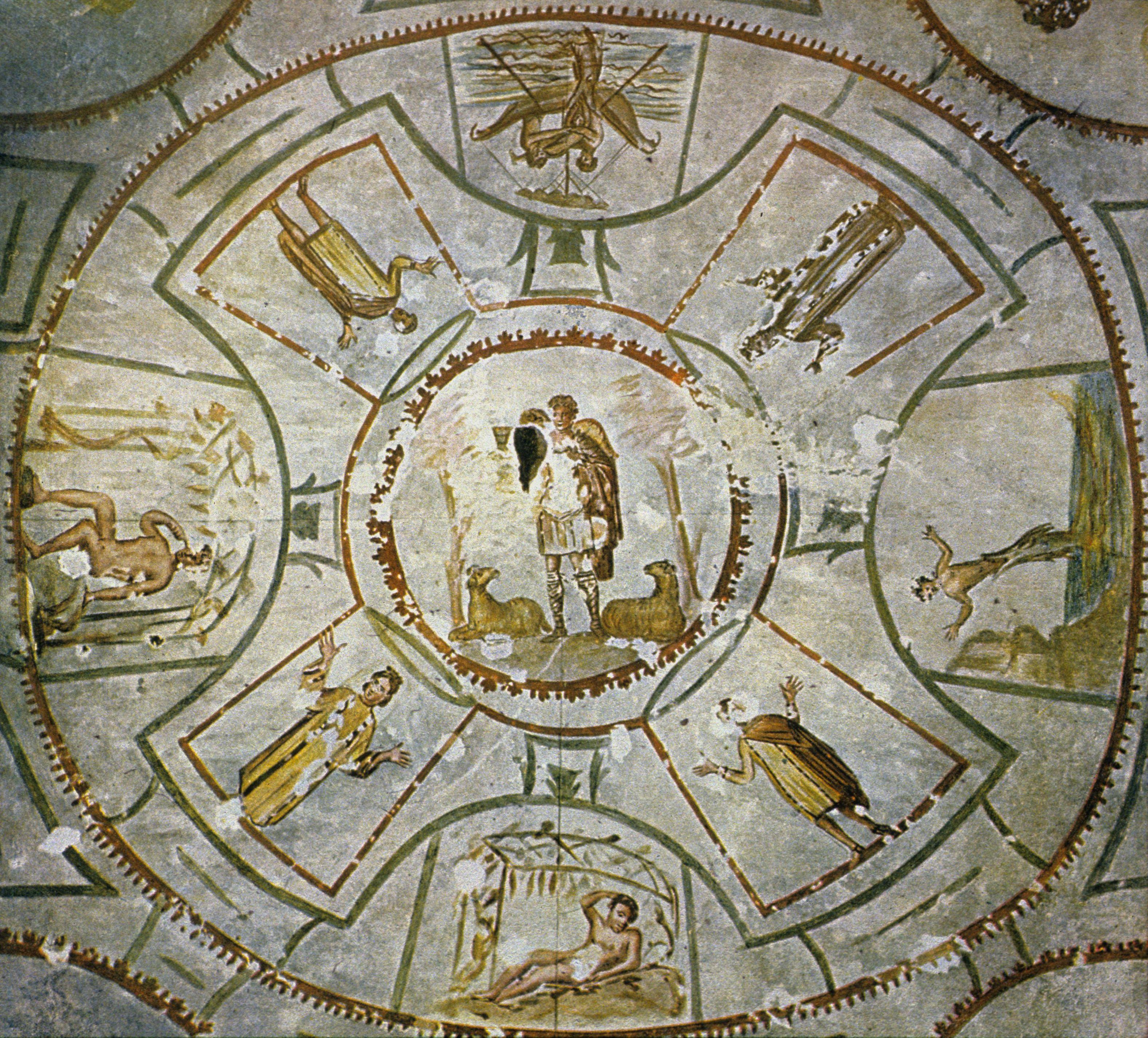
Fresco from the vault of a burial chamber, Catacomb of Saints Peter and Marcellinus, Rome, 4th century CE (Late Antiquity)
Christianity was illegal before the Edict of Milan so it was practiced in private and secret; some of the earliest Christian art is found in tombs
Is a fresco
Has pictorial narratives with saints and other important figures along with traditional Christian symbols
Matched style of non-Christian of Roman catacombs
Paintings of narratives were common and linked these narratives to events that were hoped for in the future
Iconography of Christ as the Good Shepherd
What is a transept?
In a cross-shaped church, it is the part of the building orientated perpendicular to the nave
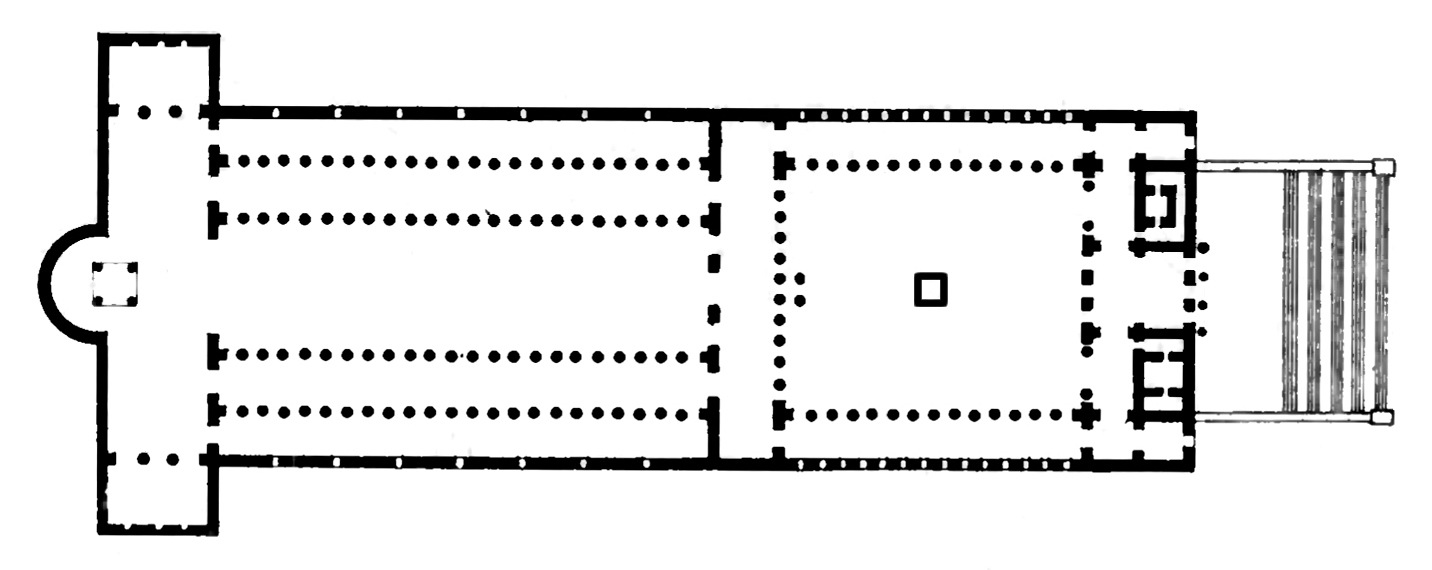
Old St. Peter’s Basilica, Rome, Italy, 4th century CE (Late Antiquity)
On Vatican Hill and was built in the spot of Nero’s circus, which is where Saint Peter died
These new Christian basilicas were very similar to other basilicas at the time
Featured long broad nave flanked by aisles
Both were suited to accommodating large numbers of people
Christian basilicas had the High Altar (where ceremonies took place) instead of the Statue of the Emperor
The apse in Old St. Peter’s contained the grave of Saint Peter
One notable architecture innovation: addition of transept
The transept in Saint Peter’s made a special space around the grave of Saint Peter and the aisles allowed priests to control access to the grave for Christians who came to worship
How does the plan of the basilica of Old St. Peter’s adhere to and add on to the architecture of a traditional Roman basilica?
Similarities:
Featured long broad nave flanked by aisles
Both were suited to accommodating large numbers of people
Both had aspses
Differences:
Had a transept
What is an oratory?
It is a private place of worship for Christian individual, family, or community
What is a blind arcade?
In architecture, it is an arcade (a series of arches carried by columns or piers) having no actual openings, applied as decoration to a wall surface
What is a cruciform?
It is a building that is cross-shaped
What is alabaster?
It is a form of fine-grained gypsum that is white and translucent
Describe the Oratory of Galla Placidia
Decorated with blind arcades and a small square tower over the crossing
Is a cruciform
Inside of the building is covered with mosaics
The pieces that makeup a mosaic are not perfectly shaped and don’t sit flat all the time and along with the fact that these pieces are shiny and reflect light, light is important in how they are perceived
Had small windows made with fine sheets of alabaster
When light shines through alabaster, it appears to glow
Light thus would enter the space soft and diffused
The interior of the oratory was likely lit by candles and lamps too; these light sources have flickering and this light from flickering would have “danced” across the walls and made them seem like they are sparkling; this effect is more pronounced because some of the pieces had gold leaf in them
Would have been like standing inside a shimmering box
Would have enhanced the feeling of otherworldliness of the space
In the barrel vaults in the oratory we can see circular patterns and vine scrolls with a central chi-rho medallion (the latter of which is very Roman)
In the vault above the crossing, we can see a cross in the middle set in a field of starts and a blue background (like if cross in floating in the sky); the stars make it a representation of heaven
In the corners of the vault there are iconographic representations of the 4 evangelists:
The winged man is St. Matthew
The eagle represents St. John
The bull represents St. Luke
The lion represents St. Mark
What is an attribute?
An attribute is a symbolic object that is conventionally used to identify a person or deity in a work of art
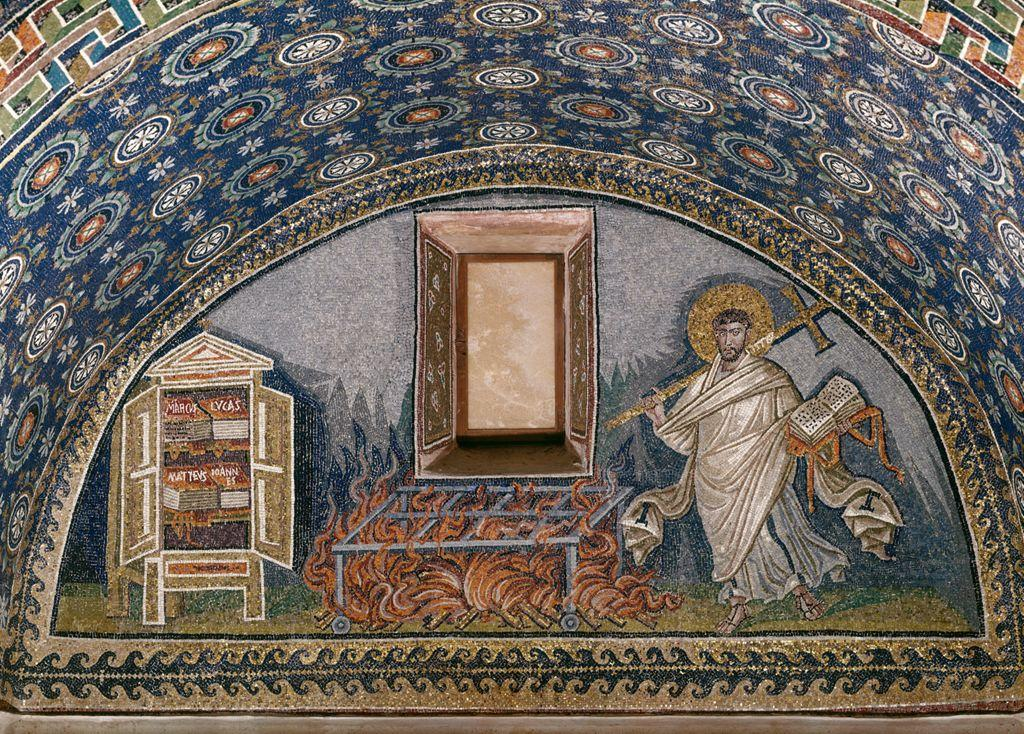
St. Lawrence mosaic, south side of the Oratory of Galla Placidia, Ravenna, Italy, c. 425 CE (Late Antiquity)
St. Lawrence was a decant of the Roman Empire
Has a gold halo around his head which indicates that he is more sacred than a regular mortal
Was killed by being roasted on a grid of iron because he didn’t give Church money to corrupt Roman officials and instead gave it to the poor
Bookcase has 4 large books with the names of the four men who wrote the 4 gospels which tell the life of Jesus Christ
In the center of the composition is a giant grid iron with a fire underneath it and is an attribute of St. Lawrence
Iconography was key to reading this scene as without knowing this context, it would be impossible to read
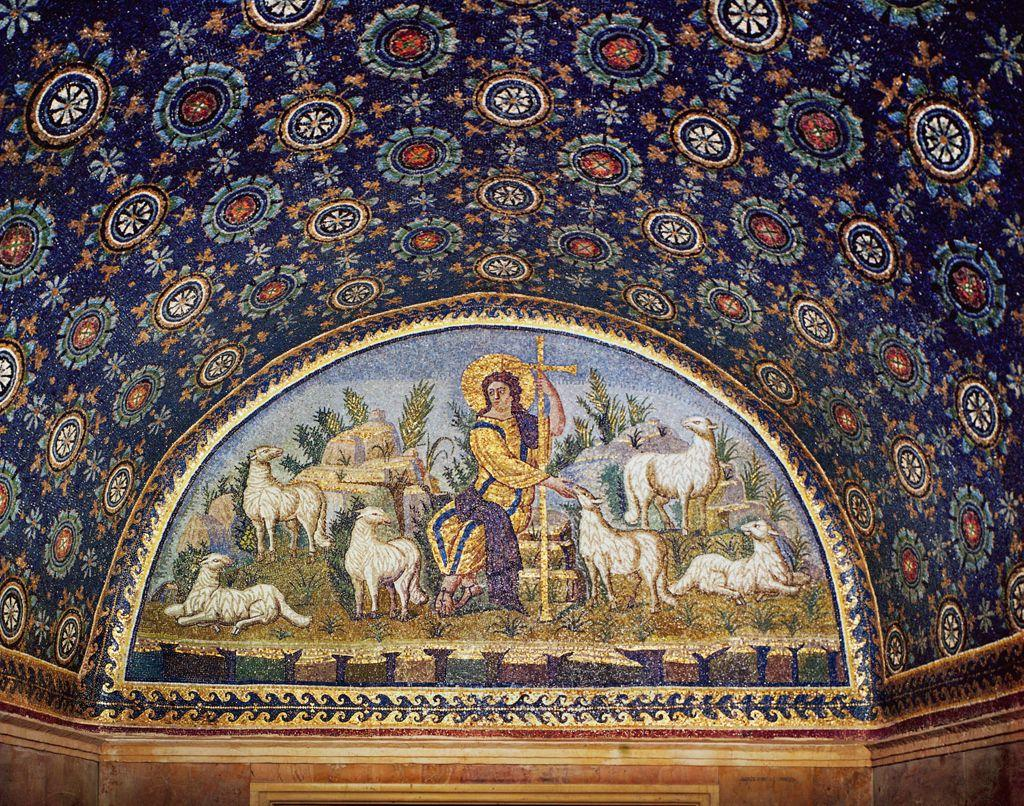
Good Shepherd mosaic, north side of the Oratory of Galla Placidia, Ravenna, Italy, c. 425 CE (Late Antiquity)
Shows Christ as the Good Shepherd
Combination of naturalistic and abstracting elements
Landscape is naturalistic
Rocks
Plants
Blue sky
Tufts of grass
Facial expressions are also naturalistic
The shape of Christ’s body is not naturalistic as the positioning of the body is not what an actual human has
The coat of the sheep is represented through triangular patterns on the sheep which is not how real fleece looks
What is a chi-rho symbol?
It is a Christogram made up of the Greek letters “chi” and “rho”, the first two letters of the Greek word for Christ (Christos).
The main symbol in early Christian art will also be flanked by the letters Alpha and Omega, which referred to Christ since Christ referred to himself as the alpha and omega (alpha was the first letter of the alphabet so beginning and omega was the last so end)
Who was Justinian I?
Conquered a lot of land and almost got back all of the land of Western Rome
Who was Empress Theodora?
Justinian’s wife and she ruled over the military and church along with her husband; was very active in politics
What was Constantinople?
It was the capital of the Byzantine empire
What is a pendentive?
A pendentive is an architectural element in the shape of a triangular segment of a sphere, used to make the transition from a square room to a circular base for the dome.
What is a narthex?
A narthex is the entrance hall or vestibule of a church
What is a central plan?
A central plan is a design for an architectural structure that features a primary central space surrounded by symmetrical areas
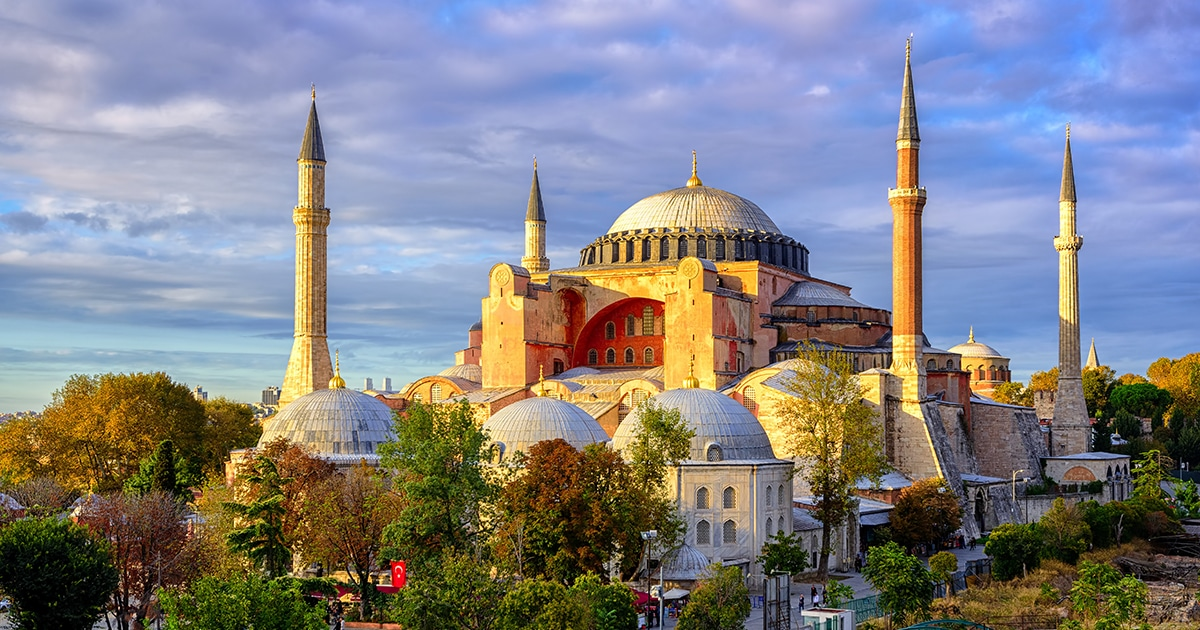
Hagia Sophia, Anthemios of Tralles and Isidore of Miletus (architects), Constantinople, begun 532 CE (Early Byzantine Empire)
In Constantinople
Hagia Sophia means “Holy Wisdom”
Anthemios of Tralles and Isidore of Miletus were chosen to construct the church (they were primarily mathematicians)
A massive interior dome was created and sits on four arches that sit on four piers; pendentives were placed to transition the straight walls and curved dome to prevent the dome from collapsing
There are also two half domes that sit on secondary piers that provide additional support to the main dome
One change was the narthex which defines the direction of the church, but this directionality was not as pronounced because the building was square and not long and rectangular like a basilica
The church is actually a combination of a longitudinal basilica and a central plan church
Basilica because of narthex
Central plan church because of central nave and massive dome
Provided visible elements of Justinian’s power and also linked back to Constantine’s Church of the Holy Apostles
This was done so Justinian could connect himself to Constantine by constructing a larger and more important church than the Church of Holy Apostles
Explain how the layout of Hagia Sophia combines a basilica plan and a central plan?
The church is actually a combination of a longitudinal basilica and a central plan church
Basilica because of narthex
Central plan church because of central nave and massive dome
What was Ravenna?
It was the former capital of Western Rome and had the Church of San Vitale built there
What is an ambulatory?
It is the passage around the apse in a basilica church or around the central space in a central-plan building
What is a gallery?
It is an upper story above the aisle, overlooking the nave (at least in church architecture)
What is hieratic?
It is a style characterized by formal, rigid, and highly stylized qualities that is meant to give precedence to symbolic or spiritual significance over naturalism, illusionism, or emotional expression
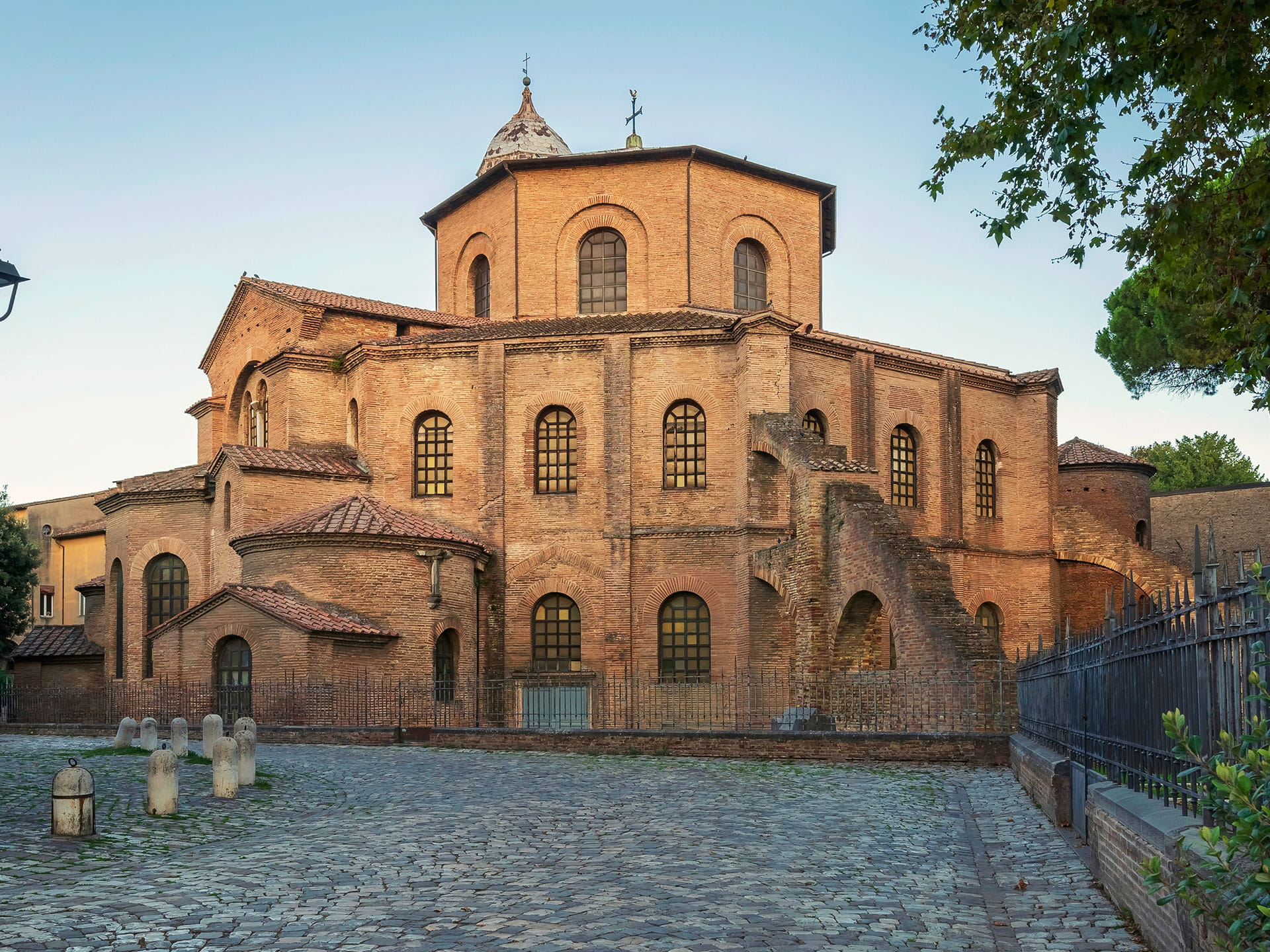
Church of San Vitale, Ravenna, Italy, consecrated in 548 CE (Early Byzantine Empire)
Plan based on a central plan church
Included an ambulatory and gallery
Is both a longitudinal and central space, like the Hagia Sophia
Directionality/an axis is established by the inclusion of a narthex; axis led straight to the apse
Mosaics:
In the vault of the apse, there is a piece depicting Christ Pantocrator
There are also two imperial panels in the apse, one depicting Justinian and his court and the other depicting Theodora and her court
In the three mosaics we see the natural world being reduced to a few descriptive forms or being removed completely because the goal was to capture the mysteries of the Christian faith instead of an actual background because the image was understood not to tell a story but to be a symbol of something higher than ourselves; images become static and timeless
These mosaics can be described as hieratic
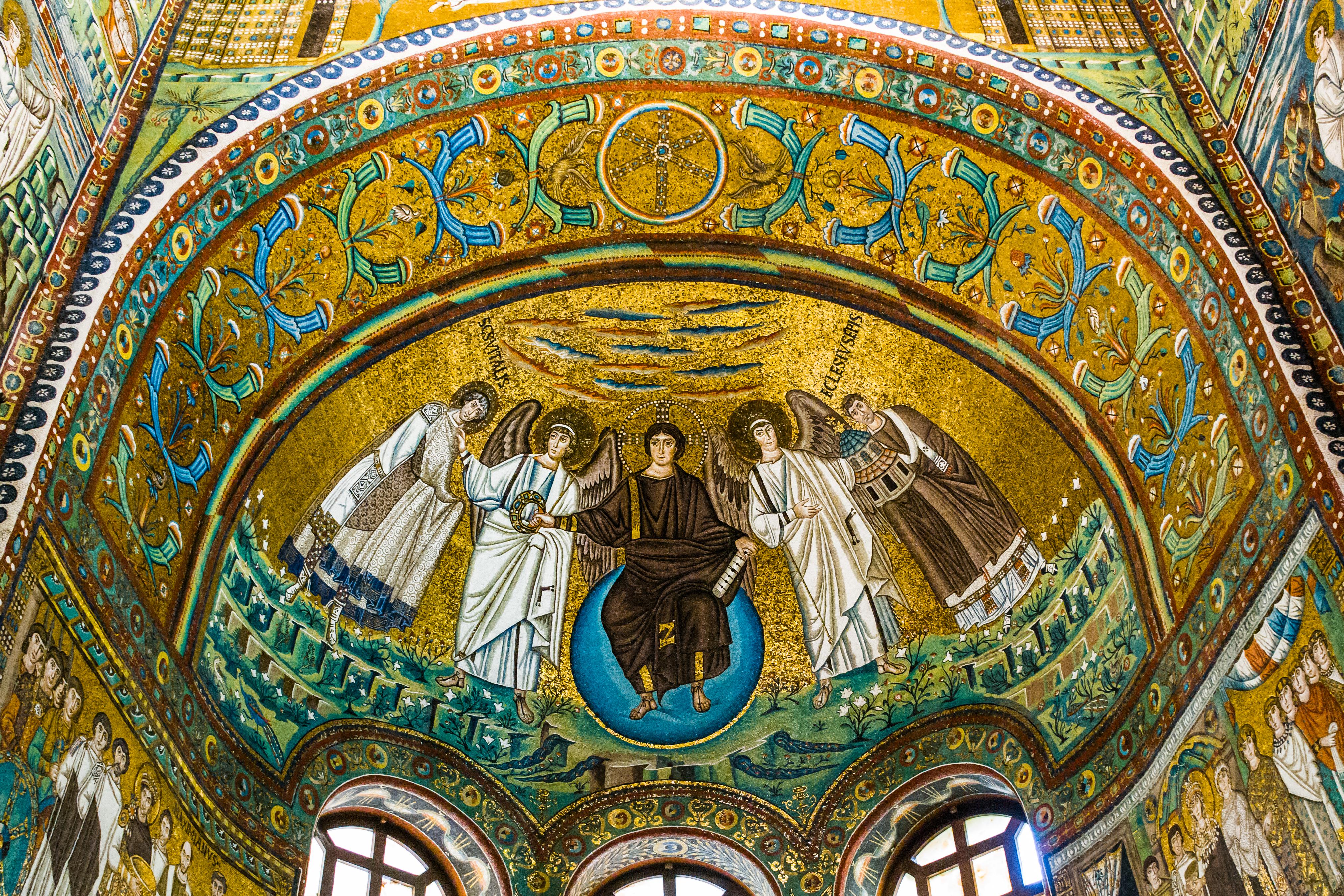
Christ Pantocrator, apse mosaic, Church of San Vitale, Ravenna, Italy, consecrated in 548 CE (Early Byzantine Empire)
Christ Pantocrator (means “Almighty” or “Ruler of All”)
Is enthroned on an orb representing the cosmos
Floating in the midst of a golden sky
The 4 rivers of Paradise represent those said to have flowed from the Garden of Eden in the Book of Genesis
Christ is flanked by two angels who are presenting two other figures to Christ
On the right is the Bishop Eccelsius, who is presenting Christ with a miniature model of the church itself, reflecting the belief that these religious construction projects were gifts to Christ and God
On the left is St. Vitalis who was the patron saint and the main saint worshipped by the church; Christ is presenting St. Vitalis with a martyr’s crown, which is symbolic of the fact that St. Vitalis was a martyr
Background on this mosaic is gold rather than a naturalistic background, showing how the art was meant to transcend the material world. Reflects the increasing importance of the message over naturalistic depiction. Meant to be a heavenly background since it is gold (representing the spiritual world, not the temporal realm which is why the one in the oratory had a blue sky)
What is Eucharist?
The Eucharist is the ritual commemoration of the last supper (Jesus gave wine and bread to his apostles representing his blood and body)
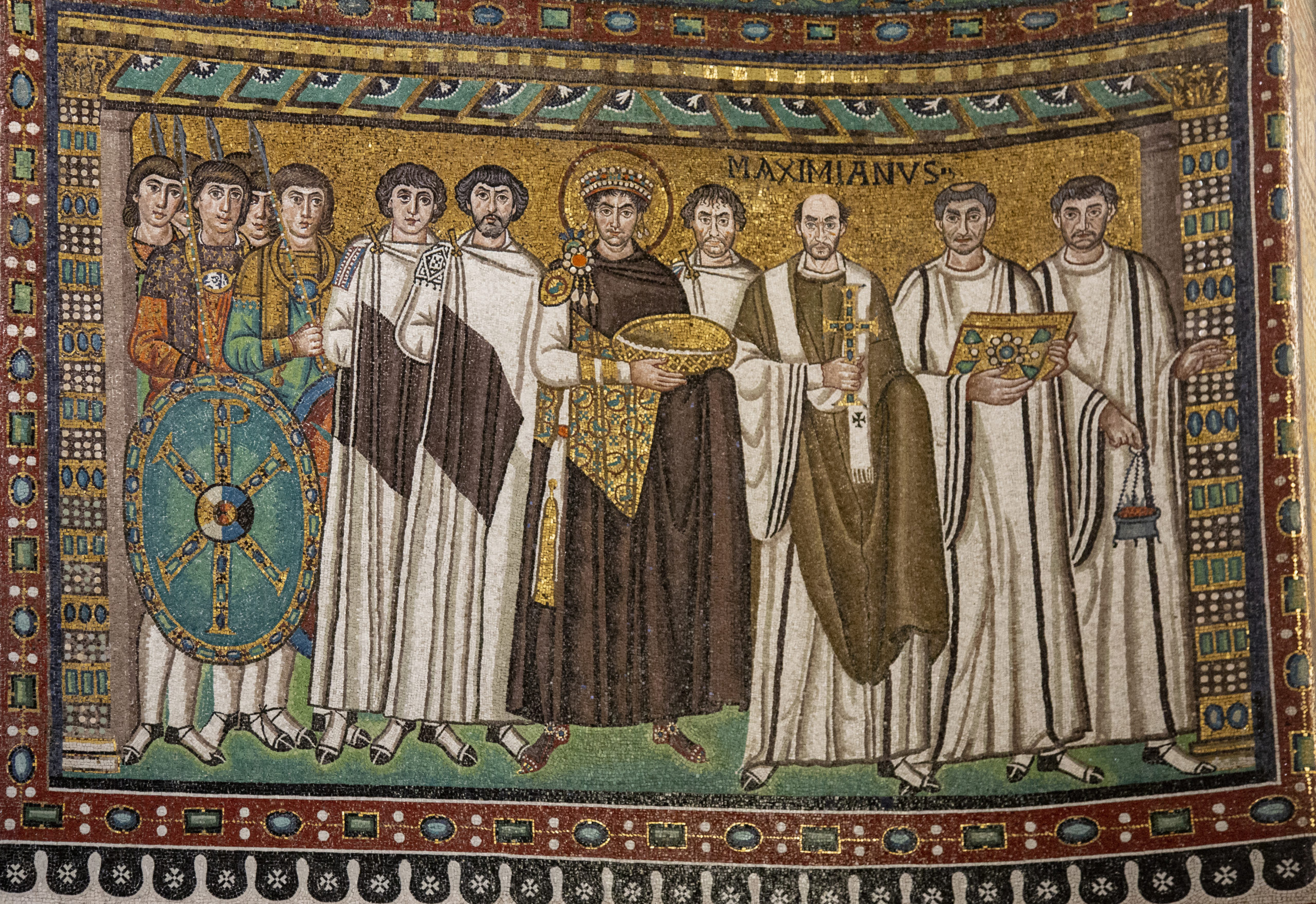
Emperor Justinian and his court, Church of San Vitale, Ravenna, Italy, consecrated in 548 CE (Early Byzantine Empire)
North wall of the apse
Justinian is dressed in royal purple and has a golden halo
To the left stand his secular advisers and the members of the armor
The shield of the army has a Christogram on it
To the right stand his clergyman who are carrying objects related to Christianity
Justinian is holding a Paten to carrying the bread during the celebration of the Eucharist
A paten is a plate used for holding the bread during the celebration of the Eucharists
The priests are carrying a gross, a gospel book, and a censor (vessel for burning incense); all of these would have been used for the ceremony of the Eucharist
The plain gold behind Justinian reflects the sacred space of the ritual
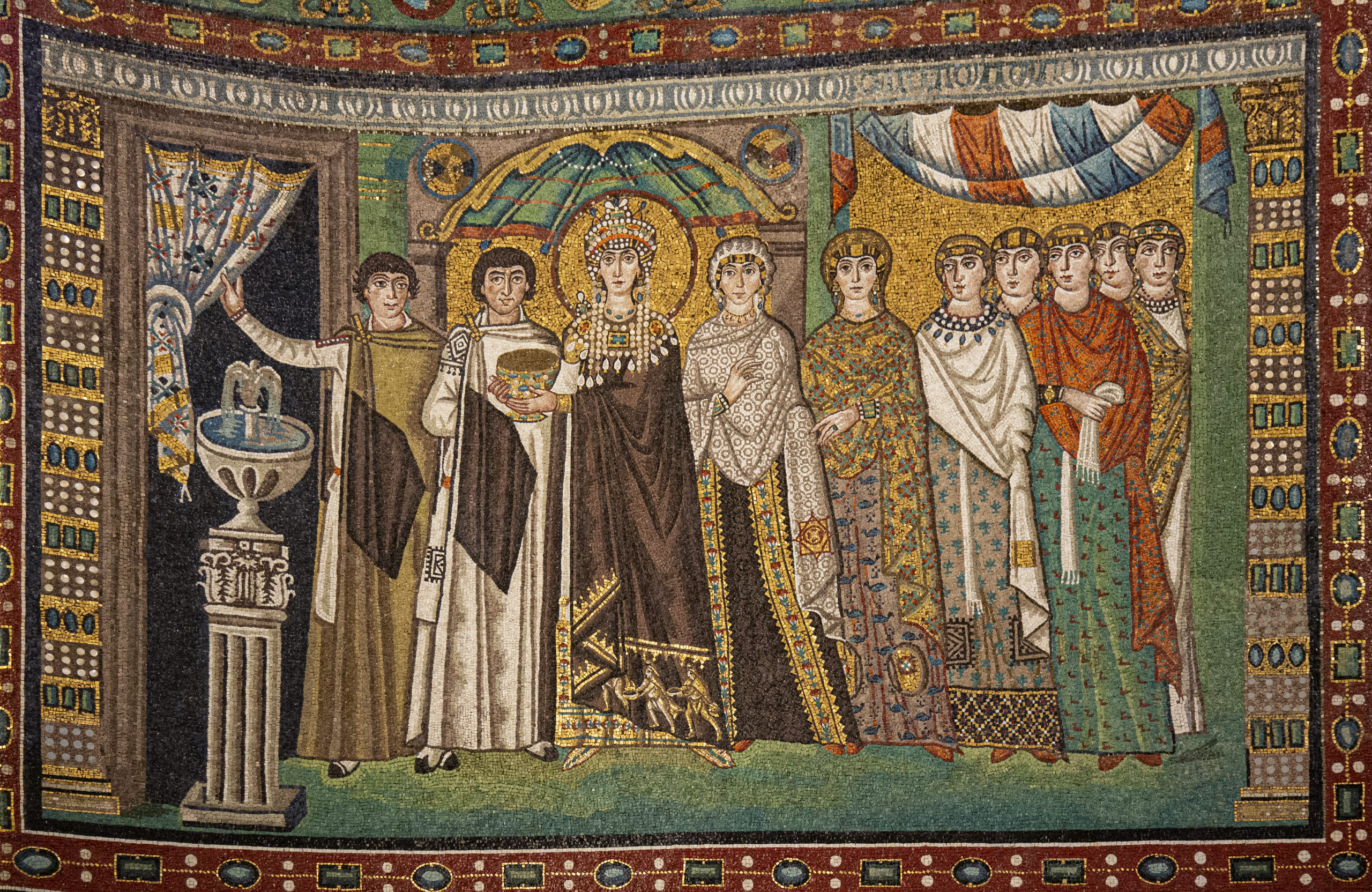
Empress Theodora and her entourage, Church of San Vitale, Ravenna, Italy, consecrated in 548 CE (Early Byzantine Empire)
South wall of the apse
Wearing a beautiful bejeweled tiara and is dressed in imperial purple
She also has a halo around her head
Surrounded by eunuchs and her ladies
The foundation present indicates that she is gathered outside of the apse since women were not allowed to enter the apse of the church at this time
The depiction of the emperor in the apse itself, however, shows just how powerful she was (was able to have a depiction of herself in a place she shouldn’t be)
Theodora is carrying a chalice to hold the wine
Theodora’s background shows she is in the courtyard and is about to enter the nave of the church to witness the services
What is the central theme of the imperial mosaics?
These panels display the presence of the rulers
The central theme was the salvation of mankind through Christ’s sacrifice and its reenactment in the Eucharist
Explain how the style of the mosaics at the Church of San Vitale in Ravenna reflect the aims of Byzantine art.
In the three mosaics we see the natural world being reduced to a few descriptive forms or being removed completely because the goal was to capture the mysteries of the Christian faith instead of an actual background because the image was understood not to tell a story but to be a symbol of something higher than ourselves; images become static and timeless
These mosaics can be described as hieratic
What is an icon and how did they work?
An icon is a small portrait of Christ, the Virgin, or the saints, designed, like pagan imperial portraits, to serve as proxies for the divine presence
Functioned as tools that actively fostered greater intimacy with the divine, offering opportunities for regular people to come into contact with the holy person represented in the icon
People thought that icons could actually bring them closer to Gods
People prayed to these figures for good health and whatnot
Icons gave them a way for their pain and suffering and prayers to reach God because they stood between the divine and human world
Who were iconophiles? What did they argue?
They were those who supported icons; argued that worship only goes to God while veneration can go to holy objects and saints; because Jesus was made of flesh, matter could be holy; they also argued that icons could imitate the divine, but weren’t divine
Who were iconoclasts? What did they argue?
They were those opposed icons; they thought icons were too close to idolatry (to people worshiping the icon over the holy person) and that it went against the commandment not to make brazen images; iconoclasts also argued that icons could never be divine
What is iconoclasm?
It refers to the intentional, religiously motivated destruction of sacred images (sometimes led by emperors)
What is the Triumph of Orthodoxy? What did it result in?
It is the decision of the Council of Constantinople that reinstated icons as part of orthodox religious practice. It resulted in:
Restoration of icon veneration
Increased production of figurative art (patronage for these was reestablished)
Art as a conduit to the sacred (support spiritual and symbolic character of the arts in Byzantine worship)
Emphasis on the Incarnation in art (emphasis on Christ’s creation of matter and Christ’s humanity (softer depictions of Christ to make him more human) to emphasize the importance and validity of icons)
Codification and standardization of artistic programs and iconography
What is iconoclasm and how did the Iconoclastic Controversy affect the development of art after the Triumph of Orthodoxy in 843 CE?
Iconoclasm is the destruction of icons and the iconoclastic controversy changed art after the Triumph of Orthodoxy by:
Restoration of icon veneration
Increased production of figurative art (patronage for these was reestablished)
Art as a conduit to the sacred (support spiritual and symbolic character of the arts in Byzantine worship)
Emphasis on the Incarnation in art (emphasis on Christ’s creation of matter and Christ’s humanity (softer depictions of Christ to make him more human) to emphasize the importance and validity of icons)
Codification and standardization of artistic programs and iconography
What is the Virgin Theotokos iconography?
Theotokos = “God Bearer” or “Mother of God”
Characterized by depiction of the Virgin Mary sitting on a throne with the Christ Child on her lap
What is the Hand of God motif?
It shows a hand of God reaching down from the top of the image
Used to indicate God’s intervention in or approval of what is going on